Prove vs Proof often creates confusion in English language and language learning, especially for people who are learning English. To begin with, these words—proof and prove—look almost identical and even share similar sound and pronunciation, but they carry different meanings. Transitioning from form to meaning, this difference comes from a common root in words and vocabulary, which makes learners assume they are interchangeable. However, in real use, their usage differences become clear through contextual meaning and semantics.
Moving further, prove functions as a verb, representing an action, process, or doing something, often used for showing truth, evidence, argument, concept, confirmation, and verification. On the other hand, proof works as a noun, referring to interpretation, meaning, or supporting evidence in language structure. As a result, differences in lexical category, sentence structure, and sentence precision directly affect writing, readability, and intuitive writing, while also preventing sloppy writing and unclear writing.
Finally, understanding Prove vs Proof improves communication, communication skills, clarity, and concept clarity. With better understanding, learners gain confidence, fluency, and stronger control over word usage patterns in everyday language and professional contexts. Transition words and practice using examples, instructional guidance, and practical usage help reduce confusion, mixing up, and common confusing patterns, strengthening overall accuracy, improvement, and learning experience.
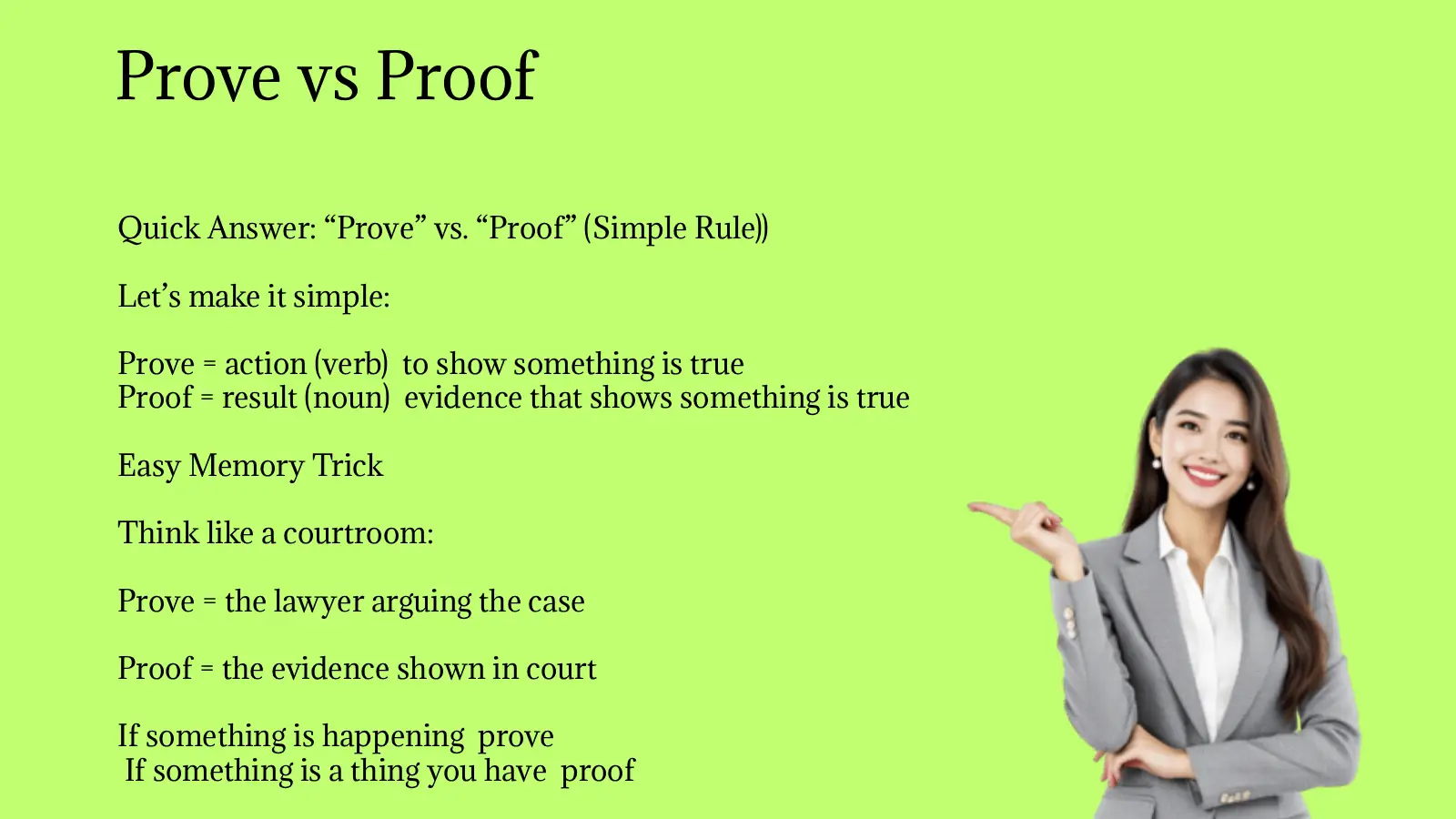
Quick Answer: “Prove” vs. “Proof” (Simple Rule)
Let’s make it simple:
Prove = action (verb) → to show something is true
Proof = result (noun) → evidence that shows something is true
Easy Memory Trick
Think like a courtroom:
- Prove = the lawyer arguing the case
- Proof = the evidence shown in court
If something is happening → prove
If something is a thing you have → proof
Core Meaning of “Prove” (With Simple Explanation)
“Prove” is a verb. It describes the action of showing that something is true or correct.
Basic Meaning
To demonstrate truth using facts, logic, or evidence.
Examples
- “Can you prove your point?”
- “She tried to prove her innocence.”
- “This experiment will prove the theory.”
Key Idea
“Prove” always involves action or process.
You don’t have prove—you do prove.
Core Meaning of “Proof” (With Simple Explanation)
“Proof is a noun. It is the evidence or information that shows something is true.
Basic Meaning
Facts, documents, or signs that confirm something.
Examples
- “Do you have proof of identity?”
- “This is proof that he was there.”
- “We need proof before making a decision.”
Key Idea
“Proof” is something you can hold, show, or present.
The Simple Grammar Difference (Big Clarity Moment)
Here’s the easiest way to remember:
| Word | Type | Meaning |
| Prove | Verb | Action of showing truth |
| Proof | Noun | Evidence of truth |
Quick Formula
- You prove something using proof
- You don’t “proof” something in normal English (except special cases like editing)
How “Prove” Works in Real Life
Let’s break it down naturally.
1. Proving a Statement
- “He tried to prove his theory.”
- “Scientists are trying to prove this idea.”
2. Proving Someone Wrong
- “I can prove you’re wrong.”
- “She proved him incorrect.”
3. Proving Yourself
- “He wants to prove himself at work.”
- “She proved she can handle pressure.”
Key Insight
“Prove” always shows action + effort + process
How “Proof” Works in Real Life
Now the result side.
1. Legal or Official Evidence
- “Show me proof of payment.”
- “We need proof of address.”
2. Everyday Evidence
- “This photo is proof they were together.”
- “His silence is proof he was guilty.”
3. Abstract Proof
- “There is no proof of that claim.”
- “This is scientific proof.”
Key Insight
“Proof” is always something concrete or demonstrable
The Biggest Mistake People Make
Here’s where confusion usually happens:
People try to use “proof” as a verb.
❌ Incorrect Usage
- “Can you proof it?” (wrong in standard English)
✅ Correct Usage
- “Can you prove it?”
Why This Happens
Because in everyday speech, words blend and people assume symmetry:
- prove → proof
- believe → belief
- solve → solution
But English is not always symmetrical like that.
Real-Life Comparison (Side-by-Side)
| Situation | Correct Verb (Prove) | Correct Noun (Proof) |
| Court case | He must prove innocence | Evidence is the proof |
| Argument | I can prove my point | This is the proof |
| Science | Scientists prove theories | Experiments give proof |
| Daily life | She tried to prove it | I need proof first |
Special Case: When “Proof” Becomes a Verb (Rare Use)
There is one exception—but it’s very specific.
In Editing / Baking / Printing:
- “Proof the dough” (bread rising process)
- “Proof a document” (check final version)
But in everyday English:
👉 You almost always use “prove,” not “proof” as a verb
Why This Confusion Happens
English creates confusion here because:
- Both words come from the same root
- They are used in similar contexts
- Some languages use one word for both meanings
- People rely on sound, not grammar rules
So learners naturally mix them up.
How to Never Confuse Them Again
Use this simple system:
Step 1: Ask yourself → Is it action?
- Yes → use prove
- No → go to Step 2
2: Is it evidence or result?
- Yes → use proof
3: Still unsure?
Replace it mentally:
- “Can I show it happening?” → prove
- “Can I show the thing?” → proof
Clear Alternative Phrases
If you want to sound more natural or professional:
Instead of “prove it”
- “Demonstrate it”
- “Show evidence”
- “Verify it”
Instead of “proof of”
- “Evidence of”
- “Documentation for”
- “Confirmation of”
Quick Decision Guide (Instant Use)
- Action happening → prove
- Evidence or result → proof
- Still unsure → rewrite the sentence simply
FAQ: “Prove” vs. “Proof”
Can “proof” be used as a verb?
Not in normal English. Only in special technical contexts like baking or editing.
What is the verb form of proof?
There isn’t a standard one. You use “prove” instead.
Is “prove” formal?
Yes, it is neutral and used in both formal and informal English.
Which is more common?
“Prove” is the action word; “proof” is used when talking about evidence.
Case Study: A Simple Misunderstanding
A student writes:
“I will proof my answer.”
Teacher feedback:
❌ Incorrect usage
✔ Correct version: “I will prove my answer.”
What went wrong?
The student treated “proof” like a verb.
Fix:
Once they learned:
- prove = action
- proof = evidence
The mistake disappeared.
Key Facts You Should Remember
- Prove = verb (action)
- Proof = noun (evidence)
- You prove something using proof
- “Proof” is rarely used as a verb in modern English
- Context decides meaning in real usage
Final Takeaway: The One Rule That Never Fails
Here’s the simplest way to lock it in:
👉 If you’re doing something → prove
👉 If you’re showing something → proof
Think of it like this:
You don’t ask for “truth itself.”
You ask for proof, and someone must prove it.
Once you see that difference clearly, you’ll never confuse “prove” vs. “proof” again.