Secularize vs secularise is a spelling comparison that explains how American and British English write the same verb. Both words mean to make something more secular or less subject to religious control. However, understanding this difference also helps clarify related concepts such as secularism, secularization, religious freedom, pseudo-secularism, and post-secularism. These terms often appear in discussions about government, education, religion, and society, but they do not all mean the same thing.
The main spelling rule is simple: American English generally uses secularize, while British English commonly uses secularise. The difference lies in the ending, not the meaning or pronunciation. The broader concepts require more care because secularism describes a principle or political framework, whereas secularization describes a process of social or institutional change.
This guide explains both spellings, compares secularism with religion and related ideologies, and provides practical examples to help you use each term accurately.
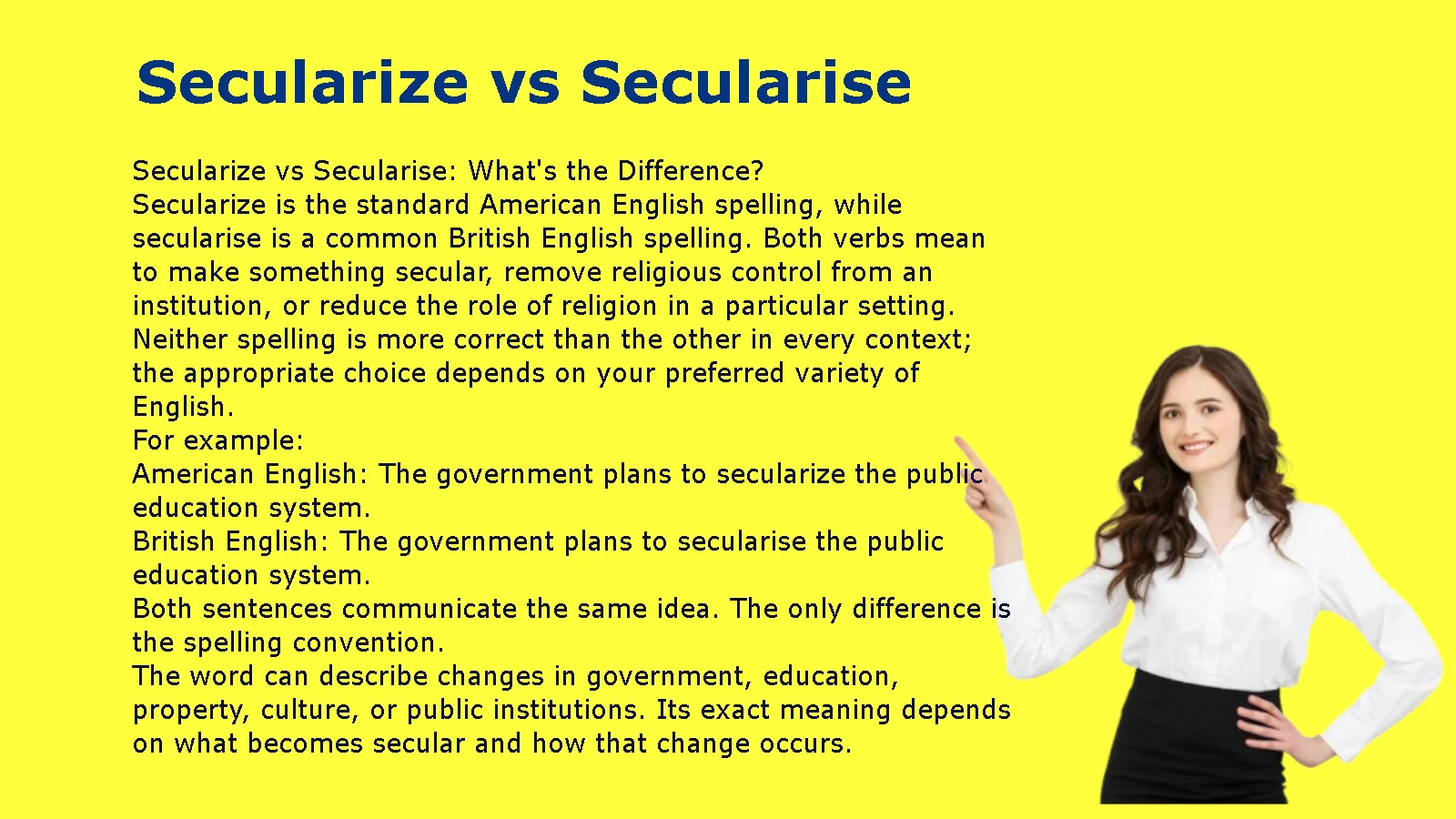
Secularize vs Secularise: What’s the Difference?
Secularize is the standard American English spelling, while secularise is a common British English spelling. Both verbs mean to make something secular, remove religious control from an institution, or reduce the role of religion in a particular setting. Neither spelling is more correct than the other in every context; the appropriate choice depends on your preferred variety of English.
For example:
- American English: The government plans to secularize the public education system.
- British English: The government plans to secularise the public education system.
Both sentences communicate the same idea. The only difference is the spelling convention.
The word can describe changes in government, education, property, culture, or public institutions. Its exact meaning depends on what becomes secular and how that change occurs.
For instance, when a school system becomes secular, religious authorities may lose control over its curriculum or administration. That change does not necessarily prevent students from practicing their faith or studying religion.
Secularize Meaning and Definition
Secularize is a verb meaning to make something secular or to separate it from religious authority, influence, or control. Depending on the context, it can describe an institutional reform, a legal change, or a broader cultural shift toward a less religious public environment.
Consider these examples:
- The university decided to secularize its curriculum by removing compulsory religious instruction.
- The reform aimed to secularize the administration of public services.
- Historians studied how the country began to secularize during the nineteenth century.
- The new policy sought to secularize the management of public institutions.
Notice that the word does not always mean eliminating religion completely. A government can transfer control of a school from a religious organization to a public authority without banning religious belief or worship.
The verb can also describe a historical process. For example, historians might explain how a formerly religious institution gradually adopted secular administration. In that situation, secularize describes the change rather than judging whether the change was beneficial.
Related words: secular, secularism, secularization, secularized, and secularizing.
Secularise Meaning and Definition
Secularise has the same meaning as secularize. Writers who follow British English spelling conventions commonly use the -ise ending.
Examples include:
- The council voted to secularise the management of local schools.
- Some historians argue that industrialization helped secularise parts of European society.
- The proposal would secularise public administration without restricting private religious practice.
- The institution gradually began to secularise its policies.
These examples show that the spelling does not change the word’s function or meaning.
British English uses both -ise and -ize endings in many words, depending on the word and the style guide. However, secularise and secularize remain recognized variants. When writing for a British audience, follow the publication’s preferred style rather than assuming that every British word must end in -ise.
Secularize vs Secularise: US and UK Spelling Rules
American English generally favors -ize in this word, while British English commonly accepts -ise. Writers should maintain consistent spelling throughout an article, report, or academic assignment.
| Word or form | American English | Common British English |
| Verb | Secularize | Secularise |
| Past tense | Secularized | Secularised |
| Present participle | Secularizing | Secularising |
| Noun describing a process | Secularization | Secularisation |
| Adjective | Secular | Secular |
The adjective secular does not change between these varieties. It generally describes something that is not religious or that operates independently of religious authority.
Practical writing tip: If your article uses American spelling in words such as organize, recognize, and modernize, use secularize as well. For a British publication that prefers organise, recognise, and modernise, secularise may fit the house style.
Consistency helps readers focus on your argument instead of noticing unnecessary spelling changes.
Secularize vs Secularism: Are They the Same?
They share a root but serve different grammatical and conceptual purposes. Secularize is a verb that describes making something secular, while secularism is a noun referring to a principle or framework concerning secular public life and the relationship between religion and the state. One describes an action; the other describes an idea or approach.
Compare these sentences:
- The government plans to secularize the public school system.
- The country’s constitution reflects principles associated with secularism.
In the first sentence, secularize describes a proposed action. In the second, secularism names a political or philosophical principle.
The distinction matters because a society can debate secularism without undergoing an immediate institutional change. Likewise, an institution can become less religiously controlled without adopting every principle associated with a particular model of secularism.
Secularization vs Secularism
Secularization refers to a process through which religion becomes less influential in certain areas of society or institutions become less subject to religious authority. Secularism, by contrast, refers to a principle or framework that addresses the role of religion in public life and government.
For example, a decline in religious attendance may form part of a secularization trend. A constitutional rule that prevents the state from establishing an official religion may reflect a form of secularism.
These concepts can overlap, but they are not interchangeable.
| Feature | Secularization | Secularism |
| Basic meaning | A process of change | A principle or framework |
| Main focus | Changes in institutions, beliefs, or social practices | The relationship between religion, government, and public life |
| Typical question | How is religion’s role changing? | How should public institutions handle religion? |
| Example | Religious authorities lose control over a public institution | A constitution protects freedom of religion and prevents an official state religion |
| Can occur without the other? | Yes, depending on the setting | Yes, a secular framework can exist in a highly religious society |
A country may have a secular constitution while many citizens remain deeply religious. Conversely, religious participation may decline even when a country’s political institutions continue to maintain formal ties with a religious organization.
This distinction helps avoid a common mistake: assuming that a secular government automatically creates a nonreligious population.
Secularism vs Religion: What’s the Difference?
Secularism concerns how religion relates to government, public institutions, or shared civic life. Religion involves beliefs, practices, traditions, communities, and understandings of the sacred or divine. Secularism is therefore not simply another religion, nor does it always require people to abandon their faith. Its practical meaning depends on the political and philosophical framework being discussed.
A secular state may protect people’s freedom to worship, change religions, or follow no religion. It may also limit the authority of religious institutions over government decisions.
Religion, on the other hand, can shape personal values, community traditions, worship, moral reasoning, and ideas about human existence.
The two concepts answer different questions:
- Religion: What do people believe, practice, or regard as sacred?
- Secularism: How should government and public institutions relate to religion?
- Religious freedom: What rights should people have to hold, change, express, or reject religious beliefs?
These questions can overlap in public debates, but they should not be treated as identical.
Secularism and Religious Freedom
Religious freedom is an important part of many secular political frameworks. Under such arrangements, the state does not need to endorse one religious doctrine to protect the rights of religious communities.
For example, imagine a public university attended by Christians, Muslims, Hindus, Buddhists, Jews, and nonreligious students. A policy that applies the same academic standards to everyone, protects lawful religious expression, and does not require students to follow one faith reflects principles of equal treatment.
However, secular systems do not all draw the same boundaries between religion and public life.
Some models emphasize a strict separation between religious institutions and the state. Others permit religious organizations to participate in public services or allow religious expression in government settings while maintaining legal protections for different beliefs.
This is why the word secularism needs context. A discussion about one country’s constitutional system may use the term differently from a discussion about another country’s political philosophy.
A useful distinction: Secular government does not automatically mean that religious people must keep every expression of faith private. The actual rules depend on constitutional protections, legislation, and the model of secularism in question.
Can a Person Be Religious and Support Secularism?
Yes. A person can follow a religion and support a secular state because personal religious belief and the organization of government are different matters.
A religious citizen might believe that their faith provides moral guidance while also supporting laws that protect people of different religions. They may argue that the government should not force citizens to follow a single religious tradition.
Consider a Muslim, Christian, or Hindu citizen who supports equal citizenship regardless of religious identity. That person may favor secular institutions because they believe the state should protect their own religious freedom alongside everyone else’s.
Other religious people may prefer a greater role for religious principles in public law. Their views can differ according to theological interpretation, political philosophy, and national context.
Neither position should automatically be attributed to every member of a religious community.
The key lesson is that religious identity does not, by itself, determine a person’s position on secularism.
Secularism vs Pseudo-Secularism
Secularism is a broad political or philosophical concept concerning religion’s place in public life. Pseudo-secularism is a contested label used to accuse a person, party, institution, or policy of claiming to support secular principles while allegedly applying them inconsistently. Unlike secularism, pseudo-secularism does not have one universally accepted definition.
The distinction is especially important in political debates, where the term can function as criticism rather than a neutral description.
For example, one political group might accuse a government of treating religious communities differently despite claiming to support secularism. The government or its supporters might reject the allegation and argue that its policies follow constitutional principles.
Simply using the label does not prove that the accusation is accurate. Readers need to examine the policy, the evidence, and the standards used to judge equal treatment.
Key Differences Between Secularism and Pseudo-Secularism
The main difference is that secularism names a broad framework, whereas pseudo-secularism usually expresses a judgment about whether someone applies secular principles consistently or sincerely.
| Feature | Secularism | Pseudo-secularism |
| Type of term | Political or philosophical concept | Contested political label |
| Main concern | Religion’s relationship with the state and public life | Alleged inconsistency between stated secular principles and actual behavior |
| Meaning across contexts | Varies by model and political tradition | Varies according to the person making the accusation |
| How to assess it | Examine principles, laws, and institutional arrangements | Examine the specific allegation and supporting evidence |
| Neutrality of the term | Can be descriptive | Often carries a critical meaning |
When assessing a claim of pseudo-secularism, ask four questions:
- What principle is supposedly being violated? Identify the claimed standard of secular treatment.
- What action is being criticized? Focus on a specific policy or decision rather than a broad accusation.
- What evidence supports the claim? Compare the actual treatment of relevant groups.
- Are alternative explanations available? Consider the legal, historical, and administrative context.
For instance, suppose a government offers public funding to several religious schools under a uniform legal program. One critic may interpret the funding as inconsistent with secularism, while another may argue that equal access for eligible institutions protects religious freedom.
To evaluate the disagreement, readers would need to examine the funding rules, eligibility criteria, constitutional framework, and actual implementation.
This approach keeps the discussion analytical rather than turning a politically charged term into an established fact.
Secularism vs Non-Secularism
Non-secularism is a broad descriptive term for approaches that do not follow a secular model or that give religion a formal or influential role in public institutions. It is not one unified ideology. Its meaning can range from an established state religion to political systems that incorporate religious principles into legislation.
The distinction becomes clearer when you examine the relationship between religious authority and government.
A secular arrangement may seek to keep the state institutionally separate from religious authorities. A non-secular arrangement may recognize a particular religion, give religious institutions a constitutional role, or use religious principles as a source of law.
However, the label alone does not reveal how much religious influence exists or how the system protects individual rights.
Secular and Religious Systems of Government
Governments organize their relationship with religion in different ways. Some establish a formal separation between religious organizations and the state. Others recognize an official religion while still protecting certain rights for people who follow different faiths.
A useful comparison includes these features:
| Feature | Secular arrangement | Non-secular arrangement |
| State’s relationship with religion | Generally limits formal religious authority over the state | May formally recognize or incorporate religious authority |
| Source of public law | Typically grounded in civil or constitutional institutions | May include religious law or principles alongside civil law |
| Official religion | Often absent, though models vary | May be formally recognized |
| Religious practice | May be protected through constitutional or legal rights | Depends on the legal framework and the rights it provides |
| Internal variation | Ranges from strict separation to cooperative models | Ranges from symbolic recognition to substantial religious influence |
These categories are broad. A country with an official religion may still operate many secular institutions, while a country without an official religion may permit religious organizations to provide public services.
It is also inaccurate to treat every non-secular arrangement as a theocracy. A theocracy is a more specific form of government in which religious authority or religious law plays a central governing role. Non-secularism is a wider category.
Examples of Secularism and Non-Secularism in Practice
Consider three hypothetical situations.
Example one: A secular public school
A public school teaches science and history through a common academic curriculum. It does not require students to practice a particular religion, and it protects students’ lawful religious expression.
This arrangement illustrates one possible form of secular education.
Example two: A state with an official religion
A constitution recognizes a particular religion while allowing citizens to practice other faiths under specified legal protections. Religious identity has an official place in the constitutional framework, but the state may still administer many public services through ordinary civil institutions.
This example illustrates a non-secular feature without automatically establishing that the entire government is a theocracy.
Example three: A system with religiously influenced legislation
A legislature incorporates religious principles into some family-law or personal-status rules while using civil law for other areas.
This system combines different sources of legal authority. Its exact classification depends on the constitution, legislation, and practical distribution of power.
These examples show why the secularism-versus-non-secularism comparison requires more than a simple yes-or-no label. The important questions concern the source of authority, the scope of religious influence, and the legal rights available to citizens.
Secularism vs Post-Secularism
Secularism concerns principles governing the relationship between religion, the state, and public life. Post-secularism is a concept used to examine the continuing public importance of religion in societies often described as secular. It questions the assumption that modernization or secular institutions will necessarily make religion disappear from public discussion.
Post-secularism does not automatically mean abandoning secular government or returning political power to religious authorities.
Instead, it draws attention to a more complex social reality: religious and nonreligious citizens may continue to shape public debate even when institutions operate under secular rules.
For example, a society may protect freedom of religion and maintain secular courts while religious organizations participate in discussions about poverty, education, migration, or environmental policy.
That society can still be secular in its institutional arrangements while displaying the kinds of religious participation examined by post-secular thinkers.
What Does Post-Secular Society Mean?
A post-secular society is generally understood as a society in which the continued relevance of religion receives renewed attention despite the presence of secular institutions or long-term secularization trends.
The concept does not have one simple definition accepted by every scholar. Writers use it to discuss the relationship between religion, public reasoning, democratic participation, and modern social life.
The term is useful because secularization does not follow one universal path.
Some communities experience declining religious participation. Others maintain strong religious identities, and some religious movements become more visible in public debates. These patterns can coexist within the same country.
A post-secular perspective asks how people with religious and nonreligious worldviews can participate in shared political life.
For example, a public debate about healthcare may involve scientific evidence, legal principles, religious moral arguments, and individual rights. A post-secular analysis examines how these different forms of reasoning interact without assuming that religion has become irrelevant.
Secularism vs Post-Secularism: Key Differences
The two concepts focus on different questions. Secularism often concerns how institutions should handle religion, while post-secularism examines the continued presence and public significance of religion in modern societies.
| Feature | Secularism | Post-secularism |
| Main focus | Religion’s relationship with the state and public life | Religion’s continuing role in societies shaped by secularization |
| Central question | How should public institutions relate to religion? | How should societies understand and accommodate the ongoing presence of religion? |
| Relationship with religion | Depends on the model of secularism | Treats continuing religious participation as an important subject of analysis |
| Government structure | May describe a political or constitutional principle | Does not necessarily prescribe a particular state structure |
| Implication | Does not automatically require a nonreligious population | Does not automatically require a return to religious government |
A common mistake is to interpret post-secular as meaning that secularism has ended. In many discussions, the term instead challenges simplistic accounts of secularization.
A country can maintain secular laws while religious communities remain active in politics, public service, and cultural debate. Post-secularism helps describe that coexistence.
What Is the Difference Between Secularism and Islam?
Secularism is a political or philosophical principle concerning religion’s role in public institutions, while Islam is a religion with diverse theological traditions, practices, legal interpretations, and political perspectives. Comparing them requires care because one term describes a framework for public life and the other describes a religious tradition.
Islam includes beliefs about God, worship, ethics, community, and religious practice. Muslim scholars and communities have developed different views about how Islamic teachings should relate to law and political authority.
Secularism also has multiple interpretations. Some models favor a strict separation between religious institutions and the state. Others allow cooperation between the state and religious organizations while seeking to protect freedom of belief and equal citizenship.
The question is therefore not simply whether Islam and secularism are identical. They are not the same category of concept. The more useful question is how particular interpretations of Islam relate to particular models of secular government.
Can Islam and Secularism Coexist?
Views differ among Muslim scholars, communities, political movements, and countries. Some Muslims support secular government as a way to protect religious freedom and equal citizenship. Others argue that Islamic principles should have a more direct role in public law and government.
Still others favor arrangements that combine civil institutions with selected religious legal or ethical principles.
These positions reflect disagreements about political authority, constitutional law, religious interpretation, and the purpose of government. It would be inaccurate to claim that all Muslims support one model.
Consider three broad approaches:
- Secular governance with Muslim citizens: The state does not establish Islamic law as its governing legal framework, while Muslims remain free to practice their religion under the applicable laws.
- Religiously informed civil governance: Political institutions operate through civil law but may consider Islamic ethical ideas in public discussion or policy.
- Governance incorporating Islamic law: Religious legal principles play a formal role in some or many areas of the legal system.
These descriptions are broad analytical categories, not labels that capture every country’s political structure.
They also do not tell us whether a system protects individual rights. That question requires examining the actual laws, institutions, and legal safeguards.
A Muslim may support secular governance for reasons rooted in religious conviction, civic equality, or political philosophy. Another Muslim may disagree because they believe religion should have a stronger formal role in public law.
The relationship between Islam and secularism is therefore a subject of continuing debate rather than a single universal position.
Secularism vs Islam: Key Differences at a Glance
| Feature | Secularism | Islam |
| Category | Political or philosophical principle | Religion |
| Main focus | Religion’s relationship with public institutions and government | Belief, worship, ethics, religious practice, and community |
| Internal variation | Includes different models of state-religion relations | Includes diverse traditions, interpretations, and communities |
| Relationship with government | Addresses how government should relate to religion | Contains diverse views on political authority and public law |
| Personal practice | Does not itself prescribe one religion | Guides religious beliefs and practices for Muslims |
The comparison should not suggest that secularism and Islam are mutually exclusive in every context. A Muslim can support a secular political framework, just as Muslims can advocate other models of government.
Similarly, the existence of religious beliefs in public life does not automatically prove that a country lacks secular institutions.
The most accurate approach is to distinguish religious identity, political philosophy, and constitutional structure. Doing so allows readers to discuss real differences without reducing a large and diverse religious tradition to a single political position.
Secularize vs Secularise: Examples in Sentences
The easiest way to remember the spelling difference is to compare the same sentence in American and British English. The meaning stays the same, even when the ending changes.
American English Examples
Use secularize when following American spelling conventions.
- The government introduced reforms to secularize the administration of public schools.
- Historians examined how political changes helped secularize the country’s institutions.
- The university decided to secularize its curriculum while protecting students’ freedom of belief.
- The debate concerned whether the proposed law would secularize public services.
- The reform sought to secularize the institution’s leadership structure.
British English Examples
Use secularise when following a British English style that favors the -ise ending.
- The government introduced reforms to secularise the administration of public schools.
- Historians examined how political changes helped secularise the country’s institutions.
- The university decided to secularise its curriculum while protecting students’ freedom of belief.
- The debate concerned whether the proposed law would secularise public services.
- The reform sought to secularise the institution’s leadership structure.
The paired examples demonstrate that the spelling changes while the meaning remains constant.
Common Mistakes When Using Secularize and Secularise
Writers often confuse spelling differences with differences in meaning. The following mistakes are worth avoiding.
Mistake: Treating the words as separate concepts
Incorrect assumption: Secularize means separating religion from government, while secularise means reducing religious belief.
Correction: Both spellings can describe the same action. The surrounding sentence determines the precise meaning.
Mistake: Mixing spelling conventions without a reason
An article that uses secularize, organise, and recognize may look inconsistent if the writer has not intentionally followed a mixed style.
Correction: Choose an English variety and apply it consistently.
Mistake: Confusing secularize with secularism
The sentence “The country supports secularize” is grammatically incorrect in ordinary usage because secularize is a verb.
Correction: Write “The country supports secularism” when referring to the principle, or “The country plans to secularize its institutions” when referring to an action.
Mistake: Assuming secularization always eliminates religion
A secular institution can continue to serve religious citizens. A secular state can contain religious communities, worship spaces, and religious organizations.
Correction: Explain whether the change concerns government authority, institutional management, social beliefs, or religious participation.
Mistake: Assuming secularism always requires identical arrangements in every country
Different secular systems draw different boundaries between religion and public life.
Correction: Identify the particular legal or political model rather than treating secularism as one uniform system.
Quick Comparison Table: Secularize, Secularism, and Related Terms
The following table summarizes the major terms covered in this article. Use it as a quick reference when writing about spelling, government, religion, and social change.
| Term | Part of speech or category | Meaning | Example |
| Secularize | Verb | Make something more secular or less subject to religious control | The reform may secularize public education. |
| Secularise | Verb | British spelling variant of secularize | The reform may secularise public education. |
| Secularism | Noun | A principle or framework concerning secular public life and religion’s relationship with the state | The debate focused on secularism and religious freedom. |
| Secularization | Noun | A process through which religion’s role changes or institutions become more secular | Researchers studied secularization in urban communities. |
| Pseudo-secularism | Noun | A contested label for allegedly inconsistent or insincere secular practice | The politician accused the administration of pseudo-secularism. |
| Non-secularism | Descriptive term | An approach that does not follow a secular model | The discussion compared secularism with non-secularism. |
| Post-secularism | Noun | A concept examining religion’s continued relevance in societies shaped by secularization | The researcher used post-secularism to discuss religion in public debate. |
Remember that these terms are related but not interchangeable. Secularize describes an action, secularism describes a principle or framework, and secularization describes a process. The other terms address political criticism, alternatives to secular arrangements, or religion’s continued public relevance.
Frequently Asked Questions
Is Secularize American or British English?
Secularize is the standard American English spelling. Secularise is a common British English variant. Both forms have the same meaning, so choose the version that matches your audience and publication style.
Does Secularize Mean the Same as Secularise?
Yes. Both words mean to make something secular or to reduce its dependence on religious authority. The difference is primarily regional spelling convention, not meaning.
What Is the Difference Between Secularism and Secularization?
Secularism is a principle or framework concerning the relationship between religion and public institutions. Secularization is a process through which religion’s influence changes or institutions become less subject to religious control. A secular state can have a highly religious population.
Is Secularism the Opposite of Religion?
Not necessarily. Secularism generally concerns how religion relates to government and public life. It can protect religious freedom without requiring people to abandon their beliefs. Some forms of secularism emphasize a stronger separation between religious institutions and the state than others.
What Is the Difference Between Secularism and Pseudo-Secularism?
Secularism is a broad political or philosophical concept. Pseudo-secularism is a contested label used to criticize alleged inconsistencies between secular principles and actual conduct. To evaluate such a claim, examine the specific policy, evidence, and relevant legal framework.
Can Islam and Secularism Exist Together?
Perspectives differ among Muslim scholars, communities, and political movements. Some Muslims support secular government and equal citizenship, while others favor a stronger formal role for Islamic principles in public law. The relationship depends on how secularism is defined and how religious authority relates to state institutions.
Conclusion: Choose the Right Spelling and Understand the Context
The difference between secularize vs secularise is straightforward: American English generally uses secularize, while British English commonly uses secularise. Both spellings carry the same meaning, and your choice should depend on your audience and style guide.
The related concepts require more careful distinctions. Secularism describes a political or philosophical framework, while secularization describes a process of change. Pseudo-secularism is a contested political label, non-secularism covers a broad range of alternatives, and post-secularism examines religion’s continued relevance in modern society. The relationship between secularism and Islam also varies according to religious interpretation, political philosophy, and constitutional arrangements.
When writing about these topics, define each term before comparing it with another. Distinguish facts from political accusations, avoid sweeping claims about religious communities, and use examples that reflect the specific context.