Waive vs. Wave – Understanding the Key Differences and Proper Usage is a topic that often confuses homophones, especially because they sound similar but have different meanings and uses. Many learners and native speakers struggle, mixing up spellings, meanings, and usage in everyday writing, academic writing, and professional emails, which creates confusion in communication. From my teaching experience, even a small mix-up in a sentence can affect clear communication, especially in contracts, formal permissions, legal rights, fees, and writing, where formal contexts and legal contexts are important. The verb waive means freely give up, renounce, right, claim, or advantage, done voluntarily in contracts and legal notes, showing Waive voluntary giving up and explicit renunciation. In contrast, wave refers to physical movement, gestures, everyday motion, or undulating movement, such as moving one’s hand, to and fro, greeting, waving a hand, waving hello, goodbye, and natural forms like sea, flag, oscillation, disturbance, moves through medium, sound waves, ocean waves, and emotional wave.
In practice, understanding waive and wave requires studying differences, comparisons, context, spelling, and meaning, because even a small mix-up can change a sentence completely. For example, He decided to waive his right to a lawyer, which shows correct use in legal rights, while wave refers to hand motion, back-and-forth motion, and natural flow. Phrases like Waive vs. Wave contrast, Waive and Wave combination, Waive or Wave decision, and the incorrect Waive of and Wave ungrammatical highlight the importance of simple grammar rules, definitions, and real examples. Differences in pronunciation like wayv pronunciation and weyv pronunciation, along with i versus a letter spelling, help reduce confusion. With practice, people build communication skills, gain confidence, learn to avoid mistakes, express thoughts, maintain consistency in different settings and situations, and improve their writing skills through better context-dependent usage.
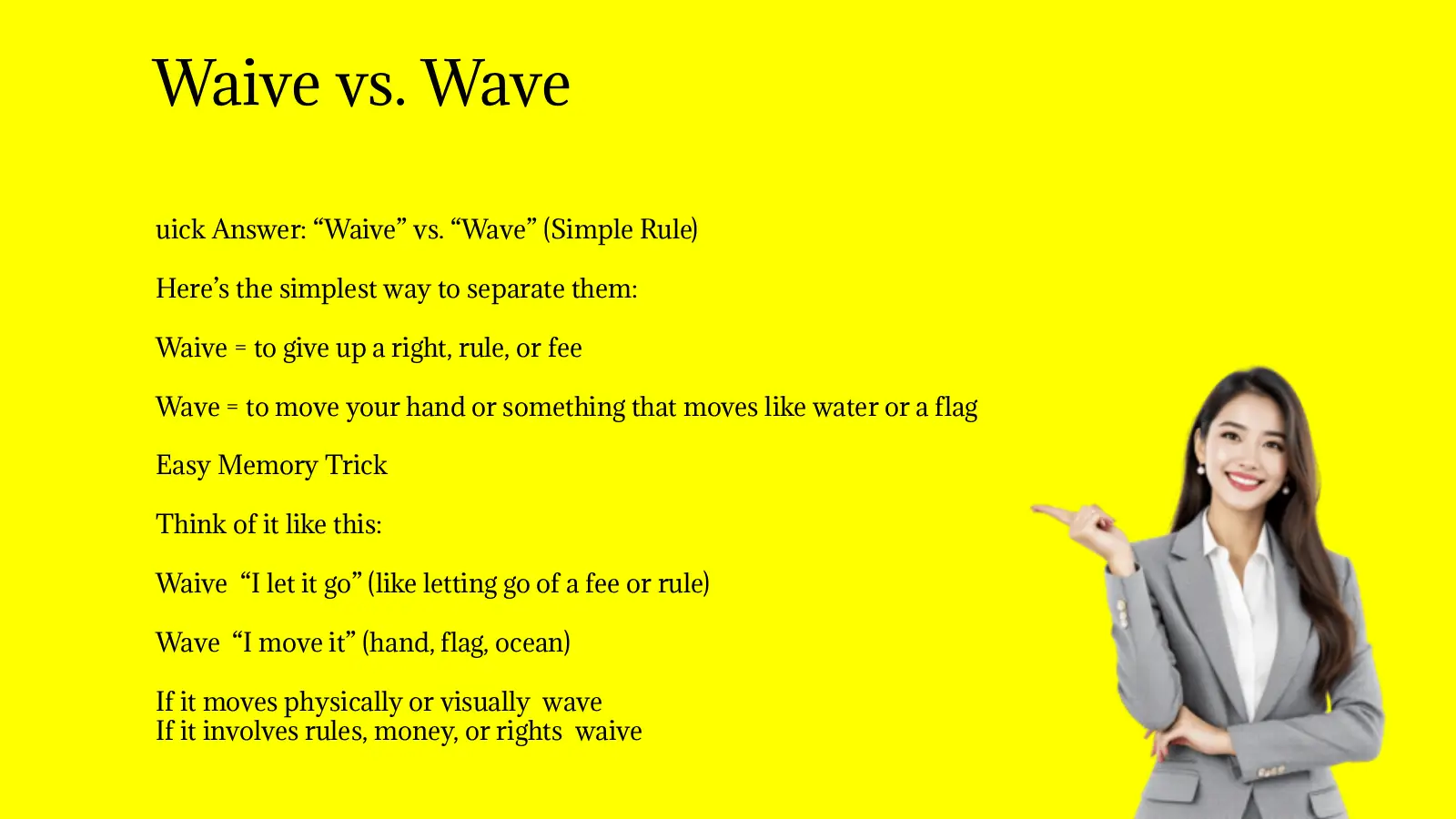
Quick Answer: “Waive” vs. “Wave” (Simple Rule)
Here’s the simplest way to separate them:
- Waive = to give up a right, rule, or fee
- Wave = to move your hand or something that moves like water or a flag
Easy Memory Trick
Think of it like this:
- Waive → “I let it go” (like letting go of a fee or rule)
- Wave → “I move it” (hand, flag, ocean)
If it moves physically or visually → wave
If it involves rules, money, or rights → waive
Do “Waive” and “Wave” Mean Anything Similar?
Not even close.
They only sound alike. That’s where the confusion comes from.
- Waive lives in legal, financial, or formal contexts
- Wave lives in physical movement and greetings
Same pronunciation vibe. Totally different worlds.
Why Do People Mix Them Up So Often?
Simple answer: English pronunciation plays tricks.
Both words:
- Start with “w”
- Sound similar when spoken quickly
- Appear in everyday writing
However, their meanings evolved separately.
So your brain hears a familiar sound and guesses. That’s where mistakes happen.
“Waive” Explained Clearly
Let’s slow it down.
What “Waive” Actually Means
To waive means you voluntarily give up something you’re entitled to.
It’s often used in formal situations like:
- Fees
- Rights
- Rules
- Requirements
Real Examples
- “The bank agreed to waive the service fee.”
- “She waived her right to a trial.”
- “The university may waive the application fee.”
What It Feels Like
Think of “waive” as a legal permission slip.
Someone says:
“You don’t have to do this anymore.”
No movement. No waving hand. Just removal of obligation.
“Wave” Explained Clearly
Now let’s switch gears.
What “Wave” Means
“Wave” usually refers to movement.
It can describe:
- Moving your hand
- Ocean movement
- A flag moving in the wind
- A sudden increase in something (like a wave of emotion)
Real Examples
- “I waved at my friend from across the street.”
- “The ocean waves were strong today.”
- “A wave of excitement spread through the crowd.”
What It Feels Like
“Wave” is visual and physical. You can almost see it happening.
It moves. flows. shifts.
The Biggest Mistake People Make
Here’s where things get messy.
People often write things like:
- “The teacher waved the exam fee” ❌
- “I will waive at you from the car” ❌
Both are wrong—but easy mistakes.
What Went Wrong?
- “Waive” was used instead of “wave” when talking about movement
- “Wave” was used instead of “waive” in formal contexts
The Fix
Ask one question:
Is something being physically moved or is a rule being removed?
That answer tells you everything.
Side-by-Side Comparison Table
Here’s a quick snapshot:
| Feature | Waive | Wave |
|---|---|---|
| Meaning | Give up a right or fee | Move hand or fluid motion |
| Context | Legal, financial, formal | Physical, emotional, visual |
| Example | Waive a fee | Wave hello |
| Tone | Serious | Casual |
| Confusion Risk | Medium | Medium |
Real-Life Examples of “Waive”
Let’s ground it in reality.
Common Situations
- “The airline waived the baggage fee.”
- “They waived the late penalty this time.”
- “The court waived the requirement.”
Mini Scenario
You apply for a job. Normally there’s a fee. But the company says:
“We will waive the application fee.”
You save money. No action required from you.
That’s “waive” in action.
Real-Life Examples of “Wave”
Now compare.
Common Situations
- “She waved goodbye at the airport.”
- “He waved his hand to get attention.”
- “A wave of heat hit the city.”
Mini Scenario
You’re leaving a café. Your friend spots you outside and waves.
You wave back.
Simple. Natural. Instant visual action.
Why “Waive” Feels Harder
Here’s the honest truth.
“Waive” shows up in formal situations. That makes it less familiar.
You’ll see it in:
- Contracts
- Government documents
- Business policies
So your brain doesn’t use it often. That increases confusion.
Meanwhile, “wave” appears everywhere—movies, chats, daily life.
How to Never Mix Them Up Again
Use this simple mental filter.
1: Look for Action
- Physical motion → wave
- No motion (rules, money, rights) → waive
2: Think Context
- Legal or financial → waive
- Social or visual → wave
Step 3: Say It Out Loud
If you can act it out, it’s wave.
If you can’t, it’s waive.
Quick Decision Guide (Use This Instantly)
When in doubt:
- Hand moves → wave
- Fee disappears → waive
- Still unsure → replace it with a synonym
Simple. Fast. Reliable.
FAQ: “Waive” vs. “Wave”
Is “waive” related to waving your hand?
No. They are completely unrelated in meaning.
Why do they sound the same?
They evolved separately but ended up with similar pronunciation patterns in English.
Can “wave” ever mean to remove something?
No. That’s always “waive.”
Which one is more common?
“Wave” is far more common in everyday speech.
Case Study: A Costly Email Mistake
A student emailed a university:
“I request you to wave the application fee.”
What Happened
The admissions office misunderstood the request at first. It looked like a grammar issue, but it also created confusion about intent.
Fix
The corrected version:
“I request you to waive the application fee.”
Outcome
Approval went through smoothly after clarification.
Lesson
One letter can change meaning completely.
Key Facts You Should Remember
- “Waive” = give up a fee, rule, or right
- “Wave” = physical or visual motion
- They are not interchangeable
- Context is your best guide
- One letter changes everything
Final Takeaway: The One Rule That Never Fails
Here’s the simplest way to lock it in.
If something moves, it’s a wave.
If something disappears or gets removed, it’s waive.
Think of it like this:
- You wave hello to someone
- A company waives your fee
Same sound. Completely different world.
Once you see that difference clearly, the confusion disappears for good.