Privatize or privatise? Both spellings are correct, but the right choice depends on whether you use American or British English. Privatize is the standard American spelling, while privatise is the standard British spelling. Both words mean transferring a business, asset, or service from public ownership or control to private ownership or control.
The word appears in discussions about privatization, government-owned companies, public education, airport security, and private-sector services. Understanding its meaning also helps you distinguish privatized from outsourced, identify its synonyms and antonyms, and use related forms such as privatizing and privatization correctly. This guide explains the spelling difference, provides original sentence examples, and explores how the term applies in different contexts.
Privatize or Privatise: Which Spelling Is Correct?
Privatize and privatise have the same meaning and pronunciation. The difference lies in regional spelling conventions. American English generally uses the -ize ending, while British English commonly uses -ise. Choose the spelling that matches your audience and maintain that choice throughout your writing.
| Feature | Privatize | Privatise |
| Spelling convention | American English | British English |
| Meaning | Transfer to private ownership or control | Transfer to private ownership or control |
| Example | The government plans to privatize the railway. | The government plans to privatise the railway. |
| Related noun | Privatization | Privatisation |
| Related adjective | Privatized | Privatised |
| Related present participle | Privatizing | Privatising |
Neither spelling is inherently more correct than the other. Your preferred variety of English determines which form fits your writing.
Privatize Is the Standard American English Spelling
American English typically uses privatize, following a spelling pattern found in words such as organize, modernize, and legalize.
Use privatize in American business reports, educational materials, government discussions, and general writing intended for a US audience.
Examples:
- The state plans to privatize its remaining government-owned factories.
- Lawmakers debated whether to privatize the public transportation system.
- The company hopes to privatize its operations after restructuring.
- Some residents oppose efforts to privatize the local water supply.
The same convention applies to related forms. American writers generally use privatized, privatizing, and privatization.
Privatise Is the Standard British English Spelling
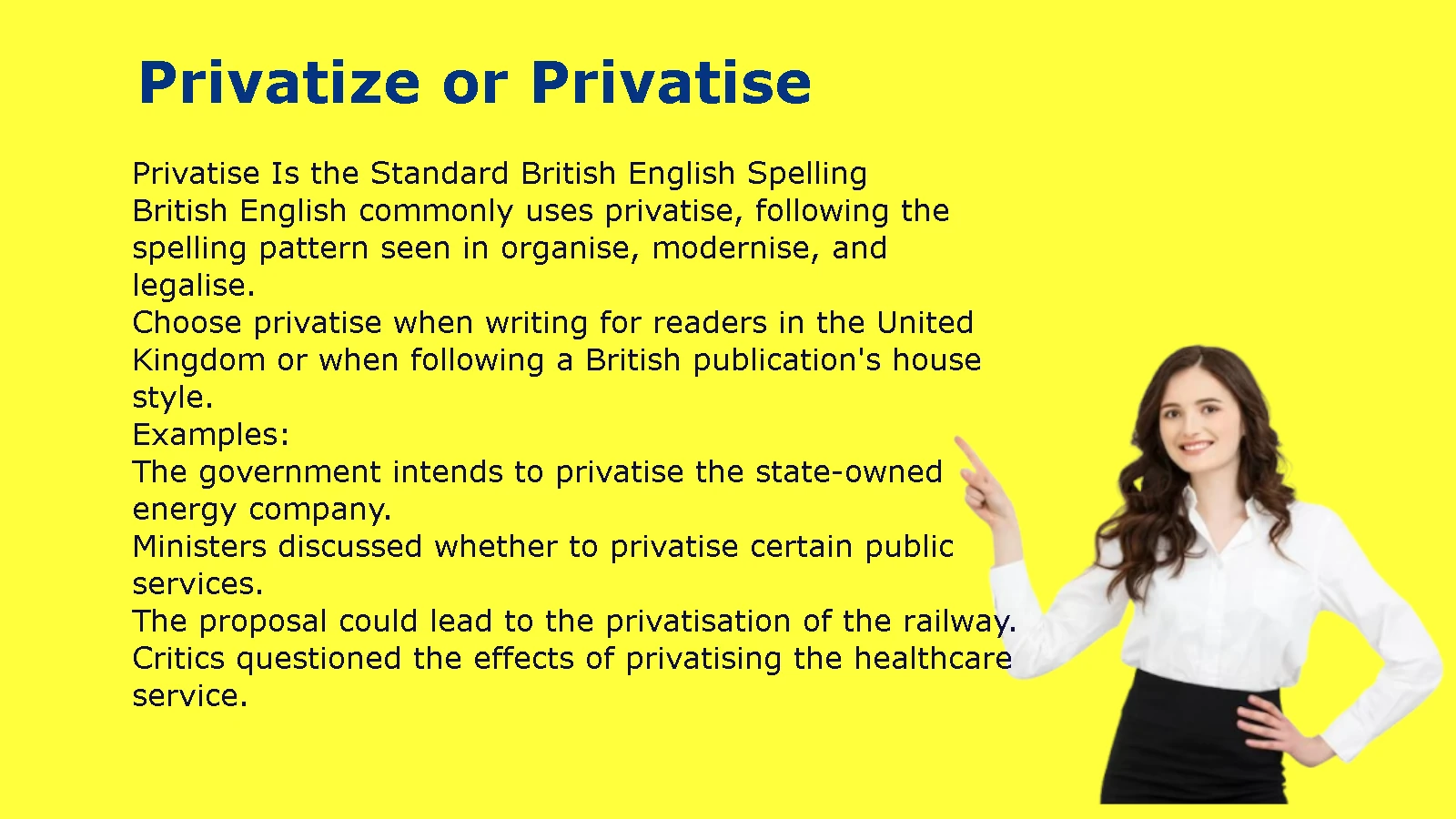
British English commonly uses privatise, following the spelling pattern seen in organise, modernise, and legalise.
Choose privatise when writing for readers in the United Kingdom or when following a British publication’s house style.
Examples:
- The government intends to privatise the state-owned energy company.
- Ministers discussed whether to privatise certain public services.
- The proposal could lead to the privatisation of the railway.
- Critics questioned the effects of privatising the healthcare service.
British spelling also uses privatised, privatising, and privatisation.
One detail matters: British English does not use -ise exclusively in every word. Some words require different endings, and individual publications may follow particular spelling conventions. For privatize, however, privatise is a well-established British form.
How to Choose Between Privatize and Privatise
Use these practical rules to select the correct spelling:
- Writing for a US audience? Choose privatize.
- Writing for a UK audience? Choose privatise.
- Writing for an international audience? Follow the spelling convention used by your publication or website.
- Editing an existing article? Keep the spelling consistent with the rest of the content.
For example, a US article should normally use privatize, privatized, and privatization. A UK article should normally use privatise, privatised, and privatisation.
Consistency improves readability and helps your content follow a recognizable editorial style.
What Does Privatize Mean?
Privatize means to transfer ownership or control of a business, asset, or service from the public sector to the private sector. Governments often use privatization when selling state-owned companies or changing how public services operate. The precise meaning depends on what changes hands: ownership, management, or responsibility for providing a service.
For example, if a government sells a publicly owned electricity company to private investors, it privatizes that company. If the government keeps ownership but hires a private business to handle customer support, it has outsourced a service rather than necessarily privatized the entire company.
Privatize Meaning in Simple English
In simple terms, to privatize something means to move it into private ownership or control.
Imagine that a city owns a bus company. The city pays for its vehicles, employs its workers, and manages its operations. Later, the city sells the company to a private business. The transfer represents privatization.
Here are more straightforward examples:
- A government sells a state-owned bank to private investors.
- A public utility transfers to private ownership.
- A government-owned factory becomes a privately owned business.
- A public agency transfers responsibility for a particular operation to a private provider under an arrangement that changes control.
The last example requires care. Hiring a private contractor does not automatically mean that the entire service has been privatized. The government may still own the assets, set the rules, and remain responsible for service delivery.
The central idea is a shift toward private ownership or control, although the precise arrangement varies.
What Privatization Means in Business and Government
Privatization is the process or policy of moving an organization, asset, or service from public ownership or control toward private ownership or control.
Governments may privatize organizations for several reasons. They might seek investment, change management incentives, reduce the need to operate commercial businesses directly, or restructure a struggling enterprise.
Common examples include:
- Energy: Selling a government-owned electricity producer.
- Transportation: Transferring a state-owned airline to private investors.
- Telecommunications: Selling shares in a public telecommunications company.
- Manufacturing: Selling a government-owned industrial business.
- Public services: Bringing private operators into the delivery or management of services.
Privatization can take different forms. An outright sale transfers ownership to a private buyer. A partial sale transfers only some ownership, while the government retains a stake. A public-private partnership can involve private financing or operations without transferring full ownership.
The outcomes depend on the terms of the arrangement, market conditions, regulation, and the service involved. Privatization does not guarantee lower prices, better quality, greater efficiency, or improved access. Those results depend on how the new arrangement works in practice.
Privatize, Privatized, Privatizing, and Privatization
These related words serve different grammatical purposes.
| Word | Part of speech or form | Meaning | Example |
| Privatize | Verb, base form | To transfer toward private ownership or control | They plan to privatize the company. |
| Privatizes | Third-person singular verb | Performs the act of privatizing | The government privatizes selected businesses. |
| Privatized | Past tense or past participle | Transferred to private ownership or control | The government privatized the airline. |
| Privatizing | Present participle or gerund | Carrying out the transfer | They are privatizing the utility. |
| Privatization | Noun | The process or policy of privatizing | Privatization remains a subject of debate. |
The spelling changes according to the English variety you use.
American English: privatize, privatized, privatizing, privatization.
British English: privatise, privatised, privatising, privatisation.
These forms allow you to discuss the same concept in different tenses and sentence structures.
Privatize Examples in Everyday and Professional Contexts
Privatize usually appears when people discuss ownership, management, government policy, or public services. Its meaning becomes clearer when you see how the verb works in a specific situation. The examples below show its use in business writing, public policy, news reporting, and everyday explanations.
Examples of Privatizing a Government-Owned Company
A government-owned company belongs to the public sector. When the government sells the company or transfers its ownership to private investors, it can privatize that business.
Examples:
- The government plans to privatize the national airline to attract private investment.
- Officials announced a proposal to privatize the state-owned steel manufacturer.
- The country began efforts to privatize several commercial enterprises.
- Investors expressed interest in buying the company after the government decided to privatize it.
- The proposed sale could change how the railway operates after privatization.
Consider a hypothetical national airline that loses money for several years. The government decides to sell a controlling stake to a private company. The buyer assumes greater responsibility for management and commercial decisions under the sale agreement.
Writers could describe this change by saying, “The government decided to privatize the national airline.”
That sentence describes the ownership decision without claiming that the sale will necessarily improve the airline’s performance.
Examples of Privatizing Public Services
Privatization discussions also cover services that governments provide or fund. However, public funding, public ownership, and public delivery are different concepts.
Examples:
- The council considered whether to privatize its waste-management operations.
- Lawmakers debated a proposal to privatize parts of the public transportation network.
- The government explored options for privatizing selected utility services.
- Residents questioned how privatizing the water company might affect their bills.
- The policy debate focused on whether to privatize the maintenance of public facilities.
A government might sell a water utility outright, transfer its management under a concession, or hire a private company to repair pipes. Each arrangement has different implications for ownership and control.
A useful writing rule is to name the actual change whenever possible. If the government sells the company, say it sold or privatized the company. If it hires a contractor, say it outsourced the service. Precise wording prevents readers from confusing different policy arrangements.
Original Example Sentences With Privatize
Use these sentences to understand the word in different contexts.
Business
- The board rejected the proposal to privatize the manufacturing division.
- Private investors offered to purchase the government-owned company.
- The ministry plans to privatize the enterprise after completing an independent valuation.
Government and public policy
- Residents asked whether the government intended to privatize the regional water authority.
- The proposal to privatize public housing prompted questions about affordability and oversight.
- Lawmakers requested a detailed assessment before deciding whether to privatize the service.
Education
- The debate centered on whether the government should privatize the management of certain schools.
- Parents wanted to know how privatizing education might affect school fees.
- The education department rejected a proposal to transfer the schools to private ownership.
Everyday explanations
- The city may privatize its parking operation next year.
- People disagree about whether the country should privatize its national railway.
- The company became privately owned after the government privatized it.
These examples also show that the word can describe a proposal, an ongoing process, or a completed action.
Privatized Synonyms and Alternative Words
A privatized synonym is a word or phrase that expresses a similar idea to privatized. The best alternative depends on the sentence. Some phrases describe a change in ownership, while others describe private management, commercial activity, or the transfer of a service to an outside provider.
No single synonym fits every context.
Common Synonyms for Privatized
Consider these alternatives when you want to avoid repeating privatized.
| Synonym or alternative | Meaning | When it fits |
| Privately owned | Owned by a private individual or organization | When describing current ownership |
| Transferred to private ownership | Ownership moved from a public entity to a private one | When emphasizing the transfer |
| Sold to private investors | Ownership transferred through a sale | When a sale actually occurred |
| Commercialized | Adapted to operate on a commercial basis | When the emphasis is on commercial activity |
| Privately operated | Managed or run by a private organization | When describing operations rather than ownership |
| Contracted out | Work assigned to an external contractor | When a service is outsourced |
| Deregulated | Government restrictions or controls reduced | When regulations change rather than ownership |
These alternatives are related, but they are not interchangeable in every sentence.
For instance, a privately owned company may have been established privately from the beginning. It is not necessarily a company that the government privatized.
Similarly, a business can operate commercially while remaining government-owned. Commercialization does not always involve a transfer of ownership.
Synonyms for Privatize in Different Contexts
Choose your wording based on what actually happened.
When the government sells an organization:
- Sell to private investors
- Transfer to private ownership
- Sell off a state-owned company
Example: “The government plans to sell the state-owned company to private investors.”
When a private company takes over operations:
- Contract out
- Hire a private operator
- Outsource a service
Example: “The council plans to contract out waste collection to a private provider.”
When the focus is on commercial activity:
- Commercialize
- Introduce commercial management
- Operate on a commercial basis
Example: “The agency plans to commercialize selected activities while retaining public ownership.”
For SEO writing, these phrases can add semantic variety to an article. Use them to clarify the context rather than simply replacing every occurrence of privatize with another term.
Is Privatized the Same as Outsourced?
No. Privatized and outsourced describe different changes.
Privatization generally concerns ownership or control. Outsourcing means that an organization hires an external provider to perform work that it might otherwise handle internally.
For example, a city may retain ownership of its waste-management department but hire a private company to collect rubbish. That is outsourcing. If the city sells its waste-management company to a private buyer, that is privatization.
| Feature | Privatization | Outsourcing |
| Main change | Ownership or control shifts toward the private sector | Work is assigned to an external provider |
| Must ownership change? | Typically, a meaningful shift in ownership or control is involved | No |
| Can government retain responsibility? | Yes, depending on the arrangement | Yes |
| Example | Selling a government-owned railway | Hiring a private company to clean public buildings |
The distinction matters because a service can be outsourced without being fully privatized. Governments can also use contracts and public-private partnerships while retaining ownership of the underlying assets.
What Is the Antonym of Privatize?
The main antonym of privatize is nationalize. Privatization shifts ownership or control toward the private sector, while nationalization generally transfers a privately owned business or asset into government ownership. Other related terms include municipalize and return to public ownership, depending on which public authority takes control.
Nationalize as the Main Opposite of Privatize
Nationalize means to bring a privately owned business, industry, or asset under national government ownership or control.
For example:
- Privatize: The government sells a state-owned bank to private investors.
- Nationalize: The government takes ownership of a privately owned bank.
These verbs describe opposing directions of ownership change.
The exact legal and financial arrangements can differ. Nationalization may involve compensation, legislation, or other mechanisms depending on the country and circumstances. The word itself does not specify how the transfer occurs.
Public Ownership vs. Private Ownership
private ownership describe who owns or controls an organization or asset.
Public ownership generally means that a government or public authority owns the asset. Private ownership means that an individual, company, or other private entity owns it.
The distinction does not automatically determine whether an organization provides good service, charges low prices, or operates efficiently. Those outcomes depend on management, competition, regulation, investment, and other factors.
Examples:
- A government-owned electricity company operates under public ownership.
- A privately owned electricity company operates under private ownership.
- A publicly owned company may hire private contractors without selling the company.
- A private company may provide a publicly funded service under a government contract.
Understanding these distinctions helps you use privatize and nationalize accurately.
Privatize vs. Nationalize vs. Municipalize
These terms describe different ownership arrangements.
| Term | General meaning | Example |
| Privatize | Transfer toward private ownership or control | Sell a state-owned airline to private investors |
| Nationalize | Transfer into national government ownership or control | Bring a privately owned energy company under state ownership |
| Municipalize | Transfer into municipal or local government ownership or control | A city takes ownership of a privately operated utility |
| Renationalize | Return an asset or company to national government ownership | The government reacquires a previously privatized railway |
The term renationalize is useful when an organization moves back into government ownership after an earlier period of private ownership.
Meanwhile, municipalize specifically concerns local government rather than the national government. These distinctions help you choose the most accurate term for a policy or ownership change.
What Does Privatizing Education Mean?
Privatizing education means shifting some or all educational ownership, management, funding arrangements, or service delivery toward private organizations. The term covers several different models, including private schools, contracted services, and transfers of school management. It does not always mean that the government stops funding education or that every school becomes privately owned.
How Education Privatization Works
Education privatization can take several forms. Understanding the arrangement matters because the word privatization can describe policies with very different effects.
Common models include:
- Private school ownership: Individuals or organizations own and operate schools.
- Private management contracts: A private organization manages a school or selected school operations.
- Outsourced services: A school system hires private companies for transport, meals, technology, or maintenance.
- Education vouchers: Public funding helps eligible families pay for education at participating schools, where such programs exist.
- Public-private partnerships: Government bodies and private organizations share specific responsibilities under an agreement.
These arrangements do not all represent full privatization. For example, outsourcing school meals does not transfer ownership of the school itself.
Likewise, a privately operated school may receive public funding and remain subject to government requirements. Ownership, financing, admissions rules, and accountability must be considered separately.
Examples of Private Schools, Charter Schools, and Contracted Education Services
The following examples illustrate how different education arrangements work.
Private schools: A privately owned organization operates a school and sets its policies within applicable legal requirements. Tuition, donations, or other revenue may fund its activities.
Charter schools: In the United States, charter schools are publicly funded schools that operate under a charter or agreement. Their legal structure and oversight differ from those of traditional public schools. Although some use private management organizations, charter schools are not automatically equivalent to private schools.
Contracted education services: A public school district may hire a private business to provide meals, transport, software, or building maintenance. The district can retain ownership and responsibility for the schools.
These distinctions are important when interpreting claims about privatizing education. A policy that changes school management differs from one that transfers ownership or makes families responsible for tuition.
Potential Benefits and Drawbacks of Privatizing Education
Education privatization remains a debated policy because its effects depend on the specific model, the local context, and the rules governing participation.
Potential arguments in favor include:
- Greater flexibility in management.
- Opportunities for new teaching models.
- Additional sources of investment.
- More options for families in some systems.
- Specialized services that public agencies may not provide directly.
Potential concerns include:
- Unequal access if fees or admissions rules create barriers.
- Differences in accountability between providers.
- Uneven service quality.
- Pressure on public budgets if funding arrangements are poorly designed.
- Challenges in maintaining consistent standards across providers.
Neither list proves that privatization always succeeds or fails. Policymakers need to examine outcomes such as student learning, affordability, access for disadvantaged groups, staffing, and long-term costs.
For example, a private operator might improve building maintenance through a well-designed contract. That result would not, by itself, prove that transferring ownership of all schools would improve educational outcomes.
The best analysis distinguishes a specific intervention from broader claims about privatization.
What Does It Mean to Privatize the TSA?
Privatizing the TSA refers to proposals to transfer some or all responsibilities of the US Transportation Security Administration to private operators. The TSA is a federal agency responsible for aviation security screening and related transportation security functions. Private contractors can already perform passenger screening at certain airports under the federal Screening Partnership Program.
What the Transportation Security Administration Does
The Transportation Security Administration (TSA) operates within the US Department of Homeland Security. Its responsibilities include passenger and baggage screening at airports, along with other transportation security duties.
When someone asks what it would mean to privatize the TSA, they may be referring to several different proposals:
- Replacing federal passenger-screening staff with private contractors.
- Expanding the use of private screening companies at airports.
- Changing who manages airport screening operations.
- Transferring broader security responsibilities away from the federal agency.
These are not identical proposals. Privatizing airport screening would not necessarily eliminate the TSA or transfer all its responsibilities to private companies.
How Private Airport Screening Differs From Federal TSA Screening
The United States already has a model in which private companies provide passenger-screening services at participating airports through the TSA’s Screening Partnership Program.
Under this arrangement, private contractors conduct screening while operating within the federal security framework. The TSA retains oversight responsibilities and establishes applicable security requirements.
This arrangement differs from a proposal to privatize the entire agency.
| Arrangement | Who performs the screening? | What remains with the federal government? |
| Federal screening | Federal TSA officers | Security requirements and agency oversight |
| Private screening under the TSA program | Approved private contractors | Federal standards and oversight |
| Broader privatization proposal | Depends on the proposal | Depends on the proposed legal and operational structure |
The distinction is important because private screening does not mean that airport security operates without federal supervision.
Arguments for and Against Privatizing Airport Security
Supporters of greater private involvement may argue that contractors can offer operational flexibility, different staffing models, or cost advantages. The actual results depend on contract design, workforce arrangements, and oversight.
Critics may raise concerns about accountability, consistency, coordination, and whether commercial incentives align with security needs.
A serious assessment should examine:
- Screening effectiveness and security outcomes.
- Passenger wait times.
- Total operating costs.
- Training and staff retention.
- Contract oversight and accountability.
- Coordination between airports, contractors, and federal agencies.
Privatizing airport screening is not the same as privatizing the entire TSA. That distinction is essential when interpreting news reports or policy discussions about airport security.
What Does Privatize Supplements Mean?
The phrase privatize supplements does not have one universally established meaning without additional context. It could refer to a company, a business strategy, a discussion about private ownership, or a specific product or service. The surrounding sentence or source determines the intended interpretation.
Does Privatize Supplements Refer to a Brand or a Business Strategy?
The phrase can be interpreted in different ways.
If supplements refers to nutritional products, a writer might be discussing the ownership of a supplement company or the transfer of its business to private investors. In that context, privatize would refer to ownership or control rather than to the ingredients in the products.
For example:
“The investors proposed to privatize the supplement company.”
This sentence means that the investors want to move the company toward private ownership or control. It does not mean that they want to change the supplement formula.
The phrase could also appear in a search related to a company name, an online service, or a specific product. Without that context, assigning one definite meaning would be misleading.
How to Interpret the Phrase in Context
Use the surrounding words to identify the intended meaning.
- If the sentence mentions investors or shareholders, the subject may be company ownership.
- If it mentions a government agency, the discussion may concern the transfer of public assets or responsibilities.
- If it mentions a product name, the phrase may be incomplete or connected to a particular brand.
- If it appears in a headline, the original article may provide context missing from the search query.
For clear writing, specify the object being privatized. Instead of writing “privatize supplements,” write “privatize the supplement company” if that is the intended meaning.
This small change makes the sentence easier to understand and prevents readers from confusing product manufacturing with business ownership.
What Does Privatized World Peace Mean?
Privatized world peace is not a standard expression with one widely established definition. Its meaning depends on the source and context. It may describe a hypothetical approach in which private organizations take a larger role in peacekeeping or conflict resolution, but it should not be treated as a recognized technical term without further evidence.
Possible Meanings of Privatized World Peace
The phrase combines two ideas: privatization and world peace.
Privatization generally refers to moving ownership or control toward private entities. World peace refers broadly to the absence of war and the pursuit of peaceful relations among countries and communities.
Together, the phrase could suggest several interpretations:
- Private peacekeeping: Private organizations perform certain security or support functions in conflict areas.
- Commercial peace initiatives: Private businesses or foundations fund mediation, dialogue, or reconstruction programs.
- Market-based approaches: A writer proposes using commercial incentives to encourage cooperation.
- Critical or satirical language: Someone uses the phrase to question the idea of treating peace as a private commercial service.
These are possible readings, not interchangeable definitions. The exact meaning depends on where the phrase appears.
How Privatization Could Apply to Peacekeeping or Conflict Resolution
Private organizations already participate in some activities connected with conflict prevention, humanitarian assistance, reconstruction, and security. However, their involvement does not mean that they can independently establish world peace.
Consider a hypothetical organization that funds negotiations between two communities after a prolonged dispute. The organization may provide meeting facilities, financial support, or mediation services. A writer could describe this as a private contribution to peacebuilding.
That is different from claiming that the organization has privatized world peace. The broader phrase would require a specific argument about who controls, funds, or provides peace-related functions.
A careful article should separate documented activities from hypothetical interpretations and avoid presenting a speculative phrase as an established policy concept.
Is Privatized World Peace a Standard Term?
No single standard definition can be inferred from the phrase alone.
If you encountered privatized world peace meaning in a particular article, book, video, or online discussion, the surrounding passage is the best guide to its intended meaning.
To explain the phrase accurately:
- Identify the original source.
- Read the sentence before and after the phrase.
- Determine whether the author is discussing private security, peacebuilding, economics, or satire.
- Explain the interpretation without presenting it as a universal definition.
This approach also helps distinguish an ordinary dictionary term from an unusual expression whose meaning depends on context.
How to Use Privatize and Privatise Correctly
Use privatize for American English and privatise for British English. Both spellings function as verbs, and both follow similar grammatical patterns. The key is to select the appropriate regional form and use the corresponding spellings for related words.
American English Examples With Privatize
American English typically uses these forms:
- Privatize: The government plans to privatize the company.
- Privatized: The government privatized the company last year.
- Privatizing: The government is privatizing selected operations.
- Privatization: The privatization proposal remains under review.
Notice that privatized can function as a past-tense verb or as a past participle used with another verb. It can also function as an adjective when describing an organization’s ownership status.
Examples:
- The government privatized the railway in the previous decade.
- The privatized railway now operates under private ownership.
- Officials are considering privatizing the energy company.
- The proposed privatization would transfer a controlling stake to private investors.
British English Examples With Privatise
British English commonly uses these forms:
- Privatise: The government plans to privatise the company.
- Privatised: The government privatised the company last year.
- Privatising: The government is privatising selected operations.
- Privatisation: The privatisation proposal remains under review.
Examples:
- Ministers discussed whether to privatise the utility.
- The privatised business operates under private ownership.
- The government is privatising selected commercial services.
- The proposed privatisation remains controversial.
The meanings and grammar remain the same. Only the spelling convention changes.
Common Spelling and Grammar Mistakes
Avoid these common errors when using privatize or privatise.
Mixing American and British spelling
Incorrect for a consistently American-styled article: “The government will privatize the company and complete its privatisation.”
Better: “The government will privatize the company and complete its privatization.”
A British-styled version would use privatise and privatisation.
Confusing privatization with outsourcing
Incorrect: “The city privatized its cleaning service” when it only hired a contractor and retained ownership and control of the service.
More precise: “The city outsourced its cleaning service to a private contractor.”
Using the wrong grammatical form
Incorrect: “The government plans privatized the railway.”
Correct: “The government plans to privatize the railway.”
You need the base form privatize after plans to.
Treating privatized as a noun
Incorrect: “The privatized of the company took two years.”
Correct: “The privatization of the company took two years.”
Use privatization for the process and privatized for the past-tense verb, past participle, or adjective.
Assuming privatization always means a complete sale
A government may sell a partial stake or transfer only certain responsibilities. Describe the arrangement accurately rather than assuming that every form of private involvement transfers full ownership.
Frequently Asked Questions
Is Privatize or Privatise Correct?
Both spellings are correct. Privatize is the standard American English form, while privatise is the standard British English form. Both mean transferring a business, asset, or service toward private ownership or control. Choose the spelling that matches your audience and keep it consistent throughout your writing.
What Is the Meaning of Privatize in Simple Words?
To privatize something means to transfer it from public ownership or control to private ownership or control. For example, when a government sells a state-owned company to a private business, it privatizes that company. The term can also describe certain changes in control or responsibility, depending on the arrangement.
What Is a Synonym and Antonym for Privatize?
Useful alternatives include transfer to private ownership, sell to private investors, and sell off, depending on the context. The main antonym is nationalize, which generally means transferring a privately owned business or asset into government ownership. Municipalize can describe a transfer into local government ownership.
What Does Privatizing Education Mean?
Privatizing education means shifting some or all educational ownership, management, funding arrangements, or service delivery toward private organizations. Examples include private school ownership and private management contracts. However, outsourcing school meals or maintenance does not necessarily mean that a school itself has been privatized.
What Does Privatizing the TSA Mean?
Privatizing the TSA generally refers to proposals to move airport screening or other agency responsibilities toward private operators. The United States already permits approved private contractors to conduct screening at participating airports under federal oversight. Private screening does not automatically mean privatizing the entire Transportation Security Administration.
Is Privatization the Same as Outsourcing?
No. Privatization generally involves a shift in ownership or control toward the private sector. Outsourcing means hiring an external provider to perform a service. A government can outsource cleaning or maintenance while retaining ownership of the organization and responsibility for the service.
Conclusion: Choose Privatize or Privatise Based on Your Audience
The difference between privatize or privatise comes down to regional spelling, not meaning. Use privatize in American English and privatise in British English. Both forms describe a shift toward private ownership or control, and both support related words such as privatized, privatizing, and privatization.
When discussing privatization, choose precise wording. A company sale differs from an outsourcing contract, and private management does not always mean private ownership. The same care applies when discussing education, the TSA, supplements, or unusual phrases such as privatized world peace.
If you are writing an article, report, or business document, decide which English variety your audience expects and apply it consistently. Then explain the specific ownership or management change rather than relying on broad claims about privatization.