Rumor vs rumour comes down to one main difference: American English uses “rumor,” while British English uses “rumour.” Both spellings are correct, and both refer to information or a story that people share without confirming whether it is true. The choice depends on your audience and the variety of English you use.
Understanding the difference between American spelling, British spelling, rumor pronunciation, and rumour plural forms helps you write consistently. You may also encounter expressions such as “spread rumors” and “rumour has it,” which describe how people circulate unverified information or introduce something people are saying. Each expression has its own meaning and fits different situations.
Rumor vs Rumour: What’s the Difference?
Rumor is the standard spelling in American English, whereas rumour is the standard spelling in British English. Both words have the same meaning, pronunciation in many accents, and grammatical function. Neither spelling is more correct than the other; you should choose the form that matches your audience.
For example:
- American English: A rumor about the new manager spread throughout the office.
- British English: A rumour about the new manager spread throughout the office.
The difference is the letter u. American English generally omits it in this word, while British English retains it.
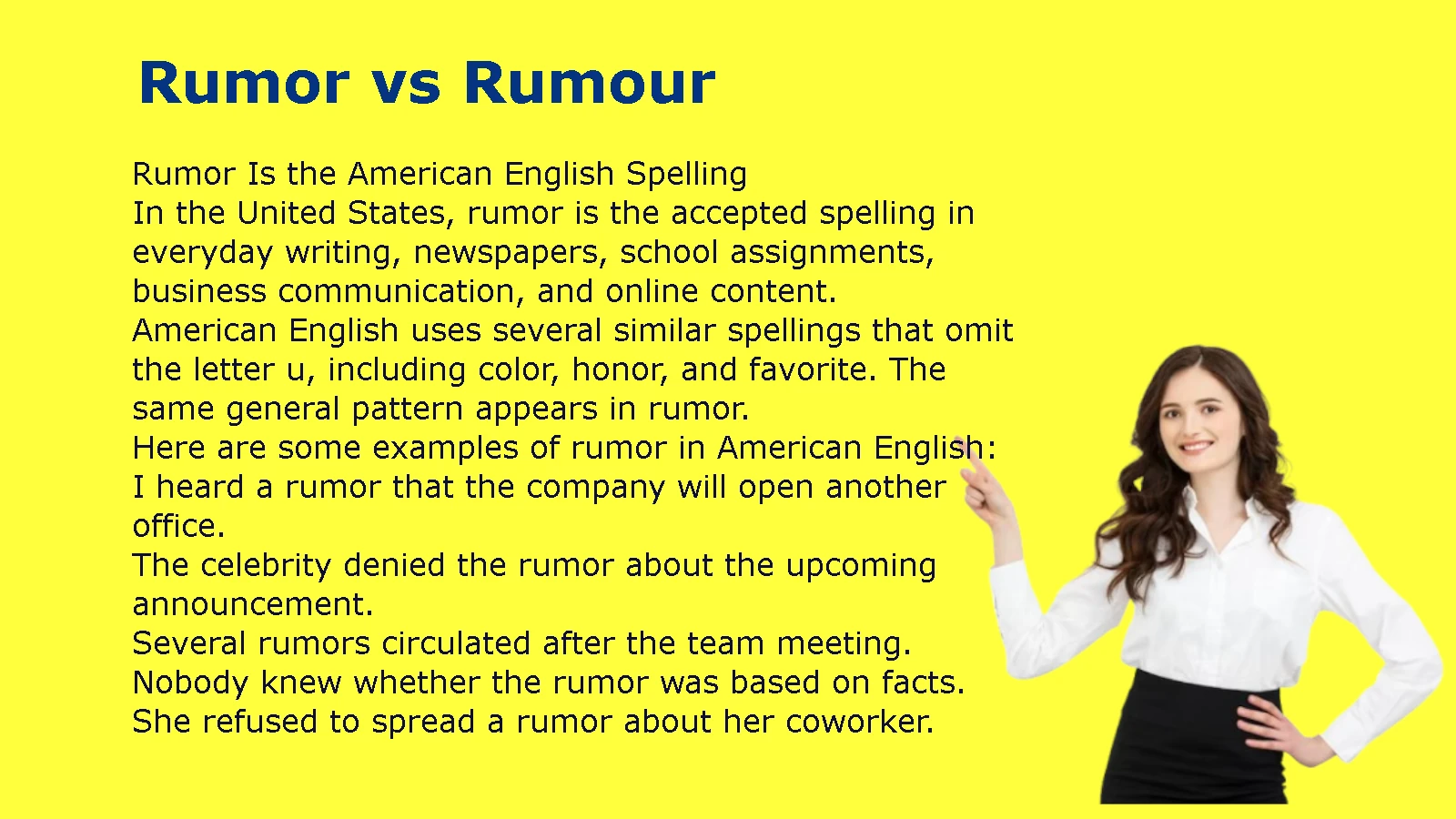
Rumor Is the American English Spelling
In the United States, rumor is the accepted spelling in everyday writing, newspapers, school assignments, business communication, and online content.
American English uses several similar spellings that omit the letter u, including color, honor, and favorite. The same general pattern appears in rumor.
Here are some examples of rumor in American English:
- I heard a rumor that the company will open another office.
- The celebrity denied the rumor about the upcoming announcement.
- Several rumors circulated after the team meeting.
- Nobody knew whether the rumor was based on facts.
- She refused to spread a rumor about her coworker.
Use rumor when writing for an American audience or following a US English style guide.
Rumour Is the British English Spelling
In British English, rumour is the standard spelling. The letter u also appears in related forms, such as rumoured and rumours.
Writers in the United Kingdom commonly use this form in news articles, essays, workplace documents, and everyday communication. Canadian, Australian, and New Zealand English also commonly follow the rumour spelling, although individual style guides may vary.
Examples of rumour in British English include:
- A rumour about the school closing spread among parents.
- The actor dismissed the rumour as completely false.
- Several rumours circulated before the announcement.
- She asked her colleague not to repeat the rumour.
- There was a rumour that the shop would move to another location.
If you write for British readers, use rumour and its related forms consistently.
Is Rumor or Rumour More Correct?
Neither spelling is universally more correct. Rumor follows standard American English conventions, while rumour follows standard British English conventions.
The correct choice depends on your intended audience, publication requirements, or writing style.
Consider these situations:
| Writing situation | Recommended spelling |
| US school assignment | Rumor |
| American business email | Rumor |
| UK newspaper article | Rumour |
| British academic essay | Rumour |
| Australian website | Usually rumour |
| Canadian publication | Usually rumour, subject to its style guide |
| International website | Choose one variety and use it consistently |
Mixing the two forms in the same article can make your writing look inconsistent. If your introduction uses rumor, your later headings and examples should generally use American spelling as well, unless you are explicitly comparing regional variants.
Rumor vs Rumour Spelling Comparison
The spelling difference extends beyond the singular noun. Related forms generally preserve the same regional pattern, including the plural, past-tense verb, and past participle.
American vs British Spelling at a Glance
| American English | British English | Meaning |
| Rumor | Rumour | An unverified story or claim |
| Rumors | Rumours | More than one unverified story or claim |
| Rumored | Rumoured | Reported or said without necessarily being confirmed |
| Rumoring | Rumouring | Spreading or circulating a rumor |
| It is rumored that | It is rumoured that | A claim is circulating |
For example:
- American: The company rumored that it would launch a new product.
- British: The company rumoured that it would launch a new product.
However, these verb constructions may sound less natural than alternatives such as “People rumored that the company would launch a new product” or “It was rumored that the company would launch a new product.”
The spelling changes according to the regional convention, but the basic meaning stays the same.
Why Does British English Use the Letter U?
The difference reflects the historical development of American and British spelling conventions. American English standardized many spellings that omit the u found in traditional British forms.
Words such as color/colour, honor/honour, and labor/labour show the same pattern. The difference is largely conventional rather than semantic.
The spelling of rumor follows this familiar pattern:
- American English: rumor, color, honor
- British English: rumour, colour, honour
This pattern can help you remember the correct form when writing for different audiences. However, not every British and American spelling difference follows this rule, so check individual words when you are unsure.
Which Spelling Should You Use in Formal Writing?
Use the spelling required by your institution, employer, publisher, or intended readership. Formal writing does not require one universal spelling; it requires consistency with the relevant standard.
For example, an American university will generally expect rumor in an assignment written in US English. A British publisher will generally prefer rumour.
Follow these practical guidelines:
- For academic writing: Check the university’s language or style requirements.
- For business documents: Match the spelling conventions used by your organization.
- For journalism: Follow the publication’s editorial style.
- For website content: Match your target audience and use one English variety throughout the page.
- For international communication: Choose the form your readers recognize most easily and keep it consistent.
If you are editing an existing document, search for both rumor and rumour. Then check related forms such as rumors, rumours, rumored, and rumoured to avoid accidental mixing.
Rumor or Rumour: Meaning and Usage
A rumor or rumour is information that people circulate without establishing whether it is true. It may concern a person, organization, event, relationship, or public issue. A rumor can eventually prove accurate, inaccurate, or partly true, so the word itself does not establish the claim’s truth.
For example, if employees hear that their company plans to relocate, they may describe the claim as a rumor until management confirms or denies it.
What Does Rumor Mean in English?
The noun rumor means a story, claim, or piece of information that spreads among people without reliable confirmation. The British spelling, rumour, has exactly the same meaning.
Rumors often spread through conversations, social media posts, messaging apps, and online discussions. People may repeat them because they seem believable, create excitement, or offer a possible explanation for an uncertain situation.
Examples include:
- A rumor suggested that the restaurant would close permanently.
- The rumour about the missing documents remained unconfirmed.
- An online rumor caused confusion among customers.
- The school addressed a rumour about a change in its examination schedule.
A rumor is not necessarily a lie. Someone may repeat information that later turns out to be accurate. The important point is that the information has not been confirmed when people describe it as a rumor.
Compare these statements:
- Unconfirmed: There is a rumor that the store will close.
- Confirmed: The store’s management announced that it will close.
- False: The store’s management confirmed that the closure rumor was untrue.
These examples show why writers should distinguish between an unverified claim and an established fact.
Is Rumor a Noun or a Verb?
Rumor is primarily a noun, but English also uses rumor as a verb. The British spelling follows the same pattern: rumour can function as a noun or a verb.
As a noun, the word identifies the information itself.
- A rumor spread through the neighborhood.
- The rumour caused unnecessary concern.
As a verb, it describes the act of circulating or reporting a claim.
- People rumored that the business would change owners.
- It was rumoured that the singer would announce a tour.
The verb often appears in passive constructions, such as “The actor is rumored to be joining the project.” This sentence reports what people are saying without claiming that the information has been confirmed.
Related forms include:
| Form | American English | British English |
| Base noun or verb | Rumor | Rumour |
| Plural noun | Rumors | Rumours |
| Past tense | Rumored | Rumoured |
| Present participle | Rumoring | Rumouring |
In everyday speech, people often use expressions such as “I heard a rumor” or “Rumor has it” more naturally than the verb form.
Rumor vs Gossip vs Hearsay
Rumor, gossip, and hearsay all involve information passed between people, but they emphasize different things.
| Word | Meaning | Typical context | Example |
| Rumor or rumour | Unconfirmed information circulating among people | News, workplace changes, public claims | A rumor suggested the company would relocate. |
| Gossip | Informal talk about other people’s personal lives or behavior | Relationships, social groups, workplaces | The coworkers exchanged gossip about the new employee. |
| Hearsay | Information someone reports hearing from another person rather than knowing directly | Legal discussions and formal accounts | The witness’s statement included information based on hearsay. |
A rumor may concern almost any subject, including a new product, a public event, or a business decision. Gossip more often focuses on people and their private affairs, although the terms can overlap.
Hearsay emphasizes the source of information: someone is repeating what another person said. In legal contexts, hearsay also has a more specific meaning governed by the applicable rules of evidence.
Choosing the right word makes your writing more precise. If employees are discussing an unconfirmed office closure, rumor fits. If they are discussing a colleague’s private relationship, gossip may be more appropriate.
Rumor vs Rumour Pronunciation
The words rumor and rumour are pronounced similarly, and the extra letter u in the British spelling does not normally represent an additional sound. However, actual pronunciation varies by accent, especially in the vowel sound and the quality of the final r.
How Do You Pronounce Rumor and Rumour?
In many American accents, rumor is pronounced with two syllables, with the stress on the first syllable. British speakers also commonly use two syllables for rumour.
A broad American English IPA transcription is /ˈruː.mɚ/. A broad British English transcription may be represented as /ˈruː.mə/, although pronunciation varies across British accents.
A simple guide is:
- Start with a sound similar to “roo.”
- Follow it with an unstressed second syllable.
- Keep the first syllable stronger than the second.
The American pronunciation commonly retains a pronounced r at the end. Many non-rhotic British accents do not pronounce that final r unless another vowel follows in connected speech.
The key point is that rumor and rumour differ mainly in spelling, not in the number of syllables.
Does Rumour Sound Different in British and American English?
The words may sound different because American and British accents use different vowel patterns and treat the letter r differently.
In many American accents, speakers pronounce the final r clearly. In many southern British accents, the final r is not pronounced when the word appears before a pause or a consonant.
Other British accents may pronounce the word differently, so it is better not to treat one accent as representative of every British speaker.
For English learners, focus on three elements:
- Stress: Put the main stress on the first syllable.
- Syllables: Use two syllables in the common pronunciation.
- Accent: Follow the pronunciation pattern of the English variety you are learning.
If you are learning American English, use a rhotic American pronunciation. If you are learning British English, listen to speakers from the relevant region rather than assuming that all British accents sound alike.
What Is the Plural of Rumor or Rumour?
The plural of rumor is rumors in American English. The plural of rumour is rumours in British English. Both forms follow the ordinary English rule of adding -s to form the plural of most regular nouns.
For example:
- One rumor; several rumors.
- One rumour; several rumours.
Rumors vs Rumours: Which Is Correct?
Both spellings are correct in their respective English varieties.
Use rumors for American English and rumours for British English. The meaning does not change when you add the u to follow British spelling conventions.
Examples:
American English
- The rumors about the new policy were inaccurate.
- Several rumors appeared on social media.
- Those rumors caused confusion among customers.
British English
- The rumours about the new policy were inaccurate.
- Several rumours appeared on social media.
- Those rumours caused confusion among customers.
Remember that the plural noun normally takes a plural verb when it functions as the subject of a sentence.
- Correct: The rumors are spreading.
- Correct: The rumours have reached the local newspaper.
- Incorrect: The rumors is spreading.
Singular and Plural Agreement
Subject-verb agreement matters regardless of whether you use American or British spelling. A singular noun normally takes a singular verb, while a plural noun takes a plural verb.
| Singular form | Plural form |
| The rumor is spreading. | The rumors are spreading. |
| The rumour has disappeared. | The rumours have disappeared. |
| A rumor was reported. | Several rumors were reported. |
| The rumour seems believable. | The rumours seem believable. |
Pay attention to the noun that controls the verb. In “A collection of rumors is circulating,” the subject is collection, which is singular. The plural noun rumors appears inside the prepositional phrase “of rumors,” so it does not determine the verb.
This distinction helps you avoid agreement errors in longer sentences.
Rumors Spelling: Common Mistakes to Avoid
The most common spelling mistake is mixing American and British forms without a clear reason. Writers may use rumor in one paragraph and rumours in another, even though the entire document follows American English.
Use this checklist:
- Rumor: American singular noun.
- Rumors: American plural noun.
- Rumour: British singular noun.
- Rumours: British plural noun.
- Rumored: American past-tense or past-participle form.
- Rumoured: British past-tense or past-participle form.
Avoid treating rumours as an incorrect plural just because your spellchecker uses American English. The form is standard in British English.
Likewise, do not change every spelling in a document automatically without checking the audience. A British publication may expect rumour, while an American publication may expect rumor.
What Does Spread Rumors Mean?
To spread rumors means to share or circulate information that has not been reliably confirmed. People can spread rumors through conversations, text messages, social media, or public statements. The phrase describes how information travels; it does not prove that the information is true or false.
The British spelling is spread rumours, while American English normally uses spread rumors.
Definition of Spread Rumors
The phrase spread rumors describes the process of passing an unverified claim from one person to another. As more people repeat the claim, it may reach a wider audience even when nobody has confirmed its accuracy.
For example, an employee might hear that a department will be eliminated and tell several colleagues. Those colleagues may repeat the story to other employees. The claim can spread quickly, even if management has made no such decision.
People spread rumors for different reasons:
- They believe the information is true.
- They want to warn others about a possible development.
- They enjoy discussing surprising or controversial claims.
- They want to influence how other people view a person or organization.
- They repeat a claim without checking its source.
The phrase does not automatically mean that someone intends to deceive others. A person can spread a false rumor simply by repeating information they mistakenly believe.
Examples of Spread Rumors in Sentences
These examples show how the phrase works in different settings.
At school
- Students began to spread rumors about the unexpected schedule change.
- The teacher reminded the class not to spread rumors about other students.
- A false rumor spread after someone misunderstood the announcement.
At work
- Employees should verify internal announcements rather than spread rumors.
- A rumor about layoffs spread before management addressed the issue.
- The manager asked everyone to stop spreading unconfirmed claims about a coworker.
On social media
- One misleading post can cause thousands of people to spread rumors.
- The company responded quickly to stop false rumors from circulating online.
- Users should check the original source before sharing claims about a public event.
In British English
- Several people began to spread rumours about the planned relocation.
- The school asked parents not to spread rumours about the new policy.
In each example, the phrase focuses on the movement of information rather than its accuracy.
Is Spreading Rumors Always Harmful?
Spreading rumors can cause harm, especially when claims target a person’s reputation, employment, relationships, or safety. However, not every unconfirmed report has the same consequences, and people may share uncertain information because they are trying to understand a developing situation.
The key distinction is whether people present the claim responsibly and whether they make reasonable efforts to verify it.
For example, a message stating “The company may relocate, but management has not confirmed anything” clearly communicates uncertainty. A message stating “The company is definitely closing next week” presents the same unconfirmed possibility as a fact.
Before sharing a claim, ask:
- Who is the original source?
- Can the information be independently verified?
- Does the message distinguish facts from speculation?
- Could sharing it unfairly harm someone?
- Would waiting for confirmation prevent unnecessary confusion?
These questions help people communicate responsibly without treating every developing story as a confirmed fact.
What Does Rumour Has It Mean?
“Rumour has it” is an expression that introduces something people are saying but that has not necessarily been confirmed. American English commonly spells the same expression “rumor has it.” Speakers often use it in conversations about relationships, workplace developments, entertainment, or upcoming events.
For example, “Rumor has it that the restaurant is opening a second location” means people are saying the restaurant may open another location, but the speaker has not necessarily verified the claim.
Definition of Rumour Has It
The phrase rumour has it signals that a claim is circulating among people. It often creates curiosity or introduces information that the speaker considers interesting but cannot confirm.
The expression does not identify a specific source. Instead, it refers generally to what people are saying.
Examples:
- Rumour has it that the school will introduce a new uniform.
- Rumor has it that the singer is preparing a surprise album.
- Rumour has it that the company will announce a major change next month.
In each case, the expression presents a circulating claim rather than an established fact.
The phrase can sound playful, dramatic, or cautious depending on the situation. However, it can also help spread misinformation if a speaker uses it to make an unsupported claim sound credible.
Rumour Has It vs Rumor Has It
The difference is regional spelling, not meaning.
| Expression | English variety | Meaning |
| Rumor has it | American English | People are saying that something may be true. |
| Rumour has it | British English | People are saying that something may be true. |
Examples:
- American: Rumor has it that the team will hire a new coach.
- British: Rumour has it that the team will hire a new coach.
Both expressions introduce a claim that has not necessarily been verified. Choose the spelling that matches the rest of your writing.
How to Use Rumour Has It in a Sentence
Place the expression at the beginning of a sentence when you want to introduce a claim that people are discussing.
Common patterns include:
- Rumor has it that + clause: Rumor has it that the store will expand.
- Rumour has it that + clause: Rumour has it that the store will expand.
- Rumor has it + reported information: Rumor has it, the two companies are planning a partnership.
The version with that is straightforward and suitable for most contexts. In informal writing, speakers sometimes omit that.
Here are examples across different situations:
Workplace
“Rumor has it that the company will introduce flexible working hours.”
Entertainment
“Rumour has it that the actor will appear in the next film.”
Relationships
“Rumor has it that the couple has moved to another city.”
Local news
“Rumour has it that the old cinema will become a community center.”
For formal reports, consider a more precise alternative if you know the source. Instead of writing “Rumor has it that the project will be delayed,” you could write “Several employees have suggested that the project may be delayed, but management has not confirmed the change.”
The second sentence gives readers more context and makes the uncertainty explicit.
Rumor vs Rumour: Examples in Everyday English
Seeing the two spellings in complete sentences makes the difference easier to remember. The meaning remains the same, but your spelling should match the English variety you have chosen.
Examples in Casual Conversations
These short exchanges show how people might use the word naturally.
American English
“Did you hear the rumor about the new restaurant?”
“No. Is it confirmed?”
“Not yet. Someone posted about it online.”
British English
“Have you heard the rumour about the school trip?”
“I have, but I don’t know whether it’s true.”
“Let’s wait until the school sends an announcement.”
Other examples include:
- I don’t believe every rumor I hear.
- She asked me where the rumour started.
- Have you heard any rumors about the new manager?
- Several rumours have circulated since the announcement.
These examples demonstrate the noun’s everyday use and show how speakers can question a claim rather than accept it as fact.
Examples in Professional and Academic Writing
In professional writing, the word often describes unverified information that may affect an organization, project, or decision.
Examples:
- The company issued a statement addressing the rumor about its proposed merger.
- Management clarified that the rumours about immediate layoffs were unconfirmed.
- Researchers should distinguish verified findings from rumors circulating online.
- The report examined how a rumour spread through a local community.
When writing a report, avoid using rumor as a substitute for evidence. If the information comes from a named source, identify the source when appropriate. If it remains unverified, make that limitation clear.
For example, “A rumor suggests that the policy may change” is more cautious than “The policy will change.” The first statement reflects uncertainty; the second presents the change as a fact.
Examples for Social Media and Online Content
Social media can circulate claims quickly, so writers should make the status of information clear.
Consider these examples:
- “A rumor about the product launch is circulating, but the company has not announced a date.”
- “Please don’t spread rumours about someone’s private life without evidence.”
- “The viral post repeated a claim that later proved false.”
- “Several online rumors appeared after the company postponed its announcement.”
A responsible post separates three things:
- What people are saying: The claim that is circulating.
- What is verified: Information supported by reliable evidence.
- What remains uncertain: Details that have not been confirmed.
This approach gives readers useful context and reduces the risk of presenting speculation as fact.
How to Remember the Difference Between Rumor and Rumour
The easiest way to remember the difference is to associate rumor without a u with American English and rumour with a u with British English. The same spelling pattern appears in several familiar words, including color/colour and honor/honour.
A Simple American vs British Spelling Trick
Use this memory aid:
- US English: rumor, color, honor, favorite.
- UK English: rumour, colour, honour, favourite.
Think of the u as a regional spelling marker. If your document uses color and honor, you will usually want rumor. If it uses colour and honour, you will usually want rumour.
This is a useful guide, but not a universal rule for all spelling differences. English contains many regional variations that do not follow the same pattern.
Keep Your Spelling Consistent
Consistency matters more than choosing one form over the other. A reader may understand both spellings, but switching between them without a reason can make a document look poorly edited.
Use this quick editing checklist before publishing:
- Choose American or British English at the start.
- Check the spelling of rumor/rumour throughout the document.
- Check the plural form: rumors/rumours.
- Check related forms: rumored/rumoured.
- Review headings, tables, captions, and image descriptions.
- Confirm that your examples match the regional spelling you selected.
For website owners, this also helps keep spelling-comparison articles clear. If your page targets American readers, use American English in the main explanatory text while showing British variants where the comparison requires them.
Frequently Asked Questions
Is Rumor American or British Spelling?
Rumor is the standard American English spelling. Rumour is the standard British English spelling. Both words have the same meaning, and neither is universally more correct. Choose the form that matches your intended audience.
Is Rumour Spelled With a U in British English?
Yes. British English normally spells the word rumour, with a u before the r. The American English form, rumor, omits that letter. The same difference appears in related forms such as rumours and rumored/rumoured.
What Is the Plural of Rumour?
The plural of rumour is rumours in British English. In American English, the corresponding singular is rumor and the plural is rumors. Both plural forms follow the standard rule of adding -s to a regular noun.
How Do You Pronounce Rumour?
Rumour is commonly pronounced with two syllables and stress on the first syllable. A broad British transcription is /ˈruː.mə/, though pronunciation varies by accent. The American spelling rumor is commonly pronounced /ˈruː.mɚ/ in rhotic American English.
What Does Spread Rumors Mean?
Spread rumors means circulating unverified information among people. The phrase can describe sharing a claim in conversation, through messages, or on social media. It does not automatically mean that the claim is false, but it indicates that its accuracy may not be established.
What Does Rumour Has It Mean?
Rumour has it means that people are saying something, although the speaker may not know whether it is true. American English uses rumor has it. Both expressions introduce a circulating claim, such as a possible announcement, business change, or upcoming event.
Conclusion: Choose Rumor or Rumour Based on Your Audience
The difference between rumor vs rumour is simple: American English uses rumor, while British English uses rumour. Both spellings refer to information that circulates without confirmed verification, and the choice does not change the word’s basic meaning.
Remember these key forms:
- American English: rumor, rumors, rumored.
- British English: rumour, rumours, rumoured.
- Spread rumors/rumours: To circulate unverified information.
- Rumor/rumour has it: An expression used to introduce something people are saying.
When you write, focus on your audience and stay consistent. If you are preparing an American English article, use rumor. If you are writing for a British audience, use rumour. Check related forms before publishing, and make a clear distinction between a circulating claim and a confirmed fact.