Patronize vs patronise is a common spelling question because both forms are correct, but they follow different English spelling conventions. Patronize is the standard American English spelling, while patronise is commonly used in British English. Both words have the same pronunciation and meanings, including treating someone as inferior and supporting a business.
The word patronize can describe two very different actions. You might patronize a local coffee shop by buying its products, or you might patronize a coworker by speaking to them as if they lack intelligence. Understanding the difference between these meanings helps you choose the right word, interpret everyday conversations, and avoid misunderstandings in professional writing.
This guide explains the difference between patronize vs patronise, the meaning of patronizing behavior, the distinction between patronize and patronage, useful synonyms, pronunciation, and examples of patronizing a business. You’ll also find practical alternatives and original quotes for business owners who want to encourage customer support.
Patronize vs Patronise: What Is the Difference?
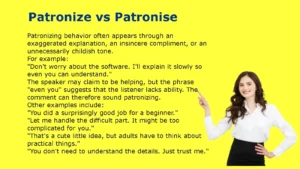
Patronize and patronise are two spellings of the same verb. American English uses patronize, while British English generally uses patronise. Both forms can mean treating someone condescendingly or supporting a business, artist, or organization.
The spelling difference does not change the word’s meaning. Your choice depends on the variety of English you’re writing in.
Patronize Is the American English Spelling
Patronize is the standard spelling in the United States. American writers use it in academic papers, business communication, news articles, websites, and everyday messages.
The word has two main meanings:
- To treat someone condescendingly: To speak or behave as if another person is less intelligent, experienced, or capable.
- To support a business or person: To buy from a business, regularly visit an establishment, or provide financial support to an artist or organization.
For example:
- “Please don’t patronize me just because I’m new to the job.”
- “We patronize the family-owned restaurant near our office.”
- “The museum depends on visitors who patronize its gift shop.”
In the first sentence, patronize expresses a negative attitude. In the other two, it describes customer support.
Patronise Is the British English Spelling
Patronise is the standard British English spelling and also appears in other varieties of English that follow British spelling conventions.
The meaning remains the same as the American form. Only the spelling changes.
Examples include:
- “I don’t appreciate it when you patronise me.”
- “Many residents patronise independent shops in their neighborhood.”
- “The organization encourages people to patronise local artists.”
British English commonly uses the -ise ending in words such as patronise, organise, and realise. American English generally uses -ize, as in patronize, organize, and realize.
However, not every English word follows this pattern. Some words have different spelling rules, so you should check each word individually when necessary.
Patronize vs Patronise Examples
The following table shows how the two spellings work in comparable sentences.
| American English | British English |
| Don’t patronize me. | Don’t patronise me. |
| We patronize local businesses. | We patronise local businesses. |
| She felt patronized by her manager. | She felt patronised by her manager. |
| The customers patronize the cafe every week. | The customers patronise the café every week. |
| Stop patronizing your colleagues. | Stop patronising your colleagues. |
Notice that the words communicate the same ideas in both columns.
Which spelling should you use? If you’re writing for a US audience, choose patronize. For a British audience, choose patronise. In either case, keep the spelling consistent throughout your article or document.
What Does Patronize Mean?
Patronize is a verb with two common meanings. It can describe treating someone as if they’re less intelligent or capable, or it can mean supporting a business by buying its products or services. The surrounding sentence usually makes the intended meaning clear.
These meanings can seem unrelated at first, but context helps readers understand which one applies.
Patronize Meaning: To Treat Someone as Inferior
When someone patronizes another person, they speak or behave as if they have superior knowledge, intelligence, or status. Their words might sound polite on the surface, yet their attitude makes the other person feel small.
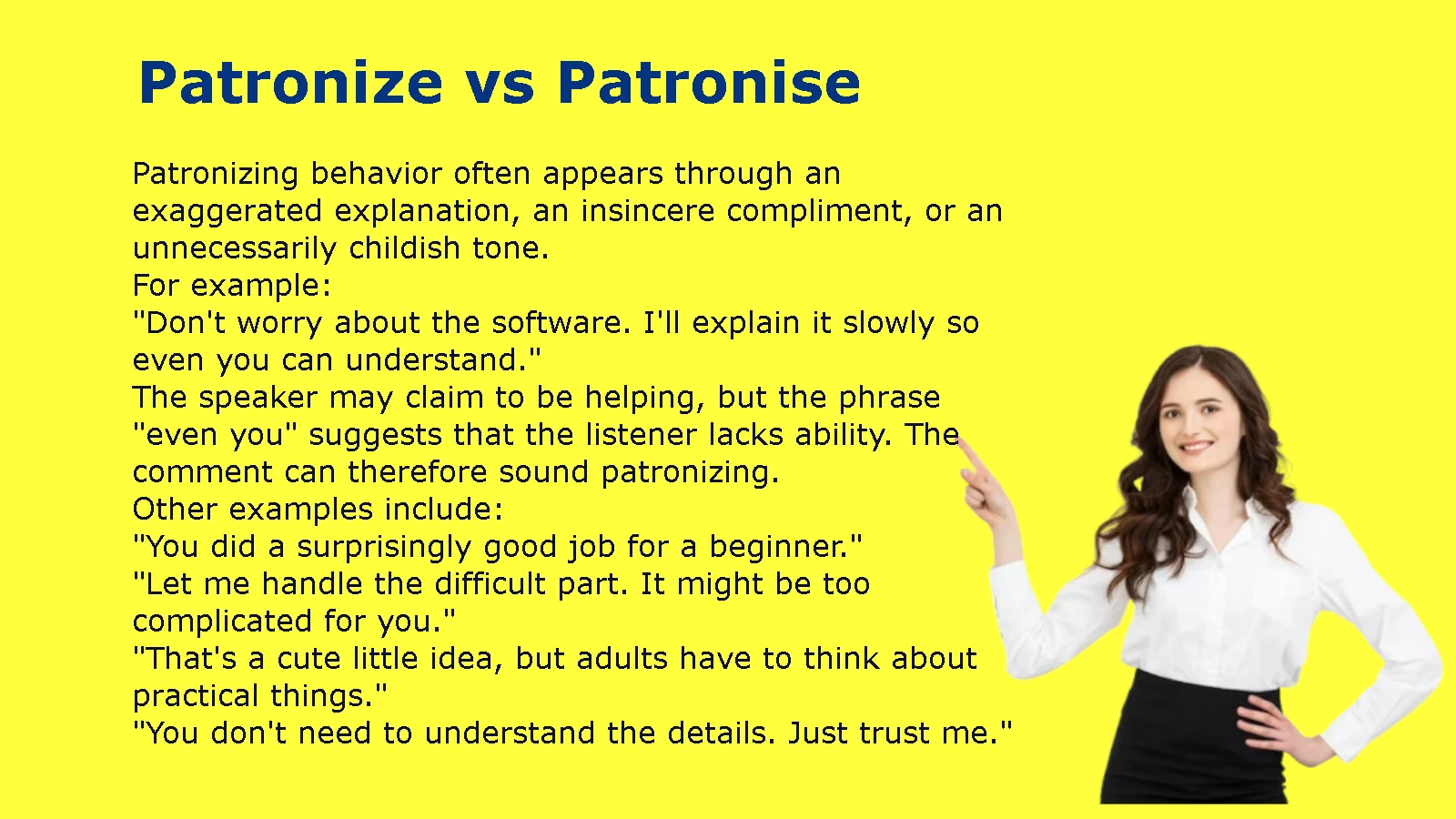
Patronizing behavior often appears through an exaggerated explanation, an insincere compliment, or an unnecessarily childish tone.
For example:
“Don’t worry about the software. I’ll explain it slowly so even you can understand.”
The speaker may claim to be helping, but the phrase “even you” suggests that the listener lacks ability. The comment can therefore sound patronizing.
Other examples include:
- “You did a surprisingly good job for a beginner.”
- “Let me handle the difficult part. It might be too complicated for you.”
- “That’s a cute little idea, but adults have to think about practical things.”
- “You don’t need to understand the details. Just trust me.”
These statements communicate superiority rather than genuine respect.
A patronizing person doesn’t always insult someone directly. Sometimes the problem lies in the way they deliver a message. A person can use polite words while still suggesting that someone else is unintelligent or unimportant.
Patronize Meaning: To Support a Business or Artist
In a different context, patronize means to support a business, shop, restaurant, artist, or service provider by purchasing products or using services.
This meaning is generally neutral or positive.
For example:
- “We patronize the same bookstore whenever we visit downtown.”
- “The community continues to patronize local restaurants.”
- “Many collectors patronize independent artists.”
- “Our family has patronized this repair shop for years.”
In these sentences, patronize describes customer behavior. It does not suggest disrespect.
The word can also describe financial or practical support for cultural institutions, performers, and creative work. A person who regularly buys paintings from an artist may patronize that artist by providing a source of income.
However, the word can sound formal in everyday American English. Many people would naturally say, “We support local businesses” or “We shop at the neighborhood bookstore.”
How Context Changes the Meaning of Patronize
The two meanings of patronize make context especially important.
Consider these examples:
| Sentence | Meaning | Tone |
| “Please don’t patronize me.” | Treating someone as inferior | Negative |
| “We patronize a local bakery.” | Buying from a business | Neutral or positive |
| “He patronized the new employee during training.” | Speaking condescendingly | Negative |
| “The family patronizes several independent artists.” | Supporting artists financially | Neutral or positive |
The subject and object often provide useful clues. When the word refers to a person in a conversation about disrespect, it may describe condescending behavior. When it refers to a shop, restaurant, artist, or other provider, it often describes customer support.
Practical tip: If a sentence could confuse your readers, replace patronize with a clearer alternative. Use talk down to for the negative meaning and support or shop at for the business meaning.
Patronize vs Patronage: What Is the Difference?
Patronize is a verb that describes an action, while patronage is a noun that describes support, business, or backing. You patronize a shop when you buy from it; your patronage is the support you provide through those purchases.
The distinction matters because the two words are related but do not perform the same grammatical role.
Patronize Is a Verb
A verb describes an action, occurrence, or state. Patronize describes what someone does, whether that action involves supporting a business or treating someone condescendingly.
Examples:
- “We patronize the local bookstore.”
- “She doesn’t want her supervisor to patronize her.”
- “Tourists patronize many small businesses during the summer.”
- “He patronized his classmates by explaining basic concepts they already understood.”
In each sentence, patronize tells you what the subject does.
You can also change the verb’s form to fit the sentence:
- Present: “They patronize the shop.”
- Past: “They patronized the shop.”
- Present participle: “They are patronizing the shop.”
- Third-person singular: “She patronizes the shop.”
The negative meaning works with the same forms. For example, “He is patronizing his teammates” describes behavior happening now.
Patronage Is a Noun
Patronage is a noun that refers to the support or business someone provides to an establishment, organization, or individual.
Examples:
- “The restaurant appreciates your patronage.”
- “The artist depends on the patronage of private collectors.”
- “The store built a loyal customer base through years of community patronage.”
- “The theater survived because of continued public patronage.”
The word also has a political meaning. In political contexts, patronage can refer to giving jobs, appointments, or other benefits to people in return for loyalty or support.
That meaning differs from ordinary customer patronage, so the context matters.
Patronize vs Patronage Examples
| Word | Part of speech | Example | Meaning |
| Patronize | Verb | “We patronize this cafe.” | We buy from it. |
| Patronage | Noun | “We appreciate your patronage.” | We appreciate your business. |
| Patronize | Verb | “Don’t patronize your colleagues.” | Don’t treat them as inferior. |
| Patronage | Noun | “The gallery depends on private patronage.” | The gallery depends on financial support. |
A useful way to remember the difference is to focus on the action and its result. You patronize; you give patronage.
For everyday business writing, We appreciate your business often sounds more natural than We appreciate your patronage. Both are grammatically correct, but the first expression feels more conversational.
What Does Don’t Patronize Me Mean?
“Don’t patronize me” means “Don’t talk down to me or treat me as if I’m less intelligent than you.” People use the expression when they feel someone is being condescending, overly superior, or unnecessarily childish in the way they explain something.
The phrase usually expresses frustration. It can also signal that the speaker wants an equal and respectful conversation.
The Meaning and Tone of Don’t Patronize Me
Imagine that an experienced employee explains a task to a new colleague. The new colleague understands the process, but the experienced employee continues explaining every basic step in a slow, exaggerated voice.
The new colleague might respond, “Don’t patronize me. I understand how the system works.”
The objection isn’t necessarily about receiving an explanation. It’s about the assumption that the listener cannot understand something without special treatment.
People may use the phrase when someone:
- Explains something obvious as if it were complicated.
- Uses a childish or exaggeratedly gentle tone.
- Gives a compliment that secretly insults the listener.
- Dismisses someone’s ideas because of their age or experience.
- Acts as if their own opinion is automatically superior.
The expression can sound confrontational, especially during a disagreement. If you want to keep the conversation calm, you can communicate the same concern in a more measured way.
Examples of Don’t Patronize Me in Conversation
Example: At work
Manager: “I’ll explain this very slowly so you don’t get confused.”
Employee: “Please don’t patronize me. I understand the instructions.”
The employee objects to the manager’s assumption about their ability.
Example: Between friends
Friend A: “That’s a nice attempt. Maybe next time you’ll get it right.”
Friend B: “Don’t patronize me. Just tell me what you think needs improvement.”
The second friend wants honest feedback instead of a disguised insult.
Example: During a family discussion
Parent: “You’ll understand when you’re older.”
Adult child: “Please don’t patronize me. I can understand the situation even if we disagree.”
The adult child wants their opinion treated seriously.
Polite Alternatives to Don’t Patronize Me
You don’t always need to use the phrase directly. These alternatives communicate the same message while allowing the conversation to continue.
| Alternative | Best situation |
| “Please don’t talk down to me.” | Directly addressing a condescending tone |
| “I’d appreciate a more respectful tone.” | Professional conversations |
| “I understand the point you’re making.” | Redirecting an unnecessary explanation |
| “Please treat me as an equal in this discussion.” | Workplace or group discussions |
| “You can explain that without assuming I don’t understand.” | Clarifying the problem |
| “Let’s focus on the issue rather than making assumptions about my ability.” | Formal disagreements |
The best response depends on your goal. If you want to establish a boundary, use a direct statement. If you want to preserve a working relationship, describe the behavior and explain how you’d prefer the other person to communicate.
Patronizing vs Condescending: Are They the Same?
Both describe behavior that makes someone feel inferior. Patronizing often emphasizes speech or actions that appear falsely kind, protective, or superior, while condescending more directly highlights an attitude of superiority.
The terms overlap, and people often use them interchangeably. Still, the difference in emphasis can help you choose the more precise word.
What Does Patronizing Mean?
Patronizing describes behavior that treats another person as if they need unnecessary guidance, protection, or simplified explanations.
The behavior may appear friendly on the surface. The problem is the implied lack of respect.
For example:
“That’s a very impressive drawing for someone your age.”
Depending on the situation, this could be sincere praise. However, if the speaker emphasizes the listener’s age to suggest that the achievement is surprisingly good, the comment may sound patronizing.
Other examples include:
- “Good job remembering that all by yourself.”
- “Let me help you with this simple task.”
- “You’re doing better than I expected.”
Patronizing behavior often involves a mismatch between the speaker’s pleasant words and the superior attitude those words communicate.
What Does Condescending Mean?
Condescending describes an attitude in which someone behaves as if they are more intelligent, important, or capable than another person.
A condescending person may openly dismiss someone else’s knowledge or treat their opinions as unworthy of consideration.
Examples:
- “You wouldn’t understand the technical details.”
- “That’s an uninformed opinion.”
- “Leave the decision to people who know what they’re doing.”
These statements clearly establish a hierarchy between the speaker and the listener.
Condescension doesn’t always involve false kindness. It can appear through blunt criticism, dismissive gestures, interruptions, or an assumption that another person has little to contribute.
Patronizing vs Condescending Examples
| Situation | Patronizing example | Condescending example |
| Teaching a coworker | “I’ll make this really easy for you.” | “You’re not qualified to understand this.” |
| Responding to an idea | “That’s a cute little suggestion.” | “That’s a foolish suggestion.” |
| Giving praise | “You’re surprisingly good at this.” | “You’re not usually capable of this kind of work.” |
| Explaining a task | “Let’s use very simple words so you can follow along.” | “You clearly don’t understand the basics.” |
These examples illustrate a difference in emphasis rather than a strict boundary. Either term could describe several of the statements, depending on the speaker’s attitude and the context.
When Should You Use Patronizing or Condescending?
Use patronizing when you want to emphasize behavior that disguises disrespect as kindness, praise, or helpfulness.
For example: “Her patronizing smile made the new employee uncomfortable.”
Use condescending when you want to emphasize an attitude of superiority.
For example: “His condescending remarks made it clear that he didn’t respect the team’s experience.”
Both words work when describing disrespectful communication. Choose the one that best captures the behavior you want to highlight.
Patronize Synonyms and Alternatives
The best synonym for patronize depends on whether you mean treating someone as inferior or supporting a business. Words such as belittle and talk down to fit the negative meaning, while support, frequent, and shop at fit the business-related meaning.
Choosing a synonym by context makes your writing clearer and more natural.
Synonyms for Patronize in the Condescending Sense
Use these alternatives when someone acts as if another person is less intelligent, capable, or important.
| Synonym | Meaning | Example |
| Talk down to | Speak as if someone is inferior | “Don’t talk down to your teammates.” |
| Belittle | Make someone seem unimportant or incapable | “The supervisor belittled his employee’s contribution.” |
| Condescend to | Behave as if someone is beneath you | “She refused to condescend to her audience.” |
| Treat as inferior | Show a lack of equal respect | “He treated the new workers as inferior.” |
| Infantilize | Treat an adult as if they were a child | “The policy can infantilize people who need assistance.” |
| Dismiss | Reject someone or their ideas without proper consideration | “The manager dismissed her concerns.” |
| Patronizingly address | Speak in a condescending manner | “He patronizingly addressed the experienced staff.” |
These alternatives don’t have identical meanings.
For instance, belittle focuses on reducing someone’s perceived importance. Infantilize specifically suggests treating someone as a child. Dismiss can mean rejecting a person’s concerns without necessarily speaking in a condescending way.
Choose the word that describes the behavior accurately rather than selecting a synonym simply because it sounds stronger.
Synonyms for Patronize in the Business Support Sense
When patronize means supporting a business, these alternatives usually sound more natural in everyday American English.
| Synonym or phrase | Best use | Example |
| Support | General encouragement or financial help | “We support independent businesses.” |
| Shop at | Buying products from a store | “I shop at the market near my home.” |
| Buy from | Purchasing goods or services | “We buy from local suppliers.” |
| Frequent | Visit or use a place regularly | “They frequently visit the neighborhood cafe.” |
| Do business with | Commercial relationships | “We do business with several local companies.” |
| Sponsor | Financial or organizational backing | “The company sponsors local arts programs.” |
| Back | Provide support or assistance | “The community backs independent creators.” |
For marketing copy, support our business often works better than patronize our business because readers understand the message immediately.
For example, a small bakery might write, “Thank you for supporting our family-owned bakery.” That sentence sounds warm and direct. “Thank you for patronizing our establishment” is correct, but it may sound formal or distant.
How to Choose the Right Patronize Synonym
Before replacing patronize, identify the meaning you want to communicate.
If you’re describing disrespectful behavior:
- Use talk down to when the problem involves someone’s tone.
- Use belittle when someone makes another person feel insignificant.
- Use condescend to when someone acts superior.
- Use infantilize when an adult receives treatment that implies they are a child.
If you’re describing customer support:
- Use support for a broad, positive message.
- Use shop at when discussing retail purchases.
- Use frequent when emphasizing repeat visits.
- Use sponsor when discussing organized financial support.
A precise synonym improves both readability and meaning. It also helps you avoid the ambiguity that can arise when a word has two distinct senses.
How Do You Pronounce Patronize?
Patronize is commonly pronounced PAY-truh-nyze in American English, with the stress on the first syllable. Patronise generally has the same pronunciation because it is an alternative spelling of the same word.
Regional accents may affect individual vowel sounds, but the spelling difference itself doesn’t create a different pronunciation.
Patronize Pronunciation in American English
A common American English pronunciation guide is:
PAY-truh-nyze
The word has three syllables:
- PAY — the stressed first syllable.
- truh — the second syllable.
- nyze — the final syllable, which rhymes with size.
In IPA, a common American pronunciation is /ˈpeɪ.trə.naɪz/.
Try saying the word in a complete sentence: “We patronize the same local bookstore every month.”
Practicing the word in context helps you remember both its pronunciation and its business-related meaning.
Is Patronise Pronounced Differently?
No. Patronize and patronise generally represent the same spoken word.
The difference is orthographic: American English prefers -ize, while British English commonly uses -ise.
The same distinction appears in pairs such as:
- Organize / organise
- Realize / realise
- Recognize / recognise
Accent differences can affect the way speakers pronounce vowels, but you shouldn’t change the pronunciation simply because the spelling changes.
Common Pronunciation Mistakes
The most useful pronunciation tips are simple:
- Put the main stress on the first syllable.
- Keep the final sound similar to the ending in size.
- Avoid giving all three syllables equal stress.
- Practice the word in a sentence rather than repeating it in isolation.
If you’re learning the word for professional communication, practice both meanings. For example, say, “We patronize local businesses,” followed by, “Please don’t patronize your colleagues.” This helps connect pronunciation with context.
What Does Patronizing a Business Mean?
Patronizing a business means buying its products, using its services, or regularly visiting its establishment. In this context, the word describes customer support rather than condescending behavior. It can refer to shopping at a local store, eating at a restaurant, hiring a service provider, or buying work from an independent artist.
The expression is grammatically correct, although supporting a business or shopping at a business often sounds more natural in everyday American English.
Examples of Patronizing a Business
Here are practical examples that show how the word works.
Shopping locally
“We patronize the grocery store on our street because it stocks products from local suppliers.”
This means the speaker regularly buys groceries from that store.
Supporting independent artists
“The couple patronizes local artists by purchasing paintings for their home.”
Here, patronizes means providing financial support through purchases.
Choosing a regular service provider
“Our company patronizes a family-owned printing shop for its promotional materials.”
The company repeatedly buys printing services from the same business.
Visiting a restaurant
“Tourists patronize the seafood restaurants near the harbor.”
The sentence describes customers who eat at those establishments.
Why Businesses Ask Customers to Patronize Them
Businesses depend on customers who purchase their products and services. In that sense, customer patronage can contribute to revenue, repeat purchases, and long-term relationships.
However, patronage is broader than a single purchase. It can include recurring visits, referrals, and ongoing financial support.
For example, a customer might support a neighborhood bookstore by buying books there, recommending it to friends, and attending its events. Each action can help the business build stronger ties with its community.
Businesses can encourage patronage through several practical steps:
- Provide reliable service. Customers are more likely to return when a business consistently meets expectations.
- Communicate clearly. Accurate product information, transparent pricing, and helpful staff make purchasing easier.
- Build customer relationships. Remembering preferences and responding to feedback can make customers feel valued.
- Offer a good experience. A clean store, useful website, or convenient ordering process removes friction.
- Show appreciation. A sincere thank-you message recognizes the role customers play in keeping a business operating.
These practices don’t guarantee customer loyalty, but they create reasons for people to return.
Natural Alternatives to Patronizing a Business
Although patronize is correct, the best wording depends on your audience and purpose.
| Formal or traditional wording | More natural alternative |
| Please patronize our store. | Please shop at our store. |
| We appreciate your patronage. | We appreciate your business. |
| Patronize local establishments. | Support local businesses. |
| Thank you for patronizing our restaurant. | Thanks for dining with us. |
| We hope you’ll patronize our services again. | We hope you’ll choose us again. |
For US marketing, the alternatives on the right generally sound more conversational. They also remove any possible confusion with the negative meaning of patronize.
Patronize My Business Quotes and Examples
Business owners can encourage customer support with short, sincere messages. Although patronize my business quotes is a useful search phrase, most US audiences respond more naturally to wording such as support my small business, shop local, or thank you for your support.
The following quotes are original examples that you can adapt for websites, social media posts, flyers, and customer messages.
Short Quotes to Encourage People to Patronize Your Business
Use these lines when you want to thank customers or encourage them to make a purchase.
- “Your support keeps our small business moving forward.”
- “Every purchase helps a local dream grow.”
- “Thank you for choosing local and shopping small.”
- “Your next favorite find might be right here.”
- “Small purchases can make a meaningful difference to a small business.”
- “Every order reminds us why we started.”
- “Thank you for being part of our business story.”
- “Your trust means more than you know.”
- “Choose local, shop small, and help your community thrive.”
- “We’re grateful every time you choose us.”
These messages work because they emphasize appreciation and community rather than pressuring customers.
Professional Quotes for Business Marketing
For business emails, websites, and printed materials, choose wording that sounds polished without becoming stiff.
For a business website
“Thank you for supporting our business. We’re committed to giving you products and service you can feel good about choosing.”
For a customer email
“We appreciate your continued business and look forward to serving you again.”
For a printed receipt
“Thank you for shopping with us. Your support helps our small business grow.”
For a local service provider
“Every referral and repeat customer helps our business thrive. Thank you for trusting us with your needs.”
For an independent artist
“Thank you for supporting independent art and helping creative work reach new homes.”
Each message gives the customer a clear reason to feel appreciated. You can make the wording more personal by mentioning the type of business, the community it serves, or the specific support customers provide.
Social Media Captions Asking People to Support a Business
Social media captions should be short enough to read quickly and clear enough to prompt an action.
For Instagram
“Shopping small makes a difference. Thanks for supporting our little corner of the community.”
For Facebook
“Looking for your next favorite local business? We’d love for you to stop by and see what we’re working on.”
For a new product launch
“Our newest collection is here! Take a look, find your favorite, and support a small business with a big passion for what we do.”
For a local restaurant
“Fresh food, friendly faces, and a neighborhood table waiting for you. Come visit us this week.”
For a service business
“Need help with your next project? We’d love the opportunity to earn your business.”
A strong caption should tell readers what you offer and what they can do next. Depending on the business, that action might be visiting a store, placing an order, booking a service, or sharing a post.
Should You Say Patronize My Business or Support My Business?
Both phrases are grammatically correct, but support my business usually sounds more natural in contemporary American English.
Patronize my business can sound formal, old-fashioned, or ambiguous because patronize also means treating someone condescendingly. Although context often removes the ambiguity, you can avoid it altogether with clearer wording.
Compare these examples:
- Formal: “We invite you to patronize our establishment.”
- Natural: “We invite you to shop with us.”
- Formal: “Thank you for your patronage.”
- Natural: “Thank you for your continued support.”
- Formal: “Please patronize our services.”
- Natural: “We’d love to help with your next project.”
If you’re writing an advertisement, website headline, or social media post, choose the phrase that your audience would naturally use. Clear language makes your message easier to understand.
Patronize Examples in Sentences
The easiest way to understand patronize is to examine it in complete sentences. The word can express disrespectful behavior or customer support, so a useful example should make the intended meaning obvious.
Patronize Used in a Negative Sense
These examples describe someone treating another person as inferior.
- “The supervisor began to patronize the interns by explaining every basic task as if they had never worked before.”
- “I felt patronized when my colleague dismissed my suggestion without considering it.”
- “Please don’t patronize me just because I asked a question.”
- “Her patronizing tone made the conversation more uncomfortable than the disagreement itself.”
- “He tried to help, but his explanation sounded patronizing.”
- “The teacher corrected the mistake without patronizing the student.”
- “Rather than patronize the new employee, the manager asked what kind of guidance would be useful.”
In each sentence, patronize relates to an attitude or way of treating another person.
Patronize Used in a Positive Sense
These examples describe supporting a business, organization, or artist.
- “Our family patronizes the same bookstore every holiday season.”
- “Residents are encouraged to patronize locally owned shops.”
- “The company patronizes several independent artists by purchasing original work for its offices.”
- “We patronize the neighborhood restaurant because the staff knows our preferences.”
- “Visitors often patronize the craft market during the weekend.”
- “The theater hopes more residents will patronize its performances.”
- “Many customers patronize small businesses because they value their products and services.”
Here, the word refers to purchases, visits, or other forms of support.
Common Mistakes When Using Patronize
Even experienced writers can misuse patronize when they overlook its two meanings.
Mistake: Assuming patronize always means disrespect.
Incorrect assumption: “We patronize the local bakery” must mean that we treat the bakery owner as inferior.
Correction: In this sentence, patronize means that we buy from the bakery.
Mistake: Confusing patronize with patronage.
Incorrect: “We appreciate you patronize our shop.”
Correct: “We appreciate your patronage.”
Also correct: “We appreciate that you patronize our shop.”
The first correct sentence uses patronage as a noun. The second uses patronize as a verb.
Mistake: Using patronize when a clearer word would work better.
A sentence such as “Please patronize our website” may confuse readers because websites aren’t always described as places people patronize.
A clearer alternative is “Please visit our website” or “Shop our online store.”
Mistake: Mixing American and British spelling conventions.
If you use patronize in an American English article, keep related forms consistent, such as patronizing and patronized. British English commonly uses patronise, patronising, and patronised.
Consistency helps readers recognize the spelling system you’re following.
Frequently Asked Questions
Is Patronize or Patronise Correct in American English?
Patronize is the standard American English spelling. Patronise is commonly used in British English and other varieties that follow British spelling conventions. Both spellings have the same meanings and generally the same pronunciation.
What Does It Mean When Someone Says Don’t Patronize Me?
“Don’t patronize me” means “Don’t talk down to me or treat me as if I’m less intelligent than you.” People use the expression when they feel someone is being condescending, dismissive, or unnecessarily superior.
What Is the Difference Between Patronize and Patronage?
Patronize is a verb, while patronage is a noun. You patronize a business when you buy its products or use its services. Your patronage refers to the support or business you provide.
Is Patronizing the Same as Condescending?
The words have similar meanings, but they emphasize slightly different aspects of behavior. Patronizing often describes disrespect disguised as kindness or helpfulness, while condescending emphasizes an attitude of superiority. Both can describe someone who makes others feel inferior.
What Is a Synonym for Patronize?
The best synonym depends on the intended meaning. When patronize means treating someone as inferior, use talk down to, belittle, or condescend to. When it means supporting a business, use support, shop at, frequent, or buy from.
Does Patronizing a Business Mean Supporting It?
Yes. Patronizing a business means buying its products, using its services, or visiting it as a customer. In everyday American English, supporting a business or shopping at a business often sounds more natural.
Conclusion: Choose the Right Meaning and Spelling
The difference between patronize vs patronise is simple: patronize is the standard American English spelling, while patronise is commonly used in British English. Both forms share the same two main meanings: treating someone condescendingly and supporting a business or individual through purchases or financial backing.
Remember these key distinctions:
- Use patronize for American English writing.
- Use patronise for British English writing.
- Use patronize to describe condescending behavior when the context calls for it.
- Use patronize a business to describe buying from or regularly supporting an establishment.
- Use patronage when you need the noun for customer support or financial backing.
- Choose clearer alternatives such as talk down to, support, or shop at when they communicate your meaning more naturally.