Romanticize vs romanticise is a spelling difference between American and British English, but both words have the same meaning: to portray someone, something, or an experience as more beautiful, exciting, desirable, or ideal than it may be in reality. Americans generally write romanticize, while British writers commonly use romanticise.
The word also appears in everyday expressions such as romanticizing life, romanticizing a relationship, and romanticizing my own energy. These phrases describe different ways of viewing experiences, memories, people, and personal identity. Understanding the distinction between romanticize and romanticise helps you choose the correct spelling, use the word naturally, and recognize when idealizing something becomes unrealistic.
Romanticize vs Romanticise: Which Spelling Is Correct?
Romanticize and romanticise are both correct spellings. The main difference is regional preference, not meaning or pronunciation. American English generally uses romanticize, while British English commonly uses romanticise. Choose the spelling that matches your audience, and keep the same convention throughout your writing.
Romanticize Is the American English Spelling
Romanticize is the standard spelling in American English. The ending -ize appears in many American verbs, including organize, realize, recognize, and prioritize.
Writers use romanticize when they describe someone who presents a person, place, memory, or lifestyle in an idealized way. The word often suggests that someone focuses on the attractive parts of an experience while overlooking its flaws.
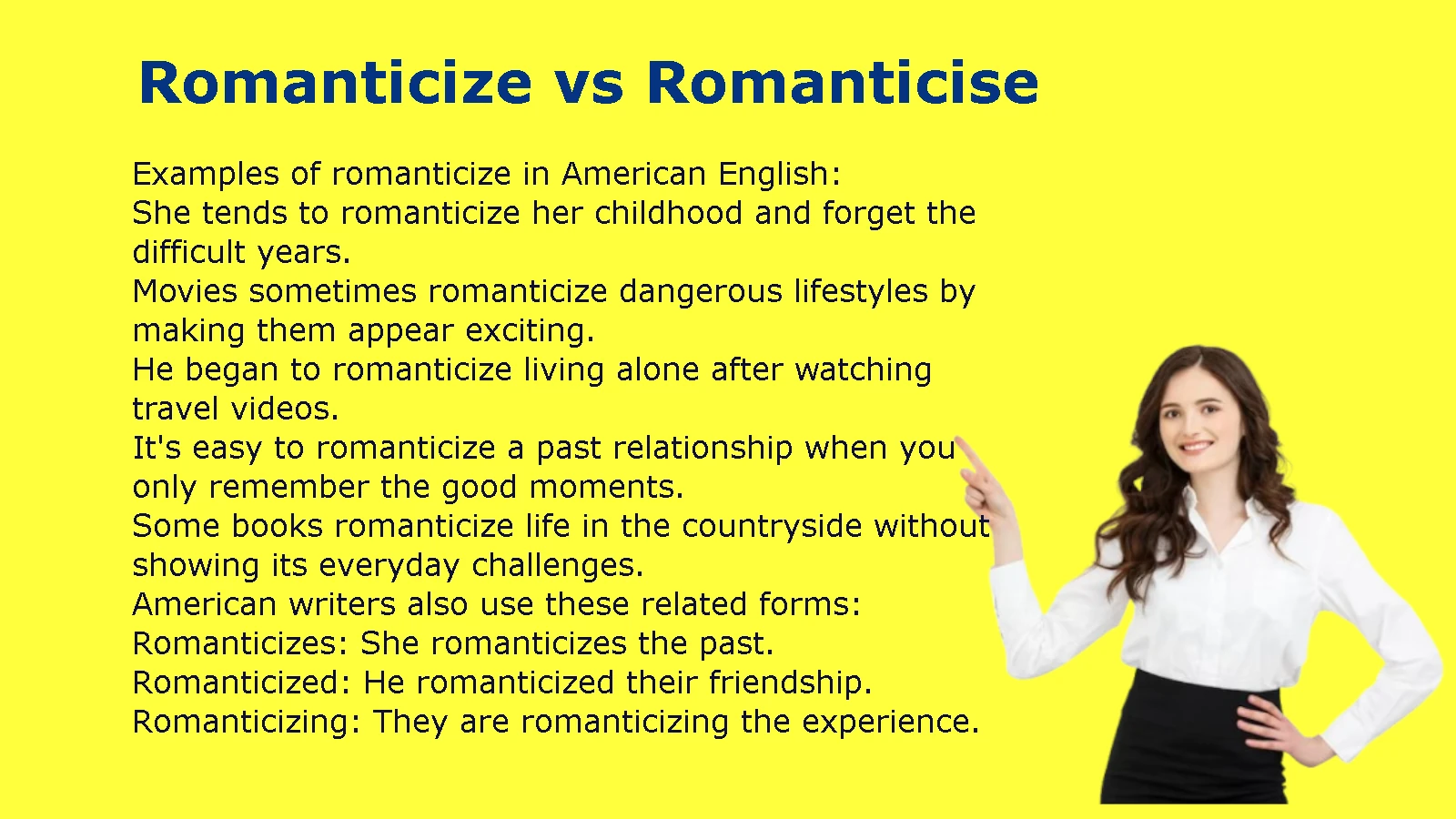
Examples of romanticize in American English:
- She tends to romanticize her childhood and forget the difficult years.
- Movies sometimes romanticize dangerous lifestyles by making them appear exciting.
- He began to romanticize living alone after watching travel videos.
- It’s easy to romanticize a past relationship when you only remember the good moments.
- Some books romanticize life in the countryside without showing its everyday challenges.
American writers also use these related forms:
- Romanticizes: She romanticizes the past.
- Romanticized: He romanticized their friendship.
- Romanticizing: They are romanticizing the experience.
These forms preserve the z spelling.
Romanticise Is the British English Spelling
Romanticise is a common standard spelling in British English. The ending -ise appears in many British words, including organise, realise, recognise, and prioritise.
The meaning remains identical to the American spelling. A British writer can romanticise a relationship, a historical period, a city, or an ordinary part of life without changing the meaning of the sentence.
Examples of romanticise in British English:
- She tends to romanticise her childhood and forget the difficult years.
- Films sometimes romanticise dangerous lifestyles.
- He began to romanticise living alone after watching travel videos.
- It’s easy to romanticise a past relationship when you remember only the good moments.
- Some novels romanticise life in the countryside.
The related British forms include:
- Romanticises: She romanticises the past.
- Romanticised: He romanticised their friendship.
- Romanticising: They are romanticising the experience.
The s remains consistent throughout these forms.
Romanticize vs Romanticise at a Glance
The following table summarizes the main spelling differences.
| Feature | Romanticize | Romanticise |
| Regional preference | American English | British English |
| Present tense | Romanticize | Romanticise |
| Third-person singular | Romanticizes | Romanticises |
| Past tense | Romanticized | Romanticised |
| Past participle | Romanticized | Romanticised |
| Present participle | Romanticizing | Romanticising |
| Meaning | To portray something ideally | To portray something ideally |
| Pronunciation | Generally the same | Generally the same |
The distinction follows a broader spelling pattern. However, British English does not always require -ise, and some British publishers and style guides accept or prefer -ize. The right choice depends on the variety of English and the style guide you follow.
Is Romanticize or Romanticise More Correct?
Neither spelling is universally more correct. Romanticize is the usual American form, while romanticise is common in British English. Both communicate the same idea and are understood by English speakers internationally.
Use these guidelines when choosing between them:
- Writing for a US audience: Use romanticize, romanticized, and romanticizing.
- Writing for a UK audience: Use romanticise, romanticised, and romanticising if that matches your chosen style.
- Writing for an international audience: Choose one spelling convention and apply it consistently.
- Editing an existing article: Follow the spelling used by the publication or website.
For example, a US lifestyle blog might write, “How to romanticize your morning routine.” A British lifestyle blog might use, “How to romanticise your morning routine.”
Both titles work. Consistency matters more than choosing one spelling for every English-speaking audience.
Romanticize Meaning and Definition
To romanticize means to present, remember, or imagine something as more attractive, pleasant, exciting, or ideal than it really is. People often romanticize relationships, childhood memories, historical periods, or lifestyles by focusing on positive details and overlooking difficulties. The word can describe harmless imagination, emotional nostalgia, or an unrealistic view of reality.
What Does Romanticize Mean?
The verb romanticize describes a way of viewing or presenting something through an idealized lens. Instead of seeing every detail clearly, a person emphasizes the appealing parts and gives less attention to the unpleasant ones.
For example, someone might remember an old relationship as perfect because they miss their former partner. They may forget the frequent arguments, incompatible goals, or reasons the relationship ended. That selective memory is a form of romanticizing.
The word does not always refer to love or romantic relationships. It can describe almost anything that someone presents as more appealing than it actually is.
People may romanticize:
- The past: Remembering childhood as carefree while forgetting its problems.
- Relationships: Treating a former partner as flawless.
- Work: Imagining that working in a creative industry means constant inspiration.
- Travel: Believing that moving abroad will solve every personal problem.
- History: Describing an earlier period as peaceful while ignoring its hardships.
- Solitude: Imagining that living alone always brings freedom and happiness.
The central idea is idealization. A romanticized version of something may contain genuine beauty, but it often leaves out information that would create a more balanced picture.
Romanticize Meaning Example Sentences
The easiest way to understand romanticize is to see how it works in different situations.
| Example sentence | Meaning |
| She tends to romanticize her childhood. | She remembers childhood as better than it may have been. |
| Don’t romanticize an unhealthy relationship. | Don’t focus on its appealing moments while ignoring its harmful aspects. |
| He romanticizes life in small towns. | He imagines small-town life as more pleasant than it may be. |
| The film romanticizes life as a celebrity. | The film emphasizes fame’s glamour and downplays its difficulties. |
| I used to romanticize working from home. | I imagined remote work as easier or more enjoyable than it turned out to be. |
| The novel romanticizes the past. | The novel presents an earlier period in an idealized way. |
| She romanticizes every trip she takes. | She emphasizes the memorable and attractive parts of her travels. |
| They romanticize the idea of starting over. | They focus on the appealing possibilities of a fresh start. |
Notice that romanticize does not necessarily mean that the subject is entirely false. A person may have enjoyed childhood, loved a former partner, or found travel rewarding. The word suggests that their view may be incomplete or overly idealistic.
Is Romanticize a Positive or Negative Word?
Romanticize can have a positive, neutral, or negative tone, depending on the context. It may describe a creative way to appreciate life, but it can also criticize an unrealistic portrayal that hides real problems.
Consider three situations.
A positive or playful use
“I like to romanticize my morning coffee by sitting near the window and enjoying the sunlight.”
Here, the speaker creates a pleasant experience from an ordinary activity. The phrase sounds lighthearted and expressive.
A neutral or descriptive use
“The author romanticizes rural life in her novel.”
This sentence describes how the author presents rural life. The reader needs more context to decide whether that portrayal is misleading or simply artistic.
A negative use
“Social media often romanticizes burnout by presenting exhaustion as proof of ambition.”
This sentence criticizes a portrayal that makes an unhealthy situation appear admirable.
The distinction depends on whether idealization hides something important. Appreciating a beautiful moment is not the same as denying the difficulties that surround it.
Romanticize as a Verb: Forms and Grammar
Romanticize is a regular verb, so it follows familiar English patterns when you change its tense or form. The main spelling difference appears in the final letters: American English uses -ize, while the corresponding British form commonly uses -ise.
| Grammatical form | American English | British English |
| Base form | Romanticize | Romanticise |
| Third-person singular | Romanticizes | Romanticises |
| Simple past | Romanticized | Romanticised |
| Past participle | Romanticized | Romanticised |
| Present participle | Romanticizing | Romanticising |
| Infinitive | To romanticize | To romanticise |
Examples show how these forms work in sentences:
- Present: I sometimes romanticize the past.
- Third-person singular: She romanticizes her childhood.
- Past: He romanticized their friendship.
- Present continuous: They are romanticizing city life.
- Perfect tense: I have romanticized that period for years.
The verb usually takes a direct object: you romanticize something. That object might be a person, experience, place, idea, or period of history.
For example, “She romanticizes her travels” is a complete and natural sentence. The reader knows exactly what she idealizes.
What Does Romanticizing Life Mean?
Romanticizing life means finding beauty, excitement, or personal meaning in ordinary experiences, sometimes by viewing them through an idealized lens. People may romanticize simple routines, quiet evenings, daily walks, or time spent alone. The phrase can describe mindful appreciation, but it can also suggest that someone overlooks the less pleasant parts of everyday life.
Romanticizing Everyday Life
Romanticizing everyday life means treating ordinary moments as meaningful rather than seeing them as chores or background activities. Someone might make breakfast feel special, enjoy a walk without checking their phone, or create a calming evening routine.
The idea has become popular in lifestyle content because it encourages people to notice small pleasures instead of waiting for major achievements or special occasions.
Examples include:
- Drinking coffee from a favorite mug before starting work.
- Listening to music while cleaning the kitchen.
- Taking a longer route home to enjoy the sunset.
- Reading a book in a quiet café.
- Preparing a homemade meal instead of rushing through dinner.
- Wearing an outfit that makes an ordinary day feel special.
- Keeping a journal about small moments worth remembering.
These activities do not change the basic facts of life. Work remains work, dishes still need washing, and responsibilities do not disappear. The difference lies in how someone experiences those moments.
For example, a person might dislike their daily commute but decide to use part of the journey to listen to an audiobook or enjoy a favorite playlist. They are not pretending the commute is perfect. They are making part of the experience more enjoyable.
That distinction helps explain why the phrase can carry a positive meaning in lifestyle conversations.
Romanticizing Your Life vs. Idealizing Your Life
The phrases overlap, but their emphasis can differ. Romanticizing your life often refers to making everyday experiences feel meaningful, beautiful, or memorable. Idealizing your life more directly suggests viewing your circumstances as better or more perfect than they actually are.
| Situation | Romanticizing your life | Idealizing your life |
| Morning routine | Enjoying coffee and sunlight before work | Believing every morning should feel peaceful |
| Career | Finding satisfaction in small accomplishments | Assuming your dream job will have no frustrating days |
| Relationships | Appreciating thoughtful gestures | Believing a good partner should never disappoint you |
| Travel | Enjoying local food and unfamiliar streets | Expecting a destination to solve every personal problem |
| Living alone | Enjoying independence and quiet time | Assuming solitude will eliminate loneliness |
The key difference is not always the behavior itself. It is the expectation attached to it.
A person can enjoy a simple routine while accepting that life remains complicated. Problems arise when an attractive image becomes a standard that reality can never meet.
How to Romanticize Your Life in a Healthy Way
You can make ordinary experiences feel special without pretending that everything is perfect. The goal is to notice what you enjoy while remaining honest about what needs attention.
Try these practical steps.
Create small rituals. Start the day with a favorite drink, a few minutes of reading, or music that improves your mood. A ritual can give an ordinary activity a sense of purpose.
Notice details. Pay attention to sunlight through a window, the smell of fresh bread, or the sound of rain. These details can make familiar surroundings feel less routine.
Make everyday tasks more pleasant. Listen to a podcast while folding laundry or prepare a meal you genuinely enjoy. You do not need to turn every chore into an elaborate event.
Document real moments. Write a short journal entry or take a photograph when something makes you happy. Focus on what actually happened rather than creating a perfect-looking version for other people.
Avoid comparing your life with edited content. A carefully framed photograph may show a beautiful apartment, but it cannot tell you whether the person lives comfortably, feels fulfilled, or has difficult days.
Allow yourself to have bad days. Romanticizing life does not require constant positivity. You can appreciate a beautiful afternoon and still admit that you feel tired, worried, or disappointed.
The most sustainable approach combines appreciation with honesty. You can find meaning in daily life without expecting every moment to feel cinematic.
A Realistic Example of Romanticizing Life
Imagine two people who have recently started working from home.
The first person imagines remote work as a perfect lifestyle. They expect long, relaxed mornings, unlimited freedom, and no stressful days. After a few weeks, they feel disappointed by deadlines, isolation, and household distractions.
The second person also enjoys the flexibility of working from home. They make coffee before opening their laptop, take a walk at lunchtime, and create a comfortable workspace. However, they still plan their workload, communicate with colleagues, and recognize when they need a break.
Both people may enjoy the appealing parts of remote work. The difference is that the second person combines enjoyment with realistic expectations.
This example illustrates a useful principle: romanticizing life works best when it helps you appreciate reality rather than escape it.
What Does “Romanticizing My Own Energy” Mean?
“Romanticizing my own energy” is an informal expression about appreciating your personality, presence, mood, style, or way of moving through life. It can mean enjoying your own company, recognizing your strengths, and treating your personal qualities as something worth celebrating. The phrase is common in self-expression and lifestyle discussions, but it does not have one fixed, formal definition.
Meaning of Romanticizing Your Own Energy
When someone says they are romanticizing their own energy, they usually mean that they are paying attention to the qualities that make them feel like themselves.
The word energy does not necessarily refer to physical energy or a scientific measurement. In this expression, it often means someone’s mood, personality, presence, attitude, or overall vibe.
For example, someone might enjoy getting dressed in a way that reflects their personality, spending a quiet evening alone, or choosing activities that match their interests. They are treating their own experience as valuable instead of waiting for someone else to validate it.
The phrase may communicate ideas such as:
- Self-appreciation: Recognizing the qualities you like about yourself.
- Confidence: Feeling comfortable with your personality and choices.
- Independence: Enjoying time alone without treating it as a problem.
- Personal style: Expressing yourself through clothing, music, hobbies, or routines.
- Emotional awareness: Noticing what helps you feel calm, motivated, or content.
Suppose someone writes, “I’m romanticizing my own energy this year.” They might mean that they are focusing on their interests, confidence, personal boundaries, and daily experiences rather than measuring their worth through other people’s opinions.
The expression can sound playful or aspirational. It does not necessarily mean the person believes they are perfect.
Examples of Romanticizing Your Own Energy
These examples show how the expression might appear in everyday conversation or social-media captions.
Example: Enjoying your own company
“I’m romanticizing my own energy by taking myself to a café and spending an afternoon reading.”
Meaning: The person enjoys time alone and treats it as a rewarding experience.
Example: Expressing personal style
“Today, I’m romanticizing my own energy with an outfit that feels completely like me.”
Meaning: The person is celebrating their identity through personal style.
Example: Protecting personal time
“I’m romanticizing my own energy by making room for rest instead of saying yes to every invitation.”
Meaning: The person is prioritizing their needs and boundaries.
Example: Appreciating personal growth
“I’m romanticizing my own energy and giving myself credit for how far I’ve come.”
Meaning: The person is recognizing their progress rather than focusing only on shortcomings.
Example: Building a satisfying routine
“My new routine is all about romanticizing my own energy: good music, a morning walk, and time for my favorite hobby.”
Meaning: The person is building a lifestyle around activities they enjoy.
These examples show that the expression often combines self-confidence, personal identity, and appreciation of everyday life.
Is Romanticizing Your Own Energy the Same as Self-Love?
The two expressions are related, but they are not identical. Self-love is a broad idea that involves treating yourself with care, respect, and compassion. Romanticizing your own energy usually emphasizes appreciating your personality, presence, and everyday experiences.
| Concept | Main idea | Example |
| Self-love | Treating yourself with care and respect | Setting a boundary that protects your well-being |
| Self-confidence | Trusting your abilities or judgment | Sharing your work without constant fear of criticism |
| Self-appreciation | Recognizing your positive qualities | Feeling proud of your creativity |
| Romanticizing your own energy | Celebrating your personal style, mood, and presence | Creating a routine that feels authentic to you |
| Self-idealization | Viewing yourself as better or more flawless than reality supports | Refusing to acknowledge any personal mistakes |
Romanticizing your own energy can be a form of self-appreciation. However, the phrase becomes less useful if it turns into a refusal to accept feedback or acknowledge mistakes.
For instance, feeling proud of your individuality is healthy self-expression. Believing that every disagreement happens because other people cannot handle your greatness is a different matter.
A grounded approach allows you to appreciate yourself while remaining open to learning, change, and honest relationships.
Romanticize Synonyms and Similar Words
Common synonyms for romanticize include idealize, glorify, sentimentalize, glamorize, and fantasize about. Each word emphasizes a slightly different idea. Idealize focuses on perfection, glorify emphasizes praise, and sentimentalize highlights emotion or nostalgia. Choosing the right synonym depends on what you want to communicate.
Common Synonyms for Romanticize
Use the following words when you want to express a similar idea without repeating romanticize.
| Synonym | Meaning or nuance | Example |
| Idealize | View someone or something as nearly perfect | She idealizes her former partner. |
| Glorify | Present something as admirable or heroic | The film glorifies reckless behavior. |
| Sentimentalize | Emphasize emotional or nostalgic appeal | He sentimentalizes his childhood. |
| Glamorize | Make something appear attractive, exciting, or glamorous | The series glamorizes celebrity life. |
| Beautify | Make something more attractive | The description beautifies an otherwise ordinary setting. |
| Fantasize about | Imagine an appealing situation that may not be real | She fantasizes about living abroad. |
| Exaggerate | Make a quality or detail seem greater than it is | He exaggerates the benefits of city living. |
| Mythologize | Turn a person, event, or period into something legendary | Later stories mythologize the explorer. |
These words are related, but they are not always interchangeable.
For example, beautify can refer to making a physical place more attractive, while romanticize usually involves presenting or viewing something through an idealized lens. Likewise, fantasize about often emphasizes imagined possibilities rather than the way someone portrays a real experience.
Romanticize vs. Idealize
Romanticize and idealize overlap because both can involve seeing something in an overly positive way. However, idealize more directly suggests treating someone or something as closer to perfect than it really is.
Consider these examples:
- “She romanticizes their first date.” This emphasizes the attractive, memorable, or emotionally appealing way she remembers the experience.
- “She idealizes her former partner.” This suggests that she views the person as better or more perfect than they actually were.
You can idealize a person without describing a specific romantic relationship. Someone might idealize a famous athlete, a business leader, or a historical figure.
You can also romanticize a place, lifestyle, or period of history. The word often suggests an appealing story or image that leaves out inconvenient details.
Romanticize vs. Glorify
Romanticize usually emphasizes idealized presentation, while glorify emphasizes praise or admiration. Glorifying something can make it seem heroic, admirable, or worthy of celebration, even when its harmful aspects deserve attention.
For example:
- “The novel romanticizes life on the frontier.” The novel may emphasize adventure, freedom, and dramatic landscapes.
- “The novel glorifies violence.” The novel may portray violent behavior as admirable or heroic.
The difference is subtle because an author can do both at once. A story might romanticize a dangerous lifestyle and glorify the people who participate in it.
When writing about a harmful activity, glorify may communicate stronger approval than romanticize. Choose the term that best describes the portrayal.
Antonyms of Romanticize
An antonym expresses an opposite or contrasting idea. The best alternative depends on whether you want to emphasize realism, criticism, or the removal of an attractive image.
| Contrasting expression | Meaning | Example |
| See realistically | Recognize both positive and negative details | She now sees the relationship realistically. |
| Demystify | Remove mystery or unrealistic assumptions | The documentary demystifies life as a professional athlete. |
| Deglamorize | Show the less attractive side of something | The report deglamorizes the celebrity lifestyle. |
| Examine critically | Evaluate something instead of accepting its idealized image | We should examine the historical period critically. |
| Disillusion | Cause someone to lose an idealized belief | The experience disillusioned him about fame. |
| Face reality | Accept the facts of a situation | She stopped fantasizing and faced reality. |
There is no single antonym that fits every use of romanticize. If you mean that someone remembers an experience too fondly, see realistically may work. If you mean that a film makes a dangerous activity look glamorous, deglamorize may be more precise.
Romanticize in Spanish: Translation and Examples
The Spanish translation of romanticize is often idealizar, especially when the intended meaning is to view a person, relationship, or experience as better than reality supports. The best translation depends on the context. A sentence about remembering the past may need different wording from one about presenting a lifestyle as glamorous or exciting.
How Do You Say Romanticize in Spanish?
The verb idealizar is a common translation of romanticize when the word means to idealize something. Spanish speakers may use it when discussing relationships, memories, public figures, or unrealistic expectations.
For example:
- English: She tends to romanticize the past.
- Spanish: Tiende a idealizar el pasado.
The Spanish sentence means that she tends to idealize the past.
Another example:
- English: Don’t romanticize that relationship.
- Spanish: No idealices esa relación.
Here, idealices is the appropriate verb form in the negative command addressed to one person using tú.
Context matters because English romanticize can emphasize several related ideas. Depending on the sentence, Spanish may use a form of idealizar or a phrase that describes making something appear more attractive than it is.
Romanticize in Spanish Example Sentences
| English sentence | Spanish translation |
| I tend to romanticize my childhood. | Tiendo a idealizar mi infancia. |
| Don’t romanticize the past. | No idealices el pasado. |
| He romanticizes life in the countryside. | Idealiza la vida en el campo. |
| She romanticizes their relationship. | Idealiza su relación. |
| The movie romanticizes fame. | La película idealiza la fama. |
These translations use idealizar because the sentences emphasize an idealized view. A different context may call for a more specific Spanish expression.
Romanticize vs. Idealizar
English romanticize and Spanish idealizar often overlap, but they do not match perfectly in every context.
Use idealizar when the main idea is treating someone or something as better, more perfect, or more desirable than reality suggests.
For example, “He romanticizes his childhood” can naturally become “Idealiza su infancia.”
However, if a sentence emphasizes presenting a dangerous lifestyle as glamorous, the best Spanish translation may need wording that conveys glamour, admiration, or an unrealistic portrayal more specifically.
When translating, ask yourself:
- Is the speaker remembering something too positively?
- Is a writer making a lifestyle look more attractive?
- Is someone treating a person as nearly perfect?
- Is the sentence about romantic love or about idealization more generally?
Answering these questions helps preserve the intended meaning instead of relying on a word-for-word translation.
Romanticize Etymology: Where Does the Word Come From?
Romanticize developed from romantic with the addition of the verb-forming suffix -ize. The related British spelling, romanticise, uses the common -ise variant. The word’s modern meaning extends beyond love: it describes portraying people, places, events, or experiences in an idealized or emotionally appealing way.
Origin of Romanticize
The word romanticize is built from two recognizable parts:
- Romantic: Associated with romance, imagination, emotional appeal, or the qualities linked with romantic stories and ideals.
- -ize: A suffix used to form verbs, often meaning to make, render, treat, or present something in a particular way.
Together, the parts form a verb that describes making something appear romantic or presenting it through an idealized lens.
The meaning is broader than simply adding love or affection to a situation. A writer can romanticize a period of history, a difficult occupation, a childhood memory, or the experience of living in a particular place.
For instance, a television series might present an earlier historical period as more elegant and exciting than everyday life would have been. That portrayal can romanticize the period even if the story contains no romantic relationship.
The word therefore connects emotional appeal with the way people interpret or present reality.
Why Does Romanticize Have Two Spellings?
The difference between romanticize and romanticise reflects regional spelling conventions and publishing preferences.
The -ize ending has a long history in English and appears in American English as well as in some British spelling systems. The -ise ending is common in British English and is widely used in British publications.
The distinction also appears in other verbs:
| American spelling | Common British spelling |
| Organize | Organise |
| Realize | Realise |
| Recognize | Recognise |
| Prioritize | Prioritise |
| Romanticize | Romanticise |
British English is not completely uniform. Some British dictionaries, publishers, and style guides use or accept -ize forms. Therefore, it is too simple to say that every British writer must use -ise.
For general writing, the most practical rule is to follow your audience’s expectations and the publication’s preferred style. The spelling choice does not change the meaning of romanticize.
Common Mistakes When Using Romanticize or Romanticise
Writers sometimes confuse the regional spelling difference with a difference in meaning. Others use romanticize when they simply mean enjoy, appreciate, or remember. Understanding the distinction helps you choose a word that communicates the right idea.
Mixing American and British Spellings
One common mistake is using both spelling systems inconsistently in the same piece of writing.
For example:
“She’s romanticizing the past, but she also glamorises her childhood.”
The sentence mixes the American form romanticizing with the British form glamorises. Neither word is inherently wrong, but the combination may look inconsistent in a publication that follows one regional convention.
A consistent American version would be:
“She’s romanticizing the past, but she also glamorizes her childhood.”
A consistent British version would be:
“She’s romanticising the past, but she also glamorises her childhood.”
Editing tip: Check related verb endings when proofreading. Search for words ending in -ize, -ise, -izing, and -ising to spot possible inconsistencies.
Confusing Romanticize With Romance
The words romance and romanticize are related, but they do not mean the same thing.
Romance can refer to love, a romantic relationship, or a story focused on romantic love. It can also describe a feeling of excitement or mystery in a situation.
Romanticize means to portray or view something in an idealized way.
Compare these sentences:
- “The book tells a romance about two people who fall in love.” This describes the story’s subject.
- “The book romanticizes their relationship.” This suggests that the story presents the relationship in an idealized way.
A relationship can be romantic without being romanticized. For example, a story may portray a loving couple while honestly showing disagreements, compromises, and personal growth.
Likewise, a person can romanticize something unrelated to love, such as an old-fashioned career or a historical period.
Using Romanticize When You Mean Appreciate
Another mistake is treating romanticize as a direct synonym for appreciate. The words can overlap in casual conversation, but they carry different implications.
Appreciate means to recognize the value or quality of something. Romanticize suggests that someone emphasizes its appealing qualities or presents it in an idealized way.
Compare these examples:
- “I appreciate living in a small town.” The speaker values the experience.
- “I romanticize living in a small town.” The speaker may imagine small-town life as more peaceful or charming than it really is.
The first sentence does not imply unrealistic expectations. The second raises the possibility that the speaker overlooks inconveniences such as limited services, fewer job opportunities, or a lack of privacy.
Similarly, saying “I appreciate my former partner” does not suggest that you view the person as flawless. Saying “I romanticize my former partner” suggests that your memories may emphasize the good while minimizing the bad.
Choose romanticize when idealization is part of the meaning. If you simply want to express gratitude or enjoyment, appreciate may be more accurate.
Frequently Asked Questions About Romanticize vs Romanticise
Is Romanticize American or British?
Romanticize is the standard American English spelling. British English commonly uses romanticise, although some British style guides accept or prefer the -ize form. Both spellings have the same meaning, so the choice depends on regional convention and editorial preference.
Is Romanticise UK Spelling?
Yes. Romanticise is a common British English spelling of the verb meaning to portray something in an idealized way. Its related forms include romanticises, romanticised, and romanticising. Some British publications use romanticize instead, so check the relevant style guide when consistency matters.
What Is the Meaning of Romanticizing Life?
Romanticizing life means finding beauty, meaning, or excitement in everyday experiences, such as enjoying a morning routine, taking a walk, or spending time alone. The phrase can describe a positive effort to appreciate small moments, but it may also suggest unrealistic expectations if someone ignores life’s difficulties.
What Is Another Word for Romanticize?
Idealize is one of the closest synonyms for romanticize. Other alternatives include glorify, sentimentalize, glamorize, and fantasize about. Choose idealize when someone seems nearly perfect, glorify when something receives excessive praise, and sentimentalize when nostalgia or emotion shapes the portrayal.
What Does Romanticize Mean in a Sentence?
In a sentence, romanticize means to portray or remember something as more attractive or ideal than it really is. For example, “She tends to romanticize her childhood and forget its difficulties.” The sentence suggests that she remembers the positive parts while overlooking less pleasant experiences.
How Do You Spell Romanticizing in the UK?
The common British spelling is romanticising, while American English uses romanticizing. Both forms describe the same action. For example, a British writer might say, “He is romanticising the past,” while an American writer would write, “He is romanticizing the past.”
Conclusion: Choose the Right Spelling and Meaning
The difference between romanticize vs romanticise comes down to regional spelling, not meaning. American English generally uses romanticize, while British English commonly uses romanticise. Both words describe presenting a person, place, experience, or idea as more attractive or ideal than reality may support.
The word also has several everyday uses. Romanticizing life can mean appreciating ordinary moments, while romanticizing your own energy often means celebrating your personality, confidence, and personal style. In other contexts, romanticizing can suggest that someone ignores important facts or remembers an experience too positively.
When writing, follow these simple rules:
- Use romanticize for standard American English.
- Use romanticise when following a British spelling convention that prefers -ise.
- Choose synonyms such as idealize, glorify, or sentimentalize when they express your meaning more precisely.
- Enjoy the appealing parts of life without pretending that its difficult parts do not exist.