Have you ever come across the unusual phrase noodge-nudge and wondered what it means? If you’re searching for noodge-nudge meaning, what does noodge-nudge mean, or noodge-nudge definition, you’re likely trying to understand a playful expression that relates to gently encouraging, reminding, or subtly pushing someone to do something.
Noodge-nudge is an informal, playful expression associated with giving someone a gentle hint, reminder, or encouragement, often in a lighthearted way. It can suggest that someone is being subtly prompted rather than directly pressured, especially when the speaker wants the other person to take action.
Examples:
- Noodge-nudge, you still need to send that email today.
- It was a little noodge-nudge to remind him about the meeting.
The confusion is understandable. People often search for noodge-nudge meaning in English, what is the meaning of noodge-nudge, noodge-nudge synonyms, noodge-nudge antonyms, or how to use noodge-nudge in a sentence because the expression is informal, uncommon, and easy to confuse with similar phrases such as nudge-nudge or nudge someone.
In this guide, you’ll learn the complete noodge-nudge meaning, including its definition, pronunciation, origin, synonyms, antonyms, and usage. You’ll also see clear examples of noodge-nudge in a sentence and learn how this playful expression differs from similar words and phrases.
Quick Answer: What Does Noodge-Nudge Mean?
Noodge means to pester, nag, complain, or bother someone persistently. As a noun, a noodge is an annoying person who keeps asking, complaining, or urging.
Nudge, on the other hand, normally means to push or poke someone gently, especially to get their attention. It can also mean a gentle reminder or encouragement.
There is one important complication: nudge is also recorded as a variant spelling of noodge. In that usage, it carries the “pester or nag” meaning rather than the ordinary “gentle push” meaning.
| Word or spelling | Meaning | Pronunciation |
| noodge | Pester, nag, complain, or annoy persistently | /nʊdʒ/ |
| nudge | Push or poke gently | /nʌdʒ/ |
| nudge | Variant of noodge | /nʊdʒ/ |
| nudzh | Alternative spelling of noodge | /nʊdʒ/ |
The key point is simple: not every “nudge” has the same meaning or pronunciation.
What Does Noodge Mean?
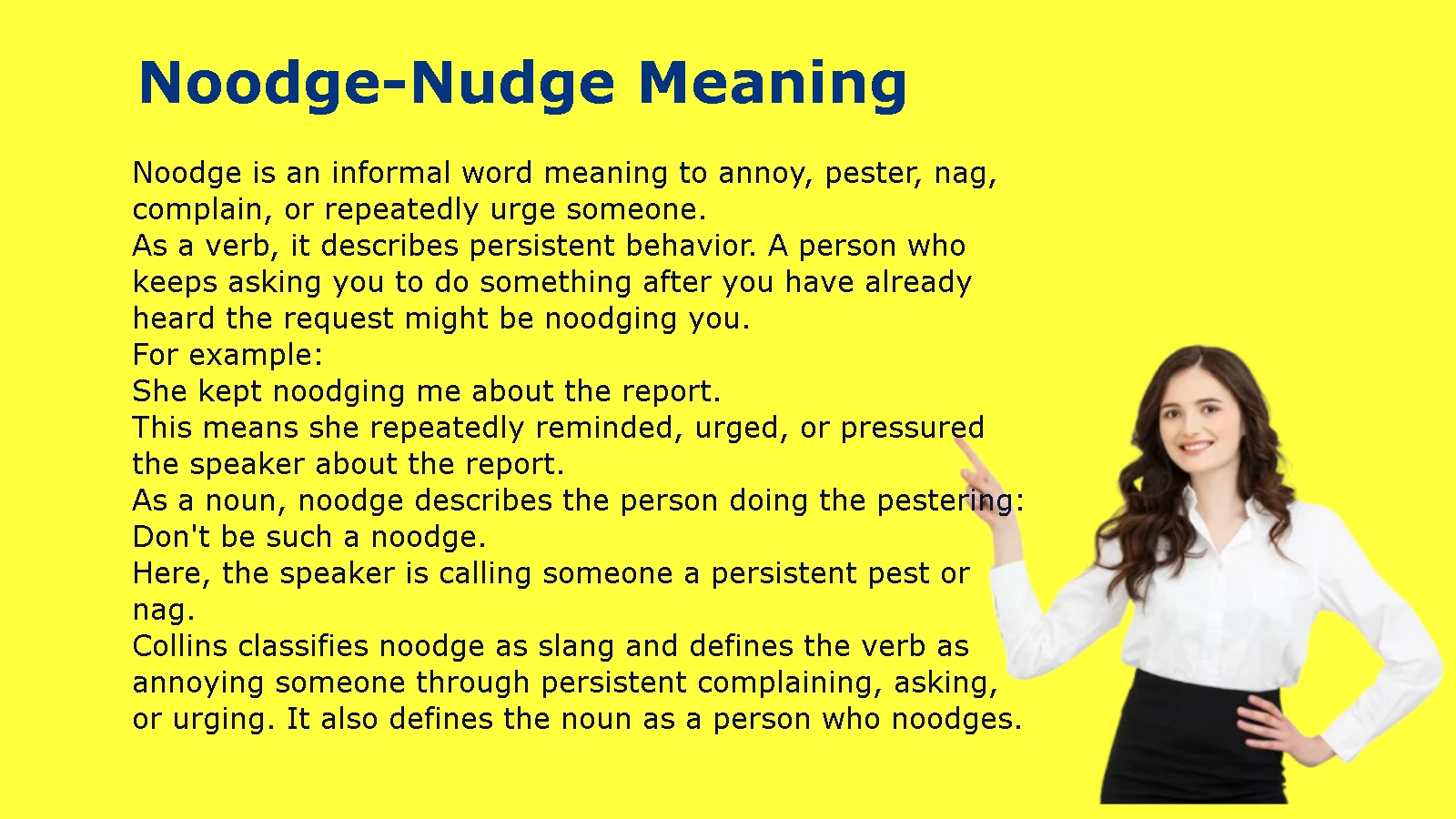
Noodge is an informal word meaning to annoy, pester, nag, complain, or repeatedly urge someone.
As a verb, it describes persistent behavior. A person who keeps asking you to do something after you have already heard the request might be noodging you.
For example:
She kept noodging me about the report.
This means she repeatedly reminded, urged, or pressured the speaker about the report.
As a noun, noodge describes the person doing the pestering:
Don’t be such a noodge.
Here, the speaker is calling someone a persistent pest or nag.
Collins classifies noodge as slang and defines the verb as annoying someone through persistent complaining, asking, or urging. It also defines the noun as a person who noodges.
Noodge as a Verb
The verb noodge can describe several closely related behaviors:
- repeatedly asking for something
- persistently reminding someone
- complaining again and again
- urging someone after they have already heard the request
- pestering someone
- nagging someone
The important idea is persistence.
A single request usually is not noodging. If someone says, “Please send me the document,” that is simply a request.
If they ask again five minutes later, then again at lunch, and again before leaving work, the repeated behavior could reasonably be described as noodging.
Noodge as a Noun
The noun noodge refers to a person who behaves this way.
For example:
My brother is a real noodge when he wants something.
The sentence does not necessarily describe someone who is malicious. It can be humorous or mildly critical. The word often carries the idea of someone who keeps at you until you respond.
Dictionary.com provides examples of noodge used this way in contemporary published writing, including descriptions of people who persistently bother or criticize others.
What Does Nudge Mean?
The ordinary English word nudge has a different meaning.
As a verb, nudge means to push or poke someone gently, often with an elbow, to attract attention or communicate something without speaking.
For example:
She nudged me when the speaker mentioned my name.
Here, the action is physical. She gave the person a small, gentle push.
As a noun:
He gave me a quick nudge.
That means he gave the speaker a gentle push or poke.
Dictionaries also use nudge for figurative encouragement. A person can receive a nudge to take action, make a decision, or remember something. Collins lists “a gentle reminder” as one of the noun’s meanings.
Nudge as a Verb
Common uses include:
- nudge someone’s elbow
- nudge someone aside
- nudge someone for attention
- nudge someone toward a decision
- nudge an object slightly
For example:
I nudged the door open with my shoulder.
This has nothing to do with nagging or pestering.
Nudge as a Noun
A nudge can be:
- a gentle physical push
- a small poke
- a subtle signal
- a gentle reminder
- an encouragement to act
For example:
I needed a little nudge to finally apply for the job.
Here, the word is figurative. No physical pushing is involved.
Noodge vs. Nudge: Are They the Same Word?
Not always.
This is the central point behind the noodge-nudge meaning.
There are effectively two relevant uses of nudge:
- Nudge meaning a gentle push or poke.
- Nudge as an informal variant spelling of noodge, meaning a pest or someone who nags.
American Heritage Dictionary lists these as separate entries: ordinary nudge and informal nudge, which it identifies as a variant of noodge.
Dictionary.com makes the same distinction by listing a second nudge with the pronunciation /nʊdʒ/ and the meaning “to annoy with persistent complaints, criticisms, or pleas; nag.”
So the spelling nudge alone does not always tell you which meaning the writer intends.
Noodge vs. Nudge Comparison
| Feature | Noodge | Nudge |
| Main meaning | Pester or nag | Push or poke gently |
| Secondary meaning | A pest or annoying person | Can also mean a reminder or encouragement |
| Informal “nag” variant | Yes | Yes, as an alternate spelling |
| Origin | Yiddish-derived | Separate English word |
| Typical register | Informal/slang | Standard everyday English |
| Physical action | No | Yes, in its ordinary sense |
| Persistent annoyance | Yes | Only in the variant noodge sense |
This distinction is especially useful when reading older writing or informal American English.
Noodge vs. Nudge Pronunciation
Pronunciation is one of the easiest ways to distinguish the two words when they are spoken.
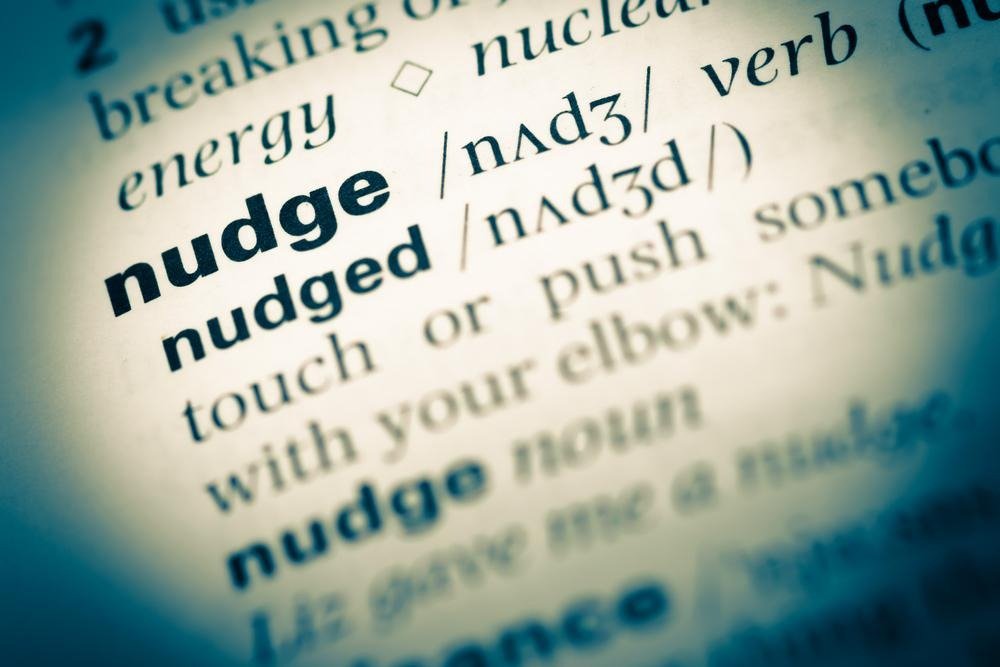
The Yiddish-derived noodge is pronounced with the vowel sound represented by /ʊ/. Dictionary.com gives it as /nʊdʒ/.
The ordinary English nudge has /ʌ/, as shown in dictionary entries such as Collins and Dictionary.com.
The difference is similar to the contrast between the vowel sounds in words such as “foot” and “fudge.”
Grammarphobia specifically notes that the Yiddish-derived word, regardless of whether it is spelled noodge or nudge, has the vowel sound associated with “foot,” while the ordinary English nudge has the vowel sound in “fudge.”
Why Pronunciation Matters
Consider these two sentences:
She gave me a nudge.
She kept noodging me.
The first sentence describes a physical or figurative push.
The second describes persistent pestering.
If someone spells the second word nudge, the context must tell you that they mean the Yiddish-derived variant rather than the ordinary English word.
Why Is Nudge Sometimes Spelled Noodge?
The spelling noodge reflects the word’s Yiddish background more clearly.
The Jewish English Lexicon traces the word to Yiddish nudyen, meaning “to bore” or “pester,” and connects it with nudnik, a Yiddish word for an annoying person or bore. The lexicon also lists nudzh and noodge as alternative spellings and explains that English nudge influenced the spelling.
Collins likewise traces noodge to Yiddish nudyen, with a connection to the Russian-derived form associated with being tedious or boring.
The situation became complicated because English already had a completely separate word nudge.
That older English word means to push or poke gently. Grammarphobia notes that the English nudge appears in written English centuries earlier than the Yiddish-derived noodge and likely has a different origin.
The result is a spelling collision:
Yiddish-derived noodge → nudge variant
while
English nudge → gentle push
The two forms look alike, but their histories and meanings differ.
Noodge Meaning in Yiddish
The English word noodge comes through Yiddish.
The Jewish English Lexicon identifies nudyen as the likely source and gives meanings such as “to bore” and “pester.” It also connects the noun noodge with nudnik, an annoying or pestering person.
That background explains why noodge has a stronger association with persistent annoyance than ordinary nudge.
It also explains why you may encounter several spellings:
- noodge
- nudge
- nudzh
The spelling noodge is particularly useful in modern English because it makes the distinction from ordinary nudge much easier to see.
Noodge and Nudnik
Nudnik is a related Yiddish-derived English word.
The Jewish English Lexicon defines nudnik as an annoying person and traces it to Yiddish, with the root associated with boring or pestering someone.
There is therefore a useful conceptual connection:
nudnik → an annoying person
noodge → a person who pesters, or the act of pestering
They are related, but they are not simply interchangeable in every sentence.
How to Use Noodge in a Sentence
The easiest way to understand noodge is to see it in natural contexts.
Noodge as a Verb
Stop noodging me about the appointment.
The person has repeatedly brought up the appointment.
She kept noodging her brother to call their parents.
The repeated urging is the important part.
I’ve already answered you, so please don’t noodge me.
The speaker is asking someone to stop pestering them.
He noodged his manager for an update.
The person repeatedly sought an answer or update.
Noodge as a Noun
Don’t be such a noodge.
The speaker is calling someone a pest or nag.
I hate to be a noodge, but could you check the figures again?
This is a particularly natural construction because it softens the criticism. Dictionary.com includes contemporary published examples of “I hate to be a noodge” used in this self-aware way.
He’s becoming a bit of a noodge about the deadline.
The person has started repeatedly bringing up the same issue.
How to Use Nudge in a Sentence
The ordinary nudge is much more common in everyday English.
Physical Nudge
She nudged me with her elbow.
This means she gently pushed or poked me.
He gave the door a nudge.
He pushed it slightly.
I nudged the box closer to the wall.
The movement was small and gentle.
Figurative Nudge
The reminder gave me a nudge to finish the application.
The reminder encouraged action.
Her friend gave her a nudge toward making a decision.
The friend encouraged her without directly forcing the decision.
I just needed a little nudge to get started.
The speaker needed encouragement.
These uses belong to ordinary nudge, not the Yiddish-derived noodge sense.
Noodge as a Variant of Nudge
The confusing part is that nudge can also be used for the “nag or pester” meaning.
For example:
He kept nudging me to call the contractor.
This sentence can technically be understood in more than one way.
It could mean he kept gently encouraging me.
It could also mean he kept pestering or nagging me.
The context usually resolves the ambiguity.
Collins records an American English nudge with /nʊdʒ/ as a slang alternative spelling of noodge.
That means the sentence’s surrounding context becomes especially important when the writer chooses nudge instead of the clearer noodge.
Noodge Meaning vs. Similar Words
| Word | Basic meaning | Main emphasis |
| Noodge | Pester or nag persistently | Repeated annoyance |
| Nag | Keep urging or complaining | Repetition |
| Pester | Bother repeatedly | Persistent disturbance |
| Badger | Pressure repeatedly | Insistent pressure |
| Whine | Complain in an irritating way | Tone of complaint |
| Bother | Annoy or disturb | Broadest meaning |
Noodge vs. Nag
Nag is the closest common everyday equivalent.
If someone repeatedly tells you to clean your room, pay a bill, or finish a task, you might say they are nagging you.
Noodge can describe similar behavior, but it has a more distinctive informal and Yiddish-derived flavor.
Noodge vs. Pester
Pester emphasizes repeated bothering.
Someone can pester you with questions, requests, messages, or interruptions.
Noodge often carries a stronger sense of repeated urging or complaining.
Noodge vs. Badger
Badger often suggests persistent pressure.
For example:
The salesman badgered me into reconsidering.
Noodge can be lighter and more conversational, particularly when the speaker is being humorous.
Is Noodge Slang?
Yes. Major dictionary sources identify noodge as an informal or slang word.
Collins labels it US slang, while its American English entry defines the word as persistently annoying someone through complaining, asking, or urging.
That does not mean noodge is fake, incorrect, or merely internet slang.
It is a documented English word with dictionary entries, historical usage, and an established Yiddish connection.
The more accurate description is:
Noodge is an established informal/slang English word of Yiddish origin.
Is Noodge a Real English Word?
Yes.
Major dictionaries record noodge as an English word.
Dictionary.com has an entry for the verb noodge and identifies it as a variant of nudge.
Collins records both noun and verb uses, including the meaning of an irritating person and the act of persistently complaining or nagging.
The Jewish English Lexicon also documents the word’s Yiddish and English usage, alternative spellings, pronunciation, regional spread, and historical dictionary sources.
So if you encounter noodge in a book, article, conversation, or piece of dialogue, you are not looking at a random misspelling.
Common Mistakes With Noodge and Nudge
Assuming Every Nudge Means a Gentle Push
This is the biggest mistake.
Ordinary nudge means a gentle push, but dictionary sources also recognize nudge as a spelling variant of noodge.
Always consider the context.
Pronouncing Noodge Like Ordinary Nudge
The two meanings can have different vowel sounds.
Noodge uses /nʊdʒ/.
Ordinary nudge uses /nʌdʒ/.
Assuming Noodge Is Internet Slang
Noodge predates social media and modern internet slang by many decades.
Grammarphobia discusses documented examples from the 20th century and notes that historical dictionary evidence traces the word to Yiddish.
Thinking Noodge Only Means “Nag”
“Nag” is a useful synonym, but noodge can also suggest complaining, pestering, or repeatedly urging someone.
Its exact force depends on context.
Treating Noodge as a Formal Word
Although noodge is legitimate English, dictionaries identify it as informal or slang.
That makes it less suitable for some professional, academic, legal, or technical contexts.
Is Noodge Appropriate in Formal Writing?
Usually, noodge is better suited to informal writing.
| Situation | Use of “noodge” |
| Casual conversation | Appropriate |
| Personal message | Appropriate |
| Informal article | Often appropriate |
| Fictional dialogue | Very useful |
| Humor or commentary | Often effective |
| Academic paper | Usually avoid |
| Formal business report | Usually avoid |
| Legal document | Prefer a precise standard term |
| Technical documentation | Prefer a clearer standard term |
In formal writing, nag, pester, repeatedly urge, or persistently complain will usually communicate the idea more directly.
For example, instead of:
The customer continued to noodge the representative.
a formal report might say:
The customer repeatedly contacted the representative for an update.
The second version removes the informal tone and states the behavior precisely.
Real-World Examples of Noodge
A Repeated Request
Imagine a friend wants you to attend a party.
They ask on Monday.
Then they ask again on Tuesday.
Then they text you Wednesday morning:
Are you coming yet?
You might jokingly say:
Stop noodging me. I’ll let you know.
The word works because the person keeps pressing for an answer.
A Workplace Reminder
A colleague needs a document from you.
They remind you once.
Later, they send another message.
Then they mention it again during a meeting.
You could describe the behavior informally as noodging.
In a formal report, however, you would probably say the colleague repeatedly requested the document.
A Family Conversation
A parent repeatedly tells an adult child to make an appointment.
The child could jokingly respond:
Mom, stop noodging me about it.
The word adds a humorous, slightly exasperated tone.
A Self-Aware Request
One of the most useful patterns is:
I hate to be a noodge, but…
This construction acknowledges that the speaker is about to ask for something again.
It can make the word sound playful rather than hostile. Dictionary.com’s contemporary examples show noodge appearing in precisely this kind of self-aware usage.
Case Study: Why Context Changes the Meaning of “Nudge”
Consider this sentence:
She kept nudging him about the deadline.
There are at least two plausible interpretations.
Interpretation one: She kept gently encouraging him to remember the deadline.
Interpretation two: She kept pestering him about the deadline.
Why?
Because ordinary nudge can mean gentle encouragement, while the Yiddish-derived nudge can mean noodge. Collins explicitly records both senses in American English.
Now compare:
She kept noodging him about the deadline.
The meaning becomes much clearer. The spelling noodging strongly signals the “pestering” sense.
This is one reason noodge can be a useful spelling even though nudge is also recorded as a variant.
Noodge vs. Nudge vs. Nudzh
There are three spellings worth knowing.
| Spelling | Meaning | Typical use |
| noodge | Pester, nag, or be a pest | Clearest spelling for this sense |
| nudge | Gentle push; also variant of noodge | Common but potentially ambiguous |
| nudzh | Variant of noodge | Less common spelling |
The Jewish English Lexicon lists nudzh and noodge as alternative spellings and explains the influence of English nudge on the Yiddish-derived form.
Grammarphobia similarly notes that dictionaries have recorded all three spellings for the Yiddish-derived term, although their treatment varies by dictionary.
For clarity, noodge is often the most useful spelling when you specifically mean “pester” or “nag.”
The History of Noodge and Nudge
The two words have surprisingly different histories.
The History of Nudge
The ordinary English nudge has been used for centuries.
Grammarphobia cites an English example from a 1675 translation of Homer’s Odyssey, where nudged refers to gently pushing another person.
The noun appeared later, carrying the idea of a gentle push or prod.
Its exact origin is uncertain, although dictionary sources have suggested Scandinavian connections.
The History of Noodge
The Yiddish-derived noodge is much newer in English.
Its roots lead to Yiddish nudyen, associated with boring or pestering, and related forms such as nudnik.
The spelling eventually became influenced by the existing English word nudge.
That explains the unusual situation in modern English:
Two different histories produced forms that now look and sound closely related.
Grammarphobia notes that historical evidence includes noodging in writing from 1960 and noun and verb examples from the early 1960s.
What Does “Noodge-Nudge” Mean in Everyday English?
When someone searches for noodge-nudge meaning, they may actually be trying to understand why the two forms appear together or why nudge sometimes means something different from “gentle push.”
The simplest explanation is:
Noodge = pester or nag.
Nudge = gently push or encourage.
Nudge can also be an alternate spelling of noodge.
So the phrase “noodge-nudge” is best understood as a comparison of two closely spelled forms rather than as one ordinary compound word with a single fixed dictionary definition.
That distinction is important. You should not automatically treat noodge-nudge as a standard compound expression.
Facts to Remember About the Noodge-Nudge Meaning
Here are the essential facts in one place:
- Noodge means to pester, nag, complain, or annoy persistently.
- A noodge can be a person who repeatedly pesters others.
- Noodge can function as both a noun and a verb.
- Noodge comes through Yiddish.
- The related Yiddish form is associated with nudyen, meaning to bore or pester.
- Nudge normally means a gentle push or poke.
- Ordinary nudge has a different origin from Yiddish-derived noodge.
- Nudge is also documented as an informal variant spelling of noodge.
- The ordinary and Yiddish-derived senses of nudge have different pronunciations.
- Nudzh is another recorded spelling of the Yiddish-derived word.
- Noodge is informal/slang rather than formal academic vocabulary.
FAQs About Noodge-Nudge Meaning
What does noodge mean?
Noodge means to pester, nag, complain, or annoy someone persistently. As a noun, it means a person who behaves in this way.
What does noodge mean in English?
In English, noodge is an informal word for persistent pestering, nagging, complaining, or urging. It can be used as both a noun and a verb.
Is noodge a Yiddish word?
Noodge is a Yiddish-derived word used in English. The Jewish English Lexicon traces it to Yiddish nudyen, meaning “to bore” or “pester.”
Is noodge the same as nudge?
Not always. Noodge means to pester or nag, while ordinary nudge means to push or poke gently. However, dictionaries also recognize nudge as a variant spelling of noodge.
Why is noodge spelled nudge?
The Yiddish-derived word was influenced by the older English word nudge, which has a similar spelling. As a result, nudge became an alternative spelling for noodge in some English usage.
How do you pronounce noodge?
Dictionary.com gives noodge the pronunciation /nʊdʒ/. This differs from ordinary nudge, which is pronounced /nʌdʒ/.
Is noodge a slang word?
Yes. Major dictionaries identify noodge as slang or informal American English.
What is a person who noodges called?
A person who repeatedly pesters, nags, or complains can be called a noodge. The related Yiddish-derived word nudnik also refers to an annoying or pestering person.
What is the difference between noodge and nag?
Both can describe persistent pestering. Nag is the much more common everyday English word, while noodge is an informal Yiddish-derived term with a distinctive conversational flavor.
Is noodge appropriate in formal writing?
Usually, it is better to use a clearer standard word such as nag, pester, repeatedly urge, or persistently complain in formal writing. Noodge is generally informal or slang.
Conclusion: Noodge vs. Nudge in Simple Terms
The noodge-nudge meaning becomes much easier once you separate the two words and their two histories.
Noodge means to pester, nag, complain, or annoy persistently. A noodge is a person who keeps doing this. The word comes through Yiddish and is generally informal or slang.
Nudge normally means to push or poke gently, either physically or figuratively. You can nudge someone’s elbow, nudge a door open, or give someone a nudge toward taking action.
But there is an important exception: nudge is also recorded as an alternative spelling of noodge. In that sense, it means to pester or nag rather than to push gently.
So, when you encounter nudge, look at the context and pronunciation. When you specifically mean “pester or nag,” noodge is often the clearer spelling because it avoids confusion with the much more common English word nudge.