Have you ever come across the word carouse and wondered what it means? Carouse is an uncommon word that usually refers to drinking and partying in a lively or noisy way, especially when people spend a long time celebrating together.
Carouse can be used as both a verb and a noun. As a verb, it means to drink alcohol freely and enjoy a boisterous celebration. As a noun, carouse refers to a drinking party or a period of noisy, festive drinking. The word often carries a sense of excessive drinking, merrymaking, or rowdy celebration.
Examples:
- The sailors caroused together after returning from their long voyage.
- They spent the evening in a noisy carouse at the local tavern.
The confusion is understandable. People often search for carouse meaning, what does carouse mean, carouse definition, or carouse meaning in English because it is rarely used in everyday conversation and can be difficult to understand from context. Its connection with drinking, partying, merrymaking, and celebration makes the word especially interesting.
In this guide, you’ll learn the complete Carouse meaning, including its definition, pronunciation, part of speech, origin, synonyms, antonyms, and usage. You’ll also see clear examples that show how to use carouse naturally in both modern and historical contexts.
Quick Answer: What Does Carouse Mean?
Carouse means to drink, celebrate, laugh, and socialize in a noisy or boisterous way, especially as part of a drinking party.
As a verb, it describes the activity:
- They caroused all night.
- The group went out to carouse after the celebration.
- The men spent the evening carousing in the tavern.
The word can also function as a noun, although this use is much less common in modern English. As a noun, carouse can refer to a noisy drinking party or a bout of heavy drinking.
Carouse in simple words
| Word | Simple meaning |
| Carouse | Drink and have loud, lively fun with others |
| Carousing | The act of drinking and partying noisily |
| Caroused | Drank and partied noisily |
| Carousal | A drinking party or period of revelry |
| Carouser | A person who carouses |
The important idea is that carouse usually involves more than ordinary socializing. Drinking, noise, merriment, and excess are often part of the picture.
What Does Carouse Mean?
The most common modern meaning of carouse is to spend time enjoying yourself in a loud group, particularly while drinking alcohol.
Oxford defines the verb as spending time drinking alcohol, laughing, and enjoying yourself noisily with other people. Cambridge gives a similar definition and describes the word as literary or humorous.
So, if someone says:
“They were carousing until dawn,”
the sentence suggests that they were awake late, drinking and enjoying themselves in a noisy or lively group.
The word often carries a sense of excess. It does not usually describe quietly having one drink with dinner. Instead, it evokes a more energetic scene involving revelry, prolonged drinking, or boisterous celebration.
What carouse implies
Depending on context, carouse can suggest:
- Drinking alcohol
- Drinking heavily
- Loud conversation
- Laughter
- Group celebration
- Late-night partying
- Rowdy behavior
- Revelry
- Excessive merrymaking
However, carouse does not automatically mean that everyone is drunk. The word describes the general activity and atmosphere rather than proving a particular person’s level of intoxication.
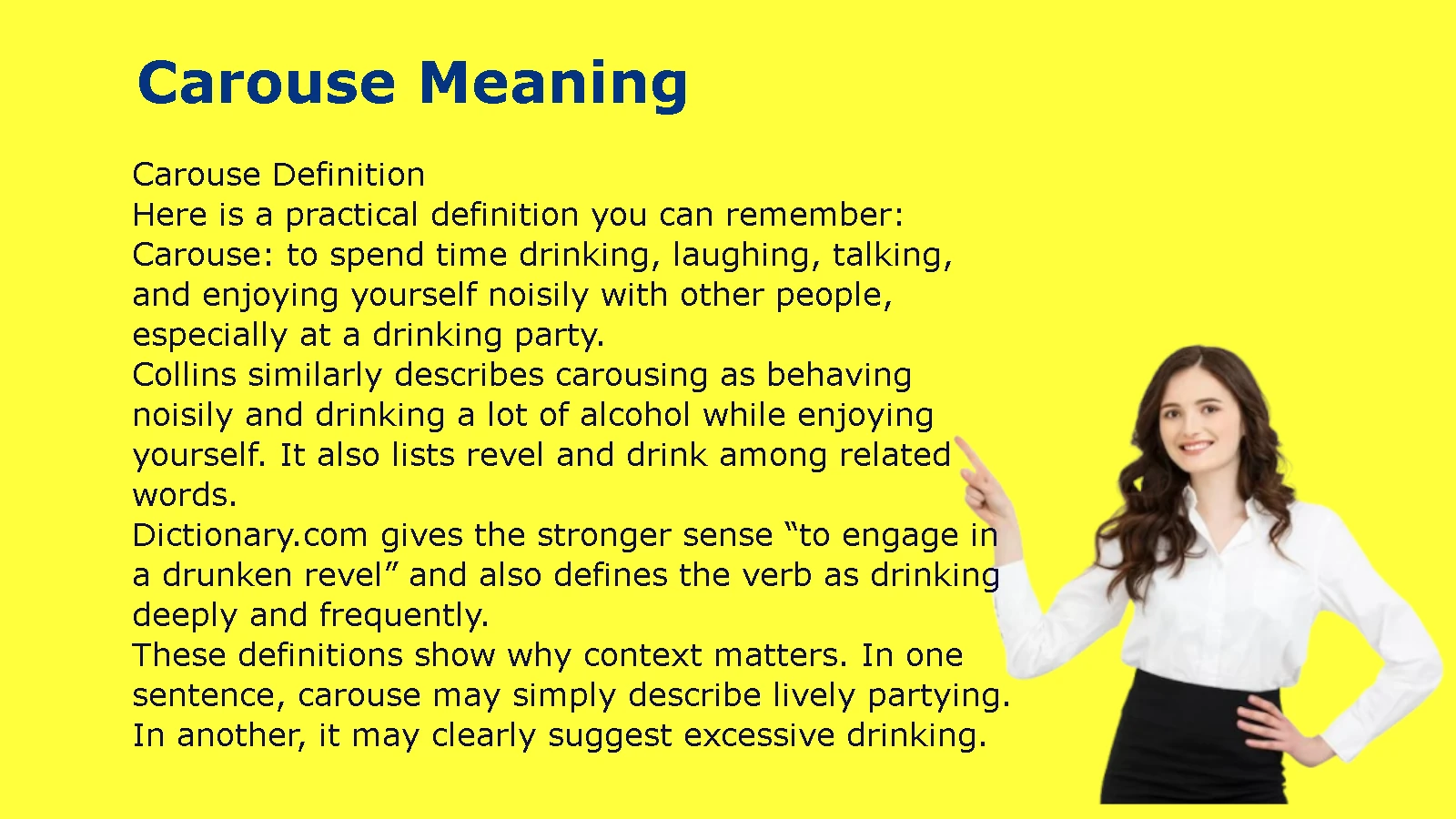
Carouse Definition
Here is a practical definition you can remember:
Carouse: to spend time drinking, laughing, talking, and enjoying yourself noisily with other people, especially at a drinking party.
Collins similarly describes carousing as behaving noisily and drinking a lot of alcohol while enjoying yourself. It also lists revel and drink among related words.
Dictionary.com gives the stronger sense “to engage in a drunken revel” and also defines the verb as drinking deeply and frequently.
These definitions show why context matters. In one sentence, carouse may simply describe lively partying. In another, it may clearly suggest excessive drinking.
Carouse as a Verb
Carouse is primarily used as an intransitive verb. That means it normally does not take a direct object.
You can say:
- They caroused all night.
- We caroused until dawn.
- The students went out carousing.
- The sailors were carousing in the tavern.
You generally would not use it in the same way as a transitive verb such as drink:
- ❌ They caroused the wine.
- ✅ They caroused all evening.
- ✅ They caroused with their friends.
Oxford lists the verb forms as carouse, carouses, caroused, and carousing.
Forms of carouse
| Form | Example |
| Base form | They carouse after work. |
| Third-person singular | He carouses with his friends. |
| Past tense | They caroused until midnight. |
| Present participle | They were carousing at the tavern. |
Because carouse is usually intransitive, phrases such as carouse with friends, carouse at a tavern, or carouse all night are more natural than constructions that treat carouse as something you do directly to an object.
Carouse as a Noun
Although carouse is most commonly encountered as a verb today, it can also be used as a noun.
As a noun, it can mean a noisy, merry drinking party or a period of revelry. Collins records this noun sense alongside the verb.
For example:
The evening ended in a wild carouse.
Here, carouse refers to the drinking celebration itself rather than the act of participating in it.
The noun is considerably less common in everyday modern English than the verb. If you are writing contemporary prose, carousing, drinking party, revelry, or celebration may sound more natural depending on what you mean.
How to Pronounce Carouse
The standard pronunciation of carouse is:
Cambridge gives the IPA pronunciation /kəˈraʊz/ for both British and American English.
The stress falls on the second syllable.
The ending sounds like the “owz” sound in a word such as browse, while the first syllable has a weak vowel sound.
Carouse pronunciation at a glance
| Feature | Detail |
| Word | carouse |
| IPA | /kəˈraʊz/ |
| Main stress | Second syllable |
| British pronunciation | /kəˈraʊz/ |
| American pronunciation | /kəˈraʊz/ |
The spelling can be misleading because some readers may initially expect the ending to sound like house. In pronunciation, however, the final sound is voiced, ending in /z/.
What Does Carouse Mean in a Sentence?
The easiest way to understand carouse is to see how it works in real sentences.
Examples of carouse
- The friends caroused until the early hours of the morning.
- The soldiers spent the evening carousing after their victory.
- The travelers stopped at an inn to eat, drink, and carouse.
- They had been carousing for hours before returning home.
- The novel describes merchants carousing in a crowded tavern.
- The guests began to carouse after the formal dinner ended.
- The sailors were known to carouse whenever they reached port.
- He preferred quiet evenings to nights spent carousing.
Notice how the word generally creates an image of group activity and noisy enjoyment.
A sentence such as:
She drank a glass of wine while reading.
does not naturally call for carouse.
But:
She and her friends caroused until sunrise.
works because the activity involves a group, drinking, prolonged enjoyment, and a lively atmosphere.
Carouse Meaning in Different Contexts
Carouse in everyday English
In ordinary modern English, carouse is understandable but somewhat unusual. It tends to sound literary, humorous, old-fashioned, or deliberately colorful.
Cambridge labels it “literary or humorous,” while Oxford labels it “literary.”
Someone casually describing last night’s plans is more likely to say:
- We partied all night.
- We went out drinking.
- We stayed out late.
- We had a wild night.
A writer might choose carouse because it paints a more vivid picture:
The young men caroused until dawn.
The word immediately suggests noise, alcohol, laughter, and excess.
Carouse in literature
Carouse has strong associations with historical and literary writing. It works particularly well when describing taverns, sailors, soldiers, revelers, medieval or early-modern settings, and extravagant celebrations.
This is partly because the word itself dates to the 16th century.
A historical novel might say:
After the battle, the soldiers returned to the village and caroused until morning.
That sentence feels natural because the vocabulary matches the setting.
Carouse in historical contexts
Historically, carouse was closely connected to drinking and the act of draining a cup.
Its etymological history is especially interesting. The word is traced through French to German gar aus, associated with drinking something completely or “right out.” Etymological sources date its English use to the 1550s.
This history explains why drinking is so central to the word.
Carouse in a Sentence: What Does It Really Imply?
Consider these three sentences:
| Sentence | What it suggests |
| They celebrated their victory. | General celebration |
| They partied after the victory. | Informal, energetic celebration |
| They caroused after the victory. | Noisy, drinking-centered revelry |
The third sentence has a stronger and more specific atmosphere.
Carouse is therefore not simply a fancy synonym for “celebrate.” It usually brings drinking and boisterous social behavior into the picture.
That distinction is useful when choosing the right word in writing.
Carouse Synonyms
Several words overlap with carouse, but they are not perfect substitutes.
Common synonyms and related terms include:
- Revel
- Party
- Celebrate
- Drink
- Booze
- Roister
- Whoop it up
- Live it up
- Make merry
- Have a spree
- Drink heavily
- Go on a drinking binge
Collins lists drink, booze, revel, and imbibe among related synonyms.
Carouse vs. revel
Revel is probably one of the closest alternatives.
To revel means to take great pleasure in something or to engage in lively celebration. It can involve drinking, but drinking is not always essential.
Carouse has a stronger connection to alcohol and noisy drinking.
- They reveled in their success. → They greatly enjoyed the success.
- They caroused after the victory. → They celebrated noisily, with drinking strongly implied.
Carouse vs. celebrate
Celebrate is much broader.
You can celebrate:
- A birthday
- A wedding
- A promotion
- A religious holiday
- A victory
- An anniversary
None of these activities necessarily involve alcohol or rowdy behavior.
Carouse, by contrast, has a much narrower and more colorful meaning.
Carouse vs. frolic
Frolic means to play, move, or behave in a lively and playful way.
It does not necessarily involve alcohol.
For example:
The children frolicked in the garden.
That sentence makes perfect sense.
The children caroused in the garden.
This sounds unusual because carouse is associated with adult drinking and revelry rather than innocent play.
Carouse vs. party
Party is the modern everyday term.
You might say:
We partied until midnight.
That is normal conversational English.
You could say:
We caroused until midnight.
That is grammatically correct, but it sounds more literary or intentionally vivid.
Carouse Antonyms
There is no single perfect opposite of carouse, but several words can express contrasting behavior.
Depending on the context, possible opposites include:
- Abstain
- Refrain
- Rest
- Stay sober
- Behave quietly
- Remain restrained
- Live temperately
The correct opposite depends on which part of carouse you want to contrast.
If the focus is alcohol:
carouse ↔ abstain
If the focus is noisy behavior:
carouse ↔ remain quiet
If the focus is excess:
carouse ↔ exercise restraint
Is Carouse a Positive or Negative Word?
The emotional tone of carouse depends heavily on context.
It can describe enjoyable social activity, but it often carries a suggestion of excess, disorder, or irresponsible drinking.
For example:
The villagers caroused after the harvest festival.
This can sound festive and humorous.
But:
He spent every night carousing instead of working.
Here, the word clearly has a negative implication because the behavior is associated with neglect and excess.
So carouse is best described as context-dependent but often slightly negative or disapproving when excessive behavior is emphasized.
Positive or negative?
| Context | Likely tone |
| Historical celebration | Neutral or colorful |
| Humorous story | Playful |
| Description of a festival | Festive |
| Excessive drinking | Negative |
| Irresponsible behavior | Clearly negative |
| Literary description | Often neutral or vivid |
The word itself does not always condemn the people involved. The surrounding sentence determines much of the judgment.
Is Carouse Formal or Informal?
Carouse is not normally considered casual everyday vocabulary.
Major dictionaries classify it as literary, and Cambridge also identifies a humorous use.
That makes it especially useful in:
- Literature
- Historical writing
- Narrative prose
- Humorous writing
- Creative nonfiction
- Descriptive journalism
It is less natural in ordinary professional communication.
For example, an email saying:
The team caroused after completing the project.
would sound unusually dramatic.
A more natural professional sentence would be:
The team celebrated after completing the project.
When to use carouse
Use carouse when you want to emphasize:
drinking + noise + group enjoyment + revelry
If you only mean “celebrate,” use celebrate.
When you only mean “have fun,” use enjoy yourself.
If you mean “play energetically,” use frolic.
When you mean “drink heavily,” use drink heavily or another more precise expression.
Carouse Meaning in the Bible
The word carouse does appear in some modern Bible translations, but its wording varies significantly between translations.
For example, 2 Peter 2:13 uses carouse in the New International Version and New King James Version. The King James Version uses “riot” instead.
Similarly, Romans 13:13 uses carousing in several modern translations, while older translations may use terms such as rioting or revelling.
This matters because someone searching for “carouse meaning in the Bible” may encounter different words in different Bible versions even when the underlying concept is similar.
The biblical context generally presents carousing or revelry as behavior to avoid rather than as harmless entertainment.
For example, Romans 13:13 contrasts honorable conduct with carousing and drunkenness in several modern translations.
Galatians 5:21 likewise includes carousing among behaviors condemned in the passage, with a translation note identifying related renderings such as “revelings” or “orgies.”
Why Bible translations differ
Older English Bible translations often use vocabulary that sounds unfamiliar today.
For example:
- Carousing
- Reveling
- Rioting
- Drunkenness
These words can overlap but are not always exact equivalents in modern English.
Therefore, when studying the biblical meaning, it is useful to check the specific Bible translation rather than assuming every English version uses carouse.
Common Mistakes With Carouse
Assuming carouse simply means party
This is the most common misunderstanding.
A party can involve food, games, music, dancing, conversation, or family activities.
Carouse is more specific. It generally evokes drinking and noisy revelry.
Assuming carouse always means being drunk
Not necessarily.
The word strongly relates to drinking, and some dictionary definitions emphasize heavy drinking, but carouse does not prove that every participant was intoxicated.
The context determines the degree of excess.
Using carouse for children
Because the word has strong associations with alcohol and adult revelry, it is usually inappropriate for innocent childhood play.
Use frolic, play, romp, or celebrate when that is what you mean.
Treating carouse as common slang
Carouse is not modern texting slang.
It is an established English word with roots going back to the 16th century, and contemporary dictionaries generally identify it as literary or humorous.
Confusing carouse with carousel
The words carouse and carousel look somewhat similar, but they have completely different meanings.
- Carouse → drink and celebrate noisily
- Carousel → a rotating amusement ride
This spelling similarity can easily cause confusion when reading quickly.
A Closer Look at the Word’s History
The history of carouse explains its unusual meaning.
Etymological sources trace the word to the 1550s. It developed through French from German gar aus, associated with drinking something completely or draining a cup.
Early English usage included the phrase “drink carouse.”
Over time, the word developed from an expression associated with drinking to a verb meaning to drink freely and engage in noisy revelry.
That historical connection is still visible in the modern meaning.
Word family
The carouse family includes:
- carouse — verb/noun
- caroused — past tense
- carousing — present participle
- carousal — noun
- carouser — a person who carouses
The form carousing is especially common because it naturally describes an ongoing activity.
For example:
They spent the night carousing.
Real-World Usage: A Simple Case Study
Imagine two groups celebrating the same event.
Group A
They meet at a restaurant, eat dinner, talk quietly, and leave at 10 p.m.
A natural description would be:
They celebrated over dinner.
Group B
They gather at a tavern, drink for hours, laugh loudly, sing, and remain out until sunrise.
A more vivid description could be:
They caroused until dawn.
The distinction shows why carouse is useful. It does not merely communicate celebration. It communicates a particular style of celebration.
The word adds information about the atmosphere without requiring a long explanation.
Carouse vs. Similar Words
| Word | Main meaning | Alcohol required? | Typical tone |
| Carouse | Drink and celebrate noisily | Usually implied | Literary/colorful |
| Party | Enjoy a social gathering | No | Casual |
| Celebrate | Mark an occasion with enjoyment | No | Neutral |
| Revel | Enjoy lively celebration | No | Literary |
| Frolic | Play or move energetically | No | Playful |
| Booze | Drink alcohol, often heavily | Yes | Informal |
| Drink | Consume alcohol | Yes | Neutral |
| Roister | Behave noisily and boisterously | Often implied | Literary |
This comparison makes one point clear: carouse occupies a specific space between celebration and excessive drinking.
Frequently Asked Questions About Carouse
What does carouse mean?
Carouse means to drink, laugh, socialize, and enjoy yourself noisily with a group of people. It often implies heavy drinking or rowdy revelry.
Is carouse a slang word?
No. Carouse is an established English word, not modern slang. Major dictionaries describe it as literary or humorous.
What does carouse mean in English?
In English, carouse means to spend time drinking and enjoying yourself in a noisy or lively way, especially with other people.
How do you pronounce carouse?
The word is pronounced /kəˈraʊz/ in both British and American English, according to Cambridge.
What is a synonym for carouse?
Depending on context, synonyms include revel, drink, party, celebrate, booze, roister, and live it up. No synonym matches every aspect of carouse exactly.
Is carouse a positive or negative word?
It can be either. In a historical or humorous description, it may sound lively or colorful. When it emphasizes excessive drinking or irresponsible behavior, it usually carries a negative tone.
What does carouse mean in the Bible?
In some modern Bible translations, carouse or carousing refers to excessive revelry and drinking and is presented negatively. Other translations use terms such as riot, revel, or revelling for related passages.
What is the difference between carouse and revel?
Revel means to enjoy oneself enthusiastically or participate in lively celebration. Carouse is more specifically associated with drinking, noisy merrymaking, and revelry.
Is carouse still used today?
Yes, but it is relatively uncommon in casual conversation. It remains useful in literary, humorous, historical, and descriptive writing. Oxford and Cambridge both identify literary usage.
What is the noun form of carouse?
Carouse itself can be a noun meaning a noisy drinking party. Carousal is another noun form referring to such revelry.
Final Takeaway: Carouse Meaning
The simplest way to remember carouse is:
Carouse means to drink, laugh, socialize, and have noisy fun with other people, often involving heavy drinking or revelry.
It is stronger and more specific than celebrate or party because it usually brings drinking, noise, and excess into the picture.
The word is also relatively old, entering English in the 16th century, with an etymological connection to German expressions concerning drinking a cup completely empty.
Its most useful distinctions are:
- Carouse = drink and revel noisily
- Revel = enjoy lively celebration
- Party = enjoy a social gathering
- Celebrate = mark an occasion with enjoyment
- Frolic = play or behave energetically
- Booze = drink alcohol, especially heavily
So if you read “They caroused until dawn,” picture a group of people drinking, laughing, talking loudly, and enjoying a prolonged night of revelry.
That is the core of the carouse meaning.