Have you ever wondered what condescension really means when someone says another person is being condescending? Condescension describes an attitude or behavior in which someone treats another person as though they are less intelligent, capable, or important than themselves.
Condescension means showing an attitude of superiority toward someone, often by speaking to them in a patronizing or dismissive way. A condescending person may use an overly gentle tone, unnecessary explanations, sarcastic comments, or words that make another person feel inferior.
Examples:
- Her condescension was obvious when she explained the simple task as if I knew nothing.
- He responded with condescension instead of taking her question seriously.
The confusion is understandable. People often search for condescension meaning, what does condescension mean, condescension definition, or what does it mean to be condescending because the word describes more than simple rudeness. It usually involves a sense of superiority, where one person talks down to another rather than treating them as an equal.
In this guide, you’ll learn the complete condescension meaning, including its definition, pronunciation, origin, synonyms, antonyms, and usage. You’ll also see clear examples of condescension in everyday conversations so you can recognize what a condescending attitude sounds like and understand how to use the word correctly.
What Does Condescension Mean?
Condescension is a noun that describes behavior, language, or an attitude that suggests superiority over another person.
When someone behaves with condescension, they don’t simply disagree with you or know more about a particular subject. Instead, they communicate the idea that they are above you in intelligence, knowledge, status, experience, or importance.
For example, imagine that you ask a coworker how to use a new software program. Instead of answering normally, the coworker says:
“Oh, it’s really simple. Even someone with no technical experience can figure it out.”
The person technically answered your question. However, the wording carries an unnecessary sense of superiority. That’s what makes the response condescending.
Cambridge marks condescension as a disapproving noun because the modern word usually carries a negative meaning.
Condescension Meaning in Simple English
In very simple terms:
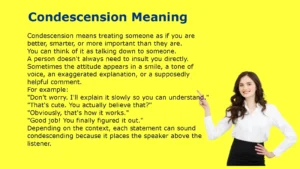
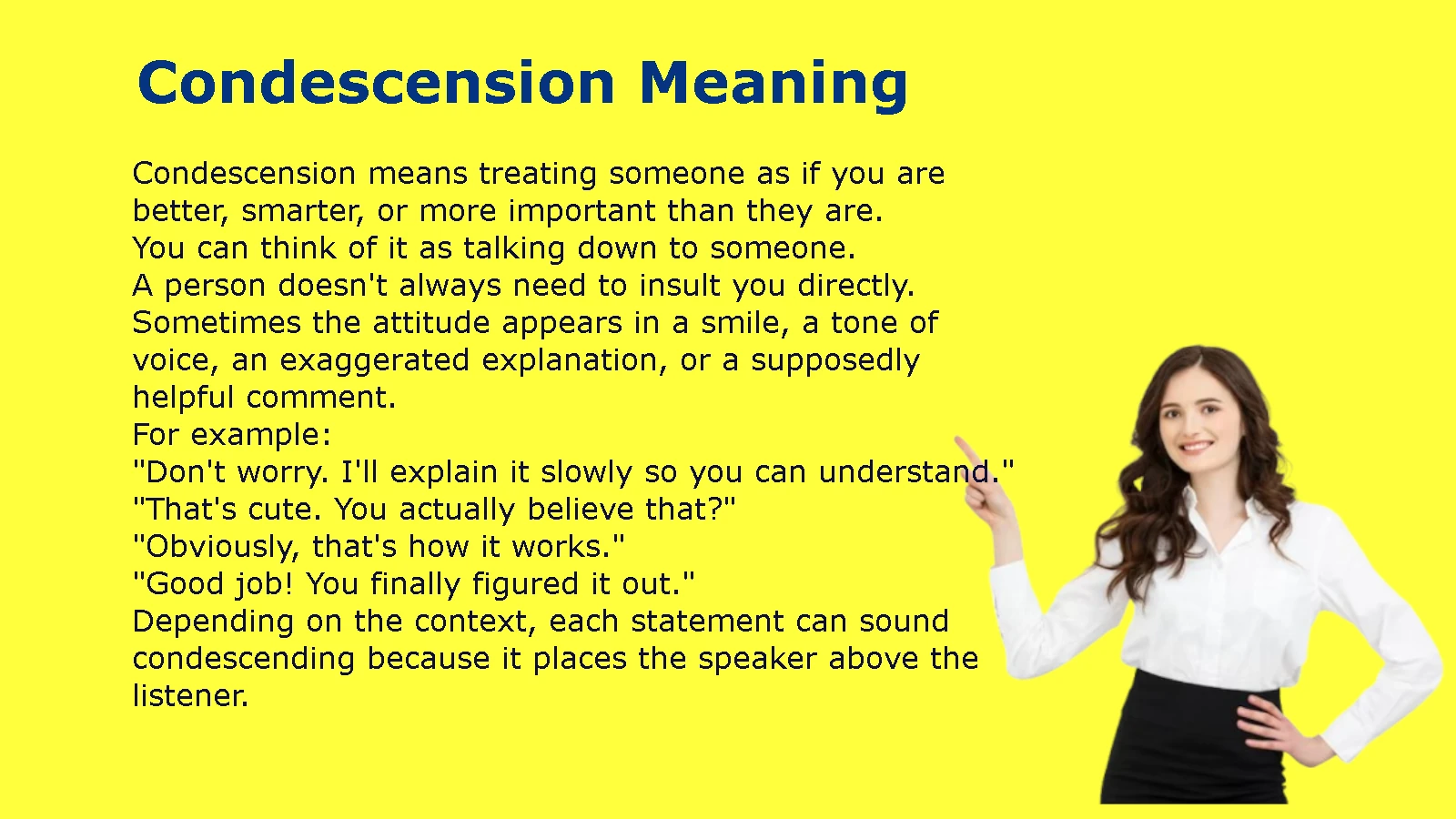
Condescension means treating someone as if you are better, smarter, or more important than they are.
You can think of it as talking down to someone.
A person doesn’t always need to insult you directly. Sometimes the attitude appears in a smile, a tone of voice, an exaggerated explanation, or a supposedly helpful comment.
For example:
- “Don’t worry. I’ll explain it slowly so you can understand.”
- “That’s cute. You actually believe that?”
- “Obviously, that’s how it works.”
- “Good job! You finally figured it out.”
Depending on the context, each statement can sound condescending because it places the speaker above the listener.
What Does It Mean to Be Condescending?
Condescending is the adjective related to condescension.
If someone is condescending, they behave as though they are more important, knowledgeable, or intelligent than another person. Cambridge defines condescending as treating someone as though you are more important or intelligent than them.
Compare these forms:
| Word | Part of speech | Meaning |
| Condescension | Noun | The attitude or behavior of treating others as inferior |
| Condescending | Adjective | Describes someone or something that shows superiority |
| Condescend | Verb | To behave as though you are superior or, in another construction, agree to do something beneath your perceived status |
| Condescendingly | Adverb | In a condescending manner |
For example:
- Noun: His condescension annoyed everyone.
- Adjective: His condescending tone annoyed everyone.
- Verb: She never condescends to her students.
- Adverb: He spoke condescendingly to the new employee.
Condescension Meaning in English
The standard English meaning of condescension centers on superiority.
A person shows condescension when their behavior communicates something like:
“I am above you.”
That superiority might involve intelligence, education, social status, professional experience, wealth, age, or another perceived advantage.
However, condescension isn’t simply the same as being more knowledgeable.
A doctor can know more about medicine than a patient without being condescending. A teacher can know more about mathematics than a student without talking down to them. An experienced employee can train a new employee without treating the newcomer as unintelligent.
The difference lies largely in how the person communicates that difference in knowledge or status.
Knowledge vs. Condescension
Consider these two responses.
Helpful:
“The setting is under the advanced options. I’ll show you where to find it.”
Condescending:
“It’s under the advanced options. I can’t believe you couldn’t find something that obvious.”
Both people provide the same basic information.
Only one adds an unnecessary judgment about the other person’s ability.
That’s the heart of condescension.
Condescension Meaning With Examples
Real examples make the word much easier to understand because condescension often depends on context.
Example of Condescension in a Conversation
Imagine this conversation between two coworkers:
Alex: “Could you show me how to export this report?”
Jordan: “Sure. It’s pretty basic, but I’ll show you.”
The words may sound harmless at first. The phrase “it’s pretty basic” adds a subtle judgment. If Jordan says it with a superior tone, Alex may feel as though the question was stupid.
A more respectful response would be:
Jordan: “Sure. Click here and then choose Export. It only takes a few steps.”
The second response gives the same information without putting the other person down.
Examples of Condescending Behavior
Condescension can appear in many forms.
Common examples include:
- Overexplaining something obvious: Giving a long explanation because you assume the other person cannot understand a basic idea.
- Talking unusually slowly: Deliberately using an exaggeratedly simple speaking style with an adult who understands the subject.
- Unnecessary correction: Correcting minor details mainly to demonstrate superior knowledge.
- Dismissive praise: Saying “Good job” in a tone that suggests the person’s accomplishment was surprisingly easy for them.
- Mocking a question: Treating someone’s genuine question as ridiculous.
- Talking over someone: Interrupting because you assume your contribution matters more.
- Using childish language: Speaking to a capable adult as though they cannot understand ordinary language.
- Pointing out obvious facts: Explaining something everyone in the conversation already understands.
None of these behaviors is automatically condescending in every situation. Context matters. A teacher may deliberately simplify an explanation for a beginner. A doctor may use plain language to make medical information easier to understand. That isn’t necessarily condescension.
The attitude behind the behavior makes the difference.
Condescending Sentences
Here are several examples of statements that can sound condescending:
| Statement | Why it can sound condescending |
| “I’ll explain it in a way you can understand.” | Implies the listener cannot understand normal explanations |
| “Obviously, that’s not how it works.” | Treats the other person’s mistake with unnecessary contempt |
| “Aw, that’s cute.” | Can dismiss another person’s idea or achievement |
| “You finally figured it out.” | Turns praise into an insult |
| “Let me handle this. It’s probably too complicated.” | Assumes the other person lacks ability |
| “Don’t worry your little head about it.” | Uses deliberately belittling language |
| “It’s really not that difficult.” | Suggests difficulty reflects poorly on the listener |
The same sentence can have a different meaning in another context. Tone, relationship, facial expression, and circumstances all matter.
Condescension vs. Patronizing
Condescension and patronizing behavior overlap heavily.
Someone who acts patronizingly often treats another person as less intelligent, capable, mature, or important. Cambridge lists patronizing among the synonyms associated with condescending.
Still, the words can emphasize slightly different things.
Condescension focuses strongly on an attitude of superiority.
Patronizing often emphasizes behavior that appears falsely kind, helpful, protective, or generous while actually putting the other person in an inferior position.
For example:
“That’s a very cute little project you’ve made.”
The speaker may sound friendly. Yet the word “little” and the tone can diminish the person’s work.
That can be both patronizing and condescending.
Condescension vs. Arrogance
Arrogance and condescension aren’t exact synonyms.
Arrogance describes an exaggerated sense of one’s own importance, abilities, or superiority.
Condescension focuses more specifically on how that perceived superiority is directed toward another person.
Think of the distinction this way:
| Term | Main idea |
| Arrogance | “I’m better than other people.” |
| Condescension | “I’m better than you, so I’ll treat you as inferior.” |
Someone can be arrogant without directly talking down to another person.
For example, a person might constantly brag about being the smartest person in the room. That’s arrogance.
If that same person tells another adult, “Don’t worry, I’ll use small words so you can keep up,” the behavior becomes condescending.
Condescension vs. Sarcasm
Sarcasm is also different from condescension.
Sarcasm often uses irony to mock or criticize someone. Condescension involves an attitude of superiority.
The two can overlap.
For example:
“Wow, what an impressive discovery. You figured out how to turn the computer on.”
That statement may be sarcastic. If the speaker uses it to belittle the other person’s intelligence, it can also be condescending.
So sarcasm describes a way of speaking, while condescension describes an attitude of superiority.
Condescension Synonyms
The best synonym depends on the exact context.
Common words associated with condescension include:
- Patronizing
- Superiority
- Arrogance
- Haughtiness
- Disdain
- Contempt
- Snobbery
- Pompousness
- Superciliousness
- Overbearing behavior
Cambridge’s thesaurus includes terms such as patronizing, superior, disdainful, and overbearing among words related to condescending.
Closest Synonyms for Condescension
Patronizing is often one of the closest choices when someone treats another person as inferior while appearing superficially polite or helpful.
Haughtiness emphasizes an attitude of superiority or self-importance.
Disdain emphasizes a lack of respect or a feeling that someone or something is beneath consideration.
Contempt is generally stronger. It can imply that someone views another person as completely unworthy of respect.
Arrogance emphasizes an inflated sense of one’s own importance rather than the specific act of talking down to someone.
Because these words overlap, choosing the right one depends on what you want to emphasize.
Antonyms of Condescension
The opposite of condescension involves treating people with respect rather than superiority.
Useful antonyms include:
- Respect
- Humility
- Equality
- Courtesy
- Consideration
- Empathy
- Politeness
The most natural opposite will depend on the sentence.
For example:
“She treated everyone with respect.”
This directly contrasts with treating people condescendingly.
Another option is:
“He spoke to his employees as equals.”
That sentence highlights equality rather than simply politeness.
Condescension vs. Respect
The contrast becomes clearer when you compare similar conversations.
Condescending:
“You probably won’t understand this, but here’s how it works.”
Respectful:
“Here’s how it works. Let me know if you’d like me to explain any part of it.”
The second speaker doesn’t assume the listener lacks intelligence.
That small difference can completely change the tone of an interaction.
Condescension Pronunciation
The American English pronunciation of condescension is:
/ˌkɑːnˈdə.sen.ʃən/
The main stress falls on the second syllable, the part pronounced like -den-.
Cambridge gives the US pronunciation as /ˌkɑːnˈdə.sen.ʃən/ and lists the UK pronunciation separately.
The related word condescending has a similar opening sound and stress pattern. Cambridge lists its US pronunciation as /ˌkɑːn.dəˈsen.dɪŋ/.
How to Remember the Pronunciation
Break the word into manageable parts:
con + de + scension
The important point is to avoid stressing the first syllable too heavily. The main stress falls in the middle of the word.
Condescension Meaning in Farsi
In Farsi, the exact translation of condescension depends on the context because English uses the word for a combination of superiority, patronizing behavior, and talking down to someone.
Possible Farsi equivalents include:
- تحقیر — humiliation or belittling
- تحقیرآمیزی — a demeaning or belittling quality
- از بالا به پایین نگاه کردن — looking down on someone
- با تکبر رفتار کردن — behaving arrogantly
- خودبرتربینی — a sense of superiority
For example, when condescension refers to someone treating another person as inferior, از بالا به پایین نگاه کردن can convey the idea naturally.
When the focus is on a superior or arrogant attitude, خودبرتربینی or با تکبر رفتار کردن may fit better.
The important distinction is that condescension isn’t always identical to simple insult. The word specifically involves a perceived difference in status or ability and the superior way one person treats another.
How to Recognize Condescension
Condescension can be subtle. In fact, some of the clearest examples sound polite on the surface.
A Superior Tone
Tone often reveals condescension before the actual words do.
Someone might say:
“Sure, I’ll help you.”
Those words are neutral. However, if the speaker delivers them with an exaggerated sigh or an eye roll, the message changes.
The person may be communicating:
“I can’t believe you need my help.”
Unnecessary Simplification
Simplifying information isn’t inherently condescending. Good teachers simplify difficult ideas all the time.
The problem arises when someone simplifies information because they assume the other person is incapable of understanding it.
For example:
“Let me use very basic terms because I’m not sure you’ll follow.”
That statement doesn’t simply simplify the subject. It makes a judgment about the listener.
Dismissive Corrections
Correction can also become condescending.
Consider:
“Actually, it’s their, not there.”
If someone genuinely needs the correction, it may be useful.
But if the person interrupts a conversation simply to show off their knowledge, the correction can feel condescending.
Insulting Praise
Some praise carries a hidden insult.
Consider:
“You did surprisingly well.”
That sentence may be sincere. However, depending on the context, it can imply that the person was expected to perform badly.
Likewise:
“I’m impressed you understood that.”
The speaker appears complimentary. The underlying message may be, “I didn’t think you were capable of understanding it.”
Condescending vs. Helpful Communication
The difference between helpfulness and condescension often comes down to respect.
A helpful person recognizes a knowledge gap without turning it into a judgment about someone’s intelligence.
A condescending person uses the knowledge gap to establish superiority.
| Helpful communication | Condescending communication |
| “Would you like me to explain it?” | “I’ll explain it because you probably don’t understand.” |
| “Here’s another way to look at it.” | “Let me make this simple for you.” |
| “That’s a common mistake.” | “You should know that by now.” |
| “I can show you how it works.” | “I’ll do it because this is too complicated for you.” |
| “Do you need any help?” | “Clearly, you need help.” |
The information may be identical.
The attitude isn’t.
Condescension in the Workplace
Workplaces provide plenty of opportunities for condescension because employees often have different levels of authority, experience, and expertise.
A manager can give instructions without being condescending.
For example:
“This report needs three additional sections. Here’s the format we use.”
That’s direct and professional.
Compare it with:
“This report needs three additional sections. I’m surprised I have to explain something this basic.”
The second version adds an unnecessary judgment.
Workplace Case Study
Imagine a new employee asks a senior colleague how to submit an expense report.
The senior employee responds:
“You just fill out the form and attach the receipt. Honestly, it’s not complicated.”
The employee now has the information but may also feel embarrassed.
A better response would be:
“You fill out the form, attach the receipt, and submit it through the finance portal. If it’s your first time, I can walk you through it.”
Both responses take only a few seconds.
The second one teaches without belittling.
Condescension in Everyday Life
Condescension doesn’t belong only in professional settings.
It can appear between:
- Friends
- Family members
- Romantic partners
- Teachers and students
- Customers and employees
- Older and younger people
- Experts and beginners
- Online users
A particularly common pattern occurs when someone assumes that another person’s lack of experience means they lack intelligence.
Those aren’t the same thing.
Someone can be unfamiliar with a subject while being perfectly capable of understanding it.
How to Respond to Condescension
When someone talks down to you, you don’t always need to turn the conversation into an argument.
A calm response can expose the behavior without escalating it.
Ask for Clarification
Try:
“What do you mean by that?”
This simple question can make a condescending comment much harder to hide behind humor.
State the Problem Directly
You can say:
“I understand the point. You don’t need to explain it as if I don’t.”
That response identifies the issue without attacking the person.
Redirect the Conversation
If the person keeps talking down to you, focus on the actual subject:
“Let’s focus on the problem we’re trying to solve.”
This keeps the conversation productive.
Set a Boundary
In a repeated situation, a clearer response may help:
“I’m happy to discuss this, but I’d appreciate being spoken to respectfully.”
The goal isn’t to win a verbal battle. It’s to make the communication clear.
Condescension Word Origin
The history of condescension is surprisingly different from its modern meaning.
The noun dates to the 1640s in English. It came through Late Latin condescensionem, from condescendere, meaning roughly “to let oneself down” or “to stoop.”
The related verb condescend appeared much earlier, in Middle English. Etymonline traces it to Old French condescendere and Late Latin condescendere. The Latin construction combines elements associated with “with/together” and “descend,” producing the basic image of coming down.
That literal image helps explain the modern concept.
Historically, someone of high status could condescend by voluntarily lowering their formal dignity or position to interact with someone considered socially inferior. The older sense wasn’t necessarily negative. In fact, the word could describe an act of graciously meeting someone at their level.
Over time, however, the idea shifted.
Historical Meaning of Condescension
The word once had a more positive or neutral sense.
Etymonline notes that condescension originally referred to an act of voluntarily lowering oneself to the level of someone considered inferior. The modern negative sense developed from the idea that such behavior could be merely a show or assumed display of superiority.
That history explains an important feature of the modern word.
Today, saying that someone acted with condescension generally isn’t praise. It suggests that the person made their supposed superiority visible through the way they treated others.
The modern meaning therefore focuses less on graciously “coming down” and more on looking down on people.
Related Words to Condescension
Understanding the word family makes it easier to use condescension correctly.
Condescend
Condescend is the verb.
In one common modern construction, it means to behave toward someone as though you are superior to them.
For example:
“She never condescends to her students.”
This means she doesn’t treat her students as though they are beneath her.
The verb can also appear in the construction condescend to do something, which has a slightly different meaning. Cambridge explains that this can refer to agreeing to do something the speaker considers beneath their social position.
For example:
“He finally condescended to answer the question.”
That wording suggests the person acted as though answering was beneath them.
Condescending
Condescending is the adjective.
It describes a person, tone, attitude, comment, expression, or behavior that communicates superiority.
Examples:
- a condescending attitude
- a condescending tone
- a condescending smile
- a condescending comment
- a condescending response
Cambridge gives condescending the meaning of treating someone as though you are more important or intelligent than they are.
Condescendingly
Condescendingly is the adverb.
It tells you how someone performs an action.
For example:
“He spoke condescendingly to the new employee.”
Here, condescendingly describes the manner in which he spoke.
Condescension in a Sentence
Here are several natural examples showing different uses of the word:
- She couldn’t hide her condescension when her colleague asked a basic question.
- His tone was filled with condescension.
- The manager answered the employee without a trace of condescension.
- I don’t mind being corrected, but I don’t appreciate the condescension.
- Her condescension made the conversation uncomfortable.
- He spoke with condescension whenever someone challenged his opinion.
- The teacher explained the concept without making the students feel embarrassed or inferior.
- His polite words couldn’t hide the condescension in his voice.
Notice that condescension usually works as an uncountable noun. You normally talk about condescension, rather than “a condescension,” when describing this attitude generally. Cambridge labels the noun as uncountable.
Common Questions About Condescension
What Does Condescension Mean in Simple Words?
Condescension means treating someone as though you are better, smarter, or more important than they are.
A person can show condescension through their words, tone, facial expressions, or behavior.
What Is an Example of Condescension?
A simple example is:
“Don’t worry. I’ll explain it slowly so you can understand.”
The statement can be condescending because it assumes the other person cannot understand a normal explanation.
Is Condescension a Negative Word?
Yes. In modern English, condescension generally has a negative or disapproving meaning. Cambridge explicitly labels the term as disapproving.
The word usually suggests that someone is treating another person as inferior.
What Is Another Word for Condescension?
Depending on the context, possible alternatives include:
- Patronizing
- Superiority
- Haughtiness
- Arrogance
- Disdain
- Contempt
- Snobbery
Patronizing is often especially close when someone behaves as though they are kindly helping an inferior person.
What Is the Opposite of Condescension?
Common opposites include:
- Respect
- Humility
- Courtesy
- Equality
- Consideration
The best choice depends on the sentence.
Is Condescension the Same as Arrogance?
Not exactly.
Arrogance describes an inflated sense of superiority or importance.
Condescension describes the way that superiority is expressed toward another person.
Someone can be arrogant without directly talking down to anyone. A condescending person, by contrast, usually directs that superior attitude toward someone else.
Is Condescension the Same as Being Condescending?
They are related but have different grammatical roles.
Condescension is a noun.
“His condescension was obvious.”
Condescending is an adjective.
“His tone was condescending.”
Both describe the same general idea of superiority, but they function differently in a sentence.
What Does Condescending Mean?
Condescending means behaving toward someone as though you are more important, intelligent, or capable than they are.
It can describe a tone, attitude, comment, expression, or general manner.
What Does Condescend Mean?
Condescend is the verb related to condescension.
In its modern interpersonal sense, it means to behave as though another person is beneath you. It can also mean agreeing to do something that you consider beneath your status, especially in the construction condescend to do something.
Final Takeaway
The condescension meaning is simple once you focus on the central idea: treating another person as though they are inferior.
Condescension can appear in obvious insults, but it often hides behind polite words. A slow explanation, a sarcastic compliment, an unnecessary correction, or a dismissive smile can all become condescending when they communicate superiority.
The key distinction is attitude.
Knowing more than someone doesn’t make you condescending. Correcting someone doesn’t automatically make you condescending. Helping a beginner isn’t condescending either.
The problem begins when you use a difference in knowledge, experience, status, or ability to talk down to another person.
So when you see the word condescension, think:
superiority expressed toward someone else.
That idea connects the noun condescension with the adjective condescending, the verb condescend, and the related concept of patronizing behavior. Once that connection is clear, the word becomes much easier to recognize and use accurately.