Have you ever wondered what chauvinist really means and why the word is often used when talking about sexist or overly dominant attitudes? The chauvinist meaning can be confusing because the word has a broader historical sense, while modern English commonly uses it to describe someone who believes their own group is superior to others.
A chauvinist is a person who shows excessive loyalty, pride, or belief in the superiority of their own group. In modern everyday English, the word most often describes a man who believes men are superior to women, although chauvinism can apply to other forms of group superiority as well.
Examples:
- His chauvinist attitude made it difficult for him to accept women in leadership roles.
- The manager was criticized for making chauvinist comments about female employees.
The confusion is understandable. People often search for chauvinist meaning, chauvinist definition, what does chauvinist mean, or chauvinist meaning in English because the word can describe both a general belief in group superiority and, in common modern usage, a specifically sexist attitude. Its meaning also connects closely with the related words chauvinism and chauvinistic.
In this guide, you’ll learn the complete chauvinist meaning, including its definition, pronunciation, origin, synonyms, antonyms, and usage. You’ll also see clear examples of how chauvinist is used in everyday English and understand the difference between a chauvinist, sexist, and misogynist.
What Does Chauvinist Mean?
Chauvinist is a noun that generally refers to a person who shows an unreasonable belief in the superiority of their own group.
Modern dictionaries identify two major uses. One refers to a man who believes men are better or more important than women. The other refers to someone who believes their country or group is superior to others.
In simple terms, a chauvinist doesn’t merely feel proud of a group. The important idea is superiority.
A person can be proud of their country without being a chauvinist. Someone can appreciate their culture without believing every other culture is inferior. Likewise, a man can be confident without believing that men are naturally more intelligent or capable than women.
The word becomes relevant when pride turns into an unreasonable belief that one group is better, more important, or more deserving than another.
Chauvinist Meaning in Simple English
In very simple English, chauvinist means a person who thinks their group is better than another group.
The group could be:
- Men compared with women
- One country compared with other countries
- One race compared with other races
- One cultural group compared with other groups
- In some contexts, a person can even show chauvinism toward a particular cause or identity
The most familiar modern example is male chauvinism.
Imagine a manager who automatically assumes a male employee will be better at engineering than a female employee, even though both have the same qualifications. That assumption reflects a belief in male superiority.
The issue isn’t simply that the manager made a poor decision. The underlying attitude is based on the idea that one gender is inherently better suited to the role.
Male Chauvinist Meaning
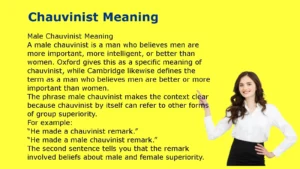
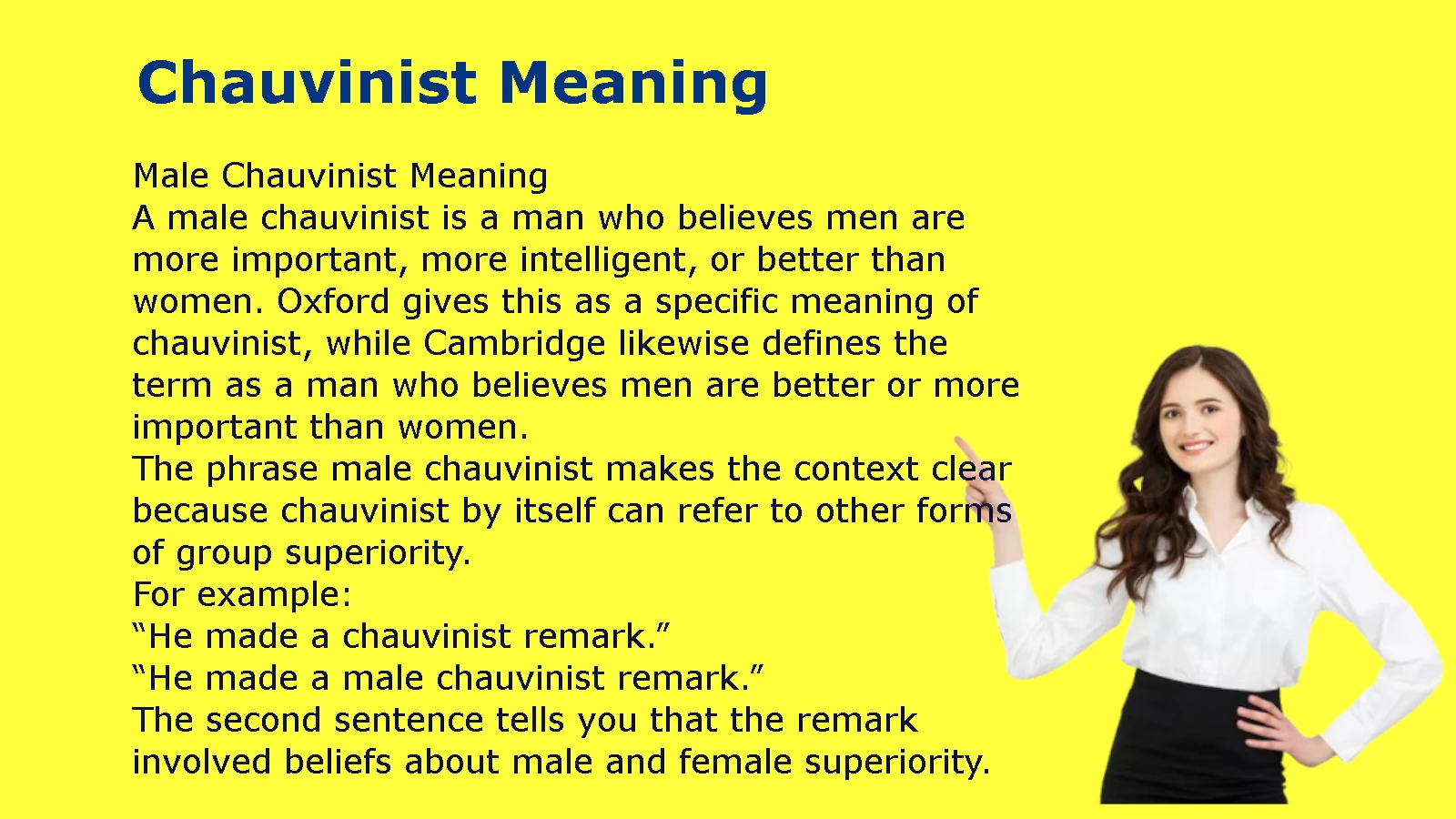
A male chauvinist is a man who believes men are more important, more intelligent, or better than women. Oxford gives this as a specific meaning of chauvinist, while Cambridge likewise defines the term as a man who believes men are better or more important than women.
The phrase male chauvinist makes the context clear because chauvinist by itself can refer to other forms of group superiority.
For example:
- “He made a chauvinist remark.”
- “He made a male chauvinist remark.”
The second sentence tells you that the remark involved beliefs about male and female superiority.
Examples of Male Chauvinism
Male chauvinism can appear in everyday behavior, workplace decisions, relationships, or comments about gender roles.
Examples include:
- Assuming men are naturally better leaders than women.
- Claiming that certain careers should be reserved for men.
- Dismissing a woman’s professional opinion simply because she is a woman.
- Assuming women are incapable of performing physically or intellectually demanding work.
- Expecting women to handle household responsibilities automatically while treating those duties as optional for men.
- Believing that men’s opinions deserve greater weight in family or workplace decisions.
- Treating women’s achievements as less significant than comparable achievements by men.
A single disagreement between a man and a woman doesn’t automatically make either person a chauvinist. Context matters. The defining issue is the belief in gender-based superiority.
Chauvinist Examples
The easiest way to understand chauvinist meaning is to see how the word works in real sentences.
| Example | What it means |
| “He is a chauvinist who believes men make better leaders.” | He believes men are inherently superior in leadership. |
| “Her boss made a chauvinist comment about women in engineering.” | The comment expressed a gender-based superiority belief. |
| “The article criticized chauvinist attitudes in the workplace.” | It criticized beliefs that favor one gender as superior. |
| “His chauvinist behavior made it difficult for female employees to advance.” | His behavior reflected biased beliefs about women. |
| “The country was criticized for chauvinist nationalism.” | The criticism concerned an aggressive belief in national superiority. |
Chauvinist in a Sentence
Here are several natural ways to use the word:
- He was called a chauvinist after repeatedly dismissing his female coworkers.
- The comment sounded chauvinist because it assumed women were less capable than men.
- She challenged the chauvinist belief that leadership belongs primarily to men.
- The novel portrays a chauvinist character who refuses to accept women as professional equals.
- The speech contained strong nationalistic and chauvinist language.
Notice how the surrounding words establish the meaning. In the first three examples, chauvinist relates to gender. In the last example, it relates to nationalism.
What Is a Chauvinist Attitude?
A chauvinist attitude is a mindset that places one group above another and treats that superiority as natural, justified, or unquestionable.
That attitude can show up in several ways.
Assuming Superiority
A person may assume their group is naturally more intelligent, capable, civilized, hardworking, or deserving.
For example, saying “men are naturally better leaders than women” expresses a chauvinist attitude because it assigns greater ability to an entire group based on gender.
Dismissing Individual Differences
Chauvinistic thinking often ignores individual ability.
Instead of evaluating people according to their actual qualifications, performance, or behavior, it judges them according to group identity.
A qualified employee gets overlooked because of gender. A foreign product gets dismissed simply because it comes from another country. A person’s opinion gets rejected because they belong to a particular group.
That is the pattern to watch for.
Treating Superiority as Common Sense
Another feature is the assumption that the hierarchy is obvious.
A chauvinist may not see their belief as prejudice. They may treat it as an ordinary fact that doesn’t need evidence.
That is one reason the word carries a negative meaning in modern English.
Chauvinist vs. Chauvinism
The difference between chauvinist and chauvinism is mainly grammatical.
| Word | Meaning | Example |
| Chauvinist | A person who holds chauvinistic beliefs | “He is a chauvinist.” |
| Chauvinism | The belief, attitude, or behavior itself | “His chauvinism affected his decisions.” |
| Chauvinistic | An adjective describing something that shows chauvinism | “That was a chauvinistic remark.” |
Think of the relationship this way:
Person → chauvinist
Belief or behavior → chauvinism
Describing word → chauvinistic
For example:
“The chauvinist expressed chauvinistic views because of his belief in male superiority.”
The sentence sounds repetitive because all three forms appear together. In ordinary writing, you would usually choose the form that best fits the sentence.
Chauvinist vs. Sexist
Chauvinist and sexist overlap when they describe attitudes toward men and women, but they aren’t exact synonyms.
Sexism concerns prejudice, stereotyping, or discrimination based on sex or gender. Chauvinism places greater emphasis on the belief that one group is superior.
Consider these examples:
“Women aren’t intelligent enough to become engineers.”
This is sexist because it makes a negative assumption about women based on gender. It can also be described as chauvinist because it implies male superiority.
Now consider:
“Women should never be allowed to make decisions in the workplace.”
That statement clearly expresses a belief in male authority or superiority. Calling it male chauvinist would fit the context.
The distinction is useful because sexism is a broader term for gender-based prejudice, while male chauvinism highlights the idea of male superiority.
Chauvinist vs. Misogynist
The words chauvinist and misogynist can overlap, but they carry different shades of meaning.
A misogynist is someone who expresses hatred, contempt, or hostility toward women. A male chauvinist, by contrast, believes men are superior to women.
That means a person can display chauvinism without expressing outright hatred.
For example:
- “Women are naturally better suited to housework than professional careers.”
This expresses a stereotypical belief about women’s role and may be described as male chauvinist.
- “Women are disgusting and should never have authority.”
This goes beyond superiority and expresses hostility or contempt. Misogynistic may therefore be the more precise description.
The two concepts can overlap, but they aren’t interchangeable in every context.
Chauvinist Synonyms
The best synonym depends on which meaning of chauvinist you need.
Synonyms Related to Gender
Depending on context, related terms can include:
- Sexist
- Misogynistic
- Male-supremacist
- Gender-biased
- Prejudiced
These words aren’t perfect replacements in every sentence.
For example, sexist is usually the most natural choice when discussing discrimination based on gender. Misogynistic carries a stronger sense of hostility or contempt toward women.
Synonyms Related to Nationalism
When chauvinist refers to aggressive national pride, related words include:
- Jingoistic
- Ultranationalistic
- Nationalistic
- Militantly patriotic
The word jingoistic is especially useful when the context involves aggressive nationalism or excessive enthusiasm for one’s country’s interests.
Chauvinist Synonyms at a Glance
| Word | Closest meaning | Typical context |
| Sexist | Gender-based prejudice | Gender and discrimination |
| Misogynistic | Hostility or contempt toward women | Strong anti-woman attitudes |
| Jingoistic | Aggressive nationalism | Countries and foreign affairs |
| Prejudiced | Unfair judgment based on group identity | Broad contexts |
| Ultranationalistic | Extreme national loyalty | National identity |
Using the closest word matters because synonyms often differ in intensity and context.
Opposite of Chauvinist
There isn’t one perfect antonym for chauvinist in every situation. The best choice depends on what kind of chauvinism you’re describing.
Useful opposites include:
- Egalitarian
- Fair-minded
- Unbiased
- Tolerant
- Open-minded
- Impartial
Egalitarian is particularly useful when the discussion concerns equality between genders or social groups.
For example:
“Rather than accepting a chauvinist view of gender, she supported an egalitarian approach.”
An egalitarian approach doesn’t claim that every person has identical abilities or preferences. Instead, it rejects the idea that one group is inherently more valuable or deserving than another.
Chauvinist Pronunciation
In American English, chauvinist is pronounced approximately as SHOH-vuh-nist.
The American English IPA is:
/ˈʃoʊvənɪst/
The stress falls on the first syllable.
The word contains three syllables in ordinary American pronunciation. The first syllable carries the main stress, which helps distinguish the natural pronunciation from attempts to pronounce every vowel strongly.
What Is the Origin of Chauvinist?
The history of chauvinist is surprisingly theatrical.
The word ultimately comes from the French name Chauvin, associated with Nicolas Chauvin, a legendary or semi-legendary French soldier famous for extreme devotion to Napoleon and France. The character became popular through the 1831 French vaudeville La Cocarde Tricolore, associated with the Cogniard brothers.
The story matters because the original meaning wasn’t about gender.
It was about excessive nationalism.
The French word chauvinisme emerged in the 19th century to describe exaggerated and unreasonable patriotism. The French Academy’s historical material also connects chauvin with the figure of Nicolas Chauvin and describes the term as referring to exaggerated patriotism and narrow nationalism.
English later adopted chauvinist. Etymonline dates the English noun to 1863, derived from French chauviniste.
Was Nicolas Chauvin a Real Person?
This part of the story needs some care.
Nicolas Chauvin is traditionally presented as a Napoleonic veteran whose exaggerated loyalty became the model for the term. However, etymological sources note that the historical identity of a real individual behind the theatrical character has not been established with certainty.
There are historical references to people named Chauvin connected with Napoleon’s forces, but that doesn’t prove that one specific soldier was the exact person portrayed in the later legend.
So the safest description is that Nicolas Chauvin became a legendary character associated with extreme French patriotism, rather than presenting every detail of the story as established biography.
How Did Chauvinist Come to Mean Male Superiority?
The gender-related meaning developed much later than the original nationalist sense.
Etymonline traces the specialized expression male chauvinist to around 1936, with the expression becoming especially popular from the late 1960s. The broader word chauvinism had already expanded beyond nationalism to describe other forms of group superiority.
That evolution explains why the word can seem to have two different meanings today.
The original concept was roughly:
“My country is superior to yours.”
The broader concept became:
“My group is superior to another group.”
The gender-specific form then became:
“Men are superior to women.”
Modern dictionaries preserve both major senses. Oxford, for example, defines chauvinist both in relation to male superiority and aggressive belief in national superiority.
Is Chauvinist Always About Men?
No.
This is one of the most important points to understand when using the word.
In everyday English, people frequently associate chauvinist with male chauvinism. That’s why someone might hear the word and immediately think of sexism.
However, the word has a broader meaning.
A person who aggressively believes their country is inherently superior to every other country can also be described as a chauvinist. Cambridge specifically includes belief in the superiority of one’s country or race among the meanings of the word.
For example:
“His speeches reflected a strong form of national chauvinism.”
That sentence doesn’t tell you anything about his views on gender. The subject is national superiority.
Chauvinism Beyond Gender
The broader concept can involve:
- National identity
- Race
- Culture
- Gender
- Other social or group identities
The central idea remains the same: unreasonable superiority or devotion to one’s own group at the expense of others.
The context tells you which form is intended.
Chauvinist and Nationalism
These terms can overlap, but nationalism and chauvinism aren’t automatically the same thing.
Nationalism can refer broadly to identification with and political concern for one’s nation. Chauvinism carries a more negative sense of excessive, aggressive, or unreasonable superiority.
That distinction matters.
A person can say:
“I care deeply about my country’s history and culture.”
That statement doesn’t establish chauvinism.
By contrast:
“Our country is naturally superior to every other country, and other nations are worthless.”
That expresses the kind of aggressive superiority associated with national chauvinism.
Oxford defines chauvinism in its national sense as an aggressive and unreasonable belief that one’s own country is better than all others.
Chauvinist vs. Patriotic
Patriotic and chauvinist shouldn’t be treated as synonyms.
Patriotism can describe affection, loyalty, or pride toward one’s country. Chauvinism adds an element of unreasonable superiority.
| Expression | Basic idea |
| Patriotic | Proud or supportive of one’s country |
| Nationalistic | Strong identification with one’s nation or its interests |
| Chauvinist | Excessively or unreasonably believes one’s country or group is superior |
| Jingoistic | Aggressively nationalistic, especially in matters involving conflict |
The key difference is simple: pride isn’t automatically superiority.
That distinction helps prevent the word from being used too broadly.
Chauvinistic Meaning
Chauvinistic is the adjective related to chauvinist and chauvinism.
It describes something that expresses chauvinism.
For example:
- chauvinistic attitude
- chauvinistic behavior
- chauvinistic remark
- chauvinistic belief
- chauvinistic nationalism
Oxford defines chauvinistic as describing a belief that men are more important, intelligent, or better than women. It also uses the adjective for aggressive and unreasonable national superiority.
Chauvinist vs. Chauvinistic
The difference is similar to the difference between a person and the quality or behavior associated with that person.
- Chauvinist: “He is a chauvinist.”
- Chauvinistic: “He made a chauvinistic remark.”
- Chauvinism: “His chauvinism affected his behavior.”
These forms are related, but they serve different grammatical roles.
Common Uses of Chauvinist
Some phrases appear frequently enough to be worth recognizing.
Male Chauvinist
This is the most familiar gender-related expression.
“The article criticized male chauvinists in the workplace.”
It specifically points to men who believe men are superior to women.
Chauvinist Attitude
This phrase describes the mindset behind the behavior.
“Her manager’s chauvinist attitude affected how he evaluated female employees.”
Chauvinist Remark
A remark can be described as chauvinist when it expresses group superiority.
“His chauvinist remark drew criticism from his coworkers.”
Chauvinist Behavior
This focuses on actions rather than individual comments.
“The organization introduced policies to address discriminatory and chauvinist behavior.”
Chauvinist Pig
Chauvinist pig is a strongly insulting expression, particularly associated with the idea of a man who displays sexist or male-supremacist attitudes.
Oxford lists male chauvinist pig as a phrase associated with the word.
Because pig makes the expression deliberately insulting, it’s more forceful than simply calling someone a male chauvinist.
Common Mistakes When Using Chauvinist
Mistake: Thinking It Only Means Sexist
The gender-related meaning is common, but it isn’t the entire definition.
A chauvinist can also show unreasonable national or group superiority.
Mistake: Treating Chauvinist and Chauvinism as Identical
They aren’t.
Chauvinist normally identifies the person.
Chauvinism identifies the belief, attitude, or behavior.
Mistake: Calling Ordinary Patriotism Chauvinism
Loving your country doesn’t automatically make you a chauvinist.
The word generally carries the additional idea of excessive or unreasonable superiority.
Mistake: Treating Chauvinist and Misogynist as Perfect Synonyms
A misogynist expresses hatred, contempt, or hostility toward women. A chauvinist emphasizes superiority.
The concepts may overlap, but the words aren’t interchangeable in every sentence.
Mistake: Assuming Only Men Can Be Chauvinists
The gender-specific expression male chauvinist refers to men who believe men are superior to women. However, the broader concept of chauvinism isn’t inherently limited to men.
The broader dictionary definition concerns superiority of one’s country, race, gender, or group.
A Simple Case Study: Understanding Chauvinist Through Context
Consider two workplace situations.
Situation One: Personal Disagreement
A male manager disagrees with a female employee’s proposal.
He explains why he thinks the proposal would cost too much and provides evidence to support his position.
That disagreement alone doesn’t make him a chauvinist.
People can disagree without expressing gender-based prejudice.
Situation Two: Gender-Based Assumption
Now imagine the same manager says:
“I don’t think women are suited to leadership roles, so I wouldn’t put a woman in charge of this project.”
The issue has changed.
The decision now rests on a generalized belief that women are inferior leaders rather than on the employee’s qualifications or the proposal itself.
That is the kind of attitude described as male chauvinist.
The comparison shows why context matters more than a single action or disagreement.
Frequently Asked Questions About Chauvinist
What does chauvinist mean in simple words?
Chauvinist means a person who believes their own group is superior to another group. In modern everyday English, it often refers to a man who believes men are better or more important than women.
What is a male chauvinist?
A male chauvinist is a man who believes men are more important, intelligent, capable, or valuable than women.
Is chauvinist the same as sexist?
Not exactly. The terms overlap when discussing gender. Sexist focuses on prejudice or discrimination based on sex or gender, while chauvinist emphasizes a belief in the superiority of one’s group.
Is chauvinist the same as misogynist?
No. A misogynist expresses hatred, contempt, or hostility toward women. A chauvinist emphasizes superiority. A person can display both attitudes.
Can a woman be a chauvinist?
The broader word chauvinist isn’t restricted to men. It can describe someone who shows unreasonable belief in the superiority of their own group. However, male chauvinist specifically refers to a man who believes men are superior to women.
What is the opposite of chauvinist?
Depending on the context, useful opposites include egalitarian, fair-minded, unbiased, tolerant, and impartial.
What is an example of a chauvinist?
A person who says that men are naturally better leaders than women is expressing a male chauvinist belief. Someone who insists that their country is inherently superior to every other country may display national chauvinism.
Is chauvinist a negative word?
Yes. Chauvinist is generally used negatively or critically because it describes an unreasonable belief in the superiority of one group over another. Oxford labels the term as disapproving.
Where does the word chauvinist come from?
The English word comes from French chauviniste, based on Chauvin, the legendary or semi-legendary French soldier associated with exaggerated devotion to Napoleon and France. English chauvinist dates to the 19th century.
What does chauvinistic mean?
Chauvinistic is an adjective meaning that something expresses chauvinism. It can describe an attitude, comment, behavior, or belief involving unreasonable group superiority.
What is chauvinism?
Chauvinism is the belief or behavior associated with chauvinists. It can refer to aggressive national superiority or, in the gender-related sense, the belief that men are superior to women.
Final Takeaway
The core chauvinist meaning is simple: a chauvinist is someone who shows an unreasonable belief that their own group is superior to another group.
In contemporary English, the word often appears in the phrase male chauvinist, which refers to a man who believes men are better, more important, or more capable than women. However, the original meaning centered on extreme nationalism rather than gender.
The easiest way to remember the related forms is:
| Word | Meaning |
| Chauvinist | A person who believes their group is superior |
| Male chauvinist | A man who believes men are superior to women |
| Chauvinism | The belief or behavior itself |
| Chauvinistic | Describes something expressing chauvinism |
The word’s history makes its modern meaning especially interesting. It began with a legendary figure associated with exaggerated patriotism, expanded into the broader idea of group superiority, and later developed its familiar gender-related sense.
When you see chauvinist in a sentence, look at the group being treated as superior. That context usually tells you whether the writer means male chauvinism, national chauvinism, or another form of group-based superiority.