Have you ever wondered whether tumor or tumour is the correct spelling? The difference between Tumor vs Tumour can be confusing because both forms are widely used, yet the spelling you choose depends mainly on the type of English, country, and writing context.
Tumor and tumour have the same meaning. Both refer to an abnormal mass of tissue that forms when cells grow or divide in an unusual way. Tumor is the standard spelling in American English, while tumour is traditionally preferred in British English and other varieties that follow British spelling conventions.
Examples:
- The doctor found a small tumor during the examination.
- The scan revealed a small tumour in the affected area.
The confusion is understandable. People often search for tumor vs tumour, tumor or tumour, which spelling is correct, or tumour meaning in English because both spellings are accepted, but they follow different spelling conventions. And here’s the kicker: neither spelling changes the word’s meaning or pronunciation.
In this guide, you’ll learn the complete difference between Tumor vs Tumour, including their meaning, pronunciation, origin, correct spelling, and usage. You’ll also discover which spelling to use in American English vs British English, along with clear examples to help you choose the right form.
Tumor vs Tumour: Quick Answer
The simplest answer is this:
Tumor is the American English spelling, while tumour is the British English spelling.
They have the same meaning and refer to the same medical concept.
| Feature | Tumor | Tumour |
| English variety | American English | British English |
| Meaning | Abnormal mass of tissue | Abnormal mass of tissue |
| Pronunciation | Generally the same | Generally the same |
| Medical meaning | Same | Same |
| Plural | tumors | tumours |
| Common example | brain tumor | brain tumour |
| Correct in US English | Yes | No, generally use tumor |
| Correct in British English | Generally not the preferred form | Yes |
Cambridge identifies tumor as the US form and tumour as the UK form. Major medical sources such as the National Cancer Institute use tumor in their US English terminology.
The important point is that the extra “u” doesn’t create a different medical term.
What Does Tumor Mean?
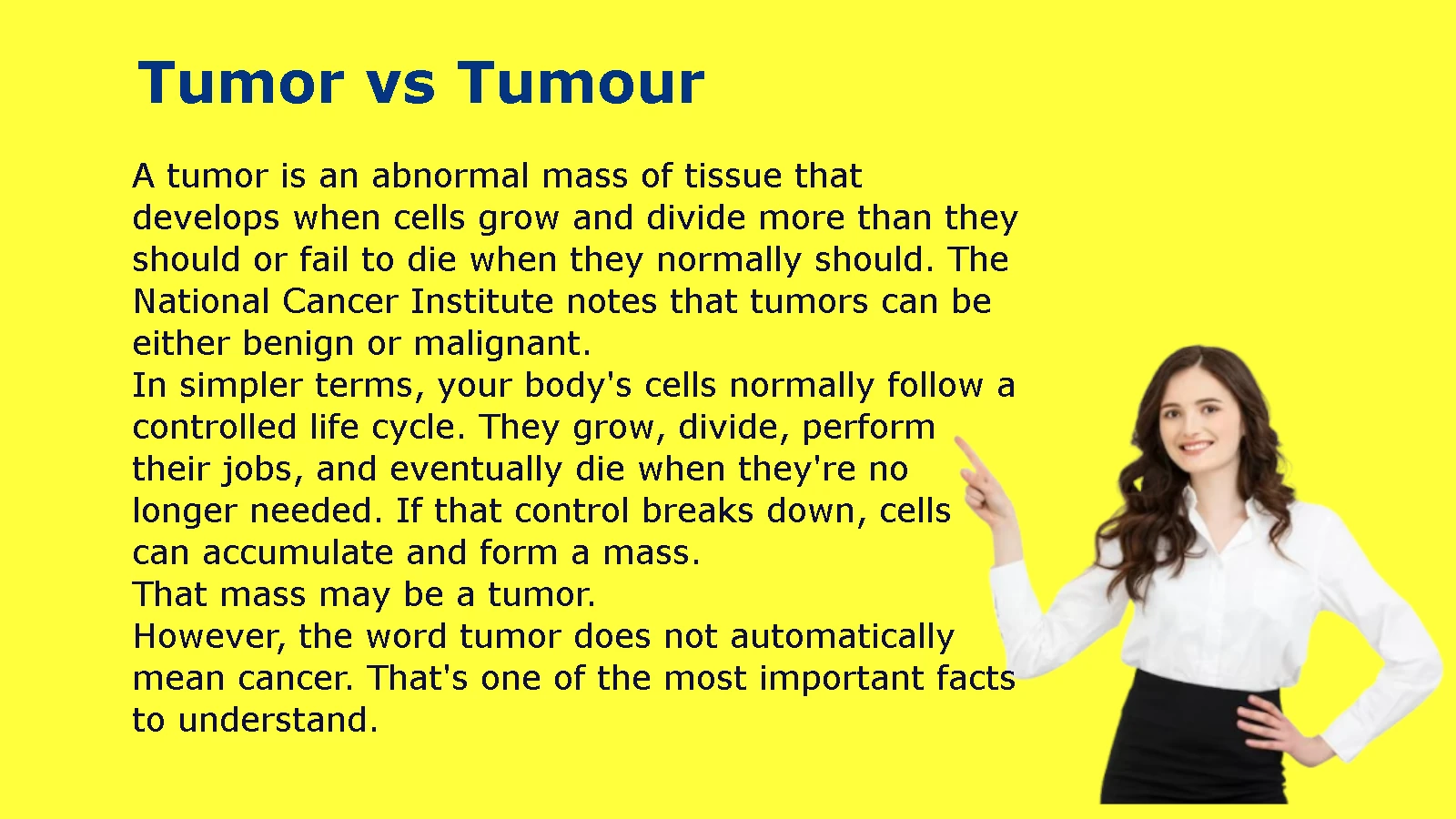
A tumor is an abnormal mass of tissue that develops when cells grow and divide more than they should or fail to die when they normally should. The National Cancer Institute notes that tumors can be either benign or malignant.
In simpler terms, your body’s cells normally follow a controlled life cycle. They grow, divide, perform their jobs, and eventually die when they’re no longer needed. If that control breaks down, cells can accumulate and form a mass.
That mass may be a tumor.
However, the word tumor does not automatically mean cancer. That’s one of the most important facts to understand.
A tumor may be:
- Benign, meaning it isn’t cancer.
- Malignant, meaning it is cancerous.
- Located in many different parts of the body.
- Small and harmless or large enough to cause significant problems, depending on its location and characteristics.
The National Cancer Institute also uses neoplasm as another term for a tumor.
Tumor Examples
You’ll commonly see tumor in phrases such as:
- brain tumor
- breast tumor
- lung tumor
- benign tumor
- malignant tumor
- tumor cells
- tumor growth
- tumor tissue
- tumor treatment
- tumor diagnosis
For example:
The scan revealed a small tumor in the patient’s brain.
Here, tumor simply identifies an abnormal mass. The word itself doesn’t tell you whether the mass is benign or malignant.
What Does Tumour Mean?
Tumour means exactly the same thing as tumor. The difference is spelling.
The -our form is the standard British spelling. British dictionaries list tumour as the British form and tumor as the American form.
For example:
Doctors discovered a benign tumour during the examination.
A British English writer might also write:
- brain tumour
- breast tumour
- lung tumour
- benign tumour
- malignant tumour
- tumour cells
- tumour growth
None of these phrases describes a different condition from their American counterparts.
Tumour Examples
Consider these British English sentences:
The scan showed a small tumour.
Doctors confirmed that the tumour was benign.
The patient was treated for a brain tumour.
If you changed tumour to tumor, the medical meaning would remain unchanged. Only the regional spelling would change.
Tumor vs Tumour: What’s the Difference?
The difference between tumor and tumour comes down to English spelling conventions.
American English generally uses the shorter -or ending:
- tumor
- color
- favor
- honor
- labor
British English commonly retains -our in these words:
- tumour
- colour
- favour
- honour
- labour
This pattern isn’t absolute across English. Many words ending in -or remain the same in both varieties, such as author and actor. Still, tumor/tumour fits the well-known American -or versus British -our pattern.
| American English | British English |
| tumor | tumour |
| color | colour |
| favor | favour |
| honor | honour |
| labor | labour |
| behavior | behaviour |
So if you’re learning American English, tumor is the spelling to remember.
If you’re learning British English, tumour is the natural choice.
Is Tumor or Tumour Correct?
Both are correct. The right choice depends on the variety of English you’re using.
For American English, use:
tumor
For British English, use:
tumour
Neither spelling is inherently more correct.
The mistake occurs when a writer treats one regional spelling as a misspelling in all forms of English. A British medical article can correctly use tumour, while an American medical article can correctly use tumor.
Which Spelling Should You Use?
Use this quick rule:
- Writing for the United States: tumor
- Writing for the United Kingdom: tumour
- Following an American style guide: tumor
- Following a British style guide: tumour
- Writing for an international audience: choose one variety and remain consistent
- Quoting a source: preserve the original spelling when appropriate
Consistency matters more than trying to make one spelling universal.
Tumor or Tumour in American English
In American English, tumor is the standard form.
You’ll see it throughout US medical terminology, including resources from the National Cancer Institute. The NCI defines a tumor as an abnormal mass of tissue that develops when cells grow and divide excessively or don’t die when they should.
Common American English expressions include:
- brain tumor
- benign tumor
- malignant tumor
- tumor cells
- tumor growth
- tumor treatment
- tumor biopsy
- tumor tissue
For example:
The doctor ordered additional tests to determine whether the tumor was benign or malignant.
The spelling is particularly easy to recognize in American medical writing because the same -or pattern appears in words such as color, behavior, and labor.
Tumor or Tumour in British English
British English normally uses tumour.
For example:
The scan revealed a small tumour near the affected tissue.
You may encounter this spelling in British medical writing, newspapers, educational materials, and general communication.
Common expressions include:
- brain tumour
- benign tumour
- malignant tumour
- tumour cells
- tumour growth
- tumour treatment
- tumour tissue
- tumour biopsy
The meaning remains identical to the American tumor.
This is why switching between tumor and tumour doesn’t represent a change in diagnosis. It represents a change in spelling convention.
Why Do Tumor and Tumour Have Different Spellings?
The history of tumor/tumour goes back much further than modern American and British English.
The word comes from the Latin tumor, meaning “swelling”, from the Latin verb tumēre, meaning “to swell.” Historical sources trace the English word back to this Latin origin.
English later developed different spelling conventions on opposite sides of the Atlantic.
American English adopted many simplified spellings ending in -or, while British English retained -our in numerous words. Noah Webster played a major role in standardizing American spelling conventions, although the history of these endings involves earlier French and English spelling traditions as well.
That’s why the spelling difference isn’t unique to tumor.
Compare:
British English:
tumour, colour, honour, favour
American English:
tumor, color, honor, favor
The extra u doesn’t add a different meaning. It’s simply part of the regional spelling system.
How Do You Pronounce Tumor and Tumour?
In ordinary modern usage, tumor and tumour are pronounced essentially the same within their respective English varieties.
Cambridge gives US pronunciation around /ˈtuː.mɚ/ and UK pronunciation around /ˈtʃuː.mə/.
The important thing to notice is that the spelling difference isn’t normally reflected by an extra syllable or an extra sound.
The word generally has two syllables:
TOO-mer
In British pronunciation, the initial sound may differ from the common American pronunciation.
So don’t assume that the u in tumour needs to be pronounced as a separate sound. It doesn’t.
Tumor vs Cancer: Are They the Same?
No. Tumor and cancer aren’t interchangeable terms.
A tumor is an abnormal mass of tissue. Cancer is a group of diseases characterized by abnormal cells that can grow uncontrollably and, in many cases, invade nearby tissue or spread to other parts of the body.
Some tumors are cancerous. Others aren’t.
Think of tumor as a description of a type of abnormal mass, while malignant tumor identifies a cancerous tumor.
A Simple Way to Remember It
Tumor ≠ automatically cancer
Instead:
Tumor → benign or malignant
Malignant tumor → cancerous
That distinction matters because saying that every tumor is cancer can give readers a misleading picture of a medical diagnosis.
Benign Tumor vs Malignant Tumor
The two broad categories are benign and malignant.
What Is a Benign Tumor?
A benign tumor is not cancer. According to the National Cancer Institute, it doesn’t invade nearby tissue or spread to other parts of the body.
That doesn’t mean every benign tumor is completely insignificant.
A benign tumor can still become a medical problem if it grows large or develops in a sensitive location. A mass inside the brain, for example, can cause serious effects simply because the skull leaves limited room for additional tissue. The NCI notes that some benign tumors can be large or cause serious symptoms.
What Is a Malignant Tumor?
A malignant tumor is cancerous.
Malignant cells can invade nearby tissues and may spread to distant parts of the body through processes such as metastasis.
This distinction is more important medically than the spelling difference between tumor and tumour.
Benign vs Malignant at a Glance
| Feature | Benign tumor | Malignant tumor |
| Cancerous? | No | Yes |
| Can grow? | Yes | Yes |
| Invades nearby tissue? | Generally no | Can |
| Can spread to distant sites? | No | Can |
| Can cause serious problems? | Yes, depending on location and size | Yes |
| Other term | Noncancerous tumor | Cancerous tumor |
The key takeaway is simple: benign does not mean “nothing to worry about,” and tumor does not automatically mean cancer.
Common Words and Phrases With Tumor and Tumour
The spelling changes in related phrases too.
If you’re using American English, write:
- brain tumor
- breast tumor
- lung tumor
- benign tumor
- malignant tumor
- tumor cells
- tumor growth
- tumor tissue
In British English, write:
- brain tumour
- breast tumour
- lung tumour
- benign tumour
- malignant tumour
- tumour cells
- tumour growth
- tumour tissue
Notice the pattern. Once you choose your regional spelling, the same spelling carries through the phrase.
Tumor vs Tumour Examples in Sentences
Parallel examples make the distinction easy to see.
American English Examples
The doctor discovered a benign tumor during the examination.
The MRI revealed a small brain tumor.
Researchers studied how the tumor responded to treatment.
The pathology report identified the tumor as malignant.
British English Examples
The doctor discovered a benign tumour during the examination.
The MRI revealed a small brain tumour.
Researchers studied how the tumour responded to treatment.
The pathology report identified the tumour as malignant.
The medical information remains the same. Only the regional spelling changes.
A Practical Case Study: Choosing the Right Spelling
Imagine that you’re writing a medical information page for an American hospital.
Your draft contains:
The patient was diagnosed with a brain tumour.
The sentence isn’t meaningless, and tumour isn’t an invented word. However, if the hospital follows American English conventions, brain tumor would be the appropriate spelling.
Now reverse the situation.
Suppose you’re preparing an educational article for a British publication. In that setting, brain tumour fits the expected spelling.
The lesson is useful beyond this one word:
Match your spelling to your intended variety of English.
You don’t need to decide which form is universally correct. You need to decide which English convention your document follows.
Tumor vs Tumour in Medical Writing
Medical writing requires extra care because readers may interpret terminology very precisely.
If you’re preparing a report, article, patient-information page, academic paper, or educational resource, follow the spelling convention required by the relevant institution or publication.
For American English, tumor is the natural choice.
For British English, tumour is the natural choice.
More importantly, don’t let the spelling distinction distract from the actual medical terminology. A medical writer should also distinguish accurately between:
- tumor and cancer
- benign and malignant
- tumor and cyst
- primary tumor and metastatic tumor
- tumor growth and metastasis
A spelling correction can’t compensate for an inaccurate medical explanation.
Tumor vs Tumour and the Word “Neoplasm”
Neoplasm is another important medical term related to tumor.
The National Cancer Institute defines a neoplasm as an abnormal mass of tissue formed when cells grow and divide excessively or don’t die when they should. It can be benign or malignant.
So you may encounter language such as:
- neoplasm
- neoplastic growth
- benign neoplasm
- malignant neoplasm
- tumor
- tumor growth
In many contexts, neoplasm is more technical, while tumor is more familiar to general readers.
For patient-facing writing, tumor is usually easier to understand. For specialized medical contexts, neoplasm may appear more frequently.
Tumor vs Tumour: Plural Forms
The plural forms follow the same regional distinction.
American English:
tumor → tumors
British English:
tumour → tumours
For example:
The study examined several tumors.
British English:
The study examined several tumours.
The plural doesn’t introduce another meaning. It simply adds the standard English plural ending while retaining the regional spelling.
Tumor vs Tumour: Related US and UK Spellings
The tumor/tumour distinction makes more sense when you see it alongside similar spelling pairs.
| US English | UK English |
| tumor | tumour |
| color | colour |
| behavior | behaviour |
| favor | favour |
| honor | honour |
| labor | labour |
| rumor | rumour |
| neighbor | neighbour |
These pairs show a recurring pattern in which American English commonly uses -or and British English commonly uses -our.
However, don’t turn this into a rigid rule for every word. English spelling contains plenty of exceptions, so check the specific word when you’re unsure.
Common Mistakes With Tumor and Tumour
Mistake: Treating Tumor and Tumour as Different Conditions
This is the biggest misunderstanding.
Tumor and tumour don’t describe two different diseases. They’re regional spellings of the same word.
Mistake: Assuming Every Tumor Is Cancer
A tumor can be benign or malignant.
The NCI specifically explains that tumors may be noncancerous or cancerous.
So this statement is too broad:
Every tumor is cancer.
A more accurate statement is:
Some tumors are cancerous, while others are benign.
Mistake: Calling Tumour a Misspelling
If you’re accustomed to American English, tumour may look unusual. That doesn’t make it incorrect.
Tumour is the standard British spelling.
Mistake: Using Tumor in Every English Variety
Likewise, American spelling isn’t automatically the preferred spelling everywhere.
If you’re writing specifically for a British audience, tumour is the expected form.
Mistake: Mixing Spellings Randomly
A document that uses tumor in one paragraph and tumour in another can look inconsistent.
For example:
The patient had a brain tumor. The tumour was later examined.
Unless you’re intentionally discussing or quoting different sources, choose one spelling system and stick with it.
Tumor vs Tumour: Which One Should You Use?
The choice becomes easy once you know your audience.
Use “Tumor” When:
- You’re writing in American English.
- Your audience is primarily in the United States.
- Your organization uses American spelling.
- A US publication or style guide specifies the spelling.
- You’re following an American medical source’s terminology.
Use “Tumour” When:
- You’re writing in British English.
- Your audience is primarily in the United Kingdom.
- Your publication follows British spelling.
- Your institution uses British English conventions.
- You’re preserving the spelling of a British source.
For International Content
International websites sometimes face a tricky choice because readers may come from many English-speaking countries.
The best approach is usually to establish one spelling convention for the page or site and use it consistently.
For example, an American English article can consistently use:
tumor, tumors, behavior, color
A British English article can consistently use:
tumour, tumours, behaviour, colour
You can also mention the alternative spelling when it helps readers find or understand the information.
Tumor vs Tumour: Does the Spelling Affect SEO?
For search-focused content, both spellings can matter because people search using the spelling familiar to their region.
A US-focused page should naturally use tumor as its primary form. A UK-focused page may naturally use tumour.
However, there’s no need to force both spellings into every sentence. That creates awkward writing and can reduce readability.
Instead, use relevant variations naturally:
- tumor vs tumour
- tumor meaning
- tumour meaning
- tumor definition
- tumour definition
- benign tumor
- benign tumour
- malignant tumor
- malignant tumour
- tumor spelling
- tumour spelling
- American spelling
- British spelling
The goal is to answer the reader’s question clearly, not to repeat the same keyword until the prose sounds robotic.
Tumor vs Tumour: Quick Comparison
| Question | Answer |
| Are tumor and tumour different words? | They are spelling variants of the same word. |
| Do they have the same meaning? | Yes. |
| Is tumor American English? | Yes. |
| Is tumour British English? | Yes. |
| Do they usually have the same meaning in medicine? | Yes. |
| Does a tumor always mean cancer? | No. |
| Can a tumor be benign? | Yes. |
| Can a tumor be malignant? | Yes. |
| What is the plural of tumor? | tumors |
| What is the plural of tumour? | tumours |
| Are they pronounced exactly the same in every accent? | Pronunciation varies by English variety, but the spelling difference itself doesn’t create a separate medical term. |
| Which should US writers use? | tumor |
| Which should British writers use? | tumour |
Tumor vs Tumour: Key Facts to Remember
If you only remember a handful of points, make them these:
- Tumor is the standard American English spelling.
- Tumour is the standard British English spelling.
- Both words refer to an abnormal mass of tissue.
- The spelling difference doesn’t represent a different disease.
- Tumors can be benign or malignant.
- A benign tumor is not cancer.
- A malignant tumor is cancerous.
- The plural forms are tumors and tumours.
- The word ultimately comes from Latin tumor, meaning swelling.
- Good writing should match the spelling to the intended English variety and remain consistent.
Frequently Asked Questions About Tumor vs Tumour
Is tumor American or British spelling?
Tumor is the standard American English spelling. British English generally uses tumour.
Is tumour British spelling?
Yes. Tumour is the standard British English spelling, while American English uses tumor.
Do tumor and tumour mean the same thing?
Yes. They have the same basic meaning. The difference is primarily regional spelling.
Are tumor and tumour pronounced differently?
The spelling itself doesn’t create a different medical term or pronunciation. Pronunciation can vary between American and British English, as it does with many words.
Is every tumor cancerous?
No. Tumors may be benign or malignant. A benign tumor isn’t cancer, while a malignant tumor is cancerous.
Which spelling should I use in American English?
Use tumor.
The patient was diagnosed with a benign tumor.
Which spelling should I use in British English?
Use tumour.
The patient was diagnosed with a benign tumour.
What is the plural of tumor?
The American English plural is tumors.
What is the plural of tumour?
The British English plural is tumours.
Is a tumor the same as a neoplasm?
In medical terminology, neoplasm is a term used for an abnormal mass of tissue, and the National Cancer Institute lists tumor as another term for it. Both can be benign or malignant.
What is the difference between a tumor and cancer?
A tumor is an abnormal mass of tissue. Cancer is a disease in which abnormal cells grow uncontrollably and can invade or spread. Some tumors are cancerous, but not all tumors are cancer.
Conclusion: Tumor vs Tumour
The difference between tumor and tumour is much simpler than it first appears.
Tumor is the standard American English spelling. Tumour is the standard British English spelling. Both describe an abnormal mass of tissue, and neither spelling indicates a different medical condition.
The bigger medical distinction isn’t tumor vs tumour. It’s benign vs malignant. A benign tumor isn’t cancer, while a malignant tumor is cancerous and can invade nearby tissue or spread to other parts of the body.
So, when you’re writing, match the spelling to your audience. For US English, choose tumor. For British English, choose tumour. Most importantly, use the chosen spelling consistently.