Have you ever wondered whether lighted or lit is the correct form to use? Lighted vs Lit can be confusing because both words are used as forms of the verb light, yet their usage can vary depending on the context, style, and type of English being used.
Lighted and lit can both function as the past tense and past participle of light. In general, lit is more common in everyday English, especially when talking about something that has been set on fire or made bright. Lighted is also correct and is often used before a noun as an adjective, particularly in expressions such as a lighted candle or a lighted path.
Examples:
- She lit a candle before dinner.
- The lighted candles made the room feel warm and inviting.
The confusion is understandable. People often search for lighted vs lit, lighted or lit, which is correct, or is lighted a word because both forms are grammatically valid, but they do not always sound equally natural in every sentence. In many situations, lit is the more natural choice, while lighted can work better when describing something that is illuminated.
In this guide, you’ll learn the complete difference between Lighted vs Lit, including their meaning, pronunciation, grammar, correct usage, and examples. You’ll also discover when to use lit or lighted in different contexts, so you can choose the form that sounds natural and fits your sentence.
Lighted vs Lit at a Glance
Here’s the quick answer before getting into the details:
| Word | Grammatical role | Typical use | Example |
| lit | Past tense | Commonly describes a completed lighting action | She lit the candle. |
| lit | Past participle | Used with has, have, had, or passive constructions | The candles were lit. |
| lighted | Past tense | Correct but less common in many everyday sentences | She lighted the candle. |
| lighted | Past participle | Correct, especially in some descriptive contexts | The room was lighted by candles. |
| lighted | Adjective | Common before nouns in descriptive phrases | A lighted candle sat on the table. |
Merriam-Webster gives the verb forms as “lit or lighted; lighting,” confirming that both forms belong to the standard verb paradigm.
The easiest practical rule is this:
Use “lit” as your default for most ordinary past-tense sentences. Use “lighted” when it fits naturally as a descriptive form, especially before a noun.
That isn’t an absolute grammatical law. It’s a useful guide to natural modern usage.
What Does “Lit” Mean?
Lit is the irregular past tense and past participle of light when light means to ignite something or illuminate something.
Merriam-Webster lists lit alongside lighted as a form of the verb. Oxford lists lit as both the past simple and past participle.
Lit as the Past Tense of Light
When someone performs the action of lighting something in the past, lit is usually the most natural choice.
For example:
- She lit a candle.
- He lit the fireplace.
- Maria lit a match.
- They lit the lantern.
- I lit the grill before dinner.
- Someone lit a cigarette outside.
Notice the pattern. The sentence focuses on what someone did.
She lit the candle.
The verb lit tells you that she caused the candle to begin burning.
This is the form you’ll most often want in everyday American English.
Lit as a Past Participle
Lit also works as a past participle.
You’ll see it after helping verbs such as has, have, and had:
- She has lit the candles.
- He had lit the fire before everyone arrived.
- They have lit the lanterns.
- We had already lit the fireplace.
It also appears in passive constructions:
- The candles were lit before dinner.
- The stage was lit by bright spotlights.
- The street was lit by rows of lamps.
Oxford gives examples such as “The candles were lit” and “The stage was lit by bright spotlights.”
Lit as an Adjective
Lit can also function adjectivally when it describes something that is illuminated or burning.
For example:
- a lit candle
- a lit match
- a lit hallway
- a lit stage
- a lit street
Consider this sentence:
A lit candle stood beside the window.
Here, lit describes the state of the candle. The sentence isn’t emphasizing the act of lighting it. Instead, it tells you that the candle was already burning.
There’s another important meaning of lit in modern informal English. In slang, lit can mean exciting, excellent, or highly enjoyable.
For example:
The party was lit.
That meaning has nothing to do with lighting a candle. It comes from a separate informal use of the word, so context matters.
What Does “Lighted” Mean?
Lighted is also a legitimate form of the verb light.
It can work as a past-tense verb, a past participle, or an adjective. The important point is that “lighted” isn’t grammatically wrong simply because “lit” is more common in many situations.
Merriam-Webster explicitly lists lighted as a form of light.
Lighted as the Past Tense
You can use lighted to describe a completed action.
For example:
- She lighted the candle.
- He lighted the lamp.
- They lighted the fire.
- She lighted a match.
These sentences are grammatically possible.
However, in ordinary modern American conversation, lit will often sound more natural:
She lit the candle.
rather than:
She lighted the candle.
That doesn’t make the second sentence incorrect. It simply means that English speakers often favor the shorter irregular form when describing the action directly.
Lighted as a Past Participle
Lighted can also function as a past participle.
For example:
- The room was lighted by several lamps.
- The candles had been lighted before the guests arrived.
- The stage was lighted from above.
Again, lit can often appear in the same places:
- The room was lit by several lamps.
- The candles had been lit before the guests arrived.
- The stage was lit from above.
Oxford specifically says that lighted is used for the past tense and past participle, especially in front of nouns.
Lighted as an Adjective
This is where lighted becomes particularly useful.
Oxford defines lighted as an adjective for something that is burning or illuminated. Its examples include “a lighted candle” and “a lighted window.”
For example:
- a lighted candle
- a lighted match
- a lighted cigarette
- a lighted window
- a lighted sign
- a lighted path
Consider the difference between these two sentences:
She lit a candle.
A lighted candle stood on the table.
The first sentence emphasizes the action. The second emphasizes the condition or appearance of the candle.
That’s one of the most useful distinctions to remember.
What Is the Difference Between Lighted and Lit?
The basic difference isn’t that one is correct and the other is wrong. Both are valid.
Instead, the difference largely involves usage and style.
Use “Lit” for Most Everyday Actions
When you’re describing someone lighting something, lit is usually the natural choice.
For example:
- He lit the fire.
- She lit a candle.
- I lit the stove.
- They lit the lantern.
- We lit the fireplace.
The same principle applies to many figurative expressions.
Her face lit up when she heard the news.
Merriam-Webster lists lit in examples involving things becoming bright or being illuminated, including the familiar expression “lit up.”
“Lighted” Often Works Well Before a Noun
Lighted has a particularly natural role when it directly describes a noun.
For example:
- a lighted candle
- a lighted match
- a lighted sign
- a lighted window
- a lighted path
Oxford’s American English entry specifically identifies this pattern.
You can think of it as a difference in emphasis:
Action:
She lit the candle.
Description:
She held a lighted candle.
The distinction isn’t absolute. You can also say “a lit candle.” English simply gives you both options.
Lighted vs Lit as Past Tense and Past Participle
Understanding the verb forms makes this comparison much easier.
| Verb form | Common form | Alternative form |
| Present | light | light |
| Third-person singular | lights | lights |
| Past tense | lit | lighted |
| Past participle | lit | lighted |
| Present participle | lighting | lighting |
Oxford gives lit as the past simple and past participle while noting that lighted is also used for those forms, particularly before nouns.
Simple Past Examples
The simple past describes a completed action:
- She lit the candle.
- He lit the fire.
- She lighted the candle.
- He lighted the fire.
All four sentences can be grammatically valid.
The first pair is generally more natural in everyday modern usage.
Past Participle Examples
The past participle appears in perfect and passive constructions:
- She has lit the candle.
- She has lighted the candle.
- They had lit the fire.
- They had lighted the fire.
- The candles were lit.
- The candles were lighted.
Again, neither form needs to be treated as an error simply because another version is more common.
When Should You Use “Lit”?
If you’re unsure which form to choose, lit is usually the safest everyday option.
Use lit when:
- you’re describing a completed lighting action
- you’re writing ordinary conversational American English
- someone ignites a candle, match, fire, lamp, cigarette, or similar object
- something becomes illuminated
- you’re using common expressions such as lit up
- you want a concise, natural-sounding sentence
Examples of Lit in Everyday Sentences
She lit the candle before dinner.
He lit the fireplace because the room was cold.
Someone lit a match in the dark.
The moon lit the path ahead.
Her smile lit up the room.
The stage was brightly lit.
The word works smoothly in each example because the sentence focuses on an action or resulting state.
When Should You Use “Lighted”?
Use lighted when it fits the structure and tone of your sentence naturally.
It’s especially useful when lighted functions as a descriptive adjective before a noun.
For example:
- a lighted candle
- a lighted match
- a lighted sign
- a lighted window
- a lighted path
Oxford’s dictionary examples support these descriptive uses.
Lighted Can Sound More Deliberately Descriptive
Compare:
A lit candle stood beside the bed.
and:
A lighted candle stood beside the bed.
Both work. The second can feel slightly more deliberate or descriptive because lighted clearly functions as a modifier before candle.
That doesn’t mean writers must always choose lighted before nouns. Lit candle is perfectly normal too.
The important lesson is to avoid turning a tendency into a rigid rule.
Lighted vs Lit Examples
The easiest way to see the distinction is to put the forms side by side.
| Sentence with lit | Sentence with lighted | Practical difference |
| She lit a candle. | She lighted a candle. | Both are correct. Lit is more natural for the action. |
| He lit the fireplace. | He lighted the fireplace. | Both describe the completed action. |
| The candles were lit. | The candles were lighted. | Both work as past participles. |
| A lit candle sat nearby. | A lighted candle sat nearby. | Both can describe the candle. |
| The room was lit by lamps. | The room was lighted by lamps. | Both describe illumination. |
| The street was well-lit. | The street was well-lighted. | Well-lit is generally more natural today. |
| She lit a match. | She lighted a match. | Lit is the usual everyday choice. |
| We lit the lanterns. | We lighted the lanterns. | Both are grammatical. |
The pattern becomes clearer after several examples: lit tends to dominate ordinary action-focused sentences, while lighted remains useful in descriptive constructions.
Is “Lighted” Grammatically Correct?
Yes.
This is one of the most important answers in the entire Lighted vs Lit debate.
Lighted is not an incorrect form invented by writers who don’t know grammar. Major dictionaries recognize it.
Merriam-Webster lists the verb as “lit or lighted; lighting.”
Oxford likewise states that lighted can be used for the past tense and past participle, particularly before nouns.
So this sentence is grammatically acceptable:
She lighted the candle.
However, that doesn’t mean it’s always the best stylistic choice.
In everyday American English, most readers will probably find this more natural:
She lit the candle.
That’s a matter of usage and preference, not a difference between grammatical and ungrammatical English.
Is “Lit” Grammatically Correct?
Yes. Absolutely.
Lit is the standard irregular past form of light and is widely used in American English.
For example:
She lit the candle.
They lit the fire.
The candles were lit.
He had lit the lamp before leaving.
Merriam-Webster identifies lit as a past form of light, while Oxford lists it as both the past simple and past participle.
In fact, if you’re writing a normal sentence about someone performing the action of lighting something, lit will usually be the first choice.
Is “Lit Candle” or “Lighted Candle” Correct?
Both are correct.
You can write:
A lit candle sat on the table.
Or:
A lighted candle sat on the table.
The difference is subtle rather than grammatical.
Lit candle is concise and very natural.
Lighted candle is also standard and can sound more explicitly descriptive.
Oxford directly gives “a lighted candle” as an example of the adjective lighted.
Compare These Two Sentences
She lit a candle and placed it on the table.
Here, lit describes the action she performed.
She placed a lighted candle on the table.
Here, lighted describes the candle’s condition.
The distinction becomes especially useful when you’re editing prose. Ask yourself what the sentence is doing. Is it describing an action or an object that is already illuminated or burning?
Is “Well-Lit” or “Well-Lighted” Correct?
Both forms are possible, but well-lit is generally the more natural modern choice.
For example:
The restaurant has a well-lit entrance.
The parking lot is well-lit at night.
The hallway is well-lit.
You may also encounter well-lighted, especially in older writing or more formal descriptive prose.
However, well-lit is the form most readers are likely to expect today.
This follows the broader pattern of modern usage. Oxford gives “well/badly lit streets” as an example of lit describing illumination.
Why “Well-Lit” Feels Natural
The compound well-lit is compact and familiar.
Compare:
The office is well-lit.
with:
The office is well-lighted.
The second sentence isn’t necessarily wrong. It simply feels less usual to many modern readers.
When clarity and naturalness matter, well-lit is generally the better choice.
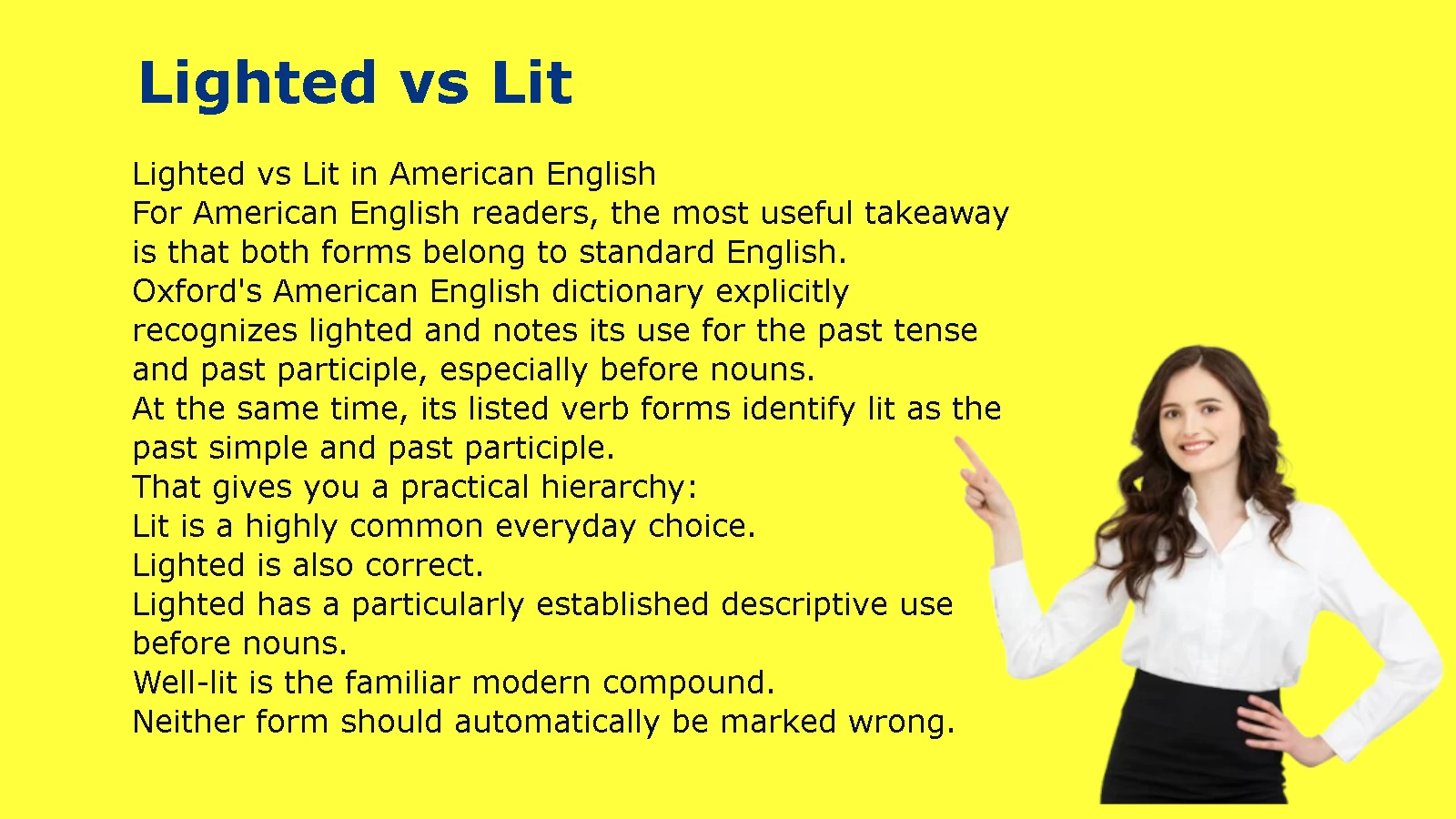
Lighted vs Lit in American English
For American English readers, the most useful takeaway is that both forms belong to standard English.
Oxford’s American English dictionary explicitly recognizes lighted and notes its use for the past tense and past participle, especially before nouns.
At the same time, its listed verb forms identify lit as the past simple and past participle.
That gives you a practical hierarchy:
- Lit is a highly common everyday choice.
- Lighted is also correct.
- Lighted has a particularly established descriptive use before nouns.
- Well-lit is the familiar modern compound.
- Neither form should automatically be marked wrong.
It’s also a mistake to claim that one word belongs exclusively to American English and the other belongs exclusively to British English. The usage is more complicated than that.
A Useful Case Study: “She Lit a Candle” vs. “A Lighted Candle”
Consider this short scene:
Anna entered the dark room and lit a candle. She placed the lighted candle beside the window.
Why do the two forms work so naturally together?
The first sentence describes an action:
Anna lit a candle.
The second describes an object:
the lighted candle
This is an excellent practical model for understanding Lighted vs Lit.
You don’t have to force the same form throughout a paragraph. Choose the word that best fits the grammatical role and emphasis of each sentence.
Here’s another example:
The caretaker lit the lamps before sunset. Soon, the courtyard was brightly lit, and several lighted windows appeared across the building.
Three related forms appear in one passage:
- lit = completed action
- lit = resulting illuminated state
- lighted = descriptive modifier before a noun
That’s real-world usage, and it’s much more useful than memorizing a simplistic rule such as “lit is correct and lighted is wrong.”
Common Mistakes With Lighted and Lit
Mistake: Thinking “Lighted” Is Always Wrong
This is the biggest misconception.
Lighted is a valid English word and a valid form of the verb light.
Major dictionaries recognize it. Oxford even highlights its use before nouns.
So don’t automatically change every instance of lighted to lit during editing.
Instead, examine the sentence.
Mistake: Assuming “Lit” Is Always the Only Correct Choice
The opposite mistake is just as unhelpful.
Although lit is often the more natural modern choice, lighted has legitimate uses.
These aren’t grammatical mistakes.
Mistake: Treating “Lit” and “Lighted” as Completely Different Tenses
They aren’t.
Both can serve as past forms of light.
| Present | Past |
| I light the candle. | I lit the candle. |
| I light the candle. | I lighted the candle. |
The important distinction isn’t tense alone. Usage and context influence which form sounds better.
Mistake: Confusing the Verb “Light” With Other Meanings
The word light has several unrelated meanings.
For example:
The bird lit on the branch.
Here, lit means landed or settled, not “ignited.”
Merriam-Webster lists this separate intransitive verb sense of light, including the meaning “to settle” or “alight.”
So context always matters.
Mistake: Confusing “Lit” With Slang
Modern English also uses lit informally to describe something exciting or excellent:
The concert was lit.
That’s different from:
The candles were lit.
In the second sentence, lit is the past participle of light. In the first, it’s an informal adjective.
The spelling is identical, but the meaning comes from context.
Lighted vs Lit: Which One Should You Use?
If you’re stuck between the two, start with lit.
For most everyday sentences that describe someone lighting something, lit is the natural choice:
- She lit the candle.
- He lit the fire.
- They lit the lantern.
- I lit a match.
When you’re describing an illuminated or burning noun, lighted can work especially well:
- a lighted candle
- a lighted match
- a lighted window
- a lighted sign
But remember that lit can also work in those descriptions:
- a lit candle
- a lit match
- a lit window
- a lit sign
So the distinction is a tendency, not a hard grammatical wall.
Quick Rule for Lighted vs Lit
When you need a fast answer, use this guide:
Action → Usually “Lit”
She lit the candle.
He lit the fireplace.
They lit a match.
Description → “Lit” or “Lighted”
A lit candle stood on the table.
A lighted candle stood on the table.
Both work.
Common Compound → Usually “Well-Lit”
The hallway was well-lit.
The parking lot was well-lit.
Well-lighted exists, but well-lit is generally the more natural modern choice.
Past Participle → Both Are Possible
The candles had been lit.
The candles had been lighted.
Both can be grammatical, although lit is often the more natural option.
Lighted vs Lit: Frequently Asked Questions
Is “lit” or “lighted” correct?
Both are correct. Lit is usually more common for ordinary past-tense uses, while lighted remains standard and has a particularly established descriptive use before nouns.
Is “lighted” the past tense of “light”?
Yes. Lighted can function as the past tense and past participle of light. Merriam-Webster lists “lit or lighted” as the forms of the verb.
Is “lit” the past tense of “light”?
Yes. Lit is the common irregular past tense of light.
She lit a candle.
Is “lighted” an adjective?
Yes. Lighted can function as an adjective meaning burning or illuminated.
For example:
a lighted candle
Oxford specifically defines lighted as an adjective for things such as candles, cigarettes, and matches that are burning, as well as windows that are bright because lights are on inside.
Is “lit” an adjective?
Yes. Lit can also describe something that is illuminated.
For example:
The room was brightly lit.
a lit candle
Which is more common, “lit” or “lighted”?
For many ordinary past-tense uses, lit is the more natural modern choice. Lighted remains correct and is particularly common in descriptive constructions before nouns.
Should you say “well-lit” or “well-lighted”?
Well-lit is generally the better choice in modern everyday English.
The office is well-lit.
Well-lighted is possible, but it tends to sound less natural to many contemporary readers.
Is “a lighted candle” correct?
Yes.
A lighted candle is completely standard English. Oxford uses this exact type of construction in its definition of lighted.
Is “a lit candle” correct?
Yes.
A lit candle is also correct and natural.
Can “lighted” and “lit” be used interchangeably?
Not always perfectly. Both can serve as forms of light, but lit is generally preferred for many ordinary action-focused sentences, while lighted has a strong descriptive use before nouns.
Final Verdict: Lighted vs Lit
The Lighted vs Lit question becomes much easier once you stop treating it as a simple right-or-wrong choice.
Both words are correct.
Lit is the common irregular past tense and past participle of light. It’s usually the most natural choice when you’re describing an action:
She lit the candle.
Oxford explicitly recognizes this usage, while Merriam-Webster lists both lit and lighted as forms of the verb.
So, when you’re writing ordinary American English and need to describe someone lighting something, lit will usually be the safest and most natural choice.
When you’re describing an object that is already burning or illuminated, lighted remains perfectly valid, especially before a noun.
The simplest rule to remember
Action? Choose “lit” most of the time. Description? “Lit” or “lighted” may work.
For example:
She lit a candle and placed the lighted candle on the table.
That’s the heart of the distinction. No complicated grammar rule is needed. Just pay attention to what the sentence is emphasizing, and choose the form that sounds natural in context.