Have you ever wondered if knowledge can be written as knowledges? The difference in Knowledge vs Knowledges can be confusing because English nouns do not always follow the same plural rules. In most everyday situations, the choice is simple: knowledge is normally used as an uncountable noun, while knowledges has a much more limited use.
Knowledge refers to the information, understanding, skills, or awareness that a person gains through learning or experience. It is usually an uncountable noun, so we normally say “knowledge” rather than “knowledges.” However, knowledges can appear in specialized contexts when referring to different bodies or systems of knowledge.
Examples:
- She has extensive knowledge of English grammar.
- The course combines different cultural knowledges and traditions.
The confusion is understandable. People often search for knowledge vs knowledges, knowledge or knowledges, is knowledges a word, or knowledge plural because they want to know if knowledge can take a plural form. The answer depends on the context. In ordinary English, knowledge is the natural choice, while knowledges is uncommon and usually appears when discussing distinct types or systems of knowledge.
In this guide, you’ll learn the complete difference between Knowledge vs Knowledges, including their meaning, plural form, grammar, correct usage, and examples. You’ll also discover when knowledge should remain singular and when knowledges can be appropriate.
Knowledge vs Knowledges: Quick Answer
Knowledge is the correct standard form in almost all ordinary situations.
Knowledges is generally not used as the plural of knowledge in modern standard English.
| Word | Standard usage | Example |
| knowledge | Correct | She has extensive knowledge of biology. |
| knowledges | Generally incorrect as an ordinary plural | ❌ She has extensive knowledges of biology. |
| types of knowledge | Correct for different categories | The course covers several types of knowledge. |
| areas of knowledge | Correct for different subjects or domains | He has knowledge in several areas. |
| bodies of knowledge | Correct for distinct organized fields | These disciplines represent different bodies of knowledge. |
The important point is that knowledge doesn’t normally become plural just because you are talking about several subjects or categories.
For example:
❌ She has many knowledges.
A natural correction would be:
She has a lot of knowledge.
If you mean that she understands several different subjects, you could say:
She has knowledge in several fields.
Or:
She has knowledge of several different subjects.
Cambridge’s grammar guidance makes the same distinction. It recommends knowledge, some knowledge, or a lot of knowledge instead of knowledges.
What Does Knowledge Mean?
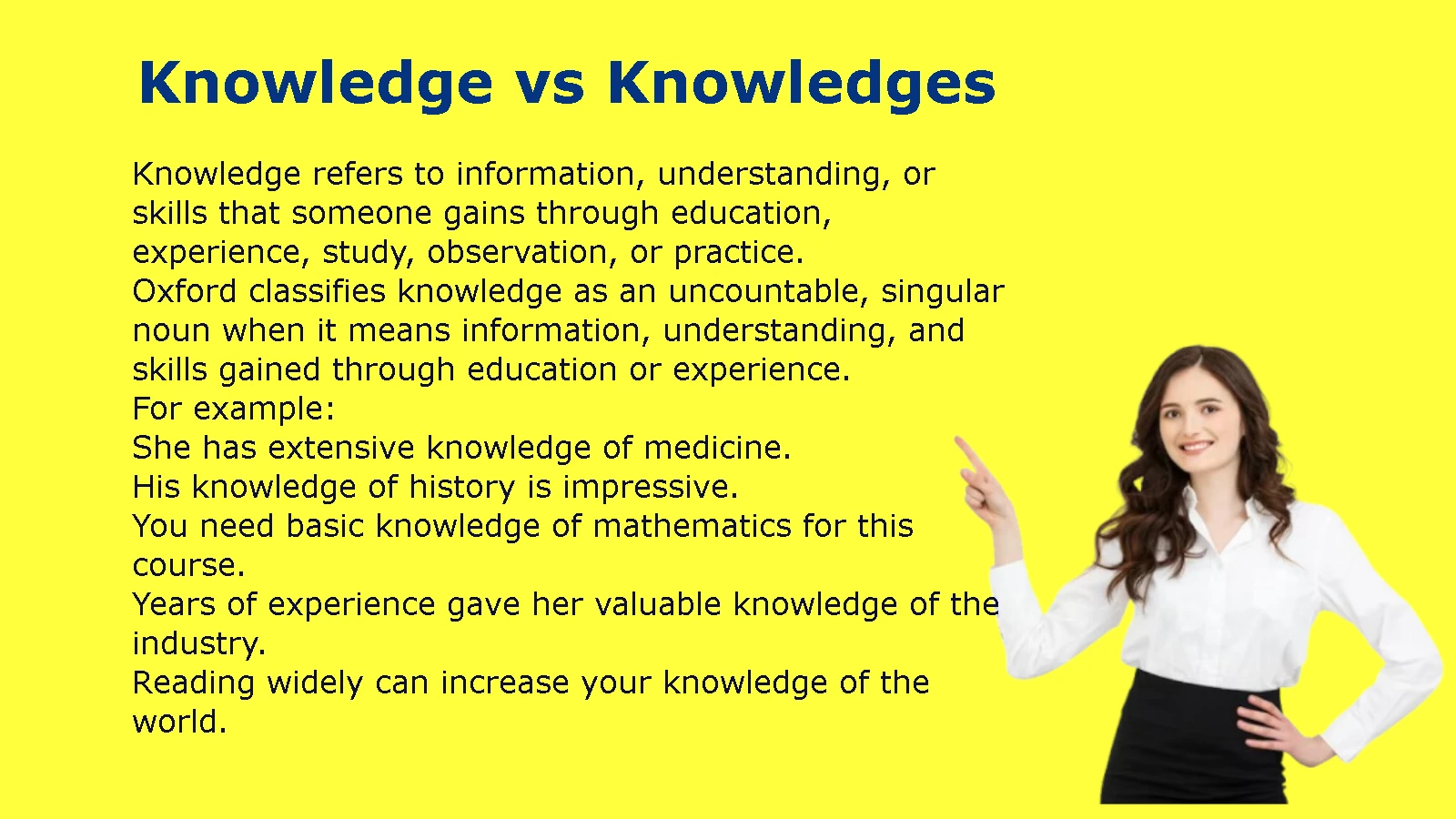
Knowledge refers to information, understanding, or skills that someone gains through education, experience, study, observation, or practice.
Oxford classifies knowledge as an uncountable, singular noun when it means information, understanding, and skills gained through education or experience.
For example:
- She has extensive knowledge of medicine.
- His knowledge of history is impressive.
- You need basic knowledge of mathematics for this course.
- Years of experience gave her valuable knowledge of the industry.
- Reading widely can increase your knowledge of the world.
The word can also describe awareness of a fact or situation.
For example:
- They made the decision without my knowledge.
- To my knowledge, the store is still open.
- She denied all knowledge of the incident.
Merriam-Webster gives several related senses, including information or understanding gained through experience or education, awareness of something, and the broader range of information a person possesses.
Knowledge as Information and Understanding
In its most common sense, knowledge describes what you know and understand.
Imagine that you read ten books about gardening.
Instead, you might say:
Reading those books gave me a lot of knowledge about gardening.
If you want to identify specific categories, you can say:
I gained knowledge about soil, plant nutrition, and pest control.
The word remains singular.
Knowledge as Awareness
Knowledge can also mean awareness of a fact, event, or situation.
Consider these common expressions:
- without my knowledge
- to my knowledge
- with his knowledge
- to the best of my knowledge
- common knowledge
- public knowledge
For example:
The decision was made without my knowledge.
Here, knowledge doesn’t mean a collection of facts that someone has studied. It means awareness of the situation.
Oxford lists this as a separate uncountable sense of knowledge.
Knowledge as a Body of What Is Known
The word can also refer to the broader collection of information and understanding available to people.
For example:
Scientific knowledge has expanded dramatically over the centuries.
Merriam-Webster defines this sense as the sum of what is known, including the body of truth, information, and principles acquired by humankind.
Again, the word stays singular:
Human knowledge continues to grow.
Not:
❌ Human knowledges continue to grow.
Is “Knowledges” a Word?
The practical answer for standard modern English is no, not as the ordinary plural of knowledge.
You may occasionally encounter knowledges in specialized, historical, theoretical, or unusual writing. A rare appearance of a form doesn’t mean it is the normal choice for everyday English.
For ordinary writing, speaking, schoolwork, business communication, and most academic contexts, use knowledge.
Cambridge directly states that knowledge does not have a plural form. Its grammar examples specifically contrast incorrect knowledges with correct forms such as knowledge and a lot of knowledge.
Why Does “Knowledges” Sound Like It Should Be Correct?
The temptation is understandable.
English commonly forms plurals by adding -s:
- book → books
- idea → ideas
- skill → skills
- fact → facts
- subject → subjects
So a learner may naturally think:
knowledge → knowledges
The problem is that English doesn’t treat every noun as countable.
Some nouns describe substances, concepts, collections, activities, or broad quantities rather than individual objects. These nouns often don’t take a plural -s in their ordinary use.
Consider:
- information, not informations
- advice, not advices
- furniture, not furnitures
- research, not researches in the ordinary mass-noun sense
- equipment, not equipments
- knowledge, not knowledges
Cambridge notes that countability matters because countable nouns can form plurals and take a/an, while uncountable nouns normally cannot.
Why Is Knowledge an Uncountable Noun?
An uncountable noun describes something that English normally treats as a mass, substance, concept, or general quantity rather than as separate countable units.
You can count:
one book, two books, three books
You normally don’t count knowledge in that way.
You don’t usually say:
one knowledge, two knowledges, three knowledges
Instead, you measure or describe it:
- some knowledge
- a little knowledge
- a lot of knowledge
- extensive knowledge
- considerable knowledge
- deep knowledge
- specialized knowledge
- practical knowledge
Cambridge explains that uncountable nouns don’t normally have plural forms. Its grammar resources list knowledge alongside other commonly confused uncountable nouns such as furniture, information, and advice.
Why You Can Say “A Good Knowledge”
Here’s an important detail that can confuse learners.
Although knowledge is generally uncountable, English can use it after a/an in certain constructions, especially when an adjective describes the quality or extent of that knowledge.
For example:
- a good knowledge of English
- a deep knowledge of history
- a sound knowledge of mathematics
- a thorough knowledge of the subject
- a detailed knowledge of local customs
Cambridge specifically notes that knowledge can be used in the singular with a, especially with adjectives such as good, sound, and deep.
Merriam-Webster also gives examples such as “a knowledge of foreign languages.”
So don’t treat the rule as “knowledge can never follow a.” The more accurate rule is that knowledge normally functions as an uncountable noun, but certain established constructions allow a singular countable-looking use.
That distinction matters.
How Do You Talk About Multiple Types of Knowledge?
This is where most knowledge vs knowledges mistakes happen.
You may want to discuss several forms of knowledge. The solution isn’t to add -s to knowledge. Instead, add a word that identifies the categories.
Use “Types of Knowledge”
This is one of the clearest alternatives.
The course introduces several types of knowledge.
Researchers distinguish between different types of knowledge.
The training combines several types of knowledge.
This structure works especially well when you are explicitly comparing categories.
Use “Areas of Knowledge”
Use areas of knowledge when you mean broad subjects or domains.
She has knowledge in several areas.
The program draws on different areas of knowledge.
Medicine requires knowledge from many areas of science.
This expression works well in educational and professional contexts.
Use “Fields of Knowledge”
Fields of knowledge emphasizes disciplines or specialized subjects.
For example:
Biology and chemistry are separate fields of knowledge.
Artificial intelligence draws on several fields of knowledge.
Experts from different fields contributed to the project.
Use “Kinds of Knowledge”
Kinds of knowledge is another natural alternative, especially in explanatory writing.
Different kinds of knowledge become useful at different stages of a project.
Children develop different kinds of knowledge through play and experience.
The phrase is grammatically straightforward and often sounds less formal than bodies of knowledge.
Use “Bodies of Knowledge”
Bodies of knowledge has a more formal or academic tone.
A body of knowledge means an organized collection of information, principles, research, or understanding associated with a particular subject or discipline.
For example:
Engineering draws on a large body of knowledge.
These disciplines have developed distinct bodies of knowledge.
The plural bodies belongs to body, not knowledge. That’s the key distinction.
Knowledge vs Knowledges in Example Sentences
The easiest way to remember the rule is to see it in action.
| Incorrect | Correct | Reason |
| ❌ She has many knowledges. | She has a lot of knowledge. | Knowledge is normally uncountable. |
| ❌ He gained several knowledges from the course. | He gained a lot of knowledge from the course. | Use knowledge for the overall learning. |
| ❌ Her knowledges of science are impressive. | Her knowledge of science is impressive. | Use the singular uncountable form. |
| ❌ We need different knowledges. | We need different types of knowledge. | Use a category word for separate forms. |
| ❌ His knowledges include history and chemistry. | His knowledge includes history and chemistry. | Multiple subjects don’t require a plural knowledge. |
| ❌ The book provides many knowledges. | The book provides a great deal of knowledge. | Use an amount expression. |
Correct Examples in Everyday English
I don’t have much knowledge of car repair.
She has a good knowledge of French.
He gained valuable knowledge through experience.
The training gave employees practical knowledge.
We need someone with specialized knowledge.
Her knowledge of local history is impressive.
Notice something important. The noun stays knowledge even when the sentence refers to a large amount or several subject areas.
Common Phrases With Knowledge
English has many established expressions containing knowledge. Learning these phrases can make your writing sound much more natural.
A Wealth of Knowledge
A wealth of knowledge means a large amount of valuable knowledge.
The professor has a wealth of knowledge about ancient history.
It doesn’t mean literal wealth. Here, wealth means abundance.
A Body of Knowledge
A body of knowledge refers to an organized collection of information or understanding within a subject.
Psychology has developed a substantial body of knowledge over the years.
The plural is possible when discussing several distinct collections:
Different professional disciplines have developed their own bodies of knowledge.
Notice that the plural appears on body, not knowledge.
Common Knowledge
Common knowledge refers to something widely known or generally understood.
It’s common knowledge that regular exercise can benefit your health.
Merriam-Webster defines the phrase in terms of information that most people know or recognize.
General Knowledge
General knowledge refers to information across a broad range of subjects rather than specialized expertise.
The quiz tests general knowledge.
She has excellent general knowledge of geography and history.
Specialized Knowledge
Specialized knowledge refers to information or expertise related to a particular field.
The position requires specialized knowledge of cybersecurity.
This phrase works particularly well in resumes, job descriptions, business documents, and academic writing.
Firsthand Knowledge
Firsthand knowledge comes directly from personal experience or observation.
The journalist had firsthand knowledge of the situation.
This differs from information received from another person.
To the Best of My Knowledge
This common expression means as far as I know or based on the information I currently have.
To the best of my knowledge, the meeting starts at 9 a.m.
It’s useful when you want to make a statement while acknowledging that your information may not be complete.
Without My Knowledge
Without my knowledge means without your awareness or permission to the extent implied by the context.
The changes were made without my knowledge.
Oxford lists without somebody’s knowledge, with somebody’s knowledge, and to somebody’s knowledge among common constructions.
Knowledge vs Information: What’s the Difference?
Knowledge and information overlap, but they aren’t identical.
Information usually refers to facts, details, or data that someone receives or discovers.
Knowledge often suggests a deeper understanding gained from information, education, study, or experience.
| Knowledge | Information |
| Understanding or awareness | Facts or details |
| Often develops through experience and learning | Can simply be received |
| Often suggests deeper comprehension | Can be individual pieces of data |
| Usually uncountable | Usually uncountable |
Consider a simple example.
A website tells you that a particular plant needs six hours of sunlight. That’s information.
After studying plant care, growing the plant yourself, understanding its soil requirements, and learning how it responds to sunlight, you develop knowledge of gardening.
The two concepts work together, but they aren’t interchangeable in every sentence.
Knowledge vs Learning: What’s the Difference?
Learning describes the process or acquisition of knowledge. Knowledge describes what you know or understand.
For example:
Learning a language takes time.
Regular practice helped her develop strong knowledge of Spanish grammar.
Merriam-Webster distinguishes knowledge from related words such as learning, erudition, and scholarship. It explains that learning especially emphasizes knowledge acquired through formal education or advanced study.
Think of it this way:
Learning is the journey. Knowledge is part of what you gain from that journey.
The distinction isn’t absolute because the words overlap. Still, the difference helps you choose the more precise term.
Knowledge vs Wisdom: What’s the Difference?
Knowledge tells you what you know. Wisdom involves using knowledge and experience with sound judgment.
Imagine that you know a stove becomes extremely hot after cooking.
That fact is knowledge.
Choosing not to touch the hot surface is practical judgment.
That judgment reflects wisdom.
The two often develop together, but they aren’t synonyms.
Merriam-Webster lists wisdom among the related words for knowledge while still distinguishing the concepts.
Can Knowledge Be Countable?
This question deserves a nuanced answer.
In standard modern English, knowledge is generally uncountable. Oxford labels it uncountable, singular in its main definition.
However, English sometimes uses a knowledge of in constructions that identify a particular level, quality, or scope of understanding.
For example:
She has a deep knowledge of literature.
He has a thorough knowledge of accounting.
They need a good knowledge of English.
This doesn’t mean you can freely turn knowledge into a normal countable noun and say:
❌ one knowledge
❌ two knowledges
❌ three knowledges
Instead, the construction a knowledge of has an established grammatical use, especially when an adjective specifies the kind or degree of knowledge.
Cambridge specifically highlights this pattern.
Knowledge vs Knowledges in Academic Writing
Academic writing requires particular care because writers often discuss several disciplines, theories, perspectives, or forms of understanding.
That doesn’t make knowledges the right plural.
Instead, choose the noun that describes the actual distinction.
Use “Types of Knowledge” for Categories
The study examines different types of knowledge.
Use “Forms of Knowledge” for Different Modes
The researchers compared several forms of knowledge.
Use “Areas of Knowledge” for Broad Domains
The course combines knowledge from different areas.
Use “Fields of Knowledge” for Disciplines
The project brings together experts from several fields of knowledge.
Use “Bodies of Knowledge” for Organized Collections
The profession draws on several established bodies of knowledge.
These alternatives make your meaning clearer. They also prevent the sentence from sounding like a direct translation from a language that handles countability differently.
Common Mistakes With Knowledge
Saying “Knowledges”
This is the most obvious error.
❌ The students gained many knowledges.
Better:
The students gained a great deal of knowledge.
Or:
The students gained knowledge in several areas.
Using “Knowledges” for Different Subjects
Suppose someone studies biology, economics, and history.
You might be tempted to write:
❌ She has several knowledges.
Instead, write:
She has knowledge of biology, economics, and history.
If you want to emphasize the separate domains:
She has knowledge in several fields.
The second version communicates the intended distinction without forcing knowledge into an unnatural plural.
Using “A Knowledge” Without Context
The phrase a knowledge isn’t automatically wrong.
Compare:
He has a good knowledge of English.
This is natural.
Now compare:
He has a knowledge of English.
This can be grammatical, but it often sounds less natural without a modifier. In many situations, a good knowledge, a deep knowledge, or simply knowledge works better.
Treating Knowledge Like a Countable Object
You wouldn’t normally say:
❌ I learned three knowledges today.
If you mean three facts, say:
I learned three facts today.
If you mean three pieces of information, say:
I learned three pieces of information today.
If you mean broad understanding, say:
I gained a lot of knowledge today.
The best replacement depends on what you’re actually trying to count.
A Simple Way to Choose the Right Expression
When you’re unsure about knowledge vs knowledges, start with the meaning you want.
Are you talking about knowledge generally?
Use:
knowledge
Example:
She has extensive knowledge of finance.
Are you talking about different categories?
Use:
types of knowledge
Example:
The course covers several types of knowledge.
Are you talking about different subjects or domains?
Use:
areas of knowledge or fields of knowledge
Example:
The research combines knowledge from several fields.
Are you talking about an organized collection within a discipline?
Use:
a body of knowledge
Example:
The profession has developed a substantial body of knowledge.
Are you talking about individual facts or details?
Use:
facts, pieces of information, or another specific countable noun.
Example:
The report contains five important facts.
This approach solves the problem without memorizing a complicated grammar rule.
Knowledge vs Knowledges: Side-by-Side Comparison
| Feature | Knowledge | Knowledges |
| Standard modern English | Yes | Generally no |
| Normal plural form | No | Not used normally |
| Main grammatical category | Uncountable noun | Not the standard plural |
| Can describe understanding | Yes | No |
| Can describe awareness | Yes | No |
| Can describe accumulated information | Yes | No |
| Common in academic writing | Yes | No |
| Can appear after “a” in certain phrases | Yes | No |
| Best alternative for categories | Types/areas/fields of knowledge | Avoid |
| Best alternative for individual facts | Facts/pieces of information | Avoid |
The key difference is simple:
Knowledge is the standard noun. Knowledges is not the normal plural form.
A Practical Correction Guide
Here are several common sentences and their best corrections.
If you mean a large amount
❌ He has many knowledges about computers.
✅ He has a lot of knowledge about computers.
If you mean several subjects
❌ She has different knowledges.
✅ She has knowledge of several subjects.
If you mean separate categories
❌ The book discusses different knowledges.
✅ The book discusses different types of knowledge.
If you mean individual facts
❌ The course gave me several knowledges.
✅ The course gave me several useful pieces of information.
If you mean expertise
❌ His knowledges are valuable to the company.
✅ His knowledge is valuable to the company.
If you mean multiple disciplines
❌ The project combines many knowledges.
✅ The project combines knowledge from several fields.
The correction isn’t always just a matter of replacing knowledges with knowledge. Sometimes the sentence needs a more precise noun phrase.
That’s an important writing lesson. Good grammar and good meaning work together.
Case Study: Why “Knowledges” Creates an Awkward Sentence
Consider this sentence:
❌ The training program provides employees with different knowledges about workplace safety, communication, and leadership.
At first glance, the writer probably means that the program teaches several distinct subjects.
Simply changing the sentence to:
The training program provides employees with different knowledge about workplace safety, communication, and leadership.
still sounds awkward.
A better version is:
The training program gives employees knowledge about workplace safety, communication, and leadership.
If the categories matter:
The training program develops different types of knowledge related to workplace safety, communication, and leadership.
Or, if the emphasis falls on disciplines:
The training program combines knowledge from several fields, including workplace safety, communication, and leadership.
This illustrates an important point. “Knowledges” isn’t just a small spelling mistake. It can signal that the writer hasn’t chosen the right structure for the intended meaning.
Why English Has So Many Uncountable Nouns
The confusion surrounding knowledge becomes easier once you understand the broader pattern.
English treats many concepts as quantities rather than separate objects.
You can have:
- some information
- a lot of advice
- much research
- a little evidence
- a great deal of knowledge
- some furniture
- a lot of equipment
You normally don’t turn these nouns into regular plurals simply because you mean a large quantity.
For example:
❌ informations
❌ advices
Instead, English often uses quantity expressions or unit phrases.
Cambridge explains that uncountable nouns can be made more specific through expressions such as a piece of or items of.
For example:
a piece of advice
a piece of information
an item of furniture
With knowledge, natural quantity expressions include:
some knowledge
a little knowledge
a lot of knowledge
a great deal of knowledge
extensive knowledge
What Is the Plural of Knowledge?
The simplest answer is:
Knowledge normally has no plural form in standard English.
If you need to refer to multiple categories, use a phrase such as:
- types of knowledge
- forms of knowledge
- areas of knowledge
- fields of knowledge
- kinds of knowledge
- bodies of knowledge
If you need to count individual pieces of information, use a more specific countable noun:
- facts
- details
- pieces of information
- ideas
- lessons
- skills
The best choice depends on your intended meaning.
Frequently Asked Questions About Knowledge vs Knowledges
Is “knowledges” grammatically correct?
Knowledges is not normally correct as the plural of knowledge in standard modern English. Use knowledge for the general concept or use a phrase such as types of knowledge when discussing separate categories. Cambridge explicitly identifies knowledges as an incorrect form for expressing an amount of knowledge.
What is the plural of knowledge?
Knowledge normally has no plural form. Instead, use expressions such as types of knowledge, areas of knowledge, fields of knowledge, or bodies of knowledge when you need to distinguish multiple categories.
Can I say “a knowledge”?
Yes. A knowledge of can be grammatical, particularly when an adjective describes the quality or depth of the knowledge.
Examples include:
- a good knowledge of English
- a deep knowledge of history
- a sound knowledge of mathematics
- a thorough knowledge of the subject
Cambridge specifically recognizes this construction.
Is “many knowledges” correct?
No, not in ordinary standard English.
Instead, say:
a lot of knowledge
or:
different types of knowledge
or:
knowledge in several fields
What should I use instead of “knowledges”?
Choose the expression that matches your meaning:
- knowledge for general understanding
- types of knowledge for categories
- areas of knowledge for broad domains
- fields of knowledge for disciplines
- bodies of knowledge for organized collections
- facts for individual truths
- pieces of information for individual details
Is knowledge a countable or uncountable noun?
Knowledge is generally an uncountable noun. Oxford labels it uncountable, singular in its main definition, and Cambridge states that it doesn’t have a plural form.
Is “a lot of knowledge” correct?
Yes.
She has a lot of knowledge about economics.
This is a natural way to describe a large amount of knowledge.
Is “different knowledge” correct?
It can be grammatical in some contexts, but it often isn’t the clearest choice.
If you mean different categories, use:
different types of knowledge
If you mean knowledge about different subjects, use:
knowledge of different subjects
The more precise phrase usually sounds more natural.
Is “knowledge of” correct?
Yes. Knowledge of is one of the most common constructions with the word.
Examples:
knowledge of English
knowledge of history
Oxford lists knowledge of/about something among its common patterns.
Knowledge vs Knowledges: Final Verdict
When choosing between knowledge vs knowledges, use knowledge in standard modern English.
The word normally functions as an uncountable noun, so you don’t add -s simply because you’re talking about a large amount or several subjects.
Remember these patterns:
- a lot of knowledge
- some knowledge
- extensive knowledge
- a deep knowledge of history
- knowledge of several subjects
- different types of knowledge
- several fields of knowledge
- different bodies of knowledge
The easiest rule to remember is this:
Don’t make “knowledge” plural just because you’re talking about more than one subject. Change the phrase around it instead.
So if you find yourself typing “knowledges,” stop for a moment and ask what you actually mean.
Once you understand that distinction, knowledge vs knowledges becomes much easier to handle.