When writing about the act of establishing control over another country or region, you may wonder whether to use colonize or colonise. The difference between Colonize vs Colonise is mainly a matter of spelling conventions, not meaning. The correct choice depends on the type of English, country, and writing context.
Colonize and colonise have the same meaning. Both mean to establish a colony in a place and take control of it, often through settlement or political rule. Colonize is the standard spelling in American English, while colonise is traditionally preferred in British English and many other varieties influenced by British spelling.
Examples:
- European powers sought to colonize parts of the Americas.
- European powers sought to colonise parts of the Americas.
The confusion is understandable. People often search for colonize vs colonise, colonize or colonise, which spelling is correct, or colonise meaning in English because both spellings are accepted, yet they follow different spelling conventions. And here’s the kicker: neither spelling changes the word’s meaning or pronunciation.
In this guide, you’ll learn the complete difference between Colonize vs Colonise, including their meaning, pronunciation, origin, correct spelling, and usage. You’ll also discover which spelling to use in American English vs British English, along with clear examples to help you choose the right form.
Colonize vs Colonise at a Glance
Here is the quickest way to see the difference:
| Feature | Colonize | Colonise |
| Meaning | Establish a colony or take control of an area | Same |
| Main usage | American English | British English |
| British English | Accepted as an alternative | Usually preferred |
| Pronunciation | Same basic pronunciation | Same basic pronunciation |
| Part of speech | Verb | Verb |
| Past tense | colonized | colonised |
| Present participle | colonizing | colonising |
| Noun | colonization | colonisation |
Cambridge lists colonize with colonise as the usual British form, while Oxford notes that British English also uses colonise. In other words, the distinction is primarily one of spelling convention rather than meaning.
The simple rule
If you’re writing in American English, use:
colonize
If you’re writing in British English, use:
colonise
For example:
- US: European powers sought to colonize new territories.
- UK: European powers sought to colonise new territories.
The sentence means the same thing in both cases.
What Does Colonize Mean?
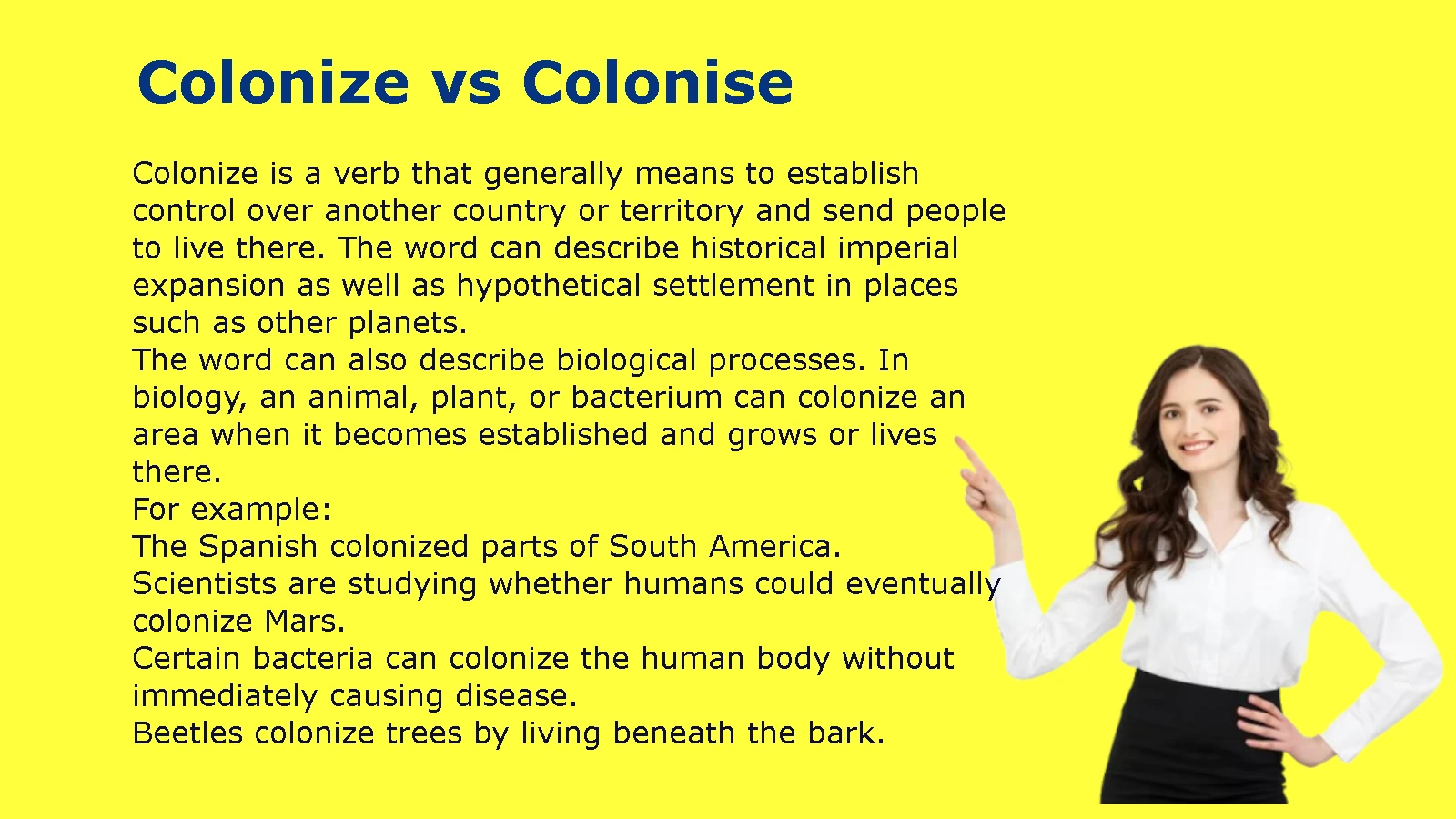
Colonize is a verb that generally means to establish control over another country or territory and send people to live there. The word can describe historical imperial expansion as well as hypothetical settlement in places such as other planets.
The word can also describe biological processes. In biology, an animal, plant, or bacterium can colonize an area when it becomes established and grows or lives there.
For example:
- The Spanish colonized parts of South America.
- Scientists are studying whether humans could eventually colonize Mars.
- Certain bacteria can colonize the human body without immediately causing disease.
- Beetles colonize trees by living beneath the bark.
Notice that these examples cover very different situations. The core idea remains the same: something establishes itself in a particular place.
Colonize in historical contexts
In historical writing, colonize often describes the process by which a powerful state established political, economic, or territorial control over another region.
For example:
European powers colonized large parts of Africa, Asia, and the Americas.
The word can involve settlement, government, military force, economic control, or a combination of these factors. The exact historical situation depends on the place and period being discussed.
Because colonialism had profound effects on Indigenous peoples and existing societies, historical writing often needs more precision than simply saying that one country “colonized” another. A strong explanation may discuss settlement, conquest, administration, displacement, trade, slavery, or resource extraction depending on the evidence.
What Does Colonise Mean?
Colonise has the same meaning as colonize. The main difference is the spelling.
British English commonly uses colonise, while American English generally uses colonize. Cambridge specifically labels colonise as the usual British form.
For example:
- Britain colonised many territories during its imperial expansion.
- Scientists once imagined humans might colonise other planets.
- Some insects colonise trees and other plants.
- Bacteria can colonise parts of the human body.
None of these examples has a different meaning simply because the spelling uses -ise.
Colonise in British English
Consider these two sentences:
The British colonised India.
The British colonized India.
The spelling differs, but the basic meaning doesn’t. The first sentence follows the spelling convention commonly associated with British English. The second uses the -ize form.
Oxford explicitly identifies colonise as a British English form of colonize.
Colonize or Colonise: Which Spelling Is Correct?
Both spellings are correct. The right choice depends mainly on the variety of English you’re using.
Use colonize in American English
American English generally prefers the -ize ending:
- colonize
- organize
- realize
- recognize
- apologize
- modernize
Therefore, in an American English article, essay, report, or academic paper, colonize is normally the natural choice.
Use colonise in British English
British English commonly uses -ise:
- colonise
- organise
- realise
- recognise
- apologise
- modernise
However, British English is a little more complicated than the simple rule suggests. -ize spellings also occur in British English, and some British dictionaries accept them.
That means it’s inaccurate to say that colonize is simply “wrong” in British English. Oxford, for example, lists colonize and notes colonise as the British English form.
Consistency matters most
The most useful rule for everyday writing is consistency.
If a document follows American spelling, write:
The settlers colonized the region.
If it follows British spelling, write:
The settlers colonised the region.
Avoid switching between spelling systems without a reason. A sentence containing colonised alongside several clearly American forms such as organized, recognized, and center may look inconsistent even though each individual word can be understood easily.
Why Does Colonize Become Colonise?
The difference comes from the broader history of the -ize and -ise endings in English.
The suffix -ize ultimately traces back through French and Latin to the Greek verb-forming element -izein. English has used both -ize and -ise spellings for centuries. The variation isn’t unique to colonize. It affects a large group of English verbs.
The history is surprisingly messy.
English adopted many words through French, Latin, and Greek. Different spelling traditions developed over time. The -ise form became especially common in Britain, while American English strongly favored -ize.
So the difference isn’t a modern invention. It’s the result of different spelling conventions developing within varieties of English.
The -ize and -ise pattern
Compare these common pairs:
| American English | British English |
| organize | organise |
| realize | realise |
| recognize | recognise |
| apologize | apologise |
| modernize | modernise |
| colonize | colonise |
| standardize | standardise |
| specialize | specialise |
This pattern explains why colonize vs colonise looks so familiar. The spelling difference follows a larger regional convention.
Colonize vs Colonise in American and British English
The difference becomes particularly clear when you compare related words.
| American English | British English |
| colonize | colonise |
| colonized | colonised |
| colonizing | colonising |
| colonization | colonisation |
| colonizer | coloniser |
Cambridge identifies colonisation as the usual British spelling of colonization.
American English example
European colonization changed the political and economic history of the Americas.
British English example
European colonisation changed the political and economic history of the Americas.
Again, the spelling changes across the word family. The underlying meaning doesn’t.
Colonize and Colonise Pronunciation
One easy point to remember is that the spelling difference doesn’t create a meaningful pronunciation difference.
Cambridge gives the US pronunciation as approximately /ˈkɑː.lə.naɪz/ and the UK pronunciation as approximately /ˈkɒl.ə.naɪz/. The most noticeable difference comes from the broader American and British vowel systems rather than from -ize versus -ise.
The final sound is essentially a z sound.
That means colonize and colonise aren’t pronounced as though the ending were the s sound in a word such as house. The spelling -ise here doesn’t mean you should automatically pronounce the final consonant as /s/.
Why does -ise still sound like /z/?
This is an important detail because English spelling can be deceptive.
In colonise, the final consonant is pronounced like the z in rise, not the s in rice. The British spelling therefore changes the written form without changing the basic pronunciation of the ending.
Examples of Colonize in Sentences
Here are examples that show how colonize works in different contexts.
Historical colonization
European powers attempted to colonize territories across several continents.
Here, colonize refers to establishing colonial control.
Settlement
The settlers hoped to colonize the island and build a permanent community.
The emphasis is on establishing a settlement.
Space exploration
Some researchers believe humans could eventually colonize Mars.
This is a future or hypothetical use. It doesn’t necessarily describe an existing colony.
Biology
Certain fungi can colonize damaged plant tissue.
Here, colonize has nothing to do with human governments. It means that an organism becomes established in a particular environment.
Urban or cultural use
Large retail chains began to colonize the city’s historic shopping district.
This figurative use suggests that a particular group or type of business has come to dominate or fill a place. Cambridge recognizes a use in which something fills a particular place or takes control of an area of activity.
Examples of Colonise in Sentences
The same meanings work with colonise in British English.
Historical use
The empire sought to colonise new territories overseas.
Settlement
The settlers planned to colonise the island.
Space
Scientists continue to debate whether humans could one day colonise Mars.
Biology
The bacteria can colonise the respiratory tract without causing immediate symptoms.
Figurative use
International brands have begun to colonise the local market.
The meaning remains the same. Only the spelling changes.
Colonize vs Colonise in Biology
The word colonize has a surprisingly broad scientific use.
In biology, an organism can colonize a particular environment when it establishes itself there. Oxford defines the biological sense as animals or plants living or growing in large numbers in a particular area.
Cambridge also includes bacteria in this sense.
For example:
- Bats can colonize abandoned buildings.
- Plants may colonize disturbed soil.
- Bacteria can colonize parts of the human body.
- Insects can colonize trees.
- Microorganisms can colonize surfaces.
Colonization doesn’t always mean disease
This distinction matters in medical and biological writing.
When bacteria colonize a body site, that doesn’t automatically mean they are causing an infection. Colonization describes their presence and establishment. Infection involves a different biological process and depends on factors such as tissue invasion and the host’s response.
That is why scientific writing often uses colonize very precisely.
For example:
The bacterium can colonize the nose without causing symptoms.
The statement describes presence rather than automatically claiming disease.
The History Behind the Word Colonize
The word has a long history connected with colony.
Etymological sources trace colonize to the Latin colonus, meaning a farmer, tenant farmer, or settler. The related Latin colonia referred to settled land, a farm, or an estate.
The English verb colonize appeared in the 17th century. Etymonline dates its early use to the 1620s, originally referring to settling with colonists or establishing a colony. By the 1630s, it could also refer to migrating to and settling in another place.
The political sense developed later. By the 1790s, colonize could describe making another place a national dependency even when settlement wasn’t the central feature.
This history helps explain why the modern word can cover several related ideas:
settlement → establishment → territorial control → colonial rule
The exact meaning depends on context.
Colonize vs Colonise Word Forms
Knowing the related forms helps prevent spelling mistakes.
Colonize
The American English family includes:
- colonize
- colonized
- colonizing
- colonization
- colonizer
Colonise
The corresponding British forms include:
- colonise
- colonised
- colonising
- colonisation
- coloniser
The spelling change generally carries through the word family.
Example
American English:
The country was colonized in the 18th century, and later historians examined the effects of colonization.
British English:
The country was colonised in the 18th century, and later historians examined the effects of colonisation.
Mixing forms isn’t usually a comprehension problem, but maintaining one spelling system makes formal writing cleaner.
Colonization vs Colonisation
The noun colonization means the act or process of colonizing or the state of being a colony. Cambridge also recognizes biological uses involving organisms becoming established in an area.
The British spelling is usually colonisation.
| US English | British English |
| colonization | colonisation |
| decolonization | decolonisation |
| recolonization | recolonisation |
For example:
US English:
The study examines the effects of European colonization.
British English:
The study examines the effects of European colonisation.
The spelling changes. The concept does not.
Colonized vs Colonised
The past tense follows the same pattern.
Colonized is the standard American spelling.
Colonised is the usual British spelling.
Examples:
The region was colonized during the 17th century.
The region was colonised during the 17th century.
The difference is exactly what you’d expect from the base forms colonize and colonise.
Colonizing vs Colonising
The present participle also follows the regional spelling pattern.
| US English | British English |
| colonizing | colonising |
For example:
Several nations competed to establish and colonize overseas territories.
Several nations competed to establish and colonise overseas territories.
Cambridge uses both forms in examples and identifies colonise as the usual British spelling.
Common Mistakes With Colonize and Colonise
A few mistakes appear repeatedly when writers encounter these two forms.
Assuming colonise has a different meaning
It doesn’t.
Colonise is not a different process from colonize. The distinction is primarily regional spelling.
Treating colonize as wrong in British English
That’s too absolute.
British English commonly prefers colonise, but colonize also appears and is accepted by major dictionaries. Oxford lists colonize while identifying colonise as the British form.
Treating colonise as an American spelling
That’s also incorrect.
American English overwhelmingly uses colonize, following the broader American preference for -ize spellings.
Mixing spelling systems
A writer might use:
The organization colonised the territory.
This combines the American organization with the British colonised.
Neither word is incomprehensible. The problem is inconsistency.
For polished writing, choose a variety of English and stick with it.
Confusing spelling with pronunciation
The -ise ending doesn’t mean the word suddenly ends with an /s/ sound. Colonise retains the same basic final z sound represented by colonize.
How to Choose Between Colonize and Colonise
Choosing the correct form takes only a few seconds.
Choose colonize when:
- You’re writing in American English.
- Your publication uses American spelling.
- Your style guide specifies -ize forms.
- Your audience primarily uses US English.
Choose colonise when:
- You’re writing in British English.
- Your publication normally uses -ise spellings.
- Your institution follows a British spelling convention.
- You want consistency with words such as organise, recognise, and realise.
Follow the required style guide
A publisher, university, newspaper, or organization may have its own spelling rules. If it does, those rules take priority over a general preference.
This is especially important for professional and academic writing. Consistency signals that the text has been carefully edited.
Colonize vs Colonise: A Practical Case Study
Imagine an American student writes:
The European powers attempted to colonise the region.
The meaning is perfectly clear. However, if the assignment requires American English, the preferred version would be:
The European powers attempted to colonize the region.
Now imagine a British publication using:
European powers attempted to colonize the region.
That spelling isn’t necessarily incomprehensible or automatically unacceptable. However, if the publication consistently uses British -ise spellings, an editor may change it to:
European powers attempted to colonise the region.
The lesson is simple: the spelling choice depends on the English variety and the style being followed.
Colonize vs Colonise in Academic Writing
Academic writing needs particular care because spelling conventions can vary between institutions, publishers, and countries.
If you’re writing for a US university, colonize will generally fit the expected American spelling system.
If you’re writing for a British university or publication, colonise may better match the house style.
However, academic quality depends on more than spelling. Historical claims should also use precise language.
For example, instead of writing:
Europeans colonized everyone they encountered.
A more precise sentence might be:
Several European powers established colonies and imposed different forms of political and economic control over territories in the Americas, Africa, and Asia.
The second sentence provides more information and avoids reducing complex historical processes to one vague statement.
Colonize vs Colonise in Modern Usage
The verb isn’t restricted to historical discussions.
Modern English uses colonize/colonise in at least three important areas:
| Context | Example |
| History | European powers colonized territories overseas. |
| Space | Scientists discuss whether humans could colonize Mars. |
| Biology | Bacteria can colonize a particular environment. |
There is also a figurative use.
A major chain has colonized the local market.
Here, the word suggests that something has spread into and become dominant within a particular space or activity. Cambridge records this broader use.
Related Words You Should Know
Understanding the word family makes the spelling distinction easier.
Colony
A colony is a territory or settlement associated with a colonizing power. The word itself has roots connected with settlement and cultivated land.
Colonist
A colonist is a person who settles in a colony.
Colonial
Colonial describes something connected with a colony or colonial period.
Colonization
Colonization refers to the process of colonizing.
Colonizer
A colonizer is a person, group, or power that colonizes another place.
Decolonize
Decolonize means to remove or reduce colonial control or influence. It can refer to the formal end of colonial rule as well as broader intellectual, cultural, or institutional processes depending on context.
These words are connected, but they aren’t interchangeable. Using the precise form matters when discussing history, politics, biology, or social science.
Colonize vs Colonise: Quick Comparison
| Question | Answer |
| Do they mean the same thing? | Yes. |
| Is colonize American English? | Yes. It is the standard US spelling. |
| Is colonise British English? | Yes. It is the usual UK spelling. |
| Is colonize accepted in British English? | Yes. It is also used in British English. |
| Is colonise accepted in American English? | It is not the standard US spelling. |
| Are they pronounced differently because of spelling? | No. |
| Is colonized American? | Yes. |
| Is colonised British? | Yes. |
| Is colonization American? | Yes. |
| Is colonisation British? | Yes. |
Frequently Asked Questions About Colonize vs Colonise
Is colonize or colonise correct?
Both are correct. Colonize is the standard American English spelling, while colonise is usually preferred in British English. British English also accepts and uses colonize.
Is colonize American or British English?
Colonize is the standard American English spelling. British English commonly uses colonise, although colonize is also found in British usage.
Is colonise the British spelling of colonize?
Yes. Colonise is the usual British spelling of colonize. The two forms have the same basic meaning.
Do colonize and colonise mean the same thing?
Yes. Both can mean establishing control over a territory and settling people there. Both can also describe organisms becoming established in an area.
Are colonize and colonise pronounced the same?
They have the same basic pronunciation of the final -ize/-ise element. American and British accents may produce differences in the vowels of the whole word, but the spelling change itself doesn’t create a different word pronunciation.
Which spelling should I use in American English?
Use colonize.
Related American forms include:
- colonized
- colonizing
- colonization
- colonizer
Which spelling should I use in British English?
Use colonise if you’re following the usual British -ise convention.
Related forms include:
- colonised
- colonising
- colonisation
- coloniser
What is the past tense of colonize?
The past tense is colonized.
The empire colonized the territory.
The British spelling is colonised.
The empire colonised the territory.
What is the British spelling of colonized?
The usual British spelling is colonised.
What is the difference between colonization and colonisation?
There is no basic difference in meaning. Colonization is the standard American spelling, while colonisation is the usual British spelling.
Final Answer: Colonize vs Colonise
Colonize and colonise are two spellings of the same verb. The main difference is regional.
- American English: colonize
- British English: colonise
- Meaning: essentially the same
- Pronunciation: essentially the same
- Past tense: colonized / colonised
- Present participle: colonizing / colonising
- Noun: colonization / colonisation
So, if you’re writing for a US audience, choose colonize. If you’re following the usual British spelling convention, choose colonise.
The easiest way to remember the distinction is to connect it with the larger -ize vs -ise pattern. Once you know which variety of English your writing follows, the choice becomes a piece of cake.