Canceled and cancelled are both correct spellings of the past tense and past participle of “cancel.” The main difference is regional: canceled is the standard spelling in American English, while cancelled is more common in British English and other varieties of English.
If you’re searching for “canceled vs cancelled,” “canceled or cancelled,” or “cancelled vs canceled,” you’re likely wondering which spelling to use in your writing. Both forms have the same meaning and pronunciation, so your choice usually depends on the type of English you follow. In US English, use canceled with one l, while British English generally uses cancelled with two l’s.
| Question | Answer |
|---|---|
| Is canceled or cancelled correct? | Both are correct spellings. |
| Which is correct in American English? | Canceled is the standard US spelling. |
| Which is correct in British English? | Cancelled is the standard British spelling. |
| Do canceled and cancelled mean the same thing? | Yes, both mean that something was stopped, called off, or no longer planned. |
Canceled vs Cancelled: What’s the Difference?
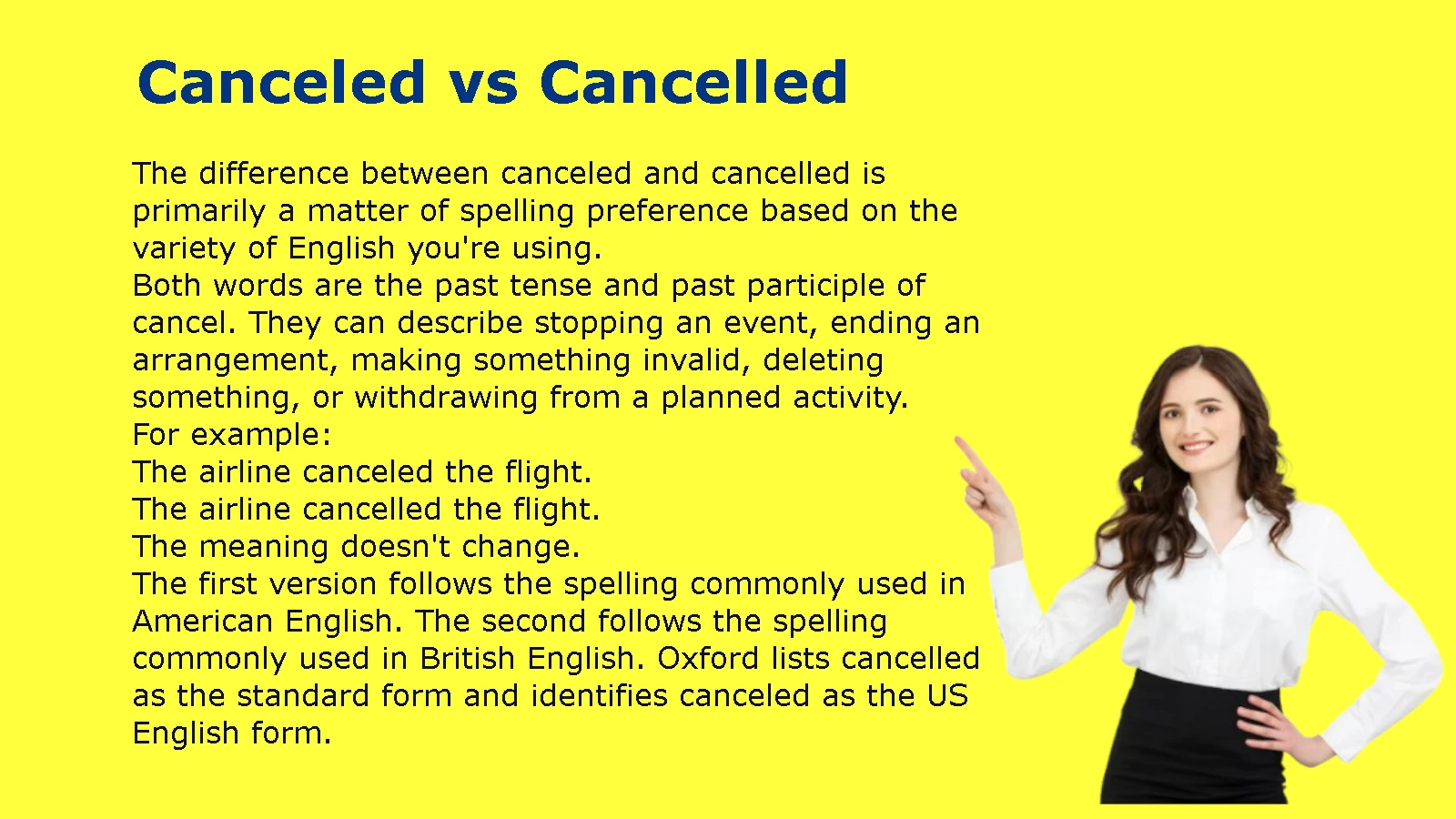
The difference between canceled and cancelled is primarily a matter of spelling preference based on the variety of English you’re using.
Both words are the past tense and past participle of cancel. They can describe stopping an event, ending an arrangement, making something invalid, deleting something, or withdrawing from a planned activity.
For example:
- The airline canceled the flight.
- The airline cancelled the flight.
The meaning doesn’t change.
The first version follows the spelling commonly used in American English. The second follows the spelling commonly used in British English. Oxford lists cancelled as the standard form and identifies canceled as the US English form.
Canceled in American English
Canceled is the preferred spelling in American English.
You’ll commonly see it in US newspapers, websites, business documents, school assignments, emails, and everyday writing.
For example:
- The meeting was canceled because the manager was sick.
- We canceled our hotel reservation.
- The airline canceled several flights.
- She canceled her subscription last month.
- The concert was canceled because of severe weather.
American dictionaries recognize both spellings, but Merriam-Webster specifically notes that canceled is more common in American English.
Cancelled in British English
Cancelled is the preferred spelling in British English.
You’ll find it in UK publications, government documents, British business writing, and other contexts that follow British spelling conventions.
Examples include:
- The meeting was cancelled.
- We cancelled our hotel reservation.
- The airline cancelled several flights.
- She cancelled her subscription.
- The concert was cancelled because of bad weather.
Oxford’s dictionary gives cancelled as the standard past tense and past participle while marking canceled as the US English form.
Do Canceled and Cancelled Have Different Meanings?
No.
This is the part that makes the question easier than it first appears. You don’t need to learn two definitions.
Canceled and cancelled have the same meaning and the same pronunciation. The spelling changes because different English varieties developed different conventions.
Think of it like color and colour. The extra letter doesn’t create a new meaning. It reflects a regional spelling preference.
The same idea applies to:
- canceled / cancelled
- canceling / cancelling
- color / colour
- traveled / travelled
The important rule is consistency. If you’re writing in American English, use the American form throughout your article or document. If you’re writing in British English, stick with the British form.
Is Canceled or Cancelled Correct?
Both are correct.
However, the best choice depends on your audience and the spelling system you’re following.
| If you’re writing for… | Preferred spelling |
| United States | canceled |
| United Kingdom | cancelled |
| American English audience | canceled |
| British English audience | cancelled |
| A US style guide | canceled |
| A UK style guide | cancelled |
Merriam-Webster summarizes the distinction clearly: both forms are acceptable, with the one-L spelling more common in American English and the two-L spelling more common in British English.
That means calling cancelled an outright spelling error in American English would be too strong. Likewise, calling canceled wrong in all British English writing would miss the actual issue. The real question is which English variety are you using?
Dictionary takeaway: Both canceled and cancelled are acceptable past-tense forms of cancel.
Canceled vs Cancelled in American and British English
The spelling difference becomes easier to remember when you look at the complete family of words.
| Word form | American English | British English |
| Base verb | cancel | cancel |
| Third-person singular | cancels | cancels |
| Past tense | canceled | cancelled |
| Past participle | canceled | cancelled |
| Present participle | canceling | cancelling |
| Noun | cancellation | cancellation |
| Person who cancels | canceler | canceller |
Merriam-Webster lists canceler/canceller and cancelable/cancellable as variant forms as well.
Notice something interesting: the base word cancel doesn’t change.
You don’t write cancell as the base verb. The extra l appears in certain forms when the word takes a suffix.
A Quick Memory Trick
If you’re writing American English, remember:
cancel → canceled → canceling
If you’re writing British English, remember:
cancel → cancelled → cancelling
The base word stays the same. The spelling changes when the suffix is added.
Why Is It Canceled With One L in American English?
The history behind canceled is more interesting than a simple “Americans removed an L” explanation.
The spelling difference developed over time as English spelling became more standardized on different sides of the Atlantic. Noah Webster is often associated with American spelling reforms because his dictionaries helped establish distinctive American preferences.
However, it would be misleading to say that Webster simply invented the one-L spelling from scratch.
Merriam-Webster points to an especially useful historical detail: its 1806 dictionary used “cancelled,” while its 1828 dictionary used “canceled.” That change shows that American usage itself shifted over time.
So the history is better understood as an evolution in spelling preference rather than a single person flipping a switch.
American English eventually favored forms such as:
- canceled
- canceling
- traveled
- traveling
- labeled
- labeling
British English generally retained the doubled consonant in comparable forms:
- cancelled
- cancelling
- travelled
- travelling
- labelled
- labelling
There are exceptions and differences across words, which is why memorizing a simple “British doubles everything” rule can lead you astray.
Why Does British English Use Cancelled?
British English generally keeps the second l before certain suffixes in words such as cancelled and cancelling.
The pattern becomes more noticeable when you compare related words:
- cancel → cancelled
- travel → travelled
- label → labelled
- model → modelled
American English often uses one l in these forms:
- cancel → canceled
- travel → traveled
- label → labeled
- model → modeled
This doesn’t mean every word follows exactly the same pattern. English spelling has plenty of historical quirks. That’s one reason spelling rules sometimes feel less like mathematics and more like a map drawn over centuries of language change.
For cancel, though, the regional distinction is clear enough to use confidently:
American English: canceled
British English: cancelled
Canceled vs Cancelled Examples
The easiest way to understand the distinction is to put the two forms side by side.
Events and Plans
American English:
The festival was canceled because heavy rain was expected.
British English:
The festival was cancelled because heavy rain was expected.
Nothing else changes. The event didn’t happen in either sentence.
Travel
American English:
Our flight was canceled three hours before departure.
British English:
Our flight was cancelled three hours before departure.
This is one of the most common contexts in which you’ll encounter both spellings.
Appointments
American English:
I canceled my dentist appointment.
British English:
I cancelled my dentist appointment.
Again, the spelling changes but the meaning stays exactly the same.
Meetings
American English:
The manager canceled the afternoon meeting.
British English:
The manager cancelled the afternoon meeting.
Orders and Subscriptions
American English:
She canceled her streaming subscription.
British English:
She cancelled her streaming subscription.
Reservations
American English:
We canceled our dinner reservation.
British English:
We cancelled our dinner reservation.
These examples demonstrate the central rule: don’t choose between the words based on meaning. Choose based on the English variety you’re using.
Canceled vs Cancelled in a Sentence
Both spellings work naturally in the same grammatical positions.
| American English | British English |
| The game was canceled. | The game was cancelled. |
| She canceled the appointment. | She cancelled the appointment. |
| The airline canceled the flight. | The airline cancelled the flight. |
| They canceled the order. | They cancelled the order. |
| We canceled our plans. | We cancelled our plans. |
| The school canceled classes. | The school cancelled classes. |
| He canceled the contract. | He cancelled the contract. |
| The event was canceled at noon. | The event was cancelled at noon. |
The grammar doesn’t change.
For example, both of these are past-tense sentences:
The company canceled the launch.
The company cancelled the launch.
The only difference is the spelling convention.
Canceling vs Cancelling
Once you understand canceled vs cancelled, the next question usually comes naturally:
What about canceling and cancelling?
The same regional pattern generally applies.
American English: Canceling
American English typically uses canceling with one l.
Examples:
- I’m canceling my appointment.
- We’re canceling the order.
- The airline is canceling several flights.
- She is canceling her subscription.
Oxford’s American English dictionary gives canceling as the US form.
British English: Cancelling
British English typically uses cancelling with two ls.
Examples:
- I’m cancelling my appointment.
- We’re cancelling the order.
- The airline is cancelling several flights.
- She is cancelling her subscription.
Oxford lists cancelling as the standard form while identifying canceling as the US English variant.
Are Canceling and Cancelling Both Correct?
Yes.
| American English | British English |
| canceling | cancelling |
| canceled | cancelled |
If your article uses American English, choose canceling. If it follows British English, choose cancelling.
Don’t switch between the two merely because both appear in search results or dictionaries.
What About Cancellation?
Here’s where many spelling explanations go off track.
You might assume that because American English writes canceled with one l, it should also write cancelation with one l.
That’s not the usual rule.
The standard and widely preferred noun is:
cancellation
It normally contains two ls.
Merriam-Webster calls cancellation the usual spelling and notes that cancelation is also used, but less commonly.
Oxford likewise lists cancellation and notes cancelation as a US English variant.
Examples of Cancellation
- The cancellation surprised everyone.
- We received a cancellation notice.
- There is a cancellation fee.
- The flight cancellation affected hundreds of passengers.
- The company announced the cancellation of the event.
The key lesson is simple:
Don’t assume that every form of cancel follows the exact same one-L or two-L pattern.
Canceled vs Cancelled vs Cancellation
These three forms often cause confusion because they look as though they should follow one uniform rule.
They don’t.
| Word | American English | British English |
| Past tense | canceled | cancelled |
| Past participle | canceled | cancelled |
| Present participle | canceling | cancelling |
| Noun | cancellation | cancellation |
The noun is the important exception to remember.
For example:
American:
The airline canceled the flight because of bad weather. The cancellation caused major delays.
British:
The airline cancelled the flight because of bad weather. The cancellation caused major delays.
Notice how the noun stays cancellation in both versions.
What Does Cancel Mean?
Before looking only at the spelling, it helps to understand the word itself.
The verb cancel can mean to decide that something planned will not happen.
For example:
- cancel a meeting
- cancel a trip
- cancel a concert
- cancel a reservation
- cancel an appointment
- cancel an order
It can also mean to make something invalid or ineffective.
For example:
- cancel a contract
- cancel a subscription
- cancel a policy
- cancel a debt
The word has additional meanings, too. Merriam-Webster includes senses involving removing or deleting something, offsetting an effect, marking a stamp so it can’t be reused, and withdrawing support from someone.
The spelling question, however, remains the same across these meanings.
Whether you write canceled or cancelled depends on your English variety, not on what you’re canceling.
Canceled and Cancelled Have the Same Pronunciation
One reason the distinction can feel strange is that the extra l doesn’t create a different spoken word.
Canceled and cancelled are pronounced the same way.
The spelling changes. The pronunciation doesn’t.
Oxford gives the past-tense pronunciation as /ˈkænsld/ for both the British and US forms.
So if someone says:
“The event was canceled.”
and another person says:
“The event was cancelled.”
you won’t hear a different pronunciation caused by the extra l.
The difference lives on the page.
Common Mistakes With Canceled and Cancelled
Mistake: Saying Cancelled Is Always Wrong
This is incorrect.
Cancelled is the normal British spelling and is also recognized in American dictionaries as an acceptable variant.
The better explanation is that canceled is more common in American English, while cancelled is more common in British English.
Mistake: Saying Canceled Is Always Wrong
The reverse claim is also inaccurate.
Canceled is the standard US form. Oxford’s American English dictionary uses it in its verb forms and examples.
If you’re writing for an American audience, there’s nothing wrong with choosing canceled.
Mistake: Mixing the Two Spellings Without a Reason
Imagine an article that says:
The company canceled the meeting but later cancelled the event.
That isn’t necessarily grammatically wrong. However, if both words refer to the same type of past-tense form in the same piece, the unexplained switch can look inconsistent.
A polished article should normally choose one spelling system and stick with it.
For American English:
- canceled
- canceling
- traveled
- traveling
For British English:
- cancelled
- cancelling
- travelled
- travelling
Consistency makes your writing look deliberate rather than accidental.
Mistake: Assuming Cancellation Should Be Cancelation
This is another common trap.
Although cancelation exists as a less common variant, cancellation is the usual spelling.
So this isn’t a reliable transformation:
canceled → cancelation
Instead, learn the forms separately:
canceled → cancellation
Mistake: Thinking the Extra L Changes the Meaning
It doesn’t.
Canceled and cancelled mean the same thing.
The difference is spelling convention, not definition.
A Practical Case Study: Writing for a US Audience
Imagine you’re writing a customer service email for an American company.
You might write:
Your order was canceled because the requested item is no longer available.
Later, you might write:
If you believe this cancellation was made in error, contact customer support.
That’s consistent American English.
Notice something else: cancellation still has two ls.
The result is:
- canceled
- cancellation
There’s no contradiction. These are simply the standard spellings of two different forms.
A Practical Case Study: Writing for a UK Audience
Now imagine the same message is being written for a British audience.
The natural version becomes:
Your order was cancelled because the requested item is no longer available.
The second sentence remains:
If you believe this cancellation was made in error, contact customer support.
Again, the noun stays cancellation.
This is why style matters. A good writer doesn’t change spelling randomly. The writer chooses a regional convention and applies it consistently.
Which Spelling Should You Use?
The safest rule is straightforward:
Use Canceled When Writing American English
Choose canceled when you’re writing for:
- A US audience
- An American company
- An American school or university
- A US publication
- A website that follows American English
- A style guide that specifies American spelling
Examples:
- The flight was canceled.
- She canceled the appointment.
- We are canceling the subscription.
Use Cancelled When Writing British English
Choose cancelled when you’re writing for:
- A UK audience
- A British company
- A UK publication
- A style guide that uses British English
- A context where British spelling is expected
Examples:
- The flight was cancelled.
- She cancelled the appointment.
- We are cancelling the subscription.
What If Your Audience Is International?
When your audience spans several countries, don’t panic over the extra l.
Pick one variety of English and use it consistently.
For a website aimed primarily at American readers, canceled is usually the better choice. For a UK focused publication, cancelled makes more sense.
If an employer, publisher, school, or client gives you a style guide, follow that guide first.
The goal isn’t to prove that one spelling is superior. The goal is to make your writing consistent and appropriate for your readers.
Canceled vs Cancelled: Quick Answer
Canceled and cancelled are both correct spellings of the past tense and past participle of cancel.
The main difference is regional:
- Canceled is more common in American English.
- Cancelled is more common in British English.
- Both have the same meaning.
- Both have the same pronunciation.
- Canceling is the usual American form.
- Cancelling is the usual British form.
- Cancellation is the usual noun spelling in both varieties.
If you’re writing in American English, use canceled. If you’re writing in British English, use cancelled.
That’s the whole rule in a nutshell.
Canceled or Cancelled: Frequently Asked Questions
Is Canceled or Cancelled Correct?
Both are correct. American English generally prefers canceled, while British English generally prefers cancelled.
Is Cancelled British or American?
Cancelled is strongly associated with British English and is the standard British spelling. It is also recognized as an acceptable variant in American dictionaries, although canceled is more common in the United States.
Is Canceled American or British?
Canceled is the preferred American English spelling. Oxford’s American English dictionary lists canceled as the past tense and past participle.
Which Is Correct in the US: Canceled or Cancelled?
Canceled is the preferred spelling in the United States.
For example:
The flight was canceled because of bad weather.
You may still encounter cancelled in US writing because the two-L form is also accepted.
Which Is Correct in the UK: Canceled or Cancelled?
Cancelled is the standard British English spelling.
For example:
The flight was cancelled because of bad weather.
Oxford lists cancelled as the standard form and canceled as the US English form.
Is Canceling or Cancelling Correct?
Both are correct.
Canceling is preferred in American English, while cancelling is preferred in British English.
Is Cancellation Spelled With One L or Two?
The usual spelling is cancellation, with two ls.
Both Merriam-Webster and Oxford recognize cancellation as the standard or usual form. Oxford also lists cancelation as a US English variant.
Do Canceled and Cancelled Have the Same Meaning?
Yes.
Both mean that something was stopped, called off, made invalid, or otherwise ended, depending on the context.
Do Canceled and Cancelled Sound Different?
No.
They have the same pronunciation. The difference appears in writing rather than speech.
Should You Use Canceled or Cancelled in Formal Writing?
Use the form that matches your chosen variety of English.
For American English, choose canceled.
For British English, choose cancelled.
Most importantly, remain consistent throughout the document.
Is Cancelation a Correct Spelling?
Cancelation exists as a less common variant, particularly in US English, but cancellation is the usual spelling.
For most formal writing, cancellation is the safer choice.
Canceled vs Cancelled: Final Verdict
The difference between canceled and cancelled is much simpler than it looks.
Canceled is the preferred American English spelling.
Cancelled is the preferred British English spelling.
Neither one changes the meaning of cancel. Neither changes the pronunciation. The extra l simply reflects a regional spelling convention.
Here’s the rule worth remembering:
| Question | Answer |
| American English? | canceled |
| British English? | cancelled |
| American present participle? | canceling |
| British present participle? | cancelling |
| Standard noun? | cancellation |
| Same meaning? | Yes |
| Same pronunciation? | Yes |
| Should you stay consistent? | Absolutely |
So, if you’re writing for American readers, canceled is the natural choice. If you’re writing for British readers, choose cancelled.
When in doubt, don’t ask which spelling is “more correct.” Ask which English variety your writing follows. Once that decision is made, the spelling choice becomes easy.