Genuine and sincere both describe something that is real, honest, or heartfelt, but they aren’t always interchangeable. Genuine usually means authentic or truly what it claims to be, while sincere focuses more on honest feelings, intentions, or expressions. For example, a genuine product is authentic, whereas a sincere apology expresses real regret.
If you’re searching for “genuine vs sincere,” “difference between genuine and sincere,” or “are genuine and sincere synonyms,” the main distinction is authenticity vs. honesty of feeling or intention. Understanding this difference makes it easier to choose the right word in everyday writing and conversation.
| Question | Answer |
|---|---|
| What does genuine mean? | Real, authentic, or true rather than fake or imitation. |
| What does sincere mean? | Honest and genuine in feelings, words, or intentions. |
| Are genuine and sincere the same? | They can overlap, but genuine emphasizes authenticity, while sincere emphasizes honest feelings or intentions. |
| Example of genuine | “She gave me a genuine smile.” |
| Example of sincere | “He offered a sincere apology.” |
Genuine vs Sincere: Quick Difference
The simplest way to understand the difference is this:
Genuine means real or authentic. Sincere means honestly felt or meant.
| Genuine | Sincere |
| Means real, authentic, or not fake | Means honest and free from pretense |
| Has a broad range of uses | Usually relates to feelings, words, intentions, or behavior |
| Can describe physical objects | Usually doesn’t describe physical objects |
| Can describe authenticity | Emphasizes honesty and earnestness |
| genuine leather | sincere apology |
| genuine interest | sincere interest |
| genuine concern | sincere concern |
| genuine antique | Not normally sincere antique |
Merriam Webster defines genuine with several related senses, including something that has its claimed qualities, comes from its claimed source, is actually true, or is free from hypocrisy and pretense. Cambridge similarly gives both the “real” meaning and the “honest and sincere” meaning.
Sincere centers more strongly on honesty. Merriam Webster explains that it stresses the absence of hypocrisy, feigning, or false embellishment, while Cambridge defines it as not pretending or lying.
So, while genuine and sincere overlap, they don’t have exactly the same range.
What Does “Genuine” Mean?
Genuine means real, authentic, or truly what something appears or claims to be.
The word can describe an object whose authenticity has been established:
- genuine gold
- genuine leather
- a genuine antique
- a genuine signature
- a genuine work of art
In these examples, genuine has nothing specifically to do with someone’s feelings. It simply tells you that something isn’t fake, counterfeit, or falsely represented.
Cambridge defines genuine as something that is “real and exactly what it appears to be.” Merriam Webster similarly connects the word with something that has its reputed qualities or comes from the claimed source.
Genuine Can Also Describe Feelings
Here’s where genuine and sincere start to overlap.
You can describe a feeling as genuine when the feeling is real rather than forced or pretended.
For example:
- She showed genuine concern for her friend.
- He expressed genuine regret.
- They have a genuine interest in the project.
- Her smile looked genuine.
- He felt genuine affection for his grandparents.
In these cases, genuine means the feeling actually exists. The person isn’t merely putting on a show.
Cambridge specifically gives examples such as genuine concern, genuine interest, and genuine affection in this sense.
Genuine Can Describe a Person
When you call someone genuine, you’re usually saying that the person seems authentic and unpretentious.
For example:
She’s a genuine person who treats everyone with respect.
This can suggest that she doesn’t put on a false personality to impress people. Her words, behavior, and personality feel natural and honest.
Calling someone genuine can therefore praise their character, not just the truthfulness of one particular statement.
What Does “Sincere” Mean?
Sincere means honest, genuine in feeling, and free from pretense.
The word commonly describes what someone feels, says, believes, intends, or expresses.
Common examples include:
- sincere apology
- sincere thanks
- sincere concern
- sincere interest
- sincere effort
- sincere belief
- sincere request
- sincere promise
Cambridge defines sincere as not pretending or lying, particularly when describing a person, feeling, or behavior. Merriam Webster adds that the word emphasizes the absence of hypocrisy, feigning, or falsifying embellishment.
Sincere Is About What Someone Truly Means
Consider this sentence:
He gave a sincere apology.
The focus isn’t whether the apology is a physical object or whether the words are grammatically correct. The point is that he actually meant the apology.
Compare that with:
He gave a genuine apology.
This is also perfectly natural. Here, genuine suggests that the apology was real rather than fake or merely performed.
The two sentences overlap heavily. Yet sincere puts slightly more attention on the person’s honest intention, while genuine can emphasize the realness or authenticity of the apology.
Genuine vs Sincere: The Main Difference
The easiest way to separate these words is to ask what kind of “realness” you mean.
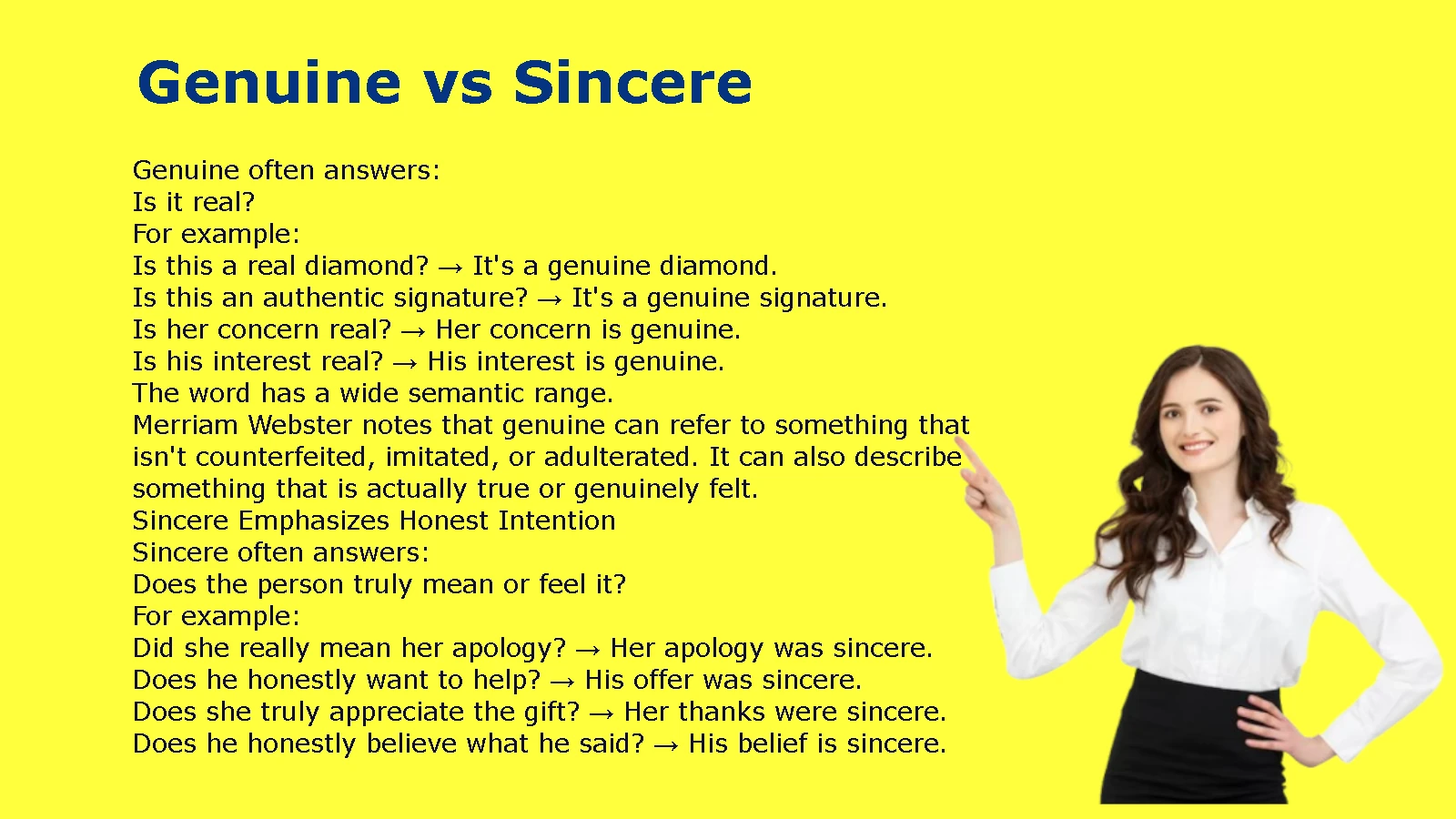
Genuine Emphasizes Authenticity
Genuine often answers:
Is it real?
For example:
- Is this a real diamond? → It’s a genuine diamond.
- Is this an authentic signature? → It’s a genuine signature.
- Is her concern real? → Her concern is genuine.
- Is his interest real? → His interest is genuine.
The word has a wide semantic range.
Merriam Webster notes that genuine can refer to something that isn’t counterfeited, imitated, or adulterated. It can also describe something that is actually true or genuinely felt.
Sincere Emphasizes Honest Intention
Sincere often answers:
Does the person truly mean or feel it?
For example:
- Did she really mean her apology? → Her apology was sincere.
- Does he honestly want to help? → His offer was sincere.
- Does she truly appreciate the gift? → Her thanks were sincere.
- Does he honestly believe what he said? → His belief is sincere.
This makes sincere particularly useful when you are judging someone’s intentions or expressions.
Genuine vs Sincere Examples
The difference becomes much easier to see when you put the words side by side.
| Example | Meaning |
| She showed genuine concern. | Her concern was real. |
| She showed sincere concern. | Her concern was honestly felt. |
| He gave a genuine apology. | His apology wasn’t fake or merely performative. |
| He gave a sincere apology. | He honestly meant what he said. |
| This is genuine leather. | The leather is authentic. |
| She has a genuine interest in science. | Her interest is real. |
| She has a sincere interest in science. | Her interest is honestly felt. |
| They expressed genuine affection. | Their affection was real. |
| They expressed sincere affection. | Their affection was honestly expressed. |
| He made a genuine effort. | The effort was real and not merely for appearance. |
| He made a sincere effort. | He honestly intended to make an effort. |
Notice something important: both words work naturally in several of these examples.
That’s why treating genuine and sincere as completely separate words would be misleading.
When Are Genuine and Sincere Interchangeable?
In many contexts involving feelings, intentions, and personal behavior, the words can be close synonyms.
Genuine Concern vs. Sincere Concern
Both expressions are natural.
She showed genuine concern for the injured child.
This emphasizes that her concern was real.
She showed sincere concern for the injured child.
This emphasizes that her concern was honestly felt.
The practical difference is subtle. In ordinary conversation, most listeners would understand both sentences in almost the same way.
Genuine Interest vs. Sincere Interest
Again, both are possible.
He has a genuine interest in history.
The interest is real. He isn’t pretending to care.
He has a sincere interest in history.
His interest is honest and earnest.
Here, genuine sounds especially natural when discussing whether an interest is authentic rather than manufactured for appearance.
Genuine Apology vs. Sincere Apology
Both expressions are common.
She offered a genuine apology.
The apology was real and not merely a public relations gesture.
She offered a sincere apology.
She honestly regretted what happened and meant her words.
The second sentence places more weight on honest feeling and intention.
Merriam Webster’s treatment of sincere is particularly useful here because it identifies sincere apology as a typical example and explains that sincere emphasizes the absence of hypocrisy or feigning.
Genuine Person vs. Sincere Person
The phrases genuine person and sincere person are both natural, but they can paint slightly different pictures.
What Is a Genuine Person?
A genuine person usually seems authentic, natural, and unaffected.
Imagine someone who behaves the same way whether they’re talking to a CEO or a delivery driver. They don’t seem to create a different personality for every audience.
You might say:
She’s one of the most genuine people I’ve ever met.
This praises her overall character.
The word can suggest:
- authenticity
- natural behavior
- openness
- lack of affectation
- honesty
- consistency between personality and behavior
What Is a Sincere Person?
A sincere person is someone whose words and feelings appear honest rather than deceptive or artificial.
For example:
He seems sincere when he talks about wanting to help.
The focus falls more heavily on whether his stated intentions are genuine.
A sincere person may be:
- honest
- earnest
- straightforward
- truthful in their feelings
- free from deliberate pretense
Are Genuine and Sincere People the Same?
Not necessarily.
Someone can appear genuine because their personality feels natural and authentic. Someone can appear sincere because they honestly mean what they’re saying.
In real life, though, the qualities often travel together. A person who is genuinely themselves may also speak sincerely.
Genuine vs Sincere in Common Expressions
Natural word combinations, or collocations, provide one of the clearest ways to understand this distinction.
Common Expressions With Genuine
- genuine leather
- genuine gold
- genuine diamond
- genuine antique
- genuine article
- genuine signature
- genuine interest
- genuine concern
- genuine affection
- genuine emotion
- genuine surprise
- genuine friendship
- genuine improvement
- genuine talent
The physical examples are especially important because they show why sincere can’t replace genuine everywhere.
Common Expressions With Sincere
- sincere apology
- sincere thanks
- sincere gratitude
- sincere concern
- sincere interest
- sincere effort
- sincere belief
- sincere request
- sincere promise
- sincere affection
- sincere sympathy
- sincere commitment
- sincere intention
These combinations usually involve a person’s feelings, words, beliefs, or intentions.
A Useful Collocation Test
When you’re unsure which word to use, look at the noun that follows it.
If you’re talking about whether an object is authentic, genuine is usually the natural choice.
If you’re talking about whether someone’s words or intentions are honestly meant, sincere is often the better choice.
That isn’t an absolute grammar rule. It’s a practical usage guide.
Genuine vs Sincere: When You Cannot Substitute One for the Other
This is where the difference becomes unmistakable.
Genuine Leather
This bag is made from genuine leather.
Here, genuine means the leather is real.
You can’t naturally replace it with sincere:
❌ This bag is made from sincere leather.
The second sentence doesn’t make sense because leather doesn’t have intentions or feelings.
Genuine Antique
The dealer confirmed that the vase is a genuine antique.
Again, genuine means authentic.
Sincere cannot perform this job.
Genuine Signature
The expert determined that the signature was genuine.
The signature is authentic rather than forged.
Calling the signature sincere would change the meaning and sound unnatural.
Sincere Apology
Now consider:
Please accept my sincere apology.
This is a standard expression because the speaker is communicating honest regret.
Genuine apology also works:
Please accept my genuine apology.
But sincere fits especially well because the focus is on the speaker’s honest feelings and intention.
Can “Genuine” and “Sincere” Always Replace Each Other?
No.
They can overlap when you describe feelings, attitudes, or expressions. They aren’t interchangeable when genuine refers to the physical or factual authenticity of something.
The overlap is where both words can describe real, honest feelings.
The difference lies outside that overlap:
- genuine extends into physical and factual authenticity.
- sincere extends more deeply into honesty of feeling and intention.
Genuine vs Sincere: A Simple Case Study
Consider a manager who tells an employee:
“I really appreciate the work you’ve done on this project.”
There are several ways to describe the statement.
If the Manager Is Genuine
You might say:
The manager’s appreciation was genuine.
The manager truly appreciated the work. The praise wasn’t simply a scripted corporate gesture.
If the Manager Is Sincere
You might say:
The manager’s appreciation was sincere.
The manager honestly meant the praise and wasn’t pretending.
If Both Are True
You could say:
The manager gave a genuine and sincere expression of appreciation.
Here, the words reinforce each other. Genuine highlights the real nature of the appreciation, while sincere highlights the honesty behind the expression.
This is why native speakers sometimes use both words together. They overlap enough to reinforce one another, yet each carries its own shade of meaning.
Genuine vs Sincere: Common Mistakes
Mistake: Treating Them as Perfect Synonyms
It’s tempting to memorize:
genuine = sincere
That shortcut works in some sentences, but it breaks down when genuine means authentic or real.
For example:
The painting is genuine.
This means the painting is authentic.
You can’t say:
❌ The painting is sincere.
The painting doesn’t have an intention to express honestly.
Mistake: Using Sincere for Physical Objects
Avoid phrases such as:
- sincere gold
- sincere leather
- sincere diamond
- sincere antique
- sincere document
Use genuine instead when you mean that something is authentic.
Mistake: Assuming Genuine Only Means “Not Fake”
That definition is incomplete.
Genuine can describe emotions and behavior too:
- genuine happiness
- genuine concern
- genuine surprise
- genuine affection
- genuine kindness
Cambridge explicitly recognizes this sense, defining genuine people and emotions as honest and sincere.
Mistake: Assuming Sincere Always Means “Deeply Emotional”
Sincere doesn’t necessarily mean dramatic or deeply emotional.
Someone can make a sincere request in a calm voice. Someone can offer sincere thanks without becoming emotional.
The key idea is honesty, not intensity.
Genuine vs Sincere: Synonyms
The words have overlapping synonyms, but their synonym sets also reveal their differences.
Synonyms for Genuine
Depending on the context, you can use:
- authentic
- real
- true
- legitimate
- bona fide
- honest
- unaffected
- original
Merriam Webster explains that genuine, authentic, and bona fide can all describe something that is actually what it claims to be. It also notes that genuine can imply that something hasn’t been counterfeited, imitated, or adulterated.
Synonyms for Sincere
Depending on context, alternatives include:
- genuine
- honest
- heartfelt
- earnest
- unfeigned
- wholehearted
- unaffected
Merriam Webster notes that sincere stresses the absence of hypocrisy, feigning, or false embellishment.
Some synonyms have their own shades of meaning. For example, heartfelt emphasizes emotional depth, while wholehearted can suggest complete and enthusiastic commitment.
So don’t treat every synonym as a perfect substitute.
Genuine vs Sincere: Which Word Should You Use?
Use genuine when you want to emphasize that something is:
- real
- authentic
- original
- not counterfeit
- naturally felt
- not artificial
- truly characteristic of someone
Use sincere when you want to emphasize that something is:
- honestly felt
- honestly meant
- free from hypocrisy
- not merely said for appearance
- earnest
- unfeigned
A quick decision table can make the choice easier:
| What do you mean? | Best choice |
| The object is authentic | Genuine |
| The feeling is real | Genuine or sincere |
| The apology is honestly meant | Sincere |
| The leather is real | Genuine |
| The person seems authentic | Genuine |
| The person’s words are honestly meant | Sincere |
| The interest isn’t fake | Genuine or sincere |
| The request is honestly made | Sincere |
| The antique isn’t counterfeit | Genuine |
| The gratitude is honestly expressed | Sincere |
Genuine vs Sincere: The Memory Trick
Here’s the shortest way to remember the distinction:
Genuine = real.
Sincere = honestly meant.
Imagine two questions.
Question one: “Is it real?”
Answer: genuine.
Question two: “Does the person really mean it?”
Answer: sincere.
For example:
The diamond is genuine.
It is real.
Her apology is sincere.
She honestly means it.
The distinction isn’t perfect in every sentence because genuine can also describe honest feelings. Still, this memory trick will help you choose the natural word in most everyday situations.
Frequently Asked Questions About Genuine vs Sincere
Is genuine the same as sincere?
Not exactly. Genuine can mean real, authentic, or honestly felt, while sincere primarily describes honest feelings, intentions, words, and behavior. They overlap when describing emotions and personal expressions.
What is the main difference between genuine and sincere?
The main difference is what each word emphasizes. Genuine emphasizes authenticity or realness. Sincere emphasizes honesty and the absence of pretense.
Can genuine and sincere be synonyms?
Yes. In contexts involving feelings, attitudes, or intentions, they can be synonyms. For example, genuine concern and sincere concern can communicate nearly the same idea.
Can genuine describe objects?
Yes. This is one of the most important differences. You can say genuine leather, genuine gold, genuine artwork, or genuine documents because genuine can mean authentic or not counterfeit.
Can sincere describe objects?
Generally, no. Sincere normally describes a person, feeling, statement, belief, intention, attitude, or behavior. Calling an object sincere is usually unnatural unless the word is being used figuratively.
Is a genuine apology the same as a sincere apology?
They are very close. A genuine apology is real and not merely for show. A sincere apology is honestly meant. In everyday English, both can describe an apology that comes from real regret.
Is a genuine person the same as a sincere person?
Not quite. A genuine person usually seems authentic, natural, and unaffected. A sincere person is someone whose words, feelings, or intentions appear honest and unfeigned.
Which is stronger, genuine or sincere?
Neither word is inherently stronger. The difference comes from emphasis. Genuine is broader and can refer to authenticity, while sincere more specifically highlights honesty of feeling or intention.
Is “genuine interest” correct?
Yes. Genuine interest is a very common and natural expression. It means the interest is real rather than artificial or merely for appearance. Cambridge specifically uses genuine interest in its examples.
Is “sincere interest” correct?
Yes. Sincere interest is also correct. It emphasizes that the person’s interest is honestly felt rather than pretended. Merriam Webster lists a sincere interest among its examples of normal usage.
Can I say “genuine and sincere”?
Yes. The two adjectives can appear together when you want to emphasize both authenticity and honesty.
For example:
She gave a genuine and sincere response.
The combination isn’t necessarily redundant because the words can highlight slightly different qualities.
Final Thoughts on Genuine vs Sincere
The difference between genuine and sincere comes down to a small but useful distinction.
Genuine has the broader meaning. It can describe something that is real, authentic, original, or honestly felt. That’s why you can have genuine leather, a genuine antique, a genuine smile, or genuine concern.
Sincere focuses more specifically on honesty and freedom from pretense. You can give a sincere apology, express sincere gratitude, make a sincere request, or show sincere concern.
When the two words describe feelings, they often overlap:
- genuine concern = concern that is real
- sincere concern = concern that is honestly felt
- genuine apology = a real, non-performative apology
- sincere apology = an apology that the speaker truly means
The easiest rule is simple:
Use genuine when you mean “real or authentic.” Use sincere when you mean “honestly felt or meant.”
Once you understand that distinction, choosing between the two becomes much easier. When both meanings overlap, either word may work. When you’re talking about authenticity, however, genuine is usually the clear winner.