Famous and infamous both describe someone or something that is widely known, but they have very different connotations. Famous usually means well-known for something positive, impressive, or notable, while infamous means well-known for something bad, harmful, or disgraceful.
The confusion is understandable because people often search for famous vs infamous, famous meaning, infamous meaning, or wonder whether infamous simply means “very famous.” In short, someone can be famous for an achievement, while someone can be infamous for a negative action or reputation.
| Question | Answer |
|---|---|
| What is the difference between famous and infamous? | Famous means widely known, usually positively; infamous means widely known for something negative or bad. |
| Does infamous mean very famous? | Not exactly. Infamous specifically carries a negative meaning. |
| What does famous mean? | Famous means known by many people, often because of an achievement or notable quality. |
| What does infamous mean? | Infamous means well-known for something bad, harmful, or disgraceful. |
| Can famous be positive and negative? | It can be neutral or positive, depending on context, but it generally has a favorable or neutral tone. |
| Is infamous always negative? | Yes, infamous normally has a strongly negative connotation. |
Famous vs Infamous: Quick Difference
The fastest way to understand Famous vs Infamous is to separate recognition from reputation.
| Word | Meaning | Connotation | Example |
| Famous | Widely known or recognized | Usually positive or neutral | She is a famous author. |
| Infamous | Widely known for something bad | Strongly negative | The criminal was infamous for his violent crimes. |
| Unfamous | Not widely known | Neutral | The artist remained unfamous during his lifetime. |
| Notorious | Widely known, especially for something bad | Negative | The area is notorious for violent crime. |
The key is that famous describes how widely someone or something is known, while infamous describes a bad reputation attached to that recognition.
Merriam-Webster defines famous as “widely known” and also recognizes a sense connected with being honored for achievement. By contrast, infamous means having a reputation of the worst kind, being notoriously evil, or causing disgrace.
Think of fame as a spotlight. Famous tells you the spotlight is bright. Infamous tells you that something unpleasant is standing underneath it.
What Does “Famous” Mean?
Famous is an adjective that describes a person, place, thing, event, work, achievement, or idea that many people know about.
Merriam-Webster defines famous primarily as widely known. It can also suggest that someone has gained recognition or honor because of an achievement.
For example:
- A famous actor is widely recognized.
- A famous landmark is known by many people.
- A famous scientist has achieved broad recognition.
- A famous restaurant attracts attention because many people know it.
- A famous novel has become widely recognized.
Importantly, famous does not automatically mean good. The word itself mainly tells you that something is well known.
Famous Definition
In everyday English, famous means:
Known by many people or recognized widely.
It often carries a positive feeling because people frequently become famous through talent, achievement, creativity, leadership, sports, entertainment, or discovery.
Consider these sentences:
- Marie Curie was a famous scientist.
- The Eiffel Tower is famous around the world.
- He became famous after winning the championship.
- That restaurant is famous for its seafood.
None of these sentences creates confusion. The reason for the person’s or thing’s recognition may be positive, neutral, or simply notable.
How to Use “Famous”
The word famous appears in several common sentence patterns.
Famous for
Use famous for when you want to explain why someone or something is well known.
Examples:
- The city is famous for its historic buildings.
- She is famous for her novels.
- The restaurant is famous for its homemade pasta.
- The scientist became famous for discovering a new species.
This construction focuses on the reason for the fame.
Famous as
Use famous as when you identify someone’s recognized role, profession, or identity.
Examples:
- He is famous as a filmmaker.
- She became famous as a television host.
- The building is famous as one of the city’s oldest landmarks.
You can also use phrases such as:
- world famous
- internationally famous
- widely famous
- famous worldwide
- famous throughout the country
For example:
The museum is famous worldwide for its collection of ancient art.
The sentence tells readers both how widely it is known and why it is known.
Does “Famous” Always Mean Good?
No.
This is one of the most important details in the Famous vs Infamous comparison.
Although famous often has a positive association, the basic meaning is still widely known. Merriam-Webster notes that the word can indicate widespread and popular recognition without necessarily making a judgment about the subject.
For example:
The politician became famous after the scandal.
Here, famous doesn’t mean the politician became admirable. It simply means the scandal brought the politician widespread attention.
However, if the sentence says:
The politician became infamous after the scandal.
the meaning becomes much sharper. The word now signals that the person’s reputation became notoriously bad.
That’s the central difference.
Famous = known.
Infamous = known for something bad.
What Does “Infamous” Mean?
Infamous describes someone or something that is widely known because of something bad, disgraceful, immoral, criminal, or deeply unpleasant.
Cambridge Dictionary defines infamous as “famous for something considered bad” and lists notorious as a synonym.
Merriam-Webster gives several related senses, including having a reputation of the worst kind, being notoriously evil, and causing or bringing infamy.
Examples include:
- an infamous criminal
- an infamous dictator
- an infamous crime
- an infamous scandal
- an infamous prison
- an infamous historical event
The word carries a clear negative judgment.
Infamous Definition
A practical definition is:
Known by many people because of something seriously bad or disgraceful.
That definition explains why infamous usually isn’t appropriate for ordinary mistakes.
For instance:
He was infamous for forgetting people’s birthdays.
This sentence sounds exaggerated unless forgetting birthdays became an unusually notorious part of his reputation.
A stronger example would be:
The criminal was infamous for his brutal attacks.
Here, the negative meaning fits naturally.
How to Use “Infamous”
The most common construction is infamous for.
Infamous for
Use infamous for to explain the bad behavior, event, feature, or quality that created the reputation.
Examples:
- The criminal was infamous for his violent attacks.
- The prison became infamous for its harsh conditions.
- The company became infamous for misleading customers.
- The ruler was infamous for his cruelty.
- The location became infamous for repeated acts of violence.
Cambridge specifically gives examples of infamous for followed by the reason for the negative reputation.
Is Infamous the Opposite of Famous?
No. Infamous is not the opposite of famous.
This is the biggest trap in the Famous vs Infamous debate.
It is tempting to look at famous and infamous and assume:
famous = known
infamous = not known
But that’s not how modern English works.
Merriam-Webster directly addresses this point. Infamous does not mean “not famous,” and it does not mean “extremely famous.” It means having a reputation of the worst kind.
Why Does “In-” Cause Confusion?
The confusion comes from the prefix in-.
In English, in- can sometimes express negation. Consider:
- visible → invisible
- complete → incomplete
- accurate → inaccurate
- direct → indirect
Because of that pattern, it seems logical to assume:
famous + in- = not famous
But English prefixes don’t always behave like simple mathematical operators.
The history of infamous is more complicated. Etymological records trace famous to Latin famosus, related to fama, meaning fame or reputation. Infamous developed through Latin infamis and Medieval Latin infamosus, with the meaning associated with ill fame or bad reputation.
So the modern word isn’t simply a neat “not + famous” equation.
English has plenty of words whose history makes their modern meaning less predictable than their spelling suggests. Infamous is one of them.
What Is the Opposite of Famous?
If you mean not widely known, infamous isn’t the right word.
Better choices include:
- unknown
- little known
- obscure
- unfamous
- unrecognized
- uncelebrated
- unfamed
Merriam-Webster defines unfamous as “not widely known or renowned.”
Cambridge also recommends words such as obscure, unknown, and little known when describing someone or something that isn’t famous.
Compare these sentences:
The young painter was unfamous during his lifetime.
This means few people knew the painter.
Now compare:
The painter became infamous after a major scandal.
This means the painter became known because of something bad.
The two words move in completely different directions.
| If you mean… | Use… |
| Known by many people | Famous |
| Not known by many people | Unknown / little known / unfamous |
| Known because of something bad | Infamous |
| Widely known and viewed negatively | Notorious |
Famous vs Infamous Examples
The easiest way to see the difference is to place the words side by side.
| Famous | Infamous |
| The author is famous for her novels. | The criminal is infamous for his crimes. |
| The city is famous for its architecture. | The city is infamous for its violent history. |
| She became famous after the movie. | He became infamous after the scandal. |
| The scientist became famous for her discovery. | The scientist became infamous for falsifying data. |
| The restaurant is famous for its desserts. | The restaurant became infamous for its unsafe food practices. |
| The landmark is famous worldwide. | The prison became infamous for its brutal conditions. |
Notice what changes.
In each famous example, the subject gains recognition. The reason may be talent, achievement, history, popularity, or simply uniqueness.
In each infamous example, the recognition is connected to something negative.
Example: A Famous Athlete
Serena Williams is famous for her achievements in tennis.
The sentence highlights recognition based on sporting success.
Example: An Infamous Criminal
The criminal became infamous for his violent attacks.
The sentence highlights recognition based on serious wrongdoing.
Example: A Famous Place
Paris is famous for its art, architecture, and culture.
The reputation is broadly positive.
Example: An Infamous Place
The prison became infamous for its brutal treatment of inmates.
The place is widely known, but its reputation is negative.
That difference remains consistent even when the subject changes.
Famous vs Infamous in a Sentence
Context often makes the correct choice obvious.
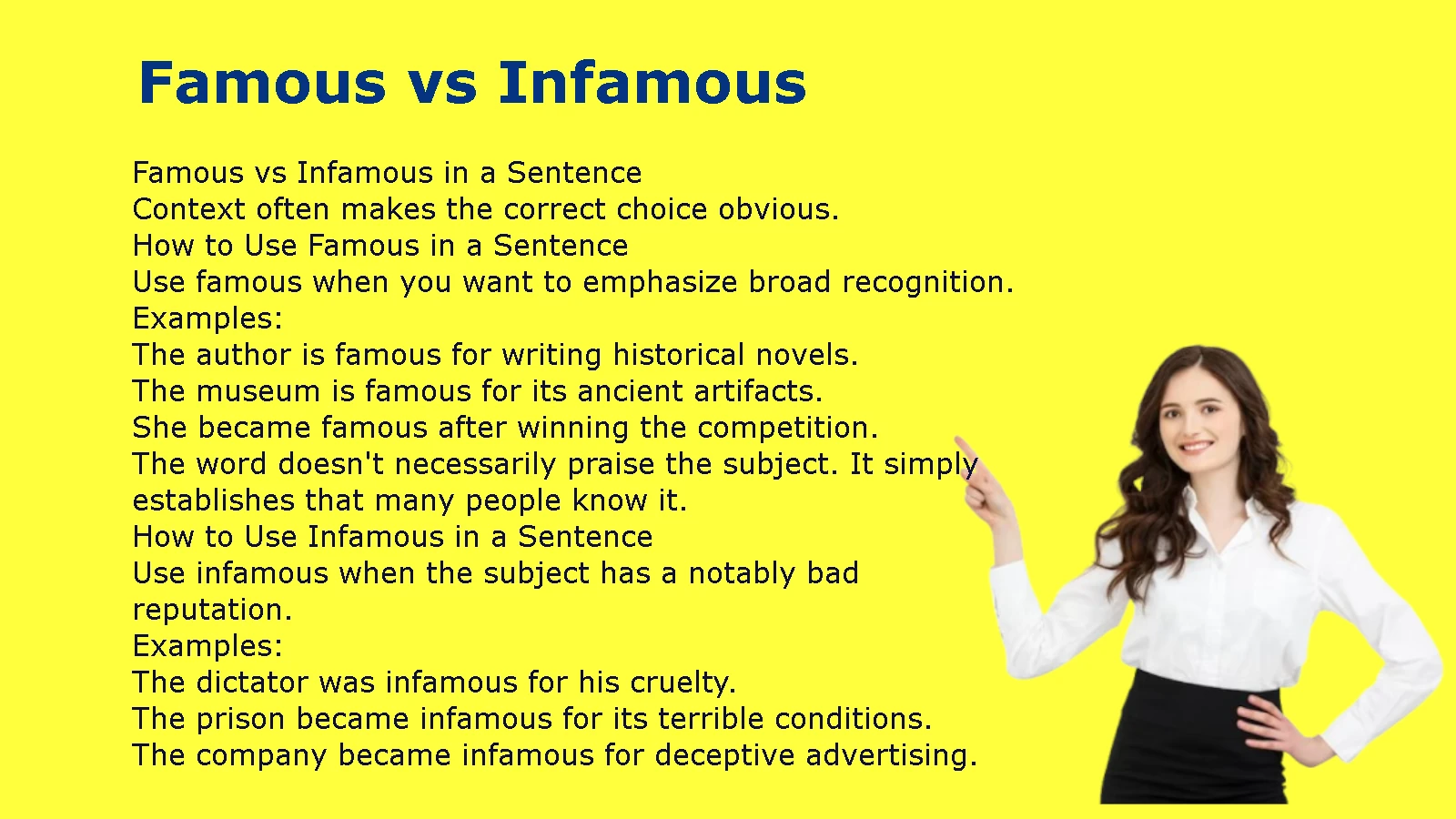
How to Use Famous in a Sentence
Use famous when you want to emphasize broad recognition.
Examples:
- The author is famous for writing historical novels.
- The museum is famous for its ancient artifacts.
- She became famous after winning the competition.
- The bridge is famous around the world.
- He is famous as one of the country’s leading architects.
- The city is famous for its beautiful coastline.
The word doesn’t necessarily praise the subject. It simply establishes that many people know it.
How to Use Infamous in a Sentence
Use infamous when the subject has a notably bad reputation.
Examples:
- The dictator was infamous for his cruelty.
- The prison became infamous for its terrible conditions.
- The company became infamous for deceptive advertising.
- The criminal was infamous for a series of violent attacks.
- The location is infamous for its history of organized crime.
- The scandal became one of the most infamous events in the company’s history.
Here, the negative meaning isn’t optional. It is part of what the word communicates.
Famous vs Infamous Pronunciation
The words also differ in pronunciation.
| Word | US pronunciation |
| famous | /ˈfeɪ.məs/ |
| infamous | /ˈɪn.fə.məs/ |
Famous has two syllables: FAY-muhs.
Infamous has three: IN-fuh-muhs.
The added syllable isn’t just a pronunciation detail. It can help distinguish the words when you’re listening to spoken English.
Merriam-Webster gives famous as /ˈfā-məs/ and infamous as /ˈin-fə-məs/. Cambridge likewise lists /ˈɪn.fə.məs/ for infamous.
Famous vs Infamous vs. Notorious
Once Famous vs Infamous makes sense, another word enters the picture: notorious.
Notorious often overlaps with infamous. Cambridge defines it as being famous for something bad and gives infamous as a synonym.
Merriam-Webster gives notorious a slightly broader definition: generally known and talked about, especially when the recognition is unfavorable.
Here’s a practical comparison:
| Word | Main idea | Typical feeling |
| Famous | Widely known | Neutral or positive |
| Infamous | Famous for something bad | Strongly negative |
| Notorious | Widely known, especially for something bad | Usually negative |
For example:
The actor is famous for her performances.
The sentence is neutral or positive.
The criminal is infamous for his crimes.
The sentence is strongly negative.
The neighborhood is notorious for its high crime rate.
Again, the meaning is negative.
In many sentences, infamous and notorious can replace each other without changing the basic idea.
Is Notorious Always Negative?
Usually, yes in modern everyday English.
However, notorious has a historical and dictionary recognized sense connected to being generally known or talked about. Its modern use most often carries an unfavorable implication. Merriam-Webster notes that notorious can function as a synonym for famous in a broad sense but has developed a strong association with disreputable people or things.
That makes famous the safer choice when you simply want to say that something is well known.
The History Behind Famous and Infamous
The relationship between these words becomes clearer when you look at their origins.
Famous entered English in the Middle English period through Anglo-French and ultimately comes from Latin famosus, meaning widely talked about or renowned. The Latin word traces back to fama, meaning fame or reputation.
Infamous has a more complicated history. Etymological sources trace it to Latin infamis, associated with ill fame and bad reputation. The English word developed into its modern sense of being known for something disgraceful or evil.
Interestingly, historical usage helps explain why the apparent prefix doesn’t give you the modern meaning “not famous.”
In other words, the two words are related. But their meanings aren’t simple opposites.
A Useful Historical Clue: Infamy
The noun infamy makes the negative meaning easier to remember.
Infamy means an extremely bad public reputation or a shameful act that becomes widely known. Merriam-Webster defines it in connection with evil reputation arising from something criminal, shocking, or brutal.
So think:
infamous → infamy → bad reputation
That chain is much more reliable than trying to decode the prefix alone.
A Famous Historical Example of “Infamy”
One of the most recognizable uses of infamy appears in President Franklin D. Roosevelt’s address to Congress after the attack on Pearl Harbor.
On December 8, 1941, Roosevelt described December 7 as:
“a date which will live in infamy”
The National Archives preserves the speech and explains that Roosevelt changed the original wording from “a date which will live in world history” to “a date which will live in infamy.”
The choice was deliberate. Infamy did not simply mean that the date would be famous or remembered. It meant the date would be remembered because of an event regarded as deeply shocking and disgraceful.
This provides a useful real world example of the difference:
Fame concerns recognition.
Infamy concerns recognition tied to disgrace or wrongdoing.
The historical phrase remains closely associated with Pearl Harbor and shows how strongly negative the word infamy can be.
Common Mistakes With Famous and Infamous
Mistake: Thinking Infamous Means “Not Famous”
This is the most common error.
Incorrect assumption:
famous = well known
infamous = not well known
Correct understanding:
famous = widely known
infamous = known for something bad
If you mean that someone isn’t well known, use unknown, little known, or unfamous instead.
Mistake: Thinking Infamous Means “Very Famous”
Some speakers assume that in- acts as an intensifier.
That’s also incorrect in standard modern usage.
Infamous doesn’t mean extremely famous.
A celebrity with millions of fans is very famous.
A criminal known for particularly serious crimes may be infamous.
The distinction is about reputation, not simply the size of the audience.
Mistake: Assuming Famous Always Means Good
Being famous doesn’t guarantee admiration.
Someone can become famous because of:
- a major achievement
- a controversial statement
- a political campaign
- a viral incident
- a scandal
- a criminal case
- an unusual event
If the sentence only needs to communicate broad recognition, famous may be correct.
If you specifically want to emphasize the negative reputation, infamous or notorious may be better.
Mistake: Calling Every Well Known Person Infamous
A person isn’t infamous simply because millions of people know them.
Infamous carries a negative judgment.
For example:
Taylor Swift is famous.
That tells readers she is widely known.
But:
Taylor Swift is infamous.
That would imply that she has a seriously bad reputation. Without a context that supports such a claim, the word would be inappropriate.
Mistake: Confusing Infamous With Unfamous
These words look similar, but their meanings sit almost at opposite ends of the recognition spectrum.
Unfamous means not famous or not widely known. Merriam-Webster lists unknown and obscure among its close synonyms.
Infamous means notorious or associated with a very bad reputation.
Compare:
The painter remained unfamous during his lifetime.
Few people knew him.
The painter became infamous after the scandal.
Many people knew him because of something disgraceful.
One word means little known. The other means notoriously known.
Famous vs Infamous: A Simple Memory Trick
When you need to choose between these words, don’t stare at the prefix.
Instead, ask one question:
Why is this person or thing known?
If the answer is simply that many people know about it, use famous.
If the answer involves something seriously bad, disgraceful, criminal, or notorious, use infamous.
Remember It This Way
Famous = known.
Infamous = known for something bad.
Unfamous = not widely known.
Notorious = widely known for something bad.
Here’s a quick mental test:
A famous singer → known for music.
An infamous criminal → known for serious wrongdoing.
An unfamous painter → not widely known.
A notorious neighborhood → widely known for a negative reason.
That four word distinction can solve most usage questions.
Famous vs Infamous: Key Differences at a Glance
| Feature | Famous | Infamous |
| Basic meaning | Widely known | Known for something bad |
| Reputation | Neutral or positive in many contexts | Strongly negative |
| Means “not famous”? | No | No |
| Means “very famous”? | No | No |
| Can describe people? | Yes | Yes |
| Can describe places? | Yes | Yes |
| Can describe events? | Yes | Yes |
| Can describe things? | Yes | Yes |
| Common pattern | famous for | infamous for |
| Related noun | fame | infamy |
| Close synonym | renowned, celebrated | notorious |
| Opposite idea | unknown, obscure | reputable, respected |
Case Study: How One Word Changes the Meaning
Consider this sentence:
The company became famous after the investigation.
The sentence tells you the investigation made the company widely known. It doesn’t tell you whether the company deserved praise or criticism.
Now change one word:
The company became infamous after the investigation.
Suddenly, the sentence carries a clear negative judgment. The company became known because the investigation exposed something seriously wrong.
That one prefix changes the emotional direction of the sentence.
Here’s another example:
The prison is famous for its history.
This could be neutral. Perhaps it is historically important or widely visited.
The prison is infamous for its brutal conditions.
Now the reason for its reputation is explicitly negative.
This is why word choice matters. Famous gives you recognition. Infamous gives you recognition plus a bad reputation.
When Should You Use Famous, Infamous, or Notorious?
Use this decision guide when you’re writing.
Choose “Famous” When:
- many people know the person or thing
- the reputation is neutral or positive
- you are discussing achievements
- you want to describe popularity or recognition
- no negative reputation needs emphasis
Example:
The university is famous for its research programs.
Choose “Infamous” When:
- someone has a very bad reputation
- something is known because of serious wrongdoing
- an event is remembered for disgrace or horror
- you want a strongly negative tone
Example:
The ruler became infamous for his cruelty.
Choose “Notorious” When:
- something is widely known for a bad reason
- you want a strong synonym for infamous
- the negative reputation is central to the sentence
Example:
The company is notorious for ignoring customer complaints.
Choose “Unknown” or “Unfamous” When:
- few people know the person or thing
- you’re describing a lack of recognition
- you don’t want to imply wrongdoing
Example:
The artist was largely unknown outside her hometown.
Frequently Asked Questions About Famous vs Infamous
Is infamous the opposite of famous?
No. Infamous doesn’t mean “not famous.” It means widely known for something bad or disgraceful. If you mean “not widely known,” use unknown, little known, obscure, or unfamous.
Does infamous mean very famous?
No. Infamous carries a negative meaning. It describes someone or something known for a bad reputation, serious wrongdoing, or disgrace.
What is the difference between famous and infamous?
Famous means widely known. Infamous means widely known because of something bad or disgraceful.
Can someone be famous and infamous?
Yes. The two words can apply to different stages or aspects of the same person’s public reputation.
For example, someone may become famous for an achievement and later become infamous because of a serious scandal.
The words describe different qualities of reputation, so they aren’t mutually exclusive.
Is infamous always negative?
In modern standard English, yes, it carries a strongly negative meaning. Merriam-Webster connects it with notorious evil, disgrace, and offenses bringing infamy.
Is notorious the same as infamous?
They are close synonyms in many contexts. Both can describe someone or something that is widely known for a bad reason. Cambridge explicitly lists infamous as a synonym of notorious.
What is the opposite of infamous?
There isn’t one perfect one word opposite in every context. Depending on what you mean, useful choices include respected, reputable, honorable, admired, or well regarded.
What does the prefix “in-” mean in infamous?
The history is more complicated than simply adding “not” to famous. Infamous comes through Latin forms associated with ill fame and bad reputation. Its modern meaning therefore isn’t simply “not famous.”
What is the noun form of infamous?
The noun is infamy.
Infamy refers to an extremely bad reputation or a shameful, shocking, or criminal act.
What is the adjective for someone who is not famous?
Unfamous can mean not widely known, although everyday English more commonly uses phrases such as unknown, little known, or obscure.
Which is correct: famous for or infamous for?
Both are grammatically correct. The choice depends on the meaning.
- Famous for = widely known because of something.
- Infamous for = widely known because of something bad.
Compare:
She is famous for her paintings.
He is infamous for his crimes.
The grammatical structure is almost identical. The reputation changes.
Final Verdict: Famous vs Infamous
The difference between Famous vs Infamous comes down to one crucial idea: reputation.
Famous means widely known. It commonly describes people, places, achievements, works, and events that have gained broad recognition. The word often sounds positive, but it doesn’t inherently guarantee that the subject is admirable.
Infamous means widely known for something bad. It carries a strong negative meaning and can describe criminals, crimes, scandals, places, historical events, or other subjects associated with disgrace or wrongdoing.
The biggest mistake is treating infamous as the opposite of famous. It isn’t.
If something isn’t well known, call it unknown, little known, obscure, or unfamous.
If something is well known because of a bad reputation, infamous or notorious is the better choice.
Keep this simple rule in mind:
Famous means known. Infamous means known for something bad.
Once that distinction clicks, these two easily confused words stop being a linguistic minefield and become surprisingly straightforward.