If you’ve ever wondered whether to write program or programme, you’re dealing with one of the clearest differences between American and British English. The two words share the same basic meanings, but English speakers in different regions don’t always spell them the same way.
The simplest rule is this: American English uses “program” in almost every context. British English usually uses “programme” for non computing meanings but uses “program” for computing. For example, an American writer will discuss a degree program and a television program. A British writer will usually write degree programme and television programme. However, both generally use computer program.
That small extra me creates plenty of confusion. It becomes especially tricky when you’re writing for an international audience, working on academic material, or switching between American and British sources.
This guide explains program vs programme in detail, including definitions, regional differences, computing terminology, academic writing, examples, common mistakes, and a practical rule you can remember.
Program vs Programme: Quick Answer
Program and programme are spelling variants of the same word. The preferred spelling depends mainly on the variety of English you’re using and, in British English, the context.
| Context | American English | British English |
| Television show | program | programme |
| Radio show | program | programme |
| University course | program | programme |
| Training | program | programme |
| Government initiative | program | programme |
| Research initiative | program | programme |
| Event schedule | program | programme |
| Theater or concert booklet | program | programme |
| Computer software | program | program |
| Computer programming | program | program |
The important detail is the British English computing exception.
British English generally retains program when the word relates to computers, software, or programming. Merriam Webster likewise identifies programme as a British spelling variant while noting that the computing sense uses program in both American and British English.
So, if you’re writing in American English, the decision is easy:
Use “program.”
If you’re writing in British English, ask one more question:
Is the word related to computing?
If yes, use program. If not, programme will often be the appropriate British spelling.
What Does “Program” Mean?
The noun program has several related meanings. At its core, it refers to an organized plan, sequence, or set of activities. It can also refer to computer instructions.
The exact meaning comes from context.
Program as a Planned Series of Activities
A program can describe an organized set of activities designed to achieve a particular goal.
For example:
- a fitness program
- a training program
- a health program
- a government program
- a research program
- a literacy program
- an employee development program
Consider this sentence:
The company introduced a new training program for managers.
The word program refers to a structured series of activities rather than a single event.
In American English, this spelling is standard. In British English, the equivalent would normally be training programme.
Program as a Television or Radio Show
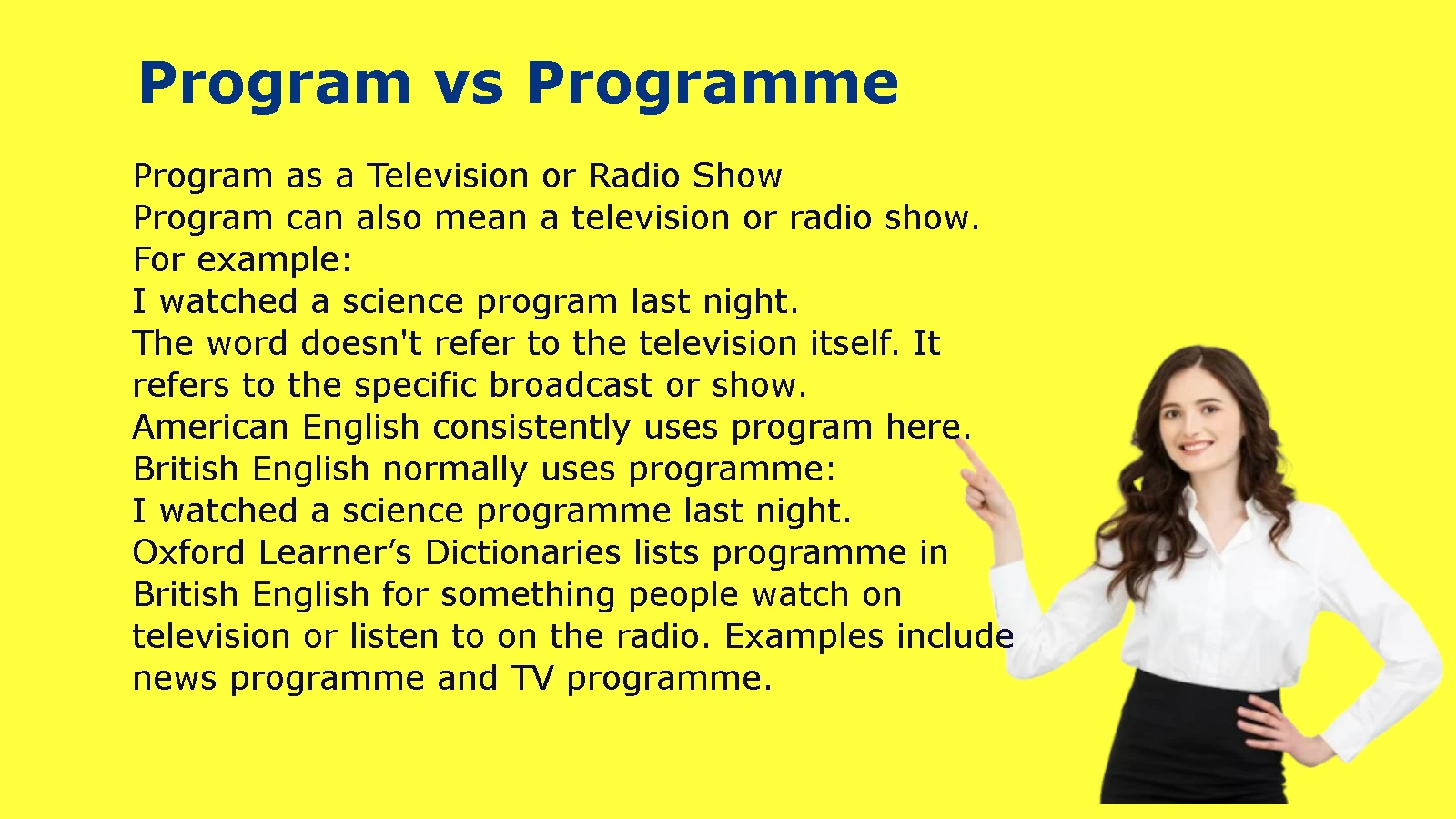
Program can also mean a television or radio show.
For example:
I watched a science program last night.
The word doesn’t refer to the television itself. It refers to the specific broadcast or show.
American English consistently uses program here. British English normally uses programme:
I watched a science programme last night.
Oxford Learner’s Dictionaries lists programme in British English for something people watch on television or listen to on the radio. Examples include news programme and TV programme.
Program as a Course of Study
Schools and universities use program to describe a structured course or area of study.
Common expressions include:
- degree program
- graduate program
- undergraduate program
- master’s program
- doctoral program
- nursing program
- engineering program
- language program
For example:
She enrolled in a graduate program in economics.
This spelling is standard American English.
A British university would generally write:
She enrolled in a postgraduate programme in economics.
The difference isn’t about the course itself. It’s about the spelling convention used by the institution.
Program as an Event Schedule
A program can also refer to a schedule or printed outline for an event.
For example:
The concert program listed all the performers.
The program might contain the order of performances, names of performers, and other information about the event.
In British English, you would generally see programme in this sense:
The concert programme listed all the performers.
This meaning has a long history. Merriam Webster explains that the word originally referred to an outline or agenda arranged in a prescribed order.
Program as Computer Software
In computing, program has a specialized meaning.
A computer program is a set of instructions that tells a computer how to perform tasks. Oxford Learner’s Dictionaries defines a computer program as a set of coded instructions that controls a computer’s operations or functions.
For example:
The program crashed when I tried to open the file.
Here, program is correct in both American and British English.
You would not normally write computer programme when following standard British computing terminology.
What Does “Programme” Mean?
Programme carries essentially the same meanings as program, but it functions primarily as the British English spelling for non computing uses.
You’ll commonly see it in British writing about television, education, events, government initiatives, and organized activities.
Programme for Television and Radio
British English generally uses programme for television and radio shows.
Examples include:
- television programme
- radio programme
- news programme
- documentary programme
- entertainment programme
- children’s programme
For example:
The BBC aired a new documentary programme last night.
American English would normally spell the same phrase:
The network aired a new documentary program last night.
The meaning doesn’t change. Only the regional spelling does.
Programme for Education
British English commonly uses programme for academic courses and organized educational schemes.
Examples include:
- degree programme
- undergraduate programme
- postgraduate programme
- training programme
- study programme
- exchange programme
For example:
She applied for a postgraduate programme in law.
An American university would typically write:
She applied for a graduate program in law.
This distinction matters when writing university content. A British university website may consistently use programme, while an American university website will generally use program.
Programme for Government Initiatives
A government can organize a programme of activities or policies.
For example:
The government launched a new housing programme.
American English would normally use:
The government launched a new housing program.
Again, the underlying meaning remains the same.
Programme for Events
British English also uses programme for an organized schedule of events.
For example:
The festival programme includes performances by local artists.
An American publication would normally write:
The festival program includes performances by local artists.
This usage also applies to theater productions, concerts, conferences, and similar events.
When to Use “Program” in American English
American English makes the choice remarkably simple.
Use “program” across the major meanings of the word.
That includes both technical and non technical contexts.
| Meaning | American English |
| TV show | TV program |
| Radio show | radio program |
| Degree course | degree program |
| Training | training program |
| Government initiative | government program |
| Fitness plan | fitness program |
| Research initiative | research program |
| Event schedule | event program |
| Theater booklet | theater program |
| Computer software | computer program |
For American readers, programme will generally look unusual because it isn’t the standard spelling used for these ordinary meanings.
Consider these examples:
The university created a new scholarship program.
The television program attracted millions of viewers.
The company offers a leadership development program.
The software program requires an internet connection.
All four use program, even though the meanings differ.
That’s one of the biggest advantages of American English in this particular spelling: you don’t have to switch forms based on meaning.
When to Use “Programme” in British English
British English requires more attention because it normally distinguishes between non computing and computing contexts.
For most traditional non computing meanings, use programme.
Common British English Examples
- television programme
- radio programme
- training programme
- degree programme
- research programme
- government programme
- education programme
- fitness programme
- development programme
- event programme
- concert programme
- theater programme
For example:
The university offers several postgraduate programmes.
The government announced a new environmental programme.
The theater’s autumn programme includes five new productions.
She joined a professional development programme.
In each sentence, programme fits standard British usage.
When to Use “Program” in British English
Here’s where the program vs programme question gets interesting.
British English uses program in computing and programming contexts.
That includes:
- computer program
- software program
- computer programming
- programming language
- program code
- program instructions
- program file
- program execution
- program a computer
- program a machine
For example:
The computer program contains several errors.
She is learning to program in Python.
The engineers developed a program to process the data.
The program runs automatically when the computer starts.
The spelling remains program because the computing sense has developed its own established usage.
Cambridge Dictionary also defines program as a series of instructions that can be put into a computer to make it perform an operation.
Why This Exception Matters
A common oversimplification says:
American English = program
British English = programme
That rule works for many everyday examples, but it’s incomplete.
A better rule is:
American English uses “program” broadly. British English uses “programme” for most non computing meanings and “program” for computing.
That one extra sentence prevents a lot of mistakes.
Program vs Programme in Different Contexts
Context can make the choice much easier.
| Phrase | US English | UK English |
| computer program | program | program |
| software program | program | program |
| programming language | programming language | programming language |
| TV program | program | programme |
| radio program | program | programme |
| degree program | program | programme |
| training program | program | programme |
| government program | program | programme |
| research program | program | programme |
| fitness program | program | programme |
| event program | program | programme |
| concert program | program | programme |
This table reveals the pattern clearly.
The difference isn’t simply about geography. British English makes a context based distinction that American English generally doesn’t make.
Program vs Programme Examples
Examples are often the fastest way to understand this spelling difference.
Education
American English:
She entered a master’s program in psychology.
British English:
She entered a master’s programme in psychology.
The academic meaning stays exactly the same.
Television
American English:
That television program starts at eight.
British English:
That television programme starts at eight.
Government
American English:
The government introduced a new housing program.
British English:
The government introduced a new housing programme.
Training
American English:
Employees must complete the safety training program.
British English:
Employees must complete the safety training programme.
Events
American English:
The conference program includes three keynote speakers.
British English:
The conference programme includes three keynote speakers.
Computing
American English:
The computer program processes the data automatically.
British English:
The computer program processes the data automatically.
Notice what happened in the final pair.
The spelling didn’t change.
That’s the British computing exception in action.
Program vs Programme as a Verb
The verb adds another layer of confusion.
In computing, program works as a verb in both American and British English.
For example:
She programs the computer every morning.
The engineer programmed the robot.
They are programming a new application.
The -ing form is normally programming, not programming with an extra me.
The spelling is especially important because people sometimes assume that adding -ing to programme should produce programming. In standard modern usage, programming is the established form in both varieties of English.
Common Forms
| Form | Standard spelling |
| Base verb | program |
| Third person | programs |
| Past tense | programmed |
| Present participle | programming |
| Person who programs | programmer |
| Adjective | programmable |
For example:
He programs industrial machines.
She programmed the device yesterday.
They are programming a new application.
The machine is programmable.
Oxford Learner’s Dictionaries also lists program as a verb meaning to give a machine instructions to perform a particular task.
Program vs Programme in Academic Writing
Academic writing is one area where consistency matters more than personal preference.
If you write for an American university, journal, publisher, or academic audience that follows American English, use program.
Examples include:
- academic program
- degree program
- doctoral program
- research program
- exchange program
- study program
If you write for a British institution that follows British English, programme will generally appear in non computing academic contexts.
Examples include:
- academic programme
- degree programme
- doctoral programme
- research programme
- exchange programme
- study programme
A Practical Academic Example
Imagine you’re writing an article about university admissions.
For an American audience:
Our graduate program prepares students for careers in environmental science.
For a British audience:
Our postgraduate programme prepares students for careers in environmental science.
Neither sentence is inherently better. The correct choice depends on the English variety being used.
When a university or publisher provides a style guide, follow that guide first. Institutional terminology can matter too. If an official organization consistently uses a particular spelling in its name, don’t casually rewrite its terminology to match a different regional convention.
Program vs Programme in Professional Writing
Professional writers face the same issue in reports, websites, proposals, brochures, and business documents.
Suppose an American company writes:
Our employee wellness program helps workers build healthier habits.
That’s completely natural in American English.
A British company might write:
Our employee wellness programme helps staff build healthier habits.
Both versions work for their intended audiences.
Where Consistency Matters Most
Pay particular attention to:
- company websites
- employee handbooks
- marketing materials
- annual reports
- business proposals
- academic documents
- government documents
- nonprofit materials
- press releases
- training manuals
Mixing spelling systems can make a document look poorly edited.
For example, a British document that repeatedly uses programme but suddenly switches to program for a training initiative may look inconsistent. On the other hand, program should remain unchanged when the context refers to computer software.
Program vs Programme in Other English Varieties
English doesn’t stop at American and British English. Countries such as Canada, Australia, and New Zealand have their own spelling traditions, and real world usage can sometimes be more complicated than a simple two column chart suggests.
That’s why broad claims such as “every country outside the United States uses programme” can be misleading.
English varieties often combine historical British conventions with local preferences and technical terminology. Style guides, publishers, institutions, and professional fields can also influence spelling.
For that reason, if you’re writing for a specific national audience, check the relevant local style guide or the terminology used by the organization you’re writing for.
The goal isn’t to memorize every country’s preference. The goal is to avoid treating English spelling as if it were governed by one worldwide rulebook.
Why Are “Program” and “Programme” Spelled Differently?
The spelling difference has a long history.
The word ultimately traces back to Greek programma, formed from elements associated with writing something beforehand. It passed through Latin and French before developing into the English forms used today. Merriam Webster notes that the original sense involved a public notice or agenda and that the French form programme influenced the British spelling.
The history also explains why the two spellings aren’t random.
Program isn’t a shortened modern invention created by Americans. It has historical roots in English. British usage later favored programme, influenced in part by French spelling.
Then computing introduced another twist.
As computer terminology developed during the twentieth century, program became established as the technical form. British English retained that spelling in computing even though it continued using programme for many traditional meanings.
So today’s distinction is the result of several layers of language history rather than a simple spelling preference.
Common Program vs Programme Mistakes
Even experienced writers can stumble over this pair.
Mistake: Assuming “Programme” Is Always British
British English doesn’t use programme in every situation.
For computing, program is standard.
Correct:
The computer program crashed.
Not:
The computer programme crashed.
Mistake: Assuming “Program” Is Always American
That’s also incomplete.
British English uses program for computing.
So this is perfectly normal in British English:
He wrote a computer program in Python.
Mistake: Mixing English Varieties
A document can look awkward when it combines American and British conventions without a reason.
For example:
The university offers several degree programmes. Students can also enroll in a summer program.
If the document follows British English, the second sentence may look inconsistent unless program has a specific computing meaning.
Choose the appropriate English variety and stick with it.
Mistake: Changing “Programming” to Match “Programme”
Don’t write programmeing.
The standard form is:
programming
This applies to both American and British English.
Mistake: Treating the Words as Different in Meaning
For most non computing uses, program and programme represent the same underlying word.
The difference is primarily spelling convention, not a fundamental difference in meaning.
How to Remember Program vs Programme
You don’t need a complicated memory trick.
Use this simple system:
If You Write American English
Always choose program.
Examples:
- TV program
- degree program
- training program
- government program
- computer program
If You Write British English
Ask whether you’re talking about computing.
Non computing → programme
- TV programme
- degree programme
- training programme
- government programme
- event programme
Computing → program
- computer program
- software program
- program code
- program a computer
- programming language
Think of it as a small fork in the road:
PROGRAM / PROGRAMME
|
What English are you using?
/ \
US UK
| |
PROGRAM Is it computing?
/ \
Yes No
| |
PROGRAM PROGRAMME
That rule handles most everyday cases.
Program vs Programme: A Quick Comparison Chart
| Feature | Program | Programme |
| American English | Yes | No, generally |
| British English | Yes, especially computing | Yes, mainly non computing |
| Computer software | Yes | No |
| Programming | Yes | No |
| Television | US | UK |
| Radio | US | UK |
| Academic courses | US | UK |
| Government initiatives | US | UK |
| Training schemes | US | UK |
| Event schedules | US | UK |
| Theater or concert materials | US | UK |
The central takeaway is straightforward:
American English favors program across the board. British English generally uses programme for traditional non computing meanings and program for computing.
Case Study: Choosing the Right Spelling for a University Website
Consider a university that serves students in the United States.
Its website might contain:
Our computer science program teaches students how to design software.
The undergraduate program includes courses in artificial intelligence.
Students can join our international exchange program.
The consistent use of program fits American English.
Now imagine a British university describing similar offerings:
Our computer science programme teaches students how to design software.
The undergraduate programme includes courses in artificial intelligence.
But when the university talks specifically about software, it can write:
Students learn how to develop computer programs.
Here, program appears in the British text because the word has a computing meaning.
This example shows why context matters. You can’t reliably determine the correct spelling by asking only, “Is this British English?” You also need to ask, “What does the word mean here?”
Program vs Programme in Technology
Technology provides the easiest situation because both American and British English generally use program.
You can write:
- computer program
- software program
- computer programming
- program code
- programming language
- program execution
- program developer
- program file
- program instructions
For example:
The developer created a computer program that analyzes large datasets.
The spelling remains program regardless of whether the surrounding document follows American or British English.
This consistency helps explain why program has become especially familiar internationally in technology. Technical vocabulary often crosses national borders quickly, and software development has developed a highly international terminology.
Program vs Programme in Everyday Sentences
Here are several examples side by side.
| American English | British English |
| I watched a television program. | I watched a television programme. |
| She joined a training program. | She joined a training programme. |
| He enrolled in a degree program. | He enrolled in a degree programme. |
| The government launched a new program. | The government launched a new programme. |
| The event program starts at noon. | The event programme starts at noon. |
| The computer program stopped working. | The computer program stopped working. |
| She is learning to program computers. | She is learning to program computers. |
| They are programming a new application. | They are programming a new application. |
The last three examples demonstrate the key technical exception.
Is “Program” or “Programme” Correct?
Both are correct.
The correct spelling depends on English variety and context.
Use program in standard American English.
Use programme for most non computing meanings in British English.
So neither spelling is universally superior. The mistake occurs when you use a spelling that doesn’t fit the English variety or context you’re targeting.
Is “Programme” Correct in American English?
Programme is not the standard American English spelling.
American English normally uses program for television, education, government initiatives, events, training, software, and other common meanings.
For example:
She enrolled in a graduate program.
The television program begins at nine.
The company created a training program.
American readers will understand programme, but it doesn’t follow the normal American spelling convention.
Is “Program” Correct in British English?
Yes.
However, British English uses it differently from American English.
For computing, program is the standard choice:
computer program
software program
programming
For many non computing meanings, British English normally uses programme:
television programme
degree programme
training programme
government programme
This distinction is one of the most important facts to remember when comparing program vs programme.
Is It “Computer Program” or “Computer Programme”?
Computer program is the standard form in both American and British English.
For example:
The computer program uses artificial intelligence to analyze the data.
The word refers specifically to software or coded instructions, so British English also uses program in this technical sense. Merriam Webster explicitly notes this shared computing spelling.
Is It “Degree Program” or “Degree Programme”?
The answer depends on your variety of English.
American English:
degree program
British English:
degree programme
The same pattern applies to related academic phrases.
| American English | British English |
| graduate program | postgraduate programme |
| undergraduate program | undergraduate programme |
| master’s program | master’s programme |
| doctoral program | doctoral programme |
| research program | research programme |
| exchange program | exchange programme |
Always check the institution’s own terminology when you’re writing about a specific university.
Is It “TV Program” or “TV Programme”?
Again, geography determines the standard spelling.
American English: TV program
British English: TV programme
Oxford Learner’s Dictionaries specifically gives TV programme, television programme, and radio programme as British English examples.
Is “Programming” Spelled the Same in American and British English?
Yes.
The standard form is programming in both varieties.
Examples:
She enjoys programming.
He is learning computer programming.
They are programming a new application.
The word does not become programmeing simply because the surrounding text uses British English.
Should You Use One Spelling Consistently?
Yes, but consistency doesn’t mean using the same form in every British English context.
If you’re writing American English, use program consistently.
If you’re writing British English, use programme for the relevant non computing meanings and program for computing.
The goal is to maintain the conventions of the English variety you’re using.
For example, a British technology article can correctly contain both:
The training programme teaches students how to build a computer program.
There is no contradiction. The first word describes a non computing educational scheme. The second refers to software.
Frequently Asked Questions About Program vs Programme
Is program or programme correct?
Both are correct. American English generally uses program, while British English normally uses programme for non computing meanings. British English also uses program for computing.
Is programme British or American?
Programme is primarily associated with British English. It is commonly used in Britain for television, education, events, government initiatives, and other non computing meanings.
Is program American or British?
Program is used in both American and British English. American English uses it broadly, while British English uses it particularly in computing and programming contexts.
Does British English use program?
Yes. British English uses program for computer software and related technical contexts. It can also appear in other specialized or established usages, so the simple “British always equals programme” rule is too broad.
Does American English use programme?
Not as the normal spelling. American English overwhelmingly uses program for the ordinary meanings covered by this word.
Is “computer programme” wrong?
In standard British computing terminology, computer program is the expected form. American English also uses computer program.
Is “degree programme” British English?
Yes. Degree programme is the standard British English form for a course or organized academic scheme.
American English normally uses degree program.
Is “TV programme” British English?
Yes. TV programme is standard British English.
American English uses TV program.
Is “training programme” British English?
Yes. British English generally uses training programme, while American English uses training program.
Is “government program” American English?
Yes. Government program is standard American English.
British English normally uses government programme when referring to a planned set of non computing government activities.
Is “programming” British or American?
Programming is used in both American and British English.
The spelling remains programming when referring to computer programming.
Does the pronunciation change between program and programme?
Generally, the extra letters in programme don’t create a fundamentally different pronunciation. The main distinction discussed here is spelling, not a major difference in how the word is spoken.
Cambridge Dictionary gives American and British pronunciation entries for program, illustrating that regional pronunciation can vary independently of the spelling distinction.
Which spelling should you use in academic writing?
Follow the English variety required by your institution, publisher, instructor, or style guide.
For American English, use program.
For British English, use programme for non computing academic contexts and program for computing.
Which spelling should you use on a US website?
Use program.
For example:
Our leadership program helps professionals develop management skills.
Which spelling should you use on a UK website?
For most non computing uses, use programme.
For example:
Our leadership programme helps professionals develop management skills.
For computing, use program:
Our computer program helps analyze customer data.
Final Verdict: Program vs Programme
The program vs programme difference looks complicated at first, but the core rule is surprisingly manageable.
Program is the standard American English spelling. Americans use it for television shows, academic courses, training initiatives, government plans, events, software, and more.
Programme is primarily the British English spelling for non computing meanings. British writers commonly use television programme, degree programme, training programme, and government programme.
But British English makes one important exception: program is used for computing and programming.
| If you’re writing about… | American English | British English |
| Television | program | programme |
| Education | program | programme |
| Training | program | programme |
| Government plans | program | programme |
| Events | program | programme |
| Software | program | program |
| Computer programming | program | program |
The easiest rule to remember is:
US English: program.
British English: programme for most non computing uses.
British computing: program.
Once you know that distinction, choosing between program and programme becomes much less of a guessing game. When in doubt, identify the English variety first, then consider whether the word refers to computing. That two step check will handle almost every ordinary usage.