Have you ever wondered whether fiber and fibre mean the same thing, or if there’s actually a difference between them? While Fiber vs Fibre may look like a spelling question, the answer depends mainly on where you use the word and which form of English you follow.
Fiber and fibre have the same meaning. Both refer to a thin, threadlike strand or material, and both can describe dietary fiber, natural or synthetic materials, or parts of plants and tissues. The main difference is spelling: fiber is the standard spelling in American English, while fibre is commonly used in British English and other varieties of English.
Examples:
- Fiber: Whole grains are a good source of dietary fiber.
- Fibre: Whole grains are a good source of dietary fibre.
The confusion is understandable. People often search for fiber vs fibre, fiber or fibre, fiber meaning, fibre meaning, or which spelling is correct because both forms are widely used. And here’s the kicker: neither spelling is wrong. Your choice usually depends on the type of English you’re writing.
In this guide, you’ll learn the complete difference between Fiber vs Fibre, including their meaning, definition, pronunciation, usage, and examples in sentences. You’ll also discover when to use fiber or fibre, which spelling is correct in American and British English, and how the two forms are used in different contexts.
Fiber vs Fibre: The Quick Answer
The simplest answer is this:
Fiber is American English. Fibre is British English.
Neither spelling is wrong. The choice depends on the variety of English you’re using.
For example:
- American English: I need more fiber in my diet.
- British English: I need more fibre in my diet.
Both sentences communicate exactly the same idea.
The same regional spelling difference appears in many related expressions:
- fiber optic vs. fibre optic
- optical fiber vs. optical fibre
- dietary fiber vs. dietary fibre
- muscle fiber vs. muscle fibre
- natural fiber vs. natural fibre
- synthetic fiber vs. synthetic fibre
The important point is consistency. If you start an article in American English, fiber should normally remain fiber throughout. Switching to fibre halfway through makes the writing look inconsistent.
What Does Fiber or Fibre Mean?
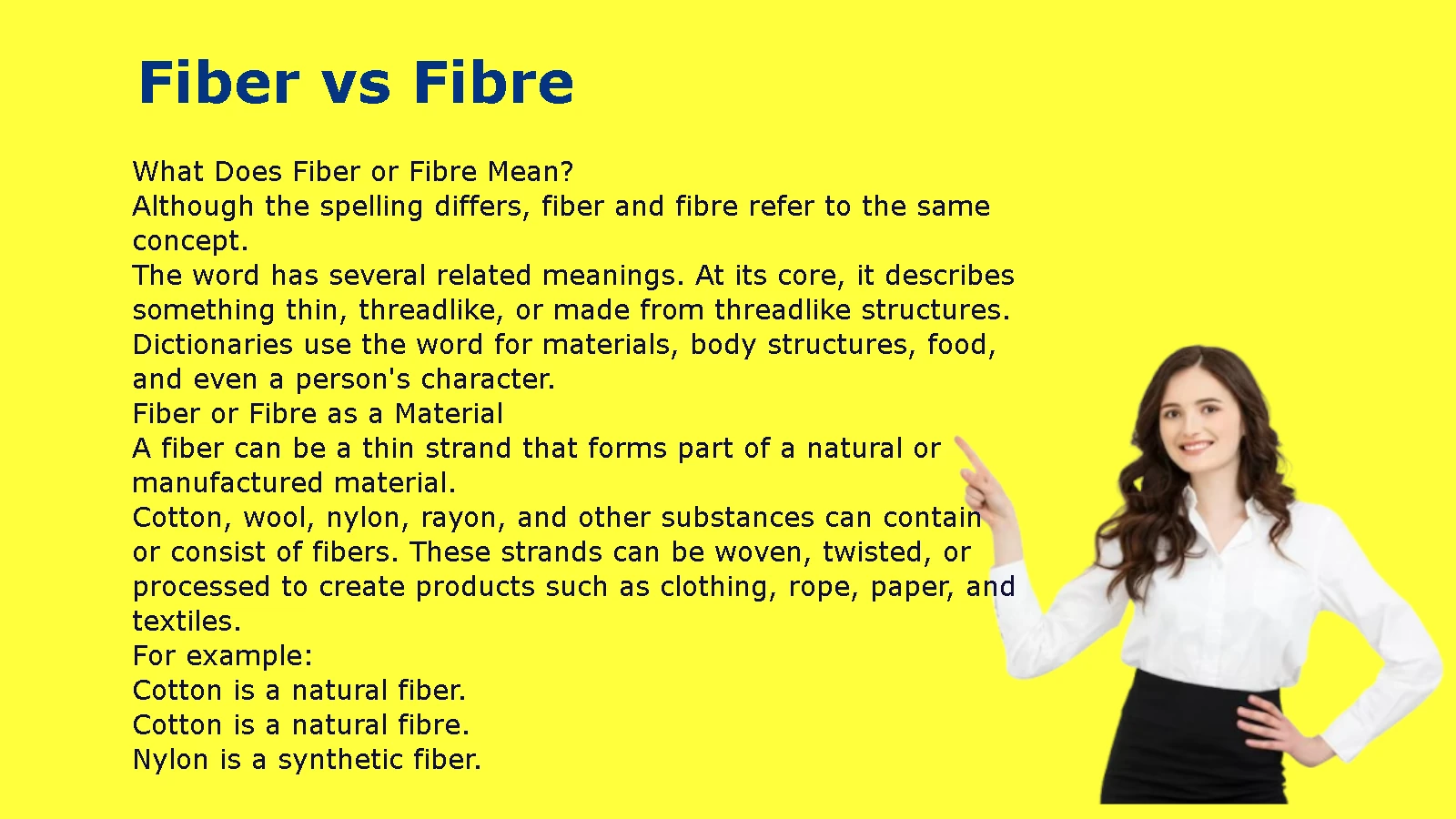
Although the spelling differs, fiber and fibre refer to the same concept.
The word has several related meanings. At its core, it describes something thin, threadlike, or made from threadlike structures. Dictionaries use the word for materials, body structures, food, and even a person’s character.
Fiber or Fibre as a Material
A fiber can be a thin strand that forms part of a natural or manufactured material.
Cotton, wool, nylon, rayon, and other substances can contain or consist of fibers. These strands can be woven, twisted, or processed to create products such as clothing, rope, paper, and textiles.
For example:
- Cotton is a natural fiber.
- Cotton is a natural fibre.
- Nylon is a synthetic fiber.
- Nylon is a synthetic fibre.
Cambridge defines the word in this sense as a threadlike part of plant or artificial material that can be used to make products such as cloth.
Fiber or Fibre in the Human Body
The word also describes thin structures within the body.
You may encounter terms such as:
- muscle fiber/fibre
- nerve fiber/fibre
- connective tissue fiber/fibre
- collagen fiber/fibre
In American medical writing, you’ll generally see fiber. British medical writing commonly uses fibre.
For example:
US English:
The exercise damaged several muscle fibers.
UK English:
The exercise damaged several muscle fibres.
The underlying biological concept doesn’t change. Only the spelling does.
Fiber or Fibre in Food
One of the most familiar uses appears in nutrition.
Fiber in American English and fibre in British English refer to components of plant based foods that the human digestive system doesn’t fully digest.
You’ll see the terms in discussions about:
- whole grains
- fruits
- vegetables
- legumes
- digestive health
- dietary intake
- high fiber/fibre foods
For example:
American English:
Beans are an excellent source of dietary fiber.
British English:
Beans are an excellent source of dietary fibre.
Oxford lists dietary fiber/fibre as a major meaning and gives related expressions such as high fiber/fibre diet, fiber/fibre intake, and fiber/fibre content.
Fiber or Fibre in Technology
The word also appears in telecommunications and computing.
Fiber optic technology uses extremely thin strands, commonly made from glass or plastic, to transmit information using light.
That produces another familiar spelling difference:
- fiber optic in American English
- fibre optic in British English
- optical fiber in American English
- optical fibre in British English
For example:
US English:
The company installed a fiber optic network.
UK English:
The company installed a fibre optic network.
The technology is the same. The spelling follows the English variety.
Is Fiber or Fibre Correct?
Both are correct.
The key is knowing which spelling fits your audience.
Use fiber when following standard American English.
Use fibre when following standard British English.
This isn’t a case where one spelling represents the modern form and the other represents an outdated form. Both remain established spellings. Cambridge explicitly labels fiber as the US spelling and fibre as the UK spelling.
A useful rule is:
| If you’re writing for… | Use… |
| United States | fiber |
| United Kingdom | fibre |
| A publication using American English | fiber |
| A publication using British English | fibre |
| An organization with a specific style guide | Follow its guide |
Think of it like color/colour or center/centre. The spelling signals the English variety rather than creating a different meaning.
Fiber vs Fibre in American and British English
The distinction becomes easier when you compare the words side by side.
American English: Fiber
American English uses fiber.
Examples include:
- dietary fiber
- fiber intake
- high fiber diet
- natural fiber
- synthetic fiber
- muscle fiber
- nerve fiber
- optical fiber
- fiber optic cable
American dictionaries such as Merriam Webster define fiber across several senses, including threadlike structures, textile material, dietary material, and figurative strength of character.
British English: Fibre
British English uses fibre.
Examples include:
- dietary fibre
- fibre intake
- high fibre diet
- natural fibre
- synthetic fibre
- muscle fibre
- nerve fibre
- optical fibre
- fibre optic cable
Oxford lists fibre as the British form and gives examples involving dietary fibre, fibre intake, fibre content, and foods rich in fibre.
Why Does American English Use “Fiber”?
The spelling belongs to a broader pattern in American English.
Words ending in -re in British English often appear as -er in American English:
| British English | American English |
| fibre | fiber |
| centre | center |
| metre | meter |
| theatre | theater |
The change is not unique to fiber. It reflects a larger history of American spelling standardization.
Oxford’s style guidance lists -re → -er among established British and American spelling differences.
Historical sources trace the spelling distinction to the development of American English and the influence of Noah Webster’s efforts to establish distinct American spelling conventions. Etymonline notes that the US shift from -re to -er in words such as fibre, centre, and theatre began in the late 18th century.
Fiber vs Fibre Pronunciation
Despite their different spellings, fiber and fibre have essentially the same pronunciation.
Cambridge gives the American pronunciation as approximately /ˈfaɪ.bɚ/ and the British pronunciation as approximately /ˈfaɪ.bə(r)/.
The main difference comes from the final unstressed sound in common American and British pronunciation.
The first syllable carries the stress:
FI-ber
The spelling therefore doesn’t tell you that these are two different spoken words. They’re regional spelling variants of the same word.
Do Fiber and Fibre Sound Different?
Not in any major way.
An American speaker will typically use the American vowel quality in the second syllable. A British speaker may use a different unstressed vowel and may pronounce the final r differently depending on their accent.
Those are ordinary accent differences, not a difference in the identity of the word.
Fiber vs Fibre Examples in Sentences
Seeing the words in context makes the rule much easier to remember.
American English Examples
- This cereal contains plenty of fiber.
- She increased her daily fiber intake.
- Beans are a good source of dietary fiber.
- The shirt is made from natural fibers.
- The doctor recommended a high fiber diet.
- The new building has a fiber optic connection.
- Exercise can affect the size and strength of muscle fibers.
- Cotton is a widely used natural fiber.
- The cable uses optical fiber to transmit data.
- He didn’t have the moral fiber to admit his mistake.
British English Examples
- This cereal contains plenty of fibre.
- She increased her daily fibre intake.
- Beans are a good source of dietary fibre.
- The shirt is made from natural fibres.
- The doctor recommended a high fibre diet.
- The new building has a fibre optic connection.
- Exercise can affect the size and strength of muscle fibres.
- Cotton is a widely used natural fibre.
- The cable uses optical fibre to transmit data.
- He didn’t have the moral fibre to admit his mistake.
Notice the pattern. The sentence structure and meaning stay the same. The spelling changes to match the English variety.
Fiber vs Fibre in Common Phrases
Some phrases appear frequently enough that it’s worth learning their regional forms directly.
| American English | British English |
| dietary fiber | dietary fibre |
| fiber intake | fibre intake |
| fiber content | fibre content |
| high fiber diet | high fibre diet |
| low fiber diet | low fibre diet |
| natural fiber | natural fibre |
| synthetic fiber | synthetic fibre |
| artificial fiber | artificial fibre |
| muscle fiber | muscle fibre |
| nerve fiber | nerve fibre |
| optical fiber | optical fibre |
| fiber optic | fibre optic |
| fiber optic cable | fibre optic cable |
| glass fiber | glass fibre |
| plant fiber | plant fibre |
These are not different concepts. They’re regional spelling equivalents.
Cambridge’s entries show the same distinction across material, biological, food, and computing contexts.
Fiber or Fibre: Which Should You Use?
The best choice depends on who will read your writing.
Use Fiber for American English
Choose fiber when you’re writing in US English.
This applies to:
- American websites
- US newspapers and magazines
- American school assignments
- US business documents
- American academic publications
- Content specifically targeting US readers
For example:
The nutrition label lists 8 grams of fiber per serving.
Writing fibre in an otherwise American document may not make the sentence incomprehensible. However, it creates a spelling mismatch that readers may notice.
Use Fibre for British English
Choose fibre when you’re writing in British English.
This includes:
- UK publications
- British educational materials
- UK focused websites
- British business writing
- Documents following British spelling conventions
For example:
The nutrition label lists 8 grams of fibre per serving.
Again, the meaning stays unchanged.
What If You’re Writing for an International Audience?
Follow the style guide or language convention required by the organization.
If there isn’t a specific requirement, choose a consistent variety of English based on your primary audience.
Fiber vs Fibre in Other English Speaking Countries
It’s tempting to divide the world neatly into “America uses fiber” and “everyone else uses fibre.” Real English usage is more nuanced.
Different countries, organizations, publishers, and style guides can make different choices. British spelling has historically influenced English in many countries outside the United States, but that doesn’t mean every institution follows every British spelling rule in every context.
That’s why a country based assumption isn’t always enough.
If you’re writing for a specific market, check the publication’s existing spelling conventions. Look at words such as color/colour, center/centre, and organize/organise. If the publication consistently uses one system, fiber/fibre should normally follow the same pattern.
The broader rule is simple:
Match the established English variety of your audience rather than mixing conventions.
Is Fibre a Different Word From Fiber?
No.
Fibre is the British spelling of fiber.
Merriam Webster describes fibre as the “chiefly British spelling of fiber,” while Cambridge identifies fibre as the UK spelling and fiber as the US spelling.
That means you don’t need to learn two separate definitions.
Instead, learn one word with two major regional spellings:
fiber = American English
fibre = British English
The same relationship appears in many other spelling pairs:
- color / colour
- center / centre
- behavior / behaviour
- favor / favour
- labor / labour
The difference lies primarily in spelling conventions.
Fiber vs Fibre: Singular and Plural Forms
The regional distinction continues when you make the word plural.
| American English | British English |
| fiber | fibre |
| fibers | fibres |
For example:
American:
The fabric contains several synthetic fibers.
British:
The fabric contains several synthetic fibres.
Don’t mix the forms in ordinary writing.
If your document follows American English, use fibers. If it follows British English, use fibres.
The same principle applies to compounds and related expressions.
Fiber vs Fibre and the Word “Fibrous”
One related word deserves special attention: fibrous.
Unlike fiber/fibre, fibrous does not normally switch to a British spelling with an added e.
It means containing, consisting of, or resembling fibers.
For example:
- a fibrous material
- fibrous tissue
- a fibrous plant
- a fibrous texture
You wouldn’t normally write fibreous simply because you’re using British English.
Merriam Webster defines fibrous as an adjective meaning “containing, consisting of, or resembling fibers.”
This distinction matters because spelling rules don’t always transfer mechanically from one word to another.
Fiber, Fibre, and Fibrous Compared
| Word | Meaning | US English | UK English |
| fiber | Threadlike structure or material | ✓ | Usually not preferred |
| fibre | Same word as fiber | Usually not preferred | ✓ |
| fibrous | Containing or resembling fibers | ✓ | ✓ |
Where Did the Word Fiber Come From?
The history of fiber/fibre goes much further back than the American and British spelling split.
Merriam Webster traces fiber through Middle French fibre to Latin fibra. Its dictionary records the first known English use of fiber in 1607.
Etymonline traces the older form to Medieval Latin and Latin fibra, with early meanings connected to bodily tissue and threadlike structures. The English word later developed meanings involving plants, textiles, strength, and other related concepts.
The modern spelling difference therefore isn’t about two separate origins.
The two forms share the same linguistic history.
The major distinction developed later as American and British spelling conventions moved in somewhat different directions.
Why Does British English Keep “Fibre”?
British English retained the -re spelling in words such as fibre, centre, and theatre.
American spelling conventions later favored -er in many of these words.
The result is a familiar pattern:
British fibre → American fiber
This isn’t a pronunciation based distinction in which the letters suddenly represent different sounds. It’s primarily a regional spelling convention.
Oxford’s guidance groups -re/-er among established British and American spelling differences.
A Simple Case Study: Writing the Same Article for Two Audiences
Imagine a nutrition website publishes the same article for readers in New York and London.
The American version might say:
A high fiber diet can include whole grains, beans, fruits, and vegetables. Check the fiber content on nutrition labels when comparing products.
The British version would naturally say:
A high fibre diet can include whole grains, beans, fruit, and vegetables. Check the fibre content on nutrition labels when comparing products.
The nutritional information doesn’t change.
The spelling does.
This illustrates an important writing principle: localization isn’t always about changing the facts. Sometimes it’s about changing the language conventions used to present the same facts.
Common Fiber vs Fibre Mistakes
The spelling itself is easy once you know the rule. Most mistakes happen when writers mix English varieties.
Mistake: Treating Fibre as Incorrect
Seeing fibre in a British publication doesn’t mean the writer misspelled fiber.
The spelling is correct for British English.
Likewise, fiber isn’t an error simply because a British reader would normally write fibre.
Mistake: Mixing Fiber and Fibre
A document might begin with:
This food contains a high amount of fiber.
A few paragraphs later, it might say:
Increasing your fibre intake can improve your diet.
That switch looks accidental unless the writer has a clear reason for changing English varieties.
Pick one system and stick with it.
Mistake: Assuming the Meaning Changes
The extra e doesn’t create a new definition.
Fiber and fibre can refer to the same:
- material
- biological structure
- dietary component
- optical medium
- figurative quality of character
The regional spelling changes. The basic meaning doesn’t.
Mistake: Changing Every Related Word
Once writers learn that fibre is British, they sometimes assume every word containing the letters fiber must change in the same way.
That’s not a safe rule.
For example, fibrous remains fibrous in both major varieties of English.
Always check the specific word rather than applying a spelling transformation mechanically.
Fiber vs Fibre in Academic and Professional Writing
In formal writing, consistency matters even more.
A university, journal, company, or publication may have a specific style guide. That guide should take priority over personal preference.
For example, if an American university requires US English, use:
- fiber
- fibers
- fiber optic
- optical fiber
If a British publication requires UK English, use:
- fibre
- fibres
- fibre optic
- optical fibre
This approach also helps with search optimization.
If a page targets American readers and repeatedly uses fiber, the language feels natural to that audience. If the page targets British readers and uses fibre, the terminology matches their normal spelling.
There is no need to force both variants into every paragraph simply to capture searches. Use the appropriate form naturally and mention the alternative when the spelling distinction is relevant.
Fiber vs Fibre: Quick Comparison
| Feature | Fiber | Fibre |
| Main variety | American English | British English |
| Meaning | Same | Same |
| Pronunciation | Essentially the same word | Essentially the same word |
| Food | dietary fiber | dietary fibre |
| Textiles | natural fiber | natural fibre |
| Biology | muscle fiber | muscle fibre |
| Technology | optical fiber | optical fibre |
| Plural | fibers | fibres |
| Standard US usage | Yes | No, except in specific names or quotations |
| Standard UK usage | Usually not | Yes |
Fiber vs Fibre FAQs
Is fiber American or British?
Fiber is the standard spelling in American English. Cambridge explicitly identifies it as the US spelling of fibre.
Is fibre American or British?
Fibre is the standard spelling in British English. Cambridge identifies it as the UK spelling of fiber, and Merriam Webster describes it as the chiefly British spelling.
Are fiber and fibre the same word?
Yes. Fiber and fibre are regional spelling variants of the same word. Their core meanings are the same.
Which is correct, fiber or fibre?
Both are correct. Use fiber for American English and fibre for British English.
Is dietary fiber or dietary fibre correct?
Both are correct in their respective English varieties.
- dietary fiber = American English
- dietary fibre = British English
Oxford lists both forms as the same term across US and UK English usage.
Is it fiber optic or fibre optic?
Use fiber optic in American English and fibre optic in British English.
You’ll also see optical fiber in US English and optical fibre in British English.
Do fiber and fibre have different pronunciations?
They have essentially the same pronunciation, although American and British accents produce differences in the final unstressed sound. Cambridge lists /ˈfaɪ.bɚ/ for the US pronunciation and /ˈfaɪ.bə(r)/ for the UK pronunciation.
Is “fibers” American and “fibres” British?
Yes.
- fibers is the standard American plural.
- fibres is the standard British plural.
Can you use fiber in British English?
Readers in Britain will understand fiber, but fibre is the conventional British spelling. If you’re writing according to British English style, use fibre.
Can you use fibre in American English?
American readers will understand fibre, but fiber is the standard American spelling. In US English writing, fiber is normally the better choice.
Is fibrous spelled differently in British English?
No. Fibrous is the standard spelling in both American and British English. It means containing, consisting of, or resembling fibers.
Which spelling should I use in SEO content?
Use the spelling that matches your target audience and the search context.
For a US audience, use fiber naturally.
For a UK audience, use fibre naturally.
If the page specifically targets the query fiber vs fibre, it’s reasonable to mention both forms because the spelling distinction is the subject of the page. However, don’t fill the article with unnatural repetitions just to increase keyword frequency.
Fiber vs Fibre: Final Verdict
The fiber vs fibre difference is straightforward once the regional spelling rule is clear.
Fiber is the standard American English spelling.
Fibre is the standard British English spelling.
Both words have the same core meaning. They can describe threadlike material, biological structures, dietary material, optical transmission media, and even qualities such as strength of character.
The best choice depends on your audience:
Writing in US English? Use “fiber.”
Writing in British English? Use “fibre.”
Most importantly, stay consistent. If a document uses American English, don’t randomly switch to British spellings. If it follows British English, keep fibre throughout.
Once that rule clicks, fiber vs fibre is no longer a tricky spelling question. It’s simply another example of how American and British English can use different spellings for the same word.