Have you ever wondered whether Defense and Defence mean different things? If you’ve seen both spellings and weren’t sure which one to use, you’re not alone. While Defense vs Defence looks like a simple spelling difference, the correct form depends on the English variety, country, and context in which you’re writing.
Defense and Defence have the same meaning. Both refer to the act of protecting someone or something from attack, harm, or criticism. The main difference is that Defense is the standard spelling in American English, while Defence is commonly used in British English and other varieties influenced by British spelling.
Examples:
- The team improved its defense during the second half.
- The government strengthened its defence against potential threats.
The confusion is understandable. People often search for defense vs defence, defence vs defense, defense or defence, and which spelling is correct because both forms are widely used. And here’s the kicker: neither spelling is wrong. You simply need to choose the one that matches the type of English you’re using.
In this guide, you’ll learn the complete difference between Defense vs Defence, including their meaning, definition, pronunciation, correct spelling, and usage in sentences. You’ll also discover whether to use defense or defence in American and British English, along with clear examples to help you choose the right spelling every time.
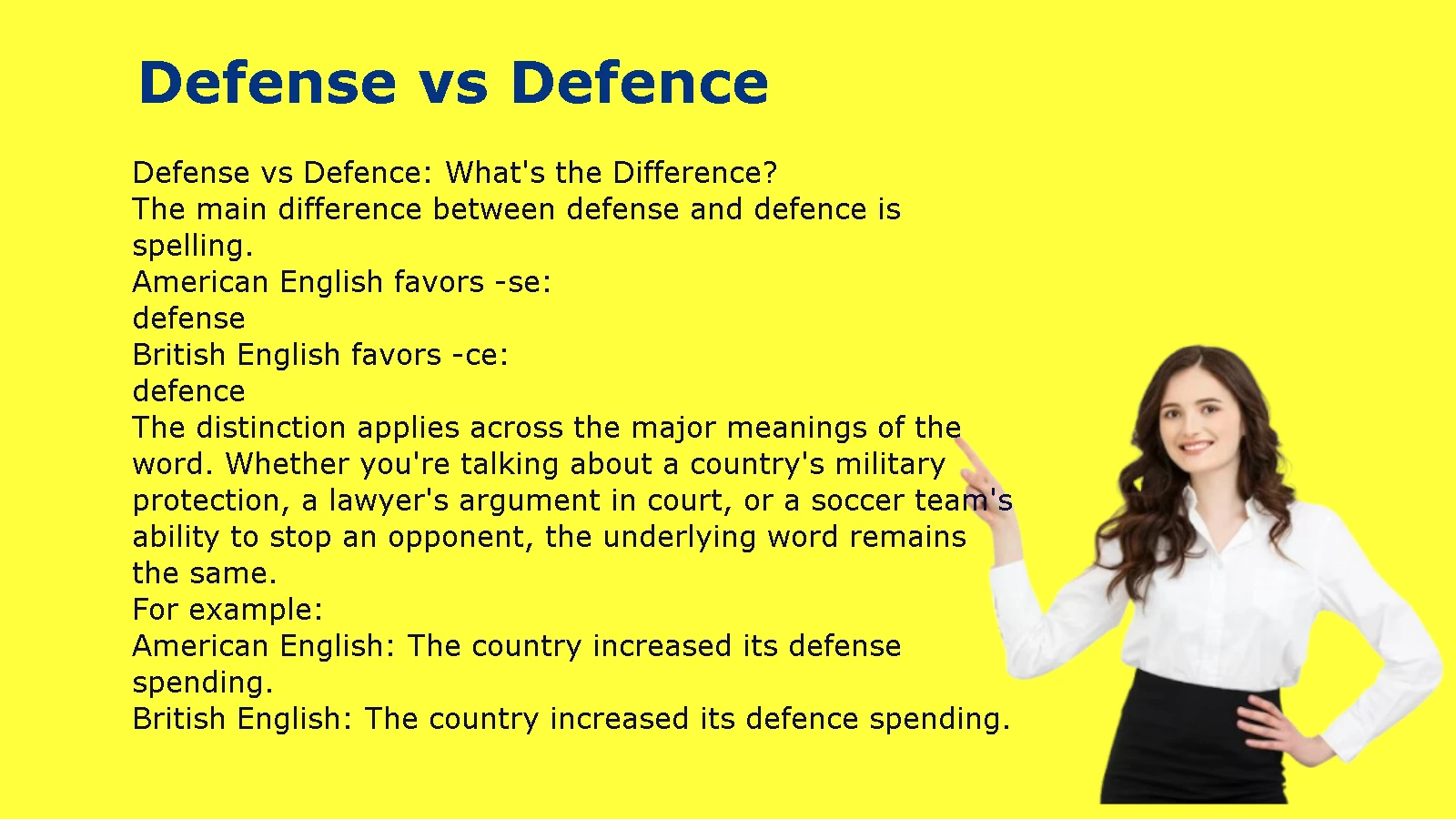
Defense vs Defence: What’s the Difference?
The main difference between defense and defence is spelling.
American English favors -se:
defense
British English favors -ce:
defence
The distinction applies across the major meanings of the word. Whether you’re talking about a country’s military protection, a lawyer’s argument in court, or a soccer team’s ability to stop an opponent, the underlying word remains the same.
For example:
- American English: The country increased its defense spending.
- British English: The country increased its defence spending.
The meaning hasn’t changed. Only the spelling has.
Merriam Webster describes defence as a chiefly British spelling of defense, while Oxford treats the two forms as US and British variants.
Quick answer
If you need the answer at a glance:
- Use defense in American English.
- Use defence in British English.
- Both words have the same core meanings.
- Both are normally pronounced the same way.
- Choose one spelling and keep it consistent throughout your writing.
That last point matters more than many writers realize. A document that switches randomly between defense and defence can look as though it was assembled from different sources.
What Does Defense Mean?
Defense is the American English spelling of the noun. It refers broadly to protection against attack, harm, criticism, accusation, or loss.
The word has several established meanings, so context determines exactly what it describes.
Merriam Webster includes meanings such as the act of defending, the ability to resist attack, a means of protection, an argument in support of something, a legal response, and defensive play in sports.
Here are the most important uses.
Defense as protection
In its broadest sense, defense means the act of protecting someone or something.
For example:
- The soldiers fought in defense of their country.
- The walls provided defense against attackers.
- The body has natural defenses against disease.
- The company improved its cybersecurity defenses.
This use doesn’t have to involve war. A defense can protect against physical danger, disease, criticism, financial loss, or other threats.
Defense as support
You can also use defense when someone speaks or acts in support of another person or idea.
For example:
- She came to her friend’s defense.
- He wrote a strong defense of the proposal.
- The article offered a detailed defense of free speech.
The common expression in defense of means that someone is supporting or protecting a person, idea, action, or position.
Defense in law
In legal contexts, defense can refer to the argument or case presented by someone accused in a legal proceeding.
For example:
- The defense challenged the evidence.
- The defense attorney questioned the witness.
- The defendant presented an unusual defense.
Oxford includes both the legal argument and the lawyers representing the accused among the word’s established meanings.
Defense in sports
In American English, defense also describes the players, tactics, or ability used to stop an opponent from scoring.
For example:
- The team’s defense allowed only one goal.
- Their defense improved dramatically after halftime.
- She is one of the league’s strongest defensive players.
In North American sports terminology, you may also hear on defense and play defense.
What Does Defence Mean?
Defence is the standard British English spelling of the same word.
It carries the same major meanings as defense. British English simply uses c where American English uses s in this particular word.
For example:
- The country increased its defence spending.
- She came to his defence.
- The lawyer prepared a strong defence.
- The team’s defence held firm.
Cambridge defines defence as protection against attack or criticism and also uses it for military forces and other forms of protection.
Oxford similarly lists military, protective, legal, supportive, and sporting meanings for defence.
Defence in British English
If you’re writing in British English, use defence in expressions such as:
- national defence
- defence spending
- defence policy
- air defence
- missile defence
- legal defence
- defence lawyer
- defence mechanism
- self defence
- defence against criticism
The spelling remains defence regardless of which meaning you intend.
Defense vs Defence Examples in Sentences
Seeing the two spellings side by side makes the rule much easier to remember.
| American English | British English |
| The country increased its defense budget. | The country increased its defence budget. |
| She came to his defense. | She came to his defence. |
| The lawyer prepared a strong defense. | The lawyer prepared a strong defence. |
| The team has an excellent defense. | The team has an excellent defence. |
| The wall provides defense against flooding. | The wall provides defence against flooding. |
| The policy focuses on national defense. | The policy focuses on national defence. |
| The company upgraded its cyber defenses. | The company upgraded its cyber defences. |
| He spoke in defense of the decision. | He spoke in defence of the decision. |
Notice what stays the same: the meaning and sentence structure.
What changes is the spelling.
Is “Defense” or “Defence” Correct in American English?
Defense is correct in standard American English.
American dictionaries and style references use the -se spelling. Cambridge explicitly labels defense as the US spelling of defence, while Oxford identifies it as the US English form.
So if you’re writing an American English article, essay, report, email, or legal document, write:
- defense
- defenses
- self-defense
- defense attorney
- defense system
- defense spending
For example:
The committee discussed changes to the country’s defense policy.
Using defence in an American English document won’t usually make the meaning unclear. However, it doesn’t match standard US spelling.
American English examples
- The defense budget increased this year.
- The team’s defense struggled in the first quarter.
- The lawyer presented a strong defense.
- She acted in self-defense.
- The company developed new defense systems.
- He wrote an essay in defense of the policy.
Is “Defense” or “Defence” Correct in British English?
Defence is correct in standard British English.
British English generally retains the -ce spelling:
- defence
- defences
- self-defence
- defence lawyer
- defence system
- defence spending
For example:
The government announced changes to its defence policy.
The spelling also appears in established British institutional names. Oxford gives Ministry of Defence as the British counterpart to the American Department of Defense.
British English examples
- The country increased its defence budget.
- The team’s defence played well.
- The solicitor prepared the client’s defence.
- She acted in self-defence.
- The government reviewed its defence policy.
- The system provides defence against cyberattacks.
Do Defense and Defence Have the Same Meaning?
Yes. In ordinary usage, defense and defence are spelling variants rather than separate words with different meanings.
Both can describe:
- Protection from attack
- Protection from harm or criticism
- A method of protecting something
- A legal response to an accusation
- An argument supporting a person, idea, or position
- A sports team’s defensive play or players
- A contest in which a previous champion tries to retain a title
Merriam Webster’s entry for defense includes protection, legal responses, arguments in support, and sports usage.
Oxford likewise lists these different senses under defense and defence.
That means the spelling does not tell you which meaning the writer intends.
Consider:
The defense was strong.
Depending on context, this could mean a legal team, a sports unit, or a country’s protective capability.
The same is true of:
The defence was strong.
British readers use the context to determine the meaning.
Do Defense and Defence Have the Same Pronunciation?
Yes. The spelling changes, but the pronunciation normally doesn’t.
Both forms are pronounced /dɪˈfens/ in the ordinary noun sense. Oxford gives this pronunciation for both forms.
The stress falls on the second syllable.
This makes defense and defence different from spelling pairs where the spelling change can signal a pronunciation difference.
So don’t assume that the c in defence creates a different sound. It doesn’t.
Defense vs Defence in Legal Writing
Legal writing provides one of the clearest examples of why the distinction matters.
In both American and British English, defense/defence can refer to the case, argument, or position presented by someone accused or sued.
The spelling changes according to the legal system’s English variety.
American legal English
American English uses:
- defense attorney
- defense counsel
- criminal defense
- affirmative defense
- defense strategy
- defense evidence
Example:
The defense attorney challenged the reliability of the witness.
British legal English
British English uses:
- defence lawyer
- defence counsel
- criminal defence
- defence strategy
- defence evidence
Example:
The defence lawyer challenged the reliability of the witness.
Oxford specifically identifies the defence as the lawyer or lawyers whose role is to establish that an accused person did not commit a crime.
The underlying legal concept remains the same. The spelling reflects the variety of English.
Defense vs Defence in Sports
Sports terminology creates another useful distinction.
In American English, defense commonly refers to the players or tactics that prevent an opponent from scoring.
For example:
The team’s defense forced three turnovers.
American sports writing also commonly uses phrases such as:
- play defense
- on defense
- defensive player
- defensive strategy
- defensive line
British English generally uses defence instead.
For example:
The team’s defence prevented the opposition from scoring.
British usage includes:
- play defence
- in defence
- defensive player
- defensive strategy
- defensive line
Oxford specifically contrasts on defense in North American English with in defence in British English.
A useful sports example
Imagine a soccer article written for two different audiences:
American English:
The team’s defense remained organized throughout the match.
British English:
The team’s defence remained organized throughout the match.
Neither sentence describes a different style of play. The spelling simply follows the intended variety of English.
Defense vs Defence in Military Contexts
Military writing uses the word frequently because defense/defence can describe a country’s ability and systems for protecting itself against attack.
Common expressions include:
| American English | British English |
| national defense | national defence |
| defense policy | defence policy |
| defense spending | defence spending |
| defense budget | defence budget |
| air defense | air defence |
| missile defense | missile defence |
| defense industry | defence industry |
| defense forces | defence forces |
Oxford uses Department of Defense for US English and Ministry of Defence for British English.
This is a useful real-world example because official names generally follow the spelling conventions of the country or institution using them.
So don’t “correct” Department of Defense to Department of Defence. The official US name uses Defense.
Likewise, don’t change Ministry of Defence to Ministry of Defense when referring to the British institution.
What About “Defensive” and “Defensible”?
Here’s where writers sometimes make an unnecessary mistake.
Although American English changes defence to defense, you shouldn’t automatically replace every c or s connected to the word.
The adjective is defensive in both American and British English.
Correct:
- defensive strategy
- defensive position
- defensive player
- defensive action
- defensive mechanism
Not standard:
- defencive
The same applies to defensible.
Correct:
- a defensible argument
- a defensible position
- a legally defensible decision
The spelling pattern is therefore not simply “change every c to s in American English.”
The noun has established regional forms:
defense / defence
But related words can retain s in both varieties.
Cambridge lists defensible and defend alongside defense, while Oxford’s entries similarly show the related forms.
Why Are Defense and Defence Spelled Differently?
The difference has a long linguistic history.
Oxford traces defence/defense through Middle English from Old French defens and ultimately from Latin forms connected with defendere, meaning “to defend.”
Over time, English developed multiple spelling conventions for words inherited through French and Latin.
British English retained defence as the conventional noun spelling. American English increasingly favored defense.
This isn’t an isolated phenomenon.
Compare:
- defense / defence
- offense / offence
- pretense / pretence
The pattern reflects broader differences between American and British spelling conventions.
However, it’s important not to assume that every pair follows exactly the same rule. English spelling contains plenty of exceptions and historical quirks.
Defense vs Defence and Other American British Spelling Differences
The defense/defence distinction belongs to a larger family of spelling differences between American and British English.
| American English | British English |
| defense | defence |
| offense | offence |
| pretense | pretence |
| color | colour |
| center | centre |
| theater | theatre |
| traveled | travelled |
| canceled | cancelled |
These patterns have different historical explanations, so they shouldn’t all be treated as one simple spelling rule.
The -se/-ce distinction is especially important because it doesn’t work identically across every word.
For example, license and licence have a special grammatical distinction in British English. Licence is generally the noun, while license functions as the verb. American English commonly uses license for both. Oxford’s style guidance specifically distinguishes defence/defense from the more complicated British treatment of licence/license.
In other words, don’t build a spelling rule that is broader than the evidence supports.
Defense vs Defence: Common Expressions
Both spellings appear in many established phrases.
| American English | British English |
| in defense of | in defence of |
| self-defense | self-defence |
| national defense | national defence |
| missile defense | missile defence |
| defense mechanism | defence mechanism |
| defense budget | defence budget |
| defense lawyer | defence lawyer |
| defense system | defence system |
| defense spending | defence spending |
| defense against | defence against |
The same regional spelling principle carries through these expressions.
“In defense of” vs “in defence of”
Both are correct.
American English:
The report was written in defense of the new policy.
British English:
The report was written in defence of the new policy.
The phrase means that someone is supporting or justifying a person, idea, decision, or position.
“Self-defense” vs “self-defence”
Again, the difference is regional:
- self-defense = American English
- self-defence = British English
The meaning is the same: protecting yourself from harm or attack.
Defense vs Defence: A Practical Case Study
Consider a company that publishes an international cybersecurity report.
Its American edition says:
Our platform provides advanced defense against cyber threats.
The British edition says:
Our platform provides advanced defence against cyber threats.
The technology hasn’t changed. The security system hasn’t changed. The target audience has.
The American publication follows US spelling. The British publication follows UK spelling.
Now imagine that the same British report contains defense in one paragraph and defence in another. Readers will probably understand both. Still, the inconsistency makes the document look less carefully edited.
The lesson: localization isn’t about changing the meaning. It’s about making the spelling, terminology, and style consistent with the audience.
How to Remember Defense vs Defence
A simple memory trick can help.
Defense = American English
Remember:
Defense → US → S
The American spelling uses s before the final e.
Defence = British English
The British spelling uses:
defence
with c.
Another useful strategy is to remember the two institutional names:
- US Department of Defense
- UK Ministry of Defence
Once you associate the spelling with the country, the distinction becomes much easier.
Common Mistakes With Defense and Defence
Mistake: Treating them as different words
They’re generally not.
Defense and defence are regional spelling variants with the same major meanings.
Mistake: Using “defence” in American writing
If you’re following standard American English, choose defense.
American: The team has a strong defense.
Mistake: Using “defense” in British writing
If you’re following standard British English, choose defence.
British: The team has a strong defence.
Mistake: Writing “defencive”
The adjective is defensive in both varieties.
Correct: The team adopted a defensive strategy.
Mistake: Mixing spelling systems
A single document should normally follow one consistent English variety.
For example, if an American article uses:
- color
- center
- traveled
- defense
it shouldn’t suddenly switch to:
- colour
- centre
- travelled
- defence
unless there’s a specific reason, such as quoting a British source or referring to an official name.
Which Spelling Should You Use?
The answer depends on your audience and the style of English you’re following.
| If you’re writing… | Use |
| American English | defense |
| British English | defence |
| For a US audience | defense |
| For a UK audience | defence |
| US academic writing | defense |
| UK academic writing | defence |
| US legal writing | defense |
| UK legal writing | defence |
| US sports writing | defense |
| UK sports writing | defence |
If you’re writing for an international audience, pick a clear house style and stick with it.
For a US focused publication, defense is the natural choice. For a British publication, defence is the natural choice.
If you’re quoting an official name, however, preserve the official spelling.
For example:
U.S. Department of Defense
should remain exactly that when you’re referring to the US department.
Defense vs Defence: Quick Comparison
Here’s the entire distinction in one table:
| Feature | Defense | Defence |
| Standard variety | American English | British English |
| Meaning | Protection, legal response, support, sports defense, etc. | Same |
| Pronunciation | /dɪˈfens/ | /dɪˈfens/ |
| Military use | Yes | Yes |
| Legal use | Yes | Yes |
| Sports use | Yes | Yes |
| “In ___ of” | in defense of | in defence of |
| “Self ___” | self-defense | self-defence |
| Related adjective | defensive | defensive |
| Related adjective | defensible | defensible |
FAQs About Defense vs Defence
Is defense the American spelling?
Yes. Defense is the standard American English spelling. Cambridge and Oxford both identify it as the US form of defence.
Is defence the British spelling?
Yes. Defence is the standard British English spelling. Cambridge labels it as UK English and gives defense as the US equivalent.
Are defense and defence the same word?
Yes. They are regional spelling variants of the same word and share the same major meanings.
Is “defence” wrong in American English?
It isn’t the standard American spelling. Defense is the normal US form.
A British spelling may appear in an American publication when the writer is quoting a source, preserving an official name, or discussing British English.
Is “defense” wrong in British English?
It isn’t the standard British spelling. Defence is the normal UK form.
Again, defense can appear in British writing when someone is quoting American material or referring to an American name.
Do defense and defence have the same pronunciation?
Yes. Both are normally pronounced /dɪˈfens/.
Which is correct: “in defense of” or “in defence of”?
Both are correct.
Use in defense of in American English and in defence of in British English.
Which is correct: “self-defense” or “self-defence”?
Both are correct, depending on the English variety.
- self-defense = American English
- self-defence = British English
Is “defensive” spelled differently in British English?
No. Defensive is the standard spelling in both American and British English.
Don’t change it to defencive.
Which is correct in sports: defense or defence?
Both can be correct.
American English generally uses defense, while British English generally uses defence. Oxford specifically distinguishes North American on defense from British in defence.
Which is correct in legal writing?
Both are correct in their respective varieties.
American legal writing uses defense, while British legal writing uses defence.
Does defense have a different meaning from defence?
No. The spelling difference doesn’t normally create a difference in meaning.
Why does American English use defense instead of defence?
The two forms developed from the same historical word. American English standardized the -se spelling, while British English retained the -ce spelling as its usual form. Oxford traces the word through Middle English and Old French to Latin defendere.
Defense vs Defence: The Bottom Line
The defense vs defence question has a simple answer.
Defense is the standard American English spelling.
Defence is the standard British English spelling.
Both forms describe the same basic concepts, including protection against attack, legal arguments, support for a person or idea, and defensive play in sports. Their pronunciation is also normally the same.
The easiest rule is:
American English → defense
British English → defence
When in doubt, look at the English variety used by the rest of your document. If you’re already writing color, center, and traveled, defense will usually fit. If you’re using colour, centre, and travelled, defence will usually fit.
Most importantly, stay consistent. A single spelling choice makes your writing look deliberate and polished. And when an official name contains one form, preserve that official spelling rather than changing it to match your preferred variety.