Have you ever wondered whether you should say “fish” or “fishes” when talking about more than one fish? While Fish vs Fishes may seem like a simple grammar question, the correct choice depends on the context, meaning, and type of fish you’re talking about.
Fish is usually the plural form of fish when referring to multiple fish, especially when they are the same species or when the species doesn’t matter. Fishes is also correct, but it’s mainly used when referring to different species or types of fish.
Examples:
- There are many fish in the lake.
- The aquarium contains several fishes from different regions.
The confusion is understandable. People often search for fish vs fishes, fish plural, is fishes correct, or when to use fishes because both forms can be grammatically correct. And here’s the tricky part: choosing between them isn’t always about the number of fish. It can depend on whether you’re talking about individual fish or different species.
In this guide, you’ll learn the complete difference between Fish vs Fishes, including their definitions, plural forms, correct usage, and examples in sentences. You’ll also discover when to use fish or fishes, whether fishes is grammatically correct, and how the two words differ in everyday and scientific English.
Fish vs Fishes at a Glance
Here’s the quickest way to understand the difference:
| Word | Main use | Example |
| fish | Singular | I saw one fish. |
| fish | Ordinary plural | I saw five fish. |
| fishes | Plural emphasizing different kinds or species | The researchers studied several fishes. |
| fish | Fish as food | We had fish for dinner. |
| fishes | Scientific or technical contexts | The study examines tropical fishes. |
Both fish and fishes are recognized plural forms. Cambridge explicitly lists both, and Merriam Webster does the same.
However, fish is much more common in everyday English.
Oxford puts the distinction especially clearly: “Fish is the usual plural form.” It then explains that the older form fishes can refer to different kinds of fish.
So if you’re simply counting animals, fish will usually be your best choice.
What Is the Plural of Fish?
The most common plural of fish is fish.
You don’t need to add -s or -es when you’re talking about more than one fish.
Singular: Fish
Use fish for one individual animal:
- I caught a fish.
- That fish is enormous.
- A fish was swimming near the boat.
- She bought a colorful fish for her aquarium.
Plural: Fish
Use the same form when you’re talking about multiple fish:
- I caught three fish.
- There are six fish in the tank.
- We saw hundreds of fish near the reef.
- Several fish were hiding under the rocks.
Notice what happens to the verb:
One fish is swimming near the boat.
Several fish are swimming near the boat.
The noun doesn’t change, but the surrounding grammar tells you whether fish is singular or plural.
Cambridge gives the same basic pattern, listing fish as both countable and uncountable and providing examples such as “Several large fish live in the pond.”
Is Fishes a Correct Plural?
Yes. Fishes is a correct plural form of fish.
It’s not a grammatical mistake. The important point is that fishes has a more specialized use.
Oxford describes fishes as an older plural that can refer to different kinds of fish. Cambridge also lists fishes as the plural of fish and provides examples from scientific and technical contexts.
For example:
The researchers studied several fishes from different families.
Here, the writer isn’t merely saying that the researchers studied a large number of individual animals. The wording draws attention to the different groups or kinds involved.
By contrast:
The researchers studied several fish.
This simply tells you that they studied multiple individual fish. The species distinction isn’t the focus.
That subtle difference is what makes Fish vs Fishes worth understanding.
When Should You Use Fish?
In most situations, use fish when you’re talking about multiple individual fish without emphasizing their species.
This is the normal choice in everyday conversation, general writing, news, and many forms of professional writing.
Use Fish for General Plurals
Consider this sentence:
We saw twenty fish in the lake.
The sentence focuses on the number of animals. There’s no reason to distinguish between species.
More examples:
- The aquarium has hundreds of fish.
- Several fish were swimming near the surface.
- We caught four fish before sunset.
- The pond contains many fish.
- The children watched the fish swim.
- Large fish often live in deeper water.
In each case, fish sounds natural.
Use Fish When Counting Individual Animals
If you’re counting individual fish, fish is usually the obvious choice.
- one fish
- two fish
- three fish
- ten fish
- fifty fish
For example:
We caught two fish before lunch.
You wouldn’t normally need fishes here.
Merriam Webster specifically notes the unchanged plural in examples such as “caught two fish.” It also explains that the unchanged form is common among people who hunt, fish for, or raise animals.
Use Fish in Everyday Conversation
Imagine someone asking:
“How many fish are in your aquarium?”
The natural answer is:
“There are about twenty fish.”
Saying twenty fishes would sound unnecessarily formal unless the context gave you a specific reason to emphasize different species.
That’s an important practical rule:
If you’re unsure, choose fish.
When Should You Use Fishes?
Use fishes when the context highlights different kinds, species, or distinct groups of fish.
This form appears more often in scientific, biological, ecological, taxonomic, and technical writing.
Fishes for Different Species
Consider the difference between these sentences:
The lake contains many fish.
This gives you a general fact about the lake.
Now compare:
The lake contains several different fishes.
This wording places more attention on the diversity of fish represented there.
A clearer scientific example would be:
Researchers compared freshwater fishes from several regions.
The focus isn’t simply the number of individual animals. The writer is dealing with distinct groups of fish across different regions.
Oxford’s dictionary gives the same underlying distinction by explaining that fishes can refer to different kinds of fish.
Fishes in Scientific Writing
Scientific writing often needs to distinguish between groups that ordinary conversation treats as one broad category.
For example:
The researchers examined marine fishes adapted to extreme environments.
The plural fishes works because the sentence treats fish as a broad collection of distinct biological groups.
Cambridge’s corpus includes examples of fishes in research contexts involving species, families, disease, evolution, and ecological studies. One example describes 2,681 fishes representing 46 species and 10 families.
That example shows why fishes can be useful. The writer isn’t merely counting 2,681 animals. The sentence also highlights their representation across species and families.
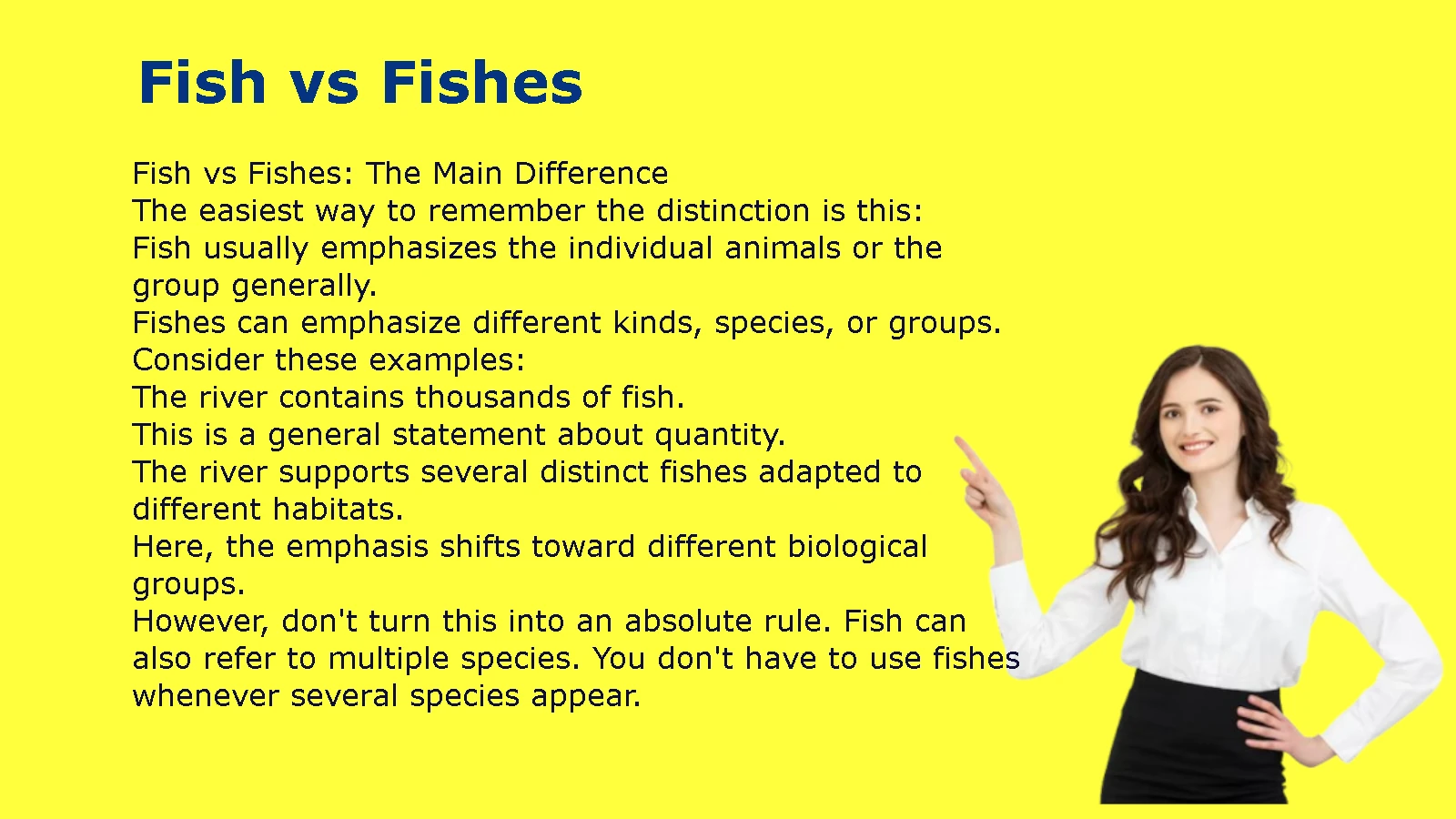
Fish vs Fishes: The Main Difference
The easiest way to remember the distinction is this:
Fish usually emphasizes the individual animals or the group generally.
Fishes can emphasize different kinds, species, or groups.
Consider these examples:
The river contains thousands of fish.
This is a general statement about quantity.
The river supports several distinct fishes adapted to different habitats.
Here, the emphasis shifts toward different biological groups.
However, don’t turn this into an absolute rule. Fish can also refer to multiple species. You don’t have to use fishes whenever several species appear.
Cambridge lists fish as the standard plural alongside fishes, and LanguageTool notes that fish can be used even when multiple species are present.
So the distinction is a usage tendency, not a rigid grammar law.
Fish vs Fishes Examples
The examples below show how context affects the choice.
| Sentence | Best choice | Why |
| I caught three ___ yesterday. | fish | Counting individual animals |
| There are many ___ in this pond. | fish | General statement |
| We had ___ for dinner. | fish | Fish as food |
| The aquarium contains hundreds of ___. | fish | General quantity |
| Researchers studied several species of ___. | fish/fishes | Both can work |
| Scientists compared tropical ___ from different regions. | fishes | Different groups are emphasized |
| The reef is home to many ___. | fish | General statement |
| The study examines freshwater ___. | fishes | Technical context can emphasize diversity |
| How many ___ did you catch? | fish | Counting individual animals |
| The collection contains marine ___ from several families. | fishes | Distinct biological groups |
The key isn’t the number alone. Context does the heavy lifting.
Is Fish Singular or Plural?
Fish can be both singular and plural.
That’s one reason the word sometimes confuses English learners.
Fish as a Singular Noun
When fish refers to one animal, it takes singular grammar:
That fish is beautiful.
The fish was swimming near the surface.
I saw one fish in the tank.
The article a also signals singular use:
I bought a fish.
You cannot normally say a fishes because fishes is plural.
Fish as a Plural Noun
When fish refers to multiple animals, it takes plural grammar:
Those fish are beautiful.
The fish were swimming near the surface.
I saw five fish in the tank.
The noun stays unchanged, but the rest of the sentence reveals the number.
| Singular | Plural |
| one fish | two fish |
| a fish | several fish |
| this fish | these fish |
| that fish | those fish |
| the fish is | the fish are |
| the fish was | the fish were |
This pattern is similar to other English nouns whose singular and plural forms can be identical, such as sheep and deer.
Cambridge teaching material explicitly lists fish among nouns that can retain the same form in the plural.
Can You Say “Two Fishes”?
Yes, but two fish is usually the natural choice when you’re simply counting two individual fish.
Ordinary Counting
I caught two fish.
There are two fish in the aquarium.
We saw two fish near the dock.
These sentences sound completely natural.
When Two Fishes Can Make Sense
Suppose a biologist is comparing two distinct species:
The researchers examined two fishes with different feeding strategies.
Here, fishes can emphasize that the animals represent different kinds or biological groups.
Still, context matters. In many sentences, two fish would remain perfectly acceptable even when the animals belong to different species.
That’s why it would be misleading to claim that fishes is required whenever you have different species.
It isn’t.
Can You Say “Many Fishes”?
Yes. Many fishes is grammatically possible.
But whether it sounds natural depends on the context.
Compare:
Many fish live in the lake.
This sounds natural and ordinary.
Now consider:
Many fishes inhabit the region.
This sounds more specialized. It could fit a scientific or ecological discussion where the writer is emphasizing diversity.
Merriam Webster explains that the -s form can be used to emphasize diversity of kinds.
So:
Many fish → general quantity
Many fishes → potentially emphasizes different kinds or species
That distinction is useful, but it shouldn’t be treated as a hard rule.
Fish as a Countable Noun
When you mean an individual animal, fish is a countable noun.
You can say:
- one fish
- two fish
- several fish
- many fish
- a fish
- three fish
For example:
She bought one fish for the aquarium.
She later bought three fish.
This is different from the uncountable use of fish when you’re talking about the animal as food.
Fish as an Uncountable Noun
Fish can also function as an uncountable noun when you mean fish as food.
For example:
I don’t eat fish.
We had fish for dinner.
She ordered grilled fish.
Here, fish doesn’t mean a countable collection of individual animals. It refers to the food.
Cambridge marks this use as uncountable and gives examples such as “I don’t like fish” and “We had fish for dinner.”
This explains why the sentence:
I don’t eat fishes.
usually sounds strange if the intended meaning is simply fish as food.
The natural expression is:
I don’t eat fish.
Fish vs Fishes When Talking About Food
When you’re discussing fish as food, fish is the standard choice.
Natural Examples
- We had fish for dinner.
- She ordered grilled fish.
- I don’t eat fish.
- They sell fresh fish at the market.
- He prepared fried fish for lunch.
The plural fishes isn’t normally used for this general food meaning.
If you need to identify different species as food, you can simply name them:
The restaurant serves salmon, trout, and cod.
That’s usually clearer than forcing fishes into the sentence.
Fish vs Fishes in Scientific Writing
Scientific writing is where fishes becomes particularly interesting.
Researchers may need to distinguish among species, families, populations, or taxonomic groups. In those settings, fishes can help frame the subject as a collection of distinct biological forms.
Example
The researchers analyzed freshwater fishes from five river systems.
The sentence can suggest that the researchers are studying a diverse collection of fish rather than simply counting individual animals.
Another example:
Tropical fishes display a wide range of feeding adaptations.
Here, fishes suits a discussion of different kinds of fish and their biological characteristics.
But Scientific Writing Doesn’t Require Fishes
This point matters.
It would be wrong to assume that every scientific paper must use fishes. Scientific sources routinely use fish as a plural too.
Cambridge’s own corpus includes scientific examples using both forms.
So the choice depends on the writer’s intended meaning and style.
A Closer Look at Scientific Usage
The difference becomes clearer when you compare two research-style sentences.
General Biological Statement
Fish are important components of aquatic ecosystems.
The sentence discusses fish generally.
Emphasis on Diverse Groups
The researchers examined several groups of fishes with different ecological adaptations.
The second sentence puts more emphasis on distinct groups.
Neither sentence is inherently more grammatical. They simply frame the subject differently.
Merriam Webster describes this broader pattern beyond fish: the unchanged animal plural is common in ordinary animal-related contexts, while the -s form can emphasize diversity of kinds.
Why Does Fish Have Two Plural Forms?
English usually forms plurals by adding -s or -es, but plenty of nouns don’t follow that basic pattern.
Words such as:
- sheep → sheep
- deer → deer
- fish → fish
- child → children
- mouse → mice
developed through different historical paths.
The word fish comes from Old English fisc. The Oxford English Dictionary records a long history of plural forms, including the unchanged plural and fishes.
Over time, English speakers retained fish as the ordinary plural while fishes remained available for particular uses.
That is why modern English doesn’t need to choose only one.
Both survived.
The Historical Side of Fishes
The plural fishes isn’t a modern invention created by scientists.
The form has a long history in English. The Oxford English Dictionary records fish with the plural forms “unchanged, fishes” and traces the noun back to Old English.
What changed over time was the distribution of the forms.
Today, fish is the normal everyday plural. Fishes has a more specialized flavor when writers want to distinguish kinds or species.
This is a good example of how English works in practice: a grammatical form can survive while developing a narrower or more marked role.
Fish vs Fishes in Everyday English
For everyday writing, fish is usually the winner.
Imagine these conversations:
“How many fish did you catch?”
“There are five fish in the tank.”
“Look at those fish!”
Nobody needs fishes here.
In fact, using fishes in a casual sentence can make the wording sound unnecessarily technical.
Everyday Rule
If you’re talking about quantity, use fish.
If you’re talking about variety, fishes may be useful.
That’s not an absolute rule, but it’s an excellent practical guide.
Common Mistakes With Fish and Fishes
Understanding the difference becomes much easier when you know what not to assume.
Mistake: “Fishes Is Wrong”
It’s not.
Cambridge, Oxford, and Merriam Webster all recognize fishes as a plural form.
Correct:
Several fishes were studied.
The context determines whether the choice sounds appropriate.
Mistake: “Fish Is Only Singular”
Also incorrect.
Fish can be singular or plural.
One fish is swimming.
Ten fish are swimming.
The verb changes even though the noun doesn’t.
Mistake: “Use Fishes Whenever There Are Many Fish”
Not quite.
A large number doesn’t automatically require fishes.
The lake contains thousands of fish.
That’s completely natural.
The number of animals isn’t what determines the choice.
Mistake: “Fishes Always Means Different Species”
This is too rigid.
Fishes can emphasize different kinds or species, but real English usage is more flexible. Scientific and technical writers may use it in contexts where the distinction between groups matters, while fish can still refer to multiple species.
Think of fishes as a useful specialized plural, not a mandatory species marker.
Mistake: “Fish and Fishes Are Completely Interchangeable”
They are both plural forms, but they don’t always sound equally natural.
Compare:
We caught twenty fish.
This is ordinary.
We caught twenty fishes.
This is grammatically possible, but it sounds marked unless the context gives fishes a reason to be there.
Good grammar isn’t only about whether a form can exist. Natural usage matters too.
Fish vs Fishes: A Practical Decision Guide
When you’re unsure which word to choose, ask what the sentence emphasizes.
Choose Fish When:
- You’re counting individual fish.
- You’re talking about fish generally.
- You’re speaking casually.
- You’re describing a group without distinguishing species.
- You’re talking about fish as food.
- You want the most natural everyday wording.
Consider Fishes When:
- You’re emphasizing different kinds.
- You’re discussing multiple species.
- You’re writing about distinct biological groups.
- You’re working in a scientific or technical context.
- The distinction among groups matters to your point.
Here’s the shortcut:
Quantity → fish
Diversity or distinct groups → fishes
Again, this is a practical guide rather than an unbreakable grammatical law.
Fish vs Fishes: Real-World Case Study
Consider a marine research project examining animals from several locations.
Version One
Researchers collected 2,000 fish from three coastal regions.
This sentence emphasizes the number of animals collected.
Version Two
Researchers collected several groups of fishes representing different species from three coastal regions.
Now the sentence emphasizes biological diversity and distinct groups.
Both forms can work because the writer’s focus has changed.
A real Cambridge English Corpus example makes this distinction especially clear. It reports a collection of 2,681 fishes representing 46 species and 10 families.
The word fishes fits naturally because the sentence isn’t merely reporting a pile of individual animals. It identifies the collection in terms of species and families.
That is exactly the kind of context where the specialized plural earns its place.
Fish vs Fishes in Formal Writing
Formal writing doesn’t automatically require fishes.
That’s another common misconception.
A formal sentence such as:
The study analyzed 500 fish collected from the river.
is perfectly acceptable.
Likewise:
The study analyzed several fishes representing different taxonomic groups.
can be appropriate when the different groups matter.
The better choice comes from meaning, not from how formal you want to sound.
Using a longer or less common word simply to make prose sound academic can backfire. If fish communicates the idea clearly, there’s no reason to replace it with fishes.
Fish vs Fishes in Ecology and Conservation
Ecology provides another useful context.
Suppose a conservation report says:
The wetland supports more than 40 species of fish.
This is entirely natural. In fact, fish is often the cleanest choice even when species are explicitly mentioned.
Now consider:
The wetland supports diverse freshwater fishes adapted to seasonal changes.
Here, fishes can emphasize the collection of distinct fish groups and their adaptations.
Both constructions are possible.
The difference lies in how the writer frames the subject.
Fish vs Fishes Quick Grammar Test
Test your understanding with these sentences.
Choose the Best Form
- I caught five ___ at the lake.
- The aquarium contains hundreds of ___.
- The researchers studied several ___ from different families.
- We had ___ for dinner.
- How many ___ did you see?
- The river supports a diverse population of freshwater ___.
- Two ___ were swimming near the boat.
- Scientists compared several groups of marine ___.
Answers
- fish
- fish
- fishes
- fish
- fish
- fish or fishes, depending on emphasis
- fish
- fishes
The most important lesson is that context matters more than the number itself.
Fish vs Fishes in Common Phrases
Some expressions almost always use fish because they’re established English phrases.
Examples include:
- fish market
- fish tank
- fish farm
- fish species
- fish population
- fish food
- fish oil
- fish stock
- fish farming
- fish habitat
You wouldn’t normally replace these with fishes simply because the subject involves more than one animal.
For example:
The lake has a healthy fish population.
Not:
The lake has a healthy fishes population.
The word fish frequently functions attributively in compound expressions, where it describes another noun.
Fish Species or Fishes?
This question deserves special attention because fish species is extremely common.
You can write:
There are thousands of fish species worldwide.
You can also encounter:
The region contains several species of fishes.
The first construction uses fish as a modifier before species. The second uses fishes as the plural noun.
In many contexts, fish species is the cleaner and more natural phrase.
So don’t assume that mentioning several species means you must use fishes.
Fish or Fishes: Which One Should You Use?
For most readers and most situations, choose fish.
Choose fishes when you have a clear reason to highlight different kinds, species, or distinct groups.
The Simple Rule
| If you mean… | Use |
| One animal | fish |
| Several animals | fish |
| A general group | fish |
| Fish as food | fish |
| Different kinds or species | fishes can be appropriate |
| Specialized biological context | fishes can be appropriate |
| Unsure which sounds natural | fish |
The Oxford Advanced Learner’s Dictionary sums up the practical rule particularly well: “Fish is the usual plural form.”
Frequently Asked Questions About Fish vs Fishes
Is fish the plural of fish?
Yes. Fish is the usual plural form of fish. For example, you can say one fish and five fish. Cambridge and Oxford both recognize this usage.
Is fishes a correct word?
Yes. Fishes is a legitimate plural form. It is often used when writers want to refer to different kinds or species of fish, particularly in specialized contexts.
Which is correct, fish or fishes?
Both are correct. However, fish is the normal plural in everyday English. Fishes has a more specialized use and can emphasize different kinds or species.
Do you say two fish or two fishes?
Usually, two fish.
I caught two fish.
Use two fishes only when the context gives you a reason to emphasize distinct kinds or groups.
When should I use fishes?
Use fishes when you want to emphasize different kinds, species, or biological groups. It appears more often in scientific and technical writing.
Is “many fishes” grammatically correct?
Yes. Many fishes is grammatically possible. However, many fish is usually more natural when you’re simply describing a large number of fish.
Is fish singular or plural?
Fish can be singular or plural.
One fish is in the tank.
Five fish are in the tank.
The surrounding grammar tells you which meaning applies.
What is the plural of fish species?
Fish species is a common expression. You don’t need to use fishes simply because you’re talking about multiple species.
Can fishes refer to different species?
Yes. This is one of its established uses. Oxford specifically notes that fishes can refer to different kinds of fish.
Is “fishes” more formal than “fish”?
Not simply. Fishes is less common in everyday English and often appears in specialized contexts, but it isn’t merely a “formal version” of fish.
Fish vs Fishes: Final Verdict
The difference between fish and fishes is easier than it first appears.
Fish is both the singular and the usual plural:
One fish.
Five fish.
Fishes is also a valid plural, but it can emphasize different kinds, species, or distinct groups, particularly in scientific and technical contexts.
So when should you use each one?
Use fish when you’re talking about fish generally or counting individual animals.
Use fishes when the diversity of species or groups matters to the sentence.
Most importantly, don’t treat fishes as a mistake. Major dictionaries recognize it. At the same time, don’t feel that you need fishes every time you mention multiple species. Fish remains the normal and widely accepted plural.
If you remember only one rule, make it this:
For ordinary plural use, choose “fish.” When different kinds or species are the focus, “fishes” may be the better fit.