Inference vs Observation is a basic science concept that helps you separate what you notice from what you think the evidence means. An observation records information gathered through your senses or measuring tools, while an inference uses that information and prior knowledge to reach a possible conclusion. Understanding the difference between observation and inference helps students analyze experiments, interpret evidence, and make better decisions.
In science, qualitative observations describe qualities such as color, shape, texture, and smell, while quantitative observations use numbers and measurements. Scientific inferences explain what observations might mean, and predictions estimate what may happen next. These concepts work together during experiments, classroom activities, and everyday problem-solving.
For example, noticing that the grass is wet is an observation. Concluding that it probably rained is an inference because the grass could also be wet from a sprinkler. Once you understand this distinction, you can classify statements more accurately, complete an observation vs. inference worksheet, and explain your answers with evidence.
What Is an Observation?
An observation is information you gather directly through your senses or scientific instruments. You might see a change in color, hear a sound, feel a texture, or measure a temperature. Observations describe available evidence rather than explain why something happened. Scientists record observations carefully because they provide the evidence needed to investigate questions and test explanations.
For example, if you see a plant with five green leaves, you can record that detail as an observation. You do not need to guess whether the plant receives enough sunlight or whether someone watered it that morning.
Types of Observations in Science
Scientists commonly divide observations into two categories: qualitative and quantitative. Both help researchers describe objects, events, and changes, but they communicate different kinds of information.
Qualitative Observations
Qualitative observations describe characteristics without using numerical measurements. They often involve color, shape, texture, odor, sound, or appearance.
Examples include:
- The liquid is blue.
- The leaf has a rough surface.
- The metal feels cold.
- The candle produces a yellow flame.
- The flower has a sweet smell.
- The rock contains visible layers.
Qualitative observations help scientists describe what they examine. For example, a student studying leaves might record that one leaf is dark green while another has yellow patches.
These descriptions do not automatically explain why the leaves look different. The differences could relate to age, disease, water availability, nutrients, or other conditions. Further investigation would help identify the cause.
Quantitative Observations
Quantitative observations use numbers, measurements, or counts. They often provide more precise information than general descriptions.
Examples include:
- The plant is 12 centimeters tall.
- The water temperature is 24°C.
- The experiment lasted 45 seconds.
- The rock has a mass of 300 grams.
- The student counted 18 seeds.
- The liquid volume is 50 milliliters.
Suppose two students measure the same plant. One records that it is tall, while the other measures it at 18 centimeters. The second observation provides a more precise measurement that other students can compare over time.
Quantitative observations are particularly useful when scientists track changes, compare experimental groups, or repeat measurements.
Examples of Observations
The following examples show how to recognize observations in science and everyday situations.
| Situation | Observation | Why It Is an Observation |
| Examining an apple | The apple has three brown spots. | It describes visible features. |
| Measuring a plant | The plant is 15 centimeters tall. | It gives a measured value. |
| Watching the weather | Dark clouds cover the sky. | It describes what is visible. |
| Studying ice | The ice cube has become smaller. | It records a visible change. |
| Listening in class | The bell rings at 9:00 a.m. | It records a sound and time. |
| Examining a rock | The rock has two visible layers. | It describes its appearance. |
| Checking a classroom | The door is open. | It states an observable condition. |
What Makes a Statement an Observation?
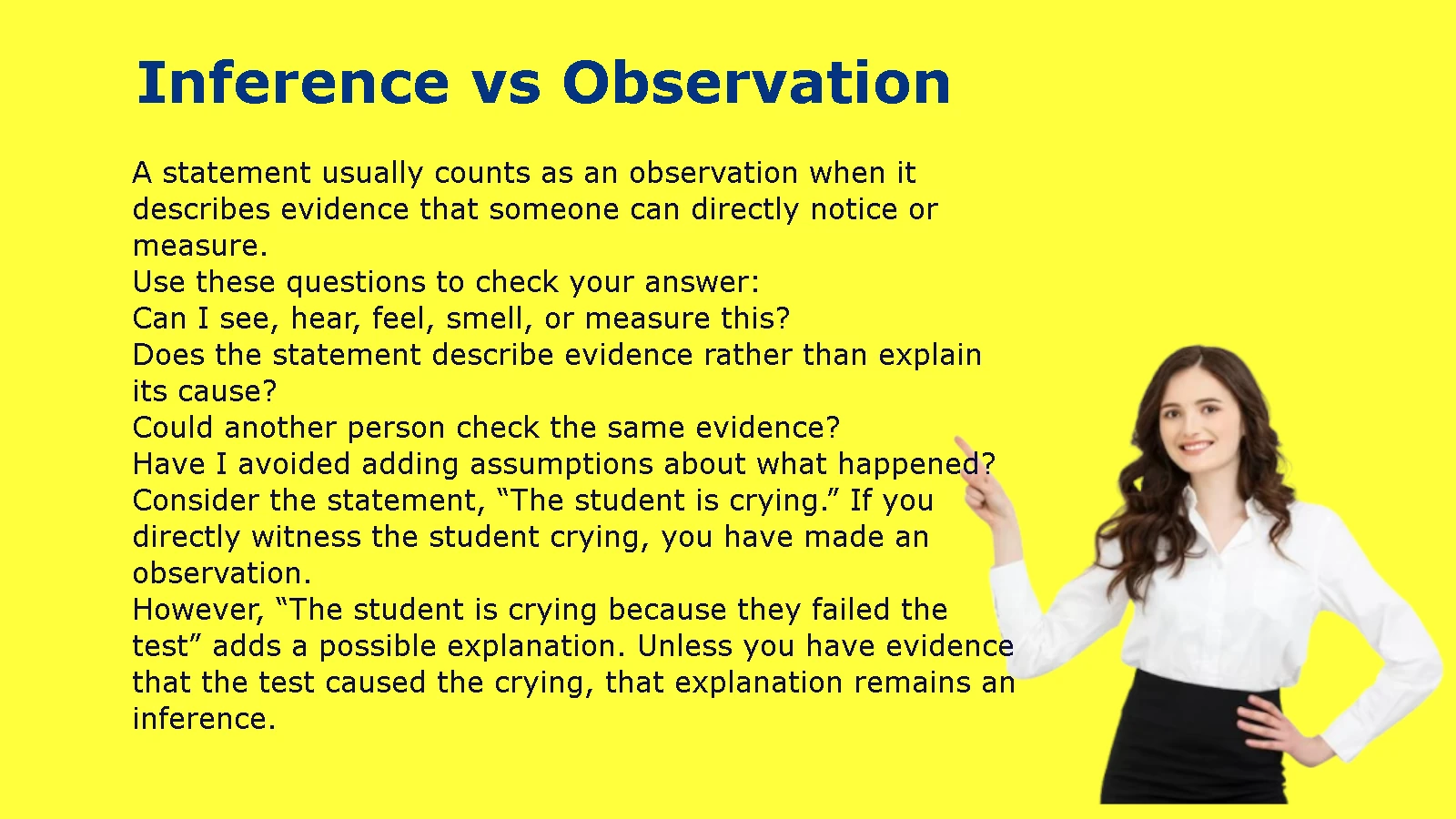
A statement usually counts as an observation when it describes evidence that someone can directly notice or measure.
Use these questions to check your answer:
- Can I see, hear, feel, smell, or measure this?
- Does the statement describe evidence rather than explain its cause?
- Could another person check the same evidence?
- Have I avoided adding assumptions about what happened?
Consider the statement, “The student is crying.” If you directly witness the student crying, you have made an observation.
However, “The student is crying because they failed the test” adds a possible explanation. Unless you have evidence that the test caused the crying, that explanation remains an inference.
Remember that observations can still contain mistakes. A faulty thermometer, poor lighting, or inaccurate measurement can produce unreliable information. Scientists reduce these problems by using appropriate tools, repeating measurements, and recording results carefully.
What Is an Inference?
An inference is a possible conclusion drawn from observations, background knowledge, and reasoning. It helps explain what the evidence might mean, but it does not automatically establish what actually happened. Scientists use inferences to develop explanations, identify possible causes, and decide which questions they should investigate next.
For example, you might observe wet grass outside a house. You could infer that rain fell overnight. However, a sprinkler or leaking pipe could also explain the wet grass. The observation provides evidence, but additional information would help determine the cause.
How Scientists Make Inferences
Scientists do not simply guess when they make inferences. They connect observations with relevant knowledge and consider whether the available evidence supports a reasonable explanation.
A typical process involves these steps:
- Examine the evidence. Record what you can directly observe or measure.
- Connect the evidence to prior knowledge. Use established facts or previous experience to interpret what you notice.
- Develop a possible explanation. Identify a conclusion that fits the available observations.
- Consider alternatives. Ask whether another explanation could account for the same evidence.
- Test the explanation. Collect more data or conduct an experiment to evaluate the inference.
Imagine that a student finds a plant with yellow leaves. The student might infer that the plant lacks a nutrient. However, yellow leaves can also result from overwatering, underwatering, disease, or natural aging.
A careful scientist would examine the soil, check watering conditions, compare other leaves, and investigate additional evidence before identifying the likely cause.
Examples of Inferences
| Observation | Possible Inference | Why It Is an Inference |
| The ground is wet. | It may have rained. | The statement proposes a cause. |
| The plant has yellow leaves. | The plant may have a nutrient deficiency. | It explains a visible condition. |
| The classroom window is open. | Someone may have opened it for ventilation. | It suggests a reason for the condition. |
| The cookie jar is empty. | Someone may have eaten the cookies. | It suggests an event that was not directly observed. |
| A dog stands beside an empty food bowl. | The dog may be hungry. | It interprets the dog’s situation. |
| The car’s tires are covered in mud. | The car may have traveled on a muddy road. | It proposes an explanation. |
| A student yawns repeatedly. | The student may be tired. | It interprets the student’s behavior. |
What Makes a Statement an Inference?
An inference usually goes beyond the information directly available. It connects evidence with a possible explanation.
Look for statements that:
- Explain why an event might have occurred.
- Suggest an unobserved cause.
- Interpret someone’s behavior or condition.
- Use prior knowledge to explain evidence.
- Draw a conclusion that could change if new evidence appears.
For instance, “The sidewalk is wet because it rained” contains an inference about the cause of the wet sidewalk. The wet sidewalk might be directly observed, but the rainfall must be established through additional evidence if nobody witnessed it.
Words such as might, probably, and could often signal an inference. However, these words do not determine the classification by themselves. The meaning of the complete statement matters more than the vocabulary alone.
Inference vs Observation: What Is the Difference?
The main difference between inference and observation is that an observation describes available evidence, while an inference explains what that evidence might mean. Observations come from direct sensory information or measurements. Inferences combine observations with knowledge and reasoning to develop possible conclusions. Both are important in science, but an inference should not be treated as a proven fact without sufficient supporting evidence.
Observation vs. Inference Comparison Table
| Feature | Observation | Inference |
| Definition | Information gathered through senses or instruments | A conclusion drawn from evidence |
| Main purpose | Describe what is noticed or measured | Explain what the evidence might mean |
| Foundation | Directly available information | Observations, knowledge, and reasoning |
| Certainty | Reports observed details, subject to measurement error | May be correct, incomplete, or incorrect |
| Example | The grass is wet. | It probably rained. |
| Scientific role | Supplies evidence | Helps explain evidence |
| Verification | Check the observation or repeat the measurement | Gather evidence to test the proposed explanation |
| Common question | What do I notice? | What might explain what I notice? |
The distinction becomes easier when you separate the evidence from the explanation.
For example:
- Observation: Smoke rises from the chimney.
- Inference: Someone may be using a fireplace.
The smoke is directly visible. The fireplace is a possible explanation, but the smoke might come from another heating system or source.
Another example involves a classroom:
- Observation: Several students have their books open.
- Inference: The students may be preparing for a lesson.
The open books are observable. The students’ purpose is not necessarily known from that detail alone.
Observation and Inference Examples Side by Side
Here are additional examples that show how the two concepts work together.
Example: A melting ice cube
- Observation: The ice cube becomes smaller over five minutes.
- Inference: Heat from the surroundings is causing the ice to melt.
A plant near a window
- Observation: The plant’s stem bends toward the window.
- Inference: The plant may be responding to light from that direction.
Example: A person wearing a coat
- Observation: The person is wearing a thick coat.
- Inference: The person may expect cold weather or feel cold.
An empty lunchbox
- Observation: The lunchbox contains no food.
- Inference: Someone may have eaten the food.
Example: A barking dog
- Observation: The dog is barking near the gate.
- Inference: The dog may have noticed someone outside.
These examples also show why an inference can have more than one explanation. A dog might bark because it sees a person, hears another animal, or reacts to an unfamiliar sound. Good reasoning considers the evidence instead of immediately choosing one explanation.
Why Observation and Inference Both Matter in Science
Scientists need observations to establish what happened and inferences to investigate what those observations mean.
Imagine a scientist studying why fish gather near the surface of a pond. The scientist might observe that several fish swim near the surface at midday. That observation alone does not explain their behavior.
The scientist could infer that the fish respond to water temperature or oxygen levels. To investigate, the scientist could measure both variables at different depths and times.
This process separates what the scientist knows from what the scientist suspects. It also creates a clear path for testing explanations.
Observation and Inference Examples in Everyday Life and Science
Observation and inference appear in classrooms, homes, workplaces, and scientific investigations. You make observations whenever you notice a condition or collect information. You make inferences when you use that information to explain an event, interpret behavior, or identify a possible cause.
The key is to identify which part of a statement describes evidence and which part adds meaning.
Everyday Observation and Inference Examples
| Situation | Observation | Inference |
| Wet clothes hang outside. | Water drips from the clothes. | The clothes may have been washed recently. |
| A dog stands near its bowl. | The bowl contains no food. | The dog may be hungry. |
| Clouds gather overhead. | Thick, dark clouds cover the sky. | Rain may be approaching. |
| A lunchbox is empty. | No food remains inside. | Someone may have eaten the lunch. |
| A person wears gloves. | The person has gloves on both hands. | The person may be trying to keep warm. |
| A room smells of fresh paint. | A strong paint odor is present. | Someone may have painted the room recently. |
| A bicycle lies on the ground. | The bicycle is resting on its side. | Someone may have dropped it. |
| A student looks at the clock repeatedly. | The student checks the clock several times. | The student may be waiting for the lesson to end. |
Notice that the inferences use words such as may and might. These words reflect uncertainty because the observations do not prove a single explanation.
For example, a person wearing gloves might be keeping warm, protecting their hands, or handling a material. The observation alone cannot establish the person’s reason.
Observation and Inference Examples in Science
Scientific investigations require the same distinction, but scientists often use more precise measurements and controlled experiments.
Plant growth
- Observation: A plant near a window grows 3 centimeters in one week.
- Inference: The plant may receive enough light to support growth.
A chemical reaction
- Observation: Two clear liquids form a cloudy mixture after being combined.
- Inference: The liquids may have reacted to form an insoluble substance.
Animal tracks
- Observation: Three-toed tracks appear in wet soil.
- Inference: A bird may have walked across the area.
Rock layers
- Observation: The rock contains several distinct layers.
- Inference: The layers may have formed during different periods of sediment deposition.
Bubbles in a container
- Observation: Bubbles appear after two substances are mixed.
- Inference: A chemical reaction may be producing a gas.
These examples illustrate an important scientific principle: an observation can support an inference without proving it by itself. Scientists strengthen conclusions by collecting additional evidence, repeating experiments, and checking whether other explanations fit the results.
Tricky Observation vs. Inference Examples
Some statements are difficult to classify because they mix observable details with explanations.
“The water is hot.”
This statement can function as an observation if someone directly notices the water’s temperature, but it is imprecise. A measured temperature, such as 70°C, provides clearer evidence.
“The water is hot enough to boil.”
This statement may be an inference if the temperature has not been measured and boiling has not been observed. If a thermometer records a temperature above the local boiling point, the statement can instead draw on measured evidence.
“The person is angry.”
This is generally an inference because anger is an internal emotional state. You may observe a person shouting, frowning, or speaking loudly, but those behaviors do not prove exactly how the person feels.
“The person is shouting.”
This is an observation when you directly hear the person shouting.
“The plant is unhealthy.”
This is a broad interpretation or inference about the plant’s condition. The statement “The plant has brown leaves and a bent stem” describes more specific observations.
“It will rain soon.”
This is a prediction because it describes a possible future event.
“Dark clouds cover the sky.”
This is an observation if you can directly see the clouds.
The practical rule is to classify a statement according to the information it actually communicates, not simply the topic it discusses.
Observation vs. Inference for Kids
For kids, an observation means what you can see, hear, smell, feel, or measure, while an inference means what you think may be happening based on those clues. For example, seeing a puddle is an observation, but thinking that it rained earlier is an inference. The rain is one possible explanation, not the only one.
An Easy Way for Kids to Remember the Difference
Try using these two questions:
- Observation: What do I notice?
- Inference: What do I think might explain it?
Suppose you enter a room and see a wet floor. You can directly observe the water on the floor. You might infer that someone spilled a drink, but the water could have come from a leaking pipe or wet shoes.
The observation describes the evidence. The inference suggests what might have caused it.
This approach works well for elementary and middle school students because it connects abstract scientific language to familiar experiences.
However, the words I see and I think are memory aids, not strict rules. An observation can involve sound or measurement rather than sight, and an inference can sometimes be stated without using the phrase “I think.”
Five Kid-Friendly Observation and Inference Examples
A puddle on the playground
- Observation: A puddle covers part of the playground.
- Inference: It may have rained earlier.
A birthday cake
- Observation: One slice is missing from the cake.
- Inference: Someone may have eaten a slice.
A dog beside its bowl
- Observation: The dog is sitting next to an empty bowl.
- Inference: The dog may want food.
A student carrying an umbrella
- Observation: The student is holding an umbrella.
- Inference: The student may expect rain.
A shrinking snowman
- Observation: The snowman’s head is smaller than it was yesterday.
- Inference: The snowman may be melting.
Each inference makes sense, but none is guaranteed to be correct. The student with an umbrella might carry it every day, even when the weather is clear. Someone other than the dog might have emptied its bowl. More evidence can help confirm or reject an inference.
A Simple Classroom Activity
Teachers and parents can teach the difference through a short observation activity.
Materials: A plant, an empty cup, a small toy, or a photograph showing a familiar scene.
Instructions:
- Ask the child to describe five details without explaining them.
- Record the details as observations.
- Ask the child to suggest two possible explanations for one detail.
- Discuss which observations support each explanation.
- Ask what additional evidence could help determine which explanation is more likely.
For example, show a plant with drooping leaves. A child might observe that the leaves hang downward and the soil looks dry. The child could infer that the plant needs water.
That is a reasonable inference, but the activity should not stop there. Ask the child how to test it. Checking the soil moisture and monitoring the plant after watering can provide additional evidence.
This exercise teaches children to support their ideas instead of treating every guess as a fact.
Difference Between Observation and Interpretation
An observation records what someone notices or measures, while an interpretation assigns meaning or significance to that information. An inference often overlaps with interpretation because both go beyond the raw evidence. In many science classrooms, an inference focuses on a possible explanation, whereas interpretation may describe the broader meaning of results or patterns.
Observation vs. Interpretation Comparison Table
| Situation | Observation | Interpretation |
| Student behavior | The student looks at the clock three times. | The student may be worried about being late. |
| Plant condition | Several leaves have brown edges. | The plant may be experiencing environmental stress. |
| Survey results | Eight out of ten respondents selected option A. | Most respondents in this small group preferred option A. |
| Classroom noise | Several students are talking at once. | The class may be having difficulty staying focused. |
| Experimental data | The measured temperature rises by 5°C. | The process may release heat into the surroundings. |
The interpretation gives meaning to the observation. Depending on the context, it may be an inference, a summary of a pattern, or a broader explanation.
For example, recording that eight out of ten students chose option A is an observation about the survey results. Concluding that most students in the group preferred option A is a straightforward interpretation of those results.
However, claiming that all students in the school prefer option A would go beyond the evidence. A small group may not represent the entire school.
Observation vs. Inference vs. Interpretation
These concepts overlap, but the following distinctions help clarify their roles.
- Observation: Records directly available evidence.
- Inference: Uses evidence and knowledge to reach a possible conclusion.
- Interpretation: Explains the meaning, significance, or implications of information.
Consider a simple experiment in which a plant grows toward a window.
- Observation: The stem bends toward the window.
- Inference: The plant may be responding to light.
- Interpretation: The result is consistent with the idea that light direction influences the plant’s growth.
The exact terminology can vary by subject. In some science lessons, the inference and interpretation may be treated as nearly interchangeable. The important skill is to distinguish the recorded evidence from the meaning you assign to it.
Observation vs. Inference vs. Prediction
An observation describes available evidence, an inference draws a possible conclusion from that evidence, and a prediction estimates what may happen next. For example, dark clouds gathering overhead are an observation, the belief that a storm may be approaching is an inference, and the expectation that it will rain within an hour is a prediction.
Comparison Table: Observation, Inference, and Prediction
| Concept | Main Question | Example |
| Observation | What do I notice? | Dark clouds are gathering. |
| Inference | What might this evidence mean? | A storm may be approaching. |
| Prediction | What might happen next? | It may rain within the next hour. |
The three concepts work together, but they answer different questions.
An observation establishes the available evidence. An inference offers a possible explanation for that evidence. A prediction uses what is known to estimate a future outcome.
Examples Using All Three Concepts
Plant growth
- Observation: The plant’s stem bends toward the window.
- Inference: The plant may be responding to light from that direction.
- Prediction: If the light continues to come from the same direction, the stem may continue bending toward it.
Weather
- Observation: Dark clouds gather and the wind becomes stronger.
- Inference: Weather conditions may be changing ahead of a storm.
- Prediction: Rain may begin soon.
Melting ice
- Observation: An ice cube becomes smaller while sitting in a warm room.
- Inference: Heat transfers from the surroundings to the ice.
- Prediction: The remaining ice will continue melting if the conditions remain suitable.
Plant watering
- Observation: The soil is dry and the leaves are drooping.
- Inference: The plant may need water.
- Prediction: If insufficient water caused the drooping, the plant may recover after appropriate watering.
The final example shows why predictions depend on assumptions. If a disease caused the drooping, watering alone might not solve the problem.
Why Predictions Are Not Always Inferences
Both predictions and inferences use evidence and reasoning, but they focus on different things.
An inference may explain a current condition or a past event. For example, finding wet footprints indoors may suggest that someone walked inside with wet shoes.
A prediction estimates a future outcome. If the floor remains wet and people continue walking across it, you might predict that more footprints will appear.
A prediction can also be based on a tested scientific model rather than a single observation. Weather forecasts, for instance, use many measurements and mathematical models to estimate future conditions.
Observation vs. Inference Worksheet With Answers
This observation vs. inference worksheet helps students practice classifying statements and explaining their choices. Each question asks you to decide whether a statement records direct evidence or proposes an explanation. Complete the exercises before checking the answers so you can identify which concepts you understand and which need more practice.
Worksheet Instructions
Read each statement carefully.
- Write O if the statement is an observation.
- Write I if the statement is an inference.
- Use only the information provided.
- Remember that a reasonable explanation is still an inference if the statement goes beyond directly available evidence.
Worksheet: Basic Practice
Classify each statement as an observation or an inference.
| No. | Statement | Your Answer |
| 1 | The apple has three brown spots. | _____ |
| 2 | The apple is beginning to rot. | _____ |
| 3 | The classroom door is open. | _____ |
| 4 | Someone opened the door to get fresh air. | _____ |
| 5 | The plant has five green leaves. | _____ |
| 6 | The plant receives enough sunlight. | _____ |
| 7 | The car’s tires are covered in mud. | _____ |
| 8 | The car was driven on a muddy road. | _____ |
| 9 | The bell rang at 9:00 a.m. | _____ |
| 10 | Class is about to begin. | _____ |
Worksheet Answer Key With Explanations
| No. | Correct Answer | Explanation |
| 1 | Observation | The statement describes visible spots on the apple. |
| 2 | Inference | It interprets the spots as evidence of decay. |
| 3 | Observation | The open door is a directly observable condition. |
| 4 | Inference | It suggests why someone opened the door. |
| 5 | Observation | It records the number and color of the leaves. |
| 6 | Inference | Leaf color and number alone do not establish the plant’s light exposure. |
| 7 | Observation | Mud on the tires is directly visible. |
| 8 | Inference | The tires’ condition suggests a possible route, but other explanations exist. |
| 9 | Observation | The statement records a sound and its time. |
| 10 | Inference | The bell may signal the start of class, but the statement predicts or concludes what will happen next. |
Why does question 10 count as an inference? In this worksheet, the statement draws a conclusion from the bell ringing. It can also function as a prediction if the student is estimating a future event. This example illustrates how context can affect classification.
Worksheet: Challenge Questions
Classify each statement as an observation, inference, or prediction.
| No. | Statement | Your Answer |
| 1 | The thermometer reads 30°C. | _____ |
| 2 | The room feels warm because the heater is on. | _____ |
| 3 | The bird has a red patch on its chest. | _____ |
| 4 | The bird may be looking for food. | _____ |
| 5 | The ice cube will melt if it stays in the warm room. | _____ |
| 6 | Bubbles appear after the two liquids are mixed. | _____ |
| 7 | A chemical reaction may have produced a gas. | _____ |
| 8 | The plant grew 2 centimeters in four days. | _____ |
| 9 | The plant will probably grow taller next week. | _____ |
| 10 | The rock has three visible layers. | _____ |
Challenge Worksheet Answer Key
| No. | Correct Answer | Explanation |
| 1 | Observation | It records a numerical temperature measurement. |
| 2 | Inference | It proposes the heater as the cause of the warmth. |
| 3 | Observation | It describes a visible feature of the bird. |
| 4 | Inference | It suggests the bird’s possible purpose. |
| 5 | Prediction | It estimates a future change under stated conditions. |
| 6 | Observation | It describes a visible event during the experiment. |
| 7 | Inference | It proposes a possible explanation for the bubbles. |
| 8 | Observation | It reports a measured change over time. |
| 9 | Prediction | It estimates future plant growth. |
| 10 | Observation | It describes the rock’s visible structure. |
For question 7, remember that bubbles do not always prove that a chemical reaction occurred. They could result from boiling, dissolved gas escaping, or another physical process. Additional evidence helps distinguish these possibilities.
Worksheet: Identify the Evidence and Conclusion
Read each scenario and write two observations, one inference, and one way to test the inference.
Scenario: A plant with drooping leaves
A student notices that a plant’s leaves hang downward. The soil looks dry, and the plant has not been watered for several days.
Possible answer:
- Observation: The leaves hang downward.
- Observation: The soil appears dry.
- Inference: The plant may need water.
- Test: Check the soil moisture and water the plant appropriately, then monitor changes in the leaves.
Scenario: A wet classroom floor
A teacher finds a wet patch near the classroom sink. The faucet is dripping.
Possible answer:
- Observation: A wet patch lies near the sink.
- Observation: Water drips from the faucet.
- Inference: The dripping faucet may have caused the wet patch.
- Test: Stop the dripping and check whether the wet patch continues to grow.
Scenario: Bubbles in a science experiment
A student mixes two liquids and notices bubbles rising through the mixture.
Possible answer:
- Observation: Bubbles rise after the liquids are combined.
- Observation: The mixture changes appearance.
- Inference: A reaction may be producing a gas.
- Test: Examine other evidence, such as temperature changes or the properties of the products, using a safe and appropriate procedure.
The purpose of these exercises is not to memorize a fixed list of answers. It is to learn how to separate evidence from explanations and identify what additional information could strengthen a conclusion.
Common Mistakes When Identifying Observations and Inferences
Students often confuse observations with inferences because everyday language combines facts, assumptions, and explanations in the same sentence. Learning to recognize these mistakes makes science worksheets easier and improves the quality of experimental reports.
Treating a Reasonable Guess as a Fact
A conclusion can sound convincing without being proven.
For example, seeing wet grass might suggest that rain fell overnight. However, a sprinkler, leaking pipe, or morning dew could explain the same condition.
The better approach is to write the evidence first and then describe the explanation as a possibility. If more evidence becomes available, you can revise the inference.
Confusing Emotions With Visible Behavior
Emotions are internal states, so statements about someone’s feelings often involve interpretation.
- Observation: The student is crying.
- Inference: The student may be upset.
- Unsupported assumption: The student is crying because of a poor test result.
The last statement adds a specific cause that the evidence does not establish. The student might be upset about something unrelated, or the tears might have another explanation.
Assuming Every Statement With “Because” Is an Inference
The word because often introduces a cause, but the entire statement determines its classification.
For example, “The floor is wet because the pipe burst” includes an inference if the burst pipe has not been observed or independently confirmed.
However, “The measured temperature increased because the experiment heated the sample” may summarize a tested relationship when the experimental evidence supports that conclusion.
Always examine what the statement claims and what evidence supports it.
Forgetting That Observations Can Be Inaccurate
Direct observation does not guarantee perfect accuracy.
A student might misread a thermometer, count a moving animal incorrectly, or record a measurement using an unsuitable tool. Scientists reduce such errors by calibrating equipment, repeating measurements, and comparing results.
An observation should be as precise as the available evidence allows. If you cannot measure a temperature accurately, describe the limitation rather than inventing a number.
Treating an Inference as a Prediction
An inference and a prediction both involve reasoning, but they answer different questions.
- Inference: The plant may be drooping because the soil is dry.
- Prediction: The plant may recover after appropriate watering if water shortage caused the drooping.
The inference proposes an explanation for the current condition. The prediction estimates what may happen after an action.
How to Improve Observation and Inference Skills in Science
Strong scientific reasoning starts with accurate observations and develops through careful testing. You do not need to know the correct explanation immediately. Instead, you need a reliable way to record evidence, generate possible explanations, and determine which explanation fits the results best.
Follow a Simple Evidence-Based Process
Use this method during classroom experiments, science projects, and everyday investigations.
Record what you notice. Write down visible details, sounds, measurements, and changes without explaining their causes.
Separate facts from assumptions. Review each statement and identify whether it describes evidence or proposes an explanation.
Develop a possible inference. Use relevant knowledge to suggest what could explain the observations.
Consider alternative explanations. Ask whether a different cause could produce the same evidence.
Collect additional evidence. Take measurements, repeat observations, or conduct an appropriate experiment.
Revise your conclusion if necessary. If new evidence contradicts the original inference, update your explanation instead of ignoring the results.
This process encourages flexible thinking. Scientists do not need to defend their first explanation at all costs. They need to develop explanations that fit the available evidence.
Use an Observation and Inference Chart
An observation and inference chart helps students organize their thinking during experiments.
| What I Observed | What I Infer | What Evidence Could Test It? |
| The soil is dry. | The plant may need water. | Measure soil moisture and monitor the plant after watering. |
| The ice cube is smaller. | Heat may be causing it to melt. | Measure its size at regular intervals and compare temperatures. |
| Bubbles appear in a mixture. | A gas may be forming. | Investigate the gas and look for other signs of a reaction. |
| The window is open. | Someone may have opened it for ventilation. | Ask the person or check other available evidence. |
The final column is especially useful because it turns a guess into a question that can be investigated. It also teaches students that several explanations may fit the same observation.
Practice With Real Experiments
Simple experiments provide opportunities to practice observation and inference without requiring complex equipment.
Investigate plant growth. Measure plants under different light conditions. Record their heights, leaf counts, and direction of growth. Then infer how light might affect the plants, while considering other factors such as water and soil.
Compare melting ice. Place equal-sized ice cubes in different environments. Record how long each takes to melt. Use the measurements to develop explanations about temperature and heat transfer.
Examine different materials. Observe the color, texture, flexibility, and mass of several objects. Infer what materials they might contain, but remember that appearance alone cannot reliably identify every substance.
Track shadows. Record the length and direction of a shadow at different times. Use the observations to explain how the apparent position of the Sun relates to shadow changes.
For every activity, separate the recorded results from the explanation. This habit makes lab reports clearer and helps students understand how scientists use evidence.
Conclusion: Learn to Separate Evidence From Assumptions
The difference between inference and observation comes down to the role each plays in reasoning. An observation records information you directly notice or measure, while an inference uses that evidence and prior knowledge to develop a possible explanation. A prediction estimates what may happen next, and an interpretation explains the meaning or significance of information.
These concepts work together in science. Observations provide the evidence, inferences help explain it, and predictions estimate possible future outcomes. Scientists test their explanations by collecting additional data and considering alternative causes.
To strengthen your skills, record observations before writing conclusions. Ask what the evidence actually shows, what it might mean, and what additional information could confirm your explanation.