Have you ever wondered whether dissappear or disappear is the correct spelling? Dissappear vs Disappear can be confusing because both versions look almost identical, but there is an important difference: one is the correct spelling, while the other is a common spelling mistake.
Disappear is the correct spelling, while dissappear is a common misspelling. Disappear means to vanish, become impossible to see, or stop being present. Unlike spelling differences such as American and British English, disappear is the standard spelling in both varieties of English.
Examples:
- The sun disappeared behind the clouds.
- My keys seem to have disappeared from the table.
The confusion is understandable. People often search for dissappear vs disappear, dissappear or disappear, which spelling is correct, or dissappear meaning in English because the word can sound as though it has a double s when spoken. However, dissappear is not an accepted spelling. The correct form is disappear, with one s and two p’s.
In this guide, you’ll learn the complete difference between Dissappear vs Disappear, including their meaning, pronunciation, origin, correct spelling, and usage. You’ll also discover why dissappear is commonly misspelled and see clear examples to help you remember the correct spelling.
Dissappear vs Disappear: Quick Answer
Disappear is the correct spelling.
Dissappear is a misspelling and isn’t the standard spelling of the English verb.
| Spelling | Correct? | Meaning |
| disappear | ✅ Yes | To become impossible to see or find or to stop existing |
| dissappear | ❌ No | Incorrect spelling of disappear |
The easiest way to remember the correct form is:
DIS + APPEAR = DISAPPEAR
Notice what happens when the two parts come together. Dis ends with one s, while appear begins with a. The result is disappear.
There are two p’s, not two s’s.
Is Dissappear a Word?
No. Dissappear isn’t the standard English spelling.
You may encounter dissappear in emails, social media posts, websites, schoolwork, or informal online writing. Its appearance in a sentence doesn’t make it an accepted spelling. In standard English, use disappear.
For example:
- ❌ The clouds will dissappear soon.
- ✅ The clouds will disappear soon.
- ❌ My keys seem to have dissappeared.
- ✅ My keys seem to have disappeared.
The difference is only a few letters, but spelling the word correctly matters in professional, academic, and edited writing.
How Do You Spell Disappear Correctly?
The correct spelling is:
D-I-S-A-P-P-E-A-R
You can break it into two useful parts:
dis + appear = disappear
That makes the spelling much easier to remember.
The Spelling Pattern in Disappear
Look closely at the word:
d i s a p p e a r
It contains:
- 1 s
- 2 p’s
- 1 e after the p’s
- 1 a before the p’s
The most common mistake is switching the doubled consonant from p to s.
| Version | What happens |
| disappear | Correct: one s, two p’s |
| dissappear | Incorrect: two s’s, two p’s |
| disapear | Incorrect: only one p |
| disaappear | Incorrect: extra a |
The word appear already contains two p’s. When you add dis- to it, those two p’s remain.
What Does Disappear Mean?
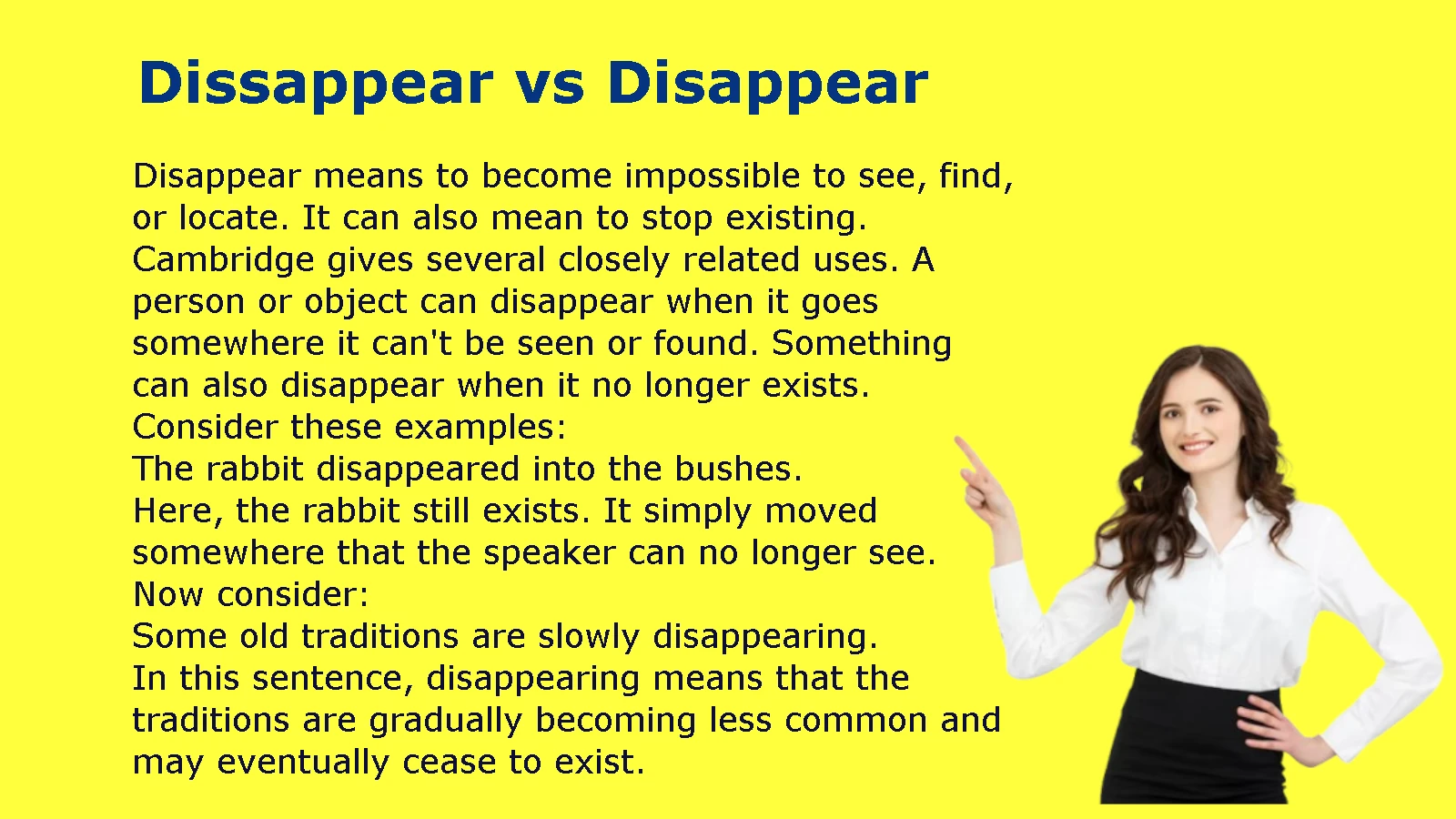
Disappear means to become impossible to see, find, or locate. It can also mean to stop existing.
Cambridge gives several closely related uses. A person or object can disappear when it goes somewhere it can’t be seen or found. Something can also disappear when it no longer exists.
Consider these examples:
The rabbit disappeared into the bushes.
Here, the rabbit still exists. It simply moved somewhere that the speaker can no longer see.
Now consider:
Some old traditions are slowly disappearing.
In this sentence, disappearing means that the traditions are gradually becoming less common and may eventually cease to exist.
Main Meanings of Disappear
The verb commonly describes three situations:
| Meaning | Example |
| Become impossible to see | The plane disappeared into the clouds. |
| Become impossible to find | My wallet disappeared from the desk. |
| Stop existing | Many old customs have disappeared. |
Context tells you which meaning applies.
Disappear Doesn’t Always Mean “Cease to Exist”
This distinction is important.
If someone says:
The child disappeared behind the door.
Likewise:
The sun disappeared behind the clouds.
The sun hasn’t vanished from existence. The clouds have blocked the view.
However:
The old building disappeared from the neighborhood.
This could mean the building was demolished or otherwise ceased to be present.
So, disappear can describe a change in visibility, location, availability, or existence.
Why Is Dissappear Incorrect?
The spelling dissappear adds an unnecessary s.
The word comes from disappear, which historically developed from dis- + appear. Etymonline traces the verb to the early 15th century, when forms such as disaperen referred to ceasing to be visible or vanishing from sight. It identifies dis- plus appear as the word’s formation.
That structure helps explain why the spelling has only one s.
Correct Word Formation
dis- + appear
↓
disappear
Not:
diss- + appear
↓
dissappear
The extra s doesn’t serve a spelling or grammatical purpose in the standard word.
Why Do People Write Dissappear?
The error is understandable.
English has many words containing double consonants, so writers may instinctively double the s in disappear. The pronunciation doesn’t make the spelling especially obvious either.
Another reason is the visual structure of the word. When people see:
dis + appear
they may mentally combine the final s of dis with the beginning of appear and incorrectly produce dissappear.
The safest approach is to remember the word as two parts:
DIS + APPEAR
That immediately gives you the correct spelling.
Disappear in Example Sentences
Seeing disappear in different contexts makes the spelling and meaning easier to understand.
Physical Objects
The coin seemed to disappear from the table.
The coin is no longer visible or easy to locate.
The bird disappeared into the trees.
The bird moved into an area where the speaker could no longer see it.
People
She disappeared into the crowd.
This means she moved into the crowd and could no longer be seen easily.
The boy disappeared around the corner.
He went around the corner and passed out of sight.
Cambridge specifically gives examples of disappear into and disappear behind, showing how the verb commonly works with these prepositions.
Weather and Nature
The sun disappeared behind a thick layer of clouds.
The fog disappeared as the morning became warmer.
The snow gradually disappeared from the sidewalks.
These examples show that disappear can describe something becoming invisible or gradually going away.
Abstract Things
Her fear slowly disappeared.
The excitement disappeared after the announcement.
Many old customs have disappeared over time.
In these examples, you’re not talking about something physically moving out of sight. Instead, a feeling, condition, or tradition becomes absent or ceases to exist.
Dissappear vs Disappear in Sentences
The clearest way to see the difference is to compare incorrect and correct sentences.
| Incorrect | Correct |
| The magician made the rabbit dissappear. | The magician made the rabbit disappear. |
| My headache finally dissappeared. | My headache finally disappeared. |
| The stars seemed to dissappear behind the clouds. | The stars seemed to disappear behind the clouds. |
| The stain will dissappear after washing. | The stain will disappear after washing. |
| The old custom slowly dissappeared. | The old custom slowly disappeared. |
Incorrect: Dissappear
The plane began to dissappear into the distance.
Correct: Disappear
The plane began to disappear into the distance.
The meaning hasn’t changed. Only the spelling has been corrected.
Common Misspellings of Disappear
Dissappear isn’t the only spelling error people make. Because the word contains several vowels and a doubled consonant, it can be misspelled in several ways.
| Misspelling | Correct form | Problem |
| dissappear | disappear | Extra s |
| dissapear | disappear | Extra s and missing p |
| disapear | disappear | Missing one p |
| disaappear | disappear | Extra a |
| disappeer | disappear | Incorrect vowel sequence |
| disappear | disappear | Correct |
The most important one for this article is dissappear, because it is the spelling most likely to cause confusion with disappear.
A Quick Spelling Check
Whenever you’re unsure, pause after dis:
dis | appear
Now spell the second part:
appear
Since appear has two p’s, the complete word becomes:
disappear
This simple split can prevent the most common spelling error.
Disappear vs Disappeared vs Disappearing
Once you know how to spell disappear, you also need to recognize its common grammatical forms.
The base verb is disappear.
The past tense is disappeared.
The present participle is disappearing.
The third-person singular form is disappears.
| Form | Use | Example |
| disappear | Base form | The clouds may disappear. |
| disappears | Present, third-person singular | The sun disappears behind the hill. |
| disappeared | Past tense | The bird disappeared suddenly. |
| disappearing | Present participle | The fog is disappearing. |
Cambridge identifies disappeared as the past form and disappearing as the present participle of disappear.
Why Doesn’t the Double P Change?
The spelling pattern remains easy to recognize:
- disappear
- disappears
- disappeared
- disappearing
The word continues to contain one s.
For example:
The magician made the coin disappear.
The coin disappeared from sight.
The coin is disappearing beneath the cloth.
The ending changes, but the core spelling stays consistent.
How to Remember the Spelling of Disappear
A good memory trick should be simple enough to use when you’re writing quickly.
The best one for disappear is:
DIS + APPEAR = DISAPPEAR
Think of appear first.
APPEAR has two p’s.
Then add DIS in front.
DIS + APPEAR
That gives you:
DISAPPEAR
Remember One S, Two P’s
Another quick trick is:
One S, two P’s: disappear.
If you’re deciding between:
- dissappear
- disappear
look for the doubled letters.
The correct word doubles P, not S.
dis + appear → disappear
That’s the spelling pattern worth remembering.
Common Uses of Disappear
The word disappear frequently appears with certain prepositions and phrases. Learning these combinations can help you use it naturally.
Disappear From
Use disappear from when something is no longer present in a particular place, source, or situation.
The product disappeared from store shelves.
Several species have disappeared from the region.
The message disappeared from my screen.
Cambridge uses disappear from when describing things that no longer exist in a particular environment or setting.
Disappear Into
Use disappear into when someone or something moves into a place or group and becomes difficult or impossible to see.
The child disappeared into the crowd.
The cat disappeared into the garden.
The train disappeared into the tunnel.
This construction often describes movement followed by loss of visibility.
Disappear Behind
Use disappear behind when something becomes hidden by another object.
The moon disappeared behind the clouds.
The boat disappeared behind the island.
The sun disappeared behind the mountain.
Here, disappear doesn’t mean that the object ceased to exist. It simply became hidden.
Disappear Without a Trace
The phrase disappear without a trace describes someone or something that vanishes without leaving an obvious sign of where it went.
The old document disappeared without a trace.
The missing hiker disappeared without a trace.
This phrase often appears in mystery, crime, and dramatic storytelling, although it can also describe ordinary objects humorously.
My favorite pen disappeared without a trace.
Of course, in everyday life, the “mystery” is often solved by finding the pen under a notebook.
Disappear vs Vanish
Disappear is the broader and more neutral word. Vanish can suggest a more sudden, complete, or mysterious disappearance.
| Word | General idea | Example |
| Disappear | Become unseen, unavailable, or nonexistent | The boat disappeared into the fog. |
| Vanish | Disappear completely, often suddenly | The magician made the coin vanish. |
Cambridge lists vanish, go missing, and fade away among related expressions for disappear.
Consider the difference:
The sunlight gradually disappeared as evening arrived.
This sounds natural and neutral.
The magician made the coin vanish.
This emphasizes a sudden or seemingly mysterious disappearance.
The two words overlap, but disappear works in more everyday situations.
Synonyms for Disappear
Depending on the context, several words can replace disappear.
Vanish
Vanish often suggests sudden or complete disappearance.
The rabbit vanished into the bushes.
Fade
Fade works especially well when something gradually becomes weaker, less visible, or less noticeable.
The writing faded over time.
Go Missing
Go missing commonly describes people or objects whose location is unknown.
My wallet has gone missing.
Fade Away
Fade away emphasizes gradual disappearance.
The sound of the music slowly faded away.
Evaporate
Evaporate can describe a liquid becoming vapor. It can also be used figuratively.
The puddle evaporated in the afternoon heat.
Their hopes of winning evaporated quickly.
Dissolve
Dissolve can mean that something breaks down into a liquid or becomes gradually less distinct.
The sugar dissolved in the tea.
The image dissolved into darkness.
The best synonym depends on why something is no longer visible or present.
Disappear vs Go Missing
These expressions overlap, but they aren’t interchangeable in every situation.
Disappear focuses on the act or state of becoming unseen, unavailable, or nonexistent.
Go missing usually emphasizes that someone or something is no longer where they are expected to be.
Compare:
The bird disappeared into the forest.
This focuses on the bird moving out of sight.
The bird went missing from its enclosure.
This suggests that the bird is absent when someone expected it to be there.
The distinction becomes especially important when talking about people.
The man disappeared after leaving the restaurant.
This simply states that he was no longer seen or found.
The man went missing after leaving the restaurant.
This more strongly suggests that his whereabouts became unknown and that his absence is concerning.
The History of the Word Disappear
The spelling becomes even easier to understand when you look at its history.
Etymonline dates disappear to the early 15th century. The earlier form disaperen meant “cease to be visible” or “vanish from sight.” It developed from dis-, meaning roughly “do the opposite of,” combined with appear.
Interestingly, English once used other forms related to the same idea. Etymonline notes disparish and unappear among historical forms. The modern standard form eventually became disappear.
The noun disappearance came later. Etymonline dates that form to 1712, describing the act or fact of disappearing.
So the modern spelling isn’t arbitrary. Its structure reflects the historical formation of the word.
Disappear and Disappearance
The noun form disappearance is also worth learning because it appears frequently in formal writing.
Disappear is a verb.
Disappearance is a noun.
Compare:
The child disappeared yesterday.
The child’s disappearance was reported to the police.
Cambridge defines disappearance as the fact or state of someone or something disappearing.
Common Forms
| Word | Part of speech | Example |
| disappear | Verb | The bird may disappear. |
| disappears | Verb | The bird disappears quickly. |
| disappeared | Verb | The bird disappeared yesterday. |
| disappearing | Verb form | The bird is disappearing from view. |
| disappearance | Noun | The bird’s disappearance was unexpected. |
Notice that disappearance also begins with dis, not diss.
❌ dissappearance
✅ disappearance
This is another useful reminder that the prefix has one s.
A Real-World Usage Case Study
Imagine a news report about an endangered plant.
A writer might say:
Several native plant species are disappearing from the region.
Here, disappearing doesn’t mean that the plants suddenly become invisible. It means the species are becoming less common and may eventually cease to exist in that area.
That use matches one of the established meanings of disappear: to no longer exist. Cambridge gives similar usage for plants, habitats, traditions, and ways of life that are gradually disappearing.
Now imagine a different situation:
The hikers disappeared into the forest.
The meaning changes because the hikers still exist. They simply moved somewhere they could no longer be seen.
This shows why context matters. Disappear can describe both physical visibility and broader loss or absence.
Facts About Disappear
Here are the key facts worth remembering:
- Disappear is the standard English spelling.
- Dissappear is a misspelling.
- Disappear is a verb.
- The word has one s and two p’s.
- It can mean to become impossible to see or find.
- It can also mean to stop existing.
- Its common forms include disappears, disappeared, and disappearing.
- The noun form is disappearance.
- The word dates back to the early 15th century.
- The noun disappearance dates to 1712, according to Etymonline.
Is Dissappear Correct in English?
No. Dissappear isn’t the correct standard spelling.
If you’re writing an essay, email, report, article, school assignment, or professional document, use disappear.
For example:
❌ The pain will dissappear soon.
✅ The pain will disappear soon.
❌ The old tradition may dissappear.
✅ The old tradition may disappear.
The incorrect form doesn’t create a different word or meaning. It’s simply a spelling error.
Dissappear or Disappear in American English?
In American English, the correct spelling is disappear.
There isn’t an American spelling variant called dissappear. The same standard spelling is used across major varieties of English.
Cambridge’s American Dictionary entry gives disappear with the American pronunciation while retaining the same spelling.
So whether you’re writing for an American audience or simply using standard English, choose:
disappear ✅
Not:
dissappear ❌
Frequently Asked Questions About Dissappear vs Disappear
Is “dissappear” correct?
No. Dissappear is a misspelling. The correct form is disappear.
Is it disappear or dissappear?
It is disappear.
Remember: one s, two p’s.
Why does disappear have two p’s?
Because the word contains appear, which is spelled with two p’s. The word can be understood as dis + appear.
Does disappear have one or two s’s?
Disappear has one s.
The correct spelling is:
d-i-s-a-p-p-e-a-r
What does disappear mean?
Disappear means to become impossible to see or find. It can also mean to stop existing.
What is the past tense of disappear?
The past tense is disappeared.
The bird disappeared into the trees.
What is the present participle of disappear?
The present participle is disappearing.
The fog is disappearing.
Cambridge identifies disappearing as the present participle of disappear.
What is the noun form of disappear?
The noun is disappearance.
The police investigated the disappearance.
What is another word for disappear?
Depending on the context, alternatives include vanish, fade, go missing, fade away, evaporate, and dissolve.
Is disappear a verb?
Yes. Disappear is an intransitive verb, which means it normally doesn’t take a direct object.
For example:
The rabbit disappeared.
You wouldn’t normally say:
❌ The magician disappeared the rabbit.
However, English also developed a transitive use of disappear in certain contexts. Etymonline records a transitive sense meaning “cause to disappear,” with evidence from the late 19th century.
For ordinary writing, though, structures such as make something disappear are often clearer:
The magician made the rabbit disappear.
Can disappear mean “stop existing”?
Yes. Disappear can mean that something no longer exists.
Many old traditions have disappeared.
Some species are disappearing from the region.
Cambridge explicitly includes this sense in its definition.
Is “disappearing” spelled with one s?
Yes.
The correct spelling is:
disappearing
Not:
dissappearing
The word retains the single s from disappear.
Final Verdict: Dissappear vs Disappear
When choosing between dissappear vs disappear, there is only one correct standard spelling:
Disappear ✅
Dissappear ❌ is a misspelling.
The easiest way to remember it is:
DIS + APPEAR = DISAPPEAR
Think one S, two P’s.
Once that pattern sticks, the spelling becomes much easier. Whether you’re describing a rabbit disappearing into the bushes, a stain disappearing from a shirt, or an old tradition disappearing over time, disappear is the word to use.
Quick rule: If you’re ever tempted to write dissappear, stop and check the middle of the word. The S stays single. The P gets doubled.