Assure and ensure are both correct words, but they have different meanings and uses. Assure means to give someone confidence or remove doubt, while ensure means to make certain that something happens. When comparing Assure vs Ensure, choosing the correct word depends on whether you are reassuring a person or guaranteeing an outcome.
The confusion usually happens when you’re trying to express confidence, certainty, or making something happen. And here’s the kicker: using the wrong word can change the meaning of your sentence and make your writing seem less accurate or professional.
The good news? The difference is easier than you might think.
In this guide, you’ll learn the difference between Assure vs Ensure, understand assure meaning, ensure meaning, assure vs ensure difference, and when to use assure or ensure correctly. You’ll also discover assure and ensure examples, common grammar mistakes, and simple memory tricks to help you choose the right word every time.
By the end, you’ll know exactly how to use assure and ensure with confidence in emails, essays, business writing, and everyday conversations.
Assure vs Ensure: The Main Difference
The easiest way to remember the distinction is this:
- Assure means to give confidence or remove someone’s doubt.
- Ensure means to make certain something happens.
The difference centers on who or what receives the action.
When you assure, your action is directed toward a person or group of people.
When you ensure, your action focuses on an event, condition, or outcome.
Think of it this way:
Assure comforts people. Ensure guarantees results.
That simple idea explains almost every situation you’ll encounter.
Consider these examples.
✅ I assured my parents that I had arrived safely.
Here, the goal is to make the parents feel confident.
✅ We ensured the package arrived before noon.
Here, the goal is making the delivery happen.
Although both sentences express certainty, they communicate entirely different actions.
Quick Comparison Table
| Feature | Assure | Ensure |
| Primary Meaning | Give confidence | Make certain |
| Focus | A person | A result or outcome |
| Typical Object | Someone | Something |
| Purpose | Remove doubt | Guarantee success |
| Common Contexts | Conversations, customer service, leadership | Procedures, safety, quality control |
| Example | I assured her everything was fine. | We ensured the project finished on time. |
| Main Question | Who needs reassurance? | What must happen? |
What Does “Assure” Mean?
Definition of Assure
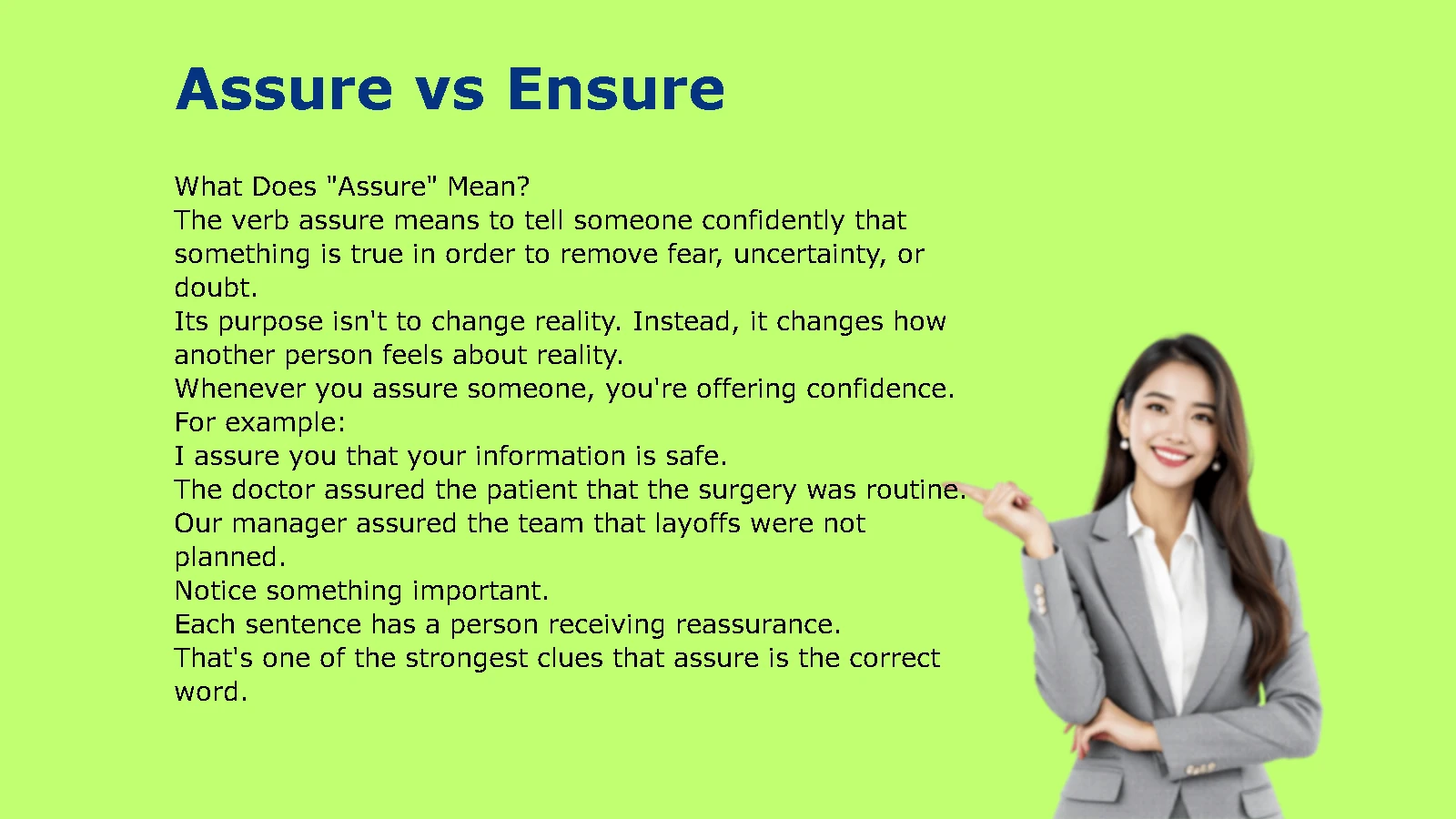
The verb assure means to tell someone confidently that something is true in order to remove fear, uncertainty, or doubt.
Its purpose isn’t to change reality. Instead, it changes how another person feels about reality.
Whenever you assure someone, you’re offering confidence.
For example:
- I assure you that your information is safe.
- The doctor assured the patient that the surgery was routine.
- Our manager assured the team that layoffs were not planned.
Notice something important.
Each sentence has a person receiving reassurance.
That’s one of the strongest clues that assure is the correct word.
Origin of the Word “Assure”
The word assure entered English through Old French and ultimately comes from the Latin word securus, meaning safe, free from care, or confident.
Its historical meaning has always centered on giving confidence or certainty to another person.
Although modern English has evolved considerably, the core idea remains unchanged.
When to Use “Assure”
You should use assure whenever your goal is to comfort, convince, encourage, or eliminate uncertainty for another person.
Common situations include:
- Reassuring customers
- Comforting family members
- Speaking with employees
- Explaining decisions
- Addressing public concerns
- Giving presentations
- Resolving complaints
If emotions or confidence play an important role, assure usually fits naturally.
Assuring Someone During Difficult Times
Imagine your friend worries about an upcoming exam.
You might say:
“I assure you that you’ve prepared well.”
You aren’t guaranteeing the exam result.
You’re helping your friend feel less anxious.
Assuring Customers
Businesses constantly reassure customers.
Examples include:
- We assure customers that their personal information remains confidential.
- Our support team assures every client that their issue receives prompt attention.
- The company assured buyers that defective products would be replaced.
Customer confidence often determines whether someone returns to a business.
Assuring Employees
Managers frequently reassure employees during organizational changes.
Examples:
- The CEO assured employees that salaries would remain unchanged.
- Human Resources assured staff that benefits would continue.
- The supervisor assured everyone that overtime would remain voluntary.
Good leaders understand that reassurance builds trust.
Examples of “Assure” in Everyday Sentences
Daily Conversations
- I assure you everything will work out.
- She assured me there wasn’t any danger.
- Dad assured us the storm would pass soon.
- Can I assure everyone that the meeting starts at nine?
Workplace Examples
- The project manager assured stakeholders that deadlines would be met.
- Our accountant assured clients that financial records remained accurate.
- The supervisor assured new employees that training would begin immediately.
Academic Writing
- The instructor assured students that the grading policy remained unchanged.
- The professor assured the class that additional resources would become available.
Customer Service
- We assure every customer that their feedback matters.
- Representatives assured travelers that flights would resume shortly.
Healthcare
- The nurse assured the child that the vaccine would only take a moment.
- Doctors assured the family that recovery looked promising.
What Does “Ensure” Mean?
Definition of Ensure
The verb ensure means to make certain that something happens or exists.
Unlike assure, ensure isn’t about someone’s feelings.
Instead, it focuses on taking action that produces a reliable outcome.
Think of it as prevention, preparation, or guarantee through action.
For example:
- We ensured every document was signed.
- Please ensure the doors are locked.
- Backup systems ensure continuous service.
Each example describes concrete action leading to a desired result.
Origin of the Word “Ensure”
Like assure, ensure traces its roots to Latin through French.
Although both words share similar origins, English gradually assigned different functions to each one.
Today, ensure almost always refers to guaranteeing a condition or outcome rather than reassuring a person.
When to Use “Ensure”
Use ensure whenever you’re talking about making something happen successfully.
Common situations include:
- Following procedures
- Preventing accidents
- Completing projects
- Maintaining quality
- Protecting data
- Improving security
- Meeting deadlines
- Ensuring compliance
In many professional fields, ensure appears constantly because organizations depend on reliable processes.
Ensuring Safety
Safety manuals almost always use ensure.
Examples include:
- Wear protective equipment to ensure your safety.
- Inspect the ladder before climbing to ensure stability.
- Emergency exits help ensure safe evacuation.
Notice that no one receives reassurance directly.
Instead, actions produce safe conditions.
Ensuring Quality
Manufacturers frequently use ensure when discussing quality.
Examples:
- Every product undergoes testing to ensure consistent performance.
- Engineers inspect each component to ensure reliability.
- Routine maintenance helps ensure long equipment life.
Ensuring Success
Many business strategies revolve around ensuring success.
Examples include:
- Weekly meetings ensure better communication.
- Staff training ensures higher productivity.
- Proper planning ensures fewer delays.
Examples of “Ensure” in Everyday Sentences
Daily Life
- Double-check your alarm to ensure you wake up on time.
- Save your work frequently to ensure nothing gets lost.
- Drink enough water to ensure proper hydration.
Workplace
- Managers ensure every department follows company policies.
- Our checklist ensures nothing gets overlooked.
- Quality inspections ensure customer satisfaction.
Technical Writing
- Software updates ensure improved security.
- Encryption helps ensure data privacy.
- Automatic backups ensure business continuity.
Legal Documents
Legal writing often prefers ensure because precision matters.
Examples include:
- These regulations ensure fair competition.
- The agreement ensures equal treatment for all parties.
- Federal laws help ensure workplace safety.
Education
- Teachers provide practice exercises to ensure understanding.
- Regular assessments ensure students meet learning objectives.
Assure vs Ensure: Side-by-Side Examples
Sometimes the difference becomes obvious only after comparing both words directly.
| Situation | Correct Word | Example |
| Comforting a nervous employee | Assure | I assured the employee that mistakes happen during training. |
| Preventing mistakes | Ensure | We introduced a checklist to ensure accuracy. |
| Speaking to customers | Assure | The representative assured customers that refunds would be processed quickly. |
| Meeting a deadline | Ensure | Better planning ensured the project finished early. |
| Hospital communication | Assure | The doctor assured the family that treatment had begun immediately. |
| Hospital procedures | Ensure | Safety protocols ensure sterile operating rooms. |
| School conversation | Assure | The teacher assured students that extra help was available. |
| School policy | Ensure | Attendance policies ensure consistent participation. |
| Banking confidence | Assure | Advisors assure clients that investments are reviewed regularly. |
| Banking operations | Ensure | Security systems ensure secure online transactions. |
Looking across the table, one pattern never changes.
Assure speaks to people.
Ensure focuses on outcomes.
The Easiest Trick to Remember the Difference
English learners often memorize grammar rules only to forget them later. Fortunately, assure vs ensure has one of the easiest memory tricks in the language.
Think of “Assure” as a Person Word
Whenever you see a person receiving confidence, choose assure.
Examples:
- assure your friend
- assure customers
- assure parents
- assure employees
- assure voters
- assure readers
Ask yourself:
Who needs reassurance?
If the answer is a person, assure is probably correct.
Think of “Ensure” as a Result Word
Whenever you’re guaranteeing an outcome, choose ensure.
Examples:
- ensure safety
- ensure accuracy
- ensure quality
- ensure success
- ensure compliance
- ensure consistency
Ask yourself:
What needs to happen?
If the answer describes a result, ensure is likely the right choice.
A Simple Formula
Keep this formula in mind whenever you write.
| Word | Think About |
| Assure | A person |
| Ensure | A result |
Most confusing sentences become clear after applying this single rule.
Another Helpful Memory Device
Notice the first letter after the prefix:
- Assure → Someone
- Ensure → Event
While this isn’t a formal grammar rule, many writers find it surprisingly effective.
Visual Diagram
Which word should you use?
START
│
Are you reassuring a person?
│ │
Yes No
│ │
Use ASSURE Are you guaranteeing
a result?
│ │
Yes No
│
Use ENSURE
Keep this mental flowchart handy when proofreading important documents.
Can You Use “Assure” and “Ensure” Interchangeably?
This question appears frequently because the two words both relate to certainty. However, they are not interchangeable in most situations.
Choosing the wrong word may confuse readers or make your writing sound less polished.
Consider these examples.
✅ I assured my client that the issue would be resolved.
The client receives reassurance.
✅ I ensured the issue was resolved.
The speaker took action to guarantee the solution.
Now compare the incorrect versions.
❌ I ensured my client.
The sentence feels incomplete because ensure doesn’t normally take a person as its direct object.
❌ I assured the report was submitted.
This sounds awkward because assure generally requires someone to receive reassurance.
Professional editors often correct these mistakes because they subtly affect clarity and precision.
That said, you may occasionally encounter sentences where both words appear in similar contexts. Even then, the meaning shifts.
Compare these two examples:
- I assured investors that the company remained financially stable.
- I ensured the company remained financially stable.
The first concerns communication.
The second concerns action.
The difference isn’t small. One builds confidence, while the other produces results.
As a practical rule, treat assure and ensure as distinct verbs with distinct jobs. Doing so will make your writing clearer, more accurate, and more professional.
Assure vs Ensure: Common Grammar Rules
Understanding the definitions of assure and ensure is only the beginning. To use these verbs naturally, you also need to know how they fit into a sentence. Fortunately, the grammar is straightforward once you recognize what each verb expects as its object.
A simple rule can prevent most mistakes:
- Assure usually takes a person as its object.
- Ensure usually takes a thing, condition, or result as its object.
Let’s look at each rule in detail.
The Object of “Assure”
When you use assure, you almost always reassure someone.
The structure usually looks like this:
Assure + person + that + statement
Examples:
- I assured my friend that everything would be fine.
- She assured the customer that a replacement was on the way.
- The lawyer assured his client that the paperwork was complete.
- Our teacher assured the class that the exam covered only assigned material.
Notice that every sentence includes a person or group receiving reassurance.
More Examples
- The pilot assured passengers that the turbulence was temporary.
- Parents assured their children that help was coming.
- The coach assured the team that they were ready for the championship.
- Management assured employees that salaries would not change.
Whenever you see someone gaining confidence, assure is usually the correct choice.
The Object of “Ensure”
With ensure, the object is normally an outcome, process, quality, or condition.
The structure often looks like this:
Ensure + noun
or
Ensure + that + clause
Examples:
- Please ensure accuracy.
- We ensured compliance with company policies.
- Engineers ensure product quality.
- The software ensures secure file transfers.
You can also write:
- Please ensure that all doors are locked.
- We ensured that every order shipped on time.
- The inspection ensured that safety standards were met.
- Proper planning ensures that projects stay on schedule.
Unlike assure, these sentences don’t focus on someone’s feelings. They focus on making something happen.
Common Sentence Structures
Below are the sentence patterns you’ll see most often.
| Pattern | Example |
| Assure + person | I assured Sarah. |
| Assure + person + that | I assured Sarah that everything was fine. |
| Ensure + noun | Ensure quality. |
| Ensure + that clause | Ensure that everyone signs in. |
| Ensure + adjective + noun | Ensure consistent performance. |
| Ensure + process | Ensure proper installation. |
Learning these patterns makes writing much easier because you don’t have to guess.
Verb Forms
Both assure and ensure are regular verbs.
Assure
| Form | Word |
| Base | assure |
| Third Person | assures |
| Past | assured |
| Past Participle | assured |
| Present Participle | assuring |
Examples:
- I assure everyone.
- She assures customers daily.
- We assured the committee yesterday.
- They have assured investors repeatedly.
- He is assuring the audience that everything is under control.
Ensure
| Form | Word |
| Base | ensure |
| Third Person | ensures |
| Past | ensured |
| Past Participle | ensured |
| Present Participle | ensuring |
Examples:
- We ensure quality.
- The company ensures customer satisfaction.
- They ensured timely delivery.
- The process has ensured reliable results.
- She is ensuring that everyone follows instructions.
Tense Usage
Both verbs work naturally in every English tense.
Present Tense
- I assure you this information is correct.
- Our policies ensure fairness.
Past Tense
- The doctor assured the family.
- Regular inspections ensured safety.
Future Tense
- We will assure customers of our continued support.
- The upgrade will ensure better performance.
Present Perfect
- We have assured everyone involved.
- New procedures have ensured greater consistency.
Active Voice vs Passive Voice
Active voice almost always sounds stronger and clearer.
Better
- The manager assured employees.
- Engineers ensure product safety.
Less Direct
- Employees were assured by the manager.
- Product safety is ensured by engineers.
Active voice tells readers exactly who performs the action. It also improves readability, especially in business and technical writing.
Common Mistakes People Make
Even experienced writers sometimes confuse assure and ensure because both involve certainty. The difference becomes clear once you know what each word is trying to accomplish.
Below are the mistakes that appear most often.
Using “Ensure” With a Person
Incorrect:
❌ We ensured our customers.
Correct:
✅ We assured our customers.
or
✅ We ensured customer satisfaction.
Remember:
- People receive assurance.
- Results receive ensuring.
Using “Assure” for Outcomes
Incorrect:
❌ This checklist assures quality.
Correct:
✅ This checklist ensures quality.
The checklist doesn’t comfort anyone. It helps achieve a result.
Mixing Them in Business Emails
Business writing often includes both words.
Incorrect:
We assure timely delivery.
Better:
We ensure timely delivery.
If you also want to reassure customers, write:
We assure our customers that we ensure timely delivery.
Each verb performs a different job in the sentence.
Confusing Confidence With Action
Compare these examples.
Confidence
- I assured my team we were prepared.
Action
- I ensured my team had the necessary equipment.
One sentence changes emotions.
The other changes circumstances.
Choosing a Word Because It Sounds More Formal
Some writers choose ensure simply because it sounds official.
That’s a mistake.
Always choose the verb that matches the meaning.
Simple, accurate writing almost always beats complicated wording.
Forgetting the Object
Read these sentences carefully.
- I assured everyone.
- I ensured success.
Notice how the objects differ.
The first sentence ends with people.
The second ends with a result.
Keeping that pattern in mind prevents most grammar errors.
Assure vs Ensure in Business Writing
Business communication depends on precision. Clients, employees, investors, and partners all expect clear language. Mixing up assure and ensure can create unnecessary confusion.
Fortunately, professional writing follows consistent patterns.
Emails
When reassuring someone, use assure.
Examples:
- We assure you that your request is being processed.
- I’d like to assure you that your feedback has been shared with management.
- Our team assures every customer of prompt assistance.
When discussing processes, use ensure.
Examples:
- We ensure every order undergoes inspection.
- Our system ensures secure payment processing.
- These procedures ensure compliance with industry standards.
Contracts
Contracts often use ensure because they describe obligations and outcomes.
Examples:
- This agreement ensures equal treatment for all parties.
- Internal controls ensure financial accountability.
- Safety inspections ensure regulatory compliance.
Lawyers prefer ensure because contracts focus on results rather than emotions.
Customer Communication
Excellent customer service combines both words naturally.
Example:
We assure every customer that their concerns matter. To ensure quick resolution, our support team responds within one business day.
The first sentence builds trust.
The second explains the action.
Reports
Business reports emphasize measurable outcomes.
Examples:
- Regular audits ensure financial accuracy.
- Automated monitoring ensures continuous performance.
- Updated policies ensure legal compliance.
Policies and Procedures
Most policy manuals use ensure repeatedly.
Examples include:
- Ensure all equipment is inspected before use.
- Ensure confidential records remain protected.
- Ensure visitors sign in upon arrival.
These statements describe required actions that produce specific results.
Assure vs Ensure in Academic Writing
Academic writing values clarity, accuracy, and precision. Professors and editors expect every word to carry the correct meaning.
Using assure when discussing research findings or procedures can weaken an otherwise strong paper.
Research Papers
Researchers generally write about outcomes.
Examples:
- Multiple trials ensured reliable data.
- Random sampling ensured unbiased results.
- Calibration ensured measurement accuracy.
Essays
Essays may use both verbs depending on the context.
Examples:
- The author assured readers that change was possible.
- Government reforms aimed to ensure equal opportunity.
Professional Reports
Reports commonly include statements such as:
- Regular inspections ensure workplace safety.
- Internal reviews ensure consistent quality.
- Training programs ensure compliance with organizational standards.
Educational Settings
Teachers often use both verbs during the same lesson.
Examples:
- The instructor assured students that extra help was available.
- Weekly quizzes ensure students understand the material.
Again, one comforts people.
The other guarantees progress.
Real-Life Examples
The easiest way to master assure vs ensure is to see the words in everyday situations.
Customer Service
Assure
- Representatives assured customers that refunds would arrive within five business days.
- Support agents assured callers that technicians were already investigating the issue.
Ensure
- Automated systems ensure faster response times.
- Quality checks ensure every replacement product meets company standards.
Healthcare
Assure
Doctors regularly reassure patients before treatment.
Examples:
- The surgeon assured the family that the procedure was routine.
- Nurses assured children before administering vaccines.
Ensure
Hospitals depend on procedures that ensure safety.
Examples:
- Sterilization protocols ensure infection control.
- Electronic medical records ensure accurate patient information.
- Medication reviews ensure proper treatment.
Schools
Assure
Teachers reassure students.
Examples:
- The principal assured parents that safety remained the school’s top priority.
- The counselor assured students that confidential conversations would stay private.
Ensure
Schools also guarantee educational outcomes.
Examples:
- Attendance policies ensure consistent learning.
- Classroom rules ensure respectful behavior.
- Lesson plans ensure curriculum coverage.
Workplace Communication
Managers constantly switch between these verbs.
Examples:
- The director assured employees that no layoffs were planned.
- New software ensures faster project tracking.
- Human Resources assured staff that benefits would remain unchanged.
- Performance reviews ensure continuous improvement.
Government Documents
Government agencies generally use ensure when describing responsibilities.
Examples:
- Regulations ensure public safety.
- Tax laws ensure equal enforcement.
- Environmental standards ensure cleaner air and water.
Officials use assure during speeches.
Examples:
- The mayor assured residents that emergency crews were responding.
- Officials assured citizens that supplies were on the way.
Product Instructions
Instruction manuals almost always choose ensure because they focus on results.
Examples:
- Tighten all screws to ensure stability.
- Allow the device to cool before storage to ensure safe handling.
- Follow these steps to ensure optimal performance.
You’ll rarely see assure in an instruction manual because manuals don’t usually reassure readers. They explain how to achieve successful outcomes.
Common Collocations
Native English speakers often pair certain words together. These combinations, known as collocations, make writing sound more natural.
Learning them helps you write with greater confidence.
Words Commonly Used With “Assure”
| Common Collocation | Example |
| assure someone | I assure you everything is fine. |
| assure customers | We assure customers of quality service. |
| assure employees | Management assured employees about job security. |
| assure investors | The CEO assured investors during the meeting. |
| assure clients | Lawyers assured clients that deadlines would be met. |
| assure parents | Teachers assured parents that safety procedures were in place. |
| assure readers | The author assured readers that every source had been verified. |
| assure voters | Candidates assured voters they would remain transparent. |
These phrases all involve giving confidence to people.
Words Commonly Used With “Ensure”
| Common Collocation | Example |
| ensure safety | Safety equipment ensures worker protection. |
| ensure quality | Regular testing ensures product quality. |
| ensure accuracy | Proofreading ensures accuracy. |
| ensure compliance | Internal audits ensure regulatory compliance. |
| ensure consistency | Standard procedures ensure consistency. |
| ensure security | Encryption ensures secure communication. |
| ensure fairness | Clear rules ensure fairness. |
| ensure reliability | Routine maintenance ensures reliability. |
| ensure success | Careful planning helps ensure success. |
| ensure efficiency | Automation ensures greater efficiency. |
Unlike assure, these combinations focus on outcomes, standards, and measurable results rather than emotions or confidence.
Synonyms of Assure
Sometimes assure is the best word. Other times, a close synonym fits the situation better. Choosing the right alternative depends on whether you’re comforting someone, making a promise, or building confidence.
| Synonym | Best Used When | How It Differs From Assure |
| Reassure | Reducing fear or anxiety | Stronger emotional comfort |
| Comfort | Supporting someone emotionally | Focuses on feelings rather than certainty |
| Convince | Changing someone’s opinion | Persuades rather than reassures |
| Promise | Making a commitment | Creates an obligation |
| Guarantee | Giving a firm commitment | Often stronger than assure |
| Encourage | Building confidence | Motivates instead of confirming facts |
| Calm | Reducing panic or stress | Focuses on emotional relief |
When to Choose a Synonym
Consider these examples:
- The teacher reassured nervous students before the exam.
- The manager promised employees that bonuses would be paid.
- The counselor comforted the family after the accident.
- The CEO guaranteed customers a full refund.
Although these words share similarities with assure, each carries a slightly different meaning. Choosing the most precise verb makes your writing more natural.
Synonyms of Ensure
Like assure, ensure has several useful alternatives. Most of them focus on producing a reliable outcome.
| Synonym | Best Used When | Difference From Ensure |
| Guarantee | Offering certainty | Often stronger and more absolute |
| Secure | Protecting something | Emphasizes safety or protection |
| Confirm | Verifying information | Checks facts rather than producing results |
| Verify | Testing accuracy | Focuses on evidence |
| Safeguard | Preventing harm | Emphasizes protection |
| Establish | Creating something | Begins a process instead of guaranteeing it |
| Maintain | Keeping something consistent | Focuses on continuity |
Examples
- Daily inspections guarantee product quality.
- Password protection secures sensitive information.
- Managers verify financial reports each month.
- Emergency procedures safeguard employees.
These verbs overlap with ensure, but each adds a different shade of meaning.
Assure, Ensure, and Insure: What’s the Difference?
Many people learn the difference between assure and ensure, only to discover a third word: insure.
Because all three words relate to certainty, they’re often confused. However, modern English gives each one a distinct purpose.
What Does Assure Mean?
Use assure when speaking to a person.
Example:
- I assured my friend that everything would be okay.
The goal is reassurance.
What Does Ensure Mean?
Use ensure when making certain something happens.
Example:
- We ensured the documents arrived safely.
The goal is a successful outcome.
What Does Insure Mean?
Use insure when talking about insurance or financial protection.
Examples:
- We insured the house against flood damage.
- She insured her car with a national insurance company.
- Businesses insure valuable equipment.
Outside insurance contexts, insure appears much less often in modern American English.
Comparison Table
| Word | Purpose | Usually Takes |
| Assure | Give confidence | A person |
| Ensure | Make certain | A result or condition |
| Insure | Provide insurance coverage | Property, life, vehicles, businesses |
Examples Using All Three Words
- The doctor assured the patient that recovery looked promising.
- The hospital ensured every safety protocol was followed.
- The hospital insured its new medical equipment against damage.
Another example:
- The travel agent assured us our vacation would be enjoyable.
- She ensured every reservation was confirmed.
- We insured our luggage before the trip.
Once you understand each word’s purpose, choosing the correct one becomes much easier.
Frequently Confused Word Pairs
English contains many word pairs that seem interchangeable but aren’t. Assure vs ensure belongs to a larger family of commonly confused verbs.
Understanding these differences strengthens both spoken and written English.
Assure vs Reassure
Assure
Provides confidence.
Example:
- I assured him that everything was ready.
Reassure
Restores confidence after someone becomes worried.
Example:
- The doctor reassured the patient after reviewing the test results.
Reassure usually suggests stronger emotional support.
Ensure vs Guarantee
Both express certainty, but they aren’t identical.
Ensure
Means taking action to make something happen.
Example:
- Daily backups ensure data security.
Guarantee
Means making a formal or explicit promise.
Example:
- The manufacturer guarantees the product for five years.
A guarantee often creates a legal or contractual obligation.
Ensure vs Secure
These words overlap in some situations.
Ensure
Focuses on making something certain.
Secure
Focuses on protecting something.
Examples:
- Passwords secure online accounts.
- Security updates ensure safer browsing.
Ensure vs Confirm
These verbs perform different jobs.
Ensure
Creates certainty.
Confirm
Checks or verifies certainty.
Examples:
- Please ensure every form is complete.
- Please confirm your appointment by email.
Assure vs Promise
A promise commits someone to future action.
An assurance builds confidence.
Examples:
- I promise I’ll call tomorrow.
- I assure you I’ll handle the situation responsibly.
Sometimes both words fit, but promise sounds stronger because it creates an obligation.
Practice Quiz
Test your understanding of assure vs ensure with these short exercises.
Fill in the Blank
Choose assure or ensure.
Question 1
The teacher wanted to ________ students that extra help was available.
Answer: assure
Question 2
Please ________ all windows are closed before leaving.
Answer: ensure
Question 3
The doctor ________ the family that recovery was expected.
Answer: assured
Question 4
Regular inspections help ________ workplace safety.
Answer: ensure
Question 5
The customer service representative ________ me that my refund had already been processed.
Answer: assured
Choose the Correct Sentence
A
- We assured quality.
- We ensured quality.
✅ Correct:
We ensured quality.
B
- I ensured my parents everything was fine.
- I assured my parents everything was fine.
✅ Correct:
I assured my parents everything was fine.
C
- Updated software ensures better performance.
- Updated software assures better performance.
✅ Correct:
Updated software ensures better performance.
Correct the Mistake
Incorrect
We ensured our customers that shipping would remain free.
Correct
We assured our customers that shipping would remain free.
Incorrect
The new checklist assures accuracy.
Correct
The new checklist ensures accuracy.
Incorrect
Our manager ensured employees about the company’s future.
Correct
Our manager assured employees about the company’s future.
Quick Self-Test
Ask yourself these questions before choosing a word.
- Am I speaking to a person?
- Am I guaranteeing a result?
- Am I discussing insurance?
If your answers are:
- Person → Assure
- Result → Ensure
- Insurance → Insure
You’ll choose correctly almost every time.
Frequently Asked Questions
Is it assure or ensure someone?
Use assure.
Correct:
- I assured my friend.
- She assured her customers.
Incorrect:
- I ensured my friend.
Can you ensure a person?
Generally, no.
Modern English almost always uses ensure for outcomes rather than people.
Instead, write:
- I assured the customer.
- We ensured customer satisfaction.
Can you assure a result?
Usually, no.
Instead of:
❌ We assured success.
Write:
✅ We ensured success.
Is ensure more formal than assure?
Not really.
Both appear in formal and informal writing.
The difference depends on meaning, not formality.
Which word appears more often in business writing?
Both are common.
Business communication typically uses:
- Assure when addressing customers, employees, or investors.
- Ensure when describing policies, procedures, quality standards, or compliance.
What’s the difference between assure, ensure, and insure?
Here’s the simplest explanation:
- Assure = Give confidence to a person.
- Ensure = Make certain something happens.
- Insure = Provide insurance coverage.
How do native English speakers remember the difference?
Many remember this simple phrase:
Assure a person. Ensure a result. Insure against risk.
It’s short, memorable, and accurate.
Is one word more common in American English?
Both words are common in American English.
However:
- Ensure appears more frequently in technical writing, government documents, safety guidelines, and business policies.
- Assure appears more often in conversations, customer service, speeches, and interpersonal communication.
Key Takeaways
If you remember only a few points from this guide, make them these:
- Assure means giving confidence to a person.
- Ensure means making certain something happens.
- Insure relates to insurance and financial protection.
- Assure focuses on emotions and reassurance.
- Ensure focuses on actions and outcomes.
- Most grammar mistakes happen because writers confuse people with results.
- Asking one simple question—“Am I reassuring someone or guaranteeing something?”—usually leads to the correct choice.
Mastering assure vs ensure doesn’t require memorizing dozens of grammar rules. Instead, focus on the purpose behind each word. If you’re building someone’s confidence, assure is the right choice. If you’re making a process, condition, or outcome certain, choose ensure.
The more you read and write, the more natural this distinction becomes. Soon, you’ll recognize the correct word instantly and use it confidently in emails, essays, reports, presentations, and everyday conversations.
Final Comparison Table
| Feature | Assure | Ensure | Insure |
| Primary Meaning | Give confidence | Make certain | Provide insurance |
| Focus | A person | A result or condition | Financial protection |
| Common Object | Someone | Something | Property, vehicles, businesses, life |
| Typical Context | Conversations, customer service, leadership | Safety, procedures, quality control, compliance | Insurance policies and coverage |
| Example | I assured her everything would be fine. | We ensured the project finished on time. | They insured the warehouse against fire. |
| Memory Trick | Assure a person | Ensure a result | Insure against risk |
“Clear writing isn’t about using bigger words. It’s about choosing the right word for the right purpose.” When you understand the distinction between assure, ensure, and insure, your writing becomes more precise, more professional, and much easier for readers to understand.