Ever confused Steal vs. Steel while writing and wondered why a single vowel changes everything? It’s a common mistake that can completely alter the meaning of your sentence—yet many people still mix them up in emails, essays, and everyday communication.
You’re not alone if you’ve struggled with this. These two words sound identical but belong to totally different worlds, which makes them one of the most frequent spelling traps in English. And here’s the kicker: even a small slip can make your writing look careless or unclear.
But don’t worry—this is easy to fix once you understand the difference.
In this guide, you’ll learn the clear meaning of Steal vs. Steel, including how each word is used in real sentences, common mistakes to avoid, and simple memory tricks to help you never confuse them again. You’ll also explore related LSI entities like theft and stealing actions, metal and iron materials, and homophones in English grammar, which will make the difference crystal clear.
So if you want to write with confidence and avoid one of the most common English mix-ups, let’s break it down step by step.
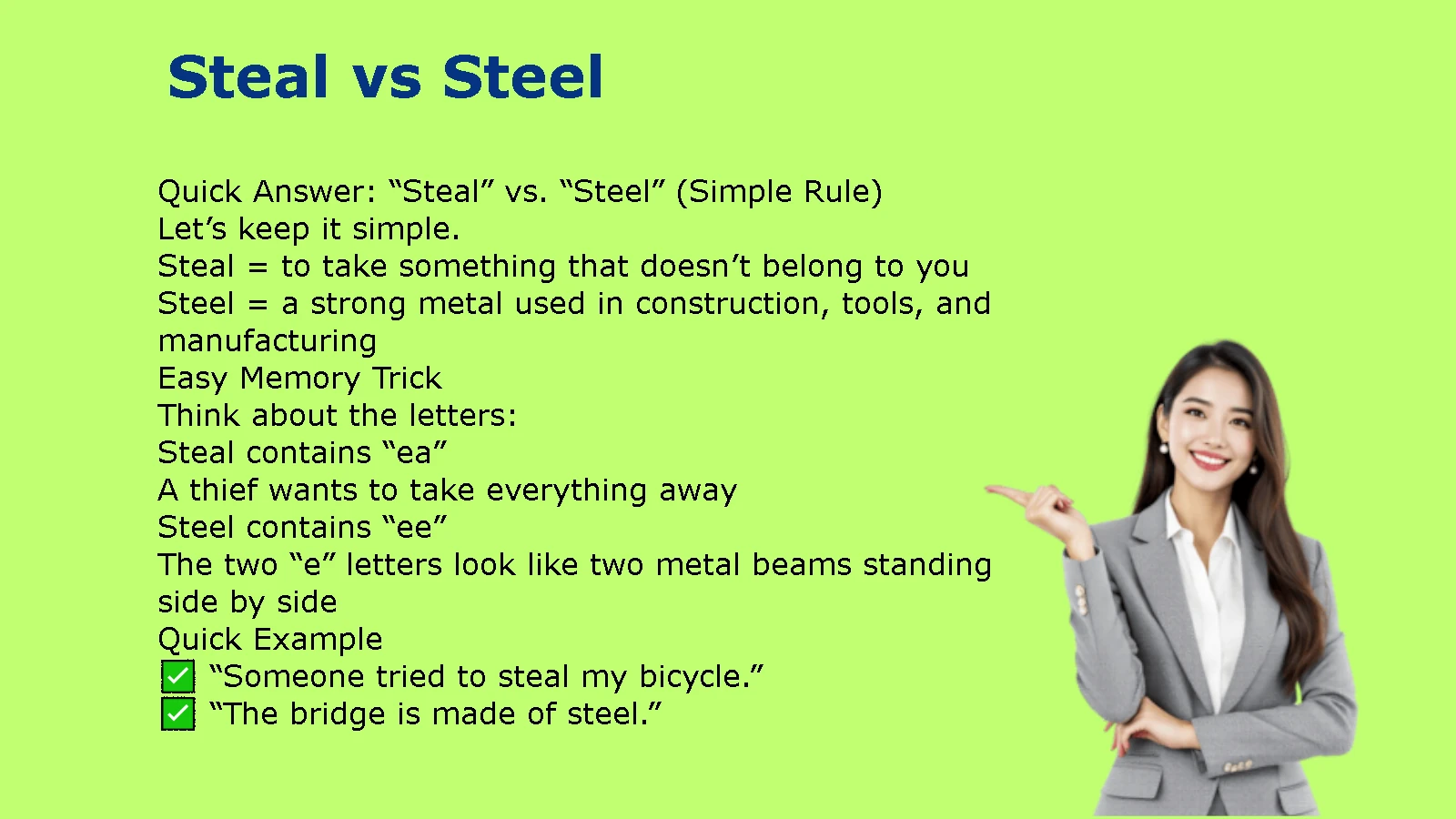
Quick Answer: “Steal” vs. “Steel” (Simple Rule)
Let’s keep it simple.
Steal = to take something that doesn’t belong to you
Steel = a strong metal used in construction, tools, and manufacturing
Easy Memory Trick
Think about the letters:
Steal contains “ea”
- A thief wants to take everything away
Steel contains “ee”
- The two “e” letters look like two metal beams standing side by side
Quick Example
✅ “Someone tried to steal my bicycle.”
✅ “The bridge is made of steel.”
How People Actually Confuse “Steal” and “Steel”
The main reason is simple.
They sound exactly the same when spoken.
In Everyday Writing
People often type quickly and rely on sound rather than spelling.
Examples:
❌ “The factory produces steal products.”
❌ “Someone tried to steel my wallet.”
At Work
Misspelling these words can create confusion.
Imagine writing:
“We need more steal for the building.”
That sentence suddenly sounds like criminal activity instead of construction planning.
Why This Happens
- They are pronounced identically
- Spell-check may not catch the mistake
- Writers focus on sound instead of meaning
The Core Difference Between “Steal” and “Steel”
The easiest way to understand them is by looking at their functions.
| Word | Part of Speech | Meaning |
| Steal | Verb | To take something unlawfully |
| Steel | Noun (sometimes adjective) | A strong metal alloy |
Key Insight
Steal is usually an action.
Steel is usually a material.
If you’re doing something, you probably mean steal.
If you’re talking about metal, you probably mean steel.
“Steal” Explained Clearly (With Examples)
The word steal means to take something without permission.
It usually refers to theft, robbery, or dishonest taking.
Common Uses of “Steal”
- Steal money
- Steal a car
- Steal an idea
- Steal attention
- Steal a glance
Real-Life Examples
✅ “The thief tried to steal a motorcycle.”
✅ “Someone stole my phone yesterday.”
✅ “Her performance managed to steal the show.”
Figurative Uses
Not every use involves crime.
For example:
✅ “The baby’s smile stole everyone’s heart.”
No actual theft occurred.
The phrase simply means the smile won people over.
Key Takeaway
Whenever the meaning involves taking, grabbing, or unfairly obtaining something, use steal.
“Steel” Explained Clearly (With Examples)
The word steel refers to a strong metal made primarily from iron and carbon.
It’s one of the most important materials in the modern world.
Common Uses of “Steel”
- Steel beams
- Steel bridges
- Steel pipes
- Steel tools
- Stainless steel
Real-Life Examples
✅ “The building uses reinforced steel beams.”
✅ “The knife is made of high-quality steel.”
✅ “Workers installed a new steel frame.”
Figurative Uses
Sometimes steel represents strength.
Example:
✅ “She showed nerves of steel during the emergency.”
This means she remained calm and strong under pressure.
Key Takeaway
If the sentence involves metal, construction, manufacturing, or strength, use steel.
The Biggest Mistake People Make
The most common error is choosing the word based on pronunciation.
Since both words sound identical, writers often spell whichever version comes to mind first.
What Goes Wrong
Someone means:
“The bridge is made of steel.”
But writes:
“The bridge is made of steal.”
The sentence becomes grammatically incorrect because steal is an action, not a material.
Lesson
Don’t listen to the sound.
Focus on the meaning.
Side-by-Side Comparison Table
Here’s a quick reference guide:
| Feature | Steal | Steel |
| Meaning | Take unlawfully | Strong metal |
| Part of Speech | Verb | Noun |
| Related To | Theft | Construction |
| Example | Steal a bike | Steel beams |
| Common Context | Crime, taking | Buildings, tools |
Real-Life Examples of “Steal”
Let’s see how the word works in everyday situations.
Common Sentences
✅ “Someone tried to steal my backpack.”
✅ “Hackers attempted to steal customer information.”
✅ “The actor managed to steal the spotlight.”
Mini Scenario
A store owner checks security footage.
He discovers someone trying to steal merchandise after closing time.
In this case, steal means taking property illegally.
Real-Life Examples of “Steel”
Now compare those examples with steel.
Common Sentences
✅ “The skyscraper uses thousands of tons of steel.”
✅ “The factory manufactures steel components.”
✅ “The chef prefers steel cookware.”
Mini Scenario
An engineer designs a bridge.
To ensure strength and durability, she chooses steel supports.
Here, steel refers to the metal material.
Memory Tricks That Actually Work
Need a quick way to remember?
Trick #1: Theft = Steal
The word steal relates to taking things.
Think:
Steal = Sneaky action
Trick #2: Steel = Structure
The word steel is used in buildings and machines.
Think:
Steel = Strong material
Trick #3: Double E = Extra Strength
The two “e” letters in steel can remind you of two sturdy metal beams.
Common Mistakes and Corrections
Here are mistakes people frequently make.
Incorrect
❌ “The company produces steal pipes.”
Correct
✅ “The company produces steel pipes.”
Incorrect
❌ “Someone tried to steel my laptop.”
Correct
✅ “Someone tried to steal my laptop.”
Incorrect
❌ “The bridge uses steal supports.”
Correct
✅ “The bridge uses steel supports.”
How to Avoid Confusion Every Time
Want a foolproof method?
Ask yourself one question:
Is it an action or a material?
If it’s an action involving taking something:
➡ Use steal
If it’s a metal or building material:
➡ Use steel
Double-Check the Context
Before submitting an email, report, or assignment, reread the sentence.
Most mistakes become obvious immediately.
What to Say Instead (Related Words)
Sometimes a synonym can help clarify your meaning.
Alternatives for “Steal”
- Take
- Rob
- Swipe
- Snatch
- Pilfer
Alternatives for “Steel”
- Metal
- Alloy
- Ironwork
- Stainless steel
- Structural metal
Using alternatives can reduce confusion in formal writing.
Quick Decision Guide (Use This Instantly)
When you’re unsure, follow this:
Taking something?
➡ Steal
Talking about metal?
➡ Steel
Still uncertain?
➡ Replace the word with “take.”
If the sentence still makes sense, use steal.
If not, use steel.
Simple. Reliable. Done.
FAQ: “Steal” vs. “Steel”
Are “steal” and “steel” pronounced the same?
Yes.
They are homophones and sound identical in standard English pronunciation.
Is “steel” ever a verb?
Rarely.
In some contexts, “steel oneself” means to prepare mentally for something difficult.
Example:
✅ “She steeled herself for the challenge.”
Which word is more commonly confused?
Both are frequently mixed up because spell-check often accepts either spelling.
How can I remember the difference?
Remember:
- Steal = take unlawfully
- Steel = metal
Case Study: A Costly Construction Email
A construction manager sent an email to suppliers.
The message read:
“We need additional steal beams by Monday.”
What Happened
The supplier was confused.
Several team members joked about the company admitting theft.
The manager had meant steel beams.
Result
- Confusion among staff
- Unnecessary clarification emails
- Delayed communication
Fix
The corrected message said:
“We need additional steel beams by Monday.”
Problem solved instantly.
Key Facts You Should Remember
- Steal means to take something unlawfully
- Steel is a strong metal alloy
- Both words sound exactly the same
- Steal is usually a verb
- Steel is usually a noun
- Context determines which word is correct
- Meaning matters more than pronunciation
Final Takeaway: The One Rule That Never Fails
Here’s the truth.
The difference between Steal vs. Steel is simple once you stop focusing on how the words sound and start focusing on what they mean.
Remember:
Steal = taking something
Steel = a metal material
Whenever you’re unsure, ask yourself:
Am I talking about an action or a material?
If it’s an action, use steal.
If it’s metal, use steel.
Think of it this way: a thief might try to steal a truck full of steel, but the two words will never mean the same thing.
And that simple distinction will keep your writing clear, professional, and mistake-free every time.