Ever wondered why Recur vs. Reoccur confuses so many writers, even in professional emails and formal writing? Both words seem similar, and both relate to something happening again—but they are not actually interchangeable.
The problem starts here. You might use “reoccur” when you mean “recur,” or the other way around, without realizing the subtle difference. And here’s the kicker: using the wrong one can make your writing look less precise, especially in academic or professional contexts.
Many writers struggle with this distinction in everyday communication. That’s why people often search for clear explanations of recurring vs reoccurring events, difference between recur and reoccur, and correct usage in sentences.
But don’t worry—this is easier to fix than it seems.
In this guide, you’ll understand Recur vs. Reoccur in a simple way, learn the exact difference between the two, and see real examples that show when to use each word correctly. You’ll also discover quick memory tricks so you never mix them up again.
So if you want to write with more clarity and confidence, let’s break it down.
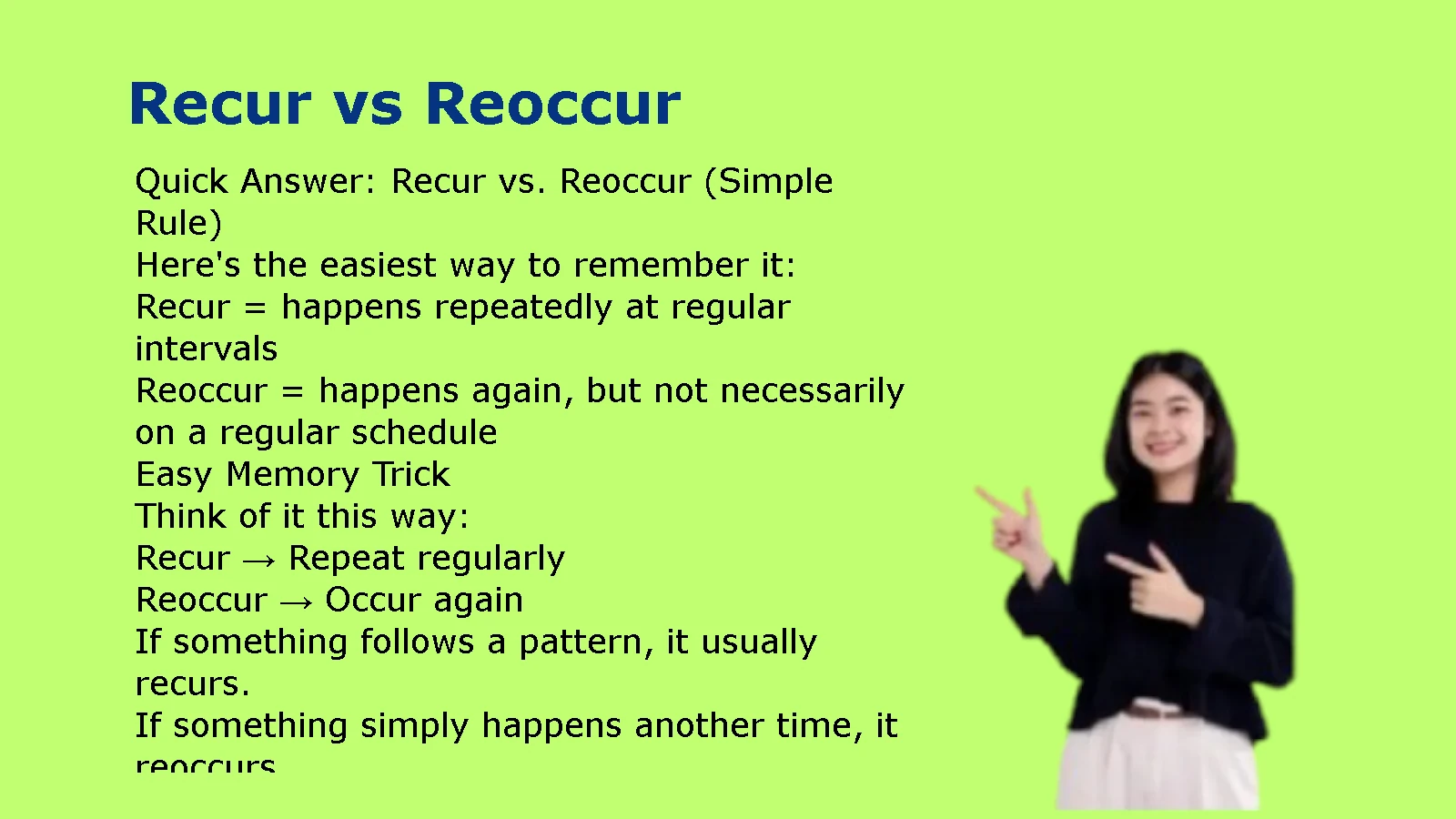
Quick Answer: Recur vs. Reoccur (Simple Rule)
Here’s the easiest way to remember it:
Recur = happens repeatedly at regular intervals
Reoccur = happens again, but not necessarily on a regular schedule
Easy Memory Trick
Think of it this way:
Recur → Repeat regularly
Reoccur → Occur again
If something follows a pattern, it usually recurs.
If something simply happens another time, it reoccurs.
How People Actually Use Recur and Reoccur
In everyday English, many speakers don’t distinguish between these words.
That’s why confusion is so common.
In Casual Conversations
People often use either word without thinking about the technical difference.
For example:
- “The problem reoccurred.”
- “The problem recurred.”
Most listeners understand both.
In Professional Writing
Editors, academics, and technical writers often prefer more precise usage.
They typically reserve:
- Recur for repeated patterns
- Reoccur for events that happen again unexpectedly
Why This Happens
Both words share the same root idea:
Something happens more than once.
The distinction is subtle, so many dictionaries recognize overlapping usage.
The Core Difference Between Recur and Reoccur
The simplest distinction comes down to regularity.
| Word | Meaning | Pattern Required? |
|---|---|---|
| Recur | Happens repeatedly | Yes |
| Reoccur | Happens again | No |
Key Insight
Every recurring event reoccurs.
But not every reoccurring event recurs.
Think of it like this:
A monthly meeting recurs.
A surprise software bug may reoccur.
What Does “Recur” Mean?
The word recur refers to something that returns repeatedly, often according to a pattern or cycle.
Common Examples
- Annual festivals recur every year.
- Seasonal allergies recur each spring.
- Monthly subscriptions recur every month.
- Weekly team meetings recur every Monday.
Why “Recur” Fits
These events follow predictable schedules.
You can anticipate when they will happen again.
Key Takeaway
Use recur when repetition is expected or follows a recognizable pattern.
What Does “Reoccur” Mean?
The word reoccur simply means to happen again.
It doesn’t imply a schedule or predictable cycle.
Common Examples
- A power outage reoccurred after the storm.
- The error reoccurred after the update.
- The conflict reoccurred unexpectedly.
- The leak reoccurred after repairs.
Why “Reoccur” Fits
These events happen again, but not according to a planned timetable.
Key Takeaway
Use reoccur when something repeats without a regular pattern.
The History Behind Recur and Reoccur
Understanding the origins can help make the distinction clearer.
Recur
Derived from Latin recurrere, meaning:
“to run back” or “return.”
Historically, it has often been associated with repeated or cyclical events.
Reoccur
Formed by combining:
- re- (again)
- occur (to happen)
Its meaning is more literal:
“to occur again.”
Interesting Fact
Many style guides note the distinction, but modern usage increasingly overlaps.
The Biggest Mistake People Make
The most common mistake is assuming both words always mean exactly the same thing.
What Goes Wrong
Writers sometimes use reoccur for scheduled events.
Or they use recur for one-time events that happen unexpectedly.
Example
Incorrect:
“The annual conference reoccurred every July.”
Better:
“The annual conference recurred every July.”
Why?
Annual events follow a predictable cycle.
Side-by-Side Comparison Table
Here’s a quick reference guide:
| Feature | Recur | Reoccur |
|---|---|---|
| Happens Again | Yes | Yes |
| Regular Pattern | Usually | Not Required |
| Predictable Timing | Often | Not Necessarily |
| Common in Scheduling | Yes | Rarely |
| Common in Unexpected Events | Sometimes | Yes |
Real-Life Examples of Recur
Let’s look at situations where recur is the better choice.
Health
“My migraines recur every few months.”
Business
“The subscription fee recurs monthly.”
Education
“The exam recurs at the end of every semester.”
Nature
“Monsoon rains recur every year.”
What These Examples Share
Each event follows a recognizable cycle.
Real-Life Examples of Reoccur
Now compare them with reoccur.
Technology
“The software bug reoccurred after installation.”
Home Maintenance
“The plumbing issue reoccurred two weeks later.”
Workplace
“The misunderstanding reoccurred during the next meeting.”
Weather
“The flooding reoccurred after another heavy storm.”
What These Examples Share
The events happened again but not according to a predictable schedule.
Recur vs. Reoccur in Medical Contexts
Medical writing often uses these words carefully.
When Doctors Use “Recur”
A disease may recur if it returns after treatment.
Examples:
- Cancer recurrence
- Recurring migraines
- Recurring infections
When Doctors Use “Reoccur”
Some medical professionals use reoccur to describe symptoms returning.
However, recur remains more common in medical literature.
Key Tip
In healthcare writing, you’ll often encounter recur more frequently.
Recur vs. Reoccur in Business Writing
Business communication values clarity.
Common Uses of Recur
- Recurring payments
- Recurring invoices
- Recurring meetings
- Recurring expenses
Common Uses of Reoccur
- Reoccurring system errors
- Reoccurring customer complaints
- Reoccurring operational issues
Why It Matters
Choosing the right word makes reports easier to understand.
Are Recur and Reoccur Interchangeable?
Technically, many dictionaries allow overlap.
However, context still matters.
In Everyday English
Most people won’t notice a difference.
In Formal Writing
Many editors prefer maintaining the traditional distinction.
Practical Rule
If you’re unsure:
- Use recur for patterns.
- Use reoccur for unexpected repeats.
You’ll rarely go wrong.
Common Phrases Using Recur
These combinations appear frequently:
- Recurring payment
- Recurring expense
- Recurring event
- Recurring theme
- Recurring dream
- Recurring problem
Why These Work
They describe things that repeatedly return over time.
Common Phrases Using Reoccur
Examples include:
- Reoccurring issue
- Reoccurring error
- Reoccurring symptom
- Reoccurring conflict
- Reoccurring problem
Why These Work
They emphasize that something happened again.
How to Avoid Confusion Every Time
Want a foolproof method?
Ask One Question
Does it follow a pattern?
If Yes
Use recur.
If No
Use reoccur.
Quick Test
Monthly bill?
→ Recur
Unexpected software bug?
→ Reoccur
Simple and effective.
What to Say Instead
Sometimes a clearer alternative works even better.
Alternatives to Recur
- Repeat regularly
- Return periodically
- Happen routinely
- Occur repeatedly
Alternatives to Reoccur
- Happen again
- Return unexpectedly
- Come back
- Arise again
These options can improve readability.
Quick Decision Guide (Use This Instantly)
Follow this simple process:
Event happens repeatedly on a schedule?
→ Recur
Event simply happens again?
→ Reoccur
Not sure?
→ Use happen again for maximum clarity.
FAQ: Recur vs. Reoccur
Do recur and reoccur mean the same thing?
They are similar, but recur usually suggests a pattern, while reoccur simply means happening again.
Which word is more common?
Recur is generally more common, especially in formal writing.
Can a problem recur?
Yes. If a problem repeatedly returns, it can recur.
Can a problem reoccur?
Yes. If it happens again, it can reoccur.
Which word should I use in professional writing?
Use recur for regular patterns and reoccur for unexpected repeats.
Case Study: A Workplace Reporting Error
A company was documenting software issues.
The report stated:
“The system outage recurs every few months.”
What Readers Assumed
They believed the outages followed a predictable pattern.
What Actually Happened
The outages occurred randomly.
Better Wording
“The system outage reoccurs periodically.”
Or:
“The system outage has occurred again.”
Result
The revised wording better reflected reality.
Key Facts You Should Remember
- Both words involve something happening again.
- Recur usually implies repetition or a pattern.
- Reoccur simply means occurring again.
- Formal writing often preserves the distinction.
- Everyday conversation may treat them as synonyms.
- When in doubt, focus on whether a pattern exists.
Final Takeaway: The One Rule That Never Fails
The difference between recur vs. reoccur is small, but understanding it can make your writing more precise.
Keep this simple rule in mind:
Recur = happens again and again in a pattern.
Reoccur = happens again, regardless of pattern.
Think of a recurring subscription payment. You expect it every month.
Now think of a software glitch that suddenly returns. It simply reoccurs.
That single distinction will help you choose the right word almost every time.
When precision matters, remember:
Patterns recur. Events reoccur.