Americanize vs Americanise comes down to regional spelling preferences: Americanize is the standard spelling in American English, while Americanise is common in British English styles that prefer -ise endings. Both words have the same meaning: to adapt something to American customs, language, culture, or practices. The related forms Americanized, Americanised, Americanization, and Americanisation follow the same spelling pattern.
The difference matters when you write for a specific audience, edit a document, or discuss Americanization in globalization. Understanding the verb forms, noun spellings, pronunciation, and real-world examples will help you use each version accurately and consistently.
| Question | Answer |
| Is it Americanize or Americanise? | Americanize is standard in US English; Americanise is common in British -ise spelling styles. |
| Is it Americanised or Americanized? | Both are correct variants. Americanized is the usual US spelling, while Americanised is common in -ise styles. |
| What does Americanised mean? | It means adapted to American customs, language, culture, or practices. |
| What is Americanization in globalization? | It is the spread or adoption of American cultural, economic, linguistic, or institutional influences across countries. |
| How do you spell Americanization in British English? | Americanisation is common in British styles that prefer -ise, although some British conventions use Americanization. |
Americanize vs Americanise: The Quick Answer
Americanize and Americanise are two spelling variants of the same verb. American English generally uses Americanize, while British English publications that follow the -ise convention often use Americanise. Neither spelling changes the word’s basic meaning or pronunciation. The right choice depends on your audience, dictionary, and chosen style guide.
Consider these examples:
- US English: The company plans to Americanize its marketing campaign.
- British -ise style: The company plans to Americanise its marketing campaign.
Both sentences describe the same action: adapting a marketing campaign to American preferences, expectations, or cultural norms.
Americanize vs Americanise: Comparison Table
| Feature | Americanize | Americanise |
| Spelling pattern | -ize | -ise |
| Typical usage | American English | British English styles that prefer -ise |
| Meaning | Adapt to American influence | Adapt to American influence |
| Past tense | Americanized | Americanised |
| Present participle | Americanizing | Americanising |
| Noun form | Americanization | Americanisation |
| Pronunciation | Generally the same | Generally the same |
The main distinction is spelling, not meaning. However, remember that British English does not always require -ise. Some British dictionaries and publishers use -ize for words such as organize, recognize, and Americanize. Follow the style required for your writing rather than assuming that every British publication uses the same convention.
Americanize vs Americanise: US and UK Spelling Rules
English spelling varies across regions. American and British English share most vocabulary, but they sometimes use different letter combinations and word endings. The -ize and -ise distinction is one example.
Why American English Uses Americanize
American English generally favors -ize in words formed with this ending. The spelling appears in verbs such as organize, modernize, prioritize, and Americanize.
The same pattern carries through related forms:
- Americanize
- Americanized
- Americanizing
- Americanization
For example, an American editor might write:
“The publisher decided to Americanize the spelling and punctuation for its US readership.”
The word Americanize describes an adaptation to American conventions. It does not necessarily mean changing every part of a text. The publisher might adjust spelling, vocabulary, date formats, measurements, or other details that American readers expect.
American English also uses the noun Americanization. This form appears in discussions of language, history, business, education, entertainment, and cultural change.
Is Americanise the Correct UK Spelling?
Americanise is a common British English spelling in publications that prefer -ise endings. The corresponding forms include Americanised, Americanising, and Americanisation.
A British writer following this convention might write:
“The company plans to Americanise its website before entering the US market.”
The sentence uses the same verb and meaning as its American counterpart. Only the spelling changes.
However, British spelling is not governed by one universal -ise rule. Some British publications follow conventions that retain -ize in words where the ending has a historical basis. As a result, Americanize can also be acceptable in British English, depending on the dictionary and house style.
For example, a publisher might consistently use organize, recognize, and Americanize, while another might prefer organise, recognise, and Americanise.
The best approach is to choose one recognized convention and apply it consistently throughout the article.
Americanize or Americanise in Other English-Speaking Countries
English-speaking countries do not all follow identical spelling rules. Canadian English, Australian English, and other national varieties combine different spelling traditions.
| Region or style | Likely spelling choice | Practical advice |
| United States | Americanize | Use -ize forms for standard US writing. |
| United Kingdom | Americanise or Americanize | Follow the publication’s preferred dictionary and style guide. |
| Canada | Depends on the style guide | Check the publisher’s convention rather than assuming one universal rule. |
| Australia | Often Americanise in -ise styles | Follow the organization’s spelling standards. |
| International publication | Depends on the target audience | Choose one English variety and use it consistently. |
For a website targeting US readers, use Americanize vs Americanise in the comparison itself but favor American spellings in your examples and explanatory text when appropriate. For a British audience, you can explain both forms while using the selected British convention throughout the article.
This approach improves readability and prevents inconsistent spelling from distracting readers.
Americanized or Americanised: Which Form Should You Use?
Americanized and Americanised are the past-tense and past-participle forms of the verb Americanize or Americanise. The first is standard in American English, while the second is common in spelling styles that use -ise. Both describe something that underwent adaptation to American customs, language, culture, or practices.
For example:
- The restaurant Americanized its menu for US customers.
- The restaurant Americanised its menu for US customers.
Both sentences communicate the same idea. Your choice should match the spelling convention used in the rest of the document.
Americanized Spelling and Meaning
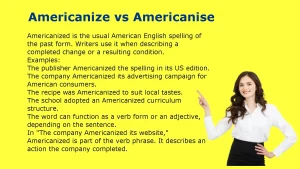
Americanized is the usual American English spelling of the past form. Writers use it when describing a completed change or a resulting condition.
Examples:
- The publisher Americanized the spelling in its US edition.
- The company Americanized its advertising campaign for American consumers.
- The recipe was Americanized to suit local tastes.
- The school adopted an Americanized curriculum structure.
The word can function as a verb form or an adjective, depending on the sentence.
In “The company Americanized its website,” Americanized is part of the verb phrase. It describes an action the company completed.
In “The company launched an Americanized website,” the word acts as an adjective. It describes the website’s adapted features.
The context helps you determine the grammatical role.
Americanised Spelling in British English
Americanised is the corresponding past form in -ise spelling styles. It has the same meaning and grammatical uses as Americanized.
Examples:
- The publisher Americanised the spelling for its British readers.
- The restaurant Americanised its menu to appeal to a new audience.
- The film’s dialogue was Americanised for a different market.
- The company introduced an Americanised version of its training materials.
The spelling difference does not indicate a difference in quality, degree, or cultural meaning. An Americanised product is not inherently more or less American than an Americanized one. The spelling simply reflects the convention chosen by the writer.
Americanize, Americanized, and Americanizing
The verb changes form according to tense and grammatical function. The same regional spelling preference applies to the related forms.
| Grammatical form | American English | -ise spelling style |
| Base verb | Americanize | Americanise |
| Third-person singular | Americanizes | Americanises |
| Simple past | Americanized | Americanised |
| Past participle | Americanized | Americanised |
| Present participle | Americanizing | Americanising |
Here is how these forms work in sentences:
- Base verb: The company wants to Americanize its customer service.
- Third-person singular: The brand Americanizes its packaging for the US market.
- Simple past: The studio Americanized the dialogue.
- Past participle: The show has been Americanized for a new audience.
- Present participle: The publisher is Americanizing the text for American readers.
One spelling detail deserves attention: American English generally drops the final e before adding -ing, producing Americanizing. The corresponding -ise form is Americanising.
Use the correct form for the sentence’s tense and grammar, then apply the spelling convention consistently.
Americanised Meaning: What Does Americanised Mean?
Americanised means adapted to American customs, culture, language, preferences, or practices. It can describe a person, product, organization, text, or cultural activity that has taken on characteristics associated with the United States. Depending on the context, the word can be neutral, positive, or critical.
For example, a British television program might become Americanised when its producers adapt the dialogue, characters, setting, and humor for US viewers. A restaurant might Americanise its menu by adding familiar US-style dishes while retaining some local food.
The word does not always imply complete transformation. An item can adopt a few American features and still preserve its original identity.
Americanised Meaning in Everyday English
In everyday language, Americanised often describes changes that make something more familiar to American audiences.
Common examples include:
- Language: A text adopts American vocabulary or spelling.
- Food: A dish changes to suit common American tastes.
- Entertainment: A television format adapts to American viewers.
- Business: A company adjusts its branding or service style for the US market.
- Education: A program adopts selected practices associated with American institutions.
Imagine a bakery in another country that begins selling larger muffins, offering coffee refills, and using US-style product names. A writer might describe some of those changes as Americanisation.
However, the label depends on the details. Larger portions alone do not prove that a business has undergone Americanisation. The description becomes more meaningful when the changes clearly reflect American practices or expectations.
The word can also carry a critical tone. Someone might complain that a city center has become Americanised if local businesses increasingly resemble US chains and traditional shops disappear. In that case, the word expresses concern about cultural change rather than merely describing it.
Americanize as a Verb and Americanization as a Noun
The verb Americanize describes the action of adapting something to American influence. The noun Americanization describes that process or its broader effects.
Compare the two:
- Verb: The publisher plans to Americanize the book.
- Noun: The Americanization of the book includes changes to spelling, vocabulary, and measurements.
In the first sentence, the verb identifies an action. In the second, the noun names the process.
The corresponding -ise forms are Americanise and Americanisation.
| Word | Part of speech | Meaning | Example |
| Americanize | Verb | Adapt to American influence | The studio will Americanize the series. |
| Americanized | Past form or adjective | Adapted to American influence | The Americanized version uses US vocabulary. |
| Americanizing | Present participle | Currently adapting to American influence | The team is Americanizing the product. |
| Americanization | Noun | The process or result of Americanizing | Americanization affected the company’s branding. |
| Americanise | Verb variant | Same meaning as Americanize | They chose to Americanise the text. |
| Americanisation | Noun variant | Same meaning as Americanization | The report discusses Americanisation in media. |
This word family helps readers understand related searches such as Americanised meaning, Americanised spelling, and Americanization examples.
Americanization Examples in Real Life
Americanization can appear in language, food, entertainment, business, and education. It does not always involve a complete cultural shift. Often, it describes the adoption of selected American features within a local setting.
The following examples illustrate how the term can apply in different contexts.
Americanization of Language
Language provides some of the easiest examples to recognize. English speakers in different countries sometimes adopt American vocabulary, expressions, spelling conventions, or media-driven phrases.
Consider these vocabulary differences:
| Common American English term | Common British English equivalent |
| Apartment | Flat |
| Elevator | Lift |
| Vacation | Holiday |
| Truck | Lorry |
| French fries | Chips |
| Movie theater | Cinema |
These pairs are not proof that Americanization has occurred whenever someone uses an American term. English speakers may choose a word because of travel, work, personal preference, or international communication.
A stronger example would be a British company that rewrites its entire website for an American audience. The company might change holiday to vacation, flat to apartment, and postcode to ZIP code where appropriate.
This process combines language adaptation with localization. The company is making its content easier for a particular audience to understand.
Spelling can also change. A text might replace colour with color, centre with center, and organise with organize. These changes reflect American spelling conventions, although adopting US spelling alone does not necessarily mean that the text has undergone broader cultural Americanization.
Americanization of Food and Lifestyle
Food businesses often adapt their products when they enter a new market. These adjustments may involve recipes, portion sizes, packaging, menu names, or ordering practices.
Imagine a local restaurant that introduces a US-style breakfast menu. It adds pancakes, breakfast sandwiches, and large takeaway coffees while keeping its traditional dishes. A writer might describe the new menu as an example of Americanization if the changes clearly draw on American dining habits.
Another example involves a local burger restaurant that redesigns its service model around quick ordering, customizable meals, branded packaging, and drive-through service.
Such changes may reflect American influence, but businesses can adopt similar practices for reasons unrelated to American culture. Convenience, customer demand, and competition can produce similar results.
A useful test: Ask whether the change reflects a recognizable American cultural or commercial model, rather than assuming that every modern or international practice originated in the United States.
Americanization in Media and Entertainment
American films, television shows, music, and streaming programs reach audiences around the world. Their popularity can influence local expressions, fashion, humor, storytelling, and consumer preferences.
For example, a local production company might adapt a television format that first became popular in the United States. It could retain the original structure while changing the contestants, presenters, jokes, and cultural references to suit local viewers.
The reverse can also happen. A US studio may adapt a story or format from another country for American audiences. That process can be described as Americanization when the adaptation adds US cultural conventions or expectations.
Media influence does not automatically erase local culture. Viewers often combine international entertainment with local music, films, traditions, and languages. They may borrow expressions from a US show without adopting the show’s wider cultural assumptions.
This makes Americanization more complex than a simple movement from one culture to another.
Americanization in Business and Education
Companies often adjust their practices when they enter the US market. They may change product names, customer support hours, marketing language, payment options, measurements, or packaging.
For example, a European clothing brand might use inches alongside centimeters on its US website, display prices in dollars, and rewrite its product descriptions using familiar American vocabulary. Those changes make the shopping experience more accessible to US customers.
Education offers another possible example. A school or training provider might adopt selected features associated with American educational institutions, such as a particular grading structure, course terminology, or classroom model.
However, similar systems may exist in multiple countries. Writers should avoid calling a practice Americanized without a clear connection to American influence.
A Practical Case Study: Adapting a Website for US Customers
Consider a fictional British software company preparing to sell its product in the United States.
The original website uses British spelling, prices in pounds, and examples based on UK customers. The marketing team decides to create a US version.
The team makes these changes:
- Replaces customise with customize.
- Displays prices in US dollars.
- Changes references to UK tax rules to relevant US information.
- Uses US date formatting where it improves clarity.
- Rewrites examples to reflect the needs of American customers.
- Adjusts support information to show US time zones.
Some changes are linguistic, while others concern commerce and local requirements. The spelling updates are Americanization in a narrow linguistic sense; the wider process is also a form of market localization.
This distinction matters because Americanization and localization overlap, but they are not identical. Localization adapts content to a particular market. Americanization specifically emphasizes the adoption of American features.
What Is Americanization in Globalization?
Americanization in globalization refers to the spread or adoption of American cultural, economic, linguistic, and institutional influences across national borders. It can occur through entertainment, trade, technology, business practices, education, and consumer products. Americanization is one possible result of globalization, but globalization also involves exchanges among many other countries and cultures.
For example, an American film watched internationally may influence fashion or everyday expressions. A US technology company may spread particular workplace practices through its overseas offices. A local business may adopt American branding to appeal to a wider audience.
These examples show how cultural influence can cross borders through media, commerce, and communication.
Americanization vs Globalization
The terms are related, but they describe different concepts.
| Feature | Americanization | Globalization |
| Core meaning | Adoption or spread of American influence | Increasing connections among countries and societies |
| Cultural scope | Focuses on the United States | Includes many countries and cultures |
| Common examples | American media, US-style branding, American vocabulary | International trade, migration, digital communication, cultural exchange |
| Relationship | Can occur as part of globalization | Can include Americanization and many other influences |
A global business network is an example of globalization. If that network spreads US management practices or American workplace terminology, those particular changes may also represent Americanization.
The distinction prevents a common mistake: treating every international trend as Americanization.
Globalization can spread American products and ideas, but it can also increase the visibility of Korean music, Japanese animation, Indian cinema, European design, and other cultural exports. Influence can move in several directions at once.
Benefits and Criticisms of Americanization
Americanization can create opportunities, but it can also raise concerns. Its effects depend on the setting, the people involved, and the extent of the changes.
Potential benefits include:
- Shared communication: Familiar American terminology can help international teams work together.
- Market access: Businesses may reach US customers by adapting their products and marketing.
- Cultural exchange: International audiences gain access to American films, music, literature, and ideas.
- Professional opportunities: Familiarity with American business practices may help people working with US organizations.
Potential criticisms include:
- Cultural homogenization: Local customs and styles may receive less attention when international brands dominate.
- Pressure on local businesses: Smaller businesses may struggle to compete with large international companies.
- Language change: Local vocabulary and expressions may lose visibility in some contexts.
- Unequal cultural influence: American media and commercial products may reach audiences at a scale that smaller cultural industries cannot easily match.
Neither list describes every situation. A community may adopt American entertainment while maintaining its own traditions. A business may use US marketing techniques without abandoning its local identity.
The important question is not simply whether Americanization is good or bad. It is how the change occurs, who benefits, and what happens to existing cultural practices.
Americanization vs Westernization
Americanization focuses on influence from the United States. Westernization is broader and refers to the adoption of practices associated with Western societies, which may include countries in Europe and North America.
The concepts overlap because the United States is part of the Western world, but they are not interchangeable.
For example, a business that adopts a specific US advertising style may be undergoing Americanization. A country that adopts a range of legal, educational, or administrative practices associated with several Western European countries may be experiencing Westernization.
A change can also fit both descriptions. A company that adopts US corporate practices as part of a wider shift toward Western business models may illustrate Americanization and Westernization at the same time.
Use the more specific term when the evidence points directly to American influence.
Americanization Pronunciation
Americanization is generally pronounced with the primary stress on the syllable za. The word has several syllables, and its ending follows the familiar pronunciation pattern of other nouns formed with -ization, such as modernization and organization.
The spellings Americanization and Americanisation generally have the same pronunciation. The difference between -ize and -ise is primarily orthographic.
How to Pronounce Americanization
A common US English pronunciation is represented in IPA as:
/əˌmerɪkənəˈzeɪʃən/
The pronunciation can be broken into manageable parts:
- Begin with the unstressed opening sound.
- Continue through the syllables associated with American.
- Place the main stress on the za syllable.
- Finish with the familiar -tion ending, pronounced like shun.
The opening vowels may sound slightly different depending on the speaker’s accent. The number of syllables and the placement of the main stress provide a useful guide for learners.
How to Pronounce Americanize and Americanise
Americanize and Americanise are generally pronounced alike. Both use the same verb ending in ordinary English speech.
The same applies to the related forms:
| Word | General pronunciation pattern |
| Americanize | Ends with a voiced -ize sound |
| Americanise | Generally the same spoken ending |
| Americanized | Ends with a -ized sound |
| Americanised | Generally the same spoken ending |
| Americanization | Has primary stress on the -za- syllable |
| Americanisation | Generally the same spoken pattern |
Do not assume that the spelling difference requires a different pronunciation. The spelling convention tells you which written form to use, not that you must pronounce the word differently.
Americanization of Emily: Meaning and Context
The Americanization of Emily is the title of a 1964 film. The phrase uses Americanization as part of a specific story title, so it should not be treated as a spelling variant or a separate dictionary definition of the word.
The film title also connects with the broader idea of Americanization: the influence of American identity, values, or expectations on individuals and society. Its meaning within the film depends on the story and its historical setting.
This distinction helps when interpreting the search phrase Americanization of Emily. A reader searching for the title may want information about the film, while someone searching for Americanization meaning may want a general definition.
When writing about the film, preserve the official title’s spelling and capitalization. When discussing the general concept, use the noun form that matches the publication’s spelling convention.
Americanize vs Americanise: Example Sentences
Example sentences make the spelling distinction easier to understand. The following examples use the same general situations with both spelling variants, allowing you to compare their usage without confusing spelling with meaning.
Americanize Example Sentences
Use Americanize when following standard American English spelling.
- The publisher will Americanize the spelling in its new US edition.
- The restaurant plans to Americanize several dishes for its American customers.
- The television network decided to Americanize the format for a new audience.
- The company hired an editor to Americanize its website.
- The director did not want to Americanize the story at the expense of its original setting.
- The brand introduced an Americanized version of its product packaging.
- The process of Americanization changed the company’s marketing language.
Each example describes an adaptation to American conventions or preferences. The exact nature of that adaptation depends on the context.
Americanise Example Sentences
Use Americanise when following a style guide that prefers -ise spellings.
- The publisher will Americanise the spelling in its new US edition.
- The restaurant plans to Americanise several dishes for its American customers.
- The television network decided to Americanise the format for a new audience.
- The company hired an editor to Americanise its website.
- The director did not want to Americanise the story at the expense of its original setting.
- The brand introduced an Americanised version of its product packaging.
- The process of Americanisation changed the company’s marketing language.
The meaning remains the same as in the American spelling examples. Only the selected spelling convention changes.
Americanization and Americanisation Example Sentences
The noun form describes the process, influence, or result of adapting to American culture or practices.
- Americanization of the website involved changes to spelling, currency, and product descriptions.
- The report examined the Americanisation of popular television formats.
- The book explores the influence of Americanization on everyday language.
- Critics debated whether the Americanisation of local businesses weakened traditional identities.
- The history course discussed Americanization as part of a wider pattern of cultural exchange.
- The article compared Americanization in entertainment with Americanization in business.
Use the noun when discussing a process or concept. Use the verb when describing an action, and use the past form when describing a completed change.
How to Choose the Right Spelling
Choosing between Americanize and Americanise is straightforward once you identify your audience and spelling convention. The key is to apply the same rule across the article, website, report, or publication.
Use Americanize for US English
For a US audience, prefer:
- Americanize
- Americanized
- Americanizing
- Americanization
These are the standard American English forms.
For example:
“The publisher will Americanize the manuscript before releasing the US edition.”
If your website primarily targets American readers, using these forms consistently helps align the content with their spelling expectations.
Use Americanise When Your Style Guide Prefers -ise
For a British publication or another style that follows -ise endings, use:
- Americanise
- Americanised
- Americanising
- Americanisation
For example:
“The publisher will Americanise the manuscript before releasing the UK edition.”
Remember that not all British publications use -ise. Some accept or prefer -ize in words where that ending follows their established convention. Check the style guide before treating one form as universally correct across the UK.
Keep Spelling Consistent Across Your Article
Consistency improves clarity and gives your writing a professional appearance. Switching between Americanized and Americanised without a reason can make an article look as though it contains editing errors.
Use this quick checklist before publishing:
- Identify the main audience.
- Select the relevant English variety.
- Check the publication’s spelling guide.
- Apply the same convention to the verb, past form, and noun.
- Review headings, tables, image captions, and examples.
- Preserve the original spelling in official titles and direct quotations when necessary.
For SEO content, you can include both variants in a comparison article because readers search for both. However, that does not mean every paragraph needs both spellings. Explain the difference clearly, then use your chosen regional form consistently in the main text.
Frequently Asked Questions
Is it Americanize or Americanise?
Both spellings are correct variants of the same verb. Americanize is the standard form in American English, while Americanise is common in British English styles that prefer -ise endings. Some British publications also use -ize, so follow the relevant style guide.
Is Americanised the UK spelling of Americanized?
Americanised is widely used in British English conventions that prefer -ise spellings. However, British English does not require -ise in every word, and Americanized can also be acceptable under some British style guides.
What does Americanised mean?
Americanised means adapted to American customs, language, culture, or practices. The word can describe a product, text, business, or cultural activity that has adopted American features. Its tone can be neutral or critical, depending on the context.
What is the difference between Americanization and globalization?
Americanization refers specifically to the spread or adoption of American influence. Globalization describes wider connections among countries through trade, communication, technology, migration, and cultural exchange. Americanization can occur as one part of globalization.
How do you pronounce Americanization?
Americanization is commonly pronounced with the main stress on the -za- syllable. A standard US English IPA transcription is /əˌmerɪkənəˈzeɪʃən/. The spelling Americanisation generally has the same pronunciation.
What is The Americanization of Emily?
The Americanization of Emily is a 1964 film title. The phrase uses the general concept of Americanization in a specific story context. It is different from a spelling comparison between Americanize and Americanise.
Conclusion: Americanize vs Americanise
The difference between Americanize vs Americanise is mainly a matter of spelling convention. American English generally uses Americanize, Americanized, and Americanization. British publications that prefer -ise spellings commonly use Americanise, Americanised, and Americanisation.
Both sets of forms describe the same process: adapting something to American customs, language, culture, or practices. The noun Americanization also appears in broader discussions of globalization, media, business, and cultural influence.
When choosing a spelling, identify your audience first, consult the appropriate style guide, and keep your usage consistent. If you’re writing for a US audience, use Americanize. If your publication follows an -ise convention, use Americanise.