Subsidize or subsidise: both spellings are correct, but American English generally uses “subsidize,” while British English commonly uses “subsidise.” Both words mean to provide financial assistance to reduce costs or support a person, business, or activity. The difference follows the broader American and British spelling conventions for words ending in “-ize” and “-ise.” Understanding these variations also helps you choose the correct forms, such as subsidizing or subsidising, subsidized or subsidised, and the related noun subsidy.
Whether you’re writing an academic paper, editing a business report, or checking British English spelling, this guide explains the meaning, pronunciation, grammar, synonyms, and practical usage of both forms.
| Question | Answer |
| Is it subsidize or subsidise? | Both are correct regional spelling variants. |
| Which spelling is used in American English? | Subsidize is the standard American spelling. |
| Is subsidise the UK spelling? | Yes, subsidise is common in British English, although subsidize is also accepted by some British style guides. |
| What does subsidize mean? | To provide financial assistance to reduce costs or support an activity. |
| Is it subsidizing or subsidising? | Both are correct; the preferred form depends on the spelling convention. |
Subsidize vs. Subsidise: What Is the Difference?
Subsidize and subsidise have the same meaning, pronunciation, and grammatical function. The main difference is regional spelling. American English generally favors “subsidize,” while British English commonly uses “subsidise.” Neither form is inherently more correct than the other. Your choice should depend on your audience, publication style, and preferred English variety.
The word is a verb that describes providing financial support to someone or something. Governments, charities, educational institutions, and private organizations may subsidize goods, services, or activities to make them more affordable.
Consider these examples:
- American English: The government will subsidize public transportation.
- British English: The government will subsidise public transport.
Both sentences communicate the same idea. The spelling changes, but the meaning remains unchanged.
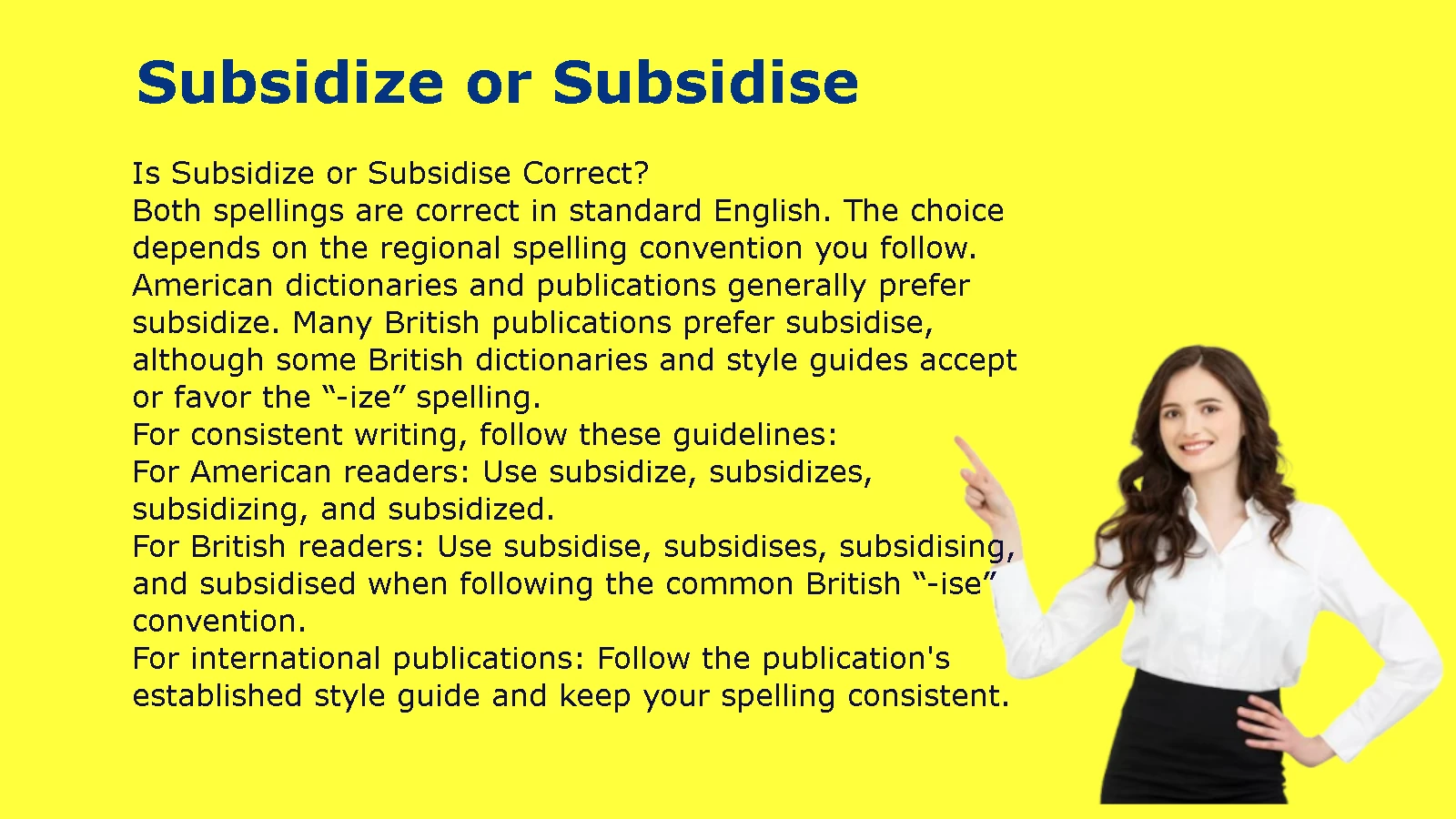
Is Subsidize or Subsidise Correct?
Both spellings are correct in standard English. The choice depends on the regional spelling convention you follow.
American dictionaries and publications generally prefer subsidize. Many British publications prefer subsidise, although some British dictionaries and style guides accept or favor the “-ize” spelling.
For consistent writing, follow these guidelines:
- For American readers: Use subsidize, subsidizes, subsidizing, and subsidized.
- For British readers: Use subsidise, subsidises, subsidising, and subsidised when following the common British “-ise” convention.
- For international publications: Follow the publication’s established style guide and keep your spelling consistent.
Avoid switching between the two systems without a reason. For example, using subsidize in one paragraph and subsidising in the next can make an otherwise polished article look inconsistent.
Is Subsidise or Subsidize Used in the UK?
British English commonly uses subsidise, particularly in publications that follow the “-ise” convention. However, the spelling subsidize also appears in British English because some style guides prefer “-ize” for words in which that spelling is established.
This distinction matters because British English does not always require “-ise” endings. Words such as organize/organise, recognize/recognise, and realize/realise demonstrate the same variation.
If you’re writing for a British school, newspaper, company, or government organization, check its style guide before deciding which form to use.
Why Do American and British English Spell the Word Differently?
American and British English developed different spelling preferences over time. American English generally favors -ize in words such as subsidize, while many British publications favor -ise.
The difference does not indicate a change in meaning or pronunciation. It reflects spelling conventions rather than a difference in the underlying word.
| American English | Common British English alternative |
| Subsidize | Subsidise |
| Organize | Organise |
| Recognize | Recognise |
| Realize | Realise |
| Apologize | Apologise |
These patterns are useful when editing a document because the same regional convention often applies to several words. However, always check individual words and the style guide you’re following rather than assuming every “-ize” word must change to “-ise.”
Subsidize or Subsidise Meaning
To subsidize or subsidise means to provide financial assistance that helps reduce the cost of a product, service, activity, or expense. The person or organization receiving the support pays less than it otherwise would. Governments often subsidize public services, farmers, businesses, housing, and education to improve affordability or encourage particular activities.
The word commonly appears in economics, public policy, business, healthcare, education, and everyday discussions about the cost of living.
For example, if a city pays part of the cost of public bus services, the money helps the operator provide transportation without charging passengers the full cost of running the service.
What Does It Mean to Subsidise Something?
To subsidise something means to help pay for it, usually through financial assistance. The support may cover part of the cost or, in some cases, provide substantial funding.
Imagine that a childcare center charges $800 per month for each child. An employer provides $200 in monthly assistance to eligible employees. The employer effectively subsidizes the childcare expense, reducing the amount employees must pay themselves to $600.
The same principle applies to many other situations:
- A government pays part of the cost of prescription medicines.
- A university provides financial assistance to reduce student meal costs.
- A local authority helps homeowners improve energy efficiency.
- A company contributes toward employee transportation expenses.
- An agricultural program helps farmers manage the cost of essential supplies.
In each case, the subsidy helps cover an expense that the recipient might otherwise struggle to afford.
Subsidize Meaning in Different Contexts
The precise purpose of a subsidy depends on who provides the assistance and why. The basic meaning remains the same, but the practical effect can vary.
Government and public policy
Governments may subsidize public transportation, housing, energy, or healthcare. They often use subsidies to improve access to essential services or support an industry considered important to the economy.
For example, a city might pay part of a bus operator’s expenses so passengers can use public transportation at affordable fares.
Business and industry
A company or public agency may subsidize business costs to encourage investment, support employment, or help an industry grow. The support could take the form of direct payments, grants, or other financial assistance.
For instance, a regional development program might help a manufacturer cover part of the cost of opening a facility in an area with limited employment opportunities.
Education
Schools, colleges, and universities may subsidize tuition, meals, accommodation, transport, or learning materials. The goal is often to reduce the financial barriers that prevent students from accessing education.
A university that pays part of the cost of student housing effectively subsidizes accommodation for eligible students.
Healthcare
Healthcare subsidies may reduce the amount patients pay for insurance, medical services, or prescription drugs. The structure depends on the country’s healthcare system and the specific program.
For example, financial assistance may help eligible households afford health insurance premiums.
Agriculture and energy
Agricultural subsidies can help farmers manage production costs, while energy subsidies may reduce the cost of electricity, heating, or fuel for particular groups.
However, subsidies can have disadvantages. They may place pressure on public budgets, distort market prices, or encourage inefficient production if policymakers design them poorly.
What Is the Difference Between Subsidize and Subsidy?
Subsidize is a verb, while subsidy is a noun. The verb describes the act of providing financial support. The noun refers to the financial assistance itself.
| Word | Part of speech | Meaning | Example |
| Subsidize | Verb | Provide financial assistance | The government will subsidize childcare. |
| Subsidy | Noun | Financial assistance provided | The childcare subsidy reduces monthly costs. |
| Subsidies | Plural noun | More than one subsidy | The program offers subsidies to eligible families. |
| Subsidized | Past-tense verb or participle | Provided financial assistance | The agency subsidized the service. |
| Subsidizing | Present participle or gerund | Providing financial assistance | The agency is subsidizing public transport. |
Use subsidy when referring to the financial support as a thing. Use subsidize when describing the action of providing that support.
For example:
- Correct: The city will subsidize the bus service.
- Correct: The city introduced a subsidy for the bus service.
- Incorrect: The city will subsidy the bus service.
The last sentence uses a noun where the sentence requires a verb.
Subsidize or Subsidise: US and UK Spelling Rules
American English generally uses subsidize, while British English commonly uses subsidise. The regional difference carries through the word’s spelling variations, including the present participle and past tense. Writers should maintain the same convention throughout a document and follow any specific style guide required by their employer, school, publisher, or client.
American English: Subsidize
In American English, subsidize is the standard spelling. Its related forms retain the letter “z.”
Examples include:
- The government plans to subsidize rural healthcare.
- The company subsidizes employee transportation.
- The university is subsidizing student accommodation.
- The state subsidized the construction of affordable housing.
- The program has subsidized energy improvements for eligible homes.
American publications generally use subsidizing rather than subsidising and subsidized rather than subsidised.
If your audience is primarily in the United States, using these forms throughout your article or report will align with the usual American convention.
British English: Subsidise
In British English, subsidise is a common spelling. Publications following the “-ise” convention also use subsidises, subsidising, and subsidised.
Examples include:
- The government plans to subsidise rural healthcare.
- The company subsidises employee travel.
- The university is subsidising student accommodation.
- The council subsidised improvements to affordable housing.
- The program has subsidised energy upgrades for eligible homes.
British English also contains publications that use subsidize and other “-ize” spellings. Therefore, the spelling preference should be understood as a style convention rather than an absolute rule that applies to every British writer.
Which Spelling Should You Use in Formal Writing?
Choose the spelling that matches your target audience or the style guide governing your work.
Use the following approach:
- American academic writing: Prefer subsidize unless the institution requires a different style.
- British business writing: Use subsidise if the organization follows the common “-ise” convention.
- International business reports: Select a consistent regional style and apply it throughout.
- SEO articles: Match the wording to the target audience while naturally including relevant spelling variants when they help readers.
For example, an article targeting the US query subsidize or subsidise can explain both forms while using subsidize consistently in its American English examples.
You don’t need to repeat both spellings in every sentence. One clear explanation of the difference, followed by consistent usage, is easier to read.
Subsidizing or Subsidising: Which Form Is Correct?
Both subsidizing and subsidising are correct. They are the present participle forms of the same verb, and they can also function as gerunds. American English generally uses subsidizing, while British English commonly uses subsidising. The spelling changes, but the grammar and meaning stay the same.
Subsidizing vs. Subsidising
The choice follows the same regional convention as the base verb.
| American English | Common British English alternative |
| Subsidize | Subsidise |
| Subsidizes | Subsidises |
| Subsidizing | Subsidising |
| Subsidized | Subsidised |
Examples:
- American English: The government is subsidizing public transport.
- British English: The government is subsidising public transport.
In both sentences, the present participle appears after is to describe an ongoing action.
The same form can act as a gerund, which is a verb form functioning as a noun.
- Subsidizing essential services can reduce household expenses.
- Subsidising public transport may encourage more people to use buses and trains.
Here, the -ing form names an activity rather than describing an action in progress.
Subsidized vs. Subsidised
Subsidized and subsidised are the past-tense and past-participle forms of the verb. The American spelling uses “z,” while the common British alternative uses “s.”
Examples:
- American English: The state subsidized the project last year.
- British English: The state subsidised the project last year.
Both sentences describe a completed action.
The past participle also appears in perfect tenses and passive constructions.
- The government has subsidized the service for several years.
- The service was subsidised by the local authority.
In the second sentence, was subsidised is a passive construction. It focuses on the service receiving financial assistance rather than the organization providing it.
Subsidize, Subsidizes, Subsidizing, and Subsidized
Use the correct form according to the subject and tense.
| Verb form | American English | Common British English | Example |
| Base form | Subsidize | Subsidise | They subsidize the service. |
| Third-person singular | Subsidizes | Subsidises | The company subsidizes meals. |
| Present participle | Subsidizing | Subsidising | They are subsidizing transport. |
| Past tense | Subsidized | Subsidised | The agency subsidized housing. |
| Past participle | Subsidized | Subsidised | The service has been subsidized. |
The verb follows ordinary English subject–verb agreement.
For example, write the company subsidizes because company is singular. Write the companies subsidize because companies is plural.
The spelling variation does not change this grammar rule.
How to Use Subsidize or Subsidise in a Sentence
Use subsidize or subsidise when a person, organization, or government provides financial assistance to reduce a cost or support an activity. The verb usually takes the person or organization providing the assistance as its subject and the supported expense, service, business, or person as its object.
A basic sentence pattern is:
Subject + subsidize/subsidise + object
For example: The council subsidizes school meals.
The council provides financial assistance, and school meals receive the support.
Subsidize in a Sentence: Examples
The following examples show how the word works in different situations. American and British forms appear where relevant.
Business and government
- The government will subsidize electricity costs for eligible households.
- The local council subsidises bus services in rural areas.
- The company subsidized employee training to improve workplace skills.
- The agency is subsidising renewable energy projects.
- The state plans to subsidize childcare for working parents.
Education and healthcare
- The university subsidizes meals for students with financial need.
- The charity subsidised medical treatment for low-income families.
- The program is subsidizing prescription costs for eligible patients.
- The school subsidises transport for students who live far away.
Everyday financial support
- My employer subsidizes part of my monthly travel expenses.
- The organization subsidised the cost of the community event.
- The city is subsidizing affordable housing projects.
- The nonprofit plans to subsidize equipment for local schools.
Each sentence identifies financial support, either directly or through the context. The object of the verb tells readers what receives the assistance.
Common Collocations With Subsidize
A collocation is a combination of words that commonly appear together. Learning these combinations can make your writing sound more natural and help you choose relevant vocabulary for different contexts.
| Collocation | Example sentence |
| Subsidize costs | The employer subsidizes commuting costs. |
| Subsidize healthcare | The program subsidizes healthcare for eligible families. |
| Subsidize education | The government subsidises education in rural communities. |
| Subsidize public transport | The city subsidizes public transport to keep fares affordable. |
| Subsidize businesses | The initiative subsidises small businesses during expansion. |
| Subsidize farmers | The program subsidizes farmers affected by severe weather. |
| Subsidize housing | The council subsidises housing for eligible residents. |
| Subsidize energy prices | The policy subsidizes energy prices for qualifying households. |
These combinations often appear in business writing, economic discussions, public policy, and news reporting.
However, the word does not always imply that the recipient receives cash directly. Financial assistance may take different forms, depending on the program. A government might provide a grant, reimburse certain expenses, or pay part of the cost of a service.
What Does “Subsidize the Pain” Mean?
“Subsidize the pain” is not a standard financial expression or a common literal collocation. In a figurative context, a writer might use it to suggest helping offset the burden of pain, discomfort, or a difficult experience. The intended meaning depends on the surrounding sentence.
For example:
- Figurative: The small victories helped subsidize the pain of a difficult year.
- More natural: The small victories helped ease the pain of a difficult year.
The second sentence communicates the intended idea more directly in ordinary English.
If you’re describing physical discomfort, use established expressions such as:
- Ease the pain.
- Relieve the pain.
- Alleviate the pain.
- Reduce discomfort.
- Manage the symptoms.
If you’re writing about financial costs associated with medical treatment, subsidize the cost of pain treatment may be more precise.
For example: The assistance program helps subsidize the cost of physical therapy.
This sentence uses subsidize in its usual financial sense. It means the program helps pay for treatment rather than directly relieving the patient’s pain.
Subsidize Synonyms and Alternatives
Common synonyms for subsidize include fund, finance, support, and underwrite. Each word emphasizes a slightly different type of assistance. Choose an alternative based on whether you mean paying for an activity, providing financial resources, helping an organization, or accepting responsibility for a cost or risk.
Common Synonyms for Subsidize
| Synonym | Meaning and best use | Example |
| Fund | Provide money for a project or activity | The foundation funds educational programs. |
| Finance | Supply money for a purchase, project, or operation | The company finances employee training. |
| Support | Help an activity or organization, financially or otherwise | The charity supports local schools. |
| Underwrite | Accept financial responsibility for a cost or risk | The sponsor underwrites the event. |
| Sponsor | Provide financial or material assistance, often in exchange for recognition or association | The business sponsors a youth sports program. |
| Partially finance | Pay for some, but not all, of an expense | The employer partially finances staff accommodation. |
| Help pay for | Provide some of the money needed for an expense | The council helps pay for public transport. |
These alternatives are related, but they are not always interchangeable.
For example, fund can mean paying for an entire project, whereas subsidize often emphasizes financial assistance that lowers the cost to the recipient. Support has a broader meaning and may refer to practical, emotional, or financial help.
Subsidize vs. Fund vs. Finance
The distinction becomes clearer when you compare the words in context.
Subsidize emphasizes reducing a cost or supporting an activity through financial assistance.
Example: The government subsidizes public transport so passengers can pay lower fares.
Fund emphasizes providing money for a project, service, or organization.
Example: The government funds a new public transportation research project.
Finance emphasizes supplying money for an expense, purchase, or operation.
Example: The company finances the purchase of new delivery vehicles.
A single program may do all three things. A government might fund a transport authority, subsidize passenger fares, and finance a long-term infrastructure project.
Choose the word that expresses the relationship you want to describe. If the central idea is making something cheaper for the recipient, subsidize is often the most precise choice.
Subsidize Pronunciation
Subsidize and subsidise generally share the same standard pronunciation. The spelling difference does not create a separate pronunciation rule. In IPA, a common American English pronunciation is /ˈsʌb.sə.daɪz/, with the main stress on the first syllable.
The word has three syllables:
- The first syllable carries the main stress.
- The middle syllable has a reduced vowel sound.
- The final syllable contains the sound represented by “-ize” or “-ise.”
The final sound is typically a voiced /z/, even when the word is written with an “s” in subsidise.
This is a useful reminder that English spelling does not always predict pronunciation directly. In this word, the “s” in the British spelling does not mean the final sound changes to /s/.
For example, both of these sentences use the same spoken verb:
- The government will subsidize the project.
- The government will subsidise the project.
You do not need to change the way you pronounce the word when switching between the two spelling conventions.
Related Word: Subsidy
A subsidy is financial assistance provided to help reduce costs, support an activity, or encourage a particular outcome. Governments often provide subsidies, but businesses, charities, educational institutions, and other organizations can also offer financial support.
The plural form is subsidies.
Examples:
- The government introduced a subsidy for eligible households.
- Agricultural subsidies help some farmers manage production costs.
- The university offers housing subsidies to qualifying students.
- Energy subsidies can reduce the amount some households pay for electricity.
The word subsidy is especially common in economics and public policy. A subsidy can take different forms, including a direct payment, a grant, a tax benefit, or assistance tied to the cost of a particular service.
Subsidy vs. Grant
A subsidy is financial assistance designed to support an activity, reduce a cost, or encourage a desired outcome. A grant is money provided for a specified purpose, often under an application or eligibility process.
The two terms can overlap, but they do not always mean the same thing.
For example, a government may provide a grant to help a school purchase equipment. It may also subsidize the ongoing cost of providing school meals.
When writing about a specific program, use the official term if one exists. This avoids suggesting that every form of financial assistance follows the same rules.
Common Mistakes to Avoid
Although subsidize and subsidise are straightforward once you understand their regional differences, several mistakes can weaken your writing.
Treating One Spelling as Universally Wrong
Neither form is universally incorrect. American English generally uses subsidize, while British publications commonly use subsidise. Check your intended audience and style guide before changing the spelling.
Mixing American and British Forms
Avoid using subsidize and subsidising in the same document unless you’re discussing the spelling difference itself.
Choose a consistent set:
- American English: subsidize, subsidizes, subsidizing, subsidized.
- Common British “-ise” style: subsidise, subsidises, subsidising, subsidised.
Confusing Subsidize With Subsidy
Remember that subsidize is a verb and subsidy is a noun.
- Correct: The city will subsidize public transport.
- Correct: The city will provide a subsidy for public transport.
- Incorrect: The city will subsidy public transport.
Assuming Every Synonym Means the Same Thing
Fund, finance, sponsor, and subsidize have related meanings, but their emphasis differs. Use subsidize when financial assistance helps reduce a cost or supports an activity.
Using “Subsidize the Pain” in Ordinary Writing
The expression may work as a creative metaphor, but it is not the usual way to describe pain relief. Use ease the pain, relieve the pain, or alleviate the pain when you mean reducing discomfort.
If you mean financial help for treatment, specify the expense: “The program subsidizes the cost of treatment.”
Forgetting Subject–Verb Agreement
The correct verb form depends on the subject.
- The company subsidizes the service.
- The companies subsidize the service.
- The government is subsidizing the service.
- The government subsidized the service last year.
The spelling convention determines whether you use “z” or “s” in the relevant forms. It does not change the rules for singular and plural subjects.
Conclusion: Subsidize or Subsidise?
Both subsidize and subsidise are correct. American English generally prefers subsidize, while British English commonly uses subsidise. The two forms have the same meaning and pronunciation, and both describe providing financial assistance to reduce costs or support an activity.
Remember these key points:
- Use subsidize for standard American English.
- Use subsidise when following the common British “-ise” convention.
- Keep related forms consistent: subsidizing/subsidising and subsidized/subsidised.
- Use subsidy as the noun and subsidies as its plural.
- Choose synonyms such as fund, finance, or support only when they fit your intended meaning.
Before publishing an article, report, or academic paper, check the spelling conventions your target audience expects. A consistent style makes your writing clearer and more professional.
Frequently Asked Questions
Is it subsidize or subsidise?
Both are correct. Subsidize is the standard American spelling, while subsidise is common in British English. Some British publications also use subsidize.
Is subsidise the UK spelling?
Yes. Subsidise is widely used in British English, especially by publications that follow the “-ise” spelling convention. However, some British style guides prefer “-ize” forms, so the choice depends on the publication’s rules.
What does subsidise mean?
Subsidise means to provide financial assistance to reduce the cost of something or support an activity. For example, a government might subsidise public transport to help keep fares affordable.
Is it subsidizing or subsidising?
Both forms are correct. American English generally uses subsidizing, while British English commonly uses subsidising. Both describe an ongoing action or an activity treated as a noun.
What is the noun form of subsidize?
The noun form is subsidy, meaning financial assistance provided to support an activity or reduce costs. Its plural is subsidies.
What is a synonym for subsidize?
Common synonyms include fund, finance, support, and underwrite. Fund emphasizes providing money, while subsidize emphasizes financial assistance that reduces costs or supports an activity.