Compatible vs incompatible describes two opposite ideas: things that can work well together and things that cannot work well together. Compatible means suitable to use, combine, or exist with something else, while incompatible means unsuitable or unable to function together. Understanding the difference helps you choose the correct word when discussing technology, relationships, ideas, requirements, and everyday situations. It also helps you avoid common spelling mistakes, such as writing uncompatible instead of incompatible.
| Question | Answer |
| What is the difference between compatible and incompatible? | Compatible things work or fit together; incompatible things conflict or do not work together properly. |
| Is it incompatible or uncompatible? | Incompatible is the standard spelling in modern English. |
| Is non-compatible correct English? | Non-compatible appears in some contexts, but incompatible is generally more natural. |
| What does incompatible mean in Urdu? | Incompatible means غیر موافق، ناموافق، or مطابقت نہ رکھنے والا. |
| What is an example of incompatible? | This software is incompatible with my computer’s operating system. |
What Do Compatible and Incompatible Mean?
Compatible and incompatible are adjectives that describe whether two or more things can work, exist, or function together. Their meanings oppose each other, but the exact distinction depends on the situation. A compatible device may connect successfully to another device, while compatible ideas may support the same goal. Incompatible items fail to meet the requirements for working together.
Compatible Meaning
Compatible means able to exist, work, or function together without significant conflict. It describes things that suit each other or meet the necessary requirements for successful use.
You can use compatible in several contexts:
- Technology: A printer is compatible with a computer when the computer can use it properly.
- Relationships: Two people are compatible when their personalities, values, or expectations fit well together.
- Work: Flexible schedules are compatible when employees can coordinate their responsibilities.
- Ideas: Two principles are compatible when they can both be accepted without a serious contradiction.
- Materials: Compatible materials can be combined or used together for a particular purpose.
For example, consider someone buying a replacement charger for a laptop. The charger must meet the laptop’s connection and power requirements. A charger that satisfies those requirements may be described as compatible.
Compatibility does not always mean that two things are identical. Different devices, personalities, or working methods can still be compatible when their differences do not prevent them from functioning together.
Incompatible Meaning
Incompatible means unable to work, exist, or function together successfully in a particular situation. It describes things that conflict, fail to meet shared requirements, or cannot be combined for the intended purpose.
Common uses include:
- Technology: An older application may be incompatible with a newer operating system.
- Relationships: Two people may have incompatible expectations about where to live or how to manage their finances.
- Work: An employee’s availability may be incompatible with a required shift.
- Ideas: Two claims may be incompatible when they contradict each other.
- Materials: Two substances may be incompatible for a specific manufacturing process.
Imagine that a software program requires a newer operating system than your computer supports. The program may be incompatible with your current system because it cannot run under those conditions.
However, incompatibility does not always mean that two things can never work together. Sometimes, a software update, adapter, revised schedule, or change in requirements can resolve the problem.
Compatible vs Incompatible: What Is the Difference?
The main difference between compatible and incompatible is whether things can work or fit together. Compatible expresses suitability or the ability to function together, whereas incompatible expresses conflict or a lack of suitability. The words are opposites in many contexts, although their practical meanings depend on what you are comparing.
Compatible vs Incompatible Comparison Table
| Feature | Compatible | Incompatible |
| Part of speech | Adjective | Adjective |
| Core meaning | Able to work or exist together | Unable to work or exist together successfully |
| Relationship | Suitable or harmonious | Conflicting or unsuitable |
| Technology | A supported device or application | An unsupported device or application |
| Personal relationships | Shared values or fitting expectations | Conflicting values or expectations |
| Ideas | Can coexist without contradiction | Conflict or contradict each other |
| Common synonyms | Suitable, consistent, harmonious | Unsuitable, conflicting, inconsistent |
| Opposite word | Incompatible | Compatible |
| Example | This keyboard is compatible with my tablet. | This keyboard is incompatible with my tablet. |
The two words often describe the same situation from opposite perspectives. Changing one word can reverse the meaning of an entire sentence.
For example:
- Compatible: These two applications work together.
- Incompatible: These two applications do not work together.
The distinction matters when you write technical instructions, product descriptions, workplace policies, or academic explanations.
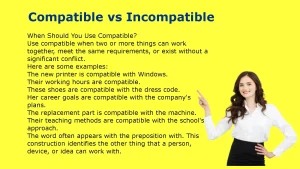
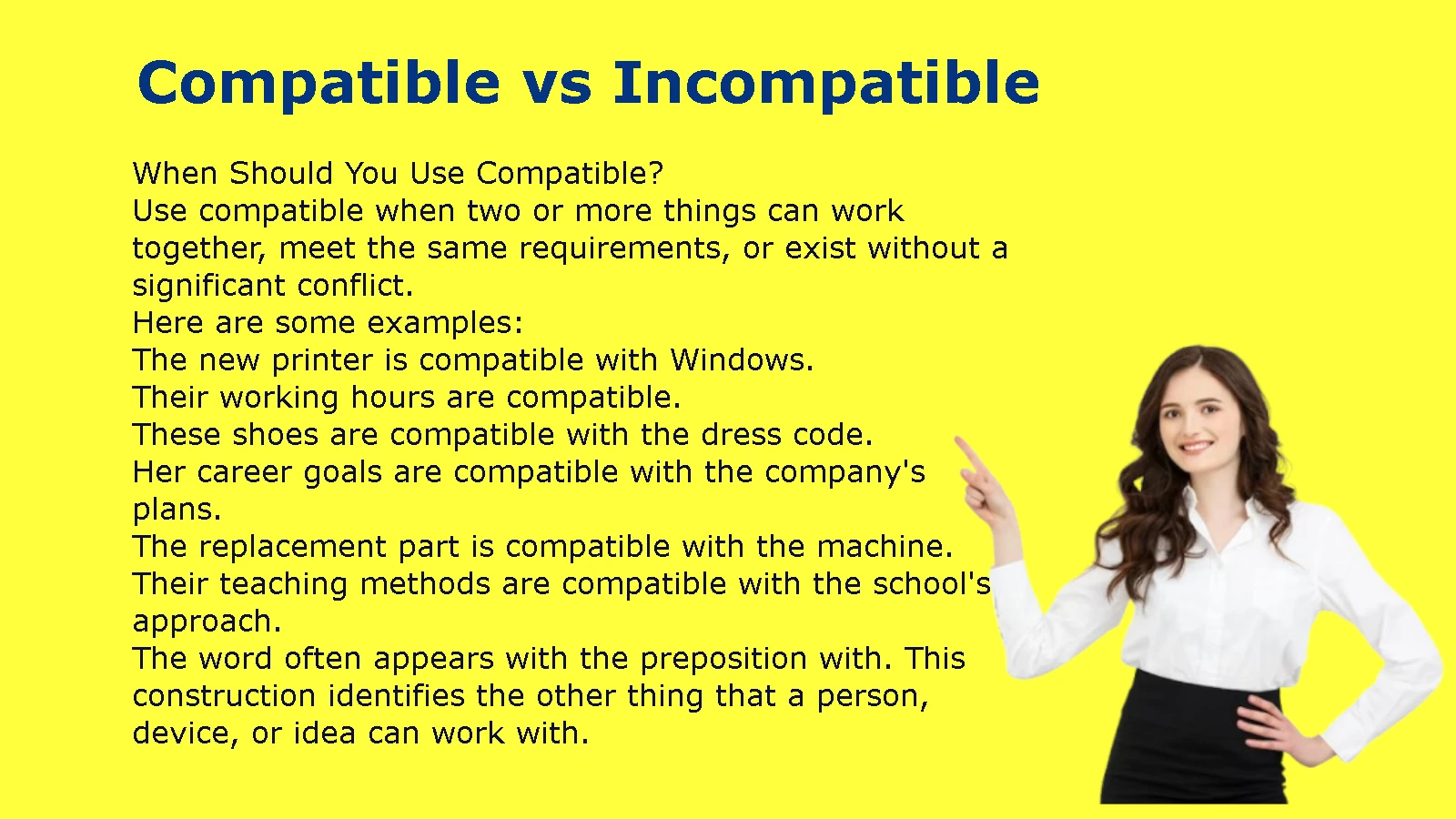
When Should You Use Compatible?
Use compatible when two or more things can work together, meet the same requirements, or exist without a significant conflict.
Here are some examples:
- The new printer is compatible with Windows.
- Their working hours are compatible.
- These shoes are compatible with the dress code.
- Her career goals are compatible with the company’s plans.
- The replacement part is compatible with the machine.
- Their teaching methods are compatible with the school’s approach.
The word often appears with the preposition with. This construction identifies the other thing that a person, device, or idea can work with.
For example, write, “This application is compatible with Android,” rather than leaving readers to guess which system the application supports.
You can also use compatible with for when discussing suitability for a particular purpose. For example, “This coating is compatible for use in the selected process” may appear in specialized technical writing, although “compatible with the selected process” is often more natural.
When Should You Use Incompatible?
Use incompatible when two or more things cannot work together properly, conflict with each other, or fail to meet the same requirements.
Examples include:
- The program is incompatible with my operating system.
- Their schedules are incompatible.
- The two policies are incompatible.
- These materials are incompatible for this application.
- His expectations are incompatible with the available budget.
- The device is incompatible with the current version of the software.
The word can describe a complete conflict or a limitation under specific conditions.
For instance, two applications might be incompatible with an older operating system but work perfectly well on a newer one. The incompatibility applies to that particular configuration, not necessarily to every possible configuration.
Common Contexts That Change the Meaning
The meaning of compatibility becomes clearer when you consider the relationship between the things being compared.
| Context | Compatible example | Incompatible example |
| Technology | The app supports the phone’s operating system. | The app cannot run on the phone’s operating system. |
| Relationships | Their long-term goals align. | One wants to relocate, while the other refuses to move. |
| Work | The employee’s availability matches the shift. | The employee cannot work during the required hours. |
| Ideas | Both proposals support the same objective. | The proposals require opposite outcomes. |
| Materials | The adhesive works with the selected surface. | The adhesive damages or fails to bond with the surface. |
| Rules | The action follows the applicable policy. | The action violates a conflicting requirement. |
These examples show why context matters. Two things can be compatible in one respect but incompatible in another.
For example, two colleagues might share professional goals but have incompatible communication styles. They may work together successfully if they establish clear expectations.
Compatible or Incompatible: Which Word Should You Use?
Choose compatible when you mean that things work or fit together. Choose incompatible when you mean that they conflict or cannot work together under the relevant conditions. To select the correct word, identify the relationship you want to describe and ask whether the items meet the requirements for working together.
Use Compatible When Things Work Well Together
The word compatible emphasizes suitability, agreement, or successful operation.
Consider these examples:
- “The new software is compatible with our existing system.” The software can work within the system’s requirements.
- “Their personalities are compatible.” Their personalities suit each other well.
- “The proposed changes are compatible with our goals.” The changes support the intended objectives.
- “This material is compatible with the chemical process.” The material is suitable for that process.
Notice that compatibility does not require perfect agreement. Two coworkers may disagree about minor details and still have compatible working styles.
Use Incompatible When Things Do Not Work Well Together
The word incompatible emphasizes conflict, limitations, or a lack of suitability.
Consider these examples:
- “The software is incompatible with the old operating system.” The system does not meet the software’s requirements.
- “Their expectations are incompatible.” Their expectations conflict in a meaningful way.
- “The two proposals are incompatible.” Both proposals cannot be implemented together as written.
- “The components are incompatible.” The components cannot work together properly under the specified conditions.
When using incompatible, explain the source of the problem whenever possible. A sentence such as “The two systems are incompatible because they use different communication protocols” gives readers more useful information than the word incompatible alone.
Common Contexts That Require Careful Word Choice
Some situations require a more precise explanation than simply labeling things compatible or incompatible.
Technology: Check supported operating systems, hardware requirements, connectors, file formats, and software versions. Two devices may have the same connector but still fail to work together.
Relationships: Compatibility does not mean that two people must agree about everything. Shared expectations, communication, and the ability to manage differences often matter more than identical interests.
Workplace requirements: Two responsibilities may be incompatible because they require the same employee to be in different places at the same time. A revised schedule might solve the problem.
Scientific and technical applications: Compatibility may depend on measurable conditions, such as temperature, material composition, dosage, or system specifications. Avoid assuming that two items are universally incompatible just because they fail under one set of conditions.
Is It Incompatible or Uncompatible?
Incompatible is the standard spelling in modern English. Although readers may encounter uncompatible, writers should generally avoid it because it is uncommon and nonstandard in ordinary contemporary usage. Use incompatible when you want to describe things that cannot work or fit together successfully.
Is Uncompatible a Correct English Word?
Uncompatible is not the normal choice in standard modern English. Dictionaries and everyday writing generally favor incompatible for the opposite of compatible.
The distinction concerns conventional word formation. English often uses different prefixes to create opposites, and those prefixes do not always work interchangeably.
For example:
- Possible → impossible
- Legal → illegal
- Regular → irregular
- Compatible → incompatible
You cannot reliably create a standard opposite simply by adding un- to any adjective.
For that reason, write incompatible, not uncompatible, in essays, business emails, product descriptions, school assignments, and professional documents.
Why Is Incompatible the Preferred Spelling?
The word incompatible uses the prefix in-, which can express negation or the opposite of a quality. The word ultimately comes from Latin roots associated with combining or bearing something together.
The prefix in- also appears in words such as inconsistent and inadequate. However, English spelling depends on established word usage, not just on a rule that allows every adjective to take the same prefix.
A useful editing method is to learn common adjective pairs as complete units:
| Correct word | Standard opposite |
| Compatible | Incompatible |
| Consistent | Inconsistent |
| Adequate | Inadequate |
| Possible | Impossible |
| Relevant | Irrelevant |
| Logical | Illogical |
Learning these pairs reduces spelling errors and makes your writing sound more natural.
Incompatible vs Uncompatible Examples
Compare the following sentences to see how the preferred form works.
| Nonstandard or awkward wording | Preferred wording |
| This application is uncompatible with my phone. | This application is incompatible with my phone. |
| The two parts are uncompatible. | The two parts are incompatible. |
| Their schedules are uncompatible. | Their schedules are incompatible. |
| The file format is uncompatible with the program. | The file format is incompatible with the program. |
| These requirements are uncompatible. | These requirements are incompatible. |
In each case, the revision preserves the intended meaning while using the conventional adjective.
If you are editing an article or checking a document, search for uncompatible and replace it with incompatible wherever the intended meaning is lack of compatibility.
Non-Compatible or Incompatible: Which Is Correct?
Incompatible is generally the clearest and most natural choice when you mean that two things cannot work together. Non-compatible also appears in some technical, administrative, or specialized contexts, but its suitability depends on the document’s terminology and the meaning the writer intends.
Is Non-Compatible Correct?
The expression non-compatible can appear in English, particularly when writers use non- to indicate that something does not belong to a category or does not meet a defined condition.
However, the existence of a possible construction does not make it the best option in every sentence.
Compare:
- Natural: This accessory is incompatible with the device.
- Possible in a specialized context: This accessory is classified as non-compatible under the company’s testing criteria.
- Often clearer: This accessory does not meet the device’s compatibility requirements.
The first sentence works well in everyday English. The second might suit a technical report that uses non-compatible as a defined classification. The third provides a direct explanation when a label might confuse readers.
For general writing, use incompatible unless a style guide, technical standard, or established classification requires another form.
Noncompatible vs Incompatible
Noncompatible is the closed form of non-compatible. Both forms may occur, but neither is usually as natural as incompatible in ordinary English.
The distinction can depend on context:
| Form | Typical use | General recommendation |
| Incompatible | Standard description of things that conflict or cannot work together | Preferred for everyday and professional writing |
| Non-compatible | Alternative form used in some technical or specialized contexts | Use when the terminology calls for it |
| Noncompatible | Closed form that may appear in specialized writing | Follow the relevant style guide |
| Not compatible | Plain-language expression that directly explains the relationship | Useful when clarity matters most |
The phrase not compatible is particularly useful when you want to explain a specific limitation without relying on a technical label.
For example, “The cable is not compatible with this port” is clear and natural. You can also write, “The cable is incompatible with this port.”
Examples of Non-Compatible and Incompatible
Here are several examples that show how to choose the clearest wording.
Technical writing
- Preferred: The component is incompatible with the existing system.
- Alternative: The component is not compatible with the existing system.
- Specialized classification: The inspection report marks the component as non-compatible.
Business communication
- Preferred: These requirements are incompatible with the proposed budget.
- Alternative: These requirements do not fit within the proposed budget.
- Less natural for general readers: These requirements are non-compatible with the proposed budget.
Everyday writing
- Preferred: This charger is incompatible with my laptop.
- Alternative: This charger does not work with my laptop.
- Unnecessary variation: This charger is non-compatible with my laptop.
Choose the wording that communicates the problem most directly. If readers need to understand the issue quickly, ordinary language often works better than a specialized label.
Compatible vs Incompatible Examples in Sentences
Examples make the difference between compatible and incompatible easier to understand. The key is to identify whether the items meet the requirements for working together. Compatible describes suitability, while incompatible identifies a conflict or limitation that prevents successful use or coexistence.
Compatible Examples
Use compatible when two or more things can work together or suit each other.
Technology
- This keyboard is compatible with my tablet.
- The application is compatible with the latest version of the operating system.
- The monitor is compatible with the computer’s video output.
- Our software is compatible with the existing database.
Relationships
- They are compatible because they share similar long-term goals.
- Their communication styles are compatible.
- The couple has compatible expectations about family life.
Work and education
- Her schedule is compatible with the training program.
- The proposed course is compatible with the student’s academic plan.
- These working arrangements are compatible with the team’s needs.
Ideas and requirements
- The proposal is compatible with the organization’s objectives.
- Both explanations are compatible with the available evidence.
- The new policy is compatible with the current rules.
Each example identifies a relationship between two things. If you want to make the sentence more informative, explain why they are compatible.
For instance, “The monitor is compatible with the computer because both support the required connection and resolution” gives readers a specific reason instead of making a general claim.
Incompatible Examples
Use incompatible when two or more things conflict or fail to meet the requirements for working together.
Technology
- This application is incompatible with my older phone.
- The file is incompatible with the software I use.
- The printer is incompatible with the computer’s operating system.
- These two devices are incompatible without an appropriate adapter.
Relationships
- Their expectations about spending are incompatible.
- The partners have incompatible plans for the future.
- Their preferred lifestyles may be incompatible.
Work and education
- The employee’s availability is incompatible with the required shift.
- The course schedule is incompatible with her work commitments.
- The two deadlines are incompatible because both require the same resources.
Ideas and requirements
- The two policies are incompatible.
- His explanation is incompatible with the recorded evidence.
- The design is incompatible with the project’s safety requirements.
The examples also demonstrate that incompatibility can have different causes. A device might lack technical support, two schedules might overlap, or two ideas might contradict each other.
Compatible vs Incompatible in Everyday Situations
Consider a small business that wants to introduce a new payment system.
The owner checks whether the system works with the existing website, accounting software, and payment terminals. If the system supports all three, the owner can describe it as compatible with the business’s current setup.
Suppose the accounting software cannot import the new system’s transaction files. The two systems are incompatible in that specific area.
The owner now has three practical options:
- Find a version that supports the required file format.
- Use a reliable integration tool to connect the systems.
- Replace the existing accounting software if the benefits justify the cost.
This example shows why the word incompatible should lead to a clear explanation of the problem. It identifies a mismatch, but it does not automatically mean that the problem has no solution.
The same principle applies outside technology. Two people may have incompatible schedules but find a workable arrangement by changing their routines. Two policies may conflict but become compatible after a revision.
Compatible and Incompatible Synonyms and Antonyms
Synonyms help you vary your writing, but you should choose them according to context. Words such as suitable, harmonious, conflicting, and inconsistent overlap with compatible and incompatible without always carrying exactly the same meaning.
Synonyms of Compatible
Common synonyms of compatible include:
- Suitable: Appropriate for a particular purpose.
- Consistent: In agreement with something else.
- Harmonious: Working together in a balanced or peaceful way.
- Well-matched: Suited to one another.
- Interoperable: Able to exchange information or function together, especially in technical systems.
- Congruent: In agreement or alignment, particularly in formal or technical contexts.
These words are not always interchangeable.
For example, two software systems may be interoperable because they exchange information successfully. Two people may be well-matched because their personalities and goals suit each other. Calling those people interoperable would sound unnatural.
Choose the synonym that matches the specific relationship you want to describe.
Synonyms of Incompatible
Common synonyms of incompatible include:
- Unsuitable: Not appropriate for a particular purpose.
- Conflicting: In opposition or disagreement.
- Inconsistent: Not in agreement with another statement, action, or principle.
- Mismatched: Not properly suited or matched.
- Incongruous: Out of place or inconsistent with its surroundings.
- Contradictory: Expressing opposing or mutually inconsistent claims.
Each synonym emphasizes a different aspect of incompatibility.
For example, two schedules can be conflicting because they require the same person at different places. Two statements can be contradictory because they cannot both be true in the same sense. A component can be unsuitable because it fails to meet a specific requirement.
Compatible vs Incompatible Antonyms
The direct opposite of compatible is incompatible. The direct opposite of incompatible is compatible.
Other opposites depend on context.
| Word | Possible opposite | Example |
| Compatible | Incompatible | Compatible devices / incompatible devices |
| Suitable | Unsuitable | Suitable equipment / unsuitable equipment |
| Consistent | Inconsistent | Consistent findings / inconsistent findings |
| Harmonious | Discordant | Harmonious relationship / discordant relationship |
| Interoperable | Non-interoperable | Interoperable systems / non-interoperable systems |
| Congruent | Incongruent | Congruent ideas / incongruent ideas |
Avoid replacing a word with an antonym simply because the pair appears in the table. The best choice depends on the sentence and the type of relationship involved.
Compatible and Incompatible Meaning in Urdu
In Urdu, compatible generally means مطابقت رکھنے والا or موافق, while incompatible means غیر موافق, ناموافق, or مطابقت نہ رکھنے والا. The most natural translation depends on the context, such as technology, relationships, ideas, or practical suitability.
Compatible Meaning in Urdu
Compatible = مطابقت رکھنے والا، موافق
The word compatible describes things that fit, suit, or work well together.
Examples:
- English: This charger is compatible with my phone.
- Urdu: یہ چارجر میرے فون کے ساتھ مطابقت رکھتا ہے۔
Another example:
- English: Their goals are compatible.
- Urdu: ان کے مقاصد ایک دوسرے سے مطابقت رکھتے ہیں۔
In everyday conversation, موافق may be more natural when you mean suitable or agreeable. In technical writing, مطابقت رکھنے والا often explains compatibility more precisely.
For example, when describing software, you might say that a program is compatible with a particular operating system because it meets that system’s requirements.
Incompatible Meaning in Urdu
Incompatible = غیر موافق، ناموافق، مطابقت نہ رکھنے والا
The word incompatible describes things that do not fit, suit, or work together properly.
Examples:
- English: This software is incompatible with my computer.
- Urdu: یہ سافٹ ویئر میرے کمپیوٹر کے ساتھ مطابقت نہیں رکھتا۔
Another example:
- English: Their expectations are incompatible.
- Urdu: ان کی توقعات ایک دوسرے سے مطابقت نہیں رکھتیں۔
A third example:
- English: These two systems are incompatible.
- Urdu: یہ دونوں نظام ایک دوسرے کے ساتھ مطابقت نہیں رکھتے۔
These translations preserve the intended meaning instead of translating each English word separately. In some situations, ناموافق may sound more natural, while مطابقت نہیں رکھتا may communicate the technical meaning more clearly.
Compatible vs Incompatible in Urdu Sentences
The following paired examples show how the two words change the meaning of a sentence.
| English sentence | Urdu translation |
| This device is compatible with my laptop. | یہ آلہ میرے لیپ ٹاپ کے ساتھ مطابقت رکھتا ہے۔ |
| This device is incompatible with my laptop. | یہ آلہ میرے لیپ ٹاپ کے ساتھ مطابقت نہیں رکھتا۔ |
| Their plans are compatible. | ان کے منصوبے ایک دوسرے سے مطابقت رکھتے ہیں۔ |
| Their plans are incompatible. | ان کے منصوبے ایک دوسرے سے مطابقت نہیں رکھتے۔ |
| These materials are compatible for this process. | یہ مواد اس عمل کے لیے موزوں ہیں۔ |
| These materials are incompatible for this process. | یہ مواد اس عمل کے لیے موزوں نہیں ہیں۔ |
The best Urdu equivalent depends on what you want to express. When discussing a relationship, موافق or مطابقت رکھنے والا may communicate suitability. When discussing devices or systems, مطابقت رکھنا often makes the technical meaning clearer.
Common Mistakes When Using Compatible and Incompatible
Writers sometimes confuse the spelling, meaning, or grammatical use of compatible and incompatible. Most mistakes are easy to correct once you understand the standard forms and the relationship each word describes.
Using Uncompatible Instead of Incompatible
The most common spelling issue is using uncompatible instead of incompatible.
Incorrect or nonstandard: “The software is uncompatible with my computer.”
Preferred: “The software is incompatible with my computer.”
Remember the established pair:
Compatible → Incompatible
Do not assume that every adjective forms its opposite by adding un-. English uses different prefixes, and common word pairs often need to be learned individually.
Confusing Incompatible With Unrelated
Incompatible and unrelated do not mean the same thing.
Incompatible means that things conflict or cannot work together properly. Unrelated means that things have no direct connection or relationship.
For example:
- “The two applications are incompatible.” They cannot work together as required.
- “The two applications are unrelated.” They serve different purposes or have no direct connection.
Two unrelated things may function perfectly well on their own. Similarly, two things can be closely related but incompatible with each other.
This distinction is particularly useful in academic, technical, and business writing.
Treating Incompatible as Always Completely Impossible
Another mistake is assuming that incompatible things can never work together under any circumstances.
In reality, incompatibility often depends on the conditions.
For example, a computer program may be incompatible with an older operating system but compatible with a newer version. A device may not connect directly to another device but may work through an appropriate adapter.
Use a more precise explanation when the limitation is conditional:
- Broad claim: The devices are incompatible.
- More precise claim: The devices are incompatible without an adapter.
- More specific claim: The devices use different connectors, but an adapter can connect them.
The more specific wording helps readers understand the actual limitation.
Using Compatible Without Specifying Compatibility
The word compatible often needs context. Readers may wonder what a device, policy, or person is compatible with.
Less informative: “The software is compatible.”
Clearer: “The software is compatible with Windows 11.”
More informative: “The software is compatible with Windows 11 and supports the file format used by our accounting system.”
The same principle applies to incompatible.
Instead of writing “The requirements are incompatible,” explain which requirements conflict and why.
This approach improves clarity and makes technical instructions, product descriptions, and professional communication more useful.
Frequently Asked Questions
What Is the Difference Between Compatible and Incompatible?
Compatible means that things can work or exist together successfully. Incompatible means that they conflict or cannot work together under the relevant conditions. For example, compatible software runs on a supported operating system, while incompatible software cannot run properly under that configuration.
Is It Incompatible or Uncompatible?
Incompatible is the standard spelling in modern English. Uncompatible is uncommon and nonstandard in ordinary writing, so use incompatible in essays, business communication, and professional documents.
Is Non-Compatible Correct English?
Non-compatible appears in some specialized contexts, but incompatible is generally more natural when describing things that cannot work together. Use non-compatible only when it fits the terminology or style guide of the document.
What Does Incompatible Mean in Urdu?
Incompatible means غیر موافق، ناموافق، or مطابقت نہ رکھنے والا. For example, “This device is incompatible with my phone” can be translated as “یہ آلہ میرے فون کے ساتھ مطابقت نہیں رکھتا۔”
Can Two People Be Compatible but Still Disagree?
Yes. Compatibility does not require people to share every opinion or interest. Two people can disagree about hobbies, preferences, or individual decisions while maintaining compatible values, expectations, and long-term goals. Compatibility concerns how well their differences fit together, not whether those differences disappear.
What Is Another Word for Incompatible?
Possible synonyms include unsuitable, conflicting, inconsistent, mismatched, and contradictory. Choose the word that matches the context. For example, conflicting suits schedules or requirements, while contradictory works well for statements or claims that oppose each other.
Conclusion: Choose Compatible or Incompatible Correctly
The difference between compatible and incompatible comes down to suitability and conflict. Compatible describes things that work or fit together, while incompatible describes things that cannot work together successfully under particular conditions.
Use incompatible as the standard opposite of compatible. Avoid uncompatible in ordinary English, and choose non-compatible only when a specific technical or editorial context calls for it.
When writing, identify the relationship you want to describe, specify the relevant conditions, and choose the word that communicates your meaning clearly. If you are explaining compatibility to Urdu-speaking readers, include a natural translation and an example that reflects the actual context.
Before publishing your next article, email, or technical description, check that you have used compatible vs incompatible correctly. A precise word choice makes your writing easier to understand and helps readers act on the information you provide.