Revolutionize vs revolutionise is a spelling difference between American and British English. Revolutionize is the standard American spelling, while revolutionise is the usual British spelling. Both words mean to change something dramatically or fundamentally, often through a new idea, invention, or method. The difference lies in spelling, not meaning or pronunciation.
Understanding revolutionize meaning, revolutionize UK spelling, and related forms such as revolutionized, revolutionised, and revolutionizing helps you write clearly for different audiences. You can also use synonyms such as transform, overhaul, and modernize when you need a more precise description of change. This guide explains the spelling rules, pronunciation, verb forms, practical examples, and the difference between a revolution and an advantage.
Revolutionize vs Revolutionise: Which Spelling Is Correct?
Revolutionize and revolutionise are both correct spellings. American English generally uses revolutionize, while British English commonly uses revolutionise. Both forms describe a major change that significantly affects how something works, develops, or operates.
Your choice depends on the variety of English you use. Neither spelling is inherently better or more accurate than the other.
Revolutionize in American English
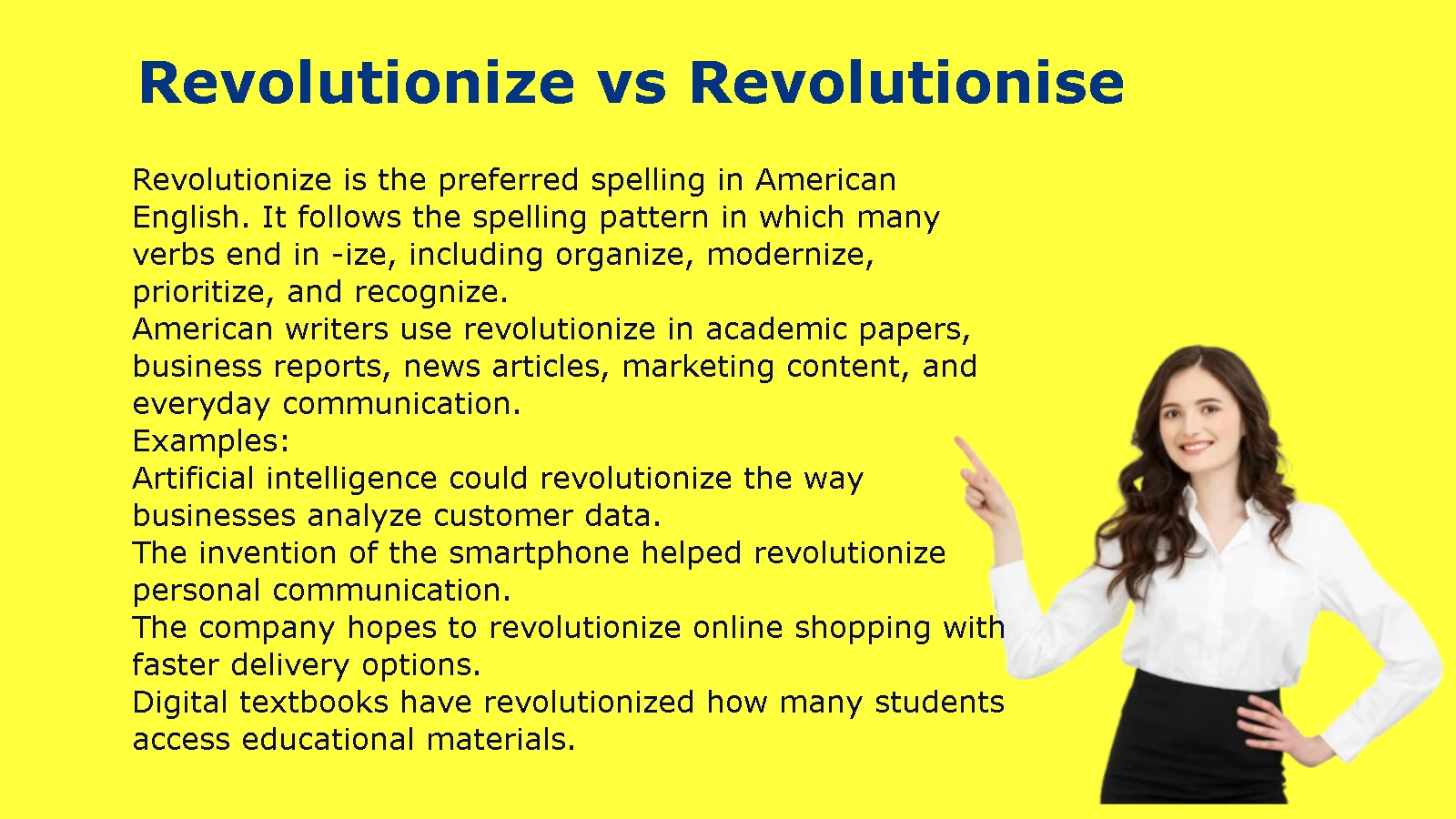
Revolutionize is the preferred spelling in American English. It follows the spelling pattern in which many verbs end in -ize, including organize, modernize, prioritize, and recognize.
American writers use revolutionize in academic papers, business reports, news articles, marketing content, and everyday communication.
Examples:
- Artificial intelligence could revolutionize the way businesses analyze customer data.
- The invention of the smartphone helped revolutionize personal communication.
- The company hopes to revolutionize online shopping with faster delivery options.
- Digital textbooks have revolutionized how many students access educational materials.
In each sentence, the word describes a significant change rather than a small improvement.
If you write primarily for a US audience, use revolutionize, revolutionized, and revolutionizing throughout your content.
Revolutionise in British English
Revolutionise is the usual British English spelling. It follows the -ise spelling pattern found in words such as organise, modernise, prioritise, and recognise.
British writers commonly use revolutionise in newspapers, educational materials, professional documents, and general writing. The same spelling convention also appears in many publications that follow British English, including some Australian and New Zealand publications.
Examples:
- The new transport system could revolutionise travel across the region.
- Online banking has revolutionised the way customers manage their money.
- Researchers hope to revolutionise the treatment of certain diseases.
- The school is revolutionising its teaching methods through digital learning.
The meaning remains identical to the American form. Only the spelling changes.
Remember: If your article uses British English, choose revolutionise. If it uses American English, choose revolutionize.
Revolutionize vs Revolutionise: Spelling Comparison Table
The spelling difference continues through the verb’s other forms.
| American English | British English | Meaning |
| Revolutionize | Revolutionise | To transform something fundamentally |
| Revolutionizes | Revolutionises | Changes something dramatically |
| Revolutionized | Revolutionised | Changed something dramatically in the past |
| Revolutionizing | Revolutionising | Making a major change |
| Revolutionization | Revolutionisation | The process of bringing about a major transformation |
The noun forms revolutionization and revolutionisation are possible, although writers often prefer simpler expressions such as revolutionary change or fundamental transformation.
The central rule is straightforward: choose one spelling convention and apply it consistently. Switching between revolutionize and revolutionise within the same article can distract readers and make your writing look unedited.
Revolutionize Meaning and Definition
Revolutionize means to change something so significantly that it transforms how people understand, use, or experience it. The change often comes from a major invention, discovery, new process, or different way of thinking. It can affect an entire industry, a social system, a profession, or an everyday activity.
For example, online banking revolutionized personal finance by allowing customers to manage many transactions without visiting a physical bank.
What Does Revolutionize Mean?
The verb revolutionize describes a fundamental or far-reaching change. It often suggests that something works differently after the change than it did before.
A simple definition is:
Revolutionize (verb): To transform something dramatically by introducing a new idea, method, system, or technology.
Consider the difference between improving a product and revolutionizing it.
A company that makes its mobile app load two seconds faster has improved the product. A company that introduces a new service model that changes how an entire industry serves customers may have revolutionized that industry.
The word often appears in discussions about innovation because major innovations can replace established practices.
For example:
- Video calls changed how people communicate over long distances.
- Digital payments changed how many customers pay for products and services.
- GPS navigation changed how drivers find unfamiliar destinations.
- Online learning expanded the ways students access educational materials.
These examples illustrate the general meaning of revolutionize. The extent of the change depends on the circumstances, so writers should avoid using the word for every minor update.
Revolutionize Meaning in Different Contexts
The word takes on slightly different practical implications depending on the subject.
Technology: In technology, revolutionize describes innovations that substantially change how people perform tasks or interact with systems.
Example: Cloud computing revolutionized how many organizations store, process, and share information.
Business: In business, the word describes changes to established operating models, customer experiences, or industry practices.
Example: A direct-to-consumer sales model revolutionized how the company reached its customers.
Science and medicine: In scientific writing, revolutionize can describe discoveries or tools that change research methods, diagnosis, or treatment.
Example: A new imaging technique could revolutionize how clinicians detect certain conditions.
Education: The word can describe major changes in teaching, learning, or access to educational resources.
Example: Online courses revolutionized access to specialized training for many learners.
Everyday life: In ordinary conversation, revolutionize can describe a personal change that makes a familiar activity substantially easier.
Example: A meal-planning app revolutionized how our family organizes weekly dinners.
In formal writing, make sure the scale of the change supports the strength of the word.
Is Revolutionize Always a Positive Word?
No. Revolutionize describes the scale of a change rather than whether that change is good or bad.
Writers often use it positively when discussing faster services, better treatments, or more efficient processes. However, a major transformation can also create risks, costs, or unintended consequences.
For example, automation may revolutionize a company’s production process by increasing output and reducing repetitive work. At the same time, it may require employees to learn new skills or move into different roles.
Similarly, digital platforms can revolutionize communication while raising concerns about privacy, misinformation, or excessive screen time.
Compare these sentences:
- The new technology revolutionized customer service by reducing waiting times.
- The new technology revolutionized customer service but introduced new privacy concerns.
Both sentences use the verb correctly. The surrounding information determines whether the transformation sounds beneficial, harmful, or mixed.
When writing about a major development, explain its actual effects rather than assuming that every revolutionary change represents progress.
Revolutionize Pronunciation
Revolutionize and revolutionise generally have the same pronunciation. The spelling difference between American and British English does not create a different word or meaning. Speakers may vary slightly in their vowels or rhythm because of their accents, but the two forms follow the same basic pronunciation pattern.
How to Pronounce Revolutionize
The word revolutionize is commonly pronounced:
- IPA: /ˌrevəˈluːʃənaɪz/
- Syllable pattern: rev-o-lu-tion-ize
- Main stress: The syllable containing the long “loo” sound.
To pronounce the word naturally, break it into manageable parts before saying it at a normal speaking speed.
The middle of the word contains the sound associated with revolution. The ending sounds like the word eyes with a final /z/ sound.
Try practicing it in a sentence:
“The new discovery could revolutionize medical research.”
Reading the word aloud in context helps you connect its pronunciation with its meaning.
Is Revolutionise Pronounced Differently?
No significant pronunciation difference follows from the change between revolutionize and revolutionise. The final letters -ize and -ise represent the same sound in these words.
For example:
- American spelling: The invention could revolutionize the industry.
- British spelling: The invention could revolutionise the industry.
Both sentences use the same verb and communicate the same idea.
Regional accents may affect vowel quality, intonation, or the rhythm of the word. However, the spelling alone does not determine a separate pronunciation.
Revolutionize Synonyms and Alternatives
Revolutionize synonyms include transform, overhaul, modernize, reshape, innovate, redefine, and reinvent. These words overlap in meaning, but they do not always express the same degree or type of change.
Choosing the right alternative helps you communicate precisely. In some sentences, transform sounds more natural. In others, overhaul better describes extensive changes to an existing system.
Common Synonyms for Revolutionize
Transform
Transform means to change the nature, appearance, structure, or condition of something.
Example: The new training program transformed the way employees approached customer service.
Use transform when you want to emphasize the result of a change without necessarily suggesting that it affects an entire industry.
Overhaul
Overhaul means to examine and make extensive changes to an existing system, process, or organization.
Example: The company overhauled its ordering system to reduce delays and errors.
Choose overhaul when the change involves substantial revisions to something that already exists.
Modernize
Modernize means to update something so it meets current needs, standards, or expectations.
Example: The hospital modernized its recordkeeping system by introducing digital files.
Use this word when the primary goal is to replace outdated methods with more current ones.
Reshape
Reshape means to change the structure, direction, or character of something.
Example: Remote work reshaped expectations about where employees could perform their jobs.
This alternative works well when a development changes the way people think, behave, or organize their activities.
Innovate
Innovate means to introduce new ideas, methods, or products.
Example: The startup innovated by offering customers a simpler way to compare service plans.
Unlike revolutionize, which emphasizes the scale of a change, innovate emphasizes the introduction of something new.
Redefine
Redefine means to change the meaning, purpose, boundaries, or accepted understanding of something.
Example: The new business model redefined convenience for busy customers.
Use redefine when a development changes people’s expectations or understanding of a subject.
Reinvent
Reinvent means to create a substantially different version of something or approach it in a new way.
Example: The retailer reinvented its brand to appeal to a younger audience.
This word often describes a deliberate change in strategy, identity, design, or working methods.
Revolutionize vs Transform vs Modernize
These three verbs are related, but each emphasizes a different aspect of change.
| Word | Main emphasis | Best use | Example |
| Revolutionize | Fundamental or far-reaching change | Major innovations | The invention revolutionized communication. |
| Transform | A substantial change in nature or condition | Broad changes in results or structure | The program transformed employee training. |
| Modernize | Updating something outdated | Systems, equipment, and methods | The city modernized its public transport network. |
A practical way to distinguish them is to ask what you want the reader to notice.
How to Choose the Best Synonym
Use the context to guide your choice.
- Choose revolutionize when a development fundamentally changes an established practice.
- Choose transform when you want to emphasize a substantial change in condition or structure.
- Choose overhaul when someone makes extensive revisions to an existing process.
- Choose modernize when an organization updates outdated systems.
- Choose innovate when the main point is the introduction of a new idea or method.
- Choose reshape when a development changes direction, structure, or expectations.
- Choose redefine when the change affects how people understand a concept or role.
- Choose reinvent when someone creates a substantially different version of an existing product, brand, or approach.
For SEO content, do not replace every instance of revolutionize with a synonym simply to avoid repetition. Instead, choose words that accurately express the intended meaning.
Revolutionized, Revolutionised, and Other Verb Forms
Revolutionized is the American English past-tense and past-participle form of revolutionize. Revolutionised is the corresponding British English form. Both describe a transformation that occurred in the past or the result of a completed change.
The other forms follow the same regional spelling distinction.
Revolutionize vs Revolutionized vs Revolutionizing
Each verb form serves a different grammatical purpose.
| Verb form | Grammatical use | Example |
| Revolutionize | Base form or infinitive | The technology may revolutionize the industry. |
| Revolutionizes | Third-person singular present | The device revolutionizes everyday tasks. |
| Revolutionized | Past tense or past participle | The invention revolutionized the industry. |
| Revolutionizing | Present participle or gerund | The company is revolutionizing its services. |
The British equivalents use revolutionise, revolutionises, revolutionised, and revolutionising.
Base form: Use revolutionize after modal verbs such as can, could, may, and will.
Example: The new approach could revolutionize the hiring process.
Present tense: Use revolutionizes when the subject is third-person singular.
Example: This tool revolutionizes how designers organize projects.
Past tense: Use revolutionized to describe a completed change.
Example: The invention revolutionized modern photography.
Present participle: Use revolutionizing with forms of be to describe an ongoing change, or use it as a gerund.
Example: The company is revolutionizing its customer support system.
Example as a gerund: Revolutionizing a complicated process takes time and careful planning.
Revolutionized vs Revolutionised
The difference between revolutionized and revolutionised is regional spelling, not meaning.
American English generally uses revolutionized, while British English generally uses revolutionised.
Examples:
- US: The new software revolutionized the industry.
- UK: The new software revolutionised the industry.
Both sentences describe the same completed transformation.
This distinction also applies to related words. American English uses organized and modernized, while British English commonly uses organised and modernised.
However, do not assume that every word ending in -ize must always take -ise in British English. Some British dictionaries and publications accept -ize spellings, and some words have distinct spelling conventions. Follow the style guide used by your publication.
Revolutionizes vs Revolutionises
Revolutionizes is the American third-person singular present-tense form. Revolutionises is the usual British equivalent.
Use these forms with a singular subject such as it, the invention, the company, or this method.
Examples:
- American: The application revolutionizes how customers track expenses.
- British: The application revolutionises how customers track expenses.
- American: This discovery revolutionizes scientific research.
- British: This discovery revolutionises scientific research.
With plural subjects, use the base form:
- The new applications revolutionize expense tracking.
- The latest discoveries revolutionize scientific research.
The rule is the same as in other present-tense verbs: a third-person singular subject takes the -s ending, while a plural subject generally takes the base form.
Singular and Plural Agreement
Correct subject-verb agreement makes your writing easier to understand.
In the present tense, a singular third-person subject takes revolutionizes in American English or revolutionises in British English. Plural subjects take revolutionize or revolutionise.
Compare the examples:
| Subject | American English | British English |
| The invention | The invention revolutionizes the process. | The invention revolutionises the process. |
| The inventions | The inventions revolutionize the process. | The inventions revolutionise the process. |
| This method | This method revolutionizes production. | This method revolutionises production. |
| These methods | These methods revolutionize production. | These methods revolutionise production. |
Past-tense forms do not change according to whether the subject is singular or plural.
For example:
- The invention revolutionized the process.
- The inventions revolutionized the process.
British English uses revolutionised in both sentences.
Revolutionizing Examples in Everyday and Professional Writing
Revolutionizing examples show how the word describes major changes in different settings. The strongest examples connect the verb to a specific development and explain what that development changes. This approach makes the word easier to understand and helps you avoid exaggerated claims.
Revolutionize Examples in Technology
Technology provides many useful contexts for the verb because new tools can change established ways of working.
Examples:
- Artificial intelligence is revolutionizing how some businesses analyze large datasets.
- Cloud computing revolutionized how many organizations store and share digital information.
- Smartphones revolutionized access to communication, navigation, and online services.
- Automated translation tools are revolutionizing how some teams handle multilingual content.
- Digital payment systems have revolutionized the way many customers complete transactions.
Each example identifies a technology and the activity it changes.
Notice that the first sentence uses is revolutionizing to describe an ongoing development. The second uses revolutionized to describe a change that has already occurred.
When using these examples in a formal article, explain the specific impact rather than treating every new product as revolutionary.
Revolutionize Examples in Business and Education
Business and education provide further examples of how a major change can affect established systems.
Business examples
- The subscription model revolutionized how many software companies sell digital products.
- Online marketplaces transformed how independent sellers reach customers around the world.
- A new inventory system revolutionized the company’s approach to stock management.
- Flexible payment options changed how some businesses attract customers.
Education examples
- Online learning revolutionized access to courses for many students.
- Digital collaboration tools changed how students complete group projects.
- Recorded lectures gave learners more flexibility when reviewing difficult topics.
- Interactive simulations created new ways to practice technical skills.
Not every example requires the word revolutionize. For instance, recorded lectures may improve flexibility without fundamentally changing the entire education system. The best word depends on the scale of the change you can support.
Revolutionize Examples in Science and Healthcare
Scientific and medical writing requires special care because strong claims should match the evidence.
Examples:
- A new diagnostic technique could revolutionize the early detection of certain diseases.
- Advances in medical imaging have changed how clinicians examine internal structures.
- Researchers hope the experimental treatment will transform care for a specific patient group.
- More accurate laboratory tools can improve the reliability of some tests.
- New research methods may revolutionize how scientists investigate complex biological processes.
The phrase could revolutionize expresses potential rather than a proven outcome. Similarly, may revolutionize signals that a change remains possible but uncertain.
This distinction matters when describing research that has not yet demonstrated its effectiveness in routine clinical practice.
For example, a promising laboratory result does not automatically mean a treatment has improved patient outcomes. Writers should distinguish early findings from established clinical benefits.
Revolutionize in Different Tenses
The following table shows how to use the main American English forms in original sentences.
| Form | Example sentence | What it communicates |
| Revolutionize | The new design could revolutionize home energy management. | A possible future transformation |
| Revolutionizes | The platform revolutionizes how teams share files. | A general or current effect |
| Revolutionized | The invention revolutionized long-distance communication. | A completed change |
| Revolutionizing | The company is revolutionizing its delivery process. | An ongoing transformation |
| Revolutionized | The process has revolutionized the team’s workflow. | A completed change with present relevance |
For British English, change the spelling consistently:
- revolutionize → revolutionise
- revolutionizes → revolutionises
- revolutionized → revolutionised
- revolutionizing → revolutionising
The grammatical rules stay the same.
A Practical Case Study: Improving an Online Store
Imagine an online retailer that receives orders through email and manually updates its inventory. Employees frequently make mistakes, customers wait for order confirmations, and staff spend hours checking stock levels.
The retailer introduces an integrated ordering system that automatically updates inventory, sends confirmations, and alerts employees when products run low.
Before the change, workers handle each task separately. After the change, several processes work together.
A writer might describe the result in three ways:
- Improved: The system improved order processing.
- Transformed: The system transformed the retailer’s daily operations.
- Revolutionized: The system revolutionized the retailer’s order management process.
The third description makes the strongest claim. It fits best if the new system fundamentally changes how the retailer handles orders, rather than simply making one task slightly faster.
This example illustrates an important writing principle: choose a word that reflects the actual scale of the change. Strong vocabulary works best when the evidence supports it.
Revolution vs Advantage: What Is the Difference?
A revolution is a major or fundamental change in a system, society, or established way of doing things. An advantage is a condition or benefit that puts a person, organization, or group in a favorable position. A revolution may create an advantage, but the two words describe different concepts.
What Does Revolution Mean?
A revolution is a noun that describes a profound change in an established system, structure, or way of thinking. The word can refer to political upheaval, social change, technological innovation, or a major shift in an industry.
Examples:
- The industrial revolution changed manufacturing and production.
- The digital revolution transformed how people create and exchange information.
- The company experienced a revolution in its approach to customer service.
The related verb revolutionize describes the action of bringing about such a change.
Compare these sentences:
- The invention sparked a revolution in communication.
- The invention revolutionized communication.
The first sentence uses a noun to identify the change. The second uses a verb to describe what the invention did.
What Does Advantage Mean?
An advantage is a favorable condition, benefit, or feature that helps someone achieve a goal or perform better in a particular situation.
Examples:
- A faster delivery service gives the retailer a competitive advantage.
- Her experience provides an advantage during the interview.
- The new software gives the team an advantage by reducing repetitive work.
An advantage does not have to involve a major transformation. A small improvement in price, speed, convenience, or skill can provide a meaningful benefit.
For example, a store that delivers orders one day faster than its competitors may gain an advantage without revolutionizing the retail industry.
Revolution vs Advantage: Key Differences
| Feature | Revolution | Advantage |
| Part of speech | Usually a noun | Noun |
| Meaning | A major or fundamental change | A favorable condition or benefit |
| Main focus | Transformation | Benefit or superiority |
| Typical scale | Often broad or substantial | Can be large or small |
| Example | The invention sparked a revolution in transport. | The invention gave the company a competitive advantage. |
The main distinction is that a revolution describes a change, while an advantage describes a benefit.
A revolution may produce advantages for some people and disadvantages for others. For example, automation may help a business increase output while requiring employees to learn new skills.
Can a Revolution Create an Advantage?
Yes. A major transformation can create an advantage when it helps a person or organization perform better than competing alternatives.
Consider a retailer that introduces automated inventory tracking. The system reduces stock errors, helps employees replenish products on time, and improves order accuracy.
The change may revolutionize the retailer’s internal process. If competitors still rely on slower manual methods, the retailer may gain a competitive advantage.
However, the advantage depends on the outcome. If the new system costs too much, creates technical problems, or fails to improve performance, the retailer may not benefit.
Keep these terms separate when writing:
- Revolution: The fundamental change itself.
- Revolutionize: The act of bringing about that change.
- Advantage: The favorable result or benefit that may follow.
Understanding this distinction helps you describe innovations more accurately in business articles, essays, and professional reports.
Common Mistakes When Using Revolutionize and Revolutionise
Writers sometimes confuse regional spelling, grammatical forms, and the strength of the word’s meaning. Avoiding these mistakes will make your writing more consistent and precise.
Mixing American and British Spellings
One common mistake is using American and British spellings inconsistently in the same article.
For example:
“The new platform revolutionized the process and is now revolutionising customer service.”
This sentence may be grammatically correct, but it mixes spelling conventions without an obvious reason.
For a US audience, write:
“The new platform revolutionized the process and is now revolutionizing customer service.”
For a British audience, write:
“The new platform revolutionised the process and is now revolutionising customer service.”
Some organizations deliberately follow a style guide that accepts selected spellings from different traditions. If you write for a publication, follow its editorial rules.
Using Revolutionize for Minor Changes
The word can sound exaggerated when it describes a small or routine improvement.
For example:
“The company revolutionized its website by changing the background color.”
Unless that change forms part of a much larger transformation, updated or redesigned would be more accurate.
Consider these alternatives:
| Situation | More precise wording |
| Fixing a small software bug | Improved the software |
| Changing a website’s layout | Redesigned the website |
| Replacing outdated equipment | Modernized the equipment |
| Rebuilding a process from the ground up | Overhauled the process |
| Fundamentally changing how an industry operates | Revolutionized the industry |
Precise language helps readers understand the significance of an event without overstating it.
Confusing Revolutionize With Revolution
Revolutionize is a verb, while revolution is a noun.
Incorrect: The invention was a revolutionize in transportation.
Correct: The invention was a revolution in transportation.
Also correct: The invention revolutionized transportation.
The noun identifies the change. The verb describes the action or effect.
Overusing Revolutionize in Marketing
Marketing content often uses revolutionary and revolutionize to make products sound impressive. However, these words lose impact when writers apply them to ordinary features.
For example, a minor change to a mobile app may improve convenience without revolutionizing the user experience.
To make a credible claim, identify what changed:
- Did the product replace an established method?
- Does it solve a problem in a substantially different way?
- Has it changed how customers or employees perform a task?
- Can you demonstrate the improvement with meaningful evidence?
If the answer is no, a more specific word may serve the reader better.
Frequently Asked Questions
Is Revolutionize or Revolutionise Correct in the UK?
Revolutionise is the usual British English spelling. Revolutionize is the standard American English spelling. Both forms have the same meaning, and the choice depends on the spelling convention you follow.
What Is the Meaning of Revolutionize?
Revolutionize means to change something fundamentally or dramatically. The word often describes an invention, discovery, or new method that significantly changes how a process, industry, or activity works.
How Do You Spell Revolutionize in British English?
In British English, the usual spelling is revolutionise. For example: “The new technology could revolutionise the way people manage their finances.”
What Is a Synonym for Revolutionize?
Common synonyms include transform, overhaul, modernize, reshape, and reinvent. Use transform for a broad change, overhaul for extensive revisions, and modernize when updating something outdated.
How Do You Pronounce Revolutionize?
The word is commonly pronounced /ˌrevəˈluːʃənaɪz/. The main stress falls on the syllable containing the long “loo” sound. The British spelling revolutionise generally has the same pronunciation.
What Is the Difference Between Revolutionized and Revolutionised?
Revolutionized is the standard American English spelling, while revolutionised is the usual British English spelling. Both are past-tense and past-participle forms of the same verb and have the same meaning.
Conclusion: Choose the Right Spelling for Your Audience
The difference between revolutionize vs revolutionise comes down to regional spelling conventions. American English generally uses revolutionize, while British English usually uses revolutionise. Both forms describe a fundamental or dramatic change, and their related verb forms follow the same spelling pattern.
When writing about innovation, business, technology, or everyday change, choose the verb that accurately reflects the scale of the transformation. Use transform for broad changes, overhaul for extensive revisions, and modernize for updates to outdated systems.