Regularize vs regularise is a spelling difference between American English and British English. Regularize is the standard American spelling, while regularise is the standard British spelling. Both words mean to make something regular, consistent, orderly, or officially established. The correct choice depends on your audience and the type of English you use.
The same spelling pattern appears in regularization vs regularisation, regularized vs regularised, and regularizing vs regularising. However, the word has meanings beyond spelling. In everyday English, regularize can describe organizing a schedule or formalizing an arrangement. In employment, regularization may refer to confirming a worker’s employment status.
Understanding these differences will help you choose the right spelling, use the word naturally, and distinguish regularize from related terms such as regulate, standardize, normalize, and optimize.
Regularize vs Regularise: The Quick Answer
Regularize and regularise are both correct spellings of the same verb. American English uses regularize, while British English generally uses regularise. The words have the same meaning and pronunciation. Neither spelling is universally more correct, so choose the form that matches your audience, publication, or organization’s style guide.
| Word | Preferred variety | Example |
| Regularize | American English | We need to regularize the payment schedule. |
| Regularise | British English | The council plans to regularise the arrangement. |
| Regularization | American English | The regularization process begins next month. |
| Regularisation | British English | The regularisation process begins next month. |
| Regularized | American English | The company regularized the procedure. |
| Regularised | British English | The company regularised the procedure. |
| Regularizing | American English | They are regularizing the reporting process. |
| Regularising | British English | They are regularising the reporting process. |
The difference follows a common spelling pattern. American English often uses -ize, while British English often uses -ise in words such as regularize and regularise. British English also accepts many -ize spellings, so the distinction is a matter of preferred usage rather than a universal rule that every British word must end in -ise.
For consistent writing, use one spelling system throughout your article. If your readers are mainly in the United States, choose regularize. For a British audience, regularise is a natural choice.
What Does Regularize Mean?
Regularize means to make something regular, consistent, orderly, or compliant with an established arrangement. Depending on the context, it can describe creating a predictable routine, bringing a process into conformity with rules, or formally establishing a status that previously lacked official recognition.
The word can appear in everyday conversation, business writing, government administration, mathematics, and machine learning. Its precise meaning depends on what someone is trying to make regular.
Regularize Meaning and Definition
The verb regularize has several closely related meanings.
- To make something consistent: Establish a predictable pattern or routine.
- To organize a process: Arrange activities according to a regular schedule or system.
- To formalize an arrangement: Give an existing situation an official or recognized status.
- To bring something into conformity: Adjust a process or situation to meet established requirements.
- To impose mathematical structure: Apply a method that helps control complexity or improve the stability of a mathematical or computational problem.
Consider these examples:
- The manager wants to regularize the work schedule so every employee knows their shifts in advance.
- The organization plans to regularize its reporting procedures across all departments.
- The authorities introduced a process to regularize certain existing arrangements.
- The research team used regularization to reduce overfitting in its predictive model.
Notice that the central idea stays similar, but the application changes. A manager creates consistency in a schedule, an organization establishes a common procedure, and a machine learning researcher controls model complexity.
Regularize does not always mean making something legal or officially approved. That meaning applies in specific administrative contexts. In other situations, it simply means making something more regular or systematic.
Regularize in a Sentence
The easiest way to understand regularize is to see how it works in different situations.
| Context | Example sentence | Meaning |
| Work | We need to regularize employee shifts. | Create a consistent schedule. |
| Business | The company regularized its invoicing process. | Established a more consistent procedure. |
| Administration | Officials introduced a scheme to regularize eligible applications. | Provided a formal process for addressing existing cases. |
| Finance | The business regularized its monthly reporting cycle. | Made reporting predictable and consistent. |
| Education | The department regularized the examination timetable. | Established a consistent schedule. |
| Mathematics | The researcher regularized the equation to improve its stability. | Applied a method to control a mathematical problem. |
| Machine learning | The developer regularized the model to reduce overfitting. | Discouraged excessive model complexity. |
Here are additional original examples:
- The school decided to regularize attendance reporting after several inconsistent records caused confusion.
- Our supplier agreed to regularize deliveries so the warehouse could plan its inventory more accurately.
- The team is working to regularize its documentation process before the next audit.
- The government announced measures intended to regularize eligible applications under the new policy.
- The data scientist added a penalty term to regularize the model during training.
You can also use the word in different grammatical forms:
- Regularize: We need to regularize the process.
- Regularizes: The new policy regularizes the reporting procedure.
- Regularized: The company regularized the arrangement last year.
- Regularizing: They are regularizing the system.
- Regularization: The regularization of the process reduced confusion.
When writing for a general audience, choose a more familiar synonym if regularize makes the sentence sound unnecessarily technical. For example, “We standardized the form” may communicate your meaning more clearly than “We regularized the form.”
Regularize Synonyms
Several words can replace regularize, but they do not mean exactly the same thing. Choose a synonym based on whether you want to emphasize consistency, control, organization, or official recognition.
| Synonym | Main meaning | Example |
| Standardize | Make something follow a common standard | We standardized the application forms. |
| Normalize | Make something conform to a normal pattern or reference | The team normalized the data. |
| Formalize | Give an arrangement an official structure | They formalized the agreement. |
| Systematize | Organize something into a structured system | We systematized the filing process. |
| Regulate | Control something through rules or requirements | The agency regulates the industry. |
| Organize | Arrange things in a useful order | She organized the weekly schedule. |
| Stabilize | Make something more stable | The team stabilized the process. |
| Rationalize | Make a system more logical or efficient, depending on context | The company rationalized its workflow. |
Standardize is often the best alternative when you want everyone to follow the same procedure. Formalize works when an informal arrangement becomes official. Normalize suits contexts involving typical patterns, reference scales, or data transformations.
Use regulate when the emphasis falls on control, rules, or oversight rather than regularity.
For example, “The agency regulates financial institutions” means the agency oversees them through rules and requirements. “The agency regularizes the reporting process” means it makes the process more consistent or establishes a regular arrangement.
Regularize vs Regularise: American and British Spelling
The distinction between regularize and regularise reflects regional spelling preferences. American English generally favors -ize, while British English often favors -ise for this word. The choice also affects related forms, including regularization, regularisation, regularized, and regularised.
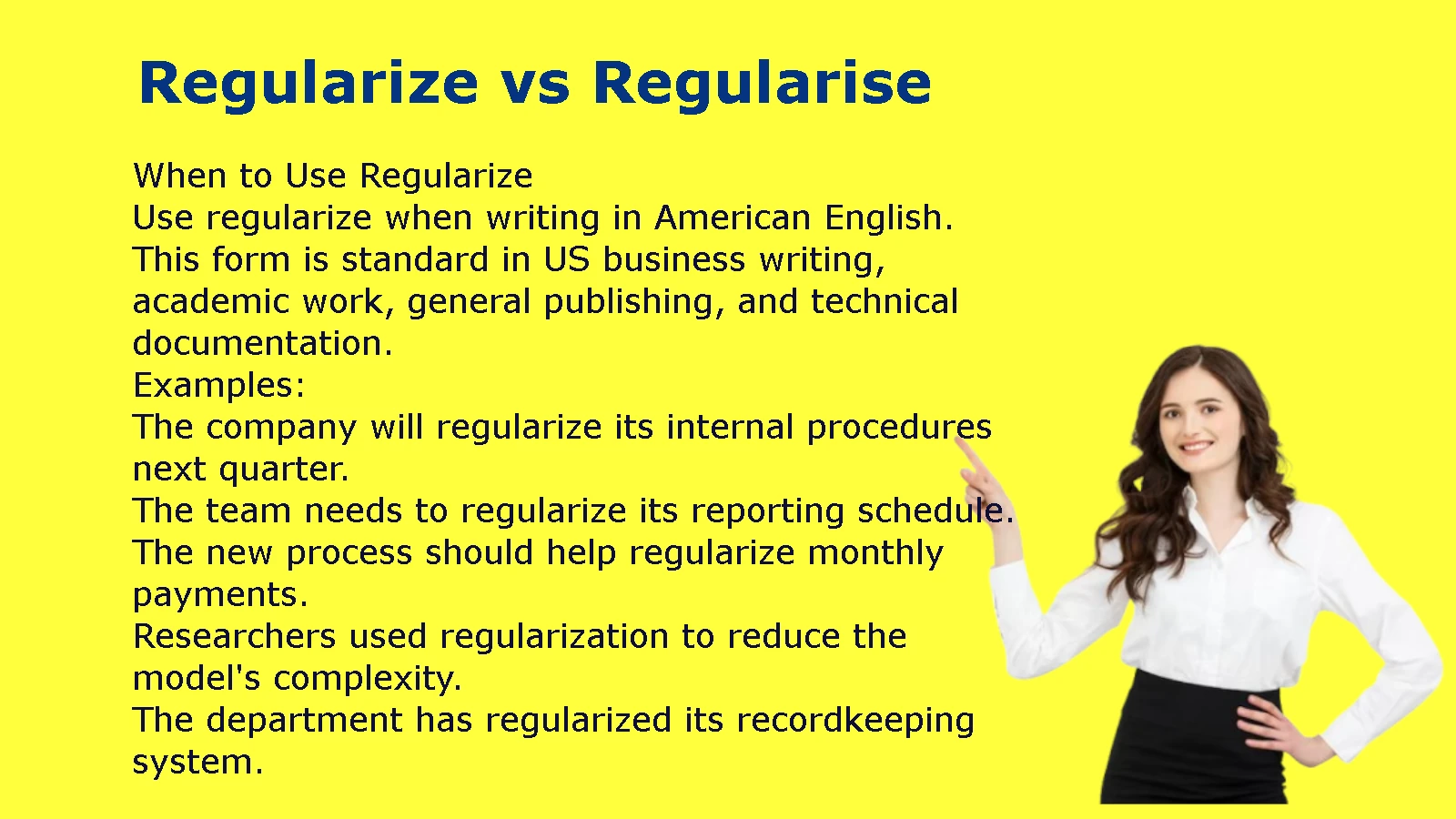
When to Use Regularize
Use regularize when writing in American English. This form is standard in US business writing, academic work, general publishing, and technical documentation.
Examples:
- The company will regularize its internal procedures next quarter.
- The team needs to regularize its reporting schedule.
- The new process should help regularize monthly payments.
- Researchers used regularization to reduce the model’s complexity.
- The department has regularized its recordkeeping system.
The spelling remains consistent across the word family:
| Word form | American spelling |
| Base verb | Regularize |
| Third-person singular | Regularizes |
| Past tense | Regularized |
| Present participle | Regularizing |
| Noun | Regularization |
| Related adjective | Regularized |
For a US-focused article, avoid switching between regularize and regularise without a specific reason. A reader may interpret the inconsistency as an editing mistake, especially when the words appear close together.
The same principle applies to the noun. If you write “regularize the process” in the opening section, use “regularization process” later in the same American English article.
When to Use Regularise
Use regularise when following the spelling conventions commonly associated with British English. The form also appears in other English varieties that generally follow British spelling, although individual style guides and regional practices may differ.
Examples:
- The company plans to regularise its procedures.
- Officials introduced a process to regularise eligible applications.
- The organization wants to regularise its reporting timetable.
- Researchers applied regularisation to the model.
- The department has regularised its records.
The related forms usually follow the same pattern:
| Word form | British-style spelling |
| Base verb | Regularise |
| Third-person singular | Regularises |
| Past tense | Regularised |
| Present participle | Regularising |
| Noun | Regularisation |
| Related adjective | Regularised |
British English does not require every word ending in -ize to change to -ise. For example, both organize and organise occur in British English, and some publishers prefer -ize spellings for certain words. However, regularise is the conventional British counterpart of American regularize.
If you are writing for a UK publication, check its style guide before making a site-wide spelling decision. Consistency matters more than switching spellings to satisfy an imagined universal rule.
Regularization vs Regularisation
Regularization is the American spelling of the noun, while regularisation is its common British counterpart. Both refer to the process or result of regularizing something. In technical writing, the spelling difference does not change the underlying mathematical or machine learning concept.
Examples:
- American English: “Regularization helps control the model’s complexity.”
- British English: “Regularisation helps control the model’s complexity.”
- American English: “The regularization of the procedure took several months.”
- British English: “The regularisation of the procedure took several months.”
The same distinction appears in related words:
| American English | British-style spelling |
| Regularize | Regularise |
| Regularizes | Regularises |
| Regularized | Regularised |
| Regularizing | Regularising |
| Regularization | Regularisation |
A useful editing tip is to search for both spellings before publishing. If you use a spelling checker, set it to the appropriate English variety. A US English checker may flag regularise, while a British English checker may accept it.
Is Regularize or Regularise More Correct?
Neither spelling is more correct in every situation. Regularize is the standard choice for American English, while regularise is the conventional British spelling. Both communicate the same meaning, so your decision should depend on the readers you want to reach.
Use this simple guide:
- US readers: Choose regularize and regularization.
- UK readers: Choose regularise and regularisation when following a style guide that prefers -ise.
- International readers: Follow the spelling system used by your organization or publication.
- Technical publications: Preserve the spelling convention used throughout the document, even when discussing terminology from another region.
Suppose you run an American business website. Your article uses “standardize,” “organize,” and “analyze.” In that case, “regularize” fits the same spelling system.
However, if your British publication consistently uses “standardise,” “organise,” and “analyse,” then “regularise” is the more natural choice.
Do not change the spelling simply because one version looks more formal. The audience and style guide should decide.
Standardize vs Regulate vs Regularize
Regularize, regulate, and standardize all relate to order or consistency, but each word emphasizes a different action. Regularize makes something regular or formally established, regulate controls it through rules, and standardize makes it conform to a shared standard.
Choosing the wrong word can change the meaning of a sentence.
Regularize vs Regulate
Regularize focuses on establishing a regular pattern, consistent procedure, or formal arrangement. Regulate focuses on controlling an activity or system through rules, limits, or authority.
Compare these examples:
- “The company wants to regularize employee schedules.” This means it wants to make schedules more consistent or predictable.
- “The government wants to regulate working conditions.” This means it wants to establish or enforce rules governing those conditions.
- “The department regularized its reporting process.” This means the department made reporting more systematic.
- “The agency regulates financial reporting.” This means the agency sets or enforces requirements for financial reports.
The distinction becomes especially important in legal, business, and policy writing.
For example, a government may regulate immigration procedures by establishing rules. A separate program may regularize the status of eligible applicants by providing a formal process for addressing their existing circumstances.
The words can appear in the same discussion, but they describe different actions.
| Feature | Regularize | Regulate |
| Main purpose | Establish regularity or formal order | Control through rules |
| Typical subject | Schedules, procedures, status, systems | Industries, behavior, activities, processes |
| Common context | Administration and organization | Law, policy, oversight |
| Example | Regularize the payment cycle | Regulate payment services |
Quick rule: If you mean “make consistent,” consider regularize. If you mean “control through rules,” choose regulate.
Regularize vs Standardize
Regularize means to make something regular, systematic, or formally established. Standardize means to make things conform to the same specification, method, or standard.
Imagine a company with five offices. Each office sends its weekly report on a different day. The company decides that every office must submit its report on Friday.
That change regularizes the reporting schedule because it establishes a consistent routine.
Now imagine each office uses a different report template. The company introduces one approved template for all five offices. That change standardizes the reports because it creates a common format.
Both actions can improve consistency, but they solve different problems.
| Situation | Better word | Reason |
| Making delivery dates predictable | Regularize | Establishes a regular schedule |
| Using one template across departments | Standardize | Creates a common format |
| Making a procedure official | Regularize or formalize | Establishes a recognized arrangement |
| Requiring every branch to follow the same checklist | Standardize | Ensures conformity to one method |
| Bringing an informal arrangement into a formal process | Regularize | Focuses on formal or systematic status |
The words sometimes overlap. A company may regularize and standardize a process at the same time. It might establish a predictable review schedule and require every department to use the same review criteria.
However, avoid treating the words as automatic synonyms. Ask yourself whether the main goal is regularity or uniformity.
Which Word Should You Use?
Choose the word that describes the action you want to emphasize.
- Use regularize when you want to create a regular pattern, formalize a situation, or bring a process into an established arrangement.
- Use regulate when you want to control behavior or an activity through rules.
- Use standardize when you want different people or systems to follow the same requirements.
- Use normalize when you want to bring something into a reference range, common pattern, or defined scale.
- Use formalize when you want to give an arrangement an official structure.
Consider this sentence: “We need to regularize the application process.”
That statement could mean the organization needs a predictable, established process. If the real objective is to require all applicants to use the same form, “standardize the application process” may be more precise. If the objective is to impose legally enforceable requirements, “regulate” might fit better, depending on the authority involved.
Clear word choice helps readers understand not only what is changing but also why.
Regularization vs Regularisation in Different Contexts
Regularization can refer to making a procedure more systematic, establishing an official arrangement, or applying a mathematical technique. Regularisation carries the same core meaning in British-style spelling. The context determines what the word means in practice.
Regularization in Everyday English
In everyday and professional writing, regularization usually describes the process of making something regular, consistent, or formally established.
For example:
- The regularization of payment dates helped customers plan their expenses.
- Regularization of the records reduced confusion between departments.
- The company began regularization of its internal procedures after an audit identified inconsistent practices.
In many sentences, a simpler word will sound more natural.
Instead of “The regularization of our weekly meetings improved communication,” you could write “Making our weekly meetings consistent improved communication.”
The longer form may suit a formal report or a discussion of an established administrative process. However, plain language often serves readers better when no technical distinction requires the term.
Use regularization when it names a specific process or appears in the relevant field’s established terminology. Choose “making consistent,” “formalizing,” or “standardizing” when those expressions communicate your meaning more clearly.
Regularization of Employee Meaning
Regularization of employees generally refers to a process that formally confirms or changes an employee’s status under an organization’s policies or applicable law. Depending on the jurisdiction and employment arrangement, it may involve moving from a temporary, casual, probationary, or otherwise non-permanent status into a recognized employment category.
The exact meaning varies. It does not automatically mean that every worker becomes a permanent employee, receives a promotion, or gains the same benefits.
For example, an organization might use the term when it reviews long-serving contract workers and determines whether they qualify for a different employment status under its rules.
A regularization process may involve:
- Reviewing the employee’s current contract and employment history.
- Checking eligibility under applicable laws and workplace policies.
- Confirming the authorized position and employment category.
- Reviewing required documents and approvals.
- Issuing a revised appointment letter or formal status confirmation, where appropriate.
- Explaining any changes to pay, benefits, duties, or other conditions.
The process and legal consequences depend on local employment law, the type of employer, and the terms governing the worker’s position.
Regularization vs Promotion
Regularization concerns formal employment status or the official recognition of an arrangement. Promotion generally means moving an employee to a higher position, often with increased responsibility and possibly higher pay.
An employee could receive regularized status without moving to a higher job title. Similarly, an employee could receive a promotion while retaining the same broad employment category.
Regularization vs Permanent Employment
Regularization may lead to permanent employment in some systems, but the terms are not universally interchangeable.
An organization may regularize an employee’s status by confirming a position, changing a contract category, or formally recording an arrangement. Whether that change creates permanent employment depends on the relevant law and the terms of the decision.
If you are interpreting an employment letter, check the exact wording. Look for the stated employment category, effective date, contract duration, benefits, and conditions. Do not rely on the word regularization alone to determine legal rights.
Regularization in Mathematics and Technical Fields
In mathematics and computing, regularization often refers to introducing constraints, penalties, or other structure to make a problem easier to solve, less sensitive to noise, or less prone to undesirable solutions.
The precise meaning depends on the field.
In statistics and machine learning, regularization often discourages overly complex models. In other mathematical settings, it can refer to methods that handle ill-posed problems or improve stability.
For example, a model that fits every detail of its training data may also learn random noise. Regularization can discourage that behavior by penalizing complexity.
This technical meaning is related to the everyday idea of bringing something into an orderly or controlled form, but it is more specific. A machine learning model is not being made regular in the sense of following a schedule. Instead, the learning process is constrained to encourage a useful solution.
Regularization in Machine Learning: Meaning and Purpose
Regularization in machine learning refers to methods that discourage excessive model complexity and can help reduce overfitting. These methods can improve a model’s performance on unseen data by discouraging it from relying too heavily on patterns that appear only in the training set.
Regularization is useful because a model can perform extremely well on training examples yet make poor predictions on new data.
What Is Regularization in Machine Learning?
Machine learning models learn patterns from data. A model that is too simple may miss important relationships, while a model that is too complex may memorize details that do not generalize.
This second problem is called overfitting.
Regularization helps manage model complexity by adding constraints or penalties to the learning process. In many methods, the training objective combines a data-fitting loss with a regularization term.
A simplified expression is:
Total objective = Data-fitting loss + Regularization penalty
The data-fitting loss measures how poorly the model predicts the training examples. The regularization penalty discourages certain kinds of complexity, such as excessively large model weights.
A tuning parameter controls how strongly the penalty influences training. In common formulations, increasing the penalty can encourage a simpler model, but too much regularization can cause underfitting.
Consider a model predicting house prices. It might learn useful patterns involving floor area, location, and property age. However, it could also react too strongly to unusual details in a small training dataset.
Regularization can discourage unnecessarily complicated relationships, potentially helping the model perform better on houses it has never seen.
Regularization does not guarantee good predictions. Results still depend on data quality, model selection, feature engineering, validation, and the type and strength of the regularization method.
Generalizationvs Regularization
Regularization is a technique used during model training, while generalization describes how well a model performs on new, unseen data. Regularization can improve generalization, but the two terms do not mean the same thing.
Imagine training a model to classify customer messages as urgent or non-urgent.
A model that memorizes the wording of every training message may perform well on those examples but struggle with new messages. That is poor generalization.
If you apply regularization, the training process may favor a less complex model that relies on more useful patterns. That can improve performance on unseen messages.
| Feature | Regularization | Generalization |
| What it is | A family of training techniques | A model’s ability to perform on new data |
| Main role | Discourage undesirable complexity | Measure performance beyond training examples |
| When it matters | During model development and training | During evaluation and real-world use |
| Example | Applying weight decay | Correctly classifying new messages |
The relationship is straightforward: regularization is one possible way to support generalization.
However, a regularized model can still generalize poorly if its training data is biased, its features are unsuitable, or the method is poorly chosen. Evaluate generalization with appropriate validation data and, when possible, a separate test set that the training process does not use.
Regularization vs Normalization in Machine Learning
Regularization controls model complexity or constrains the learning process. Normalization transforms data or features to a particular scale or reference. Both can help model training, but they solve different problems.
Suppose a model uses two features: annual income and number of purchases. Income might range from thousands to hundreds of thousands, while purchase counts might range from zero to a few dozen.
A normalization or scaling step can place features on comparable scales. That can help certain algorithms, especially those that depend on distances, gradients, or the relative magnitudes of features.
Regularization serves a different purpose. It may penalize large coefficients or randomly deactivate some units during training, depending on the method.
| Feature | Regularization | Normalization |
| Main purpose | Discourage excessive complexity | Adjust data or feature scales |
| Typical application | Training objective or model architecture | Data preprocessing or internal network layers |
| Example | L2 penalty on model weights | Scaling numeric features |
| Main concern | Overfitting and model complexity | Scale differences and numerical behavior |
The term normalization also has several meanings in machine learning. Feature normalization may rescale data, while batch normalization and layer normalization modify activations within neural networks.
Do not confuse these operations simply because both can affect training.
A model can use normalization and regularization together. For instance, a developer might scale numeric inputs and then train a model with weight decay. The two techniques address different concerns.
Regularization vs Optimization
Optimization is the process of finding model parameters that minimize an objective function. Regularization changes or constrains that learning problem to discourage undesirable solutions. Optimization determines how the model searches; regularization influences what solutions the training process favors.
A machine learning model might minimize a loss function that measures prediction errors. An optimization algorithm, such as stochastic gradient descent, updates the model parameters to reduce that loss.
When regularization is added, the objective may include an additional penalty.
A simplified example is:
Objective = Prediction loss + λ × Regularization penalty
Here, λ controls the penalty’s strength in this formulation. The precise objective depends on the model and regularization method.
The optimizer then works to minimize the combined objective.
| Feature | Regularization | Optimization |
| Main purpose | Influence model complexity or constraints | Find parameters that minimize an objective |
| Typical role | Adds a penalty or other constraint | Updates model parameters |
| Example | L2 weight penalty | Gradient descent |
| Relationship | Shapes the problem being solved | Searches for a solution to that problem |
A useful analogy is building a route planner. Optimization searches for an efficient route. Regularization adds a preference or constraint that discourages certain undesirable solutions. They can work together, but they perform different jobs.
The distinction matters when diagnosing model performance. If training fails to converge, the optimization setup may need attention. If the model fits training data too closely, regularization may help, although other causes should also be investigated.
Regularization vs Dropout
Dropout is a specific neural-network technique that can act as regularization. During training, dropout randomly deactivates selected units according to a configured probability. This discourages the network from relying too heavily on particular units or pathways.
Regularization is the broader category. Dropout is one method within that category.
Other approaches include L1 regularization, L2 regularization, weight decay, data augmentation, and early stopping. They work in different ways, and their suitability depends on the architecture, dataset, and training objective.
| Feature | General regularization | Dropout |
| Meaning | Broad family of techniques | One specific technique |
| How it works | Depends on the method | Randomly deactivates selected units during training |
| Typical use | Many types of models | Particularly associated with neural networks |
| Example | Penalizing large weights | Setting a dropout rate in a neural-network layer |
Imagine a neural network that relies heavily on a small group of units to recognize a pattern. Dropout forces the network to learn useful representations that do not depend entirely on those units being active in every training pass.
During ordinary inference, standard dropout layers generally do not randomly deactivate units in the same way they do during training. Frameworks typically handle the appropriate training and inference behavior automatically.
Dropout is not always the best choice. Some architectures and tasks benefit more from weight decay, data augmentation, or other techniques. Compare approaches using validation performance rather than assuming one method will always work better.
Examples of Regularization Techniques
Several regularization techniques address overfitting in different ways. The best option depends on the model, the data, and the type of complexity you want to discourage.
L1 Regularization
L1 regularization penalizes the absolute values of model coefficients.
In many linear models, this penalty can push some coefficients to exactly zero. As a result, L1 regularization can produce sparse models in which fewer features contribute directly to predictions.
It can be useful when a dataset contains many features and you want the model to reduce its reliance on some of them.
However, a zero coefficient does not necessarily prove that a feature is useless in every model or dataset. The result depends on the data, feature relationships, and penalty strength.
L2 Regularization and Weight Decay
L2 regularization commonly penalizes the squared magnitudes of model weights. This discourages unnecessarily large coefficients and can produce smoother, less extreme parameter values.
For example, a linear model might assign a very large coefficient to a feature because of a pattern specific to its training data. An L2 penalty can discourage that coefficient from growing too large.
The term weight decay is closely related and often used in discussions of neural-network training. Its exact relationship to L2 regularization depends on the optimizer and implementation. In standard gradient-descent settings, the two can be closely connected, but adaptive optimizers may handle weight decay differently.
Dropout
Dropout randomly deactivates selected neural-network units during training. The network must learn useful patterns that remain effective across different randomly selected subsets of active units.
It can help reduce over-reliance on particular pathways, although its benefits depend on the architecture and task.
Early Stopping
Early stopping ends training when performance on a validation set stops improving according to a chosen rule.
A model can become increasingly fitted to its training examples without improving its performance on new data. Early stopping helps limit training before that gap becomes too large.
It is not a direct penalty on model parameters, but it can serve as a practical form of regularization because it limits how far training proceeds.
Data Augmentation
Data augmentation creates modified training examples that preserve the relevant label or target. For instance, an image model may train on appropriately cropped, flipped, or slightly transformed images.
These variations can help the model learn patterns that remain useful across more examples. The transformations must make sense for the task. A transformation that changes the label or removes essential information can harm performance.
| Technique | Main mechanism | Potential benefit |
| L1 regularization | Penalizes absolute coefficient values | Can encourage sparse models |
| L2 regularization | Penalizes squared coefficient values | Discourages excessively large weights |
| Dropout | Randomly deactivates selected units during training | Reduces reliance on particular neural-network pathways |
| Early stopping | Stops training based on validation behavior | Limits unproductive training |
| Data augmentation | Expands training variation | Helps models learn more robust patterns |
No single technique solves every overfitting problem. Start with a suitable baseline, monitor training and validation performance, and adjust one or two methods at a time. This makes it easier to identify which changes actually improve the model.
Common Mistakes When Using Regularize and Regularise
Writers often confuse the two spellings, use regularize when they mean regulate, or overlook the different meanings of regularization in employment and machine learning. These mistakes are easy to avoid when you check the intended meaning and audience before publishing.
Mixing American and British Spellings
A common editing mistake is switching spelling systems within the same document.
Inconsistent example:
“The team will regularize the procedure and review the regularisation process next month.”
Consistent American English:
“The team will regularize the procedure and review the regularization process next month.”
Consistent British-style English:
“The team will regularise the procedure and review the regularisation process next month.”
The inconsistent version is not necessarily impossible to understand, but it can look careless in a professionally edited document.
To avoid the problem:
- Set your word processor to American or British English.
- Search for both forms before publishing.
- Keep related words consistent across headings, body text, tables, and image descriptions.
- Follow the publication’s style guide if it specifies a preferred spelling.
Pay attention to the whole word family. Changing regularize to regularise while leaving regularization unchanged may create inconsistency if your publication expects the -ise/-isation pattern.
Confusing Regularize With Regulate
Regularize and regulate share a similar appearance, but their meanings differ.
Incorrect word choice:
“The company plans to regularize the financial industry through new legal restrictions.”
If the intended meaning is that the company or a relevant authority will impose or enforce rules, regulate is likely the better choice.
More precise version:
“The agency plans to regulate the financial industry through new legal requirements.”
Now consider a different example:
“The company wants to regularize monthly billing.”
Here, regularize can work because the goal is to establish a predictable billing process.
When deciding between the words, ask whether the sentence emphasizes consistency or control.
Using Regularization Without Context
Regularization can refer to administrative formalization, employment status, statistical methods, or machine learning techniques. Readers need enough context to identify the intended meaning.
For example:
“The regularization process begins in July.”
This sentence leaves an important question unanswered: what is being regularized?
More informative alternatives include:
- “The employee regularization process begins in July.”
- “The regularization of payment schedules begins in July.”
- “The model’s regularization settings will be reviewed in July.”
Adding a clear subject helps readers understand the topic immediately. It also improves search relevance when the article targets a specific query, such as regularization of employee meaning or regularization in machine learning.
Frequently Asked Questions
Is Regularize or Regularise Correct?
Both regularize and regularise are correct. American English generally uses regularize, while British English commonly uses regularise. Both forms have the same meaning and pronunciation. Choose the spelling that matches your target audience and keep it consistent throughout your writing.
Is Regularise British or American?
Regularise is the conventional British spelling. American English generally uses regularize. The difference extends to related forms: regularisation is the British-style noun, while regularization is the American spelling. British publications may also use -ize spellings under certain style conventions, so follow the relevant house style.
What Is the Difference Between Regularize and Regulate?
Regularize means to make something regular, consistent, systematic, or formally established. Regulate means to control something through rules, requirements, or authority. For example, a company might regularize its payment schedule, while a government agency regulates the financial services industry.
What Is a Synonym for Regularise?
Common synonyms for regularise include standardize, normalize, formalize, systematize, organize, and stabilize. The best choice depends on the context. Use standardize when establishing a shared standard, formalize when making an arrangement official, and regulate when the intended meaning involves controlling an activity through rules.
What Does Regularization Mean in Machine Learning?
Regularization in machine learning refers to methods that discourage excessive model complexity and help reduce overfitting. Common techniques include L1 regularization, L2 regularization, dropout, and early stopping. These approaches can improve performance on unseen data, although their effectiveness depends on the model, dataset, and implementation.
What Does Regularization of Employees Mean?
Regularization of employees generally refers to formally confirming or changing an employee’s employment status under applicable policies or laws. Depending on the jurisdiction and employment arrangement, the process may involve recognizing an existing role or changing a worker’s employment category. It does not automatically mean promotion or permanent employment in every context.
Conclusion: Choose the Right Spelling for Your Audience
The difference between regularize and regularise comes down to regional spelling preferences, not meaning. Regularize is standard in American English, while regularise is the conventional British spelling. Their related forms follow the same general pattern: regularization and regularized in American English, and regularisation and regularised in British-style English.
The word also has useful applications beyond spelling. You can regularize a schedule to make it predictable, regularize a procedure to establish a consistent arrangement, or use regularization techniques to discourage excessive complexity in machine learning. In employment contexts, regularization may describe the formal confirmation or adjustment of an employee’s status, depending on local rules.
Remember these distinctions:
- Choose regularize for American English.
- Choose regularise for British-style spelling.
- Use regulate when you mean controlling something through rules.
- Use standardize when you mean making different things follow the same standard.
- Use regularization in technical writing when it refers to the established concept in mathematics or machine learning.