Lightning or lightening can be confusing because the words look almost identical but have different meanings. Lightning is the bright electrical flash you see during a storm, lightening means making something lighter in color, weight, or intensity, and lighting refers to the illumination used in homes, photography, films, and other settings. Although all three words relate to the idea of light, you cannot use them interchangeably.
Understanding the difference between lightning vs. lightening, lightning vs. lighting, and lightening vs. lightning pronunciation helps you avoid common spelling mistakes. The distinction also matters in British English, pregnancy terminology, weather descriptions, and photography. This guide explains each word with clear definitions, comparison tables, original sentence examples, synonyms, and practical tips to help you choose the correct spelling.
Lightning vs. Lightening vs. Lighting: What’s the Difference?
Lightning describes an electrical discharge in the atmosphere, lightening describes the process of becoming lighter, and lighting describes the arrangement or use of light. The correct spelling depends on what you want to express. If you are writing about a thunderstorm, use lightning. If you mean reducing darkness, weight, or intensity, use lightening. For illumination, choose lighting.
| Word | Meaning | Part of speech | Example |
| Lightning | An electrical discharge that produces a bright flash | Noun; also an adjective in some expressions | Lightning illuminated the sky. |
| Lightening | The act of making something lighter or less intense | Verb form of lighten | The lightening of the paint changed the room’s appearance. |
| Lighting | The illumination of a place or subject | Noun; also a verb form of light | The studio lighting made the portrait look professional. |
The simplest way to remember these words is to connect each spelling with its meaning. Lightning belongs to thunderstorms, it involves a change, and lighting helps people see.
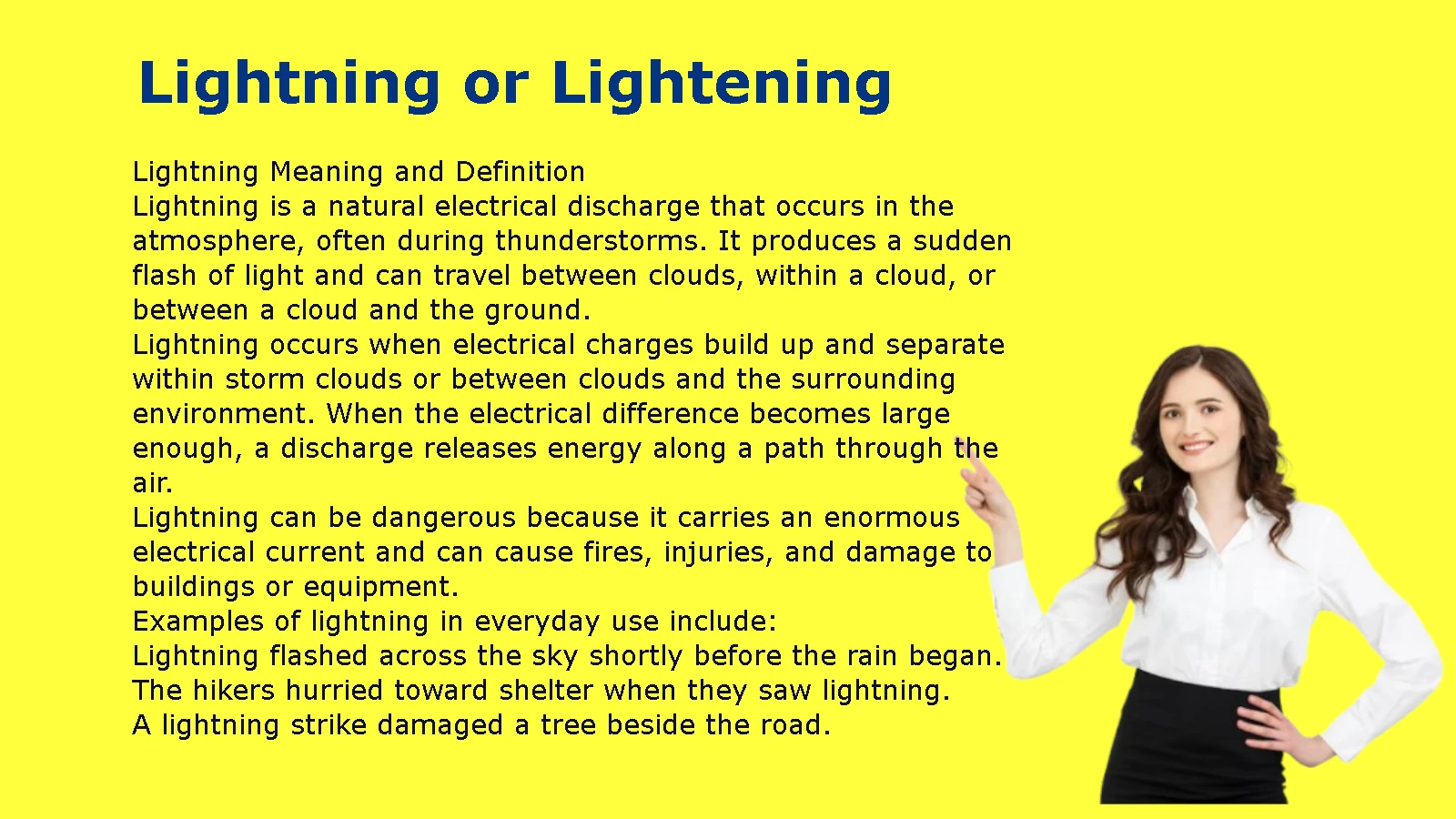
Lightning Meaning and Definition
It is a natural electrical discharge that occurs in the atmosphere, often during thunderstorms. It produces a sudden flash of light and can travel between clouds, within a cloud, or between a cloud and the ground.
Lightning occurs when electrical charges build up and separate within storm clouds or between clouds and the surrounding environment. When the electrical difference becomes large enough, a discharge releases energy along a path through the air.
Lightning can be dangerous because it carries an enormous electrical current and can cause fires, injuries, and damage to buildings or equipment.
Examples of lightning in everyday use include:
- Lightning flashed across the sky shortly before the rain began.
- The hikers hurried toward shelter when they saw lightning.
- A lightning strike damaged a tree beside the road.
- The photographer waited for lightning to illuminate the mountains.
- The sudden announcement spread through the office with lightning speed.
The word also appears in figurative expressions. For example, lightning-fast describes something that happens extremely quickly.
Lightening Meaning and Definition
Lightening is the present participle or gerund form of the verb lighten. It describes making something lighter, reducing its weight, or making a situation less serious or intense.
The word has several meanings depending on context.
Lightening in color: A substance or surface becomes paler.
- The stylist is lightening her client’s hair.
- The artist is lightening the blue paint with white.
- The clouds are lightening as the sun rises.
a load: Something becomes less heavy or burdensome.
- The workers are lightening their backpacks before the climb.
- Sharing responsibilities is lightening the manager’s workload.
- The new equipment is lightening the physical burden on the team.
Lightening a mood: A situation becomes less serious or tense.
- His joke is lightening the mood after a difficult meeting.
- The friendly conversation was lightening the atmosphere in the room.
In grammar, lightening can function as part of a verb phrase or as a noun-like gerund.
For example:
- Verb: She is lightening her hair.
- Gerund: Lightening the paint required several adjustments.
The key is the relationship with the verb lighten, which means to make or become lighter.
Lighting Meaning and Definition
Lighting refers to the illumination of a place, object, or subject. It can also describe the equipment, arrangement, or technique used to produce that illumination.
Lighting plays an important role in photography, filmmaking, interior design, theater, and architecture.
Examples include:
- The restaurant uses warm lighting to create a relaxed atmosphere.
- The photographer adjusted the lighting before taking the portrait.
- Better lighting made the product labels easier to read.
- The stage lighting changed during the final scene.
- Natural lighting gave the room a brighter appearance.
Like lightening, lighting can also function as a verb form.
- Noun: The lighting in the kitchen is too dim.
- Verb: The technician is lighting the candles.
Although lighting and lightening look similar, they describe different actions. Lighting provides illumination, while lightening makes something lighter in color, weight, or intensity.
Lightning or Lightening: Which Spelling Is Correct?
Both lightning and lightening are correct English words. Neither spelling is a universal replacement for the other. Use lightning for an electrical discharge during a storm and lightening when something becomes lighter or when describing the baby’s descent into the pelvis during pregnancy.
When to Use Lightning
Use lightning when you are writing about an electrical flash, a thunderstorm, or something that happens with extreme speed.
Common contexts include:
- Weather reports and forecasts
- Thunderstorms and electrical discharges
- Lightning strikes and storm safety
- Lightning photography
- Figurative expressions involving speed
Examples:
- Lightning struck the field during the storm.
- The weather service issued a warning about possible lightning.
- We watched lightning flicker behind the distant hills.
- She completed the task with lightning speed.
- The pilot avoided the storm because of the lightning risk.
Remember that lightning does not need to be followed by the word thunder. You can write about lightning independently when discussing electrical activity or storm conditions.
When to Use Lightening
Use lightening when you mean making something lighter or describing a process that reduces weight, darkness, seriousness, or intensity.
Common contexts include:
- Lightening hair or skin-colored materials
- Lightening paint or fabric
- Lightening a physical load
- Lightening a person’s mood
- Lightening during pregnancy
Examples:
- The hairdresser is lightening the client’s hair gradually.
- The artist is lightening the background to make the subject stand out.
- A smaller suitcase is lightening the traveler’s load.
- The comedian is lightening the mood with a funny story.
- The expectant mother noticed signs of lightening late in pregnancy.
One useful clue is the base verb lighten. If you can replace the word with a form of lighten without changing the intended meaning, lightening is probably correct.
Common Lightning and Lightening Spelling Mistakes
The most common mistake is choosing a spelling based on how the word looks instead of what the sentence means.
| Incorrect or confusing usage | Correct usage | Why |
| The lightening struck a tree. | The lightning struck a tree. | The sentence describes an electrical discharge. |
| The lightning of her hair took hours. | The lightening of her hair took hours. | The sentence describes making hair lighter. |
| We watched lightening during the storm. | We watched lightning during the storm. | The intended meaning is an electrical flash. |
| The hairdresser is lightning my hair. | The hairdresser is lightening my hair. | The hairdresser is changing the hair color. |
Not every sentence containing these words follows a simple visual rule. You must read the surrounding context to determine the intended meaning.
For instance, the sentence “The lightening sky revealed the mountains” can be correct because lightening describes the sky becoming brighter. However, “Lightning illuminated the mountains” describes a flash from an electrical discharge.
Lightning Spelling: Easy Ways to Remember It
Use these simple memory tricks to distinguish the three words.
- Lightning = electrical flash. Think of a thunderstorm and a sudden flash across the sky.
- Lightening = becoming lighter. Think of the verb lighten, as in lightening paint or reducing a load.
- Lighting = illumination. Think of lamps, studio lights, or the lighting in a room.
You can also remember the extra letters:
- Lightning contains no extra e between light and ning.
- Lightening includes the e associated with lighten.
- Lighting drops the e when the verb light takes the -ing ending.
This last distinction follows ordinary spelling patterns: lighten becomes lightening, while light becomes lighting.
Lightning vs. Lightening Pronunciation
Lightening and lightning have different standard pronunciations. Lightning generally has two syllables, while lightening has three. The additional syllable in lightening reflects its connection with the verb lighten. Although the words can sound similar in fast conversation, careful pronunciation helps distinguish them.
How to Pronounce Lightning
The word lightning is commonly pronounced LYTE-ning.
- Syllables: 2
- First syllable: light
- Second syllable: ning
The first syllable carries the main stress. The final part sounds like the ending in running.
Example: “Lightning flashed over the lake.”
When speaking, keep the two syllables connected without adding an extra vowel between them.
How to Pronounce Lightening
The word lightening is commonly pronounced LYE-tuh-ning.
- Syllables: 3
- First syllable: light
- Middle syllable: a short, unstressed sound
- Final syllable: ning
The extra syllable comes from the base word lighten.
Example: “The lightening clouds signaled a change in the weather.”
In this sentence, lightening means that the clouds were becoming brighter or less dark.
Do Lightning and Lightening Sound the Same?
No. In standard pronunciation, lightning has two syllables, while lightening has three. However, some speakers pronounce the middle syllable of lightening very quickly, which can make the difference less noticeable.
A useful way to practice is to say these sentences aloud:
- Lightning: Lightning flashed above the city.
- Lightening: The artist is lightening the shade of blue.
Listen for the extra syllable in lightening. If you need to communicate clearly in a presentation or recording, pronounce that middle syllable rather than rushing through the word.
Lightning or Lightening in British English (UK Spelling)
Lightning and lightening have the same spellings in British and American English. Unlike words such as colour and color, these terms do not change spelling based on the variety of English. Their meanings also remain consistent across the UK and the United States.
Is Lightning Spelled Differently in British English?
No. Lightning is the standard spelling in both British and American English when referring to the electrical discharge.
British English examples:
- The storm brought heavy rain and frequent lightning.
- Lightning struck a tree near the railway line.
- The forecast warned of thunderstorms and lightning.
American English uses the same spelling:
- The storm brought heavy rain and frequent lightning.
- Lightning struck a tree near the railroad tracks.
- The forecast warned of thunderstorms and lightning.
The vocabulary around the word may change, but the spelling of lightning does not.
Is Lightening Spelled Differently in the UK?
No. Lightening is also spelled the same way in British and American English.
Examples:
- The stylist is lightening her client’s hair.
- The sky is lightening as dawn approaches.
- The new process is lightening the team’s workload.
British writers should not replace lightening with lightning merely because they are writing for a UK audience.
Lightning, Lightening, or Lighting: British English Examples
These examples show how the three words work in everyday British English.
| Sentence | Correct word | Explanation |
| Lightning lit up the sky over Manchester. | Lightning | An electrical flash |
| The hairdresser is lightening the colour of her client’s hair. | Lightening | Making something paler |
| The lighting in the shop makes the products easy to see. | Lighting | Illumination |
| The sky was lightening before sunrise. | Lightening | Becoming brighter |
| The photographer captured lightning over the coast. | Lightning | Photographing an electrical flash |
Notice that colour is the British spelling in the second example, but lightening remains unchanged. The difference between these three target words concerns meaning rather than regional spelling.
Lightning vs. Thunder: What’s the Difference?
Lightning is an electrical discharge that produces a flash, while thunder is the sound created when lightning rapidly heats the surrounding air. The two often occur together during thunderstorms, but they are different physical phenomena. Lightning is visible, while thunder is audible.
What Is Lightning?
Lightning occurs when electrical charges build up in the atmosphere and discharge through the air. It can appear inside a cloud, between clouds, or between a cloud and the ground.
A lightning flash can illuminate an entire landscape for a brief moment. Cloud-to-ground lightning can also damage trees, buildings, power systems, and other objects.
For example:
“The lightning was so bright that the hills became visible in the darkness.”
In this sentence, lightning refers to the flash itself, not the sound that follows.
What Is Thunder?
Thunder is the sound caused by the rapid heating and expansion of air around a lightning channel. The intense heat causes the air to expand quickly, generating a pressure wave that travels through the atmosphere as sound.
Thunder may sound like a sharp crack, a deep boom, or a long rumble. The sound varies with the lightning channel, the distance from the listener, and atmospheric conditions.
Example:
“We heard a loud rumble of thunder after the lightning disappeared.”
Thunder can continue for several seconds because sound from different parts of an extended lightning channel reaches the listener at different times.
Why Do You See Lightning Before Hearing Thunder?
You usually see lightning before hearing thunder because light travels far faster than sound.
Light travels at approximately 300,000 kilometers per second, while sound travels through air at roughly 343 meters per second near room temperature.
This difference means the flash reaches your eyes almost immediately, while the sound takes longer to travel from the storm to your ears.
A rough distance estimate uses the time between the flash and the thunder:
- Watch for a lightning flash.
- Count the seconds until you hear thunder.
- Divide the number of seconds by five to estimate the distance in miles, or by three to estimate the distance in kilometers.
For example, if thunder arrives about nine seconds after a flash, the storm is roughly three kilometers away using the simple estimate.
This calculation is approximate because sound speed changes with temperature and wind. More importantly, hearing thunder means lightning is close enough to pose a risk. Move into a substantial enclosed building or a hard-topped vehicle rather than relying on the delay to decide whether you are safe.
Lightning and Thunder in Example Sentences
- Lightning flashed across the horizon, followed by a deep rumble of thunder.
- The children counted the seconds between lightning and thunder.
- Thunder shook the windows as lightning illuminated the clouds.
- The storm produced frequent lightning but only distant rumbles of thunder.
- We went indoors when we heard thunder and saw lightning approaching.
These examples demonstrate why lightning and thunder are related but not interchangeable.
Lightening in Pregnancy: What Does It Mean?
Lightening during pregnancy refers to the baby’s descent lower into the pregnant person’s pelvis as the body prepares for birth. This change can reduce pressure beneath the ribs and make breathing feel easier, but it may increase pelvic pressure and the need to urinate. It does not mean that lightning, the weather phenomenon, is involved.
What Is Lightening During Pregnancy?
In pregnancy, lightening describes the movement of the baby’s presenting part, usually the head, deeper into the pelvis. People sometimes call this the baby “dropping.”
The movement can change how the pregnant person feels because the baby’s position shifts relative to the diaphragm, stomach, bladder, and pelvic structures.
Possible changes include:
- Less pressure beneath the ribs.
- Easier breathing for some people.
- Increased pressure in the pelvis.
- More frequent urination.
- A feeling that the baby sits lower in the abdomen.
Not everyone notices a clear change. The baby’s position and the pregnant person’s anatomy can influence how lightening feels.
When Does Lightening Happen During Pregnancy?
Lightening often occurs during the final weeks of pregnancy, but its timing varies.
For a first pregnancy, the baby may descend several weeks before labor begins. In later pregnancies, lightening may happen closer to the start of labor or become noticeable only shortly beforehand.
However, lightening does not predict exactly when labor will begin. Some babies descend earlier, while others remain higher until labor progresses.
A pregnant person should not use this change alone to determine whether delivery is imminent. Regular contractions, leaking fluid, vaginal bleeding, reduced fetal movement, and other symptoms may require medical advice depending on the circumstances.
Contact a maternity care professional if you are unsure whether a change in symptoms is normal. Seek urgent assessment for warning signs such as significant bleeding, severe or persistent abdominal pain, or reduced fetal movement.
What Does Lightening Feel Like?
The experience differs from person to person. Some people notice an obvious change in the shape or position of the abdomen, while others do not notice any distinct sensation.
Possible experiences include:
- Reduced upper-abdominal pressure: The baby may place less pressure beneath the ribs.
- Changes in breathing comfort: Some people feel that taking a deep breath becomes easier.
- Increased pelvic pressure: The baby’s lower position can create a heavier feeling in the pelvis.
- More frequent bathroom trips: Pressure on the bladder may increase.
- Changes in walking comfort: Pelvic pressure may affect how someone moves.
These changes do not confirm that the baby has descended. A maternity care professional can assess the baby’s position when needed.
Lightening vs. Lightning in Pregnancy
The correct term for a baby’s descent into the pelvis is lightening, with an extra e.
| Term | Meaning | Pregnancy example |
| Lightening | The baby descends lower into the pelvis | She noticed lightening several weeks before labor. |
| Lightning | An electrical discharge in the atmosphere | Lightning flashed during her journey to the hospital. |
| Lighting | Illumination from lamps or other sources | The hospital adjusted the lighting in the examination room. |
A helpful memory trick is to connect lightening with a change in position or pressure. The word comes from lighten, not from the weather term lightning.
Lightning or Lighting in Photography?
In photography, lighting refers to the illumination of a subject or scene. Lightning photography, by contrast, involves capturing electrical flashes during storms. The correct word depends on whether you are describing how a photographer controls light or photographing the weather phenomenon itself.
What Does Lighting Mean in Photography?
Lighting determines how a camera records the brightness, shadows, colors, texture, and depth of a scene.
Photographers use natural light, artificial lights, reflectors, and modifiers to shape the appearance of a subject. The right lighting can make a face look softer, reveal details in a product, or create a dramatic atmosphere.
Important lighting concepts include:
- Natural lighting: Sunlight entering a room or illuminating an outdoor scene.
- Studio lighting: Artificial light sources used to control a photograph’s appearance.
- Backlighting: Light placed behind the subject to create separation or a silhouette.
- Soft lighting: Diffused light that produces gentler shadows.
- Low-light photography: Photographing scenes where little light is available.
For example, “The photographer changed the lighting to reduce shadows on the model’s face” uses the word correctly because it refers to illumination.
Is It Lighting or Lightning in Photography?
Use lighting when discussing light sources, exposure conditions, or the arrangement of light in a photograph.
Use lightning when referring to electrical flashes in the sky.
Compare these sentences:
- Correct: The photographer adjusted the lighting to make the portrait brighter.
- Correct: The photographer captured lightning above the mountains.
- Incorrect for the intended meaning: The studio lightning made the product look better.
- Incorrect for the intended meaning: The photographer adjusted the lightening in the studio.
The final example could be correct in a different context if the photographer were making a material or background lighter. However, when discussing the arrangement of illumination, lighting is the right word.
Common Photography Lighting Examples
Portrait photography: A photographer may use a large softbox to create gentle shadows and flattering light.
Product photography: Even lighting can help customers see a product’s color, texture, and details accurately.
Landscape photography: Photographers often work with natural lighting around sunrise or sunset to capture softer shadows and warmer colors.
Indoor photography: A photographer may combine window light with a reflector to brighten the subject without creating harsh shadows.
Each example uses lighting because the subject concerns illumination rather than an electrical storm.
Lightning Photography vs. Photography Lighting
These expressions describe two different activities.
| Expression | Meaning | Example |
| Lightning photography | Photographing lightning during a storm | She specializes in lightning photography. |
| Photography lighting | Controlling illumination when taking photographs | The studio invested in new photography lighting. |
| Lightning flash | A brief electrical discharge | The lightning flash illuminated the valley. |
| Lighting setup | The arrangement of lamps, flashes, or other light sources | The photographer tested the lighting setup before the shoot. |
A photographer may use a tripod, a suitable exposure, and a safe location to photograph lightning. By contrast, a studio photographer may use flash units or continuous lights to control the scene.
Never sacrifice storm safety to capture a photograph. Use a sheltered location and avoid exposed areas during thunderstorms.
Lightening Synonyms and Related Words
The best lightening synonym depends on what is becoming lighter. Brightening may describe an increase in brightness, paling may describe a reduction in color intensity, and reducing may describe a lighter workload. These words overlap in some situations, but they do not carry exactly the same meaning.
Synonyms for Lightening Color
When lightening means making a color less dark or intense, useful alternatives include:
- Brightening: Making something appear brighter.
- Paling: Becoming or making something paler.
- Bleaching: Removing or reducing color, often through a chemical or other treatment.
- Fading: Losing color or intensity over time.
- Whitening: Making something whiter.
Examples:
- “The designer is brightening the background.”
- “The fabric is fading after repeated exposure to sunlight.”
- “The stylist is lightening the client’s hair.”
These terms are not interchangeable in every situation. Bleaching, for example, may suggest a specific treatment, while brightening can refer to a visual effect.
Synonyms for Lightening Weight or Load
When lightening refers to reducing a burden, suitable alternatives include:
- Reducing: Making an amount or burden smaller.
- Easing: Making something less difficult or uncomfortable.
- Lessening: Decreasing the degree or intensity of something.
- Unburdening: Removing a physical or emotional burden.
- Relieving: Reducing pressure, strain, or discomfort.
Examples:
- “The team is reducing the amount of equipment it carries.”
- “Delegating tasks is easing the manager’s workload.”
- “Sharing responsibilities is lightening the burden on everyone.”
The best synonym depends on the intended emphasis. Reducing is broad, easing highlights lower difficulty, and unburdening emphasizes the removal of a burden.
Words Related to Lightning
There are several words associated with lightning, but not all of them are exact synonyms.
- Electrical discharge: A technical term describing the release of electrical energy.
- Flash: A brief burst of light, which may be caused by lightning or another source.
- Thunderstorm: A storm associated with thunder and lightning.
- Lightning strike: A lightning discharge that reaches an object or the ground.
- Bolt: An informal or descriptive term for a visible lightning discharge.
For example, electrical discharge is useful in scientific explanations, while flash may be more suitable for a general description.
Words Related to Lighting
Common synonyms and related expressions for lighting include:
- Illumination: Light provided to a space or object.
- Brightness: The quality or level of being bright.
- Lighting design: The planning of illumination for a specific environment.
- Light fixtures: Devices that hold or produce light sources.
- Light arrangement: The placement of light sources to achieve a particular effect.
For example, “The illumination in the hallway was too dim” conveys a meaning similar to “The lighting in the hallway was too dim.”
However, lighting design refers to planning how a space will be lit, not merely the brightness of the light.
Lightning, Lightening, and Lighting in a Sentence
Seeing each word in context makes the difference easier to remember. The following original examples cover weather, color changes, everyday activities, photography, and figurative expressions.
Lightning in a Sentence
Use lightning when referring to an electrical discharge or when describing exceptional speed.
- Lightning flashed across the sky as the storm approached the coast.
- The campers returned to their vehicles when lightning appeared over the hills.
- A sudden lightning strike damaged the old oak tree.
- The photographer captured lightning illuminating the clouds above the city.
- The sprinter moved with lightning speed during the final stretch.
In the final example, lightning speed is a figurative expression. It means extremely fast movement, not literal electrical activity.
Lightening in a Sentence
Use lightening when something becomes lighter in color, weight, or intensity.
- The artist is lightening the background to make the subject stand out.
- The stylist recommended lightening the hair gradually rather than changing the color in one session.
- Removing unnecessary equipment is lightening the hikers’ packs.
- Her humorous comment was lightening the mood after a tense discussion.
- The pregnant patient asked her midwife about lightening before labor.
Notice how the surrounding words establish the intended meaning. Hair, equipment, mood, and pregnancy all point toward the verb lighten, not the weather phenomenon.
Lighting in a Sentence
Use lighting when discussing illumination, light fixtures, or the arrangement of light sources.
- The lighting in the kitchen made food preparation easier after sunset.
- The photographer adjusted the lighting to soften the shadows around the subject.
- Warm lighting gave the hotel lobby a welcoming atmosphere.
- The film crew tested the lighting before recording the opening scene.
- Better lighting helped the students read the small print on the display.
In these sentences, lighting refers to the use or arrangement of light.
Lightning or Lightening: Practice Examples
Choose the correct word for each sentence: lightning, lightening, or lighting.
- The sudden flash of ______ startled everyone in the garden.
- The designer is ______ the wall color to make the room look larger.
- The photographer changed the ______ before taking the portrait.
- The baby began descending into the pelvis, a process known as ______.
- The storm produced frequent ______ but little rain.
- The new backpack is ______ the load carried by the hikers.
- The restaurant installed warmer ______ above the tables.
- The sky was ______ as the sun rose.
Answer key
- Lightning
- Lightening
- Lighting
- Lightening
- Lightning
- Lightening
- Lighting
- Lightening
The answers follow a simple principle: electrical flashes require lightning, a change toward something lighter requires lightening, and illumination requires lighting.
Common Mistakes When Using Lightning, Lightening, and Lighting
The most effective way to avoid these spelling mistakes is to identify the meaning before choosing the word. The three spellings are related in appearance, but each serves a different purpose.
Confusing Lightning With Lightening
This mistake often occurs when a sentence discusses something becoming brighter.
Compare:
- “Lightning flashed across the sky.” The sentence describes an electrical discharge.
- “The sky was lightening.” The sentence describes the sky becoming brighter.
- “The lightening of the paint took several hours.” The sentence describes a color change.
The second sentence does not require an electrical storm. It describes a gradual change in the sky’s appearance.
Confusing Lightning With Lighting
Writers sometimes use lightning when they mean illumination.
Compare:
- Incorrect: The lighting struck the building during the storm.
- Correct: The lightning struck the building during the storm.
- Correct: The lighting in the building was bright and even.
The word lighting usually appears in discussions about interior design, photography, theater, and visual environments.
Using Lightening When You Mean Lighting
The difference is particularly important when describing photography or interior spaces.
Compare:
- “The lighting makes the room look warm.” This describes illumination.
- “The lightening of the wall paint makes the room look brighter.” This describes a color change.
Both sentences can be correct, but they describe different processes. Lighting changes how a space is illuminated; lightening changes the color, weight, or intensity of something.
A Quick Rule for Choosing the Correct Word
Use this quick decision guide before publishing or submitting your writing.
| If you mean… | Choose… | Memory clue |
| An electrical flash during a storm | Lightning | Thunderstorms |
| Making hair or paint paler | Lightening | Lighten |
| Reducing a physical or emotional burden | Lightening | Make lighter |
| A baby’s descent into the pelvis | Lightening | Pregnancy |
| Lamps or illumination in a room | Lighting | Light sources |
| Arranging illumination for a photograph | Lighting | Photography equipment |
| Photographing electrical flashes in a storm | Lightning photography | Weather photography |
A final proofreading trick is to replace the word temporarily with a short definition. If the sentence means “an electrical flash,” choose lightning. If it means “making something lighter,” choose lightening.
Frequently Asked Questions
Is It Lightning or Lightening?
Both spellings are correct, but they have different meanings. Lightning is an electrical discharge that produces a flash during a storm. Lightening means making something lighter in color, weight, or intensity. It also describes a baby’s descent into the pelvis during pregnancy.
Is Lightning or Lightening Correct in the UK?
Both lightning and lightening are correct in British English. Their spellings are the same in the UK and the United States. Use lightning for the weather phenomenon and lightening for a change toward something lighter.
Do Lightning and Lightening Have the Same Pronunciation?
No. Lightning is generally pronounced with two syllables, while lightening has three. The additional syllable in lightening comes from its connection with the verb lighten. In fast speech, the distinction may be less noticeable.
Is It Lighting or Lightning in Photography?
Lighting is correct when referring to illumination, studio lights, or the arrangement of light sources. Lightning photography refers to photographing electrical flashes during storms. The correct choice depends on whether you mean controlling illumination or capturing a weather event.
What Is the Difference Between Lightning and Thunder?
Lightning is an electrical discharge that produces a bright flash. Thunder is the sound created when lightning rapidly heats and expands the surrounding air. You generally see lightning before hearing thunder because light travels much faster than sound.
What Does Lightening Mean During Pregnancy?
Lightening during pregnancy refers to the baby’s descent lower into the pelvis as the body prepares for birth. It may ease pressure beneath the ribs while increasing pelvic pressure or the need to urinate. The timing varies, and lightening alone cannot predict exactly when labor will begin.
Conclusion: Lightning or Lightening?
The difference between lightning or lightening comes down to meaning, not regional spelling. Lightning describes an electrical discharge during a storm, lightening describes making something lighter or a baby’s descent during pregnancy, and lighting refers to illumination.
Before choosing a spelling, consider what your sentence describes:
- Use lightning for storms, electrical flashes, and expressions such as lightning-fast.
- Use lightening for changes in color, weight, mood, intensity, or pregnancy-related descent.
- Use lighting for lamps, illumination, photography, and the arrangement of light sources.
These distinctions apply in both British and American English. Once you connect each word with its meaning, you can choose the correct spelling without relying on guesswork.