Incentivize vs Incentivise is a spelling difference between American and British English, not a difference in meaning. Both words mean to encourage someone to take an action by offering a reward, benefit, or other motivation. American English generally uses incentivize, while British English commonly uses incentivise.
Understanding the difference helps you choose the right spelling for your audience, whether you’re writing a business proposal, an employee policy, a school assignment, or a marketing campaign. You’ll also learn the meaning of incentivise, whether it’s a real English word, its most useful synonyms, the opposite of incentivise, and how to use both spellings naturally in sentences.
Incentivize vs Incentivise: What’s the Difference?
Incentivize and incentivise are two accepted spellings of the same verb. The main difference is regional spelling preference: American English favors the -ize ending, while British English commonly uses -ise. Neither spelling changes the word’s definition, pronunciation in any meaningful regional sense, or grammatical function.
| Feature | Incentivize | Incentivise |
| Preferred spelling | American English | Common British English |
| Part of speech | Verb | Verb |
| Meaning | Encourage action through an incentive | Encourage action through an incentive |
| Example | The company will incentivize employees to meet their goals. | The company will incentivise employees to meet their goals. |
| Noun form | Incentive | Incentive |
| Present participle | Incentivizing | Incentivising |
| Past tense | Incentivized | Incentivised |
The easiest way to remember the distinction is to consider your audience. If you’re writing for readers in the United States, choose incentivize. If you’re writing for a British audience that follows -ise spellings, choose incentivise.
Both forms are understood internationally. However, using the spelling your readers expect makes your writing look more consistent and professional.
Incentivize Is the Preferred American English Spelling
Incentivize is the standard spelling in American English. American businesses, schools, government organizations, and marketing teams commonly use it when discussing ways to encourage a particular behavior.
For example:
- The retailer plans to incentivize repeat purchases with a loyalty program.
- Managers can incentivize better performance by offering meaningful rewards.
- The school introduced a program to incentivize regular attendance.
- The city wants to incentivize homeowners to install energy-efficient appliances.
In each sentence, the verb describes an effort to influence behavior by offering a benefit or creating a motivation.
The spelling follows the American preference for -ize in words such as organize, prioritize, and modernize. These words often have corresponding British forms ending in -ise, although not every English word follows the same regional pattern.
Writing tip: If your article uses American spellings such as organize, prioritize, and recognize, use incentivize to maintain consistency.
Incentivise Is Common in British English
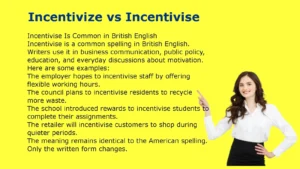
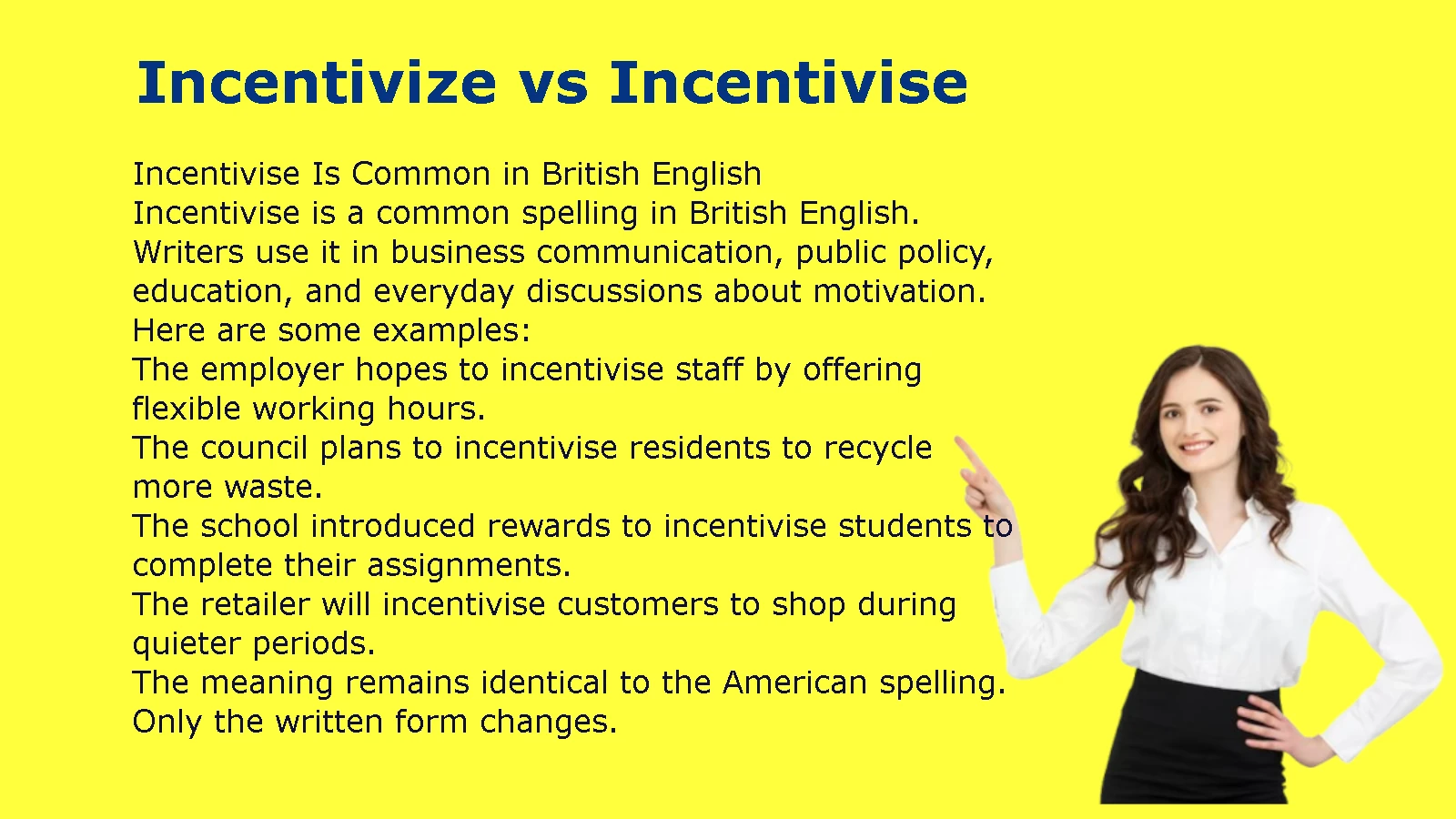
Incentivise is a common spelling in British English. Writers use it in business communication, public policy, education, and everyday discussions about motivation.
Here are some examples:
- The employer hopes to incentivise staff by offering flexible working hours.
- The council plans to incentivise residents to recycle more waste.
- The school introduced rewards to incentivise students to complete their assignments.
- The retailer will incentivise customers to shop during quieter periods.
The meaning remains identical to the American spelling. Only the written form changes.
British English often uses -ise in words such as organise, prioritise, and modernise. However, British spelling isn’t governed by one universal rule that changes every -ize word to -ise. Some British publications also accept or prefer -ize forms.
Writing tip: Follow the style guide used by your employer, publisher, or website. Consistency matters more than assuming that every British writer uses -ise.
Incentivize vs Incentivise: Which One Should You Choose?
Choose the spelling that matches your audience and the conventions of your document. You don’t need to learn two different meanings or use the words in different situations.
Consider these examples:
| Situation | Recommended spelling | Example |
| An American business proposal | Incentivize | We will incentivize customers to renew their subscriptions. |
| A British company report using -ise spellings | Incentivise | We will incentivise customers to renew their subscriptions. |
| An American academic paper | Incentivize | The policy aims to incentivize participation. |
| A British marketing campaign | Incentivise | The offer will incentivise customers to return. |
| An international website | Follow the chosen style | Use one spelling consistently across related pages. |
The distinction becomes especially important when you publish content for a specific country. A US reader may expect incentivize, while a UK reader may be more accustomed to incentivise.
Neither spelling is inherently more formal or more meaningful than the other.
What Does Incentivise Mean?
Incentivise means to encourage someone to do something by offering a reward, benefit, or other incentive. The word describes an attempt to influence behavior by making a particular action more attractive. Incentives can include money, discounts, recognition, extra time off, access to opportunities, or other benefits.
For example, a company might incentivise employees to meet sales targets by offering bonuses. A shop might incentivise repeat purchases with a loyalty scheme. A school might incentivise participation by recognizing students who consistently complete their work.
The American spelling, incentivize, carries exactly the same meaning.
Incentivise Meaning in Simple English
In simple terms, to incentivise someone means to give them a reason to do something.
The reason usually involves a benefit that makes the desired action more appealing. That benefit doesn’t always have to be financial.
For example:
- A store offers a discount to encourage customers to buy more products.
- A company gives employees bonuses for meeting performance targets.
- A teacher recognizes students who complete optional learning activities.
- A gym offers members a reward for attending regularly.
Each example involves an incentive that encourages a specific behavior.
However, incentivising someone doesn’t guarantee that the person will act as intended. A customer may ignore a discount, or an employee may decide that a bonus isn’t worth the extra work.
The verb describes the attempt to encourage behavior, not a guaranteed outcome.
Is Incentivise a Word?
Yes, incentivise is a real English word. It’s a recognized verb commonly used in British English. The spelling incentivize is more typical of American English, but both forms communicate the same idea.
You can use incentivise in a sentence such as:
“The company introduced a bonus scheme to incentivise employees to improve customer service.”
You can write the same sentence in American English by changing incentivise to incentivize. The meaning remains unchanged.
The word is particularly common in business, economics, marketing, management, and public policy. It often appears when people discuss how rewards or financial arrangements influence decisions.
Although the word is useful in professional contexts, it can sometimes sound like business jargon. In casual writing, phrases such as encourage people, offer rewards, or motivate employees may communicate the idea more clearly.
What Is the Difference Between Incentive and Incentivise?
The difference is grammatical: incentive is a noun, while incentivise is a verb.
An incentive is the reward, benefit, or motivating factor itself. To incentivise is to use an incentive or another form of motivation to encourage an action.
| Word | Part of speech | Meaning | Example |
| Incentive | Noun | Something that encourages action | The bonus is an incentive to improve performance. |
| Incentivise | Verb | To encourage through an incentive | The bonus may incentivise employees to improve performance. |
| Incentivize | Verb | American spelling of incentivise | The bonus may incentivize employees to improve performance. |
| Incentivising | Verb form | Encouraging through an incentive | The manager is incentivising the team with rewards. |
| Incentivised | Past tense or participle | Encouraged through an incentive | The scheme incentivised customers to return. |
The distinction becomes clearer when you compare the words in context.
Example one:
“The company offers a cash incentive.”
Here, incentive names the benefit.
Example two:
“The company uses cash bonuses to incentivise its employees.”
Here, incentivise describes what the company does.
A useful rule is to ask whether you’re naming a benefit or describing an action. If you’re naming the benefit, use incentive. If you’re describing the act of encouraging someone, use incentivise or incentivize.
How to Use Incentivize and Incentivise in a Sentence
Use incentivize or incentivise when you want to explain how a reward, benefit, or other motivating factor encourages a particular behavior. The verb works especially well in discussions about employees, customers, students, public policy, and business strategy.
The word usually takes a person, group, or organization as its object, followed by an explanation of the behavior being encouraged.
For example: “The program will incentivize employees to share new ideas.”
Here, employees identifies the people being encouraged, while to share new ideas identifies the desired behavior.
Incentivize in a Sentence: American English Examples
The following examples use the American spelling and cover different situations.
Business and employee management
- The company will incentivize employees to exceed their quarterly sales targets.
- Managers can incentivize teamwork by rewarding groups for shared results.
- The new bonus structure aims to incentivize staff to provide better customer service.
- The employer hopes to incentivize innovation by giving workers time to develop new ideas.
Marketing and customer behavior
- The retailer will incentivize repeat purchases with a points-based loyalty program.
- The brand offered free shipping to incentivize customers to complete their orders.
- The subscription service uses discounted annual plans to incentivize long-term commitments.
Education and public policy
- The school hopes to incentivize attendance by recognizing consistent participation.
- The city introduced rebates to incentivize homeowners to install solar panels.
- The program aims to incentivize recycling through household rewards.
These examples show that the verb can describe financial and nonfinancial incentives. A cash bonus is one option, but convenience, recognition, discounts, and opportunities can also encourage behavior.
Incentivise in a Sentence: British English Examples
These examples use the British spelling. Their meanings match the American versions above.
Business and employee management
- The company will incentivise employees to achieve their annual targets.
- Managers can incentivise teamwork by rewarding shared achievements.
- The new bonus scheme aims to incentivise staff to improve customer service.
- The employer hopes to incentivise innovation by supporting new ideas.
Marketing and customer behavior
- The retailer will incentivise repeat purchases through a loyalty scheme.
- The brand offered free delivery to incentivise customers to complete their orders.
- The subscription service uses reduced annual prices to incentivise long-term commitments.
Education and public policy
- The school hopes to incentivise attendance by recognizing regular participation.
- The council introduced grants to incentivise homeowners to install solar panels.
- The programme aims to incentivise recycling through household rewards.
Notice that other words may change with regional spelling conventions too. For example, British English commonly uses programme in contexts where American English uses program, and recognising instead of recognizing.
When adapting a sentence for a different audience, check the spelling of the entire document rather than changing only one word.
Common Usage Mistakes to Avoid
Although incentivize and incentivise are straightforward verbs, writers sometimes use them in ways that make sentences vague or awkward.
Mistake: Treating the spelling variants as different words
Incorrect assumption: “Incentivize means to offer money, while incentivise means to offer any reward.”
Better understanding: Both spellings can describe financial or nonfinancial incentives.
Mistake: Confusing an incentive with a guaranteed result
Awkward: “The discount incentivized every customer to buy the product.”
Clearer: “The discount incentivized some customers to buy the product.”
The second sentence avoids claiming that every customer responded to the offer.
Mistake: Using the word when a simpler verb works better
Corporate wording: “We will incentivize users to engage with the platform.”
Simpler wording: “We’ll encourage users to participate on the platform by offering rewards.”
The first version is appropriate when discussing a formal strategy. The second may work better in customer-facing content.
Mistake: Forgetting regional consistency
If your document uses organize, prioritize, and recognize, switching to incentivise may look inconsistent in American English. If your document follows British -ise spellings, incentivise will usually fit better.
Incentivize vs Incentivise in UK and US English
The main regional difference concerns spelling conventions. American English generally prefers incentivize, while British English commonly uses incentivise. Both forms are widely understandable, so the best choice depends on your intended audience and the style rules you follow.
Which Spelling Should You Use in the UK?
For UK-facing content that follows conventional British -ise spellings, use incentivise.
For example:
“The retailer hopes to incentivise customers by offering free delivery on their next purchase.”
This spelling fits naturally alongside forms such as organise, prioritise, and recognise when the publication uses those variants.
However, British English doesn’t require every writer or publisher to use -ise. Some British publications accept or prefer -ize spellings. If a company or publication specifies a style guide, follow that guidance.
For a UK website, check these details before publishing:
- Does the site use organise or organize?
- Does it use prioritise or prioritize?
- Does its existing content follow a consistent regional style?
- Does the publication have a preferred dictionary or editorial guide?
Use the answers to choose the spelling that fits the rest of the site.
Which Spelling Should You Use in the US?
For American readers, incentivize is the standard choice.
For example:
“The company will incentivize customers to renew their subscriptions by offering a reduced annual rate.”
The spelling aligns with common American forms such as organize, prioritize, and recognize.
American businesses often use the word in employee compensation plans, sales strategies, customer retention programs, and policy discussions. It can describe an actual financial reward or a broader effort to make a behavior more appealing.
If you’re writing a US-focused blog post, business report, or academic assignment, use incentivize unless the required style guide specifies otherwise.
Is -Ize or -Ise Always British or American?
No. The distinction is a useful guide, but it isn’t an absolute rule for every English word or publication.
Many verbs have both forms, including organize/organise and prioritize/prioritise. However, some words have established spellings that don’t follow a simple regional conversion.
For example, advertise and revise are standard spellings in both American and British English. Writers don’t normally change them to advertize or revize just to make them fit an -ize pattern.
The suffix also has a history beyond modern US spelling. British English has long included -ize forms, and some British dictionaries and style guides continue to prefer them.
The practical lesson is simple: don’t apply the spelling rule mechanically. Check the individual word when you’re unsure, then follow your publication’s preferred style.
Incentivise Synonyms and Alternatives
Several words can replace incentivise or incentivize, but each has a slightly different meaning. The best synonym depends on whether you’re offering a reward, inspiring action, changing someone’s attitude, or making a behavior more attractive.
Common Synonyms for Incentivise
| Synonym | Meaning | Example |
| Encourage | Give someone support or a reason to act | The manager encouraged employees to share ideas. |
| Motivate | Give someone a reason or desire to act | The bonus motivated the team to reach its target. |
| Reward | Give a benefit in recognition of an action | The company rewarded staff for excellent service. |
| Stimulate | Encourage activity, growth, or interest | The campaign stimulated demand for the new product. |
| Persuade | Convince someone to do something | The offer persuaded some customers to switch providers. |
| Prompt | Cause or encourage a response | The reminder prompted customers to renew their plans. |
| Entice | Attract someone with something appealing | The discount enticed shoppers to visit the store. |
| Spur | Encourage faster or stronger action | The new target spurred the team to improve its results. |
These alternatives overlap with incentivise, but they aren’t always interchangeable.
For example, reward usually describes giving someone a benefit, often after an action. Incentivise often describes creating a reason to take the action in the first place.
Compare these sentences:
- “The company rewarded employees for reaching their targets.”
- “The company incentivised employees to reach their targets.”
The first focuses on what employees received. The second focuses on how the company encouraged them to achieve the targets.
Professional Alternatives to Incentivize
In business writing, incentivize can communicate an idea efficiently. However, repeating it throughout a report may make the prose sound abstract or overly corporate.
Consider these alternatives when you want more specific wording.
Offer incentives for
Use this phrase when you want to name the reward mechanism.
Example: “The council will offer incentives for households that reduce waste.”
Encourage participation
Use this phrase when your goal is to increase involvement.
Example: “The team will encourage participation by inviting employees to suggest improvements.”
Motivate employees
Use this phrase when discussing willingness, effort, or commitment.
Example: “Managers can motivate employees by setting clear goals and recognizing good work.”
Reward performance
Use this phrase when the benefit follows a measurable result.
Example: “The company rewards performance through annual bonuses.”
Make an action more attractive
Use this plain-English alternative when writing for a general audience.
Example: “The retailer made repeat purchases more attractive by offering free delivery.”
Choosing a precise alternative helps readers understand what the organization actually plans to do.
Which Synonym Fits Your Context?
The right synonym depends on the behavior you want to influence and the method you intend to use.
| Context | Suitable word or phrase | Why it fits |
| Employee performance | Motivate employees | Focuses on effort and willingness |
| Customer loyalty | Encourage repeat purchases | Describes the desired customer behavior |
| Sales promotions | Entice customers | Highlights the appeal of an offer |
| Performance bonuses | Reward results | Emphasizes recognition after achievement |
| Public participation | Encourage participation | Uses accessible, direct wording |
| Economic activity | Stimulate demand | Focuses on increasing activity |
| Urgent action | Spur action | Suggests a push toward faster progress |
Example: A business wants more customers to renew their subscriptions.
It could say, “We’ll incentivize renewals through a discount.” That sentence works, but it doesn’t explain the offer in much detail.
A more specific version would be, “We’ll offer existing customers a 15% discount if they renew before their subscriptions expire.”
The second sentence explains the actual incentive, the intended audience, and the required action. Whenever possible, combine the general concept with the practical details.
What Is the Opposite of Incentivise?
The closest opposite of incentivise is disincentivize or disincentivise, which means to reduce someone’s motivation to take an action. Other alternatives include discourage and deter. The best choice depends on whether you’re removing a reward, introducing a disadvantage, or simply making an action less appealing.
Disincentivize and De-incentivize
Disincentivize means to make an action less attractive or reduce the motivation to perform it. American English commonly uses this spelling.
Disincentivise is a British-style spelling variant. You may also encounter de-incentivize and de-incentivise, written with a hyphen.
Examples:
- Higher delivery fees may disincentivize customers from placing small orders.
- The policy could disincentivise employers from hiring additional staff.
- Complicated registration requirements may de-incentivize people from joining the program.
- Removing the discount might disincentivise some customers from renewing.
The prefixes dis- and de- can both signal a reduction or reversal in this context. However, the unhyphenated forms disincentivize and disincentivise are common choices when you want to express the opposite of providing an incentive.
A key distinction is that disincentivizing an action doesn’t always mean actively punishing it. A business may simply remove a discount, increase a fee, or introduce a requirement that makes the action less appealing.
Other Antonyms of Incentivise
Different antonyms emphasize different ways of discouraging behavior.
| Opposite or alternative | Meaning | Example |
| Discourage | Make someone less willing to act | High fees may discourage customers from ordering. |
| Deter | Prevent or discourage action through fear of consequences | The penalty may deter people from breaking the rules. |
| Disincentivize | Reduce the motivation to perform an action | The extra cost could disincentivize early payment. |
| Penalize | Impose a disadvantage or punishment | The company may penalize late submissions. |
| Hinder | Make an action or process more difficult | Poor communication can hinder participation. |
| Suppress | Restrict or reduce an activity | The policy may suppress demand for the product. |
These words express different shades of meaning.
For example, removing a cash bonus may disincentivize employees from exceeding their targets. A warning may deter them from breaking a rule. A financial penalty may penalize a particular behavior.
Don’t use these words as exact substitutes without considering the situation.
What Does De-incentivise Mean?
De-incentivise means to reduce or remove the motivation for someone to take a particular action. It’s a British-style spelling variant of de-incentivize. The term often appears in discussions about workplace policies, economic decisions, taxes, fees, and public programs.
Consider this example:
“The new fee could de-incentivise small businesses from applying for the grant.”
The sentence suggests that the fee makes applying less attractive. It doesn’t necessarily mean that the government directly prohibits applications or punishes businesses that apply.
Another example:
“Removing the loyalty points may de-incentivise customers from shopping with the retailer.”
Here, the business removes a benefit that previously encouraged repeat purchases.
In many cases, discourage is a simpler alternative:
“The new fee could discourage small businesses from applying for the grant.”
Use de-incentivise when the connection to an incentive is important. Use discourage when you want the sentence to sound more natural to a general audience.
Related Words and Word Forms
Understanding related forms helps you use incentivize and incentivise accurately in different sentence structures. The noun incentive names the motivating benefit, while forms such as incentivising and incentivised let you discuss ongoing or completed actions.
Incentive
An incentive is something that encourages a person or organization to take an action. It may be financial, practical, social, or personal.
Common types include:
- Financial incentives: Bonuses, cash rewards, rebates, and tax benefits.
- Customer incentives: Discounts, loyalty points, free delivery, and promotional offers.
- Workplace incentives: Recognition, additional leave, professional development, and performance awards.
- Educational incentives: Certificates, privileges, recognition, and rewards for achievement.
- Environmental incentives: Rebates for energy-efficient equipment or benefits for reducing waste.
An incentive works by changing how attractive a choice appears to someone. However, the same incentive won’t motivate everyone equally. A cash bonus may appeal to one employee, while flexible working hours may matter more to another.
Example: “Flexible working hours can be an effective incentive for employees who value work-life balance.”
Here, incentive identifies the benefit. If you want to describe the employer’s action, you could write, “The employer uses flexible working hours to incentivise employees to join the company.”
Incentivizing and Incentivised
Incentivizing and incentivised are forms of the verb incentivize or incentivise.
American and British spelling conventions affect these forms too.
| American English | British English | Example |
| Incentivize | Incentivise | The company plans to incentivize staff. |
| Incentivizing | Incentivising | The company is incentivizing staff with bonuses. |
| Incentivized | Incentivised | The rewards incentivized customers to return. |
Use incentivizing when describing an ongoing action or when the form functions as a participle.
Example: “The manager is incentivizing employees by offering additional training opportunities.”
Use incentivized or incentivised when describing a past action or a resulting state.
Example: “The loyalty program incentivized customers to make repeat purchases.”
You can also use the verb in a passive construction:
“Employees were incentivized through a performance-based bonus scheme.”
Although this construction is grammatically correct, an active sentence may sound more direct:
“The company incentivized employees through a performance-based bonus scheme.”
Incentivization
Incentivization is the noun form referring to the act, process, or practice of using incentives to encourage behavior.
Example: “The incentivization of employee performance became a central part of the new management strategy.”
The term appears in business, economics, management, and policy discussions. It can be useful when referring to an entire system of incentives rather than one specific reward.
However, it may sound unnecessarily technical in everyday writing.
Compare:
- Technical: “The incentivization of customer retention requires a long-term strategy.”
- Clearer: “Encouraging customers to stay requires a long-term strategy.”
The second sentence is easier to understand and explains the action directly.
Use incentivization when you need a concise noun for a formal discussion. Otherwise, consider use of incentives, reward strategy, or motivation program.
Quick Guide: Choosing the Right Spelling
Choosing between incentivize and incentivise becomes straightforward when you identify your audience, check the required style guide, and apply the same spelling consistently throughout your content.
Use Incentivize When
Choose incentivize when:
- You’re writing for an American audience.
- Your company follows American English spelling conventions.
- Your document already uses forms such as organize, prioritize, and recognize.
- You’re preparing US-focused marketing copy, educational content, or business reports.
Example:
“We will incentivize customers to renew their subscriptions before the end of the month.”
This is the natural choice for a document following standard American spelling.
Use Incentivise When
Choose incentivise when:
- You’re writing for a British audience that prefers -ise spellings.
- Your publication uses organise, prioritise, and recognise.
- You’re editing UK-facing business content that already follows British conventions.
- Your organization explicitly requests the -ise form.
Example:
“We will incentivise customers to renew their subscriptions before the end of the month.”
The meaning remains the same, but the spelling better matches a British -ise style.
Final Proofreading Checklist
Before publishing an article or business document, review these points:
- Identify your audience. Decide whether the content targets US readers, UK readers, or an international audience.
- Check the style guide. Follow the rules used by your organization or publication.
- Keep spelling consistent. Avoid switching between incentivize and incentivise without a reason.
- Review related forms. Check incentivizing/incentivising and incentivized/incentivised too.
- Check the meaning. Make sure the word describes an attempt to encourage behavior, rather than a guaranteed outcome.
- Choose clear wording. Replace corporate jargon with a simpler expression when it improves readability.
For example, a US article that uses prioritize, organize, and recognize should normally use incentivize. A UK article using prioritise, organise, and recognise will generally fit incentivise better.
Frequently Asked Questions
Is incentivise or incentivize correct?
Both spellings are correct. Incentivize is standard in American English, while incentivise is common in British English. Both mean to encourage someone to take an action by offering an incentive or another motivating benefit.
Is incentivise a proper English word?
Yes, incentivise is a recognized English verb. It means to encourage someone to do something by offering a reward, benefit, or other incentive. It isn’t simply a misspelling of incentivize.
What does incentivise mean in simple terms?
To incentivise means to give someone a reason to do something. For example, a company may incentivise employees to meet sales targets by offering performance bonuses.
What is a synonym for incentivise?
Common synonyms include encourage, motivate, stimulate, entice, and spur. The best option depends on the context. Encourage works in general situations, while entice often emphasizes the appeal of an offer.
What is the opposite of incentivise?
Disincentivize or disincentivise is a close opposite. These verbs describe reducing someone’s motivation to take an action. Other alternatives include discourage and deter, depending on the situation.
How do you use incentivize in a sentence?
You can write, “The company will incentivize employees to improve customer satisfaction by offering performance bonuses.” The verb describes the company’s attempt to encourage a specific behavior through a benefit.
Conclusion: Incentivize or Incentivise?
The difference between Incentivize vs Incentivise comes down to regional spelling conventions. American English generally favors incentivize, while British English commonly uses incentivise. Both spellings mean to encourage someone to take an action by offering an incentive.
Remember these key points:
- Incentivize is the standard American spelling.
- Incentivise is common in British English.
- Incentive is a noun, while incentivize and incentivise are verbs.
- Encourage and motivate are useful synonyms.
- Disincentivize and disincentivise describe reducing the motivation to act.
- Consistent spelling and clear wording make your writing easier to read.
Before publishing, check your audience and the spelling conventions used elsewhere in your document. Then use the appropriate form consistently.