When people search for Cesar Chavez meaning, they are usually looking for more than a simple name definition. César Chávez was a prominent American labor leader and civil rights activist who dedicated much of his life to improving conditions for farmworkers and advancing workers’ rights.
In this guide, you’ll learn the Cesar Chavez meaning, who César Chávez was, and why his name is closely associated with the farmworker movement, labor rights, civil rights, nonviolent protest, boycotts, and the United Farm Workers (UFW). We’ll also explain his Mexican American heritage, activism, major contributions, and lasting place in American history.
By the end, you’ll understand what Cesar Chavez refers to, why he became an important figure for agricultural workers, and how his work influenced the fight for fair wages, safer working conditions, and greater labor protections.
What Does Cesar Chavez Mean?
Cesar Chavez refers to César Estrada Chávez, an American labor organizer and civil-rights activist who helped organize farmworkers and co-founded the organization that became the United Farm Workers (UFW).
Unlike a slang expression or ordinary phrase, Cesar Chavez is a person’s name.
The name is commonly written as César Chávez, with accent marks in Spanish. In English-language searches, however, many people type Cesar Chavez without the accents.
The two parts of the name have different origins:
| Part of the name | Meaning or origin |
| César | Spanish form of Caesar, a historical personal name |
| Chávez | Spanish surname |
| César Chávez | The full name of the American labor leader and activist |
When people search for Cesar Chavez meaning, they are often asking what the name refers to rather than looking for a literal translation.
That distinction matters. Cesar Chavez does not mean a particular object, action, or slang expression. It identifies a specific historical person whose work became closely connected with farmworker rights and labor organizing.
What Does the Name César Mean?
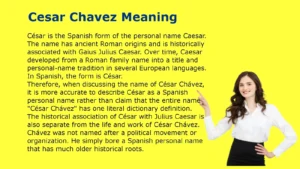
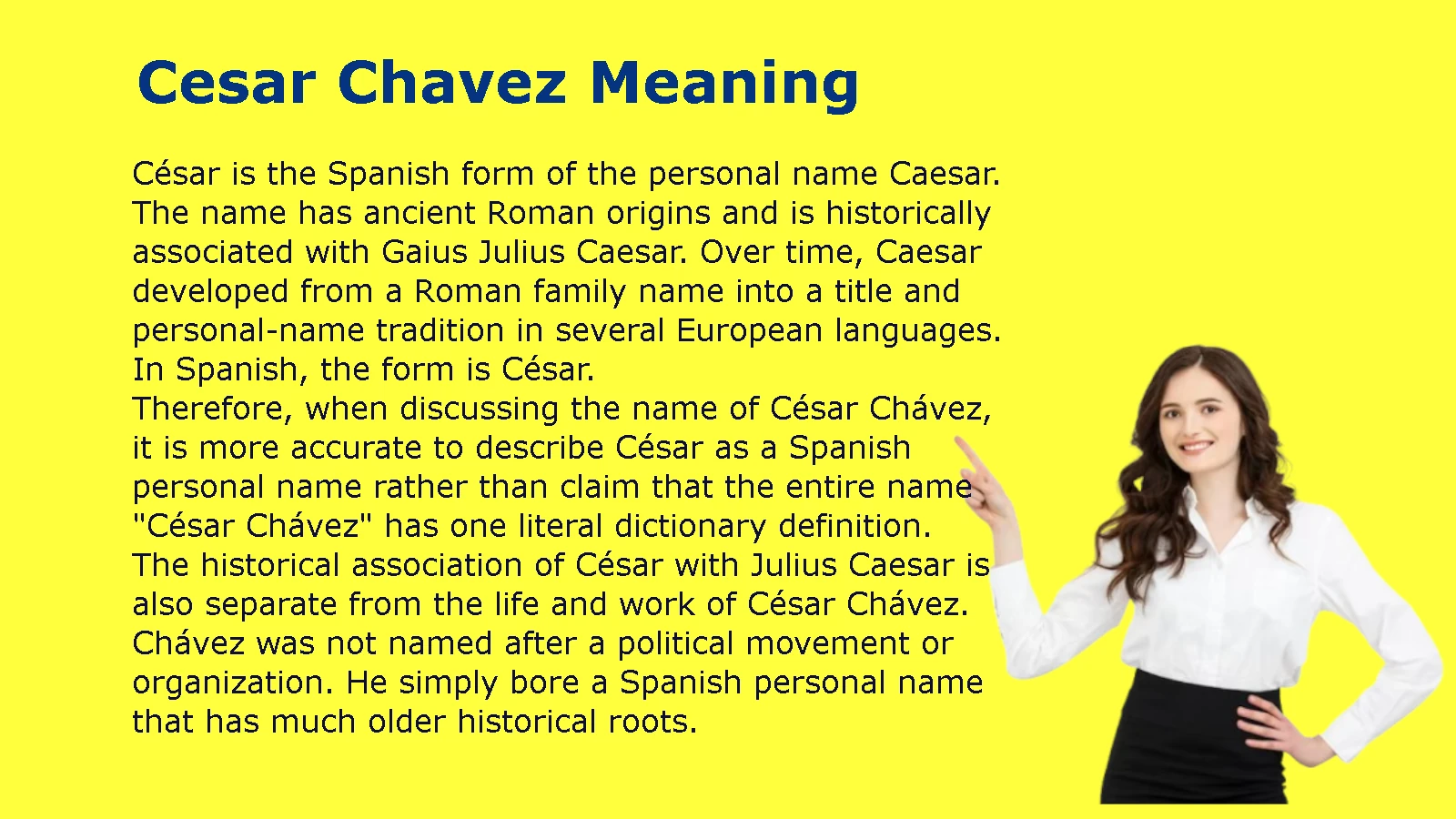
César is the Spanish form of the personal name Caesar.
The name has ancient Roman origins and is historically associated with Gaius Julius Caesar. Over time, Caesar developed from a Roman family name into a title and personal-name tradition in several European languages.
In Spanish, the form is César.
Therefore, when discussing the name of César Chávez, it is more accurate to describe César as a Spanish personal name rather than claim that the entire name “César Chávez” has one literal dictionary definition.
The historical association of César with Julius Caesar is also separate from the life and work of César Chávez. Chávez was not named after a political movement or organization. He simply bore a Spanish personal name that has much older historical roots.
What Does the Surname Chávez Mean?
Chávez is a Spanish surname.
Surname meanings can be more complicated than first names because surnames developed through different historical naming practices, including locations, occupations, personal names, nicknames, and family relationships.
For that reason, it is better not to force a simplistic one-word translation onto Chávez.
In the context of Cesar Chavez meaning, the important point is that Chávez is the family surname of César Estrada Chávez.
The name became historically recognizable because of Chávez’s public work rather than because the surname itself carries a special political or social meaning.
Who Was Cesar Chavez?
César Chávez was an American labor leader and civil-rights activist who devoted much of his career to organizing farmworkers.
His early life strongly influenced that work.
Chávez was born on a small family farm outside Yuma, Arizona, on March 31, 1927. During the Great Depression, his family lost their land. The family subsequently moved to California, where Chávez experienced migrant farm labor firsthand. The National Park Service notes that he left school after the eighth grade and worked in agricultural fields.
That experience gave Chávez a direct understanding of the conditions faced by agricultural workers.
Before becoming a nationally known labor leader, he worked as a community organizer. He became involved with the Community Service Organization (CSO), where he participated in activities such as voter-registration campaigns and efforts against discrimination.
Chávez eventually concluded that farmworkers needed a dedicated organization.
When the CSO would not make organizing farmworkers its central priority, Chávez left and began building his own organization. In 1962, he and Dolores Huerta helped establish the National Farm Workers Association (NFWA).
That organization became part of the movement that eventually developed into the United Farm Workers.
Why Is Cesar Chavez Famous?
Cesar Chavez is famous primarily for his role in organizing farmworkers and helping build a national labor movement around agricultural workers.
His work focused on issues such as:
- Better wages
- Improved working conditions
- Union recognition
- Collective bargaining
- Access to basic workplace necessities
- Protection from dangerous agricultural practices
- Farmworker dignity and representation
- Consumer boycotts as a labor-organizing strategy
The conditions faced by farmworkers were a central concern.
The Library of Congress notes that the UFW’s campaigns included strikes and boycotts and eventually helped negotiate improved wages and working conditions for farmworkers.
Chávez also became known for using nonviolent methods.
Instead of relying primarily on physical confrontation, the movement used organizing, marches, picketing, boycotts, fasting, public demonstrations, and coalition-building.
One of Chávez’s most frequently quoted statements is:
“We don’t need perfect political systems; we need perfect participation.”
The quote is documented by the Library of Congress in its biography of Chávez.
Cesar Chavez and the National Farm Workers Association
In 1962, Chávez and Dolores Huerta helped establish the National Farm Workers Association.
The organization began with limited resources. Chávez traveled through California farmworker communities, meeting workers and developing local support.
The goal was not simply to stage occasional protests. Chávez and other organizers were attempting to build a durable organization capable of representing agricultural workers.
The National Farm Workers Association eventually became part of the organization known as the United Farm Workers.
The Library of Congress records September 30, 1962, as the date Chávez and Huerta established the NFWA in Fresno, California.
The organization used a distinctive symbol and developed an organizing culture that combined labor activism with community mobilization.
What Was the United Farm Workers?
The United Farm Workers, commonly abbreviated as UFW, became the major labor organization associated with César Chávez.
Its development involved more than Chávez alone.
Filipino American farmworker organizers, including Larry Itliong, played an important role in the grape strike that began in California in 1965. The predominantly Filipino Agricultural Workers Organizing Committee and Chávez and Huerta’s NFWA eventually joined forces during the campaign.
This history is important because descriptions that portray Chávez as the sole person responsible for the farmworker movement leave out other organizers and workers who were essential to its development.
The National Park Service specifically identifies Dolores Huerta, Larry Itliong, and other leaders as significant figures in the farm labor movement.
Cesar Chavez and the Delano Grape Strike
One of the most important events associated with César Chávez was the Delano grape strike.
The strike began in 1965 after Filipino farmworkers in California’s grape-growing region walked out. The NFWA joined the campaign, bringing together Filipino and Mexican American farmworkers in a broader labor struggle.
The dispute became much larger than a local workplace strike.
Organizers understood that consumers could put pressure on growers by refusing to purchase grapes.
That strategy helped transform the farmworker struggle into a national consumer campaign.
Why the Grape Boycott Mattered
A traditional strike places pressure on an employer by withdrawing workers’ labor.
A consumer boycott adds another layer: it attempts to affect demand for the employer’s product.
The grape campaign therefore connected:
- Farmworkers
- Consumers
- Churches
- Students
- Labor organizations
- Civil-rights supporters
- Community organizers
- Political leaders
The Library of Congress describes the grape boycott as a major part of the UFW’s organizing history and notes that the union mobilized support across the United States and beyond.
The Delano-to-Sacramento March
Another important campaign involved a long march from Delano to Sacramento.
In March 1966, Chávez and farmworkers began a roughly 300-mile pilgrimage toward California’s capital. The march attracted public attention and helped turn the farmworker struggle into a major statewide and national issue.
The march demonstrated one of the movement’s central strategies: combine direct action with public education.
Rather than keeping the dispute inside agricultural communities, organizers brought it directly to consumers, politicians, churches, and the wider public.
Cesar Chavez and Dolores Huerta
Any complete explanation of Cesar Chavez meaning should also mention Dolores Huerta.
Huerta was a major labor organizer and civil-rights activist who worked closely with Chávez.
The two met through the Community Service Organization and shared an interest in organizing farmworkers. In 1962, they helped establish the National Farm Workers Association.
Huerta’s work extended well beyond her association with Chávez.
She organized workers, negotiated with employers, advocated for legislation, and helped coordinate boycott campaigns. The National Park Service describes her as a co-founder of the NFWA and an important leader in the United Farm Workers.
Cesar Chavez vs. Dolores Huerta
It is useful to understand their roles without treating the movement as the work of one person.
| Cesar Chavez | Dolores Huerta |
| Labor organizer and public leader | Labor organizer and negotiator |
| Co-founded the NFWA with Huerta and others | Co-founded the NFWA with Chávez and others |
| Became president of the organization | Served as a major organizing and leadership figure |
| Led major strikes, marches and boycott campaigns | Organized workers and directed important political and boycott efforts |
| Became the best-known public symbol of the movement | Became a prominent labor and civil-rights leader in her own right |
The Library of Congress and National Park Service both document Huerta’s substantial role in the movement.
Cesar Chavez’s Approach to Nonviolent Protest
Nonviolence was central to Chávez’s organizing philosophy.
His movement used several forms of peaceful direct action, including:
- Marches
- Picketing
- Strikes
- Consumer boycotts
- Public demonstrations
- Fasting
- Community organizing
The National Park Service describes Chávez’s use of marches and boycotts as part of his efforts to draw attention to farmworkers’ working and living conditions.
Chávez also undertook several public fasts.
According to UFW historical records, his fasts included a 25-day fast in 1968, a 24-day fast in 1972, and a 36-day fast in 1988.
The 1988 fast was particularly notable because Chávez was 61 years old at the time.
The fast drew attention to concerns over pesticide exposure affecting farmworkers and their families.
Cesar Chavez and Farmworker Working Conditions
The farmworker movement was not simply about wages.
Workers also sought improvements in everyday working conditions.
The Library of Congress notes that UFW contracts brought concrete changes, including:
- Drinking water in fields
- Portable toilets
- Rest periods
- Better housing
- Health benefits
- Disability benefits
- Workers’ compensation benefits
- Pension plans
- Protection against pesticides
These changes help explain why the name Cesar Chavez became associated with labor rights rather than simply with a particular protest or boycott.
The issues were practical.
A worker harvesting crops for hours in extreme heat needs access to water and rest. A worker handling agricultural chemicals needs protection from hazardous exposure. A family dependent on seasonal agricultural work needs greater economic security.
The movement connected these workplace concerns with broader questions about worker representation and collective bargaining.
Cesar Chavez: Key Facts
Here are the most important facts in one place:
| Fact | Details |
| Full name | César Estrada Chávez |
| Born | March 31, 1927 |
| Birthplace | Near Yuma, Arizona |
| Died | April 23, 1993 |
| Age at death | 66 |
| Known for | Farmworker organizing and labor activism |
| Major organization | National Farm Workers Association / United Farm Workers |
| Major campaigns | Delano grape strike, grape boycott and other farmworker campaigns |
| Co-founder | Dolores Huerta and other organizers |
| Military service | U.S. Navy, 1944–1946 |
| Major posthumous honor | Presidential Medal of Freedom, 1994 |
The National Park Service confirms Chávez’s 1927 birth near Yuma and his 1993 death in the Yuma-area community of San Luis.
Where Was Cesar Chavez Born?
Cesar Chavez was born near Yuma, Arizona, on March 31, 1927.
The National Park Service identifies his birthplace as a small adobe home on his family’s property outside Yuma.
His childhood was shaped by the economic pressures of the Great Depression.
His family eventually lost its property and moved to California. Chávez then experienced migrant agricultural work, an experience that became important to his later organizing career.
The location of his birth is significant because Chávez ultimately died near the same region more than six decades later.
What Was Cesar Chavez’s Ethnicity?
Cesar Chavez was Mexican American.
His family had Mexican heritage, and his upbringing was closely connected with Mexican American communities in the American Southwest and California.
It is useful to distinguish three separate facts:
- Ethnicity: Mexican American
- Nationality: American
- Birthplace: Near Yuma, Arizona
Calling Chávez simply “Mexican” would therefore be inaccurate when discussing his nationality. He was an American born in Arizona whose family had Mexican heritage.
His cultural background also mattered to his organizing work because many of the farmworkers he organized were Mexican American or Mexican immigrant workers, alongside Filipino American farmworkers and others.
Who Was Cesar Chavez’s Wife?
Cesar Chavez married Helen Fabela Chávez in 1948.
They had a large family, and his family life continued alongside his increasingly demanding organizing career.
Chávez’s wife and children were part of the personal sacrifices associated with his years of organizing. UFW historical material describes Chávez moving his family to Delano in 1962 as he committed himself to organizing farmworkers full time.
His family therefore experienced the practical consequences of a life centered on labor organizing, including financial pressures and frequent demands on his time.
How Old Was Cesar Chavez When He Died?
Cesar Chavez was 66 years old when he died.
He was born on March 31, 1927, and died on April 23, 1993.
His death occurred only a few weeks after his 66th birthday.
At the time, Chávez was still involved in UFW-related legal and labor matters rather than being retired from public activity. The National Park Service reports that he was in the San Luis area supporting farmworkers during a legal dispute when he died.
What Was Cesar Chavez’s Cause of Death?
Cesar Chavez died on April 23, 1993, while staying at a home in San Luis, Arizona.
Contemporary reporting said he died in his sleep and that authorities initially planned an autopsy to determine the cause.
The Library of Congress later described his death as occurring in his sleep at age 66 from natural causes.
Some later accounts have discussed possible connections between Chávez’s history of prolonged fasting and cardiac problems, but those claims should not be presented as an established specific medical cause without qualification.
The safest factual description is that Cesar Chavez died in his sleep in 1993 at age 66, and authoritative historical sources describe the death as being from natural causes.
What Is Cesar Chavez Day?
Cesar Chavez Day is observed on March 31, the anniversary of Chávez’s birth.
The date has been used to honor his life and legacy through educational, community, and service activities.
A federal presidential proclamation in 2013 called on Americans to observe March 31 as Cesar Chavez Day with service, community, and education programs.
The day should not automatically be described as a federal public holiday in the same sense as holidays such as Independence Day or Thanksgiving.
Instead, its recognition varies by jurisdiction and institution.
Why Is March 31 Cesar Chavez Day?
March 31 was chosen because it was Chávez’s birthday.
Since Chávez was born on March 31, 1927, the date provides a direct connection between the annual observance and his life.
The observance focuses on themes associated with his public career, including:
- Community service
- Farmworker rights
- Labor organizing
- Nonviolent activism
- Civic participation
- Education
Cesar Chavez’s Legacy
Cesar Chavez’s legacy can be understood through several connected areas.
Labor Rights
Chávez helped make farmworker labor conditions a national issue.
Agricultural workers had often been outside the traditional focus of organized labor. The campaigns associated with Chávez and the UFW demonstrated how organizing could combine workplace action with consumer activism.
Consumer Boycotts
The grape boycott became a model of how consumers could participate in a labor dispute.
Instead of limiting pressure to workers and employers, the campaign asked ordinary consumers to change their purchasing behavior.
Nonviolent Organizing
Chávez became strongly associated with peaceful protest.
His use of marches, boycotts, strikes and fasting reflected a strategy in which public participation was treated as a source of pressure.
Farmworker Contracts
The UFW’s successful campaigns resulted in contracts that addressed practical working conditions and benefits.
The Library of Congress identifies improvements involving wages, water, toilets, rest periods, housing, health benefits, disability benefits, pensions and pesticide protections.
National Recognition
Chávez received the Presidential Medal of Freedom posthumously in 1994. A Nevada gubernatorial proclamation records the award as the nation’s highest civilian honor.
His name has also been given to schools, streets, parks, community facilities, and other public institutions.
Cesar E. Chavez National Monument
One of the most significant places connected with Chávez is La Paz, the former UFW headquarters near Keene, California.
The National Park Service explains that Chávez established the UFW headquarters at Nuestra Señora Reina de la Paz, commonly called La Paz. President Barack Obama established the site as the Cesar E. Chavez National Monument in 2012.
The site covers approximately 187 acres and includes historic buildings, the César Chávez Memorial Garden, and Chávez’s burial site.
La Paz is significant because it was not simply an office.
It became an important center for the labor, civil-rights, Chicano, and environmental movements associated with Chávez and the UFW.
A Simple Case Study: Why the Grape Campaign Was Different
The grape campaign demonstrates how Chávez’s organizing strategy worked in practice.
The problem
Farmworkers wanted better wages, improved working conditions, and union recognition.
The traditional approach
Workers could strike by refusing to work.
That placed pressure directly on growers, but the campaign faced major economic and organizational obstacles.
The expanded strategy
Organizers added consumer boycotts.
Instead of asking only workers to participate, they asked consumers across the country to avoid certain grapes.
The result
The campaign turned a local agricultural labor dispute into a national public issue.
It attracted support from churches, students, labor organizations and civil-rights activists and helped sustain pressure on growers. The Library of Congress describes the grape boycott as a major part of the UFW’s national organizing strategy.
This is one reason Cesar Chavez meaning is closely connected with the idea of organized, nonviolent collective action.
What Does Cesar Chavez Symbolize?
The answer depends on the historical context, but the name is commonly associated with:
- Farmworker rights
- Labor organizing
- Nonviolent protest
- Consumer boycotts
- Community organizing
- Mexican American history
- Civil-rights activism
- Collective bargaining
- Agricultural labor reform
It is important, however, to distinguish symbolism from historical fact.
Cesar Chavez was a real person with a specific career, organizations, campaigns, supporters, critics, and historical circumstances. Treating his name only as a broad symbol can obscure the concrete events that created his public legacy.
Common Questions About Cesar Chavez
What does Cesar Chavez mean?
Cesar Chavez refers to César Estrada Chávez, the American labor leader and civil-rights activist who helped organize farmworkers and co-founded the organization that became the United Farm Workers.
Is Cesar Chavez a word or phrase?
No. Cesar Chavez is a person’s name, not an English word, slang term, or phrase.
Who was Cesar Chavez?
Cesar Chavez was an American labor organizer and civil-rights activist best known for organizing farmworkers and helping establish the National Farm Workers Association, which became part of the United Farm Workers movement.
Why was Cesar Chavez famous?
He became famous for farmworker organizing, the Delano grape strike, consumer boycotts, marches, nonviolent activism, and his leadership within the farmworker labor movement.
Where was Cesar Chavez born?
He was born near Yuma, Arizona, on March 31, 1927.
What was Cesar Chavez’s ethnicity?
Cesar Chavez was Mexican American and was born in the United States.
Who was Cesar Chavez’s wife?
His wife was Helen Fabela Chávez, whom he married in 1948.
How old was Cesar Chavez when he died?
He was 66 years old when he died on April 23, 1993.
What was Cesar Chavez’s cause of death?
He died in his sleep in San Luis, Arizona, at age 66. The Library of Congress describes his death as being from natural causes.
When is Cesar Chavez Day?
Cesar Chavez Day is observed on March 31, his birthday.
Was Cesar Chavez part of the United Farm Workers?
Yes. Chávez was the central public leader of the organization that developed into the United Farm Workers, following the formation of the National Farm Workers Association and its collaboration with other farmworker organizations.
What was Cesar Chavez’s most famous protest?
The grape boycott and the broader Delano grape strike campaign are among the most famous actions associated with Chávez and the UFW.
What did Cesar Chavez accomplish?
His organizing helped establish a durable farmworker labor movement, contributed to union contracts and improved workplace conditions, and brought national attention to agricultural workers’ rights.
Facts to Remember About the Cesar Chavez Meaning
If you only need the essential information, remember these points:
- Cesar Chavez is a person’s name, not slang.
- The correct Spanish spelling is César Chávez.
- César is a Spanish personal name.
- Chávez is a Spanish surname.
- César Chávez was born on March 31, 1927.
- He was born near Yuma, Arizona.
- He became a major farmworker labor organizer.
- He and Dolores Huerta helped establish the National Farm Workers Association.
- The organization became part of the movement that developed into the United Farm Workers.
- The Delano grape strike and grape boycott were central campaigns in the movement.
- Chávez strongly promoted nonviolent organizing.
- He died on April 23, 1993, at age 66.
- His death occurred in San Luis, Arizona.
- March 31 is observed as Cesar Chavez Day.
- He received the Presidential Medal of Freedom posthumously in 1994.
Conclusion
The meaning of Cesar Chavez goes beyond the literal meaning of two names.
Cesar Chavez refers to César Estrada Chávez, the American labor leader and civil-rights activist whose career became closely associated with the organization of farmworkers and the development of the United Farm Workers.
His life was shaped by firsthand experience with migrant agricultural work. After losing his family’s land during the Great Depression, Chávez worked in the fields before becoming a community organizer. He later devoted himself to building a farmworker organization and worked alongside figures such as Dolores Huerta and Larry Itliong.
The grape strike, consumer boycotts, marches and nonviolent campaigns associated with the movement helped bring farmworker conditions into national public discussion. The resulting labor contracts addressed concrete workplace issues, including wages, benefits, rest periods, drinking water and pesticide protections.
Today, the name Cesar Chavez is therefore commonly associated with farmworker rights, labor organizing, nonviolent activism, consumer boycotts, and Mexican American history.
Understanding those historical facts gives the search term “Cesar Chavez meaning” its full context: it is not simply the meaning of a name, but an introduction to the person, movement, and historical events connected with that name.