A chart topper is more than just a popular song—it’s a track that reaches a leading position on a music chart, often because of strong sales, streams, downloads, radio play, or other measures of audience activity. If you’ve come across the phrase “chart topper” and wondered what it means, how it is used, or why certain songs are called chart-topping hits, the term is closely connected to music charts, rankings, hit songs, artists, singles, albums, and commercial success.
The chart topper meaning refers to a song, album, or sometimes an artist that reaches one of the highest positions on a music chart, especially the number-one spot. However, the exact meaning can depend on the context and the chart being discussed. Terms such as chart-topping, number-one hit, top-charting song, hit single, bestseller, and music-chart leader are related but can have slightly different uses.
In this guide, you’ll learn what “chart topper” means, how the phrase is used in sentences, what makes a song a chart-topper, and how “chart topper” differs from related expressions such as “hit song” and “number-one hit.” You’ll also see clear examples to make the meaning easy to understand.
By the end, you’ll know exactly what chart topper means and how to use this popular music term naturally and correctly.
Quick Answer: What Does “Chart Topper” Mean?
Chart topper means a song, recording, singer, band, or musical act that reaches the top position on a music chart.
For example:
“The song became a chart topper within a few weeks.”
This means the song reached the top of a music chart.
| Term | Meaning |
| Chart topper | A song, recording, artist, or act at the top of a music chart |
| Chart-topper | Hyphenated form of the same noun |
| Chart-topping | Describes something that has reached the top of the charts |
| Top the charts | To reach the highest position on a music chart |
| Number-one hit | A song that reaches No. 1 on a particular chart |
The exact wording can vary depending on the publication and style guide, but the underlying idea is the same: reaching the top of a music ranking.
What Does “Chart Topper” Mean?
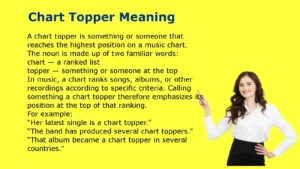
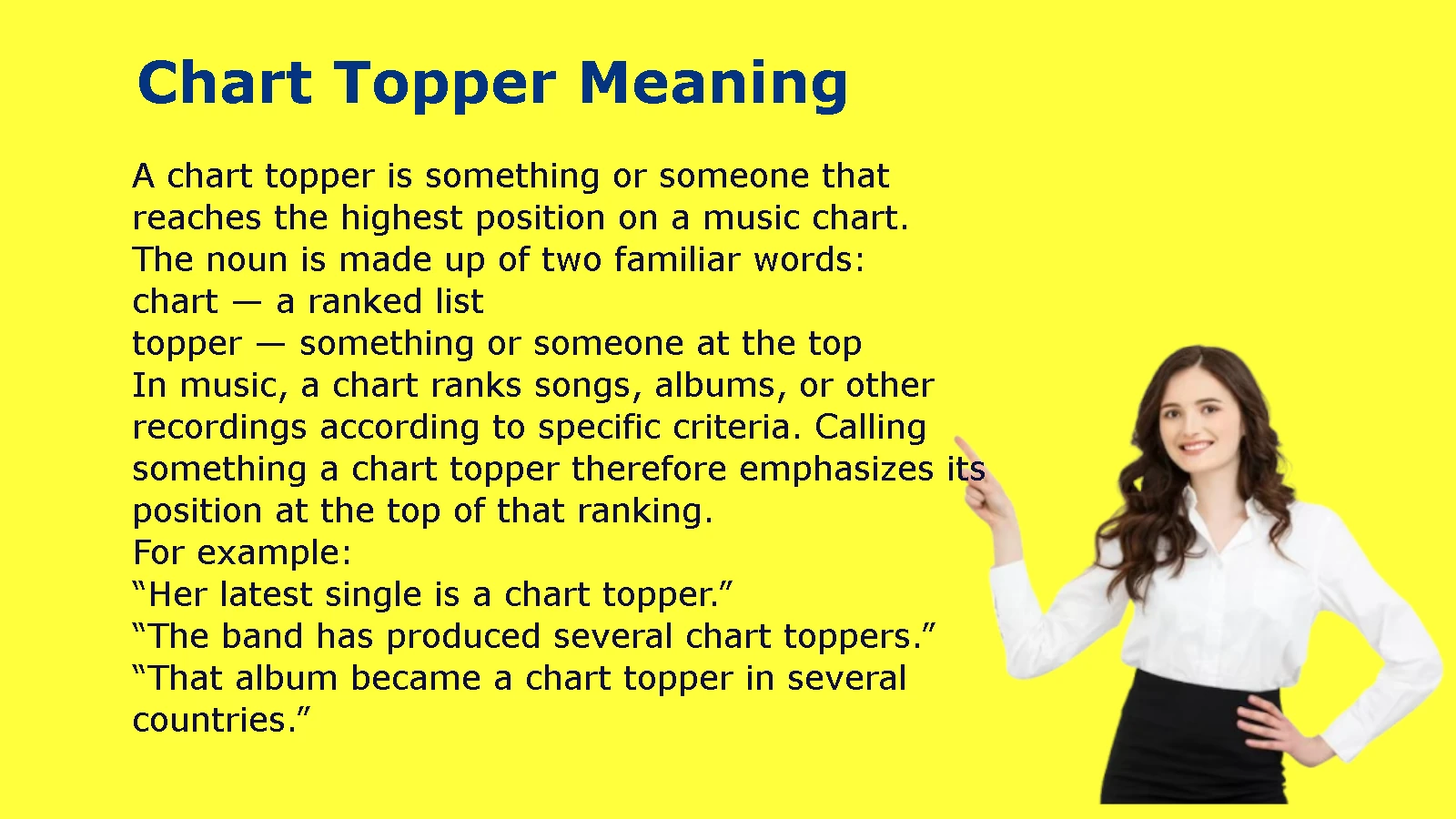
A chart topper is something or someone that reaches the highest position on a music chart.
The noun is made up of two familiar words:
- chart — a ranked list
- topper — something or someone at the top
In music, a chart ranks songs, albums, or other recordings according to specific criteria. Calling something a chart topper therefore emphasizes its position at the top of that ranking.
For example:
- “Her latest single is a chart topper.”
- “The band has produced several chart toppers.”
- “That album became a chart topper in several countries.”
The expression doesn’t simply mean that a song was popular. More specifically, it suggests that the song or artist reached the highest position on a relevant chart.
That distinction matters.
A song can be popular without reaching No. 1. A song described as a chart topper has achieved the top position on the particular chart being discussed.
What Does “Chart Topper” Mean in Music?
In music, chart topper generally refers to a song, recording, album, singer, band, or act that reaches the top of a music chart.
For instance, imagine a weekly chart ranking 100 songs:
| Position | Song |
| 1 | Song A |
| 2 | Song B |
| 3 | Song C |
| 4 | Song D |
| 5 | Song E |
If Song A reaches position 1, it can be described as a chart topper.
The important point is that the phrase is connected to ranking, not merely popularity.
Oxford’s related adjective chart-topping specifically describes a song, singer, or band that has reached the highest position in the music charts.
What Is a Chart Topper in Music?
A chart topper in music is a recording or musical act that reaches the highest position on a particular chart.
Music charts exist because listeners and the music industry need ways to track the performance of recordings. Depending on the chart, rankings can involve different measurements.
These can include:
- sales
- digital downloads
- streaming activity
- radio performance
- audience data
- combinations of several measurements
The criteria aren’t identical across all charts. Therefore, saying that a song is a chart topper should be understood in relation to a particular chart or market.
For example, a song could reach No. 1 on a national singles chart while performing differently on another country’s chart.
Does “Chart Topper” Always Mean Number One?
Usually, yes, when the phrase is being used in its standard music sense.
The idea comes directly from topping the charts. Oxford’s definition of chart-topping refers to reaching the highest position in the music charts.
However, context matters.
Someone might casually call a very successful song a “chart topper” without specifying the exact chart. In precise writing, it is better to identify the chart or market when the distinction matters.
For example:
Less precise:
“The song was a chart topper.”
More precise:
“The song reached No. 1 on the national singles chart.”
The second version tells the reader exactly what achievement is being discussed.
How Does a Song Become a Chart Topper?
A song becomes a chart topper by reaching the highest position on a particular chart under that chart’s ranking system.
There isn’t one universal formula for every music chart.
Different chart organizations can use different combinations of data. Some charts emphasize sales, while others incorporate streaming, downloads, radio plays, or other measurements.
Cambridge describes the charts as lists produced each week of recordings with the highest sales, while its dictionary examples also refer to songs being number one in the charts.
A Simple Example
Suppose a fictional weekly chart uses three factors:
| Song | Sales | Streams | Radio activity | Final position |
| Song A | High | High | High | 1 |
| Song B | High | Medium | High | 2 |
| Song C | Medium | High | Medium | 3 |
Because Song A reaches position 1, it could be described as that week’s chart topper.
The exact calculation in a real chart would depend on the chart’s published methodology.
Chart Topper Examples
The phrase is especially common in music journalism, entertainment writing, biographies, interviews, and everyday conversation.
Example 1: A Song
“The singer released a chart topper last summer.”
Here, chart topper refers to the song.
Example 2: An Artist
“She became a chart topper after the success of her debut single.”
Here, the expression can describe the artist in the sense that the artist achieved a top-charting release.
Example 3: A Band
“The band has several chart toppers in its catalog.”
Here, chart toppers most naturally refers to successful recordings associated with the band.
Example 4: An Album
“Their new album became a chart topper.”
The meaning is that the album reached the top position on a relevant chart.
Example 5: A General Music Discussion
“The track quickly became a chart topper.”
The sentence says that the track reached the top of a chart.
What Does “Chart Topper” Mean in a Sentence?
Here are some natural examples:
| Sentence | Meaning |
| The song became a chart topper. | The song reached the top position on a chart. |
| She released another chart topper. | She released another recording that reached the top of a chart. |
| The band has several chart toppers. | Several of the band’s recordings reached top positions. |
| His latest single is a chart topper. | His latest single has reached the top of a chart. |
| They celebrated their first chart topper. | They celebrated achieving their first top-charting recording. |
| The album became a chart topper overseas. | The album reached the top position in another market. |
Notice that the phrase describes a measurable chart achievement, rather than simply saying that something is good or popular.
Chart Topper vs. Chart-Topping
One of the most useful distinctions to understand is the difference between chart topper and chart-topping.
They are closely related, but they perform different grammatical jobs.
Chart Topper
Chart topper is a noun phrase.
It refers to the person, recording, or act that reaches the top of a chart.
“The song was a chart topper.”
Here, chart topper identifies the song.
Chart-Topping
Chart-topping is an adjective.
It describes something that has reached the highest position in a music chart.
“The singer released a chart-topping single.”
Here, chart-topping describes the single.
Oxford explicitly defines chart-topping as an adjective used for a song, singer, band, and similar subjects that have reached the highest position in the music charts.
Compare the Two
| Expression | Part of speech | Example |
| chart topper | Noun | “The song was a chart topper.” |
| chart-topper | Noun | “The song was a chart-topper.” |
| chart-topping | Adjective | “It was a chart-topping song.” |
| top the charts | Verb phrase | “The song topped the charts.” |
This difference is useful when writing headlines, articles, reviews, or biographies.
Chart Topper vs. “Top the Charts”
These expressions are related but aren’t interchangeable.
Chart Topper
A chart topper is the thing or person that reaches the top.
“The single became a chart topper.”
Top the Charts
Top the charts is a verb phrase meaning to reach the highest position.
“The single topped the charts.”
Oxford’s definition of chart includes the expression to top the charts, explaining it as being the record that has sold more copies than the others in that chart context.
The grammatical difference is simple:
Chart topper = noun
Top the charts = verb phrase
Is “Chart Topper” One Word or Two Words?
Chart topper is normally written as two words when used as a noun phrase.
You may also encounter the hyphenated form chart-topper.
For example:
“The singer released a new chart topper.”
or:
“The singer released a new chart-topper.”
The hyphenated form can be useful when treating the expression as a compound noun, particularly where a publication’s style conventions favor hyphenation.
The related adjective is normally written:
chart-topping
For example:
“It became a chart-topping hit.”
Chart Topper vs. Chart-Topper
The meaning doesn’t fundamentally change because of the hyphen.
| Form | Example | Function |
| chart topper | “It was a chart topper.” | Noun |
| chart-topper | “It was a chart-topper.” | Compound noun |
| chart-topping | “It was a chart-topping song.” | Adjective |
For SEO, it’s worth recognizing all three forms because users and publications don’t always type compound expressions in exactly the same way.
Chart Topper vs. Number-One Hit
Chart topper and number-one hit are closely related, but they don’t always communicate exactly the same thing.
A number-one hit explicitly says that a song reached No. 1.
A chart topper also generally carries that meaning, but it can be used more broadly for an artist, group, recording, or other subject associated with the top of a chart.
For example:
“The song became a number-one hit.”
This focuses directly on the song’s No. 1 position.
Compare:
“She became a chart topper.”
This can focus more broadly on the artist’s success at the top of music charts.
The surrounding context determines exactly what chart topper refers to.
Chart Topper vs. Chart-Topping Hit
These expressions are closely connected.
A chart topper is a noun.
A chart-topping hit is a noun phrase containing an adjective.
For example:
“The song was a chart topper.”
and:
“The song was a chart-topping hit.”
Both communicate that the song reached the top of a music chart.
Oxford’s definition of chart-topping specifically gives a chart-topping hit as an example of the adjective’s use.
Chart Topper Synonyms and Related Terms
There isn’t always a perfect one-word synonym for chart topper. The best alternative depends on what you’re describing.
| Term | How it relates |
| number-one hit | A song that reaches No. 1 |
| No. 1 hit | Short form emphasizing the top position |
| chart-topping hit | A hit that reaches the top of a chart |
| hit song | A successful song, but not necessarily No. 1 |
| top-charting song | A song that performs highly on a chart |
| top-selling recording | Focuses specifically on sales |
| chart-topping artist | An artist associated with top-charting releases |
Is “Hit Song” the Same as “Chart Topper”?
Not necessarily.
A hit song can be highly successful without reaching No. 1.
A chart topper, in its standard sense, has reached the highest position on a particular chart.
So these shouldn’t automatically be treated as exact synonyms.
What Is the Difference Between a Chart Topper and a Chart-Topping Song?
The main difference is grammatical.
Chart topper is the noun:
“The song became a chart topper.”
Chart-topping song uses chart-topping as an adjective:
“The singer released a chart-topping song.”
The underlying achievement is the same: reaching the top of a music chart.
What Does “Top the Charts” Mean?
Top the charts means to reach the highest position on a music chart.
For example:
“The single topped the charts.”
This means the single reached the highest position.
Cambridge gives the example “top the charts” in the sense of a song reaching the most important or successful position on the music ranking.
Oxford similarly lists to top the charts under its definition of the music sense of chart.
“Top the Charts” vs. “Be a Chart Topper”
These sentences communicate closely related information:
“The song topped the charts.”
“The song was a chart topper.”
The first uses a verb phrase.
The second uses a noun.
Why Does the Word “Chart” Refer to Music Rankings?
The word chart has several meanings in English.
It can mean a diagram, a map, or a ranked list. In music, the charts refers to ranked lists of recordings.
Cambridge defines the charts as lists of records with the highest sales, while Oxford’s American dictionary describes the music charts as lists of music CDs that have sold the most copies.
This explains the language behind expressions such as:
- in the charts
- top the charts
- at the top of the charts
- chart hit
- chart topper
- chart-topping
- chart-topping artist
The underlying idea is always connected to ranking musical success.
Chart Topper and the Meaning of “The Charts”
When someone says:
“The song is in the charts.”
they mean the song appears on a recognized music ranking.
Cambridge gives in the charts as a phrase used for a song, record, singer, or group that appears on lists of recordings with high sales.
But being in the charts isn’t the same as being a chart topper.
Consider this simplified ranking:
| Position | Status |
| 1 | Chart topper |
| 2 | High chart position |
| 10 | In the charts |
| 50 | In the charts |
| 100 | In the charts |
The exact number of positions varies by chart, but the distinction illustrates the basic idea: being on a chart and topping a chart are different achievements.
A Simple Case Study: How the Terms Work Together
Imagine a fictional singer named Maya releases a single called “Northern Lights.”
During its first week, the song enters a national chart at No. 12.
You could say:
“Northern Lights entered the charts at No. 12.”
The following week, it rises to No. 4.
Now you could say:
“Northern Lights climbed the charts.”
After another week, it reaches No. 1.
Now:
“Northern Lights topped the charts.”
And:
“Northern Lights became a chart topper.”
You could also describe it as:
“a chart-topping single.”
The four expressions describe different stages or grammatical forms of the same chart performance.
| Stage | Natural expression |
| Enters at No. 12 | “Entered the charts at No. 12” |
| Rises to No. 4 | “Climbed the charts” |
| Reaches No. 1 | “Topped the charts” |
| Describing the No. 1 song | “A chart topper” |
| Describing the song adjectivally | “A chart-topping single” |
This makes the relationship among the expressions much easier to understand.
Common Mistakes With “Chart Topper”
Mistake 1: Treating Every Successful Song as a Chart Topper
Not every popular song is automatically a chart topper.
The phrase normally implies that the recording or artist reached the top position on a relevant chart.
A song can be commercially successful, widely streamed, or culturally influential without reaching No. 1.
Mistake 2: Confusing “Chart Topper” With “Chart-Topping”
These have different grammatical roles.
- chart topper = noun
- chart-topping = adjective
Compare:
“She is a chart topper.”
with:
“She released a chart-topping single.”
Mistake 3: Assuming Every Chart Uses the Same Ranking System
Music charts don’t necessarily measure success in exactly the same way.
Different organizations can use different datasets and methodologies.
Therefore, a precise article should identify which chart is being discussed when the distinction matters.
Mistake 4: Assuming “In the Charts” Means No. 1
It doesn’t.
A recording can be in the charts without being at the top.
Cambridge’s examples distinguish appearing in the charts from being number one in the charts.
How to Use “Chart Topper” Naturally
Use chart topper when you’re talking about the recording, artist, or act that has reached the top of a chart.
Natural examples
- “The single became a chart topper.”
- “The band produced several chart toppers.”
- “Her latest release is a chart topper.”
- “The album became a chart topper in several markets.”
- “He is known for producing chart-topping songs.”
Less precise usage
Avoid using chart topper simply as another word for:
- good song
- famous song
- popular song
- successful artist
Those expressions can describe broader types of success.
A chart topper specifically connects that success with a top chart position.
Is “Chart Topper” Formal or Informal?
Chart topper is a standard English expression used in entertainment writing, music journalism, biographies, interviews, and everyday speech.
It isn’t restricted to texting or internet slang.
However, in highly formal writing, you may sometimes prefer a more precise description such as:
“The song reached No. 1 on the national singles chart.”
That wording identifies the exact achievement rather than relying on the more conversational expression chart topper.
For general writing, though, chart topper is perfectly natural.
What Does “Chart Topper” Mean in the UK?
In British English, the charts commonly refers to ranked lists of popular music.
Cambridge’s British-English material uses expressions such as in the charts, number one in the charts, and top the charts for music rankings.
So in British usage:
“The band had another chart topper.”
means that the band had another recording that reached the top of a music chart.
The underlying meaning is the same in American English: a top-ranking musical recording or act.
What Does “Chart Topper” Mean in Different Contexts?
The phrase is most strongly associated with music, but the exact subject can vary.
A Chart Topper Song
A song that reaches the top of a chart.
“The single became a chart topper.”
A Chart Topper Artist
An artist associated with reaching the top of music charts.
“The singer became a chart topper after her breakthrough single.”
A Chart Topper Band
A band with a recording that reaches the top.
“The band has produced several chart toppers.”
A Chart Topper Album
An album that reaches the top of an album chart.
“Their second album became a chart topper.”
The surrounding noun or context tells you exactly what the phrase refers to.
Frequently Asked Questions About Chart Topper Meaning
What does chart topper mean?
Chart topper means a song, recording, artist, band, or similar musical act that reaches the highest position on a music chart.
What is a chart topper in music?
A chart topper in music is a recording or musical act that reaches the top of a particular music chart.
Is a chart topper always number one?
In its standard music sense, chart topper implies reaching the top position of the relevant chart. For precise writing, specify the chart and position when necessary.
Is chart topper one word or two?
Chart topper is generally written as two words. You may also encounter chart-topper as a hyphenated compound noun.
What is chart-topping?
Chart-topping is an adjective describing a song, singer, band, or similar subject that has reached the highest position in the music charts. Oxford specifically defines the adjective in this way.
What is the difference between chart topper and chart-topping?
Chart topper is a noun, while chart-topping is an adjective.
“The song is a chart topper.”
“It is a chart-topping song.”
What does “top the charts” mean?
Top the charts means to reach the highest position on a music chart. Oxford and Cambridge both document this music-related usage.
Is a chart topper the same as a hit song?
Not necessarily. A hit song can be very successful without reaching No. 1. Chart topper specifically emphasizes reaching the top of a chart.
Can an artist be called a chart topper?
Yes. Cambridge’s definition of topper includes a person or group in the highest position on a list and gives musical examples involving chart toppers.
What is another word for chart topper?
Depending on context, alternatives include number-one hit, No. 1 hit, and chart-topping hit. However, these aren’t always exact replacements because chart topper can refer to different subjects in context.
Key Facts About the Chart Topper Meaning
- Chart topper refers to something or someone at the top of a music chart.
- The expression is strongly associated with No. 1 chart positions.
- Chart topper functions as a noun.
- Chart-topping functions as an adjective.
- Top the charts is a verb phrase.
- In the charts simply means appearing on a music chart; it doesn’t necessarily mean being No. 1.
- A hit song isn’t automatically a chart topper.
- Chart topper and chart-topper are both encountered as noun forms.
- Different music charts can use different ranking criteria, so precise writing should identify the relevant chart when necessary.
- The expression is used in both British and American English, although terminology around the charts is particularly common in British music discussion.
Final Takeaway
The simplest chart topper meaning is a song, recording, artist, or musical act that reaches the top position on a music chart.
The expression becomes easier to understand when you connect it with its related forms. A song can top the charts, become a chart topper, and then be described as a chart-topping song. These expressions all revolve around the same basic idea: achieving the highest position in a music ranking.
The key distinction is that being in the charts is not the same as topping the charts. A recording can appear anywhere on a chart, while a chart topper occupies the highest position. Cambridge and Oxford both document this distinction in their explanations of music-chart terminology.
For everyday writing, chart topper is a clear and natural way to describe a top-ranking musical success. For precise reporting, however, naming the chart and position—such as “reached No. 1 on the national singles chart”—gives the reader more specific information.