Ever heard someone say they’re hyped and wondered what they actually mean? Hyped is a common informal word for feeling very excited, enthusiastic, or eager about something, especially an upcoming event, experience, product, or activity.
Hyped usually describes a strong feeling of excitement or anticipation. In casual English, saying “I’m hyped” means you’re really looking forward to something. The word can also describe something that has received a lot of public attention, promotion, or excitement, sometimes more than it deserves.
Examples:
- I’m so hyped for the concert tonight.
- Everyone was hyped about the new game.
Seeing hyped in texts, social media posts, conversations, and online comments can leave people wondering what it means. Common searches include hyped meaning, what does hyped mean, hyped meaning in text, hyped slang, and what does it mean when someone says they’re hyped. These searches usually point to two main uses: hyped can describe someone’s personal excitement, or it can describe something that people have heavily promoted.
And here’s the kicker: hyped doesn’t always mean exactly the same thing as simply excited. Depending on the context, it can suggest a much stronger sense of enthusiasm, anticipation, or buzz.
In this guide, you’ll learn the complete meaning of hyped, including its definition, slang meaning, pronunciation, origin, synonyms, and usage. You’ll also see clear examples of hyped in a sentence, learn what hyped means in texting and social media, and understand how to use the word naturally in everyday English.
Hyped Meaning
The basic hyped meaning is very excited or enthusiastic about something. In informal American English, people often use hyped when they feel a strong rush of excitement about an upcoming event, activity, purchase, game, trip, or achievement.
For example:
“I’m hyped for the game tonight.”
This means:
“I’m really excited about the game tonight.”
The word can also describe something that has received a lot of attention or promotion.
“The new game was heavily hyped before its release.”
Here, hyped doesn’t describe the game’s emotional state. It means people promoted and talked about the game extensively.
That difference matters.
The Two Main Meanings of Hyped
| Meaning | What it describes | Example |
| Excited or enthusiastic | A person or group | “The fans were hyped for the final.” |
| Highly promoted or publicized | A product, event, movie, idea, etc. | “The movie was heavily hyped.” |
Context usually makes the intended meaning clear.
If you hear “She’s hyped,” the speaker probably means she is excited. If you hear “The product is hyped,” the speaker may mean the product has received extensive promotion.
Cambridge also gives examples of hyped describing something that received significant media attention or promotion.
Hyped in Everyday Conversation
In casual speech, hyped often works as an energetic alternative to excited.
You might say:
- I’m hyped for the weekend.
- We’re hyped about the new season.
- He was hyped for his first concert.
- Everyone got hyped when the team scored.
- She’s absolutely hyped about the trip.
The expression feels informal and lively. It often suggests more than mild interest.
Compare these:
“I’m excited about the concert.”
“I’m hyped for the concert!”
Both sentences express excitement. The second one sounds more energetic and casual.
What Does Hyped Mean?
So, what does hyped mean in plain English?
It usually means extremely excited, enthusiastic, or emotionally energized. It can also mean strongly promoted or publicized, particularly when you’re talking about a product, movie, event, or idea.
Think of it as a word with two connected paths.
Excitement path:
hype → excitement → anticipation → energy
Promotion path:
hype → publicity → attention → heightened expectations
The original word hype has long been associated with publicity and excitement. Dictionaries also recognize its use for stimulating or exciting someone. American Heritage, for example, records hype both as a term for excessive publicity and as a verb meaning to stimulate or excite.
Examples of Hyped Meaning
Person:
“I’m hyped about my new job.”
Meaning: I’m very excited about my new job.
Group:
“The crowd was hyped before the match.”
Meaning: The crowd was energetic and excited.
Product:
“The phone was heavily hyped before launch.”
Meaning: The phone received a lot of promotional attention.
Event:
“The festival has been hyped for months.”
Meaning: People have promoted and talked about the festival extensively.
Expectation:
“The restaurant was so hyped that I expected something extraordinary.”
Here, hyped suggests that extensive publicity or enthusiastic discussion created unusually high expectations.
Hyped Meaning in Slang
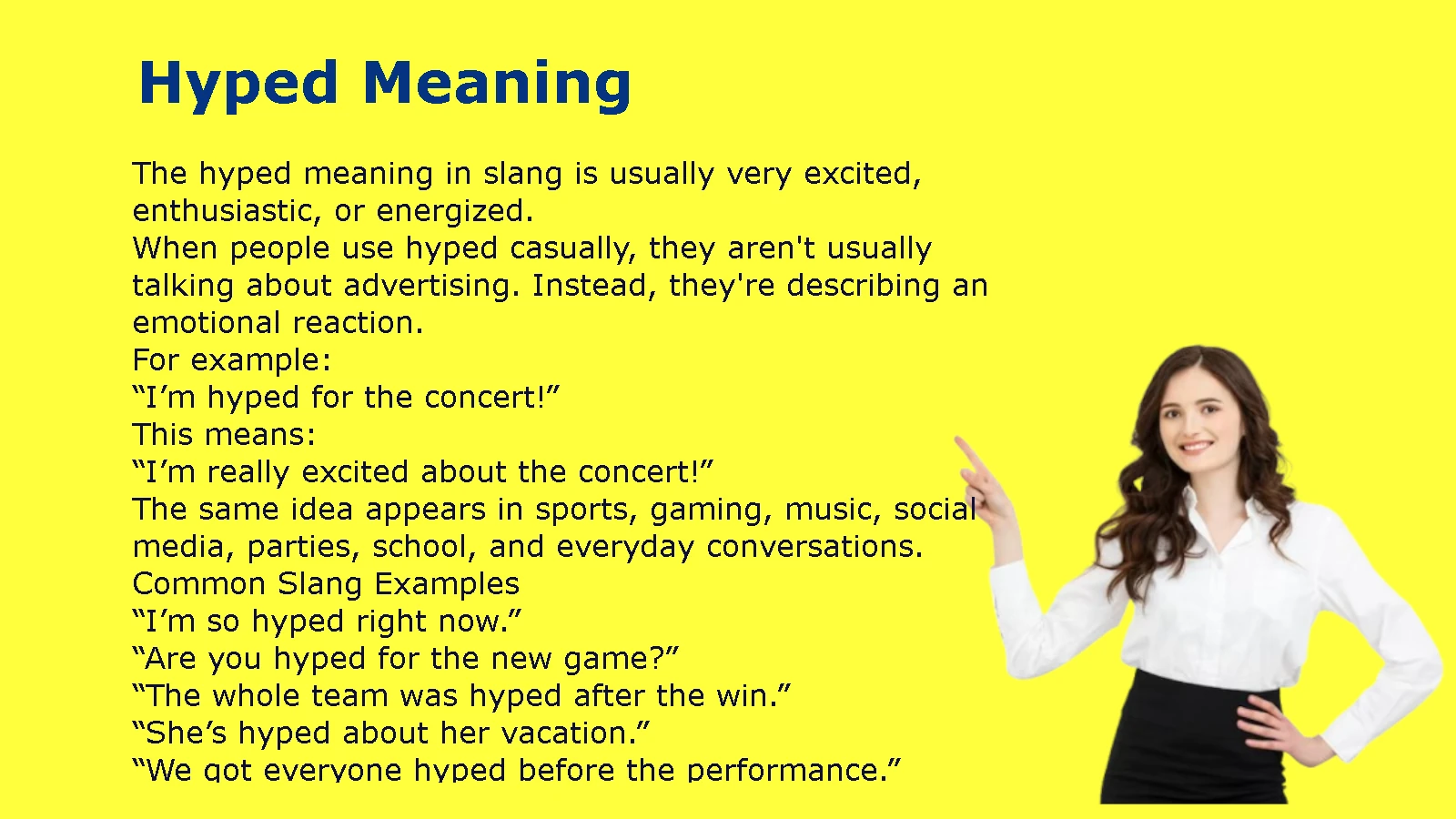
The hyped meaning in slang is usually very excited, enthusiastic, or energized.
When people use hyped casually, they aren’t usually talking about advertising. Instead, they’re describing an emotional reaction.
For example:
“I’m hyped for the concert!”
This means:
“I’m really excited about the concert!”
The same idea appears in sports, gaming, music, social media, parties, school, and everyday conversations.
Common Slang Examples
- “I’m so hyped right now.”
- “Are you hyped for the new game?”
- “The whole team was hyped after the win.”
- “She’s hyped about her vacation.”
- “We got everyone hyped before the performance.”
In these examples, hyped carries an energetic, informal tone.
It can also describe someone who feels highly stimulated or worked up. Cambridge defines hyped up as informal language for someone who is emotionally excited, nervous, or anxious.
What Does “Hyped Up Meaning Slang” Refer To?
The slang phrase hyped up generally means extremely excited, energized, or worked up.
For instance:
“The players were hyped up before the championship game.”
The players weren’t simply interested. They were highly energized and emotionally ready for what was about to happen.
Depending on context, hyped up can also suggest nervous energy. That’s why someone can be hyped up before an exam even though an exam isn’t necessarily fun.
What Does “Hyped Up” Mean?
Hyped up has several closely related meanings. It can mean very excited or energized, or it can describe something that has been strongly promoted, exaggerated, or intensified.
Cambridge defines hyped up as informal language for being too excited or nervous to remain calm. It also recognizes hype up as a verb meaning to make someone feel very excited.
Hyped Up Meaning: Excited or Energized
When hyped up describes a person, it usually means very excited, nervous, or energized.
“The kids were hyped up before the party.”
The children were full of excitement and energy.
Another example:
“I was so hyped up before the interview that I couldn’t sit still.”
Here, the phrase suggests a mixture of anticipation and nervous energy.
Oxford also defines hyped up as informal language for being very worried or excited about something that is going to happen.
Hyped Up Meaning: Promoted or Exaggerated
There is another use.
Something can be hyped up when people promote it heavily or make it seem more impressive than it really is.
“The new restaurant was hyped up online.”
This means people promoted or praised it extensively.
Similarly:
“The product was hyped up as revolutionary.”
The wording suggests that promotional claims created strong expectations about the product.
Dictionary.com describes hyped-up as something intensively or excessively stimulated or exaggerated.
A Simple Way to Tell the Difference
Ask yourself:
Is “hyped up” describing a person’s feelings?
If yes, it probably means very excited, energized, or nervous.
Is it describing a product, event, claim, or idea?
If yes, it may mean heavily promoted or exaggerated.
| Sentence | Meaning |
| “I’m hyped up for the concert.” | Very excited |
| “The fans were hyped up before kickoff.” | Highly energized |
| “The movie was hyped up for months.” | Heavily promoted |
| “The benefits were hyped up in the advertisement.” | Exaggerated or strongly promoted |
What Does “I Am So Hyped” Mean?
“I am so hyped” means “I am extremely excited.”
It’s an informal expression that usually communicates strong enthusiasm about something that is happening soon or something you really want to experience.
For example:
“I am so hyped for the concert tomorrow!”
This means:
“I’m extremely excited about the concert tomorrow!”
The phrase often appears in texts, social media posts, gaming conversations, sports discussions, and casual speech.
Natural Examples of “I Am So Hyped”
“I am so hyped for the new season!”
Meaning: I’m extremely excited to watch it.
“I am so hyped about our vacation.”
Meaning: I’m really excited about going on vacation.
“I am so hyped for this game.”
Meaning: I’m extremely excited to play or watch the game.
“I am so hyped right now!”
Meaning: I feel incredibly excited and energized at the moment.
Is “I Am So Hyped” Positive?
Usually, yes.
When someone says “I’m so hyped!”, they generally express enthusiasm or anticipation. The phrase often has a positive, energetic tone.
Still, context can add a slightly different shade. Someone can feel hyped up and nervous before an important event. Cambridge specifically includes nervousness in its definition of hyped up.
Hyped vs. Hyped Up
Hyped and hyped up overlap heavily, especially when they describe excitement. However, they don’t always sound identical.
Hyped is often shorter and more casual:
“I’m hyped for the game.”
Hyped up can sound stronger or emphasize a heightened emotional state:
“I’m really hyped up for the game.”
Both sentences communicate excitement.
Hyped vs. Hyped Up Comparison
| Expression | Common meaning | Example |
| Hyped | Very excited | “I’m hyped for Friday.” |
| Hyped up | Very excited or energized | “I’m hyped up for the match.” |
| Hyped | Heavily promoted | “The film was heavily hyped.” |
| Hyped up | Intensely promoted or exaggerated | “The product was hyped up online.” |
The phrase hyped up can also work as a phrasal verb.
“My friends hyped me up before the presentation.”
Here, hyped me up means made me feel more excited or confident.
Cambridge specifically defines hype someone up as making someone feel very excited.
“Hyped for” vs. “Hyped about”
Both are common.
“I’m hyped for the concert.”
This focuses on anticipation of an upcoming event.
“I’m hyped about my new laptop.”
This focuses more on excitement about a particular thing.
You can often use either expression without changing the basic message.
Hyped Synonyms
The best hyped synonym depends on which meaning you intend.
If hyped means excited, words such as excited, thrilled, enthusiastic, pumped, energized, and eager can work.
If hyped means promoted, alternatives include publicized, advertised, promoted, marketed, and touted.
In contexts involving exaggeration, words like overstated or overpromoted may be more appropriate.
Hyped Up Synonyms for Excitement
| Synonym | Best used when… | Example |
| Excited | You want a neutral word | “I’m excited about the trip.” |
| Thrilled | You feel especially happy | “She’s thrilled about the opportunity.” |
| Enthusiastic | You want a more formal word | “He’s enthusiastic about the project.” |
| Pumped | You want casual, energetic language | “We’re pumped for the game.” |
| Energized | You emphasize energy | “The crowd felt energized.” |
| Eager | You strongly want something to happen | “She’s eager to get started.” |
| Fired up | You want a highly energetic expression | “The team was fired up.” |
Synonyms for Hyped as “Promoted”
When hyped describes publicity, excited isn’t the right replacement.
Consider these alternatives:
- Promoted
- Publicized
- Advertised
- Marketed
- Touted
- Pitched
- Plugged
- Overpromoted
- Exaggerated
- Publicized heavily
Collins lists words such as publicize, push, promote, and advertise as synonyms connected with the promotional meaning of hype.
Which Hyped Synonym Should You Use?
Use the synonym that matches the intensity and context.
For a casual conversation:
“I’m pumped for the trip.”
For a neutral statement:
“I’m excited about the trip.”
For stronger enthusiasm:
“I’m thrilled about the trip.”
For a formal context:
“She is enthusiastic about the opportunity.”
For advertising:
“The company heavily promoted the product.”
That distinction keeps your writing precise.
Hyped Meaning in a Sentence
Seeing hyped meaning in a sentence makes the difference between its uses much easier to understand.
Hyped Meaning “Excited”
“I’m hyped for the concert tonight.”
The speaker is very excited about the concert.
“The fans were hyped after the team won.”
The fans were highly energized and enthusiastic.
“She’s hyped about her new job.”
She feels very excited about getting the new job.
“We’re all hyped for the weekend.”
Everyone feels enthusiastic about the upcoming weekend.
Hyped Meaning “Promoted”
“The new phone was heavily hyped before launch.”
The phone received extensive publicity.
“The movie was hyped as a major blockbuster.”
Promoters presented the movie as something particularly important or impressive.
“The restaurant was more hyped than impressive.”
People promoted or praised it so much that expectations became very high.
Hyped Up in a Sentence
“The crowd was hyped up before the concert.”
Here, hyped up means excited and energized.
“The company hyped up the new product for months.”
Here, hyped up means heavily promoted.
“My friends hyped me up before the competition.”
Here, hyped me up means they encouraged and energized me.
Notice how the grammar helps reveal the meaning.
Being hyped usually describes a person’s excited or energized emotional state.
The verb “hype” refers to promoting or building excitement around something.
To hype someone up means to make that person feel more excited, confident, or energized.
How Do You Pronounce Hyped Up?
Hyped up has two syllables and uses the same vowel sound as hyped followed by up.
Cambridge gives the US pronunciation as /ˌhaɪpt ˈʌp/.
Hyped Up
/haɪpt ʌp/
Give feedback
The main stress falls on up, while hyped sounds like the word typed.
Why Does “Hyped” Sometimes Mean Excited and Sometimes Mean Promoted?
At first glance, the two meanings can seem unrelated. They actually connect through the idea of heightened excitement or attention.
To hype a product means to generate interest around it. Advertisers, journalists, fans, influencers, or companies can build anticipation by repeatedly talking about something.
That attention can then make people hyped about the thing.
For example, imagine a new video game.
First, the company announces it. Then trailers appear. Influencers discuss it. Fans speculate about its features. Social media fills with predictions.
The game becomes hyped.
Now someone says:
“I’m so hyped to play it.”
The first use describes promotion and public attention. The second describes personal excitement.
The meanings meet at the same point: heightened interest and excitement.
Hyped, Hype, and Hyping: Understanding the Word Family
Learning the related forms makes the vocabulary much easier to use.
| Word | Part of speech | Meaning | Example |
| Hype | Noun | Excitement or publicity | “There’s a lot of hype around the movie.” |
| Hype | Verb | Promote or excite | “They hype the product heavily.” |
| Hyped | Past tense/adjective | Excited or promoted | “Everyone was hyped.” |
| Hyping | Present participle | Promoting or exciting | “Fans are hyping the event.” |
| Hyped up | Adjective | Very excited or energized | “The crowd was hyped up.” |
| Hype someone up | Phrasal verb | Make someone excited | “Her friends hyped her up.” |
Cambridge identifies hyped as the past simple and past participle of hype, while hype someone up functions as a phrasal verb.
Hype as a Noun
When hype functions as a noun, it often means intense publicity or excitement.
“There was so much hype around the new phone.”
The sentence means the phone attracted a large amount of attention and promotion.
Hype as a Verb
As a verb, hype can mean to promote something heavily.
“The company hyped the launch for months.”
It can also mean to make someone excited.
“The coach hyped the players up before the match.”
Hyping
Hyping describes the ongoing action.
“Fans are hyping the new album online.”
The fans are actively creating excitement or attention around it.
Is Hyped the Same as Excited?
Hyped and excited can mean nearly the same thing, especially in casual conversation. However, hyped usually sounds more informal and energetic.
Compare:
“I’m excited about the trip.”
This sounds neutral.
“I’m hyped about the trip.”
This sounds more casual and enthusiastic.
You wouldn’t normally replace excited with hyped in every formal sentence. For example, in professional writing, enthusiastic, pleased, or eager may fit better depending on the context.
Hyped vs. Excited
| Word | Tone | Intensity | Typical use |
| Excited | Neutral | Moderate to strong | Everyday and formal contexts |
| Hyped | Informal | Strong | Casual speech and social media |
| Thrilled | Neutral to positive | Strong | Happy excitement |
| Pumped | Very informal | Strong | Sports, events, activities |
| Eager | Neutral/formal | Moderate | Anticipation and willingness |
| Enthusiastic | Neutral/formal | Moderate to strong | Interest and support |
So, if your friend says “I’m hyped!”, you can understand it as “I’m really excited!”
When Should You Use “Hyped”?
Hyped works especially well in casual conversations where you want to express energy or enthusiasm.
Good contexts include:
- Sports
- Concerts
- Video games
- Movies and TV shows
- Parties
- Vacations
- New products
- Social media
- Informal text messages
- Friendly conversations
For example:
“Are you hyped for the playoffs?”
“I’m hyped about the new update.”
“Everyone was hyped when the singer came onstage.”
In formal writing, choose a more precise alternative when needed.
Instead of:
“The employees were hyped about the new policy.”
You might write:
“The employees were enthusiastic about the new policy.”
The best choice depends on your audience and tone.
When Does “Hyped” Have a Negative Meaning?
Hyped isn’t automatically negative. However, the word can take on a negative tone when it refers to excessive promotion or exaggerated expectations.
Consider:
“The movie was heavily hyped, but the story was disappointing.”
Here, hyped implies that the promotion created expectations the movie didn’t meet.
Similarly:
“The product is more hyped than useful.”
The speaker isn’t simply saying that people promoted the product. The statement suggests the promotion may have gone too far.
Dictionary.com and the American Heritage Dictionary both recognize a sense of hype involving exaggerated or excessive publicity.
Positive, Neutral, and Negative Uses
| Sentence | Tone |
| “I’m hyped for the concert.” | Positive |
| “The fans were hyped before the game.” | Positive |
| “The product was heavily hyped.” | Neutral |
| “The product was way overhyped.” | Negative |
| “The movie was hyped as a masterpiece.” | Potentially skeptical |
| “The crowd was hyped up.” | Usually positive |
The prefix over- changes the message significantly.
Hyped can simply mean promoted.
Overhyped means promoted or praised too much.
Real-Life Contexts Where You’ll Hear “Hyped”
Sports
Sports fans frequently use hyped to describe excitement before a major game.
“The fans are hyped for the championship.”
Here, the word expresses anticipation and energy.
Gaming
Gamers often use hyped when discussing upcoming releases, updates, characters, or tournaments.
“I’m hyped for the next update.”
The phrase communicates strong enthusiasm.
Music
Fans may describe themselves as hyped before a concert or album release.
“Everyone was hyped when the band announced the tour.”
Movies and Television
Entertainment coverage often uses hyped in both senses.
“Fans are hyped for the new season.”
This describes excitement.
“The show was heavily hyped before its premiere.”
This describes promotion and publicity.
Shopping and Products
Marketing creates another common use.
“The new phone has been heavily hyped online.”
Here, hyped refers to promotional attention.
Social Media
Social media has popularized informal expressions such as “I’m hyped,” “so hyped,” and “hyped for this,” making them especially common in casual online conversations.
Someone might post:
“So hyped for tomorrow!”
The meaning is simple: “I’m extremely excited about tomorrow.”
A Quick Case Study: One Word, Two Meanings
Consider a fictional new movie called Midnight City.
Before release, the studio publishes trailers and interviews. Influencers discuss the film. News outlets cover it. Fans post theories.
At this stage:
“The movie is heavily hyped.”
That means the movie has received extensive publicity and attention.
Then you ask a friend whether they want to see it.
They reply:
“Absolutely! I’m so hyped for it.”
Now hyped means extremely excited.
After the movie comes out, another friend says:
“It was good, but it was overhyped.”
Now overhyped means promoted or praised more heavily than the speaker thinks was justified.
The same word family moves through three related ideas:
Promotion → Anticipation → Personal excitement
That’s why context matters so much when interpreting hyped meaning.
Common Expressions With Hyped
Here are several phrases you may encounter in everyday English:
“I’m hyped for…”
Means “I’m very excited about…”
“I’m hyped for the weekend.”
“I’m hyped about…”
Means “I’m very excited about…”
“She’s hyped about her new project.”
“Get hyped!”
Means “Get excited!” or “Get energized!”
“The match starts in five minutes. Get hyped!”
“Hype someone up”
Means to make someone feel excited or energized.
“Her friends hyped her up before the audition.”
“Hype up something”
Means to promote or praise something intensely.
“The company hyped up the product before launch.”
“Overhyped”
Means promoted or praised excessively.
“The restaurant was completely overhyped.”
Common Mistakes With Hyped
Mistake: Assuming hyped always means excited
That’s the most common misunderstanding.
“The product was hyped before launch.”
This may refer to promotion, not someone’s emotional state.
Mistake: Treating hyped as formal language
Hyped is common and natural in informal English. However, it can sound too casual in some professional contexts.
For formal writing, alternatives such as enthusiastic, eager, promoted, or publicized may work better.
Mistake: Assuming hyped always has a positive meaning
It doesn’t.
“I’m hyped for the concert.”
Positive.
“The movie was ridiculously hyped.”
Potentially negative.
The surrounding words determine the tone.
Mistake: Confusing “hyped” with “overhyped”
These aren’t identical.
Hyped can simply mean excited or heavily promoted.
Overhyped suggests that the excitement or promotion went too far.
Frequently Asked Questions About Hyped
What does hyped mean in slang?
In slang and casual conversation, hyped usually means very excited, enthusiastic, or energized.
For example:
“I’m hyped for the game.”
This means “I’m extremely excited about the game.”
What does hyped up mean?
Hyped up usually means very excited, energized, nervous, or worked up. It can also describe something that people have promoted or exaggerated heavily. Cambridge specifically recognizes the informal emotional meaning.
What does “I am so hyped” mean?
“I am so hyped” means “I am extremely excited.”
It is an informal expression commonly used when someone looks forward to an event, activity, release, trip, game, or experience.
Is hyped the same as excited?
Not exactly, but the meanings often overlap.
Excited is more neutral and works in both casual and formal contexts. Hyped sounds more informal and often suggests a stronger burst of enthusiasm.
What is another word for hyped?
If hyped means excited, alternatives include excited, thrilled, enthusiastic, pumped, energized, eager, and fired up.
If it means promoted, alternatives include advertised, publicized, marketed, promoted, and touted.
What does hyped up mean in a sentence?
“The fans were hyped up before the final.”
Here, hyped up means very excited and energized.
Another example shows the promotional meaning:
“The new product was hyped up for months.”
Here, it means heavily promoted or publicized.
Final Takeaway: What Does Hyped Mean?
The hyped meaning depends on context, but the word generally revolves around heightened excitement, energy, attention, or promotion.
When you say:
“I’m hyped!”
you usually mean “I’m extremely excited!”
When you say:
“The movie was heavily hyped.”
you mean the movie received a lot of promotion and publicity.
And when someone says:
“They hyped me up before the game.”
they mean someone made them feel more excited, energized, or confident.
The easiest rule is simple: hyped describes excitement when it refers to people and often describes promotion when it refers to things. Once you look at the surrounding context, the intended meaning becomes clear.