Have you ever come across the word desirous and wondered what it really means? Although desirous may look familiar because it comes from the word desire, its meaning and usage can sometimes be confusing. Understanding the desirous meaning can help you use this adjective correctly in everyday and formal English.
Desirous means wanting or wishing for something strongly. It describes a person who has a strong desire to have, achieve, or experience something. The word is often followed by of, as in “desirous of success” or “desirous of change.”
Examples:
- She was desirous of a better opportunity.
- He was desirous of learning more about the subject.
The confusion is understandable. People often search for desirous meaning, desirous meaning in English, what does desirous mean, or desirous definition because the word sounds similar to desire but isn’t always used in the same way. It can also sound more formal or old-fashioned than simpler alternatives such as wanting, eager, or wishing.
In this guide, you’ll learn the complete desirous meaning, including its definition, pronunciation, origin, part of speech, and usage. You’ll also see clear examples, common phrases, synonyms, and helpful explanations to understand when and how to use desirous correctly.
What Does Desirous Mean?
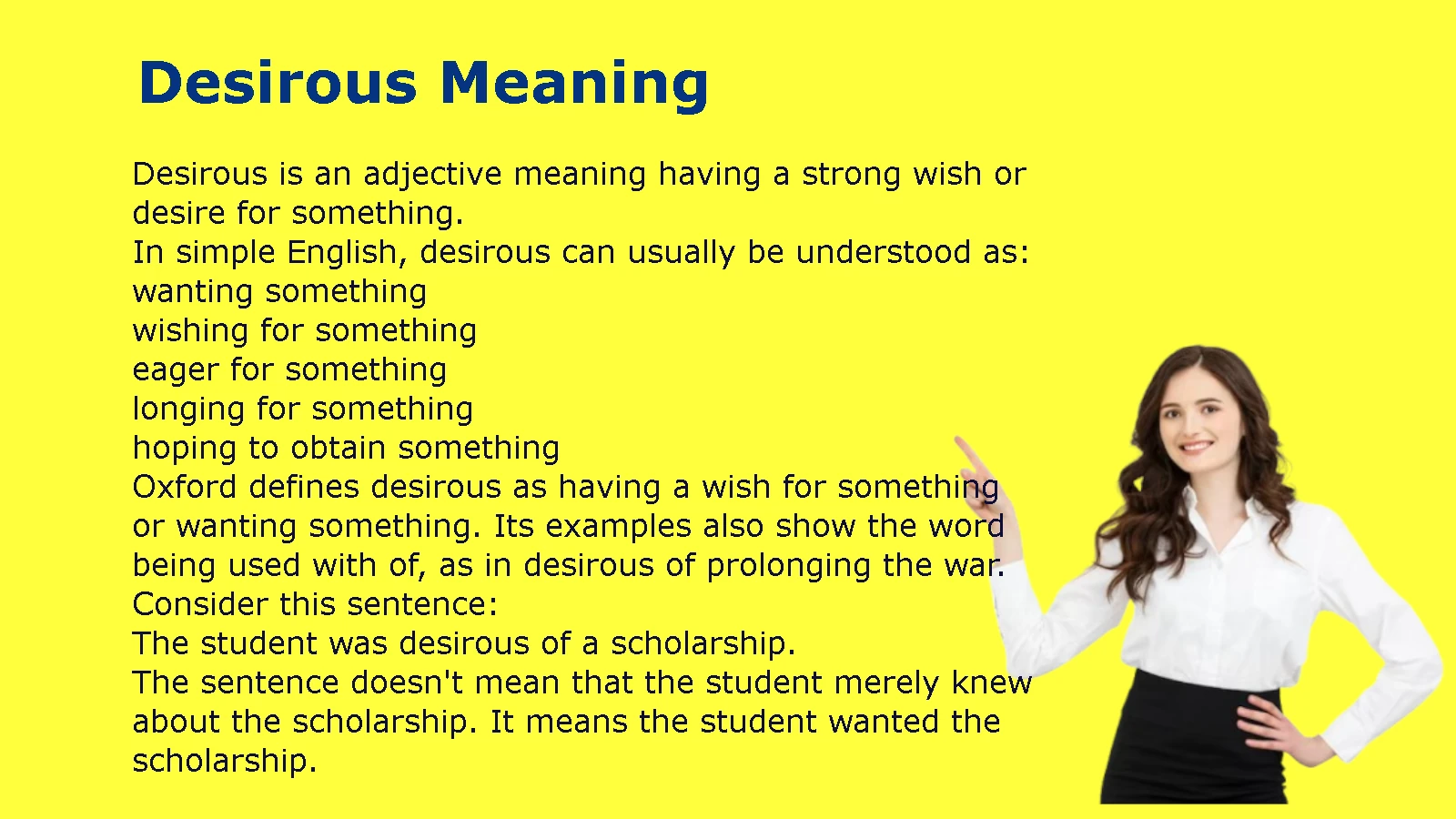
Desirous is an adjective meaning having a strong wish or desire for something.
In simple English, desirous can usually be understood as:
- wanting something
- wishing for something
- eager for something
- longing for something
- hoping to obtain something
Oxford defines desirous as having a wish for something or wanting something. Its examples also show the word being used with of, as in desirous of prolonging the war.
Consider this sentence:
The student was desirous of a scholarship.
The sentence doesn’t mean that the student merely knew about the scholarship. It means the student wanted the scholarship.
You could rewrite it in simpler language as:
The student wanted a scholarship.
The two sentences communicate essentially the same idea. The difference lies mainly in tone and style.
Desirous Meaning in Simple Words
The easiest way to remember the meaning of desirous is:
Desirous = wanting something.
For example:
- He was desirous of wealth. → He wanted wealth.
- She was desirous of recognition. → She wanted recognition.
- They were desirous of peace. → They wanted peace.
- We were desirous of finding a solution. → We wanted to find a solution.
The word can describe ordinary wishes, serious ambitions, long-term goals, or strong emotional wants. The surrounding context tells you how intense or important the desire is.
Desirous Definition
Here is a quick reference for the word:
| Feature | Details |
| Word | Desirous |
| Part of speech | Adjective |
| Basic meaning | Wanting or wishing for something |
| Common pattern | Desirous of + noun |
| Another pattern | Desirous of + -ing verb |
| Tone | Formal, sometimes old-fashioned |
| Related noun | Desire |
| Related verb | Desire |
| Common alternatives | Wanting, eager, wishing, longing |
A useful distinction is that desirous describes the person who has the desire.
For example:
Maria was desirous of independence.
Maria has the desire.
Compare that with:
Independence was desirable.
Here, desirable describes the thing that is considered worth having or wanting.
That difference becomes important because desirous and desirable are related but do not mean the same thing.
How to Pronounce Desirous
In American English, desirous is pronounced approximately:
duh-ZY-rus
Its US IPA pronunciation is /dəˈzaɪr.əs/ according to Cambridge Dictionary. British English commonly uses a pronunciation closer to /dɪˈzaɪə.rəs/.
The main stress falls on the middle syllable:
de-ZI-rous
The pronunciation connects naturally with desire, which has the familiar sound duh-ZYRE in American English.
Desirous Syllables
The word can be broken into three syllables:
de-si-rous
However, English pronunciation doesn’t always sound exactly like the spelling suggests. In American English, the word generally has the rhythm of duh-ZY-rus.
If you’re learning the word for conversation, focus on the stressed ZY sound rather than trying to pronounce every written letter equally.
Desirous Part of Speech
Desirous is an adjective.
An adjective describes a person, thing, or state. In this case, desirous describes someone who has a desire.
For example:
- a desirous individual
- a desirous customer
- people desirous of change
- students desirous of knowledge
However, modern English speakers don’t often use desirous in casual conversation. The construction desirous of is much more likely to appear in formal, literary, historical, or carefully written language.
Cambridge’s US dictionary explicitly classifies the word as old-fashioned formal, while Oxford marks it as formal.
That doesn’t make the word incorrect. It simply means you should consider the tone before using it.
How to Use Desirous in a Sentence
The most important grammatical pattern is:
desirous of + something
The “something” can be a noun or an activity expressed with an -ing form.
Desirous of Something
Use desirous of when the object of the desire is a noun or noun phrase.
Examples:
- She was desirous of success.
- He was desirous of greater freedom.
- The company was desirous of expansion.
- They were desirous of peace.
- The child was desirous of attention.
In each example, desirous tells us what someone wants.
The construction is particularly useful in formal writing because it compresses the idea of “having a strong desire for” into one adjective.
For instance:
The organization was desirous of reform.
A simpler version would be:
The organization wanted reform.
The first sentence sounds more formal. The second sounds more direct and natural in everyday English.
Desirous of Doing Something
You can also use desirous of + gerund when someone wants to perform an action.
Examples include:
- She was desirous of improving her skills.
- He was desirous of learning more about the subject.
- They were desirous of finding a peaceful solution.
- The company was desirous of expanding into new markets.
- The researchers were desirous of understanding the cause.
Here, improving, learning, finding, expanding, and understanding function as gerund forms after the preposition of.
This pattern is useful because it lets you describe a desired action without changing the sentence into a separate clause.
Desirous to Do Something
You may also encounter desirous to + verb, particularly in formal or older writing.
Oxford lists both desirous of something/of doing something and desirous to do something among its grammatical patterns.
For example:
He was desirous to meet the king.
The sentence means that he wanted to meet the king.
Still, desirous of meeting is a well-established construction, and in contemporary writing you should choose the form that fits your intended tone.
For ordinary modern communication, you could simply write:
He wanted to meet the king.
That version is shorter and more conversational.
Examples of Desirous in a Sentence
Seeing the word in different contexts makes its meaning much easier to grasp.
| Sentence | Meaning |
| She was desirous of success. | She strongly wanted success. |
| He was desirous of a fresh start. | He wanted a fresh start. |
| They were desirous of peace. | They wanted peace. |
| The student was desirous of knowledge. | The student strongly wanted knowledge. |
| She was desirous of improving her writing. | She wanted to improve her writing. |
| The company was desirous of expansion. | The company wanted to expand. |
| He became desirous of independence. | He began strongly wanting independence. |
| The committee was desirous of avoiding conflict. | The committee wanted to avoid conflict. |
| The travelers were desirous of seeing the city. | The travelers wanted to see the city. |
| She was desirous of a better opportunity. | She wanted a better opportunity. |
Desirous in Personal Goals
The word can describe ambition or personal goals.
After years of study, she was desirous of a position that would allow her to use her skills.
Here, desirous suggests a deliberate and meaningful wish rather than a passing impulse.
A simpler version would be:
After years of study, she wanted a position that would allow her to use her skills.
Both work. The second feels more natural for most modern readers.
Desirous in Professional Writing
The word can also appear in formal professional contexts.
The organization was desirous of establishing stronger partnerships with local institutions.
This means:
The organization wanted to establish stronger partnerships with local institutions.
The formal version isn’t necessarily better. It simply creates a different tone.
When clarity matters more than formality, wanted is often the better choice.
Desirous in Literature
Literary writing may use desirous because the word carries a slightly elevated tone.
For example:
He was desirous of a life beyond the narrow boundaries of his village.
The sentence sounds more reflective and formal than:
He wanted a life beyond his village.
Neither version changes the basic meaning. The choice depends on the voice of the writing.
What Is the Difference Between Desirous and Desirable?
Desirous and desirable come from the same family of words, but they describe different things.
Desirous means having a desire.
Desirable means worth wanting or considered attractive or beneficial.
Compare these sentences:
She is desirous of success.
She wants success.
Success is desirable.
Success is considered worth having.
The easiest way to remember the distinction is:
Desirous describes the person who wants. Desirable describes the thing that is wanted or worth wanting.
Oxford defines desirable as something you would like to have or do, or something worth having or doing. It can also describe a person who causes others to feel sexual desire.
Desirous vs. Desirable Examples
| Word | Example | Meaning |
| Desirous | She is desirous of success. | She wants success. |
| Desirable | Success is desirable. | Success is worth wanting. |
| Desirous | They are desirous of change. | They want change. |
| Desirable | Change may be desirable. | Change may be beneficial or worth having. |
A quick memory trick helps:
The person is desirous. The thing can be desirable.
That isn’t an absolute rule for every possible sentence, but it captures the central distinction.
Desirous vs. Desiring
The words desirous and desiring are closely related, but their grammatical behavior differs.
Desirous is an adjective.
Desiring is the present participle of the verb desire and can also function as a participial adjective.
Compare:
She was desirous of success.
and:
She was desiring success.
The first sentence sounds formal and somewhat literary. The second is grammatically possible but often sounds less natural in ordinary English.
In many contexts, a native speaker would simply say:
She wanted success.
The verb desire itself is also more formal than want. Cambridge describes desire as a formal verb meaning to want something, especially strongly.
That gives you a useful style ladder:
want → desire → be desirous of
The meaning remains related, but the tone becomes increasingly formal.
Synonyms for Desirous
The best synonym depends on how strong the desire is and what tone you want.
Common Everyday Synonyms
These words usually sound more natural than desirous in conversation:
- wanting
- eager
- wishing
- hoping
- interested in
For example:
She was desirous of learning more.
can become:
She was eager to learn more.
The second sentence sounds much more natural in everyday English.
Stronger Synonyms
Some words suggest a deeper or more intense desire:
- longing
- yearning
- craving
- hankering
- aching for
These aren’t always interchangeable with desirous.
For example:
He was desirous of a new home.
simply tells us that he wanted one.
He was yearning for a new home.
suggests a much deeper emotional longing.
Formal Synonyms
Depending on the context, possible formal alternatives include:
- wishing
- aspiring
- seeking
- intent on
- eager
However, these words carry different shades of meaning.
Aspiring usually relates to a goal or ambition.
Seeking emphasizes an attempt to obtain something.
Eager often suggests enthusiasm.
Yearning suggests emotional intensity.
So don’t treat a thesaurus as a word-swapping machine. Meaning lives in context.
Antonyms of Desirous
The opposite of desirous depends on why someone doesn’t want something.
Useful antonyms and near-antonyms include:
- unwilling
- reluctant
- indifferent
- uninterested
- disinclined
- averse
These words aren’t exact opposites in every situation.
For example, reluctant means someone doesn’t want to do something readily.
She was reluctant to accept the offer.
Indifferent, however, means the person doesn’t particularly care.
He was indifferent to the outcome.
Averse means strongly opposed or disinclined toward something.
She was averse to taking unnecessary risks.
So the best opposite depends on the kind of unwillingness you’re describing.
Desirous Meaning in Different Contexts
The word’s core definition stays stable, but its tone changes depending on where you use it.
Desirous in Everyday English
In casual conversation, desirous can sound unnecessarily formal.
Someone would normally say:
I want a new car.
rather than:
I am desirous of a new car.
The second sentence isn’t useful merely because it contains a longer word. In fact, it may make the speaker sound stiff.
Simple language often wins.
Desirous in Formal Writing
Formal writing provides a more natural home for the word.
For example:
The parties were desirous of reaching an agreement.
This kind of construction can appear in formal documents, historical writing, and institutional language.
However, you shouldn’t automatically replace want with desirous just to make your writing sound sophisticated. Clear writing usually works best when the vocabulary matches the audience.
Desirous in Literature
Literary writing can use desirous to create a more elevated voice.
A character described as desirous of power may sound ambitious or driven.
A character desirous of revenge may appear consumed by a particular goal.
A person desirous of peace may seem deeply committed to achieving it.
The word itself doesn’t tell you whether the desire is good or bad. The object of the desire and the surrounding context provide that meaning.
Is Desirous a Positive or Negative Word?
Desirous is generally neutral.
It simply describes having a desire. The word doesn’t automatically praise or criticize the person who has that desire.
Consider these examples:
She was desirous of knowledge.
This sounds positive.
He was desirous of wealth.
This is neutral.
The ruler was desirous of absolute power.
This may sound negative because the desired object raises concerns.
The prisoner was desirous of revenge.
Again, the context gives the sentence its negative force.
So don’t assume that desirous itself carries a positive or negative judgment.
A Useful Context Test
When deciding how the word feels, ask:
- What does the person want?
- Why do they want it?
- Does the sentence praise, criticize, or simply describe the desire?
That three-question test usually reveals the intended tone.
Is Desirous a Formal Word?
Yes. Desirous is generally formal and can sound old-fashioned.
This is one of the most important facts to remember about the word.
Cambridge explicitly labels it old-fashioned formal, while Oxford identifies it as formal.
That doesn’t mean you should avoid it completely. Instead, choose it when its tone fits the context.
Formal
The parties were desirous of reaching a settlement.
Neutral
The parties wanted to reach a settlement.
More conversational
Both sides wanted to work things out.
All three sentences communicate a similar basic idea. The difference is style.
If you’re writing a school essay, article, business document, or literary piece, desirous may occasionally fit. If you’re texting a friend, it will probably sound like you’re wearing a three-piece suit to a backyard barbecue.
Common Grammar Mistakes With Desirous
Understanding the definition isn’t enough. You also need to know how the word behaves in a sentence.
Using the Wrong Preposition
One of the most useful patterns to remember is:
desirous of + noun
Examples:
- desirous of success
- desirous of peace
- desirous of change
- desirous of recognition
You can also use:
desirous of + -ing
Examples:
- desirous of learning
- desirous of improving
- desirous of expanding
- desirous of finding
Oxford specifically records the patterns desirous of something, desirous of doing something, and desirous to do something.
Confusing Desirous With Desirable
This is another common vocabulary problem.
Don’t write:
The new policy is desirous.
when you mean that the policy is worth having.
Use:
The new policy is desirable.
If you mean that people strongly want the policy, you could write:
People are desirous of the new policy.
The difference is subtle but important.
Using Desirous When Wanting Is Better
A sentence can be grammatically correct yet stylistically awkward.
I am desirous of another cup of coffee.
Nothing about the basic grammar makes the sentence meaningless. However, it sounds dramatically more formal than necessary.
A natural alternative is:
I want another cup of coffee.
Good writing isn’t a contest to use the most complicated synonym available. The right word is the one that fits the context.
Word Forms Related to Desirous
The word belongs to a larger family built around desire.
| Word | Part of Speech | Meaning |
| desire | Noun | A strong feeling of wanting something |
| desire | Verb | To want something strongly |
| desirous | Adjective | Having or expressing a desire |
| desirable | Adjective | Worth wanting or considered desirable |
| desiring | Verb form/adjective | Wanting or expressing a desire |
| desirously | Adverb | In a desirous manner |
Cambridge defines desire as a strong feeling that you want something and also uses desire as a formal verb meaning to want something, especially strongly.
Desire as a Noun
She had a strong desire for independence.
Here, desire names the feeling.
Desire as a Verb
She desires independence.
Here, desire describes the action or state of wanting.
Desirous as an Adjective
She is desirous of independence.
Here, desirous describes her state of wanting.
Desirable as an Adjective
Independence is desirable.
Here, desirable describes the thing being wanted.
These four sentences are related, but each word plays a different grammatical role.
Origin and Etymology of Desirous
The history of desirous reaches back to Middle English.
Oxford traces the word to Middle English desireus, from Old French, ultimately connecting it with Latin desiderare, meaning “to desire.”
Etymonline dates desirous to around 1300 and traces it through Anglo-French and Old French to Vulgar Latin desiderosus, from the stem of Latin desiderare.
The related English word desire also entered English through Old French from Latin desiderare. The English noun is recorded from around the beginning of the 14th century.
There is an interesting but qualified detail in the deeper etymology. Some sources connect Latin desiderare with sidus, meaning a heavenly body or star, suggesting an older association with waiting for what the stars might bring. However, this explanation is debated. Etymonline itself notes that alternative etymological analysis exists.
Therefore, it’s safer to say that desirous is historically related to Latin desiderare rather than presenting the “desire from the stars” explanation as an established fact.
Desirous vs. Wanting: Which Should You Use?
For most modern readers, wanting is the simpler and more natural choice.
Compare:
The customer was desirous of additional information.
with:
The customer wanted additional information.
The second sentence is easier to process.
However, desirous can be useful when you deliberately want a formal tone.
| Situation | Better Choice |
| Casual conversation | wanting |
| Friendly email | wanting / eager |
| General web writing | wanting / eager |
| Formal writing | desirous may fit |
| Literary writing | desirous can fit |
| Historical-style writing | desirous may fit |
| Clear instructions | wanting / wishing |
The key isn’t to eliminate formal vocabulary. It’s to match vocabulary to the reader.
Desirous vs. Eager
Desirous and eager can overlap, but eager often carries a stronger sense of enthusiasm or impatience.
Compare:
She was desirous of learning more.
This simply tells us that she wanted to learn more.
She was eager to learn more.
This suggests enthusiasm and strong interest.
That makes eager a better everyday alternative in many situations.
For example:
The children were eager to open their presents.
sounds natural.
The children were desirous of opening their presents.
sounds unnecessarily formal.
The underlying desire is similar, but the emotional flavor changes.
Desirous vs. Longing
Longing usually suggests a deeper emotional desire.
He was desirous of returning home.
This tells us that he wanted to return.
He was longing to return home.
This suggests emotional attachment and perhaps sadness or distance.
Likewise:
- desirous of success → wants success
- longing for home → deeply misses or yearns for home
- desirous of companionship → wants companionship
- longing for companionship → strongly and emotionally yearns for companionship
These distinctions matter when you want precise writing.
Case Study: Choosing the Right Word
Imagine you’re writing three versions of the same message.
Version A: Casual
I want to learn more about photography.
This works well in conversation.
Version B: Professional
I am eager to learn more about professional photography.
This sounds positive and purposeful.
Version C: Formal
I am desirous of learning more about professional photography.
This is grammatically sound but considerably more formal.
The three sentences don’t require three different meanings. They require three different voices.
That is the real value of understanding desirous. You aren’t merely learning another synonym for want. You’re learning how English changes its tone while preserving a related idea.
Quick Facts About Desirous
Here are the most useful facts at a glance:
- Desirous is an adjective.
- It means wanting or wishing for something.
- The common structure is desirous of + noun.
- You can also use desirous of + -ing form.
- Oxford also records desirous to + verb.
- The word is generally formal.
- Cambridge describes it as old-fashioned formal.
- Desirous describes the person or entity that has the desire.
- Desirable describes something considered worth wanting.
- The word ultimately traces back through French to Latin desiderare.
- In everyday conversation, wanting, eager, or wishing will often sound more natural.
Desirous Meaning: Quick Summary
| Question | Answer |
| What does desirous mean? | Wanting or wishing for something |
| What part of speech is desirous? | Adjective |
| What is the common structure? | Desirous of + noun |
| Can it be followed by an -ing verb? | Yes |
| Is desirous formal? | Yes |
| Is desirous positive or negative? | Neutral; context determines the tone |
| What is a simple synonym? | Wanting |
| What is another common synonym? | Eager |
| What is an opposite? | Reluctant, unwilling, indifferent, or disinclined, depending on context |
| Is desirous the same as desirable? | No |
| What does desirable mean? | Worth wanting or considered attractive/beneficial |
| What is desirous of? | A formal construction meaning “wanting” or “wishing for” something |
Frequently Asked Questions About Desirous
What does desirous mean?
Desirous means wanting or wishing for something. It is an adjective and commonly appears in the construction desirous of.
For example:
She was desirous of success.
This means she wanted success.
What is the simple meaning of desirous?
The simplest meaning is wanting.
You can remember it as:
desirous = wanting something
What is a synonym for desirous?
Common synonyms include wanting, eager, wishing, longing, yearning, and interested, depending on the context.
These aren’t perfect substitutes in every sentence because each word carries a slightly different tone or level of intensity.
What is the opposite of desirous?
Possible opposites include unwilling, reluctant, indifferent, uninterested, disinclined, and averse.
The best choice depends on the exact meaning you want.
Is desirous a formal word?
Yes. Desirous is a formal word and can sound old-fashioned in casual conversation. Cambridge specifically labels it old-fashioned formal.
For everyday speech, wanting or eager will usually sound more natural.
What is the difference between desirous and desirable?
Desirous means having a desire.
Desirable means worth wanting or considered desirable.
For example:
He is desirous of success.
He wants success.
Success is desirable.
Success is considered worth having.
How do you use desirous in a sentence?
The most common structure is:
subject + be + desirous of + noun
For example:
The students were desirous of greater opportunities.
You can also use an -ing form:
The students were desirous of learning new skills.
Do you say desirous of or desirous for?
The standard and most established construction is desirous of.
Examples include:
- desirous of success
- desirous of peace
- desirous of change
- desirous of learning
- desirous of improving
Major learner dictionaries specifically give desirous of as a standard construction.
What part of speech is desirous?
Desirous is an adjective.
It describes someone or something that has a desire.
They were desirous of change.
Here, desirous describes they.
Is desirous the same as eager?
Not exactly.
Both can describe someone who strongly wants something, but eager often adds enthusiasm or excitement.
Desirous is more formal and can sound old-fashioned.
Can desirous describe a bad desire?
Yes.
The word itself is neutral.
For example:
He was desirous of revenge.
The sentence describes what he wanted. The negative judgment comes from the idea of revenge, not from the adjective desirous itself.
Final Thoughts on the Meaning of Desirous
The simplest definition of desirous is wanting or wishing for something. Its connection with desire makes the meaning easy to remember, while its formal tone explains why you may encounter it more often in formal, literary, historical, or carefully written English than in casual conversation.
The most useful grammatical pattern is desirous of:
desirous of success
desirous of change
desirous of learning
desirous of improving
Remember the distinction between desirous and desirable, too. A person can be desirous of something, while that thing can be desirable.
Most importantly, don’t use desirous simply because it sounds sophisticated. If want, eager, or wishing communicates the idea more naturally, use the simpler word. Good vocabulary isn’t about making every sentence sound grand. It’s about choosing the word that delivers the exact meaning and tone your reader needs.