Have you ever wondered whether civilize or civilise is the correct spelling? While Civilize vs Civilise may look like a simple spelling difference, the choice usually depends on the type of English, country, and writing style you follow.
Civilize and civilise have the same meaning. Both mean to make a person, society, or place more civilized, orderly, or developed. Civilize is the standard spelling in American English, while civilise is traditionally preferred in British English and other varieties that follow British spelling conventions.
Examples:
- The reforms were designed to civilize the country’s legal system.
- The reforms were designed to civilise the country’s legal system.
The confusion is understandable. People often search for civilize vs civilise, civilize or civilise, which spelling is correct, or civilise meaning because both spellings are accepted, yet they follow different spelling conventions. And here’s the kicker: neither spelling changes the word’s meaning or pronunciation.
In this guide, you’ll learn the complete difference between Civilize vs Civilise, including their meaning, pronunciation, origin, correct spelling, and usage. You’ll also discover which spelling to use in American English vs British English, along with clear examples to help you choose the right form.
Civilize vs Civilise: Quick Answer
Civilize and civilise are two regional spellings of the same verb. American English generally uses civilize with a z, while British English commonly uses civilise with an s.
| Form | American English | British English |
| Base verb | civilize | civilise |
| Third person | civilizes | civilises |
| Past tense | civilized | civilised |
| Present participle | civilizing | civilising |
| Noun | civilization | civilisation |
The spelling changes, but the meaning stays the same.
What Does Civilise Mean?
Civilise means to make someone or something more civilized.
The verb can refer to improving manners, behavior, education, social systems, culture, or living conditions. It can also describe the process of bringing greater order or refinement to a society or community.
For example:
- Education can help civilise a society.
- The reforms aimed to civilise public institutions.
- The new laws were intended to civilise the treatment of prisoners.
- Some people believe that travel can civilise a person.
In American English, these examples would use civilize instead.
The word can also have a historical or colonial context. Writers should therefore consider the tone and context carefully when using it to describe groups of people. The word can imply that one group is judging another group as less civilized.
Civilize vs Civilise Meaning
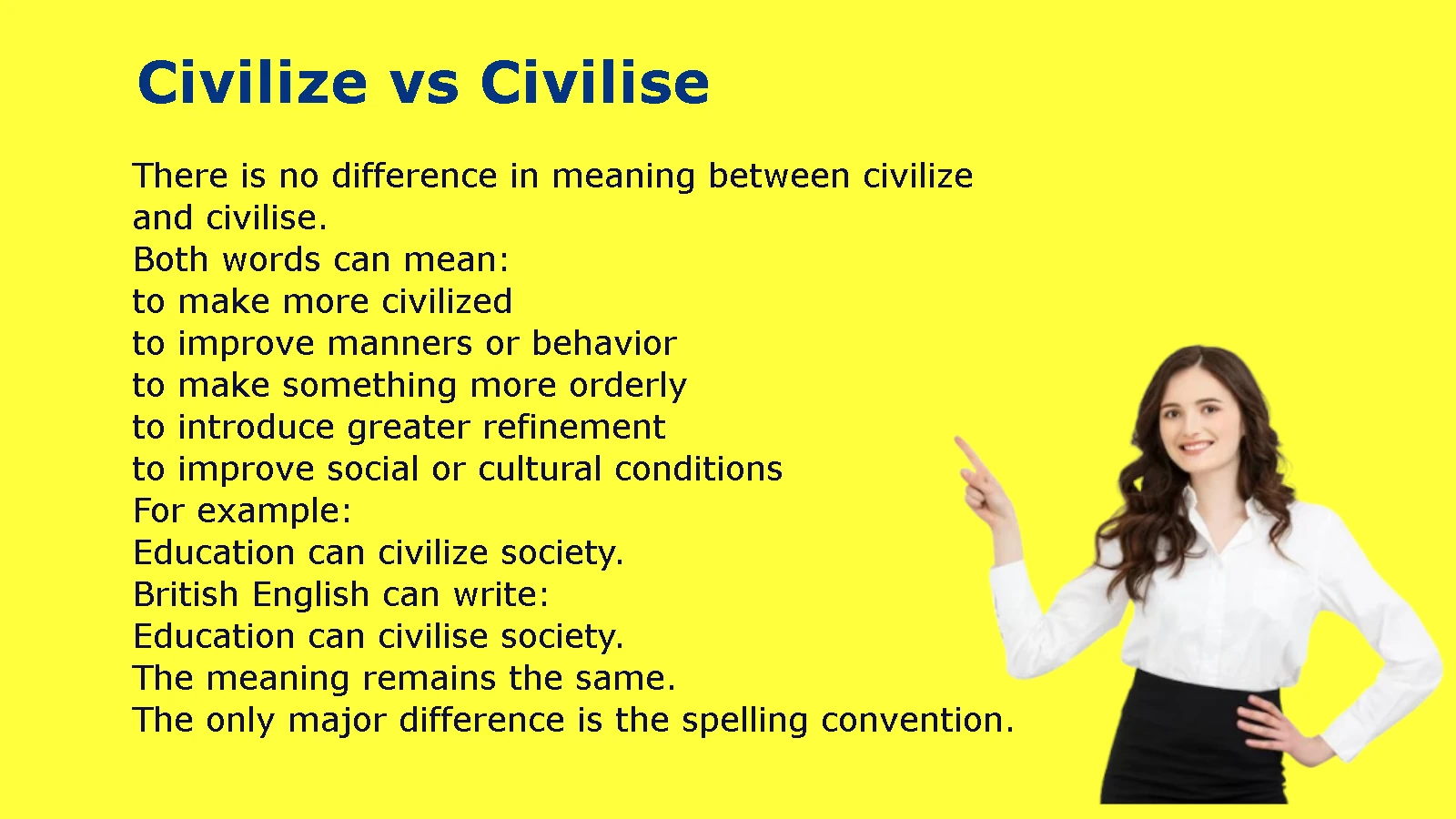
There is no difference in meaning between civilize and civilise.
Both words can mean:
- to make more civilized
- to improve manners or behavior
- to make something more orderly
- to introduce greater refinement
- to improve social or cultural conditions
For example:
Education can civilize society.
British English can write:
Education can civilise society.
The meaning remains the same.
The only major difference is the spelling convention.
Civilize or Civilise: Which Is Correct?
Both spellings are correct.
Your choice depends on the variety of English you are using.
Civilize in American English
American English normally uses civilize.
Examples include:
- The program aims to civilize public services.
- Education can civilize communities.
- The reforms civilized the legal system.
- She believes that literature can civilize society.
Civilise in British English
British English commonly uses civilise.
Examples include:
- The program aims to civilise public services.
- Education can civilise communities.
- The reforms civilised the legal system.
- She believes that literature can civilise society.
Neither spelling is inherently wrong. The important point is to follow the spelling convention that matches your audience and keep your writing consistent.
Civilize vs Civilise in American and British English
The main difference appears throughout the entire word family.
| Word form | American English | British English |
| Base verb | civilize | civilise |
| Third person | civilizes | civilises |
| Past tense | civilized | civilised |
| Past participle | civilized | civilised |
| Present participle | civilizing | civilising |
| Noun | civilization | civilisation |
| Adjective | civilized | civilised |
American English generally uses z in this word family, while British English commonly uses s.
The pattern looks like this:
US: civilize → civilizes → civilized → civilizing → civilization
UK: civilise → civilises → civilised → civilising → civilisation
Following one spelling style throughout your writing will make your work more consistent.
Civilise vs Civilize Examples
The two spellings work in the same grammatical contexts.
Civilize
- Good education can civilize a community.
- The reforms helped civilize the legal system.
- Some writers argued that art could civilize society.
- The organization hopes to civilize the working environment.
- The experience helped civilize his behavior.
Civilise
- Good education can civilise a community.
- The reforms helped civilise the legal system.
- Some writers argued that art could civilise society.
- The organization hopes to civilise the working environment.
- The experience helped civilise his behavior.
The spelling changes from z to s, but the grammatical role and meaning remain the same.
Civilized vs Civilised
Civilized is the standard American English spelling.
Civilised is the common British English spelling.
Both forms can function as the past tense or past participle of the verb civilize/civilise. They can also work as adjectives.
| American English | British English |
| civilized | civilised |
Examples With Civilized
- The reforms civilized the treatment of prisoners.
- The city became more civilized over time.
- They have civilized the process.
- He was known for his civilized behavior.
Examples With Civilised
- The reforms civilised the treatment of prisoners.
- The city became more civilised over time.
- They have civilised the process.
- He was known for his civilised behavior.
If your article follows US spelling, choose civilized. British style generally favors civilised.
Civilizes vs Civilises
The third person singular forms are:
American English: civilizes
British English: civilises
Use these forms with he, she, it, or a singular noun.
American English
- Education civilizes society.
- The program civilizes public institutions.
- Literature civilizes the mind.
British English
- Education civilises society.
- The program civilises public institutions.
- Literature civilises the mind.
The difference follows the same z versus s pattern found in the base verb.
Civilizing vs Civilising
The present participle and gerund forms are:
American English: civilizing
British English: civilising
Examples include:
- The organization is civilizing the workplace culture.
- Civilizing a society involves more than creating laws.
- The program focuses on civilizing public institutions.
In British English:
- The organization is civilising the workplace culture.
- Civilising a society involves more than creating laws.
- The program focuses on civilising public institutions.
The grammatical function stays the same in both varieties.
Civilization vs Civilisation
The noun forms are:
- American English: civilization
- British English: civilisation
Both refer to a society or social system that has developed complex institutions, culture, knowledge, technology, and ways of organizing life. The noun can also describe the process or state of becoming more civilized.
Examples:
Ancient civilization developed complex systems of government.
British English can use:
Ancient civilisation developed complex systems of government.
The spelling difference does not change the basic meaning.
Civilize Spelling: How to Remember It
If you are unsure about the civilize spelling, first identify which variety of English you are using.
American English
Use:
civilize
Remember:
US English → Z
British English
Use:
civilise
Remember:
UK English → S
The same distinction appears in related forms:
US: civilize, civilizes, civilized, civilizing, civilization
UK: civilise, civilises, civilised, civilising, civilisation
A simple memory trick is to connect civilize with other common American spellings such as organize and realize.
British English commonly uses civilise, organise, and realise.
How to Use Civilize and Civilise in a Sentence
Civilize/civilise normally works as a transitive verb, so it often takes an object.
For example:
Education can civilize people.
Here, education performs the action, civilize is the verb, and people receive the action.
Another example is:
The reforms helped civilise the institution.
The object can be a person, group, institution, system, or society.
Common sentence patterns
civilize/civilise + person
The experience helped civilize him.
civilize/civilise + society
Education can civilise society.
civilize/civilise + institution
The reforms aimed to civilise the institution.
civilize/civilise + behavior
The experience helped civilise his behavior.
Because the word can carry judgment about what counts as “civilized,” choose your wording carefully when describing people or cultures.
Common Phrases With Civilize and Civilise
Here are some common combinations:
| Phrase | Example |
| civilize society | Education can help civilize society. |
| civilize behavior | The experience helped civilize his behavior. |
| civilize a community | The reforms sought to civilize the community. |
| civilize institutions | The changes aimed to civilize public institutions. |
| civilize the world | Some writers believed education could civilize the world. |
| civilizing influence | Art can serve as a civilizing influence. |
| civilized society | The law is important in a civilized society. |
British English can use civilise and civilising in the same expressions.
Is Civilise Correct?
Yes. Civilise is a correct spelling commonly used in British English.
It has the same basic meaning as civilize.
For example:
Education can civilise society.
American English would normally write:
Education can civilize society.
The difference is regional spelling rather than meaning.
Is Civilize Correct?
Yes. Civilize is the standard American English spelling.
For example:
Education can civilize society.
British English commonly uses:
Education can civilise society.
Both forms are recognized English spellings.
Is Civilise British English?
Yes. Civilise is commonly used in British English.
It follows the spelling pattern found in words such as organise and realise, although spelling preferences can vary among English speaking regions and individual style guides.
Is Civilize American English?
Yes. Civilize is the standard American English spelling.
American English commonly uses z in this word family:
- civilize
- civilizes
- civilized
- civilizing
- civilization
Common Mistakes With Civilize and Civilise
Mistake 1: Assuming Civilise Is Wrong
Civilise is not simply a misspelling. It is a standard British spelling.
Mistake 2: Assuming Civilize Is Wrong
Civilize is the standard American spelling and is also recognized in British English.
Mistake 3: Mixing Spelling Styles
Avoid switching between civilize and civilise without a reason.
For example:
The program will civilize the system and organise the records.
This combines common American and British spellings.
For a consistent American style, you could write:
The program will civilize the system and organize the records.
For a consistent British style:
The program will civilise the system and organise the records.
Mistake 4: Thinking the Word Forms Have Different Meanings
They do not.
Civilized and civilised have the same meaning.
Likewise, civilization and civilisation refer to the same basic concept.
The difference comes from regional spelling conventions.
Civilize vs Civilise: Quick Comparison Table
| Question | Answer |
| Is civilize correct? | Yes. It is the standard American spelling. |
| Is civilise correct? | Yes. It is commonly used in British English. |
| Do civilize and civilise mean the same thing? | Yes. |
| Is civilise British English? | Yes. |
| Is civilize American English? | Yes. |
| What is the past tense of civilize? | civilized |
| What is the British past tense? | civilised |
| What is the US third person form? | civilizes |
| What is the British third person form? | civilises |
| What is the US present participle? | civilizing |
| What is the British present participle? | civilising |
| What is the US noun form? | civilization |
| What is the British noun form? | civilisation |
Frequently Asked Questions
What does civilise mean?
Civilise means to make someone or something more civilized, orderly, refined, or socially developed. The exact meaning depends on the context.
What is the difference between civilize and civilise?
The main difference is spelling. Civilize is the standard American English spelling, while civilise is the common British English spelling.
Is civilize or civilise correct?
Both are correct. Choose civilize for standard American English and civilise for common British English.
Is civilise American or British?
Civilise is commonly associated with British English.
Is civilize American or British?
Civilize is the standard American English spelling.
What is the past tense of civilise?
The British English past tense is civilised.
What is the past tense of civilize?
The American English past tense is civilized.
What is the difference between civilized and civilised?
There is no difference in basic meaning. Civilized is the American spelling, while civilised is the common British spelling.
What is the difference between civilization and civilisation?
Both nouns refer to the same basic concept. Civilization is the American spelling, while civilisation is the common British spelling.
Is civilising British English?
Yes. Civilising is the common British spelling of the present participle.
Is civilizing American English?
Yes. Civilizing is the standard American English spelling.
Does civilize mean to make civilized?
Yes. Civilize can mean to make a person, group, society, institution, or behavior more civilized.
Can civilise describe a person?
Yes, but context matters. The word can imply that someone’s behavior or manners need improvement. When discussing cultures or societies, it can also carry historical or judgmental associations, so writers should use it carefully.
Final Answer
Civilize and civilise are two spelling variants of the same English verb.
Use civilize in standard American English.
Use civilise in common British English.
Both words mean to make someone or something more civilized, orderly, refined, or socially developed.
The same spelling pattern continues through the word family:
| American English | British English |
| civilize | civilise |
| civilizes | civilises |
| civilized | civilised |
| civilizing | civilising |
| civilization | civilisation |
Therefore, civilize vs civilise is not a question of right versus wrong. It is mainly a question of US versus UK spelling. Choose the form that matches your audience, and keep the spelling consistent throughout your writing.