Meter vs Metre is a classic example of a spelling difference between varieties of English. If you write in American English, you’ll normally use meter. If you write in British English, you’ll generally use metre when you mean the metric unit of length.
The important part is that meter and metre represent the same unit of length. One meter, or one metre, equals 100 centimeters, or 100 centimetres. The difference lies mainly in spelling and regional usage, not measurement.
There’s another wrinkle, though. Meter has meanings that go beyond distance. It can describe a device that measures electricity, gas, water, time, or another quantity. It can also describe the rhythm of poetry and music. In British English, metre can refer to poetic rhythm, while meter remains the usual spelling for a measuring device and the verb meter.
So, which spelling should you choose? That depends on what you mean and which variety of English you’re using.
Meter vs Metre at a Glance
| Word | Meaning | Common spelling | Example |
| meter | Metric unit of length | American English | The room is five meters wide. |
| metre | Metric unit of length | British English | The room is five metres wide. |
| meter | Measuring device | American and British English | The technician checked the meter. |
| meter | Verb meaning to measure or regulate | American and British English | The system meters water usage. |
| meter | Poetic rhythm | American English | The poem uses iambic meter. |
| metre | Poetic rhythm | British English | The poem uses iambic metre. |
The simplest rule is easy to remember:
Use “meter” in American English and “metre” for the unit of length in British English.
However, don’t change every instance of meter to metre just because you’re writing for a British audience. A water meter, gas meter, or parking meter still uses meter in British English.
What Does Meter Mean?
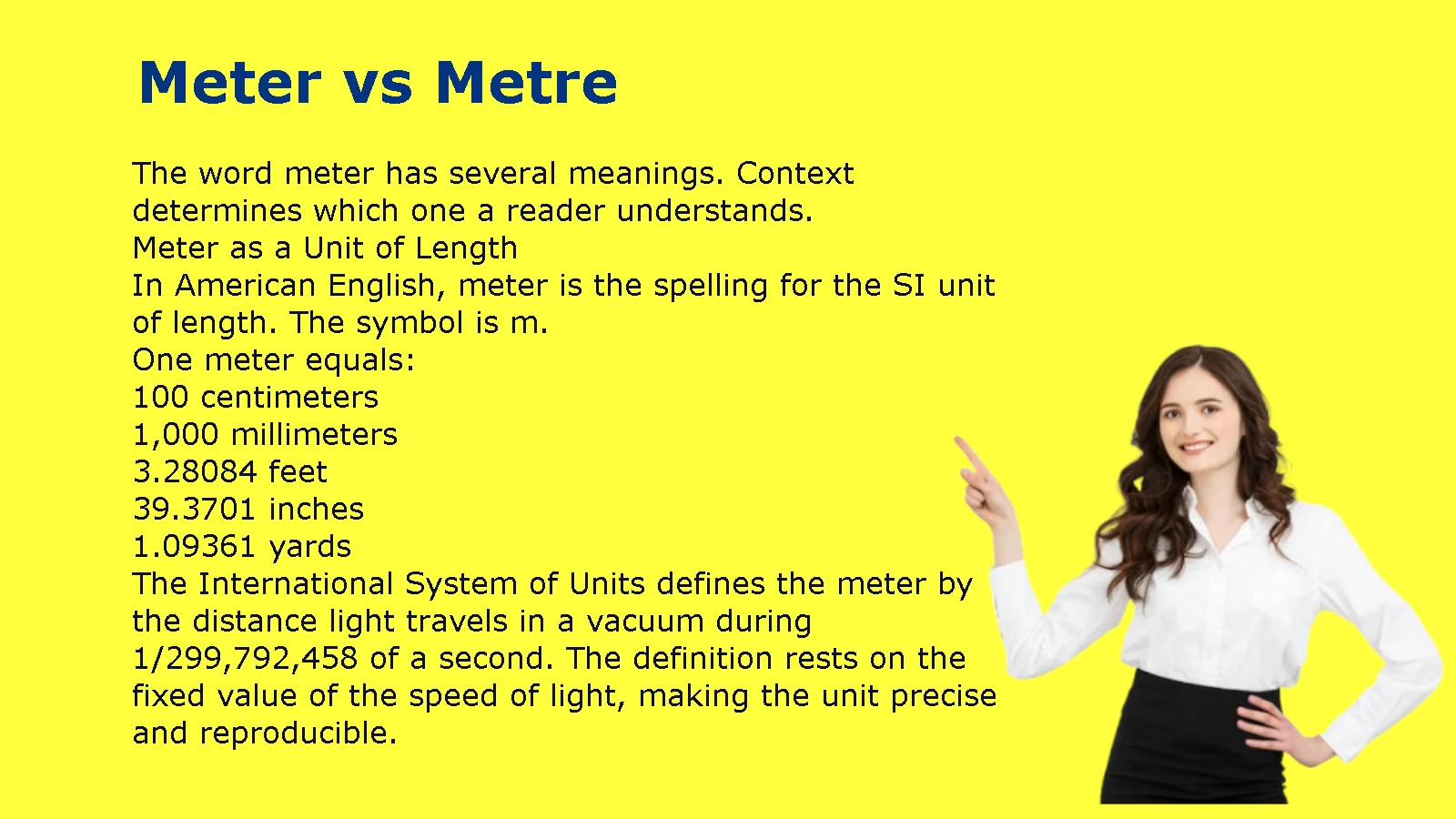
The word meter has several meanings. Context determines which one a reader understands.
Meter as a Unit of Length
In American English, meter is the spelling for the SI unit of length. The symbol is m.
One meter equals:
- 100 centimeters
- 1,000 millimeters
- 3.28084 feet
- 39.3701 inches
- 1.09361 yards
The International System of Units defines the meter by the distance light travels in a vacuum during 1/299,792,458 of a second. The definition rests on the fixed value of the speed of light, making the unit precise and reproducible.
For everyday writing, you don’t need to explain the physics behind the definition. You simply need to know that a meter is the standard SI unit of length.
Examples:
- The table is two meters long.
- The race covers 100 meters.
- The building stands 30 meters from the road.
- The pool is 25 meters long.
In British English, each of these examples would normally use metres instead.
Meter as a Measuring Device
Meter also means a device that measures or records something.
You’ll see the word in terms such as:
- water meter
- gas meter
- electricity meter
- electric meter
- parking meter
- taxi meter
- speed meter
- light meter
- exposure meter
- postage meter
For example:
The utility company installed a new electricity meter.
Here, meter doesn’t refer to a unit of length. It refers to an instrument.
This distinction matters in British English. You might write five metres for distance but a water meter for the measuring device. Oxford Learner’s Dictionaries lists meter for devices that measure and record electricity, gas, water, time, distance, and other quantities.
Meter in Poetry
Meter can also describe the rhythmic structure of poetry.
Poetic meter refers to a pattern of stressed and unstressed syllables. These patterns help create the rhythm of a line.
For example, iambic meter commonly alternates an unstressed syllable with a stressed syllable. Shakespeare frequently used iambic pentameter, which contains five iambic feet in a line.
In American English, the usual spelling is:
meter
In British English, the usual spelling is:
metre
So you might see:
- American English: The poem is written in iambic meter.
- British English: The poem is written in iambic metre.
The meaning remains the same.
What Does Metre Mean?
Metre is primarily the British English spelling of the metric unit of length.
If a British writer says that a road is 500 metres long, the writer means exactly the same distance that an American writer describes as 500 meters.
Metre as a Unit of Length
In British English, metre is the standard spelling for the SI unit of length.
Examples include:
- The wall is three metres high.
- The runner completed the 100 metres.
- The cable is 20 metres long.
- The tree is approximately 15 metres tall.
The unit itself doesn’t change. Only the English spelling changes.
The official SI unit is represented by the symbol m, so the symbol doesn’t change between meter and metre. The BIPM identifies the metre, symbol m, as the SI unit of length.
Metre in Poetry
British English also uses metre when discussing poetic rhythm.
For example:
The poem follows a regular metre.
A British literature textbook might discuss iambic metre, trochaic metre, or blank verse.
American publications generally use meter for the same concept.
That gives you an important distinction:
| Meaning | American English | British English |
| Unit of length | meter | metre |
| Poetic rhythm | meter | metre |
| Measuring device | meter | meter |
| Verb meaning to measure | meter | meter |
Why Are Meter and Metre Spelled Differently?
The difference comes from the spelling conventions that developed in different varieties of English.
British English commonly preserves -re spellings in words such as:
- metre
- centre
- theatre
- fibre
- litre
- kilometre
American English commonly uses -er in these corresponding forms:
- meter
- center
- theater
- fiber
- liter
- kilometer
The pattern isn’t random. It reflects broader differences between British and American spelling conventions.
However, spelling history doesn’t change the measurement. A meter and a metre remain the same SI unit.
The US National Institute of Standards and Technology explicitly uses American English spellings such as meter, liter, and deka in its SI guidance. NIST explains that its spelling follows US government style conventions.
Meter vs Metre in American English
If your audience uses American English, choose meter when referring to the metric unit.
Use:
- 1 meter
- 5 meters
- 100 meters
- 500 meters
- kilometer
- centimeter
- millimeter
Examples:
The hallway is 20 meters long.
She finished the 100 meters in record time.
The package is less than one meter wide.
American English also uses meter for poetic rhythm:
The poem uses iambic meter.
And it uses meter for measuring devices:
The technician inspected the gas meter.
So American English keeps the spelling meter across these meanings.
Meter vs Metre in British English
British English makes the distinction more interesting.
For the unit of length, use metre:
The road is two kilometres long.
The swimming pool is 25 metres long.
For poetic rhythm, use metre:
The poem uses iambic metre.
But for a measuring device, use meter:
The engineer checked the electricity meter.
The verb also remains meter:
The company meters water consumption.
That means the statement “British English uses metre instead of meter” is too broad. It works for the unit of length, but it doesn’t cover every meaning.
Meter vs Metre in Canada, Australia, and Other English Varieties
English spelling doesn’t stop at the US and UK borders.
Different English speaking regions follow different conventions. Canadian English, for example, commonly uses metre for the metric unit. Oxford Learner’s Dictionaries specifically notes that Canadian English usually uses metre.
British influenced varieties such as Australian and New Zealand English also commonly use metre for the unit of length.
A practical comparison looks like this:
| English variety | Unit of length | Poetic rhythm | Measuring device |
| American English | meter | meter | meter |
| British English | metre | metre | meter |
| Canadian English | metre | metre | meter |
| Australian English | metre | metre | meter |
| New Zealand English | metre | metre | meter |
| Many Commonwealth varieties | metre | metre | meter |
The table provides a useful general guide, but individual publications can follow their own style guides. When writing professionally, consistency matters more than forcing one spelling onto every audience.
Meter vs Metre in Poetry
Poetry creates one of the most interesting parts of the Meter vs Metre question.
Here, the word doesn’t describe distance. It describes rhythm.
What Is Poetic Meter or Metre?
Poetic meter is the arrangement of stressed and unstressed syllables in a line.
A poem’s meter can influence how the line sounds when spoken aloud. Think of it as the underlying beat that gives a poem its rhythm.
Common types include:
- Iambic meter: unstressed followed by stressed
- Trochaic meter: stressed followed by unstressed
- Anapestic meter: two unstressed syllables followed by a stressed syllable
- Dactylic meter: a stressed syllable followed by two unstressed syllables
One of the best known forms is iambic pentameter. Shakespeare’s plays and sonnets provide famous examples of this rhythmic pattern.
The regional spelling changes, but the literary concept doesn’t:
- American English: poetic meter
- British English: poetic metre
Meter and Metre Are Not Always About Distance
This is where context saves the day.
Consider these two sentences:
The bridge is 100 meters long.
The poem has a regular meter.
The first sentence concerns distance.
The second concerns rhythm.
In British English, the equivalent would normally be:
The bridge is 100 metres long.
The poem has a regular metre.
The spelling follows the regional convention, while the meaning comes from context.
Meter vs Metre Examples
Seeing the words in real sentences makes the distinction much easier.
Examples With Meter
In American English, use meter for the unit of length:
- The rope is five meters long.
- The room measures six meters across.
- The runner completed the 400 meters.
- The tower is 100 meters tall.
- The cable extends 20 meters underground.
Use meter for measuring devices:
- The technician checked the water meter.
- The electric meter needs replacement.
- The parking meter stopped working.
- The gas meter recorded the latest reading.
Use meter for poetic rhythm:
- The poem has a consistent meter.
- The writer uses iambic meter.
- The unusual meter gives the poem a distinctive rhythm.
Examples With Metre
In British English, use metre for distance:
- The rope is five metres long.
- The room measures six metres across.
- The runner completed the 400 metres.
- The tower is 100 metres tall.
- The cable extends 20 metres underground.
Use metre for poetic rhythm:
- The poem has a consistent metre.
- The writer uses iambic metre.
- The unusual metre gives the poem a distinctive rhythm.
But keep meter for a measuring device:
- The technician checked the water meter.
- The electric meter needs replacement.
- The parking meter stopped working.
- The gas meter recorded the latest reading.
Meter vs Metre Side by Side
A side by side comparison can make the regional difference obvious.
| American English | British English |
| 10 meters | 10 metres |
| 50 meters | 50 metres |
| 100 meters | 100 metres |
| 400 meters | 400 metres |
| 2 kilometers | 2 kilometres |
| 5 centimeters | 5 centimetres |
| poetic meter | poetic metre |
| water meter | water meter |
| gas meter | gas meter |
| parking meter | parking meter |
| meter electricity | meter electricity |
| metered parking | metered parking |
Notice something important: the spelling doesn’t change simply because the writer is British. Meter remains the normal word for a measuring device and for the verb.
Meter and Metre as Verbs
The verb meter means to measure, regulate, or control something according to a particular rate or amount.
For example:
The city meters parking in busy areas.
The system meters water usage.
The company meters electricity consumption.
This verb is spelled meter, including in British English.
That’s why the following distinction matters:
- metre = British spelling for the unit of length
- meter = measuring device
- meter = verb meaning to measure or regulate
You shouldn’t assume that the British spelling metre applies to every related form.
Metered vs. Metred: Which Is Correct?
The standard form is metered.
For example:
- metered parking
- metered water
- metered electricity
- metered service
- metered usage
The verb remains meter, so its forms follow that spelling:
| Base verb | Past tense | Present participle |
| meter | metered | metering |
For example:
The city introduced metered parking downtown.
The system is metering water consumption.
Writing metred because you’re using British English can create unnecessary confusion. When the word functions as the verb meaning “to measure or regulate,” metered is the standard form.
Meter vs Metre Pronunciation
Meter and metre are generally pronounced alike in the varieties of English where they are used for the metric unit.
The main difference you see on the page is spelling, not a major difference in pronunciation.
Oxford lists meter with pronunciation beginning /ˈmiːt…/ and uses the same basic pronunciation for the British form metre.
This makes the pair similar to other British and American spelling differences. You can often hear the same word while seeing two different spellings.
Meter vs Metre vs. Centimeter
Once you understand Meter vs Metre, related metric words become much easier.
In American English:
- meter
- centimeter
- millimeter
- kilometer
In British English:
- metre
- centimetre
- millimetre
- kilometre
The numerical relationships remain identical.
1 meter = 100 centimeters
1 kilometer = 1,000 meters
In British spelling:
1 metre = 100 centimetres
1 kilometre = 1,000 metres
The SI symbols also stay the same:
- meter/metre = m
- centimeter/centimetre = cm
- millimeter/millimetre = mm
- kilometer/kilometre = km
The symbol doesn’t become metre’s symbol simply because the spelling changes.
Meter vs Metre vs. Kilometer
The same spelling pattern applies to kilometer and kilometre.
American English uses:
The city is 10 kilometers away.
British English uses:
The city is 10 kilometres away.
The difference is purely orthographic. Both describe a distance of 10,000 meters/metres.
This pattern can help you remember several related words:
| American English | British English |
| meter | metre |
| kilometer | kilometre |
| centimeter | centimetre |
| millimeter | millimetre |
| liter | litre |
If you’re writing an article in American English, consistency means using the American forms throughout. The same principle applies when writing for a British audience.
Is Meter or Metre Correct?
Both are correct.
Neither spelling is universally “right” or “wrong.” The appropriate choice depends on the variety of English and the meaning.
Use meter when:
- You’re writing American English.
- You mean the metric unit of length in American English.
- You’re referring to a measuring device.
- You’re using meter as a verb.
- You’re discussing poetic rhythm in American English.
Use metre when:
- You’re writing British English.
- You mean the metric unit of length.
- You’re discussing poetic rhythm in British English.
- You’re following a style guide that uses British spelling.
The key is context plus regional spelling.
Common Meter vs Metre Mistakes
Even though the distinction looks simple, several mistakes appear regularly.
Mistake 1: Assuming They Represent Different Units
A meter and a metre don’t represent different distances.
Incorrect idea: A metre is a different length from a meter.
Correct: They are two spellings for the same metric unit of length.
The SI symbol m applies to the unit regardless of whether an English writer spells it meter or metre.
Mistake 2: Using Metre for Every British English Meaning
British English uses metre for the unit of length, but meter remains standard for measuring devices.
Correct:
The car stopped beside a parking meter.
Not:
The car stopped beside a parking metre.
The second version changes the meaning and doesn’t describe the parking device.
Mistake 3: Assuming Meter Is Exclusively American
That’s also too simplistic.
British English uses meter in words and phrases involving measuring devices:
- water meter
- gas meter
- electricity meter
- parking meter
- taxi meter
Oxford explicitly lists meter as a device that measures and records quantities such as electricity, gas, water, time, and distance.
Mistake 4: Mixing Regional Spellings
Suppose an American article says:
The building is 30 metres tall.
That spelling may look out of place in otherwise consistent American English.
Likewise, a British article that repeatedly uses meter for distance may look inconsistent.
The best approach is simple: choose your English variety before you write and stick with it.
Mistake 5: Changing Metered to Metred
The British spelling metre doesn’t mean the verb becomes metre.
Use:
metered parking
metered water
metering system
The verb is meter.
A Practical Case Study: Writing for Two Audiences
Imagine a company publishes a guide about swimming pools.
For an American audience, the copy might say:
Our facility has a 25-meter pool designed for competitive training.
For a British audience, the same sentence would normally become:
Our facility has a 25-metre pool designed for competitive training.
The pool hasn’t changed. The distance hasn’t changed. Only the spelling has.
Now imagine the article discusses the device that measures water usage:
The maintenance team checked the water meter.
That remains meter in both versions.
This small example shows why blindly replacing every meter with metre can introduce errors.
How to Choose Between Meter and Metre
When you’re unsure, ask yourself three questions.
Are You Writing in American English?
If yes, use meter for the unit of length.
The road is 15 meters long.
Are You Writing in British English?
If yes, use metre for the unit of length.
The road is 15 metres long.
Are You Talking About a Measuring Device or the Verb?
Use meter.
The technician read the gas meter.
The system meters electricity usage.
This three question test solves most Meter vs Metre problems in seconds.
Meter vs Metre Quick Reference
| Question | Answer |
| Are meter and metre the same unit? | Yes, when they refer to the metric unit of length. |
| Which spelling is American? | Meter |
| Which spelling is British for length? | Metre |
| What is the SI symbol? | m |
| How many centimeters are in one meter/metre? | 100 |
| How many millimeters are in one meter/metre? | 1,000 |
| How many meters are in one kilometer? | 1,000 |
| Which spelling refers to a measuring device? | Meter |
| Which spelling is used as the verb? | Meter |
| Is poetic meter different from poetic metre? | No, the spelling follows regional English. |
| Are meter and metre pronounced differently? | Generally no |
| Is one spelling more correct everywhere? | No |
Frequently Asked Questions About Meter vs Metre
Is it meter or metre?
Both are correct. Meter is the standard American English spelling for the metric unit of length, while metre is the standard British English spelling.
Is “metre” British or American?
Metre is primarily the British spelling of the metric unit of length. It is also used in several other English varieties, including Canadian English.
Is “meter” American or British?
Meter is the standard American spelling for the unit of length. British English also uses meter for measuring devices and as a verb.
Is a meter the same as a metre?
Yes. When the words refer to the metric unit of length, one meter and one metre are exactly the same measurement.
Both equal 100 centimeters/centimetres.
Why do Americans spell metre as meter?
American English developed spelling conventions that favor -er in several words where British English uses -re. This produces pairs such as meter/metre, center/centre, and theater/theatre.
US government measurement guidance uses meter rather than metre as part of its American English spelling practice.
Does the UK use meter or metre?
The answer depends on the meaning.
The UK generally uses metre for the unit of length and poetic rhythm.
It uses meter for a measuring device and for the verb meter.
Is it 10 meters or 10 metres?
Use 10 meters in American English.
Use 10 metres in British English.
Both expressions describe exactly the same distance.
Is it meter or metre in Canada?
Metre is generally preferred in Canadian English for the metric unit. Oxford Learner’s Dictionaries specifically notes that Canadian English usually uses metre.
Is “metered” or “metred” correct?
Metered is the standard spelling for the verb meter.
For example:
The city introduced metered parking.
The spelling doesn’t change to metred simply because the writer uses British English.
Are meter and metre pronounced the same?
Generally, yes. The spelling differs between English varieties, but the words are normally pronounced alike when they have the same meaning.
Is poetic meter the same as a meter of length?
No. The word has different meanings.
A meter/metre of length measures distance. Meter/metre in poetry describes rhythmic patterns of stressed and unstressed syllables.
Context tells you which meaning applies.
Final Verdict: Meter or Metre?
The Meter vs Metre difference is mainly a matter of regional spelling, but context adds an important layer.
Use meter in American English when referring to the metric unit of length:
The bridge is 500 meters long.
Use metre in British English for the same unit:
The bridge is 500 metres long.
When you mean a measuring device, use meter:
The technician checked the electricity meter.
When you use the verb meaning to measure or regulate, use meter:
The system meters water consumption.
For poetry, American English uses meter, while British English generally uses metre.
The easiest rule to remember is:
Meter is the American spelling of the metric unit. Metre is the British spelling. Meter also names a measuring device and serves as a verb in both varieties.
Once you separate meaning from regional spelling, the confusion disappears. The unit stays the same. Only the letters change.