Have you ever written “conscious” when you meant “conscience” and wondered which word was correct? While Conscious vs Conscience may look and sound similar, these two words have completely different meanings and uses.
Conscious is an adjective that describes being awake, aware, or aware of something around you. Conscience, on the other hand, is a noun that refers to your inner sense of right and wrong, especially the feeling that guides your decisions and behavior.
Examples:
- She was conscious of the noise coming from outside.
- His conscience wouldn’t let him keep the money.
The confusion is understandable. People often search for conscious vs conscience, conscience or conscious, conscious meaning, or conscience meaning because the two words have similar spellings and pronunciations. And here’s the kicker: one describes awareness, while the other deals with your sense of morality.
In this guide, you’ll learn the complete difference between conscious and conscience, including their meanings, definitions, pronunciation, spelling, correct usage, and examples in sentences. You’ll also discover an easy way to remember conscious vs conscience and avoid confusing these commonly mixed up words.
Conscious vs Conscience at a Glance
Here’s the difference in one quick reference:
| Feature | Conscious | Conscience |
| Word type | Adjective | Noun |
| Core idea | Awareness | Morality |
| Can mean awake? | Yes | No |
| Can mean aware? | Yes | No |
| Can describe an intentional choice? | Yes | No |
| Connected with guilt? | Sometimes, but not primarily | Yes |
| Common phrase | conscious of | guilty conscience |
| Example | I’m conscious of the problem. | My conscience bothers me. |
| Opposite or related form | unconscious | conscientious is related but different |
A useful shortcut is:
Conscious = what you know or notice.
Conscience = what you believe is right or wrong.
Cambridge Dictionary defines conscious as an adjective with meanings involving noticing, being awake, being aware, and acting intentionally. It defines conscience as a noun associated with judging the morality of your actions and feelings of guilt.
What Does Conscious Mean?
Conscious is an adjective. It describes someone or something that is awake, aware, intentional, or particularly attentive to a certain issue.
The word has several related meanings, but they all circle around one central idea: awareness.
Merriam Webster lists meanings that include being awake, noticing something, being concerned about something, and acting with deliberate awareness.
Conscious Means Awake and Alert
The most literal meaning of conscious is awake and able to think or respond.
For example:
- The patient was conscious after the operation.
- He remained conscious after the accident.
- She wasn’t fully conscious when the paramedics arrived.
- The injured man was conscious and able to answer questions.
In this sense, conscious is the opposite of unconscious.
If someone loses consciousness, they aren’t awake or aware in the normal sense. When they regain consciousness, they become awake and responsive again.
Cambridge gives the same basic distinction, defining this use of conscious as being awake, thinking, and aware of what’s happening around you.
Conscious Means Aware of Something
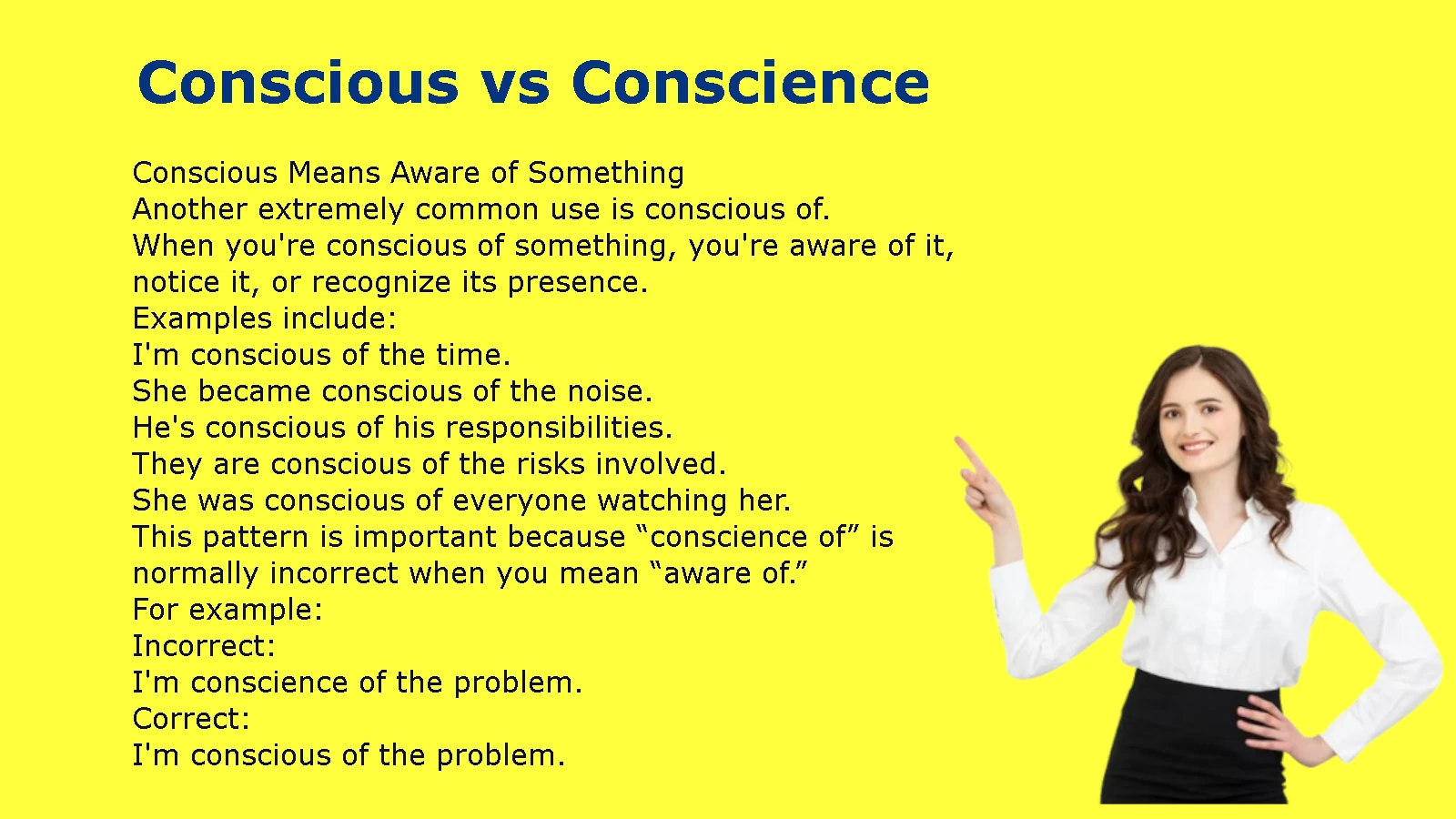
Another extremely common use is conscious of.
When you’re conscious of something, you’re aware of it, notice it, or recognize its presence.
Examples include:
- I’m conscious of the time.
- She became conscious of the noise.
- He’s conscious of his responsibilities.
- They are conscious of the risks involved.
- She was conscious of everyone watching her.
This pattern is important because “conscience of” is normally incorrect when you mean “aware of.”
For example:
Incorrect:
I’m conscience of the problem.
Correct:
I’m conscious of the problem.
Cambridge specifically lists be conscious of something or someone as a standard construction meaning to notice or be aware of something or someone.
Conscious Can Mean Intentional
Conscious can also describe an action, choice, or decision that someone makes deliberately.
Consider these examples:
- It was a conscious decision.
- She made a conscious effort to improve.
- He took a conscious step back from the argument.
- They made a conscious choice to spend less money.
Here, conscious means deliberate or intentional.
You didn’t simply happen to do something. You knew what you were doing and chose to do it.
Cambridge identifies conscious decision and conscious effort as examples of this intentional meaning.
Conscious Can Mean Especially Concerned About Something
You can also use conscious to describe someone who pays particular attention to an issue.
Common examples include:
- cost conscious
- budget conscious
- health conscious
- environmentally conscious
- safety conscious
- socially conscious
For example:
She’s very budget conscious when she shops.
This means she pays close attention to how much things cost.
Likewise:
The company is becoming more environmentally conscious.
Here, environmentally conscious means aware of environmental concerns and attentive to their impact.
Merriam Webster lists this broader use of conscious for people who are likely to notice, consider, or care about a particular matter.
What Does Conscience Mean?
Conscience is a noun.
It refers to your inner sense of right and wrong. It can guide your behavior and create feelings such as guilt or remorse when you believe you’ve done something wrong.
Cambridge describes conscience as the part of you that judges the morality of your actions and can make you feel guilty about things you’ve done or feel responsible for.
Think of your conscience as an internal moral compass.
It doesn’t tell you whether you’re awake. It doesn’t tell you whether you noticed something. Instead, it concerns what you believe you should or shouldn’t do.
Conscience Helps Guide Moral Decisions
When someone says their conscience won’t let them do something, they’re talking about their moral judgment.
For example:
- My conscience wouldn’t let me keep the money.
- She followed her conscience and told the truth.
- His conscience told him to apologize.
- I couldn’t go against my conscience.
- They acted according to their conscience.
The important idea is moral judgment.
Suppose you find a wallet full of cash on the sidewalk. You could physically pick it up without difficulty. Your conscience, however, might tell you that keeping someone else’s money is wrong.
That’s conscience at work.
Conscience and Guilt
The word conscience often appears when someone feels guilty about something.
That’s why guilty conscience is such a common phrase.
Examples:
- He had a guilty conscience after lying to his parents.
- Her guilty conscience kept her awake.
- His conscience bothered him after he blamed someone else.
- She returned the money because she had a guilty conscience.
A guilty conscience means that you feel troubled because you believe you’ve done something morally wrong.
Cambridge lists guilty conscience, clear conscience, and matter of conscience among common uses.
Conscience and a Clear Conscience
A clear conscience means you don’t feel guilty because you believe you’ve done nothing wrong.
For example:
I can leave with a clear conscience because I told everyone the truth.
The phrase focuses on moral peace. You don’t have a lingering feeling that you’ve violated your own standards.
Compare:
- Guilty conscience: I feel troubled because I believe I did something wrong.
- Clear conscience: I don’t feel guilty because I believe I acted properly.
Conscience in “Good Conscience”
The expression in good conscience means that you cannot honestly or morally do something because it would conflict with your principles.
For example:
I can’t, in good conscience, recommend a product I don’t trust.
This doesn’t mean you aren’t physically capable of recommending it. You could say the words. However, doing so would conflict with your moral judgment.
Another example:
She couldn’t, in good conscience, ignore the situation.
This is a very useful phrase in formal writing because it expresses a strong ethical objection without sounding overly dramatic.
The Main Difference Between Conscious and Conscience
The clearest way to understand Conscious vs Conscience is to separate awareness from morality.
Conscious deals with what you know, notice, feel, or deliberately do.
Conscience deals with what you believe is right or wrong.
Consider this sentence:
She was conscious that she had made a mistake, and her conscience told her to fix it.
Both words work because they perform completely different jobs.
The first part concerns awareness. She knew about her mistake.
The second part concerns morality. She felt that correcting the mistake was the right thing to do.
| Meaning | Correct Word | Example |
| Awake | Conscious | He was still conscious. |
| Aware | Conscious | She was conscious of the problem. |
| Noticing | Conscious | I’m conscious of the noise. |
| Deliberate | Conscious | It was a conscious choice. |
| Concerned about an issue | Conscious | He’s environmentally conscious. |
| Sense of right and wrong | Conscience | Her conscience guided her. |
| Moral guilt | Conscience | He has a guilty conscience. |
| Moral principles | Conscience | It goes against my conscience. |
| Freedom from guilt | Conscience | She has a clear conscience. |
A Simple Rule for Conscious or Conscience
When you’re stuck, use this rule:
Awareness = conscious. Morality = conscience.
Ask:
“Am I talking about knowing or noticing something?”
Use conscious.
“Am I talking about right, wrong, guilt, or moral responsibility?”
Use conscience.
This rule handles most everyday uses.
Conscious vs Conscience Examples
Seeing the words in realistic sentences makes the distinction easier to remember.
Examples With Conscious
- She remained conscious throughout the examination.
- I’m conscious of how much time we have left.
- He became conscious of the mistake immediately.
- They made a conscious effort to arrive early.
- It was a conscious decision.
- She’s very health conscious.
- The company is becoming more environmentally conscious.
- He wasn’t conscious of the noise outside.
- I’m conscious that this decision could affect everyone.
- She was conscious of the attention she was receiving.
Examples With Conscience
- My conscience wouldn’t let me lie.
- He had a guilty conscience.
- She acted according to her conscience.
- I couldn’t do that in good conscience.
- His conscience bothered him all night.
- She has a clear conscience.
- The decision became a matter of conscience.
- He couldn’t live with the decision on his conscience.
- Returning the wallet gave him peace of conscience.
- Her conscience told her that she needed to apologize.
Conscious or Conscience: Common Mistakes
The confusion between these words isn’t just about spelling. People often substitute one for the other because they sound so similar.
Here are the mistakes worth watching for.
“Guilty Conscious” vs. “Guilty Conscience”
Wrong:
I have a guilty conscious.
Correct:
I have a guilty conscience.
A guilty feeling involves your moral judgment. Therefore, the correct noun is conscience.
The phrase guilty conscience is well established in standard English.
“Conscience of” vs. “Conscious of”
Wrong:
She was conscience of the danger.
Correct:
She was conscious of the danger.
You’re describing awareness, so use the adjective conscious.
The standard construction is conscious of.
“Conscience Decision” vs. “Conscious Decision”
Wrong:
It was a conscience decision.
Correct:
It was a conscious decision.
A decision can be intentional or deliberate. That’s the meaning of conscious in this phrase.
A conscience isn’t a type of decision. It’s the moral sense that might influence a decision.
“Socially Conscience” vs. “Socially Conscious”
Wrong:
She is socially conscience.
Correct:
She is socially conscious.
Here, conscious means aware of and concerned about social issues.
The same pattern appears in:
- environmentally conscious
- politically conscious
- health conscious
- cost conscious
- safety conscious
How to Remember the Difference Between Conscious and Conscience
Spelling is often where the trouble starts. Fortunately, a few memory tricks can make the distinction stick.
Remember: Conscious = Awareness
Think about conscious as the word connected with being awake and aware.
You can be:
- conscious of your surroundings
- conscious of a problem
- conscious of your behavior
- conscious of the time
- conscious of a risk
If the sentence involves noticing or awareness, you’re probably looking for conscious.
Remember: Conscience = Morality
Think of conscience as your internal moral guide.
It appears naturally with words such as:
- guilty
- clear
- moral
- right
- wrong
- guilt
- good
For example:
- guilty conscience
- clear conscience
- in good conscience
- against my conscience
- matter of conscience
That cluster makes the spelling easier to recognize.
Use the “Science” Spelling Trick
Here’s a popular spelling aid:
conscience contains science.
You can picture the word as:
con + science
This doesn’t explain the actual meaning of conscience. It’s simply a spelling trick.
Merriam Webster also points to science as a useful way to remember the spelling of conscience.
A memorable version is:
Your conscience tells you how you should behave, while science helps explain how the world behaves.
The trick works because conscience contains the exact sequence of letters found in science.
Remember the Word Endings
Another useful clue is the ending.
Conscious ends in -ous and functions primarily as an adjective.
Conscience ends in -ence and functions as a noun.
| Word | Ending | Typical Role |
| conscious | -ous | Adjective |
| conscience | -ence | Noun |
Merriam Webster specifically notes this grammatical distinction: conscience is a noun, while conscious is an adjective.
Is Conscience an Adjective?
In ordinary modern English, conscience is used as a noun.
You can say:
- My conscience bothers me.
- She has a clear conscience.
- His conscience guided him.
You generally wouldn’t use conscience as the adjective in these situations.
However, there’s another word that often causes confusion: conscientious.
Conscience vs. Conscientious
Conscience = your moral sense.
Conscientious = careful, responsible, and attentive to doing something properly. It can also mean guided by one’s conscience.
Compare:
Her conscience told her to tell the truth.
with:
She is a conscientious employee.
The first sentence concerns her moral judgment.
The second describes her behavior and character. She takes her responsibilities seriously and works carefully.
Merriam Webster defines conscientious with meanings including careful and meticulous as well as guided by conscience.
Conscious vs. Conscientious
These words look even more similar, but their meanings remain distinct.
| Word | Meaning | Example |
| Conscious | Aware or intentional | He was conscious of the deadline. |
| Conscience | Inner moral sense | His conscience bothered him. |
| Conscientious | Careful, responsible, or morally principled | She is a conscientious worker. |
Consider this example:
She was conscious of the deadline, so she became more conscientious about completing the project.
The first conscious means she was aware of the deadline.
The second conscientious means she worked carefully and responsibly.
Conscious vs. Consciousness vs. Conscience
There’s another word worth separating from these two: consciousness.
Consciousness is the noun form related to being conscious. It refers to the state or condition of being aware, awake, or mentally active.
For example:
- He lost consciousness.
- She regained consciousness.
- The patient remained in a state of consciousness.
- The experience changed his consciousness.
Meanwhile, conscience concerns morality.
| Word | Core Meaning | Example |
| Conscious | Awake or aware | She is conscious of the risk. |
| Consciousness | State of awareness | He regained consciousness. |
| Conscience | Moral sense | His conscience bothered him. |
This distinction matters because consciousness and conscience share more than a few letters, yet they describe completely different concepts.
Merriam Webster defines consciousness in terms of the condition or state of being conscious and conscious thought and awareness.
Conscious or Conscience in Everyday Phrases
Certain phrases make the correct choice almost automatic.
Common Phrases With Conscious
- conscious of
- conscious effort
- conscious decision
- conscious choice
- self conscious
- health conscious
- cost conscious
- budget conscious
- environmentally conscious
- socially conscious
- conscious mind
- fully conscious
Examples:
She made a conscious effort to listen.
Consumers are becoming more environmentally conscious.
He became conscious of the problem.
Common Phrases With Conscience
- guilty conscience
- clear conscience
- in good conscience
- against my conscience
- matter of conscience
- voice of conscience
- on my conscience
- conscience-stricken
- let your conscience be your guide
Examples:
I couldn’t do it in good conscience.
She has a clear conscience.
His guilty conscience eventually pushed him to confess.
These phrase patterns are useful because you don’t always need to analyze every letter. Sometimes the surrounding words give you the answer.
Realistic Usage Scenarios: Conscious or Conscience?
Scenario: Finding a Lost Wallet
Imagine someone finds a wallet on a park bench.
They become conscious of the wallet because they notice it.
They then think about whether they should return it. Their conscience may tell them to find the owner.
So both words can appear naturally in the same situation:
He was conscious of the wallet on the bench, but his conscience told him to return it.
That’s the difference in action.
Conscious = awareness of the situation.
Conscience = moral judgment about what to do.
Scenario: Making a Difficult Choice
Suppose an employee discovers that a report contains an important error.
The employee is conscious of the error because they know it exists.
If they decide to report it because hiding it would be dishonest, their conscience influences the decision.
Again, the words describe two different stages:
- Awareness: I know about the problem.
- Moral judgment: I believe I should do something about it.
That distinction is one of the easiest ways to understand Conscious vs Conscience in real writing.
A Quick Conscious vs Conscience Quiz
Choose conscious or conscience for each sentence.
Test Yourself
- She was ________ of the risks.
- His ________ wouldn’t let him lie.
- The patient remained ________ after the accident.
- I couldn’t, in good ________, recommend it.
- She made a ________ effort to improve.
- He had a guilty ________.
- They are becoming more environmentally ________.
- My ________ told me to return the money.
- He wasn’t ________ of the noise.
- She left with a clear ________.
Answers
| Question | Answer | Why |
| 1 | conscious | Awareness of risks |
| 2 | conscience | Moral judgment |
| 3 | conscious | Awake and responsive |
| 4 | conscience | Moral principle |
| 5 | conscious | Deliberate effort |
| 6 | conscience | Moral guilt |
| 7 | conscious | Awareness and concern |
| 8 | conscience | Inner moral guide |
| 9 | conscious | Awareness of something |
| 10 | conscience | Freedom from guilt |
If you can separate awareness from morality, most of these questions become straightforward.
Frequently Asked Questions About Conscious or Conscience
Which is correct: conscious or conscience?
Both words are correct, but they have different meanings.
Use conscious when you mean awake, aware, noticing, intentional, or concerned about something.
Use conscience when you mean your inner sense of right and wrong.
For example:
- She was conscious of the problem.
- Her conscience told her to fix it.
Is it “guilty conscious” or “guilty conscience”?
The correct phrase is guilty conscience.
A conscience is the moral sense that can make you feel guilty about something you believe you did wrong.
Example: He had a guilty conscience after breaking his promise.
Is it “conscious of” or “conscience of”?
When you mean aware of, the correct phrase is conscious of.
Correct: She was conscious of the noise.
Incorrect: She was conscience of the noise.
Is it “conscious decision” or “conscience decision”?
The correct phrase is conscious decision.
A conscious decision is a deliberate or intentional choice.
Example: He made a conscious decision to change his habits.
Is it “socially conscious” or “socially conscience”?
The correct phrase is socially conscious.
Here, conscious means aware of or concerned about social issues.
Is it “cost conscious” or “cost conscience”?
The correct phrase is cost conscious.
A cost conscious person pays particular attention to expenses and prices.
What does “in good conscience” mean?
In good conscience means doing something without violating your moral principles.
For example:
I can’t, in good conscience, tell them the product is safe when I don’t have enough evidence.
The speaker could physically say it, but doing so would conflict with their moral judgment.
What does “clear conscience” mean?
A clear conscience means you don’t feel guilty about something because you believe you acted properly.
Example: She left the meeting with a clear conscience because she had told the truth.
What does “conscious of” mean?
Conscious of means aware of, noticing, or recognizing something.
Examples include:
- I’m conscious of the time.
- She’s conscious of her responsibilities.
- He became conscious of the attention.
What is the difference between conscience and conscientious?
Conscience is a noun meaning your moral sense of right and wrong.
Conscientious is an adjective describing someone who is careful, responsible, or guided by a strong sense of duty.
Example:
Her conscience told her to help.
She’s a conscientious worker.
What is the difference between conscious and consciousness?
Conscious is mainly an adjective meaning awake or aware.
Consciousness is a noun referring to the state or condition of being conscious.
Example:
The patient is conscious.
The patient regained consciousness.
How do you spell conscience?
The spelling is:
C-O-N-S-C-I-E-N-C-E
A useful memory trick is to notice that conscience contains “science.”
Don’t rely on pronunciation alone. Conscious and conscience sound similar enough that spelling them correctly by sound can be difficult.
Conscious vs Conscience: The Bottom Line
The difference between conscious and conscience becomes much easier once you focus on the central ideas.
Conscious is about awareness.
You can be:
- conscious of a problem
- conscious of your surroundings
- conscious of the time
- fully conscious
- health conscious
- environmentally conscious
- conscious of a choice
Conscience is about morality.
You can have:
- a guilty conscience
- a clear conscience
- a troubled conscience
- a matter of conscience
- something on your conscience
- a conscience that guides your decisions
The fastest memory rule is:
Conscious = aware.
Conscience = right and wrong.
So if you’re deciding between conscious or conscience, ask what the sentence is really about.
If it’s about being awake, noticing something, being aware, or making an intentional choice, choose conscious.
If it’s about guilt, morality, ethical judgment, or your inner sense of right and wrong, choose conscience.
One final sentence brings the whole distinction together:
Be conscious of what you’re doing, and listen to your conscience when deciding whether it’s right.
Once you separate awareness from morality, these two easily confused words stop looking like twins and start doing their own jobs.