Have you ever written “offense” and wondered whether “offence” is the correct spelling? If so, you’re not alone. Offense vs Offence can be confusing because both words have the same meaning, but the spelling depends on the variety of English you’re using.
Offense is the standard spelling in American English, while offence is the standard spelling in British English and other varieties such as Canadian and Australian English. Both words can refer to an act that breaks a law or rule, or something that causes anger, hurt, or insult.
Examples:
- He was charged with a serious offense.
- He was charged with a serious offence.
The confusion is understandable. People often search for offense vs offence, offense or offence, offense meaning, or which is correct, offense or offence because the difference comes down mainly to regional spelling. And here’s the kicker: neither spelling is wrong. You just need to match it to the type of English you’re writing.
In this guide, you’ll learn the complete Offense vs Offence difference, including their meaning, definition, pronunciation, correct usage, and examples in sentences. You’ll also discover when to use offense or offence, how the spellings differ between American and British English, and other related spelling differences you may encounter.
Offense vs Offence: Quick Answer
The spelling changes, but the core word does not.
| Feature | American English | British English |
| Singular | offense | offence |
| Plural | offenses | offences |
| Meaning | Same | Same |
| Crime | offense | offence |
| Hurt feelings | offense | offence |
| Sports | offense | offence |
| Common phrase | take offense | take offence |
| Another common phrase | no offense | no offence |
Cambridge specifically identifies offense as the American spelling of offence and identifies offence as the British spelling of offense.
That means the difference isn’t like affect vs effect, where the words have different meanings. It’s closer to spelling differences such as color vs colour or center vs centre.
The easiest rule to remember
US English → offense
UK English → offence
If you’re writing an American article, essay, email, or report, choose offense. If you’re following British English conventions, choose offence.
The important thing is consistency. Switching between the two forms in the same piece of writing can make your spelling look careless unless you’re reproducing an original quotation or following a specific editorial rule.
What Does Offense Mean?
In American English, offense is a noun with several related meanings. The most common uses involve crime, hurt feelings, and sports.
Oxford lists the American form offense with these meanings and identifies offence as the British equivalent.
Offense as a Crime
An offense can mean an illegal act or crime.
For example:
- Driving without a license can be a serious offense.
- He was charged with a criminal offense.
- The court treated it as a minor offense.
- This was her first offense.
In this sense, offense often appears in legal and law enforcement contexts.
Common expressions include:
- criminal offense
- serious offense
- minor offense
- sexual offense
- traffic offense
- first offense
- capital offense
- statutory offense
- commit an offense
- be charged with an offense
- be convicted of an offense
The word doesn’t always mean a major crime. An offense can range from a relatively minor violation to a serious criminal act.
For example, a traffic offense and a capital offense describe very different levels of wrongdoing. The surrounding words tell you how serious the offense is.
Offense as Hurt Feelings
Offense can also describe the feeling of being upset, insulted, or disrespected.
This meaning appears frequently in everyday conversation.
Consider these examples:
- I didn’t mean to cause offense.
- She took offense at his comment.
- No offense, but I’d rather stay home.
- The joke caused offense among some members of the audience.
- He seemed to take offense when she questioned his decision.
Here, offense isn’t a crime. Instead, it describes an emotional reaction to something someone says or does.
Cambridge defines this use as the condition of having your feelings hurt, particularly when someone behaves rudely or shows a lack of respect.
Offense in Sports
In American sports terminology, offense can refer to the players or part of a team responsible for scoring.
For example:
- The team’s offense scored three touchdowns.
- Their offense struggled in the first half.
- He played offense for the team.
- The coach wants to improve the team’s offensive strategy.
In American football, offense specifically refers to the team that has possession of the ball and attempts to score.
Cambridge also recognizes this sports meaning, describing offense as the ability to score or, particularly in football, the team with the ball trying to score.
This meaning creates an interesting pronunciation difference in some accents. The crime and emotional senses commonly use the pronunciation /əˈfens/, while the sports sense can have a different first syllable in American English. Oxford lists the sports pronunciation separately.
What Does Offence Mean?
Offence has the same core meanings as offense, but it is the standard spelling in British English.
Oxford identifies offence as the British form and gives meanings related to crime, hurt feelings, and sports.
Offence as a Crime
In British English, offence means an illegal act or crime.
For example:
- He committed a serious offence.
- Driving without a license is an offence.
- She was convicted of a criminal offence.
- This was his first offence.
- The police investigated several offences.
British English commonly uses phrases such as:
- criminal offence
- serious offence
- minor offence
- sexual offence
- traffic offence
- first offence
- capital offence
- statutory offence
- commit an offence
- be charged with an offence
- be convicted of an offence
Oxford gives examples including criminal offence, serious offence, minor offence, and first offence.
Notice that the meaning hasn’t changed. Only the spelling has.
Offence as Hurt Feelings
British English also uses offence when someone feels insulted or upset.
For example:
- I didn’t mean to cause offence.
- She took offence at his remark.
- No offence intended.
- The advertisement caused offence.
- He was worried that his comment might give offence.
This is exactly the same concept as the American offense.
Compare:
American English: I didn’t mean to cause offense.
British English: I didn’t mean to cause offence.
The sentence means the same thing in both varieties.
Offence in Sports
British English can also use offence for the scoring side or attacking part of a sports team.
For example:
- The team’s offence was much stronger in the second half.
- Their offence created several scoring opportunities.
Cambridge lists offence as the British spelling for the sports sense as well.
However, sports terminology can vary according to the sport and country. In American sports writing, offense is overwhelmingly the expected spelling.
Is Offense or Offence Correct?
Both are correct.
The choice depends on the variety of English.
If you’re writing in American English, use offense.
If you’re writing in British English, use offence.
| Writing context | Preferred spelling |
| US newspaper | offense |
| US academic paper | offense |
| US business email | offense |
| US website | offense |
| UK newspaper | offence |
| UK academic paper | offence |
| UK business writing | offence |
| UK website | offence |
There is no need to treat one version as the “correct” spelling and the other as a mistake.
Think of it as choosing between favorite and favourite. Your audience and style determine the appropriate form.
Is Offense American or British?
Offense is American English.
Offence is British English.
Cambridge and Oxford both make this regional distinction explicitly.
This distinction also applies to the plural:
- American English: offenses
- British English: offences
Why Does Offense Have Two Spellings?
The difference comes from the development of American and British spelling conventions.
English has never had one perfectly uniform spelling system. Different regions have developed and maintained different conventions over time. American English eventually favored a number of spellings that differ from those commonly used in British English.
The -ense ending in offense is one example. British English generally retains -ence in offence.
The distinction is also visible in related spelling patterns:
| American English | British English |
| offense | offence |
| defense | defence |
| license* | licence* |
| practice | practice |
| organize | organize |
| color | colour |
| center | centre |
*The rules surrounding license/licence and practice/practise are more complicated because British English distinguishes some noun and verb forms. They shouldn’t be treated as exact copies of the offense/offence pattern.
The important point is that offense vs offence is a regional spelling difference that developed within English, not a difference between two separate words with unrelated meanings.
Offense vs Offence Pronunciation
For the main noun senses, offense and offence are generally pronounced the same despite their different spellings.
Cambridge gives the standard pronunciation for both forms as approximately /əˈfens/ in their main uses.
The spelling therefore doesn’t signal a major pronunciation difference.
Sports pronunciation can differ
The sports sense can behave differently.
Oxford gives a distinct pronunciation for the sports use, including American pronunciation with a stronger first syllable.
This distinction is useful because a sentence such as:
The team’s offense needs improvement.
uses offense in a sports context rather than a legal or emotional one.
The meaning comes from context.
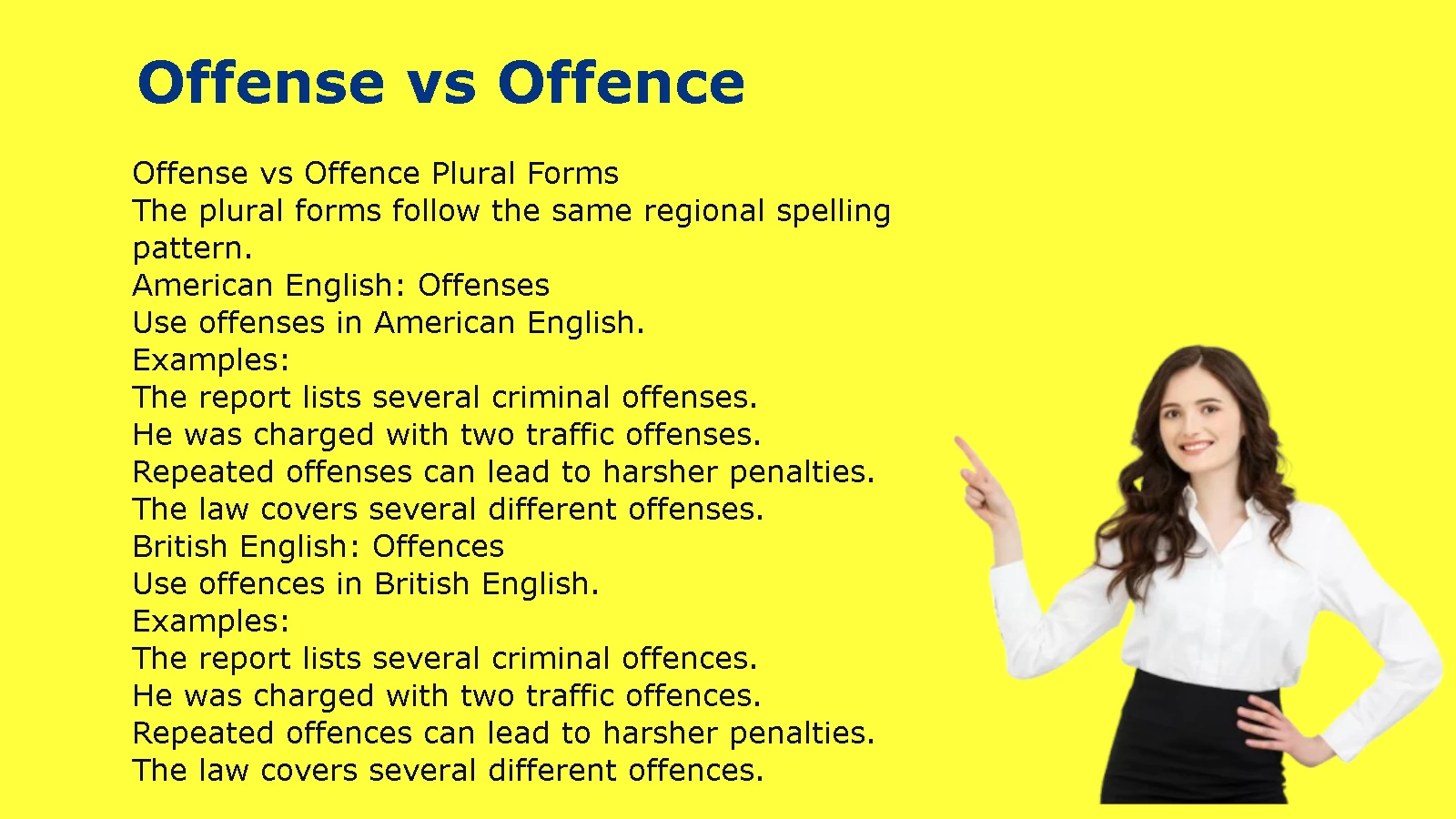
Offense vs Offence Plural Forms
The plural forms follow the same regional spelling pattern.
American English: Offenses
Use offenses in American English.
Examples:
- The report lists several criminal offenses.
- He was charged with two traffic offenses.
- Repeated offenses can lead to harsher penalties.
- The law covers several different offenses.
British English: Offences
Use offences in British English.
Examples:
- The report lists several criminal offences.
- He was charged with two traffic offences.
- Repeated offences can lead to harsher penalties.
- The law covers several different offences.
Oxford’s British entry uses offences as the plural form in examples involving criminal acts.
So the rule is straightforward:
offense → offenses
offence → offences
Don’t mix the forms unless you’re intentionally preserving another variety of English.
Common Phrases With Offense and Offence
Many common expressions use the word offense/offence.
| American English | British English |
| take offense | take offence |
| cause offense | cause offence |
| give offense | give offence |
| no offense | no offence |
| criminal offense | criminal offence |
| serious offense | serious offence |
| minor offense | minor offence |
| first offense | first offence |
| capital offense | capital offence |
| traffic offense | traffic offence |
Take offense vs Take offence
This phrase means to become upset or feel insulted.
American English:
She took offense at his comment.
British English:
She took offence at his comment.
The meaning stays exactly the same.
People use the expression when they want to soften a statement that might sound rude.
For example:
No offense, but I don’t think that’s the best solution.
The phrase doesn’t necessarily mean that the following statement won’t hurt someone’s feelings. In fact, people sometimes use no offense immediately before saying something that could easily offend someone.
That’s part of its conversational character.
Cause offense vs Cause offence
This expression means to make someone feel insulted, upset, or disrespected.
- The advertisement may cause offense.
- The advertisement may cause offence.
Cambridge gives cause offense/cause offence among its examples and usage information.
Offense vs Offence Examples
Seeing the two forms side by side makes the distinction much easier.
American English examples
- He was charged with a serious offense.
- This is her first offense.
- I didn’t mean to cause offense.
- He took offense at the remark.
- The team’s offense struggled during the first quarter.
- The report identifies several criminal offenses.
British English examples
- He was charged with a serious offence.
- This is her first offence.
- I didn’t mean to cause offence.
- He took offence at the remark.
- The team’s offence struggled during the first quarter.
- The report identifies several criminal offences.
The structure remains almost identical. The spelling changes to match the English variety.
How to Choose Between Offense and Offence
Choosing the right spelling takes only a few seconds once you know your audience.
Use offense for American English
Choose offense when your writing follows American English conventions.
This includes most writing intended for:
- the United States
- American schools and universities
- US businesses
- American publications
- US legal or government audiences
- American sports audiences
For example:
The player was removed from the game after committing a serious offense.
If the rest of your article uses American spellings such as color, favorite, and center, then offense fits naturally.
Use offence for British English
Choose offence when you’re writing for a British English audience.
This includes writing intended primarily for:
- the United Kingdom
- British schools and universities
- UK publications
- British businesses
- British government audiences
For example:
The player was removed from the game after committing a serious offence.
If your document consistently uses British spellings such as colour, favourite, and centre, then offence is the natural choice.
Follow the required style guide
Sometimes the audience isn’t enough to determine the spelling.
A publication, university, employer, or organization may have its own style guide. When one exists, follow it.
The goal isn’t to prove that one spelling is better. The goal is to produce consistent writing that fits the required standard.
Offense vs Offence in Formal Writing
Formal writing doesn’t change the spelling rule.
American formal writing uses offense.
British formal writing uses offence.
Academic writing
An American academic paper might say:
The study examines how criminal offenses are classified under federal law.
A British academic paper could say:
The study examines how criminal offences are classified under national law.
The important distinction is not formality. It’s regional English.
Business writing
American:
The employee’s actions may constitute an offense under company policy.
British:
The employee’s actions may constitute an offence under company policy.
Again, the spelling follows the variety of English.
Legal writing
Legal contexts deserve extra care because terminology can vary between jurisdictions.
In American English, offense is standard in phrases such as criminal offense and statutory offense.
In British English, offence is standard in phrases such as criminal offence and statutory offence. Oxford explicitly lists statutory offence as the British form and statutory offense as the North American form.
The spelling difference does not mean American and British law use identical legal systems or identical legal categories. A legal writer should always check the terminology used by the relevant jurisdiction.
Offense vs Offence in Sports
Sports provide one of the clearest examples of how context changes meaning.
In American English, offense can refer to the part of a team responsible for scoring.
For example:
The team’s offense scored 28 points in the first half.
Here, offense has nothing to do with criminal behavior or hurt feelings.
It describes the team’s attacking or scoring function.
Cambridge defines the sports sense as the ability to score or the team that has possession and is attempting to score, particularly in football.
British English can use offence for the same general concept:
The team’s offence created several chances to score.
This creates an important distinction for international readers. The same sentence structure can describe completely different things depending on context.
Compare:
| Sentence | Meaning |
| He committed an offense. | He committed an illegal act. |
| She took offense at the comment. | She felt insulted or upset. |
| The offense scored twice. | The attacking side scored. |
Context does most of the heavy lifting.
Offense vs Offence vs Offensive
These words belong to the same word family, but they don’t serve the same grammatical role.
| Word | Part of speech | Basic meaning |
| offense | noun | American spelling for an illegal act, insult, or sports attack |
| offence | noun | British spelling of offense |
| offensive | adjective/noun | Describes something that causes offense or relates to attacking play |
| offend | verb | To upset, insult, or violate a rule or law |
| offender | noun | A person who commits an offense or does something wrong |
For example:
- Offense: The offense was serious.
- Offence: The offence was serious.
- Offensive: The comment was offensive.
- Offend: She didn’t intend to offend anyone.
- Offender: The offender was arrested.
Oxford defines offend as making someone upset through something rude or embarrassing. It also recognizes a formal criminal sense meaning to commit a crime.
The word family therefore connects several ideas: doing something wrong, causing emotional harm, or breaking a rule.
Offense vs Offence in Legal Contexts
The legal meaning deserves special attention because offense/offence is a common legal noun.
An offense or offence is an act that violates a law.
Common combinations include:
| American English | British English |
| criminal offense | criminal offence |
| serious offense | serious offence |
| minor offense | minor offence |
| traffic offense | traffic offence |
| sexual offense | sexual offence |
| statutory offense | statutory offence |
| first offense | first offence |
| commit an offense | commit an offence |
| convicted of an offense | convicted of an offence |
Oxford’s entries provide examples of these combinations, including criminal offense, minor offense, first offense, criminal offence, and statutory offence.
Why legal context matters
A legal document should never change terminology simply because another spelling looks more familiar.
For instance, an American legal document should generally retain offense if it follows US English. A British legal document should generally use offence.
More importantly, don’t assume that an American legal term has an exact British legal equivalent just because the spelling changes from s to c.
The spelling distinction is linguistic. The legal systems themselves are different.
A Simple Case Study: One Sentence, Two English Varieties
Consider this sentence:
The driver committed a serious offense.
For an American audience, the spelling looks completely natural.
Now change only one letter:
The driver committed a serious offence.
For a British audience, the second version is the expected spelling.
Nothing about the driver’s behavior changed. Nothing about the seriousness of the act changed. The difference lies entirely in the regional spelling convention.
This is why offense vs offence shouldn’t be treated as a vocabulary distinction. It’s primarily a regional spelling distinction.
Common Mistakes With Offense and Offence
The spelling itself is easy once the rule becomes familiar. Most mistakes happen when writers mix English varieties or misunderstand the word’s different meanings.
Using Offence in American English
Writing offence isn’t inherently wrong. However, it may look inconsistent in a document that otherwise follows American English.
For example:
The color of the center court was changed after the offence.
If the document uses American spelling elsewhere, offense would be more consistent.
Using Offense in British English
The same issue works in reverse.
A British English document would normally use:
The color of the center court was changed after the offense.
No. That combination mixes regional spelling conventions.
A consistently British version would use:
The colour of the centre court was changed after the offence.
The point isn’t that mixing spellings makes a sentence impossible to understand. It simply makes the writing less consistent.
Mixing Offense and Offence
One of the clearest mistakes is using both forms in the same article without a reason.
For example:
The first offense was minor, but the second offence was more serious.
If this is supposed to be American English, change offence to offense.
If it’s British English, change offense to offence.
Assuming the Words Have Different Meanings
This is another common misconception.
Offense and offence don’t normally represent two different definitions.
They represent the American and British spellings of the same noun.
Confusing Offense With Offensive
Offense is a noun.
Offensive is usually an adjective when it describes something that causes insult or relates to attacking play.
Compare:
- The comment caused offense.
- The comment was offensive.
The first sentence names the reaction or harm. The second describes the comment.
Offense or Offence: Which One Should You Use?
Use this quick decision guide:
Are you writing in American English?
→ Use offense.
Are you writing in British English?
→ Use offence.
Are you quoting an American or British source?
→ Preserve the source’s original spelling when accuracy requires it.
Are you following a publication or organizational style guide?
→ Follow that guide.
Are you writing for an international audience?
→ Choose one variety and use it consistently. If your publication has a preferred regional style, follow it.
That simple rule handles most situations.
Frequently Asked Questions About Offense vs Offence
Is offense American or British?
Offense is the American English spelling. British English normally uses offence. Cambridge and Oxford both identify this regional distinction.
Is offence the British spelling of offense?
Yes. Offence is the standard British spelling of the American offense.
Are offense and offence the same word?
Yes. They are regional spelling variants of the same noun and generally have the same meanings.
Which is correct, offense or offence?
Both are correct. Use offense in American English and offence in British English.
Is offense spelled with a C or an S?
In American English, it’s spelled with S:
offense
In British English, it’s spelled with C:
offence
What is the plural of offense?
The American English plural is offenses.
The British English plural is offences.
Does offense mean a crime?
Yes. One meaning of offense is an illegal act or crime. Cambridge and Oxford both list this as a core definition.
Does offense mean insult?
Yes. Offense can describe the feeling of being upset or insulted because of something someone said or did.
For example:
She took offense at his comment.
The British spelling is:
She took offence at his comment.
Is offense used in sports?
Yes. In American English, offense can refer to the scoring side of a sports team or its ability to score.
British English can use offence for the same general sports meaning.
Is “no offense” American English?
Yes. No offense is the American spelling.
British English normally uses no offence.
Should academic writing use offense or offence?
Use the form required by your English variety or style guide.
For American academic writing, use offense.
For British academic writing, use offence.
Is “criminal offense” or “criminal offence” correct?
Both are correct.
- Criminal offense = American English
- Criminal offence = British English
Are offense and offence pronounced differently?
In their main crime and emotional senses, they are generally pronounced alike. The spelling difference doesn’t normally create a different pronunciation. Cambridge gives /əˈfens/ for these main senses.
Offense vs Offence: Key Takeaway
The difference between offense vs offence is much simpler than it first appears.
Offense is the standard American English spelling.
Offence is the standard British English spelling.
Both words can describe:
- an illegal act or crime
- the feeling of being insulted or upset
- the scoring side or ability to score in sports
The plural forms follow the same pattern:
- offenses in American English
- offences in British English
The best spelling isn’t determined by which word looks more familiar. It depends on which variety of English you’re using.
So when you’re deciding between offense or offence, ask one simple question: Who are you writing for?
For a US audience, choose offense.
For a UK audience, choose offence.
Once you make that choice, stick with it. Consistency is what makes the spelling look right from the first sentence to the last.