Have you ever wondered whether you should write “peel” or “peal”? These two words sound alike, but they have completely different meanings and uses. If you’re unsure about the Peel or Peal difference, you’re not alone. Their similar pronunciation can make this pair easy to mix up in writing.
Peel usually refers to the outer skin of a fruit or vegetable. It can also mean to remove that outer layer. Peal, on the other hand, refers to a loud, clear, or repeated sound, especially the sound of bells or laughter.
Examples:
- Please peel the orange before eating it.
- The peal of church bells echoed through the town.
The confusion is understandable. People often search for peel or peal, peal vs peel, difference between peel and peal, or how to use peel and peal in a sentence because both words sound the same but work in very different contexts. And here’s the kicker: one can describe something you remove from a fruit, while the other can describe a sound that fills the air.
In this guide, you’ll learn the complete Peel or Peal difference, including their meanings, definitions, pronunciations, correct usage, and examples in sentences. You’ll also discover an easy way to remember peel vs peal and avoid confusing these two commonly mixed up words.
Peel or Peal: Quick Difference
The fastest way to remember the difference is to connect each word with its main idea.
| Word | Meaning | Example |
| Peel | To remove an outer layer or the outer layer itself | Peel the apple. |
| Peal | A loud, ringing, or prolonged sound | We heard a peal of thunder. |
Think of peel as something that comes off.
Think of peal as a sound that rings out.
That simple distinction covers most everyday uses. Peel commonly describes removing the skin of fruit or vegetables, taking away a covering, or having a surface come away. Peal, meanwhile, describes a loud sound, especially bells, thunder, or laughter.
Peel in a Sentence
Peel the potatoes before you boil them.
Here, peel means to remove the potatoes’ outer skin.
Peal in a Sentence
A peal of thunder woke everyone in the house.
Here, peal means a loud sound.
The words may sound identical when spoken. On the page, however, the spelling carries the meaning.
What Does “Peel” Mean?
Peel has several related meanings, but they all revolve around the idea of an outer layer being removed or coming away.
As a verb, peel can mean removing the skin of food, removing a covering, or having a layer come away. As a noun, peel commonly means the skin or outer covering itself.
Peel as a Verb
The most familiar use appears in the kitchen.
You peel an orange, potato, carrot, apple, or other fruit or vegetable when you remove its outer skin. Cambridge Dictionary gives peel this food related meaning and also records broader uses involving coverings and surfaces.
Examples:
- Please peel the carrots.
- She peeled an orange after lunch.
- He is peeling the potatoes.
- Can you peel the apples before making the pie?
- The recipe says to peel and chop the onions.
The word doesn’t stop at food, though.
You can also peel something away from a surface. For example, you might peel a sticker from a box or peel wallpaper from a wall. In these cases, the same basic idea remains: an outer covering comes away.
Examples:
- She peeled the label off the jar.
- We peeled the old wallpaper from the wall.
- The tape peeled away easily.
- The paint started to peel from the door.
- He peeled the protective film from the screen.
The verb can also describe skin or another surface layer coming away.
After spending too much time in the sun, his skin began peeling.
This use still fits the central idea. A top layer is coming off.
Peel as a Noun
As a noun, peel usually means the outer skin or covering of a fruit or vegetable.
Examples:
- Don’t leave the banana peel on the floor.
- Add a little lemon peel to the mixture.
- The recipe calls for orange peel.
- Potato peels can be used in several recipes.
Cambridge Dictionary defines peel as the skin of fruits and vegetables, especially after removal.
The word also has a more specialized noun meaning. A peel can refer to a flat, shovel like tool used to move food such as pizza or bread in and out of an oven. This meaning is less common in everyday conversation, but it is a genuine dictionary use.
Peel Can Describe More Than Food
One reason learners sometimes underestimate peel is that they associate it only with bananas and oranges.
In reality, the word can describe many kinds of coverings.
| Example | Meaning of peel |
| Peel an orange | Remove the fruit’s skin |
| Peel a sticker off | Remove a covering |
| Paint is peeling | The paint is coming away |
| Peel wallpaper from a wall | Remove a surface covering |
| Skin is peeling | The outer skin layer is coming away |
| Peel off a jacket | Remove clothing |
That last use is especially useful in everyday American English. Peel off can mean removing clothing or another outer layer.
What Does “Peal” Mean?
Peal belongs to the world of sound.
As a noun, a peal is a loud sound or a series of loud sounds. The word often appears with bells, thunder, and laughter. As a verb, peal means to produce or ring out with a loud sound.
Peal as a Noun
The classic example is a peal of bells.
A peal of bells echoed through the town.
Here, peal doesn’t mean the bells themselves. It describes their loud, ringing sound.
The word can also describe thunder.
A sudden peal of thunder shook the windows.
And it can describe laughter.
A peal of laughter came from the next room.
These aren’t random combinations. They reflect one central meaning: a loud or prolonged sound. Cambridge Dictionary specifically gives examples involving laughter, thunder, and bells.
Peal as a Verb
As a verb, peal means to sound loudly.
Bells can peal.
The church bells pealed at noon.
Thunder can peal.
Thunder pealed across the valley.
A sound can also peal out.
The bells pealed out from the tower.
Cambridge Dictionary notes that peal out is also used when bells ring loudly.
The important point is that peal involves sound. If nothing is ringing, booming, or sounding loudly, you probably don’t want peal.
Peel vs. Peal: Side by Side
A comparison makes the distinction easier to see.
| Feature | Peel | Peal |
| Main idea | Outer layer | Loud sound |
| Common verb use | Remove a covering | Sound loudly |
| Common noun use | Skin or outer covering | Loud or prolonged sound |
| Typical examples | Peel an apple, peeling paint | Peal of thunder, peal of laughter |
| Present participle | Peeling | Pealing |
| Past tense | Peeled | Pealed |
| Pronunciation | /piːl/ | /piːl/ |
| Homophone? | Yes | Yes |
The pronunciation creates the problem. The meanings solve it.
When you’re writing, don’t ask, “Which one sounds right?” Both sound right.
Instead, ask:
Am I talking about an outer layer or a sound?
If the answer is an outer layer, choose peel.
If the answer is a sound, choose peal.
Peeling vs. Pealing
The confusion doesn’t disappear when you add -ing. In fact, it can become even trickier.
What Does “Peeling” Mean?
Peeling is the present participle of peel. It describes the act of removing an outer layer or the process of an outer layer coming away.
Examples:
- She is peeling a banana.
- They are peeling potatoes.
- The paint is peeling from the ceiling.
- His skin was peeling after the sunburn.
- We spent the afternoon peeling apples.
Here’s a useful test:
If you could replace the word with removing the skin or coming off, you probably need peeling.
What Does “Pealing” Mean?
Pealing is the present participle of peal. It relates to loud or ringing sounds.
Examples:
- The bells were pealing across the city.
- We heard pealing laughter from the crowd.
- The bells kept pealing through the night.
- Thunder was pealing in the distance.
A quick comparison helps:
| Incorrect idea | Correct form |
| Pealing an apple | Peeling an apple |
| Peeling bells | Pealing bells |
| Paint is pealing | Paint is peeling |
| Bells are peeling | Bells are pealing |
The spelling follows the base verb.
Peel → peeling
Peal → pealing
That rule is much more reliable than trying to remember each word separately.
Peeled vs. Pealed
The past tense creates another common trap.
When to Use “Peeled”
Use peeled when something was stripped of an outer layer or when an outer layer came away.
Examples:
- She peeled the orange.
- He peeled the potatoes.
- The paint peeled from the wall.
- We peeled the label from the bottle.
- She peeled the protective cover from the device.
Cambridge Dictionary identifies peeled as the past simple and past participle form of peel.
When to Use “Pealed”
Use pealed when something produced a loud or ringing sound.
Examples:
- The bells pealed at midnight.
- Thunder pealed across the mountains.
- Laughter pealed from the audience.
- The warning bells pealed through the station.
Cambridge Dictionary gives pealed as the past form of peal and uses it in examples involving bells.
A Simple Past Tense Test
Look at the object or subject around the verb.
She peeled the apple.
The apple has an outer layer.
The bells pealed.
The bells produced a sound.
If the action changes a surface, think peeled.
If the action produces a sound, think pealed.
Common Phrases With “Peel”
Some expressions make the correct spelling much easier to remember.
Peel Off
Peel off means to remove something from a surface or to come away from it.
- Peel off the sticker.
- The paint began to peel off.
- Peel off the protective backing.
Cambridge Dictionary records peel off and peel away as common phrasal uses.
Peel Away
Peel away emphasizes something separating from a surface or moving away.
- The old wallpaper peeled away from the wall.
- The outer layer slowly peeled away.
- The crowd peeled away after the event.
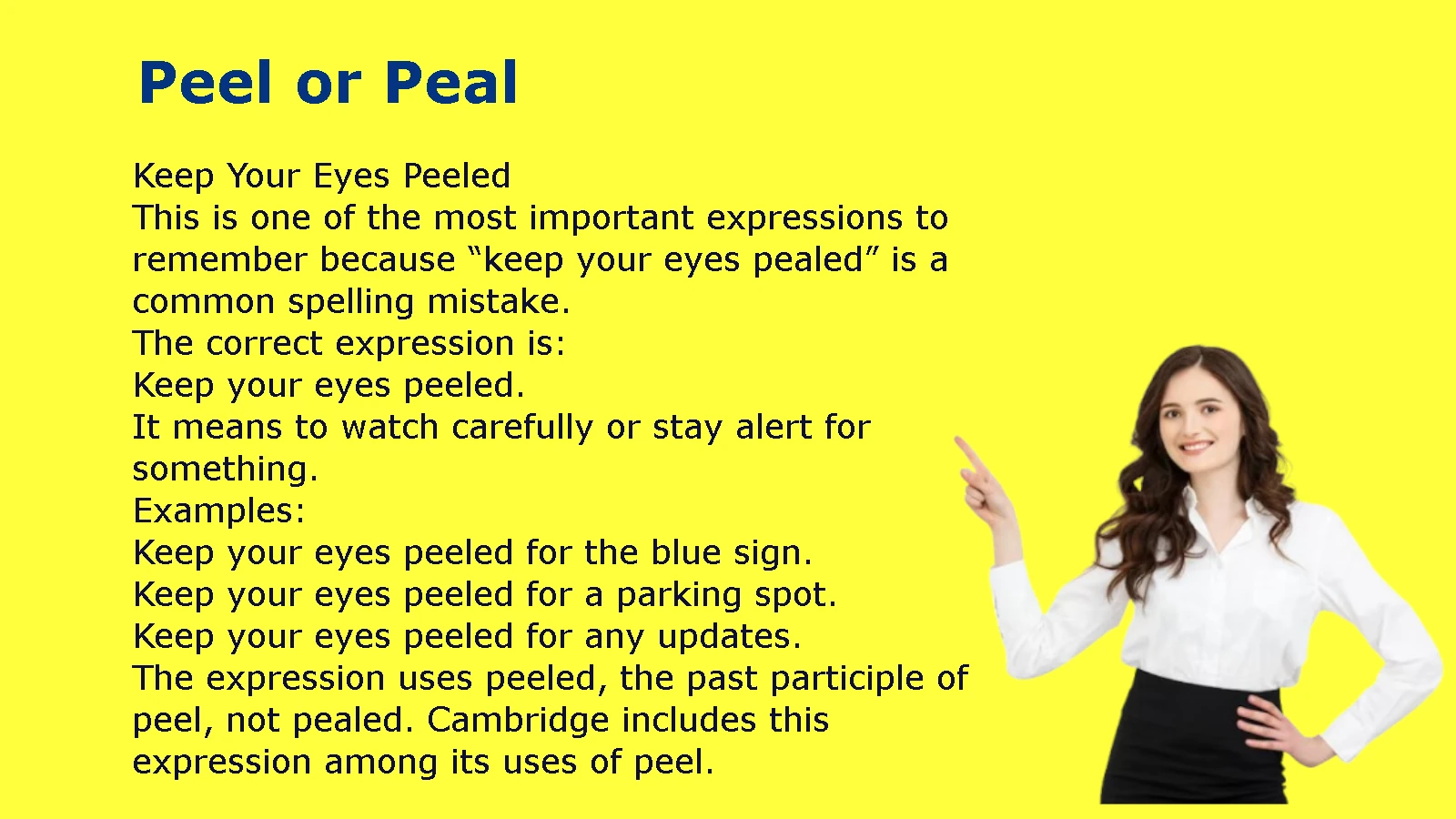
Keep Your Eyes Peeled
This is one of the most important expressions to remember because “keep your eyes pealed” is a common spelling mistake.
The correct expression is:
Keep your eyes peeled.
It means to watch carefully or stay alert for something.
Examples:
- Keep your eyes peeled for the blue sign.
- Keep your eyes peeled for a parking spot.
- Keep your eyes peeled for any updates.
The expression uses peeled, the past participle of peel, not pealed. Cambridge includes this expression among its uses of peel.
Common Phrases With “Peal”
Peal tends to appear in phrases involving loud sounds.
A Peal of Bells
A peal of bells announced the celebration.
This is one of the most traditional uses of peal.
A Peal of Thunder
A peal of thunder rolled across the sky.
The phrase emphasizes the loud, dramatic quality of the sound.
A Peal of Laughter
A peal of laughter erupted from the audience.
Here, peal describes loud, ringing laughter.
These combinations are especially useful because they give you a built in memory aid:
bells → peal
thunder → peal
laughter → peal
If you’re describing the skin of a fruit or something coming off a surface, switch to peel.
Peel or Peal in Example Sentences
Seeing the words in context makes the distinction almost impossible to miss.
- Please peel the apples before making the pie.
- A peal of thunder shook the windows.
- The paint is beginning to peel from the door.
- The church bells pealed at noon.
- She peeled the label from the bottle.
- A peal of laughter came from the audience.
- The children were peeling potatoes.
- The bells were pealing across the square.
- Keep your eyes peeled for the exit.
- The old wallpaper slowly peeled away.
- We heard another peal of thunder.
- The bells pealed out from the tower.
- He peeled the protective film from the screen.
- Her laughter pealed through the room.
- The sunburn caused his skin to start peeling.
Notice how pronunciation doesn’t change. The context does all the heavy lifting.
Common Mistakes With Peel and Peal
Because the words are homophones, even experienced writers can occasionally choose the wrong spelling. A few patterns cause most of the confusion.
Mistake: “Pealed an Orange”
Incorrect:
She pealed an orange.
Correct:
She peeled an orange.
An orange has an outer skin that you remove. Therefore, the correct verb is peel.
Mistake: “A Peel of Laughter”
Incorrect:
A peel of laughter filled the room.
Correct:
A peal of laughter filled the room.
Laughter is a sound, so the correct word is peal.
Mistake: “Keep Your Eyes Pealed”
Incorrect:
Keep your eyes pealed for the sign.
Correct:
Keep your eyes peeled for the sign.
The expression comes from peel, not peal.
Mistake: “The Bells Peeled”
Incorrect:
The bells peeled across the town.
Correct:
The bells pealed across the town.
Bells produce a ringing sound. Therefore, use peal.
Mistake: “The Paint Is Pealing”
Incorrect:
The paint is pealing from the wall.
Correct:
The paint is peeling from the wall.
Paint can come away from a surface. It doesn’t make a peal.
Peel or Peal: Practical Usage Cases
The easiest way to master these words is to put them into realistic situations.
Every example involves an outer layer.
Now imagine that a storm rolls in while you’re cooking. You hear a loud peal of thunder.
The meaning changes completely. So does the spelling.
Case Study: Home Maintenance
Suppose an old house needs repainting.
The paint has started peeling from the walls. You peel away loose sections before applying a new coat.
Again, the word is peel because you’re describing a surface layer coming off.
If thunder suddenly peals outside, that’s a different matter. The house may be old, but the spelling isn’t.
Case Study: A Celebration
Imagine a wedding ceremony ending in a church.
The bells peal from the tower.
A peal of bells fills the air.
Guests respond with peals of laughter as someone makes a joke.
Nothing is being stripped from anything. The entire scene revolves around sound, so peal is the right choice.
How to Remember the Difference Between Peel and Peal
You don’t need a complicated mnemonic. One simple association is enough.
Remember “Peel” With an Orange
Think:
Peel a banana.
Both the verb and noun connect directly to an outer layer.
If something has skin, a covering, or a surface that comes off, peel is your word.
Remember “Peal” With Bells
Think:
Peal of bells.
If you’re talking about a loud, ringing, or prolonged sound, choose peal.
This gives you two anchor images:
🍊 Peel → outer layer
🔔 Peal → sound
Once those two ideas stick, most spelling choices become automatic.
Peel and Peal Pronunciation
One reason this pair causes trouble is that pronunciation doesn’t rescue you.
Both peel and peal are pronounced /piːl/ in the dictionary entries cited above.
That means you can’t hear the difference in ordinary speech.
Compare that with words that have different pronunciations. If two words sound different, pronunciation can help you select the correct spelling. With peel and peal, it can’t.
Instead, use context.
Consider this sentence:
I heard a ___ of thunder.
You hear a sound. Therefore:
I heard a peal of thunder.
Now consider:
I need to ___ the orange.
You’re removing its skin. Therefore:
I need to peel the orange.
The pronunciation stays the same. The meaning changes.
Are Peel and Peal Homophones?
Yes. Peel and peal are homophones.
A homophone is a word that sounds the same as another word but has a different meaning and usually a different spelling.
Other familiar examples include:
- flower / flour
- right / write
- sea / see
- pair / pear
- brake / break
Peel / peal belongs in the same family.
The important distinction is that the two words aren’t interchangeable. Their identical pronunciation doesn’t make them synonyms.
Peel means an outer layer or the act of removing one.
Peal refers to a loud sound or the act of producing one.
Dictionary.com likewise identifies the pair as homophones and distinguishes their meanings by outer coverings versus sound.
Peel or Peal: A Quick Grammar Guide
The following chart covers the forms most likely to cause confusion.
| Form | Correct use | Example |
| Peel | Remove an outer layer | Peel the apple. |
| Peels | Removes an outer layer | She peels the potatoes. |
| Peeled | Removed an outer layer | He peeled the orange. |
| Peeling | Removing or losing an outer layer | The paint is peeling. |
| Peal | Produce a loud sound | The bells peal. |
| Peals | Loud sounds or produces loud sounds | Peals of laughter filled the room. |
| Pealed | Produced a loud sound | The bells pealed. |
| Pealing | Producing a loud sound | The bells were pealing. |
The pattern is straightforward:
Peel → peels → peeled → peeling
Peal → peals → pealed → pealing
The base spelling determines the rest of the word.
Peel or Peal: Which One Should You Use?
When you’re stuck between peel or peal, don’t focus on pronunciation. Focus on the action.
Ask yourself three questions:
Is Something Being Removed?
If yes, use peel.
- Peel the orange.
- Peel the sticker.
- The paint is peeling.
- She peeled the potatoes.
Is an Outer Layer Coming Off?
If yes, use peel.
- The wallpaper is peeling.
- His skin was peeling.
- The label peeled away.
Is the Sentence About a Loud Sound?
If yes, use peal.
- A peal of thunder.
- A peal of laughter.
- A peal of bells.
- The bells pealed.
That’s the whole decision process.
Peel vs. Peal: The Most Important Examples
If you only remember a handful of examples, remember these:
| Meaning | Correct example |
| Remove fruit skin | Peel the orange. |
| Fruit or vegetable skin | Orange peel |
| Remove a covering | Peel off the label. |
| Covering comes away | The paint is peeling. |
| Stay alert | Keep your eyes peeled. |
| Loud bell sound | A peal of bells |
| Loud thunder | A peal of thunder |
| Loud laughter | A peal of laughter |
| Bells making sound | The bells pealed. |
| Bells making sound now | The bells are pealing. |
This table captures the practical difference better than a long definition alone.
Frequently Asked Questions About Peel or Peal
Is it “peel” or “peal” of laughter?
The correct expression is peal of laughter.
The joke was followed by a peal of laughter.
Laughter is a sound, so peal is the correct spelling.
Is it “peel” or “peal” of thunder?
Use peal.
A peal of thunder woke me up.
Thunder produces a loud sound, which is exactly the meaning of peal.
Is it “peeled” or “pealed” an orange?
Use peeled.
She peeled an orange.
You’re removing the orange’s outer layer.
Is it “peeling” or “pealing” an apple?
Use peeling.
He is peeling an apple.
Peeling comes from peel.
Is it “pealing” or “peeling” bells?
Use pealing.
The bells were pealing in the distance.
Pealing comes from peal, which relates to loud sound.
Is it “keep your eyes peeled” or “keep your eyes pealed”?
The correct expression is keep your eyes peeled.
Keep your eyes peeled for the entrance.
The expression uses peel, not peal.
Are peel and peal pronounced the same?
Yes. Both are pronounced /piːl/ in the dictionary sources cited here.
Are peel and peal synonyms?
No.
They are homophones, not synonyms.
Peel relates to an outer layer or removing one.
Peal relates to a loud sound.
What is the easiest way to remember peel vs. peal?
Use two images:
- Peel = orange
- Peal = bell
If you can connect the word to one of those images, the spelling becomes much easier.
Final Takeaway: Peel or Peal?
The difference between peel and peal is simple once you connect each spelling with its meaning.
Peel refers to an outer layer or the act of removing one.
Peel the apple.
Peal refers to a loud, ringing, or prolonged sound.
A peal of thunder shook the house.
The same distinction carries through their related forms:
- Peel → peeled → peeling
- Peal → pealed → pealing
So when you hesitate, ignore the pronunciation. Both words sound the same.
Instead, ask what the sentence describes.
Is something coming off? Use peel.
Is something ringing, booming, or sounding loudly? Use peal.
That one rule will keep most peel or peal mistakes at bay.