Wich vs which: Which is the correct spelling when you ask about a choice, identify something, or introduce certain clauses. Wich is generally a misspelling of which in standard English. However, witch is a different word that refers to a person associated with magic or witchcraft.
The confusion between wich vs which often happens because English speakers may pronounce which and witch the same way. Their meanings, spelling, and grammatical uses differ. Understanding which meaning, which one meaning, and which vs witch will help you choose the right word in sentences, emails, schoolwork, and everyday writing.
| Question | Answer |
| Is wich or which correct? | Which is the standard spelling for the intended word. |
| Is wich a word? | It can appear in names and specialized or historical contexts, but it is not the standard spelling of which. |
| How do you spell which? | W-H-I-C-H. |
| Are which and witch homophones? | Yes, in most English accents, they sound the same. |
| What does which one mean? | It asks someone to identify one choice from a known or understood set. |
Wich vs Which: Which Spelling Is Correct?
Which is the correct spelling when you ask someone to identify a person, thing, option, or choice. Wich is usually a spelling mistake in everyday English. For example, write “Which dress do you prefer?” rather than “Wich dress do you prefer?” The correct spelling contains an h after the c.
Wich or Which: The Quick Answer
Use which when asking a question or referring to a particular thing.
Examples:
- Which restaurant serves breakfast?
- Which shoes match this outfit?
- I remember which street leads to the station.
- Tell me which option works best.
The word wich usually appears when someone accidentally leaves out the h.
For example:
Incorrect: Wich movie did you watch?
Correct: Which movie did you watch?
This small spelling error can make your writing look careless, especially in professional messages, academic assignments, articles, and website content.
However, context matters. You might encounter Wich in a business name, surname, place name, or specialized expression. That does not make it an acceptable substitute for which in an ordinary sentence.
Is Wich a Word?
Wich can appear as a word element, name, or historical form, but it is not the standard modern spelling of the everyday word which. If you want to ask a question or identify an option, use which.
The distinction matters because English contains unusual spellings and word forms. Not every unfamiliar sequence of letters is automatically meaningless.
For example, wich appears in some English place names and older naming traditions. The element can be associated with different historical origins, including terms connected with settlements or specialized locations. Its interpretation depends on the particular name.
Consider these situations:
- Which book? Use which to ask about a book.
- Wich in a proper name: Preserve the spelling if it is genuinely part of that name.
- Wich in an ordinary question: Usually correct it to which.
Do not confuse the fact that a letter sequence can occur in a name with its acceptability as a replacement for a standard English word.
How to Spell Which Correctly
The correct spelling is W-H-I-C-H.
A simple way to remember it is to associate which with a question about a choice.
Try this memory trick:
WHICH = Which choice?
Both begin with the same four letters: W-H-I-C.
Remember these examples:
- Which answer is correct?
- Which road should we take?
- Which one belongs to you?
- Which chapter should I read first?
When proofreading, pay attention to the missing h. Because wich looks similar to which, your eyes may skip over the error while you read quickly.
A spelling checker can help, but do not rely on it alone. Some proper names or unusual terms may confuse automated tools.
Which vs Witch: Meaning and Difference
Which helps identify or ask about a choice, person, or thing. Witch is a noun commonly used for a person associated with witchcraft, magic, folklore, or fantasy. Although these words sound alike in most English accents, their meanings and grammatical roles differ.
What Does Which Mean?
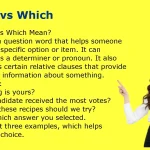
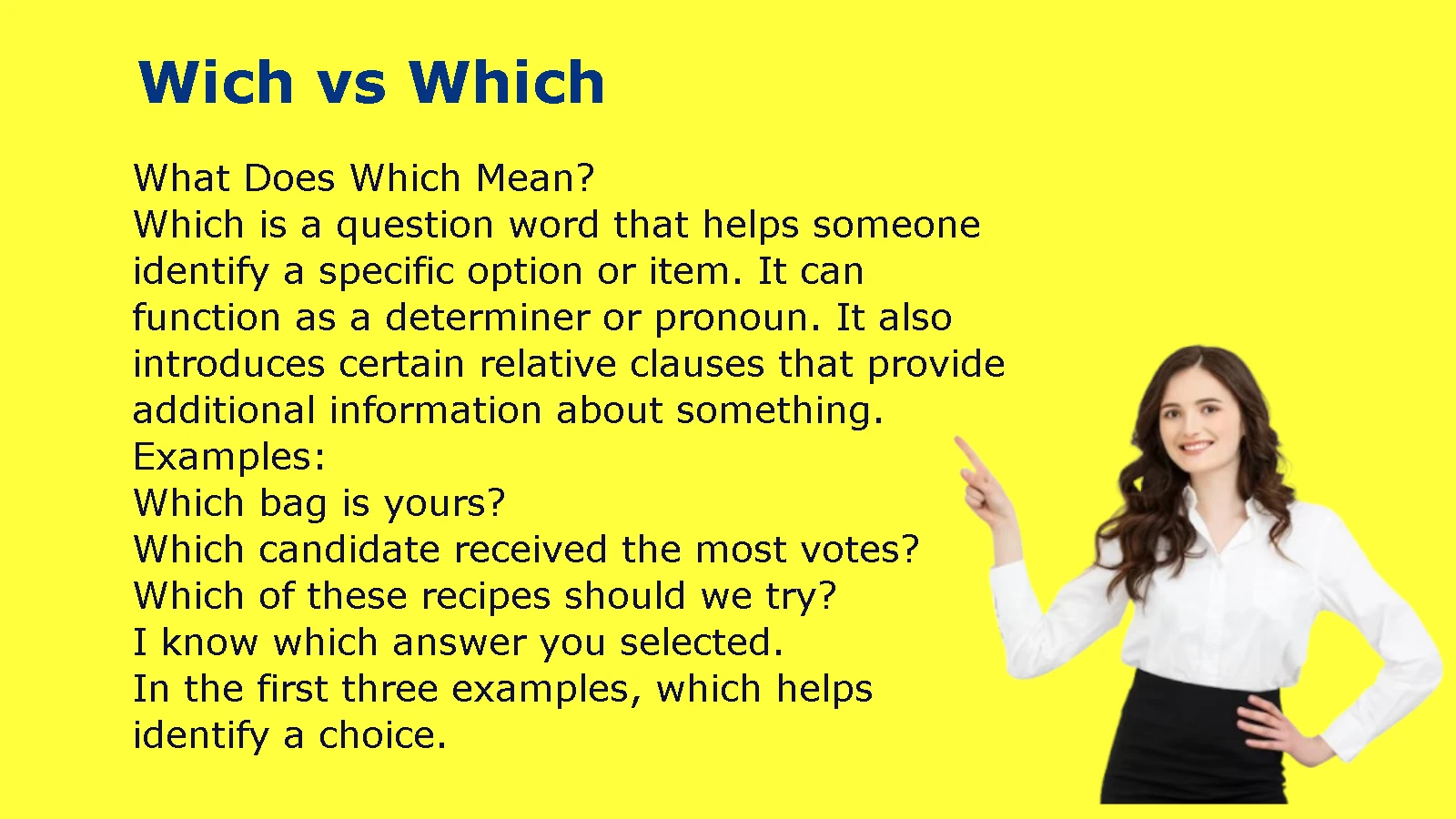
Which is a question word that helps someone identify a specific option or item. It can function as a determiner or pronoun. It also introduces certain relative clauses that provide additional information about something.
Examples:
- Which bag is yours?
- Which candidate received the most votes?
- Which of these recipes should we try?
- I know which answer you selected.
In the first three examples, which helps identify a choice.
In the last example, it introduces an indirect question. The sentence does not ask the reader directly. Instead, it explains what the speaker knows.
The word which also appears in relative clauses.
For example:
- The laptop, which I bought last year, still works well.
- We visited the park, which overlooks the river.
- She selected a route which avoided heavy traffic.
In these examples, which introduces additional information about a noun.
In formal writing, writers often use which for nonrestrictive relative clauses, which add extra information. Restrictive uses also occur, particularly in British English and in some American English contexts.
The correct choice depends on sentence structure, style, and intended meaning.
What Does Witch Mean?
A witch is a person associated with witchcraft or magical practices. The word appears in folklore, mythology, religious discussions, fantasy stories, films, and cultural traditions.
Its meaning can vary significantly depending on context.
For example:
- The witch lived in a cottage near the forest.
- The novel follows a young witch learning magic.
- The villagers accused the woman of witchcraft.
- The story portrays the witch as a helpful healer.
These sentences show different portrayals of witches. Some fictional works present witches as villains, while others portray them as heroes, mentors, or ordinary people with magical abilities.
The word can also refer to real people who identify with particular contemporary spiritual or religious practices. Therefore, avoid assuming that every use of witch refers to a fictional character or an evil person.
Witch is a noun in ordinary usage.
By contrast, which generally helps identify something or connects parts of a sentence.
Which vs Witch Comparison Table
| Feature | Which | Witch |
| Meaning | Identifies or asks about a choice | A person associated with witchcraft |
| Part of speech | Pronoun or determiner; also used in relative clauses | Noun |
| Typical use | Questions, choices, descriptions | People, folklore, fiction, beliefs |
| Example | Which book should I read? | The witch opened an old book. |
| Spelling clue | Contains wh | Contains tch |
| Sound | Usually /wɪtʃ/ | Usually /wɪtʃ/ |
The easiest way to distinguish these words is to examine their meanings.
If the sentence asks about a selection, which is probably correct.
If it names a person associated with magic, witch is likely the intended word.
Are Which and Witch Homophones?
Which and witch are homophones in most mainstream English accents because they share the same pronunciation. Homophones are words that sound alike but have different meanings and spellings.
Examples of their use:
- Which dress should I wear?
- The witch wore a purple dress.
- Which witch appears in the final scene?
- I cannot decide which character is the witch.
The pronunciation does not usually help you distinguish these words in conversation.
Instead, listeners rely on sentence meaning and context.
For instance, if someone asks, “Which witch did you see?” the first which asks for identification, while the second witch names the person.
This distinction becomes especially important in writing because spelling carries meaning that speech alone may not communicate.
Accent variation also exists. Some speakers distinguish the initial sounds of which and witch, while others pronounce them identically.
Wich or Which Examples: Correct Sentences
Which is the correct spelling in standard questions and statements that ask about or identify an option. Use it when selecting an item, describing a choice, or connecting information. The examples below show common sentence patterns and explain how to avoid the spelling error.
Examples of Which in Questions
Use which when you want someone to identify a particular choice.
- Which shirt should I wear to the interview?
- Which bus goes to the city center?
- Which option costs less?
- Which one belongs to your brother?
- Which subject do you enjoy most?
- Which restaurant has outdoor seating?
- Which player scored the winning goal?
- Which laptop would suit a college student?
- Which road leads to the airport?
- Which answer matches the question?
Notice how each sentence asks the reader or listener to identify something.
The options may be explicitly listed or understood from the situation.
For example, a person standing in front of two jackets might ask, “Which one should I buy?” The listener already understands the available choices.
Examples of Which in Statements
Which does not appear only in direct questions. It can also introduce indirect questions and relative clauses.
Here are some examples:
- I cannot remember which drawer contains the documents.
- She knows which train arrives first.
- Tell me which design you prefer.
- We visited the museum, which opened last year.
- The book, which I borrowed yesterday, is interesting.
- He explained which steps we needed to follow.
- I found the website which offers free lessons.
- They discussed which proposal would save money.
- Nobody knows which team will win.
- Please confirm which date works for you.
These examples illustrate three useful patterns.
Direct question: Which design do you prefer?
Indirect question: I know which design you prefer.
Relative clause: The design, which won the award, attracted attention.
The punctuation and sentence structure change depending on the role of which.
An indirect question usually follows normal statement word order.
Correct: I wonder which route is faster.
Incorrect: I wonder which route is faster?
The second version is not necessarily wrong in every context, but it should not be treated as a direct question simply because it contains which. The punctuation depends on whether the entire sentence asks a question.
Which and Witch in a Sentence
These examples show how both words can appear naturally in the same sentence.
- Which witch appears in the final chapter?
- I wonder which witch made the potion.
- Which witch do you think helped the villagers?
- The detective asked which witch owned the cottage.
- Which character is the witch in this story?
- The witch explained which ingredients she needed.
- Nobody knew which witch had hidden the key.
In each sentence, which identifies a choice, while witch refers to a person.
This pattern is useful for understanding the difference because it shows how meaning determines spelling.
For example:
“Which witch won the contest?”
The first word asks for identification. The second names the contest participant.
Incorrect vs Correct Spelling Examples
The following table highlights frequent spelling mistakes.
| Incorrect | Correct |
| Wich book is yours? | Which book is yours? |
| Wich one do you want? | Which one do you want? |
| I don’t know wich way to go. | I don’t know which way to go. |
| Wich color looks better? | Which color looks better? |
| Tell me wich answer you chose. | Tell me which answer you chose. |
| Wich restaurant did you visit? | Which restaurant did you visit? |
| Can you explain wich option is cheaper? | Can you explain which option is cheaper? |
Editing tip: Search your draft for wich. Review every occurrence instead of automatically replacing it. A proper name or quoted spelling may need to remain unchanged.
This simple proofreading habit can catch errors before publication.
A Practical Example: Correcting a Short Message
Imagine a student sends this message:
“Hi, I forgot wich assignment we need to submit tomorrow. Can you tell me wich chapter the teacher mentioned?”
The corrected version is:
“Hi, I forgot which assignment we need to submit tomorrow. Can you tell me which chapter the teacher mentioned?”
The correction does not change the intended meaning. It simply fixes the spelling.
For bloggers and website owners, these small edits matter because repeated spelling errors can weaken readers’ confidence in otherwise useful content.
Which One Meaning and How to Use It
Which one means a particular person or thing selected from a known or understood set of options. People use this phrase when they want someone to identify one choice without repeating the noun. For example, “Which phone do you prefer?” can become “Which one do you prefer?”
What Does Which One Mean?
The phrase which one combines which with one.
Here, one stands in for a singular noun that the conversation already establishes or makes clear.
For example:
Person A: I am choosing between two notebooks.
Person B: Which one do you like better?
The listener understands that one refers to a notebook.
Compare these sentences:
- Which dress should I buy?
- Which one should I buy?
Both sentences ask the same basic question if the available dresses are already understood.
This construction helps speakers avoid repeating nouns.
You can use which one when choosing between:
- Two or more products.
- Different dates or appointments.
- Several possible answers.
- Available routes.
- Multiple people or candidates.
The phrase does not require exactly two options. You can use it when choosing from a larger group.
Which One vs Which Ones
Use which one when asking someone to identify a single item.
Use which ones when asking about multiple items.
| Phrase | Use | Example |
| Which one | One item | Which one is yours? |
| Which ones | Multiple items | Which ones are yours? |
More examples:
Singular:
- Which one is cheaper?
- Which one should we order?
- Which one belongs to Maria?
- Which one looks more professional?
Plural:
- Which ones are ready?
- Which ones should we keep?
- Which ones belong to the new collection?
- Which ones did you select?
The verb should agree with the subject.
Correct: Which one is missing?
Correct: Which ones are missing?
This agreement becomes easier when you identify whether the question refers to one item or several.
Common Questions Using Which One
Here are natural examples you can use in everyday conversations.
Shopping
- Which one should I buy?
- Which one offers better value?
- Which one is available in my size?
School and work
- Which one is the correct answer?
- Which one should I finish first?
- Which one did the manager approve?
Everyday decisions
- Which one tastes better?
- Which one should we watch tonight?
- Which one would you choose?
A useful writing principle is to include enough context for readers to understand what one replaces.
Without context, the question may sound vague.
For example, “Which one do you want?” works when the available choices are visible or already known. In a standalone paragraph, identify the options first.
Which vs Witch vs Wich: Common Spelling Confusion
Which is the standard word for choices and identification, witch refers to a person associated with witchcraft, and wich is generally an error when someone intends either of those words.
The main difference is the h.
- Which: Correct spelling for the everyday question word.
- Wich: Usually a misspelling of which.
Examples:
Incorrect: Wich phone has a better camera?
Correct: Which phone has a better camera?
Incorrect: I don’t remember wich day we agreed on.
Correct: I don’t remember which day we agreed on.
A reliable correction method is to read the entire sentence before choosing a spelling.
If you are referring to a person associated with magic, use witch.
If wich appears in a name, check the original spelling before editing it.
Which vs Witch
The difference between which and witch is not simply a spelling variation. These words serve different purposes.
Which helps identify something.
Example: Which character should I describe?
Witch names a person.
Example: The witch appears in the opening scene.
Here is another comparison:
- Which house belongs to the main character?
- The witch lives in the blue house.
The first sentence asks about a house. The second identifies a person and describes where that person lives.
Writers sometimes confuse these words because their pronunciation overlaps.
When proofreading, ask:
- Am I asking about a choice?
- Am I referring to a person?
- Does the sentence need a question word or a noun?
Answering these questions usually resolves the confusion.
Witch vs Wizard: What’s the Difference?
A witch and a wizard are terms commonly associated with magic, but their meanings depend on folklore, cultural traditions, and fictional settings. Some stories distinguish them by gender, magical role, or training. Others use the terms more flexibly.
In fantasy writing, a wizard often appears as a learned magic user, scholar, or spellcaster. A witch may be portrayed as a spellcaster, healer, practitioner of witchcraft, or character with supernatural abilities.
However, these are common portrayals, not universal definitions.
| Feature | Witch | Wizard |
| Typical meaning | Person associated with witchcraft or magic | Person portrayed as having magical knowledge or abilities |
| Common fictional portrayal | Spellcaster, healer, magical figure | Scholar, spellcaster, magical mentor |
| Gender | Can refer to people of different genders | Often portrayed as male in traditional fantasy, but not exclusively |
| Usage | Folklore, religion, fiction, modern spiritual contexts | Mainly folklore, fantasy, and fictional contexts |
| Meaning across stories | Varies | Varies |
For example:
- The witch prepared a healing potion.
- The wizard studied ancient spells.
- The story features a witch and a wizard who protect the village.
A writer should follow the terminology established by the particular story or tradition.
Avoid assuming that all witches are women or that every wizard must be a man. Modern fantasy often challenges these older conventions.
Wich Craft or Witchcraft: Which Is Correct?
Witchcraft is the standard spelling of the noun referring to magical practices or beliefs associated with witches. Wich craft is generally a spelling or spacing mistake when someone intends the word witchcraft.
Examples:
Incorrect: The book explores the history of wich craft.
Correct: The book explores the history of witchcraft.
Incorrect: She wrote a story about wichcraft.
Correct: She wrote a story about witchcraft.
The word witchcraft combines witch and craft.
Depending on context, it can describe:
- Magical practices in folklore.
- Beliefs about supernatural powers.
- Practices within particular spiritual traditions.
- A subject explored in history, anthropology, literature, or fiction.
The word does not carry one universal meaning across all cultures or communities.
For example:
“The novel explores witchcraft through the experiences of a village healer.”
This sentence describes a literary subject without assuming that every tradition understands witchcraft in the same way.
Spelling reminder: Write witchcraft as one word when referring to the established term.
Easy Ways to Remember Which vs Witch
The easiest way to remember which vs witch is to connect each spelling with its meaning. Use which when identifying a choice and witch when naming a person associated with magic. Check the sentence context rather than relying only on pronunciation.
Use a Meaning-Based Memory Trick
Try these associations:
Which = Choice
- Which road should I take?
- Which answer is correct?
- Which product offers better value?
Witch = Magic
- The witch cast a spell.
- The witch entered the castle.
- The story introduces a mysterious witch.
The associations do not explain every possible use of which, but they provide a practical starting point.
For a spelling reminder, remember:
WHICH contains an H.
You can also create a short mental test:
“If I can replace the word with a question about a choice, I probably need which.”
For example:
“___ color do you prefer?”
The sentence asks about a choice, so which fits.
Now consider:
“The ___ prepared a potion.”
The sentence names a person, so witch fits.
Check the Sentence Before You Publish
A quick editing routine can help you catch mistakes.
Follow these steps:
- Read the entire sentence.
- Identify the intended meaning.
- Decide whether the word asks about a choice or refers to a person.
- Check the spelling.
- Read the corrected sentence once more.
This process is particularly helpful when editing long articles containing repeated uses of which.
For website owners, a targeted proofreading pass can also improve content quality.
For example, search for these strings in your draft:
- wich
- witch
- witchcraft
- which one
Review each result in context.
Do not replace every occurrence of witch with which. Both words are valid, and a careless replacement can create a new error.
Common Mistakes to Avoid
Watch out for these common problems.
Leaving out the h
Incorrect: Wich option is better?
Correct: Which option is better?
Confusing which with witch
Incorrect: The which entered the forest.
Correct: The witch entered the forest.
Splitting witchcraft into two words
Incorrect: The book discusses wich craft.
Correct: The book discusses witchcraft.
Using which without clear context
Unclear: Which one is better?
Clearer: Which of these two laptops is better?
The first sentence is perfectly grammatical when the choices are already known. The second provides context for readers who have not seen the options.
Misunderstanding indirect questions
Direct question: Which train leaves first?
Indirect question: Can you tell me which train leaves first?
The indirect question uses statement word order after which train.
Understanding these patterns makes your writing more natural and precise.
Frequently Asked Questions
Is Wich or Which Correct?
Which is correct when you want to ask about a choice or identify something. Wich is generally a misspelling in ordinary English. Always use the spelling that matches your intended meaning.
Is Wich a Real English Word?
Wich can appear in proper names, place names, and specialized or historical contexts. However, it is not the standard spelling of which in everyday questions or statements.
How Do You Spell Which?
Spell which as W-H-I-C-H. Remember the h after the c. For example, write “Which answer is correct?” rather than “Wich answer is correct?”
Are Which and Witch Pronounced the Same?
Yes, which and witch sound the same in most English accents. They are homophones in those accents. Some speakers distinguish their initial sounds, so pronunciation can vary.
What Does Which One Mean?
Which one asks someone to identify a particular item or person from a known or understood set. For example, “Which one is yours?” asks someone to select the item that belongs to them.
What Is the Difference Between a Witch and a Wizard?
A witch is commonly associated with witchcraft or magical practices, while a wizard is often portrayed as a person with magical knowledge or abilities. Their exact meanings depend on the cultural tradition or fictional setting.
Conclusion: Choose Which or Witch Based on Meaning
The difference between wich vs which is simple once you focus on spelling and context. Which is the standard word for asking about choices, identifying things, and introducing certain clauses. Witch is a noun associated with witchcraft, magic, folklore, and other cultural or fictional contexts.
Remember these key points:
- Use which when asking about a choice.
- Use witch when referring to a person associated with magic.
- Avoid wich as a replacement for which in standard English.
- Write witchcraft as one word.
- Check sentence meaning when proofreading.