The difference between freshman or freshmen comes down to number: freshman refers to one first-year student, while freshmen refers to two or more first-year students. Both words are correct, but you must choose the right form for the sentence. The same rule applies to college and high school students, although phrases such as freshman year, freshman class, and freshman team follow a related noun-modifier rule.
Understanding the difference between freshman vs. freshmen will help you avoid common grammar mistakes, write more naturally, and choose the correct expression in academic settings. Whether you’re describing one college student, a group of new students, or an entire school year, these seven simple rules will help you get it right.
| Question | Answer |
| What is the difference between freshman and freshmen? | Freshman is singular, while freshmen is plural. |
| Is it freshman year or freshmen year? | Freshman year is the standard expression. |
| Is it freshman class or freshmen class? | Freshman class is the conventional term for a cohort of first-year students. |
| Do you say freshman or freshmen in college? | Use freshman for one student and freshmen for multiple students. |
| Is it freshman students or freshmen students? | Both occur, but freshman students and freshmen are generally more natural choices. |
Freshman vs. Freshmen: What’s the Difference?
Freshman means a student in the first year of high school or college, while freshmen is the plural form of the same word. Use freshman when you mean one student and freshmen when you mean multiple students. The correct choice depends on the number of students and the grammatical role of the word.
For example:
- Singular: My brother is a freshman at college.
- Plural: My brother and his friends are freshmen at college.
- Noun modifier: My brother enjoyed his freshman year.
The third example is important because freshman can also describe another noun. In freshman year, the word identifies the type of year rather than counting the students.
What Does Freshman Mean?
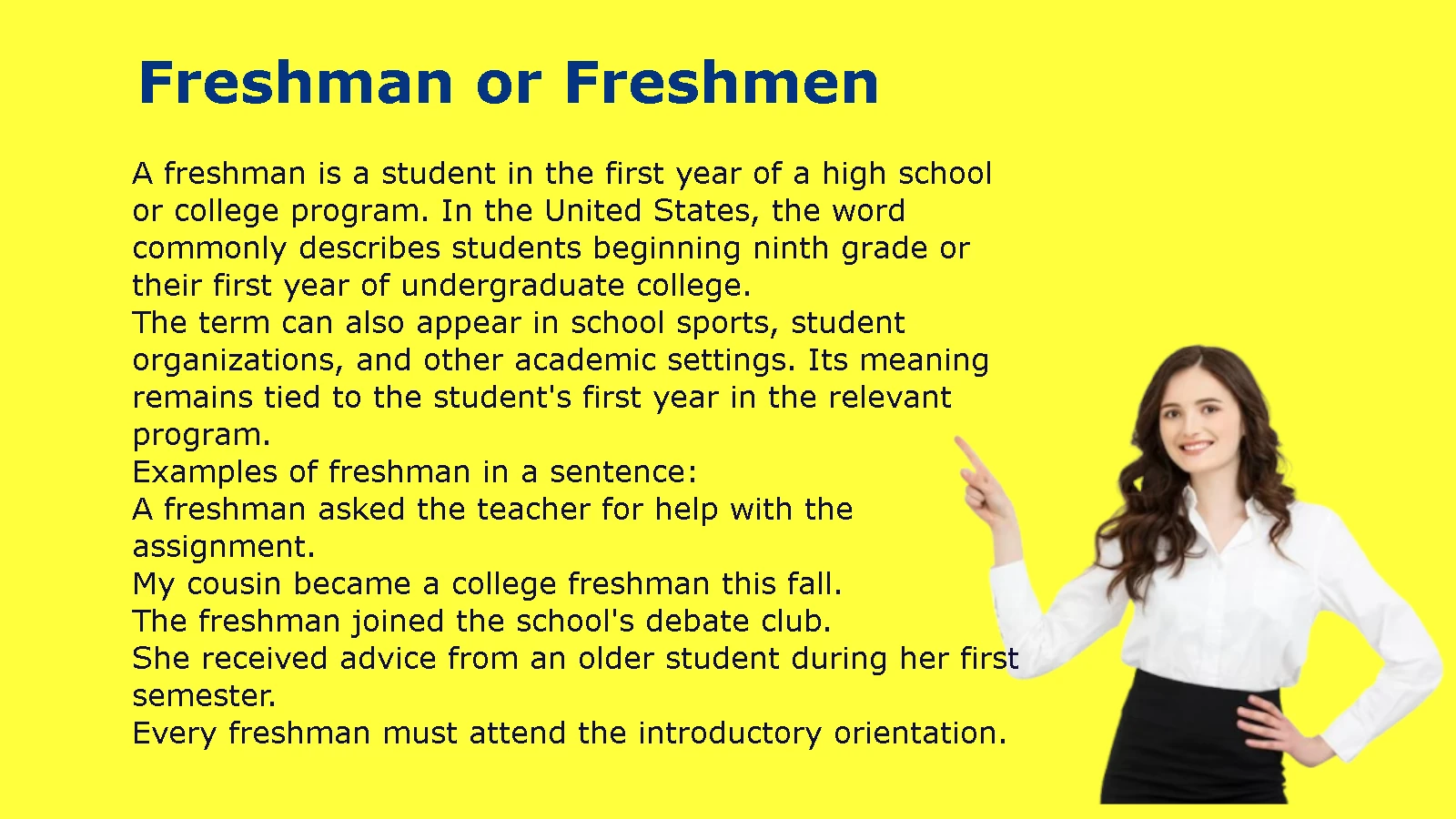
A freshman is a student in the first year of a high school or college program. In the United States, the word commonly describes students beginning ninth grade or their first year of undergraduate college.
The term can also appear in school sports, student organizations, and other academic settings. Its meaning remains tied to the student’s first year in the relevant program.
Examples of freshman in a sentence:
- A freshman asked the teacher for help with the assignment.
- My cousin became a college freshman this fall.
- The freshman joined the school’s debate club.
- She received advice from an older student during her first semester.
- Every freshman must attend the introductory orientation.
Notice that each example refers to one student. Even when the sentence includes several other people, the word freshman remains singular if it describes only one person.
Grammar tip: If you can replace the word with one first-year student, use freshman when referring directly to the student.
What Does Freshmen Mean?
Freshmen is the plural form of freshman. It refers to two or more students who are in the first year of high school, college, or another relevant educational program.
Unlike most regular English nouns, which form the plural by adding -s or -es, freshman changes its ending from -man to -men.
Examples of freshmen in a sentence:
- The freshmen attended an orientation session.
- Several freshmen joined the student newspaper.
- The college welcomed hundreds of freshmen this semester.
- Most freshmen need time to adjust to their new schedules.
- The teacher gave the freshmen a tour of the campus.
In each sentence, freshmen refers to more than one student.
The plural form also affects subject-verb agreement. For example, write “The freshmen are excited,” not “The freshmen is excited.”
Freshman vs. Freshmen at a Glance
| Feature | Freshman | Freshmen |
| Grammatical number | Singular | Plural |
| Meaning | One first-year student | Two or more first-year students |
| Example | He is a freshman. | They are freshmen. |
| College usage | A college freshman | College freshmen |
| High school usage | A high school freshman | High school freshmen |
| Common phrase | Freshman year | Freshmen attended orientation |
| Verb agreement when used as a subject | The freshman is ready. | The freshmen are ready. |
Is Freshman or Freshmen the Correct Word?
Both words are correct. The right choice depends on what you mean.
Use freshman when referring to one student or when the word modifies another noun, as in freshman year. Use freshmen when referring directly to multiple students.
Try this simple test:
- If you mean one first-year student, choose freshman.
- If you mean multiple first-year students, choose freshmen.
- If you are describing a year, class, team, or another noun, check whether the established phrase uses freshman as a modifier.
For instance, “The freshman is waiting outside” refers to one student. “The freshmen are waiting outside” refers to several students. However, “The freshman class is waiting outside” describes a group as one collective unit.
Freshman Year or Freshmen Year?
Freshman year is the standard expression because freshman acts as a noun modifier describing the year. Although the phrase may refer to a period experienced by many students, the word does not become plural. Use freshman year when discussing someone’s first year in high school or college.
Why Freshman Year Is Correct
The phrase freshman year names the first year of a student’s academic experience. Here, year is the main noun, and freshman describes which year you mean.
English often uses singular nouns before other nouns to describe a category or purpose. Examples include:
- Student handbook: A handbook intended for students.
- School bus: A bus used by a school.
- College application: An application for college admission.
- Freshman year: The first year of high school or college.
The first word in these expressions does not necessarily need to be plural, even when the item serves many people.
Consider these sentences:
- My freshman year was more difficult than I expected.
- They met during their freshman year at college.
- Our freshman year brought many new experiences.
- She learned to manage her time during freshman year.
The students may be different people, but the established expression remains freshman year.
Examples of Freshman Year in a Sentence
The following examples show how to use the phrase in different contexts.
College:
- My freshman year taught me how to study independently.
- He moved into a residence hall during his freshman year.
- Their freshman year included several introductory courses.
High school:
- Freshman year can involve adjusting to a larger school.
- She joined the volleyball team during her freshman year.
- My freshman year was the beginning of a new chapter.
General academic writing:
- The university offers support programs for students during freshman year.
- Students often develop new study habits in their freshman year.
- The survey measured students’ experiences during their freshman year.
In all these examples, freshman year is the correct phrase.
Is Freshmen Year Ever Correct?
In standard American English, freshmen year is generally incorrect when you mean the first year of high school or college.
The confusion happens because writers assume that a plural group of students requires a plural word before year. However, the phrase does not describe multiple freshmen as its main noun. It names a particular stage of education.
Compare these examples:
| Incorrect or less natural | Correct | Explanation |
| I enjoyed my freshmen year. | I enjoyed my freshman year. | Freshman modifies year. |
| Their freshmen year was exciting. | Their freshman year was exciting. | The established phrase uses the singular modifier. |
| We met during freshmen year. | We met during freshman year. | Use the conventional expression. |
| The freshmen attended orientation. | The freshmen attended orientation. | Correct because freshmen directly refers to multiple students. |
Remember: Use freshman year for the academic period and freshmen when referring directly to the students.
Freshman Class or Freshmen Class?
Freshman class is the conventional expression for a cohort of students in their first year of high school or college. The word freshman modifies class to identify the type of group. Use freshmen when you refer directly to the students themselves, rather than using it as the modifier in the phrase.
When to Use Freshman Class
A freshman class can refer to a group of students who entered a school or academic program during the same year. Depending on the context, it may mean a school’s incoming cohort or a class specifically organized for first-year students.
Examples include:
- The freshman class attended a welcome event.
- Our freshman class raised money for a school project.
- The college introduced new academic support services for the freshman class.
- The freshman class elected its student representatives.
- Teachers welcomed the incoming freshman class on the first day.
The phrase can describe a large group of students without changing freshman to freshmen.
There is also an important distinction between a freshman class and a class of freshmen. Both can be correct, but their structures differ:
- The freshman class met in the auditorium.
- A class of freshmen met in the auditorium.
In the first sentence, freshman modifies class. In the second, freshmen identifies the students who make up the class.
When to Use Freshmen
Use freshmen when the word itself refers to multiple first-year students.
For example:
- The freshmen arrived early.
- Several freshmen asked questions about registration.
- The school invited freshmen to join its volunteer program.
- Most freshmen attended the welcome meeting.
Compare those examples with freshman class:
- The freshman class attended the meeting.
- The freshmen attended the meeting.
Both sentences can describe the same group, but they emphasize different things. The first treats the class as a collective unit. The second focuses on the individual students who belong to that group.
Freshman Class vs. Freshmen Class Examples
Use this table to check common expressions.
| Phrase | Recommended? | Why |
| The freshman class | Yes | Standard phrase for a first-year cohort |
| Our freshman class | Yes | The singular modifier identifies the group |
| The freshmen attended | Yes | Freshmen is the plural noun |
| A class of freshmen | Yes | Freshmen identifies the students in the class |
| The freshmen class | Generally less natural | Freshman class is the conventional expression |
For formal writing, use freshman class when naming the cohort and freshmen when referring to its members.
Freshman or Freshmen in College?
Use freshman for one student in the first year of college and freshmen for two or more students in their first year. For example, “She is a college freshman” is correct, while “The college welcomed its freshmen” refers to a group of new students.
Use Freshman for One College Student
A college freshman is typically a student in the first year of an undergraduate program. In the United States, the term commonly describes someone beginning college after high school.
Examples:
- My sister is a freshman at a public university.
- He became a college freshman in August.
- A freshman asked the academic adviser about course selection.
- The university assigned each freshman an orientation group.
- She hopes to join a research project as a freshman.
The word does not necessarily mean the student is a particular age. Some first-year college students enter directly after high school, while others begin college later in life.
For this reason, first-year college student can be a useful alternative when the student’s age or educational path makes the term freshman less suitable.
Use Freshmen for Multiple College Students
When discussing several students in their first year of college, use freshmen.
Examples:
- The freshmen attended a campus safety presentation.
- Many freshmen live in residence halls.
- The university created a mentoring program for freshmen.
- Freshmen can contact the academic advising office for help.
- Several freshmen joined the student government association.
The plural form is especially useful when discussing campus life, orientation, student housing, and introductory courses.
For example, a university might offer a program for freshmen who need help with time management. The word identifies the student group rather than a single person.
Freshman vs. Freshmen in College Examples
| Situation | Correct wording | Example |
| One student | College freshman | My friend is a college freshman. |
| Several students | College freshmen | The college freshmen attended orientation. |
| Academic period | Freshman year | Her freshman year was challenging. |
| Incoming cohort | Freshman class | The freshman class met with the dean. |
| Students in a group | The freshmen | The freshmen explored the campus. |
| Neutral terminology | First-year student | Every first-year student received an adviser. |
Practical tip: In college writing, choose the phrase that describes your subject most precisely. Use freshman for an individual, freshmen for multiple students, and freshman year for the academic period.
Freshman or Freshmen in High School?
In high school, freshman refers to one student in the first year, while freshmen refers to multiple students in that year. In the traditional four-year American high school system, freshmen are usually ninth graders. The singular and plural rules remain the same as they do in college.
When to Use High School Freshman
Use high school freshman when you mean one student in the first year of high school.
Examples:
- My nephew is a high school freshman.
- The freshman joined the school’s music program.
- A freshman asked the counselor about elective courses.
- She started playing basketball as a freshman.
- Every freshman received a copy of the student handbook.
The word can describe a student’s academic standing, extracurricular activities, or adjustment to high school.
A freshman may be learning to manage several teachers, follow a more complex timetable, or balance schoolwork with extracurricular activities. These experiences often explain why schools organize orientation sessions and mentoring programs specifically for first-year students.
When to Use High School Freshmen
Use high school freshmen when referring to multiple students in their first year.
Examples:
- The high school freshmen attended an introductory assembly.
- Several freshmen joined the school’s robotics club.
- Teachers helped freshmen understand the new grading system.
- The school organized a welcome event for freshmen.
- Freshmen participated in a student leadership workshop.
Notice that the plural form appears when the sentence identifies several students.
For example, “The freshman asked about the science course” refers to one student. “The freshmen asked about the science course” refers to multiple students.
Do Freshman and Freshmen Mean the Same Thing in High School and College?
The basic grammatical difference stays the same in both settings. The terms identify first-year students, but the educational context determines whether they attend high school or college.
| Context | Singular | Plural |
| High school | A high school freshman | High school freshmen |
| College | A college freshman | College freshmen |
| Academic period | Freshman year | Freshman year |
| Student cohort | Freshman class | Freshman class |
| Sports | Freshman athlete | Freshmen athletes |
One regional detail matters: freshman and freshmen are especially common in American English. Other English-speaking education systems may prefer terms such as Year 9 student, first-year student, or university student in their first year.
If you are writing for an international audience, first-year student is often the clearest option.
Freshman Team or Freshmen Team?
Freshman team is generally the conventional phrase for a school sports team made up of first-year students. Here, freshman modifies team. Use freshmen when referring directly to multiple first-year players, as in “The freshmen played well.”
Why Freshman Team Is Usually Correct
Schools often use freshman team to identify a team associated with students in their first year of high school or another school program. In some American schools, the phrase appears in basketball, football, volleyball, and other sports.
Examples:
- She made the freshman basketball team.
- The freshman football team practiced after school.
- Our freshman team played its first game on Friday.
- The coach announced the freshman volleyball schedule.
- The freshman team improved throughout the season.
The word freshman describes the team’s level or category. It does not count the players.
This is the same grammatical pattern found in freshman year and freshman class. A singular noun can modify another noun even when the phrase refers to a group.
However, schools may use different official team names. If a school calls its team the freshmen team or uses another local label, follow that official name when reporting the team’s name. For ordinary prose, freshman team is the more conventional choice.
When to Use Freshmen Team Members
Use freshmen when referring to the players themselves.
Examples:
- The freshmen played an excellent game.
- Several freshmen earned places on the varsity roster.
- The coach encouraged the freshmen to practice regularly.
- Two freshmen scored in the final quarter.
- The freshmen worked together throughout the season.
Compare these sentences:
- The freshman team won the tournament.
- The freshmen won the tournament.
The first sentence identifies the team as a unit. The second emphasizes the players.
Freshman Team vs. Freshmen Team Examples
| Sentence | Best choice | Reason |
| She joined the ___ basketball team. | Freshman | The word modifies team. |
| The ___ played against the neighboring school. | Freshmen | The word refers directly to the players. |
| Our ___ football schedule starts next week. | Freshman | The word describes the team category. |
| Three ___ scored during the match. | Freshmen | The sentence counts multiple students. |
When in doubt, ask yourself whether you are naming a team or describing the students who play on it.
Freshman Students or Freshmen Students?
Both freshman students and freshmen students appear in English, but freshman students is generally the more conventional choice in American usage. In many sentences, simply writing freshmen is even more natural. If you want wording that works well for an international audience, consider first-year students.
Is Freshman Students Grammatically Correct?
Yes. In the phrase freshman students, the word freshman modifies students to identify their academic level.
Examples:
- The university organized a workshop for freshman students.
- Freshman students received information about campus services.
- The school introduced a mentoring program for freshman students.
- The adviser met with several freshman students.
- Freshman students can ask questions during orientation.
The phrase may sound repetitive in some contexts because freshman already identifies a student in the first year. Still, it can help clarify the intended meaning when the audience needs additional context.
For example, a school brochure might refer to freshman students when describing a support program for incoming ninth graders. In a shorter sentence, freshmen would often communicate the same meaning more efficiently.
Should You Use Freshmen Students Instead?
The phrase freshmen students occurs in usage, but it is often less natural than freshman students or simply freshmen in standard American English.
The reason is grammatical: freshmen is already a plural noun. When you place it directly before another noun, the result can sound awkward in this expression.
Compare these examples:
- More conventional: The freshman students attended orientation.
- More concise: The freshmen attended orientation.
- Less natural: The freshmen students attended orientation.
The third sentence is understandable, but most writers can improve it by choosing one of the first two options.
This distinction does not mean that every plural noun is unsuitable before another noun. English allows many plural noun modifiers in established phrases. The point is that freshman students is the more conventional expression for this particular meaning.
Which Phrase Sounds More Natural?
Choose your wording based on context and audience.
| Phrase | Best use |
| Freshman student | One first-year student, especially in a descriptive phrase |
| Freshman students | A group of students in their first year |
| Freshmen | A concise reference to multiple first-year students |
| First-year student | One student, with neutral international wording |
| First-year students | Multiple students, with neutral international wording |
| Freshmen students | Understandable, but generally less natural than the alternatives |
For most general writing, freshmen or first-year students will keep your sentences clear and concise.
Common Mistakes When Using Freshman and Freshmen
The most common mistakes involve confusing singular and plural forms, adding an unnecessary plural ending to established expressions, and using the wrong verb with the subject.
Using Freshmen for One Student
Because freshman and freshmen look similar, writers sometimes use the plural form for a single person.
Incorrect: She is a freshmen at the university.
Correct: She is a freshman at the university.
Incorrect: My cousin became a freshmen this year.
Correct: My cousin became a freshman this year.
The easiest way to avoid this error is to identify the number of students before choosing the word.
Using Freshmen Year Instead of Freshman Year
The phrase freshmen year is generally incorrect in standard American English.
Incorrect: His freshmen year was unforgettable.
Correct: His freshman year was unforgettable.
Incorrect: They met during their freshmen year.
Correct: They met during their freshman year.
The key is to recognize that freshman modifies year. The phrase remains singular even when the sentence refers to several people.
Confusing a Group with the People in It
A group name and the people who belong to that group do not always use the same grammatical form.
Compare:
- The freshman class elected a representative.
- The freshmen elected a representative.
Both sentences are correct. In the first, class is the subject. In the second, freshmen is the subject.
This distinction can affect verb agreement:
- The freshman class is meeting today.
- The freshmen are meeting today.
The first sentence treats the class as one collective unit. The second treats the students as a plural group.
Forgetting Subject-Verb Agreement
When freshman or freshmen acts as the subject, the verb should agree with the noun’s number.
| Incorrect | Correct |
| The freshman are ready. | The freshman is ready. |
| The freshmen is ready. | The freshmen are ready. |
| A freshman have an appointment. | A freshman has an appointment. |
| Several freshmen was absent. | Several freshmen were absent. |
The same rule applies to other verbs:
- A freshman needs a student ID.
- Freshmen need student IDs.
- The freshman has a question.
- The freshmen have questions.
A quick check of the subject will usually reveal the correct form.
Freshman vs. Freshmen: Quick Grammar Rules and Examples
You can remember the difference with three simple rules: use freshman for one student, use freshmen for multiple students, and use freshman in conventional expressions such as freshman year and freshman team.
A Simple Rule to Remember
Use the following framework whenever you are unsure.
Rule 1: One student means freshman.
- The freshman needs help.
- A freshman joined the club.
- My friend is a freshman.
2: Multiple students mean freshmen.
- The freshmen need help.
- Several freshmen joined the club.
- My friends are freshmen.
3: A conventional noun phrase often uses freshman as a modifier.
- Freshman year
- Freshman class
- Freshman team
- Freshman orientation
- Freshman seminar
These phrases describe a year, group, team, event, or course associated with first-year students. The modifier does not automatically become plural just because several students are involved.
Freshman and Freshmen Example Sentences
Use these examples as a quick reference for schoolwork, emails, articles, and everyday writing.
| Example | Correct form | Why |
| My sister is a ___ at college. | Freshman | One student |
| The ___ attended the welcome event. | Freshmen | Multiple students |
| I enjoyed my ___ year. | Freshman | Standard noun modifier |
| Our ___ class elected a leader. | Freshman | Conventional cohort phrase |
| Several ___ joined the club. | Freshmen | Plural noun |
| He plays on the ___ basketball team. | Freshman | Team category |
| The ___ are preparing for exams. | Freshmen | Plural subject |
| Every ___ must complete registration. | Freshman | Singular after every |
| The adviser met with two ___. | Freshmen | Plural after two |
| A group of ___ toured the campus. | Freshmen | Plural noun after of |
One useful clue is the word that comes before the blank. Words such as a, one, and every usually point toward the singular form. Numbers greater than one and words such as several or many usually point toward the plural form.
However, always consider the whole phrase. For example, every freshman is singular, while all freshmen is plural.
Is Freshman Gender-Neutral?
Traditionally, freshman can refer to a student of any gender. The word does not mean that the student must be male. However, some writers prefer first-year student because it is more explicitly gender-neutral and often works better for international audiences.
Examples:
- Traditional wording: The freshman attended the lecture.
- Alternative wording: The first-year student attended the lecture.
- Traditional plural: The freshmen attended the lecture.
- Alternative plural: The first-year students attended the lecture.
Both versions communicate the same academic level.
The best choice depends on your audience and purpose. In American school and college contexts, freshman and freshmen remain familiar terms. In formal policies, international publications, and communications that prioritize inclusive language, first-year student and first-year students may be preferable.
A Practical Case Study: Choosing the Right Form
Imagine a university communications officer preparing an email for new students. The message needs to describe an orientation event, the incoming cohort, and the students’ first academic year.
A draft might contain these sentences:
- The freshmen class will attend orientation.
- Every freshmen must register online.
- Students should prepare for their freshmen year.
- The freshman are invited to meet their advisers.
Each sentence contains a different usage problem.
Here is how the writer can revise the message:
| Draft sentence | Revised sentence | Reason |
| The freshmen class will attend orientation. | The freshman class will attend orientation. | Freshman modifies class. |
| Every freshmen must register online. | Every freshman must register online. | Every takes a singular noun. |
| Students should prepare for their freshmen year. | Students should prepare for their freshman year. | Freshman year is the standard phrase. |
| The freshman are invited to meet their advisers. | The freshmen are invited to meet their advisers. | The sentence refers to multiple students. |
These corrections do more than fix spelling. They make the message easier to understand and ensure that the nouns and verbs agree.
The same process works for essays, school newsletters, student handbooks, sports announcements, and college websites.
Frequently Asked Questions
Is It Freshman or Freshmen?
Use freshman for one first-year student and freshmen for two or more. For example, “She is a freshman” is singular, while “They are freshmen” is plural.
Is It Freshman Year or Freshmen Year?
Freshman year is the standard expression. The word freshman modifies year, so it does not become plural even when several students are discussing their first year.
Is It Freshman Class or Freshmen Class?
Freshman class is the conventional phrase for a cohort of first-year students. Use freshmen when referring directly to the students, as in “The freshmen attended the assembly.”
Do You Say Freshman or Freshmen in College?
Use freshman for one first-year college student and freshmen for multiple first-year college students. For example, “He is a college freshman” and “The college welcomed its freshmen” are both correct.
Is It Freshman Students or Freshmen Students?
Freshman students is generally more conventional than freshmen students. You can also use freshmen alone or choose first-year students for a neutral alternative.
Is Freshman Gender-Neutral?
Yes. Freshman traditionally refers to a first-year student of any gender. If you prefer a more explicitly gender-neutral expression, use first-year student for one person or first-year students for a group.
Conclusion: Choose Freshman or Freshmen Correctly
The difference between freshman and freshmen is simple once you identify what the word describes. Use freshman for one first-year student and freshmen for two or more students. When the word modifies another noun, use conventional phrases such as freshman year, freshman class, and freshman team.
Keep these rules in mind:
- One student: A freshman
- Multiple students: Freshmen
- Academic period: Freshman year
- Student cohort: Freshman class
- Sports category: Freshman team
- Neutral alternative: First-year student or first-year students
Before you publish an article, submit an assignment, or send a school email, check whether you mean one student, several students, or a phrase describing a program or academic stage. That small check will help you choose the correct form every time.