Have you ever come across the word venal and wondered what it really means? Venal is a useful word for describing someone who is willing to act dishonestly in exchange for money or another personal benefit. It often appears in discussions about corruption, bribery, dishonesty, and unethical behavior.
The word venal is an adjective. It describes a person, official, or action that can be bought or influenced by money, especially when someone accepts a bribe or puts personal gain above honesty. In simple terms, a venal person is willing to sacrifice integrity for financial or personal advantage.
Examples:
- The investigation exposed several venal officials who accepted bribes.
- His venal behavior damaged the public’s trust in the organization.
The meaning can be confusing because venal isn’t a word you hear in everyday conversation very often. People may search for venal meaning, venal definition, what does venal mean, or venal meaning in English when they encounter it in books, news reports, or formal writing. It also has a specific connection to corruption and bribery, which makes its meaning more precise than simply calling someone dishonest.
In this guide, you’ll learn the complete meaning of venal, including its definition, pronunciation, origin, synonyms, antonyms, and usage. You’ll also see clear examples that show how to use venal correctly in a sentence and understand the difference between venal and similar words such as corrupt, dishonest, and mercenary.
What Does Venal Mean?
Venal is an adjective that describes a person or thing that can be influenced, bought, or corrupted by money.
In its most common modern sense, venal means willing to behave dishonestly or immorally in exchange for money. Cambridge defines a venal person as someone willing to behave dishonestly or immorally for money. It also uses venal for activities or systems driven by financial gain.
Merriam-Webster gives the word a closely related sense: something capable of being bought for money or other valuable consideration, especially when that means being open to corrupt influence or bribery.
Venal Meaning in Simple Words
In simple terms, venal means willing to sell your honesty, principles, influence, or decisions for money.
Think of it this way:
If money can buy someone’s principles, that person may be described as venal.
Imagine a judge who secretly accepts money to favor one side in a case. The problem isn’t simply that the judge wants money. The money has become powerful enough to change a professional or moral duty.
That is where venal fits.
Venal Definition
Here is the meaning at a glance:
| Word | Meaning |
| Venal | Willing to act dishonestly or immorally for money |
| Part of speech | Adjective |
| Related noun | Venality |
| Related adverb | Venally |
| Common associations | Bribery, corruption, money, improper influence |
| Tone | Strongly negative and usually formal |
Oxford similarly defines venal as being prepared to do things that are not honest or moral in return for money.
Venal Meaning and Part of Speech
Venal is an adjective. It describes a person, action, motive, institution, relationship, or system.
You might see it used before a noun:
- venal official
- venal politician
- venal judge
- venal journalist
- venal behavior
- venal conduct
- venal practices
- venal system
- venal government
It can also appear after a linking verb:
- The official was venal.
- The administration became increasingly venal.
- His motives seemed venal.
The noun form is venality, which refers to the quality or practice of being venal. Merriam-Webster lists venality as the noun related to venal.
For example:
The investigation exposed widespread venality within the agency.
Here, venality refers to the corrupt willingness to put money or material gain ahead of proper conduct.
Venal Pronunciation
Venal is pronounced approximately VEE-nuhl.
Cambridge gives the US pronunciation as /ˈviː.nəl/. Merriam-Webster also gives a pronunciation beginning with the long ee sound.
The first syllable carries the stress:
VEE-nuhl
Don’t confuse the pronunciation with venial, which looks remarkably similar but has a different meaning.
How Is Venal Used?
The word usually appears when money affects behavior that should be guided by honesty, duty, fairness, or principle.
That’s an important point.
Someone isn’t necessarily venal simply because they like money. A salesperson who wants a higher commission isn’t automatically venal. A business owner trying to increase profits isn’t necessarily venal either.
The word becomes appropriate when financial gain corrupts conduct or makes someone willing to compromise important principles.
Venal Person
A venal person is someone who can be bought or influenced through money.
For example:
The investigation found that the official was venal and routinely accepted payments from contractors.
The sentence suggests more than ordinary greed. It implies that the official’s public responsibilities could be purchased.
Venal Behavior
Venal behavior involves actions motivated by improper financial gain.
For example:
The company fired the manager after discovering his venal dealings with suppliers.
The manager didn’t merely make a profitable decision. The wording suggests that he used his position improperly for personal financial benefit.
Venal Motives
You can also describe someone’s intentions as venal.
The charity questioned whether the donor’s motives were genuinely generous or merely venal.
Here, venal suggests that the person’s apparent generosity may have been driven by money, influence, or some other material advantage.
Venal Practices
The phrase venal practices often refers to repeated or organized corruption.
For example:
The investigation uncovered venal practices involving bribes, preferential treatment, and manipulated contracts.
This usage works particularly well when the problem goes beyond one isolated act.
Venal Examples in Sentences
Seeing venal in context makes the meaning much easier to remember.
Examples
- The venal official accepted bribes from companies seeking government contracts.
- The newspaper accused several executives of venal conduct.
- A venal judge could allow money to influence an otherwise impartial decision.
- The investigation revealed a venal system in which permits were effectively available to the highest bidder.
- His venal motives became obvious when he changed his position after receiving a financial offer.
- The minister condemned the venal practices that had damaged public trust.
- The organization needed stronger safeguards to prevent venal employees from abusing their authority.
- Her reputation suffered after critics described her decisions as venal.
Notice the common thread: money or material advantage influences conduct in a morally improper way.
What Is an Example of Venal Behavior?
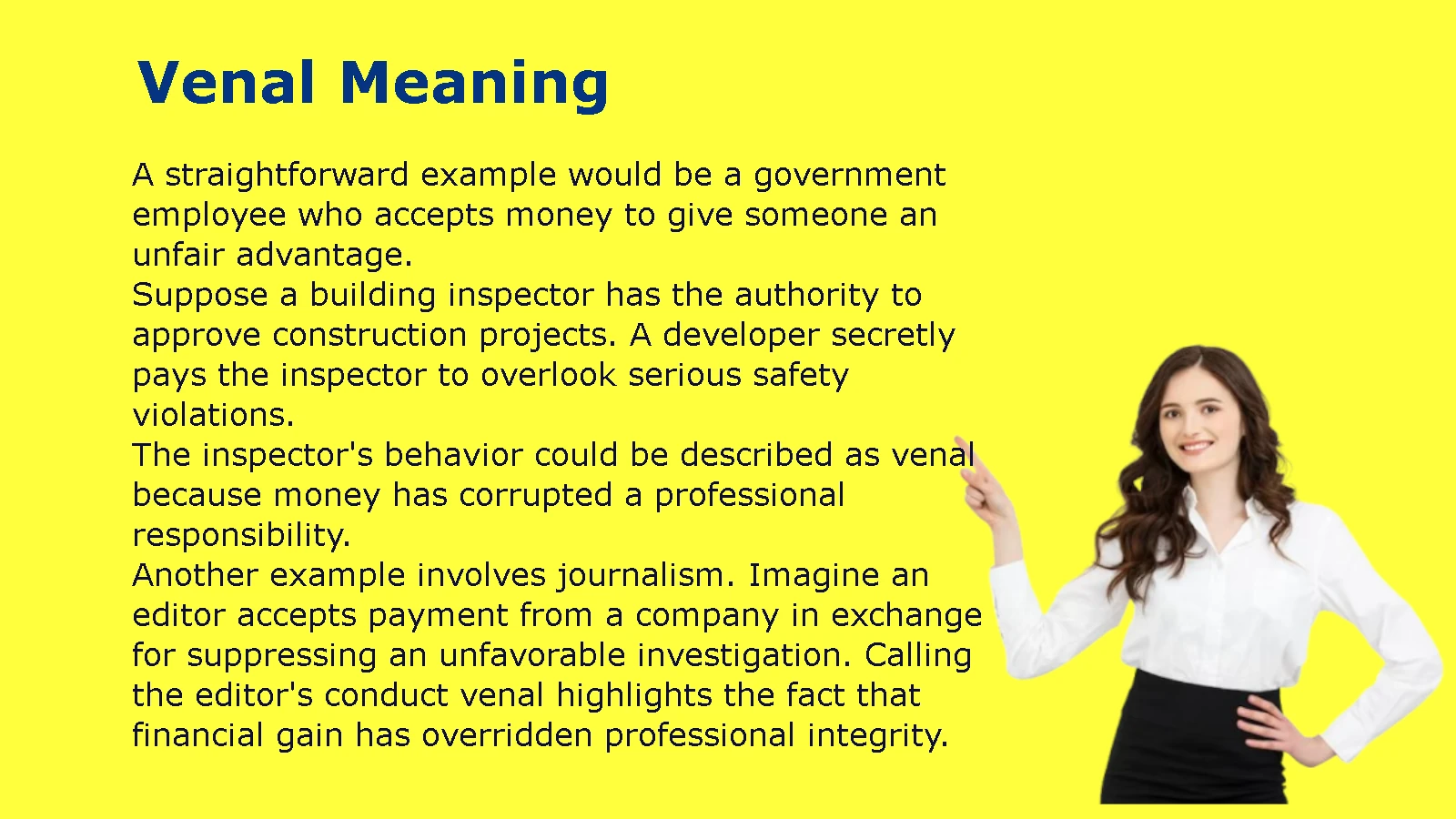
A straightforward example would be a government employee who accepts money to give someone an unfair advantage.
Suppose a building inspector has the authority to approve construction projects. A developer secretly pays the inspector to overlook serious safety violations.
The inspector’s behavior could be described as venal because money has corrupted a professional responsibility.
Another example involves journalism. Imagine an editor accepts payment from a company in exchange for suppressing an unfavorable investigation. Calling the editor’s conduct venal highlights the fact that financial gain has overridden professional integrity.
The word therefore works best when financial incentives and moral compromise intersect.
Venal in Politics and Public Life
Political writing frequently uses venal because public officials often hold authority that should serve the public rather than private financial interests.
A venal politician isn’t simply a politician who wants wealth. The label suggests that money, bribery, or personal financial interests can influence the politician’s decisions.
For example:
Critics described the official as venal after evidence suggested that private payments influenced government contracts.
The word can also describe a wider system:
The investigation exposed a venal political culture in which access depended heavily on money.
In that second example, venal describes a pattern rather than one person’s actions.
This broader use matters because corruption doesn’t always involve someone handing over an envelope of cash. Improper financial influence can take different forms, including favors, hidden payments, manipulated contracts, or other material benefits.
Venal in Business
Business writing can use venal when financial incentives lead someone to violate professional or ethical standards.
Consider a purchasing manager who awards a large contract to a supplier because the supplier secretly pays the manager.
The manager may be described as venal.
However, simply choosing the most profitable supplier isn’t venal. The word requires a stronger ethical problem.
A Useful Test
When you’re unsure whether venal fits, ask:
Did money or material gain cause someone to compromise a duty, principle, or ethical standard?
If the answer is yes, venal may be appropriate.
If the answer is simply “the person wanted to make money,” another word such as greedy, profit-driven, or mercenary may fit better.
Venal Synonyms
Several words overlap with venal, but they don’t all carry exactly the same meaning.
| Synonym | Basic meaning | Difference from venal |
| Corrupt | Dishonest or morally compromised | Broader; doesn’t always emphasize money |
| Bribable | Open to being influenced by bribes | More specifically connected to bribery |
| Dishonest | Not truthful or trustworthy | Much broader |
| Mercenary | Mainly motivated by money or personal gain | Doesn’t always imply corruption |
| Greedy | Excessively eager for money or possessions | Doesn’t necessarily involve misconduct |
| Unprincipled | Lacking strong moral standards | Doesn’t specifically involve financial gain |
| Crooked | Dishonest or involved in illegal activity | More informal |
Is Venal the Same as Corrupt?
Venal and corrupt overlap, but they aren’t identical.
Corrupt is the broader term. Someone can be corrupt for many reasons and through many kinds of misconduct.
Venal puts special emphasis on money or material reward.
Consider these examples:
The official was corrupt.
This tells you that the official behaved dishonestly or abused their position. It doesn’t explain why.
Now consider:
The official was venal.
This suggests that the official’s principles or conduct could be bought, particularly through financial incentives.
Merriam-Webster specifically connects venal with corrupt influence and bribery.
Is Venal the Same as Mercenary?
Not quite.
Mercenary describes someone who is strongly motivated by money or personal gain. It doesn’t necessarily mean that the person behaves illegally or dishonestly.
For example:
She took the highest-paying job because she was mercenary about her career.
That suggests a strong focus on money.
Now consider:
She sold confidential information to the highest bidder because she was venal.
The second sentence suggests a moral breach driven by money.
Mercenary focuses on financial motivation. Venal focuses on corruption or moral compromise connected to financial gain.
Venal vs. Bribable
Bribable means susceptible to bribery.
A person who is bribable may accept money in exchange for changing a decision or action.
Venal can express that idea, but it often carries a broader moral judgment. It can suggest that someone’s principles, influence, or conduct are effectively for sale.
That’s why a phrase such as venal official can sound more forceful than bribable official.
Venal Antonyms
The strongest antonyms for venal describe people who cannot easily be bought or corrupted.
Useful opposites include:
- Incorruptible
- Honest
- Ethical
- Principled
- Upright
- Honorable
- Trustworthy
- Unbribable
What Is the Opposite of Venal?
Incorruptible is one of the clearest opposites.
An incorruptible person refuses to compromise their principles for money, power, or improper influence.
Compare:
The venal official accepted payments to change his decisions.
with:
The incorruptible official refused the bribe and reported the attempt.
The contrast is almost exact.
Venal vs. Venial: What’s the Difference?
Venal and venial look and sound similar, but their meanings have little in common.
This is one of the most important distinctions to remember.
| Word | Meaning | Example |
| Venal | Corruptible or willing to act improperly for money | The venal official accepted bribes. |
| Venial | A relatively minor or pardonable fault, especially in religious terminology | The mistake was considered a venial offense. |
What Does Venal Mean?
Venal relates to being bought, bribed, or corrupted for money.
The venal official put personal profit above public duty.
What Does Venial Mean?
Venial traditionally describes a relatively minor fault or sin that can be forgiven. In Christian theology, particularly Catholic theology, a venial sin contrasts with a mortal sin.
The two words come from different Latin sources. Venal comes from Latin venalis, meaning “for sale,” while venial comes from Latin venia, associated with favor, indulgence, or pardon.
Easy Way to Remember Venal vs. Venial
Think:
- Venal → value → money
- Venial → pardon → minor fault
So if money and corruption are involved, venal is the word you want.
Venal vs. Corrupt
The difference becomes clearer when you compare the two words directly.
| Feature | Venal | Corrupt |
| Financial motivation | Usually central | May or may not be central |
| Bribery | Strong association | Common association |
| Moral wrongdoing | Yes | Yes |
| Scope | More specific | Broader |
| Formality | Formal | Neutral and widely used |
| Example | A venal official | A corrupt official |
You can think of venal as a more precise lens.
If corrupt tells you that something has gone morally wrong, venal often tells you money helped make it happen.
Venal vs. Mercenary
These words are also easy to confuse.
| Feature | Venal | Mercenary |
| Focus | Corruption for money | Financial motivation |
| Dishonesty implied | Usually | Not necessarily |
| Bribery implied | Often | Not necessarily |
| Moral judgment | Strong | Can be milder |
| Typical use | Venal official | Mercenary attitude |
For example, a person who chooses a career solely because it pays well might be called mercenary.
A person who breaks a professional duty because someone pays them may be called venal.
The distinction is subtle but useful.
How to Use Venal in a Sentence
The easiest structure is:
venal + noun
Examples include:
- venal politician
- venal official
- venal judge
- venal journalist
- venal employee
- venal government
- venal regime
- venal practice
- venal conduct
- venal behavior
You can also use the word after a linking verb:
The official became venal after years of exposure to bribery.
Or:
His motives appeared venal.
Common Sentence Patterns
Venal + person
The newspaper criticized the venal official.
Venal + behavior
The committee investigated the manager’s venal behavior.
Venal + system
The report described a venal system that rewarded those willing to pay.
Venal + motive
The accusation raised questions about his venal motives.
Venally + verb
The official acted venally when he accepted the payment.
When Not to Use Venal
Because venal has a specific meaning, you shouldn’t use it as a fancy substitute for every negative adjective.
Don’t automatically call someone venal because they are:
- greedy
- selfish
- ambitious
- expensive
- materialistic
- dishonest
- unpopular
- profit-oriented
The word works best when money or material reward connects directly to unethical conduct.
For instance:
The designer charged a high price for the product.
Nothing about that sentence suggests venal behavior.
But:
The designer secretly paid a reviewer to give the product a favorable rating.
Now the financial relationship involves improper influence. Venal could fit the situation.
Venal Meaning in Literature and Formal Writing
it has a distinctly formal flavor. You are more likely to encounter it in journalism, political commentary, academic writing, literature, legal discussions, and serious opinion writing than in casual conversation.
Someone might say:
He’s corrupt.
in everyday conversation.
A formal writer might say:
The investigation revealed a deeply venal network of officials and contractors.
The second sentence has a sharper rhetorical quality. It doesn’t merely state that wrongdoing occurred. It portrays the participants as willing to put their principles up for sale.
Cambridge’s entry labels venal as formal, while Oxford also presents it as a formal adjective.
Word Origin and Etymology of Venal
The history of venal explains why money and corruption are so closely tied to its modern meaning.
The word ultimately comes from the Latin venalis, meaning “for sale” or “to be sold.” Latin venum referred to something offered for sale.
The English word developed meanings connected with something being obtainable for a price and something capable of being corrupted. Merriam-Webster records the modern sense of venal in English from 1652.
Etymonline traces an earlier English use to the mid-15th century, with meanings related to something being obtainable for a price or capable of corruption.
That history creates a powerful underlying image:
Something venal is, in effect, for sale.
Instead of selling an ordinary object, however, a venal person may be selling influence, loyalty, judgment, access, or principles.
The related noun venality also emerged from the same word family and came to refer to the selling or prostitution of talents, principles, or influence for money or reward.
A Practical Case Study: When Does Venal Fit?
Consider this fictional example.
A city employee reviews applications for construction permits. A developer offers the employee $5,000 to approve an application that doesn’t meet the city’s requirements.
The employee accepts the payment and approves the permit.
Several words could describe the situation:
- Dishonest — because the employee acted dishonestly.
- Corrupt — because the employee abused their position.
- Bribable — because the employee accepted a bribe.
- Greedy — because the employee wanted additional money.
- Venal — because the employee allowed money to corrupt an official responsibility.
The last word captures the particular relationship between financial gain and compromised principles.
That’s what makes venal useful.
Venal Meaning in Real-World Context
The word can describe more than obvious cash bribes. It can also refer to situations where money or material benefits influence decisions that should follow another standard.
For example, consider:
- awarding a contract because of an undisclosed payment
- accepting money to influence an official decision
- selling access to someone who holds public authority
- changing professional judgment for personal financial gain
- using an official position to obtain improper benefits
- manipulating information because someone paid for favorable treatment
The exact circumstances vary, but the central idea stays consistent:
Money has compromised conduct that should not have been for sale.
Venal, Venality, and Venally
The three main forms are easy to distinguish.
| Form | Part of speech | Example |
| Venal | Adjective | The official was venal. |
| Venality | Noun | The investigation exposed widespread venality. |
| Venally | Adverb | The official acted venally. |
Venal
The reporter exposed a venal network.
Venality
The report documented widespread venality.
Venally
The official acted venally when he accepted the payment.
Knowing these forms helps you use the word naturally instead of forcing the adjective into every sentence.
Common Phrases With Venal
Some useful combinations include:
- venal official
- venal politician
- venal judge
- venal government
- venal regime
- venal practices
- venal conduct
- venal behavior
- venal motives
- venal interests
- venal influence
- venal dealings
- venal corruption
- venal system
These combinations work because they connect venal with people, actions, or institutions that can be compromised by financial interests.
What Does Venal Mean in a Sentence?
Here are several concise examples that show the word’s range:
The venal official accepted money to ignore the violation.
Here, venal describes an official whose judgment can be bought.
The company dismissed the executive for venal conduct.
The word suggests that financial interests motivated unethical behavior.
Critics accused the organization of operating a venal system.
This expands the meaning from an individual to an entire system.
His venal motives became clear after the secret payment was discovered.
The adjective describes motives shaped by improper financial gain.
Is Venal a Positive or Negative Word?
Venal is strongly negative.
Calling someone venal is an accusation of serious moral compromise. It suggests that the person’s principles, responsibilities, or influence are available for purchase.
Because of that strong meaning, use the word carefully when describing real people or organizations. In formal writing, accusations involving corruption can carry significant consequences, so the evidence should support the claim.
Is Venal an Insult?
It can function as an insult, but it is more accurately described as a strong negative judgment.
Calling someone venal doesn’t merely say that you dislike them. It alleges that money can corrupt their behavior or that they are willing to act improperly for financial gain.
That’s why the word often appears in serious political, journalistic, and literary criticism.
Quick Comparison: Venal and Similar Words
| Word | Core idea | Money required? | Corruption implied? |
| Venal | Corruptible for money | Usually | Yes |
| Corrupt | Dishonest or morally compromised | No | Yes |
| Mercenary | Motivated by financial gain | Usually | Not necessarily |
| Greedy | Excessively wanting wealth | Yes | Not necessarily |
| Dishonest | Lacking truthfulness | No | Not necessarily |
| Bribable | Open to bribery | Yes | Usually |
| Unprincipled | Lacking moral standards | No | Often |
The table highlights the most important point: venal is more specific than corrupt and more morally charged than merely mercenary.
Frequently Asked Questions About Venal
What does venal mean in simple terms?
Venal means willing to do something dishonest or immoral for money. It can also describe someone or something that can be bought or influenced through financial reward.
What is an example of venal behavior?
A government official who accepts money to approve an application that should be rejected is engaging in venal behavior.
Does venal mean corrupt?
Yes, the meanings overlap. However, venal usually emphasizes corruption connected to money, bribery, or material gain, while corrupt has a broader meaning.
What is the opposite of venal?
Incorruptible is one of the best opposites. Other antonyms include honest, ethical, principled, upright, and honorable.
Is venal the same as greedy?
No. Greedy means excessively eager for money or possessions. Venal suggests that money has influenced someone to compromise their principles or behave improperly.
Is venal the same as mercenary?
No. Mercenary emphasizes financial motivation, while venal emphasizes corruption or unethical conduct for financial gain.
Can venal describe a person?
Yes. You can describe someone as venal when you mean that they are willing to compromise honesty or morality for money.
For example:
The investigator described the official as venal.
Can venal describe an institution?
Yes. Writers can describe a venal government, system, administration, regime, or institution when financial interests have corrupted its decisions or practices.
What is the difference between venal and venial?
Venal relates to corruption or being willing to act improperly for money. Venial describes a relatively minor or pardonable fault and has a different Latin origin.
What is the noun form of venal?
The noun is venality.
The report exposed widespread venality among officials.
What is the adverb form of venal?
The adverb is venally.
The official acted venally for personal financial gain.
Final Takeaway: Venal Meaning
The clearest way to remember venal is to connect it with the idea of being for sale.
A venal person isn’t simply greedy or dishonest. The word suggests something more specific: money can buy that person’s influence, judgment, loyalty, principles, or actions.
The most important points are:
- Venal is an adjective.
- It usually describes corruption connected with money or material gain.
- A venal person is willing to behave dishonestly or immorally for money.
- Corrupt is a broader synonym.
- Mercenary emphasizes financial motivation but doesn’t necessarily imply corruption.
- Incorruptible is a strong antonym.
- Venal and venial have completely different meanings.
- The word comes from Latin venalis, meaning “for sale.”
In short, when someone’s principles can be bought, venal is often the word that says exactly what happened.