Economic and economical are closely related words, but they’re not interchangeable. Economic usually relates to the economy, trade, money, or the production and use of resources, while economical describes something that uses money or resources carefully and avoids waste.
The confusion is understandable because people often search for economic vs economical, economic meaning, economical meaning, or wonder which word to use in a sentence. A simple way to remember the difference is: economic usually concerns the economy, while economical means cost-effective or not wasteful.
| Question | Answer |
|---|---|
| What is the difference between economic and economical? | Economic relates to the economy or financial matters, while economical means using money or resources carefully. |
| What does economic mean? | Economic means relating to the economy, production, trade, or financial systems. |
| What does economical mean? | Economical means using resources, money, or time efficiently without unnecessary waste. |
| Can economic and economical be used interchangeably? | Usually not. They have different meanings and are used in different contexts. |
| What is an example of economic? | “The country is facing serious economic challenges.” |
| What is an example of economical? | “This car is economical because it uses very little fuel.” |
Economic vs Economical: Quick Difference
The easiest way to understand Economic vs Economical is to look at what each adjective focuses on.
| Word | Main meaning | Common focus | Example |
| Economic | Related to an economy, economics, trade, industry, or money | Countries, markets, policies, businesses, economic conditions | economic growth |
| Economical | Using little money or resources and avoiding waste | Products, choices, methods, fuel, time, space, energy | an economical car |
Cambridge Dictionary explains that economic is used for things related to trade, industry, or money, while economical refers to something that does not use a lot of money.
Oxford makes the distinction even clearer: economic concerns an economy or the money of a society or individual, while economical describes careful spending or resource use that avoids waste.
The simplest rule
Think of the two words this way:
Economic = connected to the economy.
Economical = avoids waste.
So:
- economic policy → a policy concerning the economy
- economic crisis → a crisis affecting the economy
- economical car → a car that costs relatively little to operate
- economical solution → a solution that avoids unnecessary expense
This rule works in the vast majority of everyday situations.
What Does Economic Mean?
Economic is an adjective that usually means related to the economy, economics, trade, industry, money, or the production and distribution of wealth.
Oxford defines it as being connected with the trade, industry, and development of wealth of a country, area, or society.
The word often appears before nouns that describe large systems, conditions, policies, activities, or trends.
Common meanings of economic
Economic commonly refers to:
- A country’s economy
- Regional economic activity
- International trade
- Business conditions
- Government economic policy
- Economic development
- Employment and production
- Financial conditions
- Economic research
- The profitability or viability of an activity in certain contexts
For example:
The government introduced a new economic policy.
The policy isn’t necessarily cheap or efficient. It is a policy concerning the economy.
Likewise:
The country experienced rapid economic growth.
The sentence describes growth in the country’s economy. It doesn’t mean the growth itself was inexpensive.
Common phrases with economic
Some combinations are so established that they sound natural immediately:
- economic growth
- economic development
- economic policy
- economic crisis
- economic conditions
- economic activity
- economic impact
- economic forecast
- economic downturn
- economic slowdown
- economic reform
- economic system
- economic climate
- economic data
- economic theory
- economic cooperation
Cambridge lists many of these combinations, including economic growth, economic development, economic policy, economic crisis, economic impact, economic downturn, and economic slowdown.
Examples of economic in sentences
- The country is recovering from a severe economic crisis.
- Rising unemployment can weaken economic growth.
- The government announced several economic reforms.
- Inflation has affected the region’s economic conditions.
- The report examines the economic impact of tourism.
- Several industries contribute to the state’s economic activity.
- Analysts expect the current economic downturn to continue.
- The university offers courses in economic theory.
- Trade remains an important part of the country’s economic development.
- Businesses are adjusting to a changing economic climate.
Notice the pattern. These sentences deal with economies, industries, markets, policies, or financial conditions. That is the territory of economic.
What Does Economical Mean?
Economical usually means using as little money, time, energy, fuel, space, or another resource as necessary.
The key idea is avoiding waste.
Cambridge defines economical as using as little of something as possible while wasting little or nothing. Oxford similarly describes it as using something carefully in a way that avoids waste.
That means economical can describe much more than money.
A car can be economical because it uses little fuel. A room can be economical because it makes efficient use of limited space. A writer can use an economical style because the prose contains no unnecessary words.
Economical does not simply mean cheap
This distinction matters.
If something is cheap, it has a low purchase price. If something is economical, it provides good value or avoids unnecessary spending or waste.
Imagine two washing machines:
- Machine A costs $400 but uses a great deal of electricity.
- Machine B costs $600 but uses much less electricity and lasts longer.
Machine B may be the more economical choice even though it costs more at the beginning.
Oxford specifically gives the idea of providing good service or value in relation to the time or money spent.
Common phrases with economical
Natural combinations include:
- economical car
- economical choice
- economical solution
- economical method
- economical option
- economical use of space
- economical use of resources
- economical use of fuel
- economical way to travel
- economical appliance
- economical system
- economical approach
- economical use of time
Examples of economical in sentences
- This hybrid car is extremely economical to run.
- Buying the larger package was more economical.
- We need an economical way to heat the building.
- The new design makes economical use of space.
- Solar power can become an economical option over time.
- She found an economical way to travel between the two cities.
- The factory needs a more economical use of raw materials.
- His writing style is simple and economical.
- Repairing the old machine wasn’t economical.
- The company adopted a more economical production method.
The focus has shifted. These sentences aren’t mainly about an economy. They concern efficiency, value, conservation, or avoiding unnecessary expense.
Economic vs Economical: The Key Difference
The central difference becomes much easier when you compare the questions each word answers.
| If you’re asking… | Use |
| Is this related to the economy? | Economic |
| Does this concern trade or industry? | Economic |
| Does this concern government economic policy? | Economic |
| Does this describe a country’s financial conditions? | Economic |
| Does this use little money? | Economical |
| Does this save fuel? | Economical |
| Does this avoid wasting space? | Economical |
| Does this use resources efficiently? | Economical |
| Does this save time or effort? | Economical |
A useful memory trick is:
Economic → economy
Economical → efficient use
That isn’t a complete dictionary definition, but it is an excellent practical shortcut.
Economic vs Economical Examples
Seeing the words side by side makes the distinction even clearer.
| Sentence | Why? |
| The country is facing an economic crisis. | The crisis concerns the economy. |
| The hybrid is an economical car. | The car uses fuel efficiently. |
| The government changed its economic policy. | The policy concerns the economy. |
| We need an economical solution. | The solution should avoid unnecessary cost. |
| The report discusses economic growth. | It concerns growth in the economy. |
| The apartment makes economical use of space. | It uses limited space efficiently. |
| Inflation has created serious economic problems. | The problems concern money and the economy. |
| Buying in bulk can be more economical. | It can reduce the cost per unit. |
| The company studied the project’s economic impact. | The impact concerns financial or economic effects. |
| We need a more economical method. | The method should reduce waste or expense. |
Compare these two sentences
The government announced an economic plan.
The plan concerns the economy.
Now compare:
The government chose an economical plan.
Here, economical suggests that the plan uses money or resources carefully.
The nouns may look similar, but the adjective changes the focus.
Economic Growth vs. Economical Growth
One common mistake is using economical when the intended phrase is economic growth.
Correct
The country recorded strong economic growth.
This means the country’s economy grew.
Usually incorrect for this meaning
The country recorded strong economical growth.
That wording doesn’t express the standard meaning of growth in an economy.
When discussing national or regional economies, use economic:
- economic growth
- economic development
- economic recovery
- economic expansion
- economic slowdown
The distinction follows the basic rule: these terms describe what happens within an economy.
Economic Policy vs. Economical Policy
The phrase economic policy is standard when referring to government decisions about the economy.
For example:
The administration introduced a new economic policy to address inflation.
The policy could involve taxation, interest rates, spending, trade, regulation, or other economic matters.
Economical policy, however, would suggest something different. It could describe a policy designed to avoid unnecessary spending or waste, although that isn’t the normal phrase for government economic policy.
Compare:
The government changed its economic policy.
The policy concerns the economy.
The company adopted an economical policy for office supplies.
The second sentence could mean the company created a policy designed to reduce waste or spending.
The context changes the meaning.
Economic Problems vs. Economical Problems
This is another area where writers often choose the wrong adjective.
Economic problems
Use economic problems when the problems involve the economy, financial conditions, employment, trade, production, or related matters.
The country faces serious economic problems.
Economical problems
This phrase could theoretically refer to problems involving economical use of resources, but it isn’t normally what writers mean when discussing a country’s financial difficulties.
For example, if the intended meaning is that unemployment is hurting a country’s economy, write:
Unemployment is causing serious economic problems.
Not:
Unemployment is causing serious economical problems.
Cambridge specifically warns against using economical when referring to the economy of a country or region.
Economic Car vs. Economical Car
A car provides one of the clearest examples of the distinction.
Economical car
An economical car usually uses relatively little fuel or costs relatively little to operate.
She wanted an economical car for her daily commute.
The focus is operating cost and resource use.
Economic car
Economic car isn’t the normal choice in everyday American English when the intended meaning is fuel efficient or inexpensive to operate.
If the goal is to describe fuel consumption or running costs, economical car is clearer.
Cambridge uses hybrid cars as an example of something that can be described as economical because they do not cost much to run.
Economic Impact vs. Economical Impact
These expressions don’t mean the same thing.
Economic impact
Economic impact refers to the effect something has on money, business, employment, production, income, or an economy.
The new stadium could have a major economic impact on the city.
The question is: How does this affect the economy?
Economical impact
This isn’t the standard phrase when discussing effects on an economy.
If the intended meaning is that something reduces expenses or waste, use a clearer construction such as:
The new system has a significant effect on operating costs.
That wording tells the reader exactly what kind of financial effect is meant.
Economic vs Economical in Business Writing
Business writing makes the distinction especially important because both words frequently appear in professional contexts.
Use economic for broader business conditions
Examples include:
- economic conditions
- economic uncertainty
- economic growth
- economic trends
- economic policy
- economic outlook
- economic impact
- economic activity
For example:
Businesses are adjusting their strategies to changing economic conditions.
The sentence concerns the broader environment in which companies operate.
Use economical for cost efficiency
Use economical when describing a product, process, or decision that reduces waste or delivers value.
The company developed a more economical production method.
Here, the production method presumably requires fewer resources or costs less to operate.
Another example:
Cloud storage proved more economical than maintaining additional physical servers.
The focus is the relative cost and resource use.
Economic vs Economical in Everyday English
The distinction isn’t limited to business or government.
Consider a household budget.
Rising prices are creating difficult economic conditions.
This describes a broader financial environment.
Now consider:
Cooking at home is often more economical than eating at restaurants.
This describes a choice that can reduce spending.
The same subject, money, appears in both sentences. Yet the focus changes.
Economic looks at the larger financial picture.
Economical looks at how efficiently resources are used.
Can Economic Mean Economical?
Yes, and this is where the distinction becomes more interesting.
Although economic usually relates to the economy, dictionaries also recognize another meaning connected with profitability or financial viability.
Cambridge defines one sense of economic as “making a profit, or likely to make a profit.”
For example:
The project is no longer economic.
In this context, economic can mean that the project is no longer financially viable or profitable.
This usage is different from simply saying that something is economical because it saves resources.
Economic and economical can overlap
There are situations where both words can relate to financial practicality.
For example:
- an economic decision
- an economical decision
The first may emphasize the financial or economic aspect of the decision.
The second more strongly suggests that the decision avoids unnecessary expense.
Likewise, economic can sometimes describe whether a business activity makes financial sense, while economical tends to emphasize efficient use of resources.
So the distinction isn’t a rigid wall. It’s more like two overlapping circles.
Still, for most learners, the practical rule remains highly reliable:
Use economic for the economy. Use economical for avoiding waste.
Economical Can Describe More Than Money
One of the biggest advantages of understanding economical is realizing that it isn’t restricted to dollars and cents.
Oxford specifically includes efficient use of space, time, resources, and words in its examples.
Consider these examples:
Economical with space
The furniture arrangement makes economical use of space.
The arrangement fits more into a limited area.
Economical with time
The new process is more economical with time.
It avoids wasting time.
Economical with words
Her writing is clear and economical.
She expresses ideas without unnecessary words.
Economical with fuel
This engine is highly economical on fuel.
It doesn’t consume much fuel.
Economical with resources
The factory needs a more economical use of raw materials.
The goal is to reduce waste.
This broader meaning explains why economical is often closer to efficient or thrifty than simply cheap.
A Practical Case Study: Choosing a Car
Imagine you’re comparing two vehicles.
Car A costs $24,000 and uses a lot of fuel.
Car B costs $27,000 but uses significantly less fuel and has lower operating costs.
If you’re discussing fuel consumption and long term running costs, you might call Car B more economical.
But suppose you’re analyzing how automobile manufacturing affects employment, imports, fuel demand, and national production.
Now you’re discussing the economic effects of cars.
The subject hasn’t changed completely. The perspective has.
| Question | Correct word |
| Does the car use little fuel? | Economical |
| Is the car inexpensive to operate? | Economical |
| How do car imports affect the country? | Economic |
| How does the industry contribute to GDP? | Economic |
| What is the economic effect of fuel prices? | Economic |
That’s the difference in action.
A Practical Case Study: Choosing a Heating System
Consider a building that needs a new heating system.
System A costs less to install but consumes more energy.
System B costs more initially but consumes much less energy.
If the question is which system uses energy and money more efficiently over time, System B may be the more economical choice.
Now imagine a government report examining how energy prices affect national production and household spending.
That report would examine economic effects.
Again:
Economic = broader financial or economic context.
Economical = efficient use of resources.
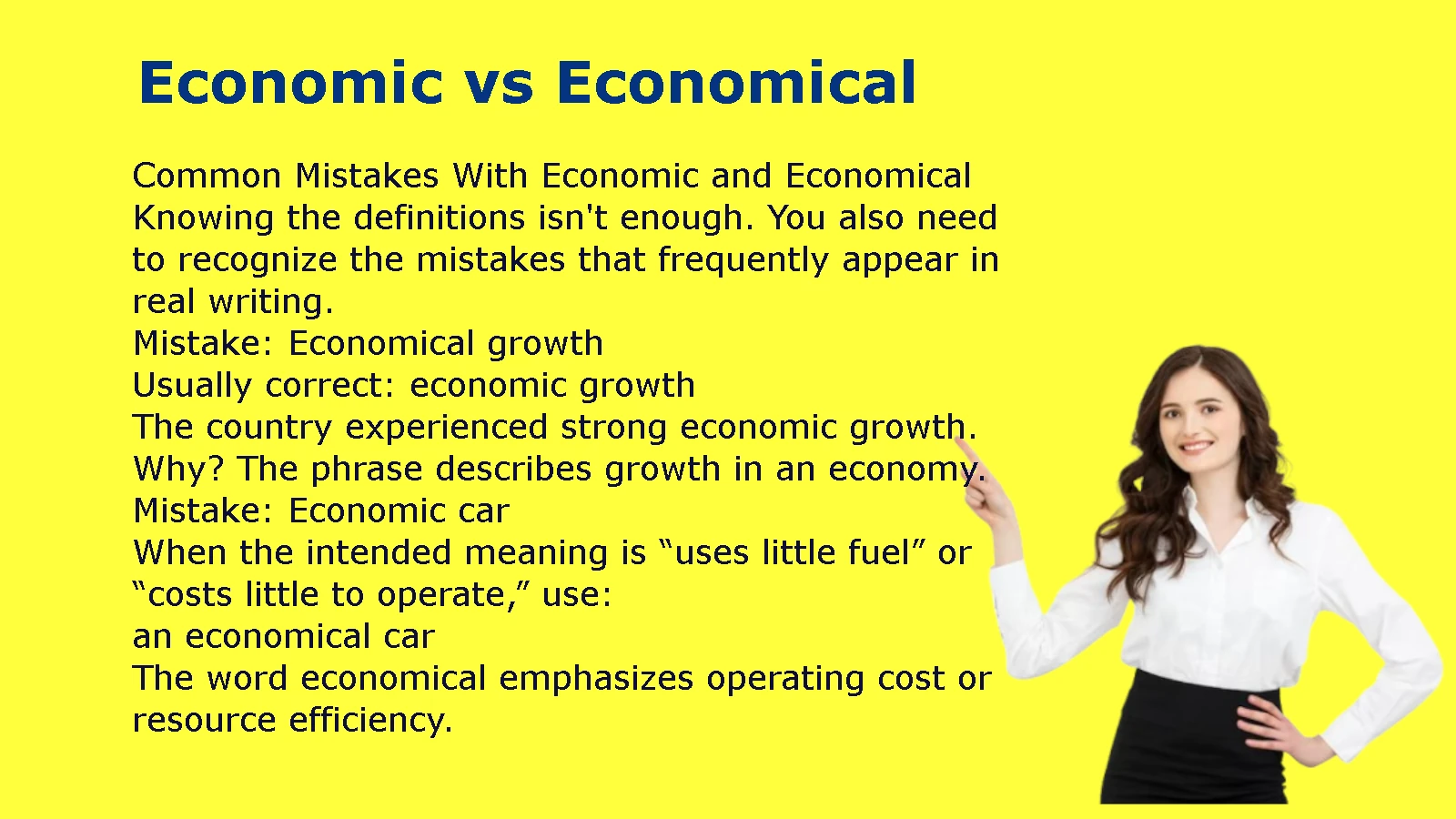
Common Mistakes With Economic and Economical
Knowing the definitions isn’t enough. You also need to recognize the mistakes that frequently appear in real writing.
Mistake: Economical growth
Usually correct: economic growth
The country experienced strong economic growth.
Why? The phrase describes growth in an economy.
Mistake: Economic car
When the intended meaning is “uses little fuel” or “costs little to operate,” use:
an economical car
The word economical emphasizes operating cost or resource efficiency.
Mistake: Economical policy
If you mean government policy concerning the economy, use:
economic policy
For example:
The government is reviewing its economic policy.
Mistake: Economical crisis
Use:
economic crisis
An economic crisis affects an economy.
Mistake: Economic solution
This isn’t always wrong, but the intended meaning matters.
If the solution concerns the economy, economic solution may be appropriate.
If you mean a solution that costs less or avoids waste, economical solution is usually better.
Compare:
The researchers proposed an economic solution to the country’s unemployment problem.
The solution concerns the economic problem.
The company found an economical solution to its storage problem.
The solution reduces cost or resource use.
Economic vs Economical: Common Collocations
Learning common word combinations can help you choose naturally.
Common economic collocations
| Phrase | Meaning |
| economic growth | Growth in an economy |
| economic development | Development related to an economy |
| economic policy | Policy concerning the economy |
| economic crisis | A serious disruption in economic conditions |
| economic activity | Activity involving production, trade, and related economic processes |
| economic impact | Financial or economic effect |
| economic conditions | The current state of an economy |
| economic forecast | Prediction about economic conditions |
| economic downturn | A period of declining economic activity |
| economic reform | Changes intended to improve an economic system |
Common economical collocations
| Phrase | Meaning |
| economical car | A car that costs relatively little to operate |
| economical choice | A choice that avoids unnecessary expense |
| economical solution | A solution that reduces cost or waste |
| economical method | A method that uses resources efficiently |
| economical use of space | Efficient use of available space |
| economical use of fuel | Low fuel consumption |
| economical appliance | An appliance that uses resources efficiently |
| economical option | An option that provides good value |
| economical approach | An approach that avoids unnecessary cost or waste |
| economical use of time | Efficient use of available time |
These combinations are useful because English relies heavily on natural word partnerships. Learning the collocation can sometimes be easier than memorizing an abstract grammar rule.
Economic vs Economical: How to Choose the Right Word
When you’re unsure, don’t stare at the two spellings. Ask what the sentence actually means.
Ask whether the subject is the economy
If you’re talking about:
- a country’s economy
- economic policy
- trade
- industry
- economic development
- economic growth
- financial conditions
- markets
- economic data
choose economic.
Ask whether the subject avoids waste
If you’re talking about:
- fuel efficiency
- lower operating costs
- careful spending
- efficient use of space
- saving time
- reducing waste
- efficient use of resources
choose economical.
The two-question test
Use this quick test:
Question 1: Is this related to an economy or economic activity?
→ Economic
Question 2: Does this use less money or another resource than an alternative?
→ Economical
If the answer to the second question is yes, economical is often the better choice.
Economic vs Economical Practice Quiz
Choose economic or economical in each sentence.
- The country is experiencing rapid ______ growth.
- This vehicle is surprisingly ______ to operate.
- The government announced a new ______ policy.
- We need an ______ way to heat the building.
- Inflation has created serious ______ problems.
- Buying in larger quantities can be more ______.
- The study measures the ______ impact of tourism.
- The apartment makes ______ use of limited space.
- Investors are concerned about current ______ conditions.
- The company developed a more ______ production method.
Answers
| Question | Answer | Reason |
| 1 | economic | Growth of an economy |
| 2 | economical | Low operating cost |
| 3 | economic | Policy concerning the economy |
| 4 | economical | Uses money or energy efficiently |
| 5 | economic | Problems affecting the economy |
| 6 | economical | Reduces spending |
| 7 | economic | Financial or economic effects |
| 8 | economical | Uses space efficiently |
| 9 | economic | Conditions affecting the economy |
| 10 | economical | Reduces cost or resource waste |
If you got most of these right, you’ve already mastered the core distinction.
Frequently Asked Questions About Economic vs Economical
What is the main difference between economic and economical?
Economic usually means related to the economy, trade, industry, money, or economic activity. Economical usually means using money or resources carefully and avoiding waste.
Is “economic growth” correct?
Yes. Economic growth is the standard phrase for growth in a country’s, region’s, or broader economy.
Is “economical car” correct?
Yes. An economical car generally costs relatively little to operate, often because it uses fuel efficiently.
Can economic mean profitable?
Yes. In certain contexts, economic can mean profitable or financially viable. Cambridge recognizes this sense alongside its more common meaning related to the economy.
Does economical only refer to money?
No. Economical can describe efficient use of fuel, energy, space, time, words, and other resources. Oxford gives examples involving space, time, resources, and writing style.
Are economic and economical synonyms?
Not generally. They overlap in some financial contexts, but they usually have different meanings.
Economic normally connects something to an economy or economic activity.
Economical normally describes something that avoids waste or provides good value for the resources used.
Is “economical policy” correct?
It can be grammatically possible if the intended meaning is a policy designed to reduce spending or waste. However, when referring to government policy concerning the economy, economic policy is the standard expression.
Is “economical crisis” correct?
When referring to a crisis affecting an economy, use economic crisis.
Is “economical solution” correct?
Yes. An economical solution is a solution that avoids unnecessary expense or resource use.
Is “economic solution” correct?
Yes, but the meaning can differ. Economic solution can refer to a solution connected with an economic problem or issue. Economical solution more clearly emphasizes low cost or efficient resource use.
Economic vs Economical: Final Comparison
The distinction can be reduced to one useful contrast:
| Economic | Economical |
| Related to the economy | Avoids waste |
| Connected with trade | Uses fewer resources |
| Connected with industry | Saves money |
| Describes economic policy | Describes cost efficient choices |
| Describes economic growth | Describes fuel efficient products |
| Describes economic conditions | Describes efficient methods |
| Describes economic impact | Describes efficient use of space |
| Describes economic activity | Describes careful spending |
The words share the same linguistic family, so the confusion is understandable. Yet their usual roles are quite different.
When you write about an economy, economic policy, trade, industry, growth, or financial conditions, choose economic.
When you describe something that saves money, uses less fuel, consumes fewer resources, avoids waste, or provides good value, choose economical.
There is one important wrinkle: economic can also describe something that is financially viable or profitable. That overlap explains why the two words sometimes appear in similar contexts.
Still, the practical rule remains easy to remember:
Economic is about the economy. Economical is about using resources wisely.
Once that distinction becomes familiar, choosing between Economic vs Economical becomes much less of a guessing game.