Have you ever wondered whether you should write “stationary” or “stationery” when talking about paper, pens, or office supplies? While Stationary vs Stationery may look like a simple spelling difference, these two words have completely different meanings and uses.
Stationary means not moving or staying in one place. Stationery, on the other hand, refers to writing materials, such as paper, envelopes, pens, and other office supplies.
Examples:
- The car remained stationary at the traffic light.
- She bought new stationery for writing letters.
The confusion is understandable. Stationary vs Stationery differ by only one letter, and their similar pronunciation makes them easy to mix up. People often search for stationary or stationery, stationary vs stationery meaning, stationery meaning, or how to remember the difference because the two words look and sound almost identical. And here’s the kicker: using the wrong one can completely change the meaning of your sentence.
In this guide, you’ll learn the complete Stationary vs Stationery difference, including their meanings, definitions, pronunciation, correct usage, and examples in sentences. You’ll also discover easy ways to remember the difference, common mistakes to avoid, and when to use stationary or stationery in everyday English,
Stationary vs Stationery at a Glance
| Word | Part of Speech | Meaning | Example |
| Stationary | Adjective | Not moving or not changing | The train remained stationary. |
| Stationery | Noun | Writing materials | She bought new stationery. |
The easiest way to separate the two is to focus on meaning rather than pronunciation.
If something is still, fixed, or unchanged, use stationary.
If you’re talking about paper, envelopes, pens, pencils, or other writing supplies, use stationery.
Cambridge Dictionary defines stationary as something that is not moving or changing. It defines stationery as the things needed for writing, including paper, pens, pencils, and envelopes.
The quickest rule
Stationary = still.
Stationery = writing materials.
That one distinction handles most everyday situations.
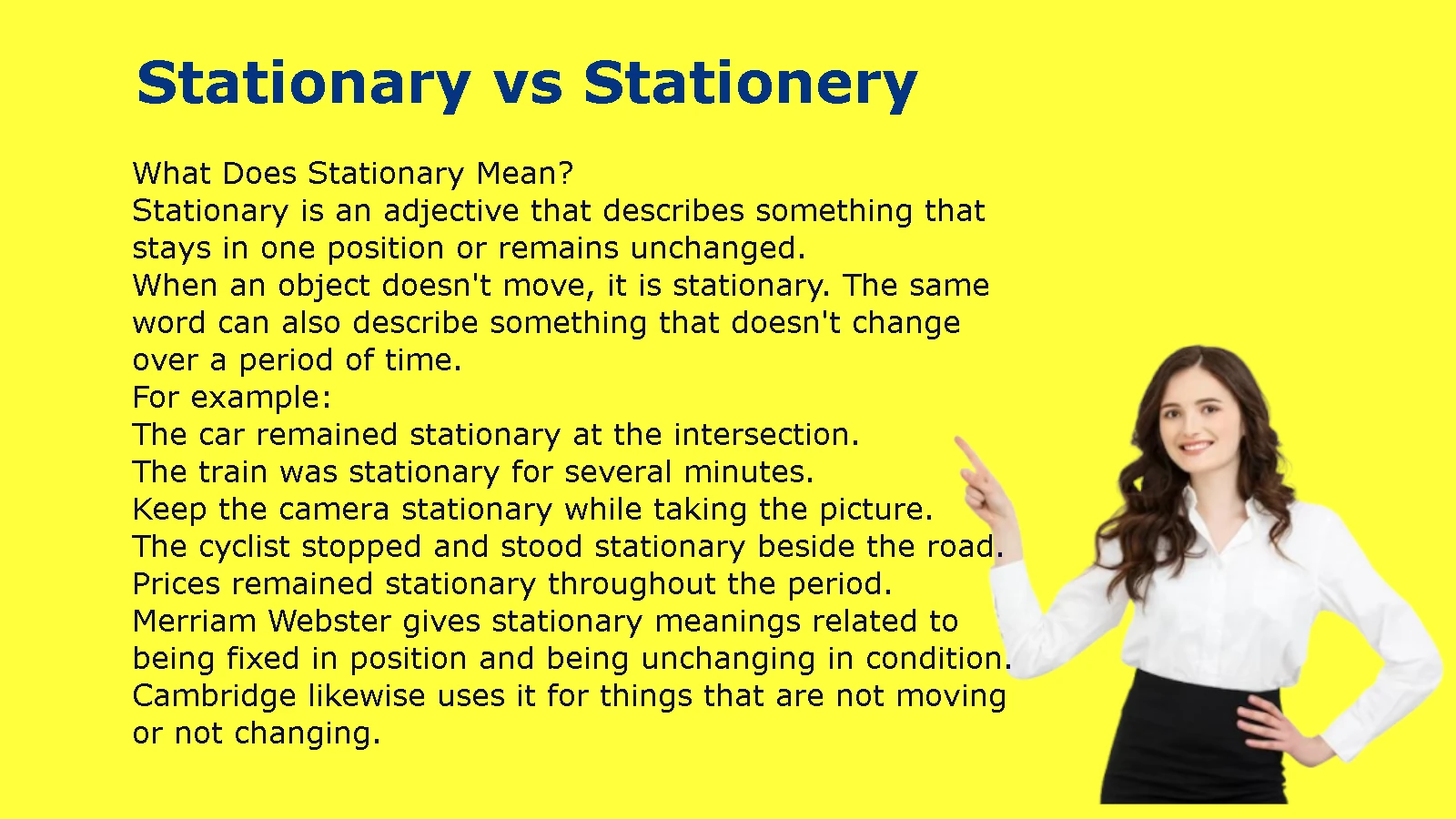
What Does Stationary Mean?
Stationary is an adjective that describes something that stays in one position or remains unchanged.
When an object doesn’t move, it is stationary. The same word can also describe something that doesn’t change over a period of time.
For example:
- The car remained stationary at the intersection.
- The train was stationary for several minutes.
- Keep the camera stationary while taking the picture.
- The cyclist stopped and stood stationary beside the road.
- Prices remained stationary throughout the period.
Merriam Webster gives stationary meanings related to being fixed in position and being unchanging in condition. Cambridge likewise uses it for things that are not moving or not changing.
Stationary Means More Than “Not Moving”
Although physical movement is the most common context, stationary can also describe a condition that remains unchanged.
Consider these two examples:
Physical position:
The truck remained stationary outside the building.
Here, the truck isn’t moving.
Lack of change:
The population remained stationary for several years.
Here, stationary doesn’t mean the people literally stood still. It means the condition being discussed did not change significantly.
This second use is important because it shows why stationary can appear in technical, scientific, economic, and academic writing.
Common Uses of Stationary
You’ll often see stationary used with words related to movement, position, machines, and changing conditions.
Common combinations include:
- stationary car
- stationary vehicle
- stationary train
- stationary object
- stationary position
- stationary bike
- stationary bicycle
- stationary machine
- stationary equipment
- stationary target
- stationary population
- stationary condition
- stationary state
The phrase stationary bike is especially useful because it creates one of the most common opportunities for confusion. A stationary bike stays in place while you pedal it.
Merriam Webster lists stationary bicycle as an example of the word’s ordinary use.
What Does Stationery Mean?
Stationery is a noun that refers to materials used for writing.
Depending on the context, stationery can include:
- paper
- letter paper
- envelopes
- pens
- pencils
- notebooks
- writing pads
- other writing supplies
Cambridge defines stationery as things needed for writing, while Merriam Webster includes materials such as paper, pens, and ink. Merriam Webster also notes the more specific sense of letter paper with matching envelopes.
For example:
I bought some new stationery for my home office.
The word refers to the writing materials, not to anything that stays still.
Stationery Can Have a Narrower Meaning
Stationery doesn’t always mean every writing tool in sight.
In some contexts, it specifically refers to writing paper, especially paper designed for letters or formal correspondence.
For example:
She wrote the thank you note on elegant stationery.
Here, stationery most likely refers to the paper itself, perhaps with a matching envelope.
In business settings, the word can have a broader meaning. Business stationery may include printed letterhead, envelopes, forms, and other materials used for written correspondence. Cambridge’s Business English entry specifically uses stationery for workplace writing materials.
Examples of Stationery in a Sentence
Here are several natural examples:
- I need to buy some stationery for school.
- The company ordered new stationery with its logo.
- She keeps her stationery in the top desk drawer.
- He wrote the invitation on personalized stationery.
- The office has run out of printer paper and other stationery supplies.
- The letter arrived on beautiful cream colored stationery.
- We ordered envelopes and matching stationery for the event.
The surrounding context makes the meaning clear: each example involves writing materials.
Stationary vs Stationery: The Key Difference
The central difference between stationary vs stationery comes down to one question:
Are you describing something that stays still, or are you naming writing materials?
| If you mean… | Use… | Example |
| Not moving | stationary | The bus remained stationary. |
| Not changing | stationary | The rate remained stationary. |
| Fixed in position | stationary | Keep the camera stationary. |
| Writing paper | stationery | She bought stationery. |
| Envelopes | stationery | The stationery included matching envelopes. |
| Writing supplies | stationery | The store sells stationery. |
| Business writing materials | stationery | We need new business stationery. |
This is why the two words shouldn’t be treated as interchangeable spellings. They belong to different grammatical categories and express different ideas.
Stationary vs Stationery: Part of Speech
Grammar provides another reliable way to distinguish the words.
Stationary Is an Adjective
Stationary is an adjective.
An adjective describes a person, place, thing, or condition. In this case, stationary describes something that isn’t moving or changing.
Examples:
- a stationary car
- a stationary bicycle
- a stationary object
- a stationary train
- a stationary population
You can usually ask:
What is it like?
If the answer is “not moving” or “unchanged,” stationary may be the right word.
Stationery Is a Noun
Stationery is a noun.
It names writing materials rather than describing something.
Examples:
- I bought stationery.
- She sells stationery.
- The office needs more stationery.
- The wedding invitations came with matching stationery.
Cambridge marks stationery as an uncountable noun in its dictionary entries.
That means you normally don’t say:
I bought three stationeries.
Instead, say:
I bought three sets of stationery.
Or, if you’re talking about individual items:
I bought three pieces of stationery.
The exact measure depends on what you’re counting.
Stationary vs Stationery Examples
Sometimes definitions aren’t enough. Context does the heavy lifting.
Compare these pairs:
| Incorrect | Correct | Reason |
| I bought new stationary. | I bought new stationery. | Writing materials require stationery. |
| The car was stationery. | The car was stationary. | A motionless car is stationary. |
| She ordered business stationary. | She ordered business stationery. | Business writing materials are stationery. |
| We used a stationery bike. | We used a stationary bike. | The exercise bike stays in place. |
| The train remained stationery. | The train remained stationary. | The train wasn’t moving. |
| He wrote on expensive stationary. | He wrote on expensive stationery. | Writing paper is stationery. |
Example: The Office
Imagine someone walks into an office and says:
“The printer is stationary, but we need more stationery.”
Both words are correct.
The printer is stationary because it isn’t moving.
The stationery refers to writing and office materials.
One letter changes the meaning. The sentence is a neat demonstration of why spelling matters.
Stationary vs Stationery in Business Writing
The difference becomes particularly important in professional communication.
Businesses regularly use stationery for materials that carry company information, branding, or correspondence details.
This can include:
- letterhead
- envelopes
- printed forms
- business correspondence paper
- branded writing materials
- office writing supplies
For example:
The company redesigned its business stationery after updating its logo.
Here, stationery refers to the printed materials used for communication.
Cambridge specifically gives business stationery as an example and describes stationery as workplace writing materials.
Stationary in a Business Context
Stationary can also appear in professional writing, but its meaning remains completely different.
For example:
The vehicle remained stationary while the technician inspected it.
Or:
The equipment must remain stationary during testing.
In technical documents, stationary can describe machinery, equipment, objects, or conditions that remain fixed.
So, if a company orders printed letterhead, it needs stationery.
If a machine doesn’t move during a test, the machine is stationary.
Stationary vs Stationery in Everyday English
A simple context test works surprisingly well.
Movement Context: Stationary
When the sentence involves movement, position, or remaining still, stationary is usually the correct choice.
Examples:
- stationary car
- stationary truck
- stationary train
- stationary bicycle
- stationary object
- stationary camera
- stationary equipment
Think:
“It isn’t moving.”
That points toward stationary.
Writing Context: Stationery
When the sentence involves writing, correspondence, paper, or office supplies, use stationery.
Examples:
- stationery store
- office stationery
- business stationery
- personal stationery
- wedding stationery
- stationery supplies
- writing stationery
Think:
“You write with it or on it.”
That points toward stationery.
Why Are Stationary and Stationery So Easy to Confuse?
The spelling is only part of the problem.
The bigger issue is pronunciation.
In standard American English, stationary and stationery are pronounced the same way. Cambridge provides the same US pronunciation for both words.
That makes them homophones: words that sound alike but have different meanings and spellings.
You can’t reliably solve this particular spelling problem by listening.
If someone says:
“I need some stationery.”
You can’t determine from the sound alone whether they mean stationery or stationary. The surrounding context tells you.
That’s why visual memory and context are more useful than pronunciation here.
How to Remember Stationary vs Stationery
Fortunately, you don’t need a complicated trick.
Stationary = A for At Rest
The A in stationary can remind you of at rest.
Something stationary is at rest or fixed in position.
For example:
The car was stationary.
The car wasn’t moving.
Stationery = E for Envelope
The E in stationery can remind you of envelope.
An envelope is a classic piece of stationery.
stationery → E → envelope
This is one of several commonly recommended memory devices for the pair. Merriam Webster also suggests connecting the er in stationery with words such as paper.
Another Useful Trick: Paper
Look at the ending:
- paper
- letter
- stationery
The E in stationery can connect it mentally with paper and letter.
You don’t need to memorize every spelling rule. You only need one reliable association.
Stationary Bike or Stationery Bike?
This is one of the most common real world examples of the distinction.
The correct phrase is:
stationary bike
A stationary bike is an exercise bicycle designed to remain in one place while you pedal.
Stationery bike is incorrect when you’re referring to exercise equipment.
Why?
Because the word describes the bike’s position. The bike stays stationary.
Compare:
- stationary bike = exercise equipment that stays in one place
- stationery = writing materials
The two phrases have completely different meanings.
Merriam Webster specifically lists stationary bicycle as an example of the adjective stationary.
Stationary or Stationery for Writing Paper?
Use stationery.
For example:
She bought beautiful stationery for writing letters.
If you’re talking specifically about writing paper, envelopes, or a collection of writing supplies, stationery is the correct spelling.
Don’t write:
She bought beautiful stationary.
That spelling would suggest something that doesn’t move, which doesn’t make sense in this context.
Correct examples
- personal stationery
- business stationery
- wedding stationery
- office stationery
- personalized stationery
- letter stationery
Stationary or Stationery for a Car?
Use stationary.
For example:
The car remained stationary at the traffic light.
The car isn’t moving.
The same rule applies to other vehicles:
- stationary bus
- stationary truck
- stationary train
- stationary bicycle
- stationary motorcycle
- stationary vehicle
The word describes the vehicle’s lack of movement.
Stationary or Stationery for a Store?
The answer depends on what you’re describing.
If you’re talking about a store that sells writing materials, the correct phrase is:
stationery store
A stationery store sells products such as paper, envelopes, pens, pencils, and other writing supplies.
A stationary store would suggest a store that doesn’t move, which isn’t the intended meaning.
The related noun stationer refers to someone who sells stationery. Merriam Webster traces stationer to an older word that also referred to a bookseller or publisher.
That connection makes the spelling easier to remember:
stationer → stationery
The History Behind Stationary and Stationery
The two words have related historical roots, which helps explain why their spellings look so similar.
Stationary developed from words connected with station and the idea of a fixed position. Merriam Webster records its first known use in English in the 15th century.
Stationery developed through stationer, a term historically associated with people who sold books and writing materials. Merriam Webster records stationery in its modern sense from the 18th century.
The word stationer itself has an interesting history. It originally referred to a bookseller or publisher and later became associated with sellers of paper, writing materials, and office goods.
So although the modern words are easy to confuse, their meanings developed along different paths.
Common Mistakes With Stationary and Stationery
“I Bought New Stationary”
If you’re talking about paper or writing supplies, this is incorrect.
Use:
I bought new stationery.
“The Car Was Stationery”
If you mean that the car wasn’t moving, use:
The car was stationary.
“Business Stationary”
For company letterhead, envelopes, and other correspondence materials, use:
business stationery
“Stationery Bike”
For exercise equipment that stays in one place, use:
stationary bike
“The Train Became Stationery”
If the train stopped moving, write:
The train became stationary.
The word stationery belongs to the world of writing materials, not transportation.
A Simple Decision Test for Stationary vs Stationery
When you’re unsure, don’t stare at the two spellings and hope one suddenly looks right.
Ask yourself one question:
Is it about movement?
If yes, choose stationary.
The truck remained stationary.
Is it about writing?
If yes, choose stationery.
The office ordered new stationery.
Is it about change?
If something remains unchanged, stationary can work.
The population remained stationary.
Is it about paper or envelopes?
Choose stationery.
The letter was written on personalized stationery.
This context based approach is more reliable than trying to remember the spelling in isolation.
Stationary vs Stationery: A Quick Case Study
Consider this short workplace scenario.
A company is preparing for a new marketing campaign. The office manager orders business stationery with the company’s updated logo. At the same time, the design team tests a camera that must remain stationary while it photographs product samples.
Both words appear in the same workplace, yet they perform completely different jobs.
| Situation | Correct word | Explanation |
| Printed company letterhead | stationery | It is writing material. |
| Matching business envelopes | stationery | Envelopes are stationery. |
| Camera that stays in one position | stationary | It isn’t moving. |
| Equipment fixed during testing | stationary | It remains in place. |
This is the distinction in action. Once you connect each word to its meaning, the spelling becomes much easier.
Stationary vs Stationery Practice Quiz
Choose stationary or stationery for each sentence.
- The bus remained ______ while passengers boarded.
- She ordered personalized ______ for her wedding invitations.
- The office needs more ______ supplies.
- Keep the camera ______ during the recording.
- He bought a new box of ______.
- The bicycle remained ______ while the mechanic worked on it.
- The company printed its logo on official ______.
- The vehicle was completely ______ after the engine stopped.
- She wrote the letter on expensive ______.
- The machine must remain ______ during the experiment.
Answers
| No. | Answer | Why |
| 1 | stationary | The bus isn’t moving. |
| 2 | stationery | The item is writing material. |
| 3 | stationery | Office writing supplies are stationery. |
| 4 | stationary | The camera needs to stay still. |
| 5 | stationery | Writing materials are stationery. |
| 6 | stationary | The bicycle remains in place. |
| 7 | stationery | Printed correspondence materials are stationery. |
| 8 | stationary | The vehicle isn’t moving. |
| 9 | stationery | Writing paper is stationery. |
| 10 | stationary | The machine must stay in one position. |
Stationary vs Stationery: Synonyms
Looking at related words can reinforce the distinction.
Synonyms for Stationary
Depending on context, synonyms include:
- still
- motionless
- immobile
- fixed
- unmoving
- static
- unchanged
- immovable
Merriam Webster’s thesaurus lists terms such as static, motionless, immobile, standing, and in place among synonyms or related words for stationary.
For example:
The vehicle was stationary.
You could express the same basic idea with:
The vehicle was motionless.
Related Words for Stationery
Because stationery is a category of writing materials, related terms include:
- writing paper
- letter paper
- envelopes
- writing supplies
- office supplies
- paper goods
- correspondence materials
These aren’t always perfect synonyms because stationery can cover different collections of writing materials depending on the context.
Is Stationary an Adjective?
Yes. Stationary is an adjective.
It describes something that doesn’t move or change.
Examples:
- a stationary vehicle
- a stationary object
- a stationary bike
- a stationary position
- a stationary condition
The word generally comes before a noun when it directly modifies that noun, although it can also appear after a linking verb:
The car is stationary.
The car remained stationary.
Is Stationery a Noun?
Yes. Stationery is a noun.
It refers to writing materials.
For example:
The store sells stationery.
I need some stationery.
The company ordered new stationery.
Because stationery is generally treated as an uncountable noun, expressions such as some stationery, a piece of stationery, or a set of stationery are more natural than treating stationery as an ordinary count noun. Cambridge labels it as a noun [U], meaning uncountable.
Are Stationary and Stationery Pronounced the Same?
Yes, they are commonly pronounced the same in American English.
Cambridge gives the same US pronunciation for both words.
That makes pronunciation a poor way to distinguish them.
Instead, pay attention to the meaning.
If someone says:
“The object is stationary.”
The context tells you they’re talking about something that isn’t moving.
If someone says:
“I bought stationery.”
The context tells you they’re talking about writing materials.
Same sound. Different spelling. Completely different meaning.
What Is the Difference Between Stationary and Stationery?
The difference is straightforward:
Stationary is an adjective meaning not moving or not changing.
Stationery is a noun meaning writing materials, such as paper, envelopes, pens, and pencils.
For example:
The car was stationary, but the driver bought stationery from the store.
The first word describes the car’s position. The second names writing materials.
Is It Stationary or Stationery for Writing Paper?
It is stationery.
She wrote the letter on beautiful stationery.
Writing paper is one of the core meanings of stationery. In American English, the word can refer particularly to paper used for letters as well as broader writing materials.
Is It Stationary or Stationery for a Bike?
It is stationary bike.
The adjective stationary describes the bike because it remains in one place while you exercise.
I ride a stationary bike at the gym.
Stationery bike is not the correct spelling for exercise equipment.
Is Stationery Singular or Plural?
Stationery is generally an uncountable noun.
You can say:
- some stationery
- a piece of stationery
- a set of stationery
- a box of stationery
- office stationery
Avoid using stationeries as the ordinary plural when you mean writing materials.
If you’re talking about different products or collections, choose a more precise count noun:
three sets of stationery
several stationery items
different types of stationery
Cambridge explicitly marks stationery as an uncountable noun in its English dictionary entry.
Is “Office Stationery” Correct?
Yes.
Office stationery is a standard phrase for writing materials used in an office.
It can include paper, envelopes, pens, and other materials used for written communication. Cambridge’s Business English entry gives workplace examples involving stationery and a stationery cupboard.
For example:
The office manager ordered new stationery for the department.
Remember that office stationary would mean something entirely different. It would describe something in the office that isn’t moving or changing.
Final Takeaway: Stationary or Stationery?
The difference between stationary vs stationery becomes easy once you connect each spelling to its meaning.
Stationary means not moving or not changing. It is an adjective.
The car remained stationary.
Stationery means writing materials, including paper, envelopes, pens, and pencils. It is a noun.
She bought new stationery.
The best memory trick is simple:
Stationary → A → at rest
Stationery → E → envelope
You can also connect the E in stationery with paper and letter, both closely associated with writing materials. Merriam Webster recommends a similar connection between the ending of stationery and words such as paper.
When in doubt, forget the pronunciation and look at the meaning.
If it stays still, it’s stationary. If you write with it or on it, it’s stationery.