Have you ever wondered whether you should say “costed” or “cost” when talking about the price of something? While both words may look correct, Costed vs Cost can be confusing because cost has an unusual past tense that does not normally change.
Cost is the standard past tense and past participle of the verb cost. It means that something had a particular price in the past. Costed is much less common and is mainly used in specific contexts, such as calculating or estimating the cost of a project, plan, or proposal.
Examples:
- The new laptop cost $900 last year.
- The company costed the entire project before approving it.
The confusion is understandable. People often search for costed or cost, past tense of cost, is costed a word, or cost meaning because the usual grammar pattern makes us expect a form like “costed.” And here’s the tricky part: cost stays the same in the present, past, and past participle in most everyday uses.
In this guide, you’ll learn the difference between Costed vs Cost, their meaning, past tense, correct usage, and examples in sentences. You’ll also discover when to use cost instead of costed, whether costed is grammatically correct, and how these two forms differ in everyday and professional English.
Costed or Cost: What’s the Difference?
The words cost and costed can both be correct, but they don’t normally serve the same purpose.
| Word | Meaning | Example |
| cost | Had a particular price or caused a loss or expense | “The repairs cost $500.” |
| cost | Caused someone to lose something | “The mistake cost him his job.” |
| costed | Calculated or estimated the cost | “The team costed the project.” |
| costed | Determined what something should cost | “The proposal was costed at $2 million.” |
The key isn’t simply past versus present. That’s where many explanations become misleading.
Instead, look at the meaning of the verb.
When cost means “have a price” or “cause someone to lose something,” its ordinary past form remains cost. Merriam Webster lists cost as the past form for these everyday meanings.
When cost means “calculate or estimate the cost,” costed is appropriate. Cambridge specifically defines this use as calculating the cost of something and gives examples involving materials, production, and projects.
Use “Cost” for an Actual Price
Suppose you bought a phone yesterday for $700.
You’d say:
“The phone cost $700.”
You’re describing the phone’s actual price. You’re not talking about the process of calculating that price.
The same pattern works in many situations:
- “The jacket cost $120.”
- “The repairs cost $800.”
- “The tickets cost more than expected.”
- “The vacation cost us $3,000.”
- “The new computer cost less than the old one.”
In each example, cost describes the amount required or paid.
Use “Costed” for Cost Calculation
Now imagine that an accountant is preparing a budget for a construction project.
The accountant examines labor, materials, transportation, equipment, permits, and other expenses. After working through the numbers, the accountant determines that the project should require $2 million.
You could say:
“The accountant costed the project at $2 million.”
Here, costed doesn’t simply mean “the project cost $2 million.” It means someone calculated or estimated the project’s cost.
That’s the specialized sense recognized by major dictionaries. Oxford describes this use as estimating how much money will be needed or determining the price that should be charged.
What Is the Past Tense of Cost?
For the ordinary meaning of cost, the past tense is cost.
That’s because cost is an irregular verb. It doesn’t follow the familiar pattern of adding -ed to create the past tense.
Compare these verbs:
| Present | Past |
| walk | walked |
| play | played |
| work | worked |
| open | opened |
| cost | cost |
So you say:
- “The book cost $20.”
- “The meal cost $45.”
- “The trip cost more than expected.”
- “The mistake cost us valuable time.”
You don’t normally say:
- “The book costed $20.”
- “The meal costed $45.”
- “The trip costed more than expected.”
Those sentences use costed for the wrong sense of the verb.
Oxford’s standard verb forms list cost as the simple past and past participle for the ordinary meaning.
Why Doesn’t “Cost” Become “Costed”?
English has plenty of irregular verbs, and cost is one of them.
Consider:
- buy → bought
- bring → brought
- keep → kept
- cut → cut
- put → put
- cost → cost
There isn’t a rule saying every English verb must take -ed in the past tense.
That’s why “It cost $50 yesterday” is perfectly normal.
The unchanged form may look unusual at first, but English has several verbs that work this way.
Is “Costed” a Word?
Yes.
This is an important point because some grammar explanations incorrectly treat costed as simply wrong.
Merriam Webster recognizes costed as a form of cost meaning “to estimate or set the cost of.” It also notes that this form is often used with out, as in “costed out.”
Cambridge likewise recognizes costed as meaning “to calculate the cost of something.”
So the problem isn’t that costed is an incorrect word.
The problem comes from using it when you mean something else.
“Costed” Is Correct in the Right Context
Consider these sentences:
“The project costed $5 million.”
This could be understood as saying that someone calculated or estimated the project’s cost at $5 million, although the phrasing can be made clearer.
A more explicit version is:
“The project was costed at $5 million.”
Or:
“The finance team costed the project at $5 million.”
Now the meaning is clear. Someone performed a costing exercise.
Compare that with:
“The project cost $5 million.”
This sentence simply states the project’s cost.
The distinction is subtle, but it matters.
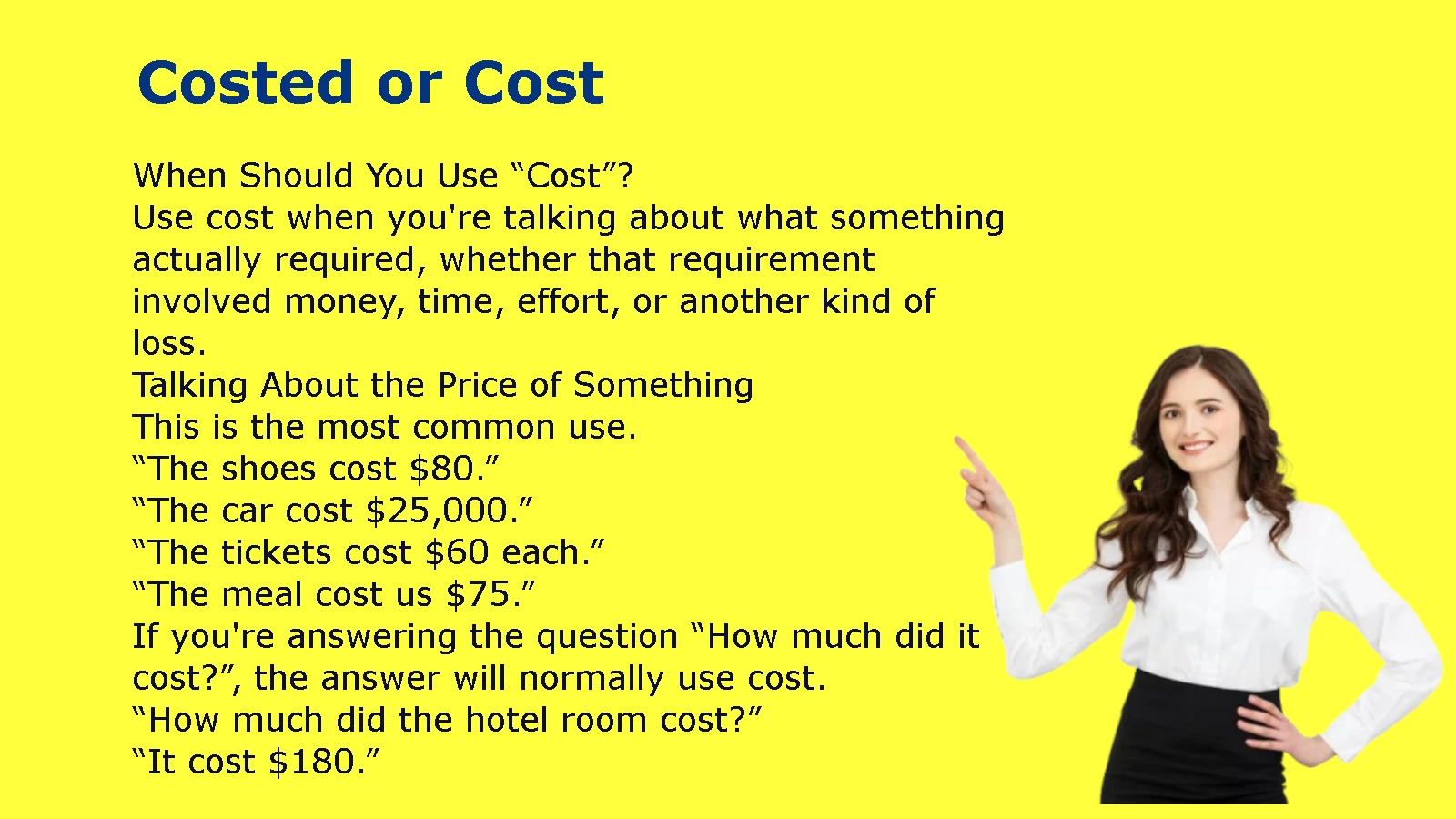
When Should You Use “Cost”?
Use cost when you’re talking about what something actually required, whether that requirement involved money, time, effort, or another kind of loss.
Talking About the Price of Something
This is the most common use.
- “The shoes cost $80.”
- “The car cost $25,000.”
- “The tickets cost $60 each.”
- “The meal cost us $75.”
If you’re answering the question “How much did it cost?”, the answer will normally use cost.
“How much did the hotel room cost?”
“It cost $180.”
Cambridge uses the same ordinary pattern in examples such as “How much did the trip cost?” and “The repairs to our car cost much more than we were expecting.”
Talking About an Expense
You can also use cost when discussing a larger expense.
For example:
“The renovation cost more than we expected.”
Here, you’re describing the amount of money required to complete the renovation.
Other examples include:
- “The repairs cost thousands of dollars.”
- “The move cost us more than we planned.”
- “The upgrade cost less than the original estimate.”
- “The project cost $1.5 million.”
Talking About a Consequence or Loss
The verb cost doesn’t always involve money.
It can describe something that causes a person to lose another valuable thing.
For example:
“His mistake cost him the promotion.”
The mistake didn’t necessarily require him to pay money. Instead, it caused him to lose an opportunity.
Other examples include:
- “The error cost the team the game.”
- “The delay cost the company several customers.”
- “His absence cost him his job.”
- “The accident cost her several months of work.”
Oxford recognizes this meaning as causing the loss of something.
Talking About Time or Effort
Cost can also describe a demand on time or effort.
For example:
“Fixing the mistake cost us three hours.”
Here, the “cost” isn’t financial.
The same idea appears in:
- “The delay cost us valuable time.”
- “The extra work cost her an entire weekend.”
- “The error cost the team several days.”
- “The decision cost him a great deal of effort.”
That broader meaning explains why replacing cost with costed can sound wrong even when you’re clearly talking about the past.
When Should You Use “Costed”?
Use costed when the verb means calculated, estimated, or assigned a cost.
This use appears most often in business, accounting, budgeting, project management, manufacturing, construction, and procurement.
Costed in Project Planning
Imagine a construction company preparing a proposal.
Before work starts, the company needs to calculate:
- Material costs
- Labor costs
- Equipment expenses
- Transportation
- Permits
- Overhead
- Contingency costs
The company might say:
“The construction team costed the project before submitting the proposal.”
That sentence means the team calculated how much the project would require.
It doesn’t mean the project had already spent that amount.
Costed in Accounting
Accounting and financial planning provide another common setting.
For example:
“The finance department costed each option before preparing the budget.”
The department didn’t merely observe the price. It worked out the financial implications of each option.
You might also see:
- “The accountant costed the materials.”
- “The team costed each phase separately.”
- “The proposal was fully costed.”
- “The department costed the program before approval.”
Cambridge specifically lists this use in its accounting context, where costed means calculating the price of something or deciding how much it will cost.
Costed in Business Proposals
Businesses often need to determine whether a proposal is financially realistic before approving it.
For example:
“The company costed the new service before launching it.”
This means the company calculated expected expenses and used those figures to assess the proposal.
You might also encounter the phrase:
fully costed proposal
A fully costed proposal is one for which the expected costs have been calculated in sufficient detail.
Oxford gives examples such as “fully costed proposals” and projects that have been costed at a specified amount.
Costed Out
Another phrase worth knowing is costed out.
Cost out means to calculate the cost of something in detail.
For example:
“We need to cost out the materials before ordering them.”
Or:
“The team costed out several production options.”
Cambridge and Merriam Webster both recognize this construction.
Cost vs. Costed Examples
The fastest way to understand costed or cost is to compare the two forms side by side.
| Situation | Correct sentence | Why? |
| Actual price | “The laptop cost $900.” | It had a price of $900. |
| Past expense | “The repairs cost $500.” | The repairs required $500. |
| Financial loss | “The error cost us $10,000.” | The error caused a loss. |
| Loss of opportunity | “The mistake cost him the job.” | He lost his job because of it. |
| Cost calculation | “The accountant costed the project.” | The accountant calculated its cost. |
| Estimated project price | “The project was costed at $2 million.” | Someone estimated or set the cost. |
| Detailed calculation | “We costed out the materials.” | We calculated their expected cost. |
The difference becomes obvious when you ask one question:
Is the sentence describing a cost, or the process of calculating a cost?
If it describes the cost itself, cost will usually be the right choice.
If it describes the calculation of that cost, costed may be the right choice.
Costed or Cost in the Past Tense
The phrase “past tense of cost” creates much of the confusion.
For everyday use, the past tense is cost:
Present: “The phone costs $800.”
Past: “The phone cost $800.”
The present tense changes to costs with he, she, or it, but the simple past remains cost.
Ordinary Verb Forms of Cost
| Verb form | Example |
| Base form | “Things cost money.” |
| Present, third person | “The phone costs $800.” |
| Simple past | “The phone cost $800.” |
| Past participle | “The phone has cost $800.” |
| Present participle | “The phone is costing more.” |
There is one important qualification: costed exists for the specialized meaning of calculating or setting a cost.
Oxford explicitly distinguishes that specialized sense and notes costed as its past and past participle form.
So a complete answer isn’t simply “the past tense is cost.”
A more accurate answer is:
Cost is the normal past tense for the ordinary meaning of the verb. Costed is used for the specialized meaning of calculating or estimating a cost.
That’s the distinction worth remembering.
Cost vs. Costed: Common Mistakes
Some errors appear again and again because English speakers naturally expect cost to behave like a regular verb.
Mistake: “The Car Costed $20,000”
If you mean that the car had a price of $20,000, use cost.
Correct:
“The car cost $20,000.”
Not standard for that meaning:
“The car costed $20,000.”
The issue isn’t that costed can never appear near a dollar amount. It can. The issue is the intended meaning.
Compare:
“The car cost $20,000.”
This states the price.
“The car was costed at $20,000.”
This can mean that someone calculated or estimated the car’s cost at $20,000.
Mistake: “It Has Costed Me a Lot of Time”
When cost means caused you to lose time, use has cost.
Correct:
“It has cost me a lot of time.”
The same applies to other consequences:
- “It has cost us thousands of dollars.”
- “The mistake has cost her the opportunity.”
- “The delay has cost the company valuable time.”
Mistake: Assuming Every Past Verb Needs “-ed”
English learners often learn a useful rule:
Add -ed to regular verbs to form the past tense.
That rule works for verbs such as:
- work → worked
- call → called
- finish → finished
- start → started
But it doesn’t work for every verb.
Cost belongs to the group of irregular verbs whose ordinary past form doesn’t change.
That’s why cost stays cost.
Cost or Costed: A Practical Test
When you’re unsure, don’t stare at the verb. Look at the meaning.
Ask:
Am I saying how much something cost, or am I saying that someone calculated how much it would cost?
If You’re Giving the Price, Use Cost
“The meal cost $50.”
You’re giving the price.
If You’re Describing the Calculation, Use Costed
“The restaurant costed the new menu before introducing it.”
The restaurant calculated the expected costs.
This simple test works in most situations.
A Real World Case Study: Planning a Construction Project
Consider a company planning to build a small office.
The finished building eventually costs $2 million.
After construction, someone might write:
“The office building cost $2 million to construct.”
That’s a statement about the actual expense.
Before construction begins, however, the company might hire an analyst to calculate the expected expense.
The analyst examines labor, materials, equipment, permits, and other costs. The analyst then prepares an estimate.
At that stage, you could say:
“The analyst costed the construction project at $2 million.”
The two sentences look similar, but they describe different actions.
| Stage | Sentence | Meaning |
| Planning | “The analyst costed the project at $2 million.” | The analyst calculated the expected cost. |
| Completion | “The project cost $2 million.” | The project actually required $2 million. |
This is why treating costed as simply “wrong” misses an important part of English usage.
A Real World Case Study: Business Proposal
Suppose a software company wants to develop a new application.
Before approving the project, management asks the finance team to calculate the expected expenses.
The finance team estimates:
- Developer salaries: $500,000
- Design: $100,000
- Infrastructure: $75,000
- Testing: $50,000
- Marketing: $125,000
- Other expenses: $50,000
The finance team might cost the project at $900,000.
Once the project is completed, a report might say:
“The project cost $920,000.”
The first sentence describes cost calculation.
The second describes the actual expense.
That’s the difference between costed and cost in a practical business setting.
Costed or Cost: American English Usage
For readers using American English, cost is the natural choice in everyday sentences about prices and expenses.
For example:
“The house cost $400,000.”
“The repairs cost $2,000.”
“The mistake cost us a contract.”
These sound completely natural.
The specialized use of costed also exists in professional English. Merriam Webster, Cambridge, and Oxford all recognize the sense involving the calculation or estimation of costs.
That means the safest approach isn’t to label costed as “incorrect English.”
Instead, treat it as a specialized form with a specific meaning.
Is “Costed” Formal English?
Costed can sound more technical than ordinary cost because it often appears in professional contexts.
You may encounter it in:
- Accounting
- Financial planning
- Procurement
- Manufacturing
- Construction
- Government budgeting
- Project management
- Business proposals
- Cost analysis
For example:
“The procurement team costed the materials before placing the order.”
That sentence fits a business context naturally.
In casual conversation, however, people usually don’t need the specialized verb.
If someone asks:
“How much did your new phone cost?”
The natural answer is:
“It cost $700.”
There’s no reason to introduce costed.
Is “Costed” Ever Correct in Everyday English?
Yes, but it depends on the meaning.
If you’re talking about the actual price, cost is the natural choice.
If you’re talking about calculating the price, costed can be correct even if the conversation isn’t highly technical.
For example:
“We need to cost the ingredients before we set the menu price.”
Here, the speaker means calculate the cost of the ingredients.
The specialized meaning is what makes costed appropriate.
Costed vs. Cost: Quick Comparison
Here’s the entire rule at a glance:
| Question | Answer |
| What is the ordinary past tense of cost? | Cost |
| Is costed a real word? | Yes |
| Is costed always wrong? | No |
| When should you use cost? | For an actual price, expense, loss, or consequence |
| When should you use costed? | When someone calculates, estimates, or sets a cost |
| “The phone cost $500” or “costed $500”? | Cost $500 |
| “The accountant costed the project” correct? | Yes |
| “The project was costed at $2 million” correct? | Yes, when referring to its calculated or estimated cost |
| “The mistake cost me my job” correct? | Yes |
| “The mistake costed me my job” correct? | No for the ordinary meaning |
Costed or Cost: Practice Exercise
Test the rule with these examples.
Choose cost or costed.
- The laptop ___ $1,200 last year.
- The finance team ___ the project before approval.
- The repairs ___ more than expected.
- The contractor ___ the materials before submitting the proposal.
- The mistake ___ the company thousands of dollars.
- The project was ___ at $4 million.
- The vacation ___ us $3,500.
- We ___ out several production options.
- The delay ___ us two days.
- The proposal had not been fully ___.
Answers
- cost
- costed
- cost
- costed
- cost
- costed
- cost
- costed
- cost
- costed
Why These Answers Work
The sentences alternate between two meanings.
In sentences 1, 3, 5, 7, and 9, cost describes an actual price, expense, or loss.
In sentences 2, 4, 6, 8, and 10, costed refers to calculating or determining a cost.
Once that distinction clicks, the answers become almost automatic.
Frequently Asked Questions About Costed or Cost
What is the past tense of “cost”?
The standard past tense of cost is cost when the verb means “have a price” or “cause a loss.”
For example:
“The tickets cost $100.”
The specialized meaning involving cost calculation uses costed.
Is “costed” grammatically correct?
Yes.
Costed is grammatically correct when it means calculated, estimated, or set the cost of something.
For example:
“The accountants costed the project at $3 million.”
Cambridge and Merriam Webster both recognize this meaning.
Do you say “it cost” or “it costed”?
Use “it cost” when you’re talking about the price or expense.
“The car cost $30,000.”
Use costed only when you’re describing the process of calculating or estimating a cost.
“The project was costed at $30 million.”
Is “costed” the past tense of “cost”?
It can be the past form for the specialized meaning of cost that involves calculating or estimating a cost.
For the ordinary meaning, the past tense is cost.
So the complete answer is more nuanced than simply saying one form is right and the other is wrong.
What is the past participle of “cost”?
For the ordinary meaning, the past participle is cost.
For example:
“The mistake has cost us a lot.”
The specialized cost calculation sense can use costed as its past participle:
“The project has been costed in detail.”
Oxford specifically distinguishes this specialized use.
Can you say “has costed”?
Yes, but only when costed carries its specialized meaning.
For example:
“The project has been costed at $5 million.”
This means someone has calculated or estimated the project’s cost.
But if you mean that something caused an actual expense or loss, use cost:
“The project has cost more than expected.”
Is “The project costed $2 million” correct?
It can be confusing because the intended meaning isn’t obvious.
If you mean the project actually required $2 million, the clearest sentence is:
“The project cost $2 million.”
If you mean someone calculated or estimated its cost, a clearer construction is:
“The project was costed at $2 million.”
That wording makes the specialized meaning unmistakable.
Is “costed out” correct?
Yes.
Cost out means to calculate the cost of something. Cambridge and Merriam Webster both recognize this usage.
For example:
“The company costed out the materials before placing the order.”
Why do people say “costed” when “cost” is correct?
The most likely reason is that English learners expect past tense verbs to take -ed.
Words such as worked, played, finished, and called follow that pattern. But cost is irregular.
So someone may naturally assume:
cost → costed
For the ordinary meaning, that assumption doesn’t work.
However, costed does exist as a separate specialized form. That’s what makes the word particularly confusing.
Costed or Cost: The Final Verdict
The answer to “costed or cost?” depends on what you’re trying to say.
Use cost when you’re talking about an actual price, expense, loss, or consequence:
- “The phone cost $800.”
- “The repairs cost $600.”
- “The mistake cost him his job.”
- “The delay cost us two days.”
Use costed when you’re talking about calculating, estimating, or setting a cost:
- “The accountant costed the project.”
- “The proposal was costed at $2 million.”
- “The team costed out the materials.”
- “The project has been fully costed.”
The easiest rule is worth repeating:
If you’re describing what something cost, use “cost.” If you’re describing the process of figuring out what something should or would cost, “costed” can be correct.
So if you write “The shoes cost $100,” you’re using the standard form correctly.
If you write “The finance team costed the project,” you’re also correct, because the sentence describes a calculation rather than an ordinary past price.
Both words have a place. The trick is knowing which meaning you’re using.